Taking up the cross. What on earth does that mean?

This is what I emerged with by way of a sermon for Trinity 3A. The gospel from Matthew 10:24-39 was a tricky one. The sparrows caught my eye when I was preparing. So often in his teaching Jesus picks up on what is seemingly worthless and what usually goes unnoticed by others. I wanted us to explore this in relation to Jesus’s mission and the way disciples join his mission by taking up the cross. My exploration took me to the heart of brokenness and all that is wrong in the world. The text of the gospel is at the foot of this page.

The Sermon:

Has anyone got a penny? Long gone is the penny bazaar. You can’t even spend a penny when you’re desperate, when you’ve got everything crossed. A penny for your thoughts. You wouldn’t even give me the time of day for a penny. What’s the point of a penny?

The point of a penny is that it is the price of worthlessness. Way back in the day, before even the pound in your pocket was something, Jesus took up worthlessness when he took up the cross.

Are not two sparrows sold for a penny?

I imagine Jesus at the market, casting his eyes around the stalls and finding someone so poor that all they had to sell was pairs of sparrows. Two-a-penny. You could get them anywhere – and who wants them anyway? 

Jesus here is talking poverty. His own family was poor. Tradition had it that after the birth of a first born the mother would offer a lamb to the priest as a burnt offering. This was the law, and it applied to both boys and girls. The exception was for those who couldn’t afford a sheep – then it was to be two turtle doves or two pigeons. That is what Mary offered when Jesus was born according to Luke’s gospel (Luke 2:24). They couldn’t afford a sheep.

Are not two sparrows sold for a penny? They’re ridiculously cheep! Put it another way. The cost of sparrows on the open market is nothing, zilch, nada. 

Jesus has an eye for the worthless, for what the world doesn’t even bother counting or noticing, and he uses that in his teaching, like in the parable of the mustard seed and the parable of the leaven. He also picks strands of hair. Nobody counts strands of hair unless they’re folically challenged. Even the hairs of your head are counted.

The point of this passage is not about how precious the sparrow is but about the importance to God of every part of creation, particularly those people overlooked by the powers that be. It’s about those who don’t fit in ……. It’s about those who become “lost” in the system, or the gas chamber, or at sea, those who get lost through the carelessness of others. Most particularly, in this passage, it is about “the lost sheep of Israelall those lost by the religious leaders who were supposed to be good shepherds loving everyone dear to God, but didn’t. It’s about those who count for nothing in the world.

And it’s about the disciples themselves. Jesus is aware of the cost of discipleship – that the disciples will be humiliated, flogged, imprisoned, betrayed (even by members of their families), even killed. This is what Jesus’ talk about the sparrows and the hair is leading up to – the encouragement to the disciples not to be afraid of the opposition which will want to discredit and reduce them to nothing.

Jesus stands at the heart of poverty and there gives his life. This becomes his mission and the consequences are the same for him as for those who live at the heart of poverty and brokenness: rejection, betrayal, humiliation and even death. This is the mission, (and the consequences), he is preparing the 12 for in this morning’s gospel, and this is the mission he would love us to join.

We can summarise the mission of Jesus (and the mission of God) as taking up the cross.

One of the questions that has bugged me while I was preparing this sermon is what this means for us. What does it mean for us to take up the cross? It sounds like it is a lot easier for us to be part of Jesus’ mission than it was for those first disciples, or for Christians who continue to live with the threat of persecution, humiliation and hatred. By and large, we live in a society where Christianity has been a dominating culture. I suspect that none of us imagine being persecuted, imprisoned or killed for joining Jesus’ mission taking up the cross.

So what does it mean for us to be taking up the cross in Jesus’ mission?

I played with the word “cross”. I discovered that it is “the cross” in our gospel this morning. It is not “your cross”. Reading “your cross” gives rise to the expression “everyone has their cross to bear”, which might not be true, and which might lead some to think that they’ve got enough to bear carrying their own cross that they’re not going to help carry anyone else’s. If it’s “your cross” it becomes your own bubble of trouble – individualised, almost self-centred. 

No, Jesus’ mission is to “take up the cross”, and anyone taking up the cross is worthy of him. Ever since God became the God of the Hebrew slaves in Egypt God has been “taking up the cross” – as it were.

So I played with the word cross. I did a word search of my imagination, and I remembered all the crosses marking my homework and the failure they denoted.

I thought about the crossings out we do and was reminded of those who are crossed out for being who they are, for being wrong – the wrong ethnicity, the wrong race, the wrong gender, the wrong sexuality. 

Probably because it was the 75th anniversary of the Windrush landing on Thursday, and probably because it was World Refugee Day on Tuesday, and probably because of the sinking of the boat carrying hundreds of refugees and migrants off the west coast of Greece, I thought of crossings – and the bravery, and the desperation and the exploitation of those who make dangerous crossings.

Already I see the wrong (and who says anyone is wrong?), the wronged, the displaced and the misplaced in the cross. And I see that there is not one cross, with one victim (the object of our worship), but that there are so many crosses and so many for whom Jesus dies to live for in this mission to “take up the cross”.

Black theologians are helping us to understand the folly of not using our imaginations when joining Jesus’ mission of taking up the cross. One of them, James Cone, an American, wonders how ever we managed to divorce the cross from the “lynching tree”. James Cone was a black American theologian. He died in 2018. 

It didn’t take much imagination for him to link the cross to the lynching tree. In the lynching era, between 1880 and 1940, white Christians lynched nearly 5000 black men and women in a manner with echoes of the Roman crucifixion of Jesus. Cone’s comment on this is that these white Christians didn’t see any irony or contradiction in what they were doing. 

Cone writes: “during the course of 2000 years of Christian history, this symbol of salvation [the cross] has been detached from any reference to the ongoing suffering and oppression of human beings – those whom Ignacio Ellacuria, the Salvadoran martyr, called “the crucified peoples of history””.

He continues: “The cross and the lynching tree interpret each other. Both were public spectacles, shameful events, instruments of punishment reserved for the most despised people in society. Any genuine theology and any genuine preaching of the Christian gospel must be measured against the test of the scandal of the cross and the lynching tree.”

I carried on with my wordsearch – my play with the word cross and I remembered that that is how we vote. We put a cross by what we are voting for. And I park that idea – the cross being election and choice. We are free to choose to take up the cross, or we can vote another way.

Then I got my sourdough out of the fridge and got it ready for baking in the oven. Those who have the sourdough baking bug know that you have to score the dough before putting it in the oven. If you don’t score the dough the steam will find the weakest point in the loaf to make its escape. The scoring provides a controlled escape for letting off steam. I score with the cross – and the cross-score becomes the way out, the release, the exodus, as well as the lines along which I would break the bread for sharing with those who are hungry.

And I remember the sign we use for kisses, the cross we choose to show our love for others, and how far we are prepared to go to honour the pledge of our commitment – even to the extent of taking up the cross in our love for them

So, what does it mean to “take up the cross”?  Is it something like this?

To choose (elect) to be at the heart of the age-old brokenness of the world with those bearing the burden of that brokenness? Is it to be there with long-suffering love? Is it to be at the broken heart of creation as typified by all Jesus predicted for the 12 (and suffered in his own person) – flogging, imprisonment, humiliation, betrayal?

This is where we’re at, in the midst of brokenness, grief, pain – at the heart of a poverty where life can be so cheap, and when not enough are held dear, where so many are undervalued and so much taken for granted. There is so much wrong. This is where God wants us to be – at the heart of this brokenness and the forefront of his mission.

But just being there is not enough, because those who follow Jesus in taking up the cross are taking up the cross of Jesus which becomes the gateway to resurrection and the new heart of life. Taking up the cross of Jesus is taking up the promise of deliverance – it is trusting that God is at the heart of brokenness, that he is always with us as light and love in the darkness, and that God gives God’s life in the mission he invites us to join. Taking up the cross means taking up the cross in faith, trusting God who sees his people through terrible times of trauma.

So, here we are, as “sheep among wolves”, just like Jesus called those first disciples. He refers to sheep again when he talks about a judgement (Matthew 25:31-46). He divides people into sheep and goats. The sheep are the righteous. They have fed the hungry, given water to the thirsty, welcomed the stranger, clothed the naked, taken care of the sick and visited the prisoner. 

The difference between sheep and goats is that goats go their own way, leading the goatherd. The sheep, on the other hand follow the shepherd, just as Jesus encourages his disciples to join him in giving their lives in the brokenness and wrong of the world.

Matthew 10:24-39
“A disciple is not above the teacher, nor a slave above the master. It is enough for the disciple to be like the teacher and the slave like the master. If they have called the master of the house Beelzebul, how much more will they malign those of his household! So have no fear of them, for nothing is covered up that will not be uncovered, and nothing secret that will not become known. What I say to you in the dark, tell in the light, and what you hear whispered, proclaim from the housetops. Do not fear those who kill the body but cannot kill the soul, rather fear him who can destroy both soul and body in hell.
Are not two sparrows sold for a penny? Yet not one of them will fall to the ground unperceived by your Father. And even the hairs of your head are all counted. So do not be afraid, you are of more value than many sparrows.
Everyone therefore who acknowledges me before others, I also will acknowledge before my Father in heaven, but whoever denies me before others, I also will deny before my Father in heaven.
Do not think that I have come to bring peace to the earth, I have not come to bring peace, but a sword.
For I have come to set a man against his father, and a daughter against her mother, and a daughter-in-law against her mother-in-law and one’s foes will be members of one’s own household.
Whoever loves father or mother more than me is not worthy of me, and whoever loves son or daughter more than me is not worthy of me, and whoever does not take up the cross and follow me is not worthy of me. Those who find their life will lose it and those who lose their life for my sake will find it.
An Old Woman – a poem by Arun Kolatkar

An old woman grabs
hold of your sleeve
and tags along.

She wants a fifty paise coin.
She says she will take you
to the horseshoe shrine.

You’ve seen it already.
She hobbles along anyway
and tightens her grip on your shirt.

She won’t let you go.
You know how old women are.
They stick to you like a burr.

You turn around and face her
with an air of finality.
You want to end the farce.

When you hear her say,
‘What else can an old woman do
on hills as wretched as these?’

You look right at the sky.
Clear through the bullet holes
she has for her eyes.

And as you look on
the cracks that begin around her eyes
spread beyond her skin.

And the hills crack.
And the temples crack.
And the sky falls

With a plateglass clatter
around the shatterproof crone
who stands alone.

And you are reduced
to such much small change
in her hand.

Arun Kolatkar (1932-2004)

img_0307
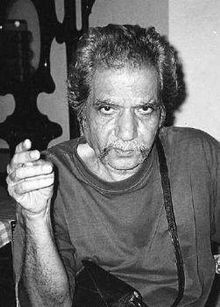
Arun Kolatkar was a poet from Maharashtra in India. He was a prolific poet writing in both Marathi and English. He was also an award winning designer. He won the Commonwealth Poetry Prize for his collection of poems, Jejuri, published in 1976.

This poem describes a fairly typical experience. The reader stands in the shoes of someone accosted in the street by a beggar desperate for money for something to eat. The reader knows what it’s like, to be stuck to “like a burr”. What we often forget, because we want to look past them as if they weren’t there, is that, for the desperate too, it’s part of their everyday, to latch on to others in the hope of charity. The tendency for the accosted is to shake off the attention. The norm for the beggar is to be shaken off.

But, in this poem, there is a notable turn towards compassion. The speaker looks “clear through the bullet holes she has for her eyes”. “You” look through and past her, but as you do so what you look at begins to shatter, and it’s only the “shatterproof crone who stands alone”. Is it then that the bullet hole eyes take on their significance? Is it at this point you recognise her wounds, the battles she may have fought and lost? Is it at this point that you realise what has become of her, and what has become of you in the hands of poverty – that “you are reduced to so much small change in her hand”?

There is such pathos in that last line. There is such small change in small change for a life that should be demanding huge change.

Broken: stunning, timely and beautiful BBC drama

For “Broken” read “broke”.
For “Broken” read “society terribly broken”.
For “Broken” read “heartbreaking”.
For “Broken” read “compassion”.

Broken is a six part drama by Jimmy McGovern set in the north of England (filmed in Liverpool). It is Daniel Blake-bleak. You can watch it on BBC iPlayer.

There are many great performances. Sean Bean makes an excellent priest (playing Father Michael Kerrigan) and Anna Friel plays the part of a single mother well past the end of her tether. They do “broken” very well.

We only get hints about the reasons for Father Michael’s brokenness. He has been shamed and shaming and he is willing to break himself for the rest of his life. We see his brokenness mending as he seeks to make amends for his past, and we see the brokenness around him mending through his offering.

The parish could be any urban area in northern England. It is poverty stricken. The people walk, they don’t drive. The shops are closed. The only shops left open are the betting shops – their gaming machines having bled the community dry reducing people to dire debt and desperation.

Sam Wollaston, in his review for the Guardian, is right when he says: “This is a portrait of poverty in forgotten Britain, minimum pay and zero hours, crisis, debt and desperation.”

This is where people live and where they stay. Father Michael also sounds like a man who isn’t going anywhere. He has a strong regional accent. He sounds as if he comes from somewhere. It isn’t surprising that the priest and people love one another dearly. They might be from different places, but they both belong somewhere – as opposed to the urban metropolitans who could belong anywhere and often can’t be trusted because of that. (See note below about the Anywhere and Somewhere tribes.)

Father Michael is the person people turn to – they rely on him. They trust him above all others. But he is not the “heroic leader”. He is wounded himself, shamed and vulnerable, hoping for heaven. He is unassuming, self-effacing. He knows “it’s easy to forget Christ’s here, giving us strength, easing our pain,” and so he lights a candle as he invites people to open the heart of their troubles.

I could be critical. It is very clerical. But is that liberalism speaking? Is that the criticism of a metropolitan who could belong anywhere. There is no criticism from the people who are THERE, broken. He can be trusted. He is there. He is on their side utterly. They need someone to be on their side. The institutions they should be able to rely on repeatedly let them down. They need his ministry.

Christina played by Anna Friel is desperately poor. Just when we think she can go no lower her mother with whom she lives (and who helps share the living costs) dies. She pretends that she is still alive so she can claim her mother’s next pension payment. She’s arrested. Father Michael goes to court as her character witness. He calls her “this wonderful woman” who does everything for her children. I have no doubt that anybody would ever have called her “wonderful” before, but there was evident integrity in Father Michael’s statement. He uncovered the truth through his love and practical wisdom.

There is a moving scene n the confessional. A woman confesses that she is going to kill herself because she has stolen a vast amount from her employer (to feed her gambling addition). She recognises Father Michael’s vulnerability and witnesses his own confession.

We need more drama like this. We need to know more about people like Christina. We need to understand how wonderful they are. We need her to have more of a say in our national life. We need more priests like Sean Bean. We need more people to know they are “wonderful”. We need as much as ever to find our way through brokenness, and we need our Prime Ministers to learn from the witness of the faithful ministers in our broken communities.

I wonder how many priests, having watched this, will be left wondering how far they have moved from their calling – going somewhere else. And I wonder how many will be left wondering whether they are called to be priests – at any rate, whether they are good enough to be a friend broken for others somewhere just like that.

NOTE: David Goodhart in The Road to Somewhere: the populist revolt and the future of politics (2017) claims that there are two tribes, the Anywheres and the Somewheres. The Anywheres are light in their attachments “to larger group identities, including national ones; they value autonomy and self-realisation before stability, community and tradition”.  The Somewheres are grounded in place, uneasy with the modern world, experiencing change as loss. Goodhart used this theory to explain Brexit decision.

A Romero celebration in Alsager

Sermon preached at the lovely reordered St Mary’s Alsager for the meeting of Congleton Deanery Synod. It commemorates Archbishop Oscar Romero. It could have been said better – but I share it anyway.

27 bishops wrote to the Daily Mirror a couple of weeks ago complaining about the Government’s welfare reforms. They pointed out that recent cuts have forced tens of thousands of people into a painful choice of “heat or eat” and reminded us that half a million people visited a food bank last year, and 5.5 people were admitted to hospital with malnutrition.

The letter caused a minor stir. Why? Was it because the bishops were dabbling in politics? Was it that they chose the Mirror rather than the Times? Was it because they knew what was lamentable and lament?

The letter raises the question of the place of church in society. What is this place?

Is it at the centre of things? Hopefully the answer to that is “yes”, so long as that means the “heart of the community”, as opposed to wanting to look big.

Is its place to be on the side, on the edge? Hopefully the answer to that question is “yes”, if by yes we are meaning that we are on the side of those who are overlooked – those who are overlooked because of their poverty, because they don’t fit in, because they are shied away.

On this day 34 years ago Archbishop Oscar Romero was shot dead while celebrating Mass. He was Archbishop of San Salvador, Archbishop of a church which took the people of El Salvador to heart, a church which had been edged out by a violent government, a church which was on the side of the landless poor. He spoke out on their behalf and became known as the Voice of the Voiceless. His voice became stronger. People packed into the Cathedral to hear him. They listened to him on the Archdiocese’s radio station. And then he was silenced, by a gun fired from the doorway of the chapel in a cancer hospital as he celebrated Mass.

He was the third bishop to have been murdered in the sanctuary. Bishop Stanislaus of Krakow was killed in 1079 (for scolding the Polish king for his sins), Thomas Becket was killed in 1170 for defending the Church’s rights and freedoms. Oscar Romero was killed in 1977 as an outspoken opponent of injustice and defender of the poor.

Oscar Romero, other martyrs, other ministers, remind us what these spaces are for. They are spaces where we become occupied with God and by God. They are spaces where we occupy ourselves with what occupies God – spaces for the sinner (rather than the righteous), for Lazarus (not the rich man Dives, or the celebrity Divas), for those whose cries are heard by God (and ignored by others). It is the poor, who, according to Romero, “are the ones who tell us what the world is and what service the church must offer to the world.”

We need to safeguard these spaces of blessing and salvation, where truth is told and lives are rebuilt. They are dangerous, countercultural breathing spaces in which lives are lost for the sake of gaining the kingdom.

Romero said this in one of his sermons: “An accommodating church that seeks prestige without the pain of the cross is not the authentic church of Jesus Christ.”

This is the Jesus who comforts his followers in the face of the hatred of the world. He reminded followers then, as he reminds us in this evening’s gospel, that the world didn’t love him, but hated him. “If they persecute me, they will persecute you.” But “if you belonged to the world, the world would love you as its own.” Going the way of the world is not following Jesus’ way. That’s not the way Jesus had in mind when he calls people to follow him.

There has been a lot of ink spilt about the identity of the “beloved disciple” in John’s gospel. Was it John Zebedee, Lazarus, Thomas, Nathanael, John the Elder, or even Paul? Or, was it none of these people? Whoever it was had a special place in Jesus’ life. That place is stated as “the place nearby” at the cross (John 19:25), and “reclining next to him” (13:23).

The beloved disciple is the one who “leant back against Jesus”. He is the one who had the physical contact. He is the one who was at Jesus’ side. 

Who is the beloved disciple? Is it you? Is it me?

The beloved disciple is THERE, just there (indicating heart/shoulder). The beloved disciple is at the side of Jesus, and because of that SEES and understands what the others couldn’t. That closeness means that he/she is able to hear the whisper of Jesus. (13:23).

Oscar Romero was at that place. He could see, understand and articulate the truth of what was happening. He was able to name the injustice and the suffering.

The place is the “kolpos” or “bosom” of Jesus.

There is one other use of the word “kolpos” in the gospel, and that is at 1:18, where it is Jesus who is described as being at his Father’s bosom, or “close to the Father’s heart”.

The beloved disciple is the one who is at the heart of Jesus, who is close to the Father’s heart, who hears what occupies Jesus’ heart – who sees and hears as Jesus hears.

That is the space we are called to be in as beloved disciples.

It’s the space Oscar Romero occupied as he celebrated Mass in the chapel of a cancer hospital (a place at the edge and on the edge of life). His place was close to the Father’s heart, occupied with what occupies God.

In that most dangerous of places he was shot – a life given for the sake of the kingdom.

A prayer to finish with, from Oscar Romero:

“Let us be today’s Christians. Let us not take fright at the boldness of today’s church. With Christ’s light let us illuminate even the most hideous caverns of the human person: torture, jail, plunder, want, chronic illness. The oppressed must be saved, not with a revolutionary salvation, in mere human fashion, but with the holy revolution of the Son of Man.”

Here’s a sermon preached by ++Rowan Williams on the 30th anniversary of Romero’s assassination.

Maggi Dawn has posted a prayer closely associated with Oscar Romero.

A message from Oscar Romero

Embed from Getty Images

Today marks the anniversary of Archbishop Oscar Romero’s martyrdom. He was shot dead on March 24th 1980 when celebrating Mass in the cancer hospital where he lived. This is from one of his sermons:

Those who have listened to me here in church on Sundays
with sincerity,
without prejudices,
without hatred,
without ill will,
without intending to defend indefensible interests,
those who have listened to me here cannot say
I am giving political or subversive sermons.
All that is simply slander.
You are listening to  me at this moment,
and I am saying what I have always said.
What I want to say here in the cathedral pulpit
is what the church is,
and in the name of the church
I want to support what is good,
applaud it,
encourage it,
console the victims of atrocities, of injustices,
and also with courage
disclose the atrocities,
the tortures,
the disappearance of prisoners,
the social injustice.
This is not engaging in politics;
this is building up the church
and carrying out the church’s duty
as imposed by the church’s identity
My conscience is undisturbed,
and I call on all of you:
Let us build up the true church!

Sermon preached on September 10th 1978, from Oscar Romero: the Violence of Love

Get me crying again

Crying Giant

The Old Testament book of Deuteronomy reminds us, “Open your hand to the poor and needy neighbour in your land”. The reading community is told “If there is anyone of you in need, a member of your community in any of your towns within the land that the Lord your God is giving you, do not be hard-hearted or tight-fisted towards your needy neighbour. You should rather open your hand, willingly lending enough to meet the need, whatever it may be.”

This remarkable passage (Deut 15:1-11) adds a further twist implying that it’s worth keeping on the right side of your neighbour in case “your neighbour might cry to the Lord against you.” I may not have noticed this had I not read Psalm 56 alongside the Deuteronomy passage. There the Psalmist says “”You have counted up my groaning; put my tears into your bottle.” Tears count for God and he favours the one who cries.

David Runcorn reminded a group of us this week that tears count, and that they should be regarded as a spiritual gift. For Orthodox Christians they are a gift as important as the ability to speak in tongues. Bishop Kallistos Ware, in a chapter in Holy Tears: Weeping in the Religious Imaginationrefers to Abba Makarios beginning an address with “Brethren, let us weep”. For Bishop Kallistos, it is only tears that count at the Last Judgement. (We can weep inwardly).

Dominus Flevit Church

Hezekiah, king of Judah, prayed with tears. God prompts Isaiah to respond to Hezekiah’s prayer. He says, “I have heard your prayer, I have seen your tears; I will heal you”. Jesus wept over Lazarus and Jerusalem, and one of Jerusalem’s sacred sites, the church of Dominus flevit (Jesus wept) treasures that moment. There is a time to cry, and that is this time. The Psalmist says “those who sow in tears will reap with songs of joy” (Ps 126:5) and it is only in the fullness of time that God will wipe every tear from every eye (only those who are crying?), and “there will be no more death or mourning or crying or pain.” (Rev. 21:4)

My own concern is my own increasing difficulty to cry. I am not easily enough moved to tears. Have my tears stopped because I have been used to managing grief and to managing lament and complaint? Have I preferred a quiet life? Have I changed sides? Do I side with the oppressor? And, as a society, have we put our fingers in our ears against the cries of the poor? Have we justified our tight-fistedness by austerity measures? The counting of tears doesn’t seem to be part of the economic measures we adopt, in stark contrast to the measures outlined in Deuteronomy, the Psalms and throughout scripture. Sadly, in our culture, crying is a shame.

I think I am ready, for the moment at least, to pray. “O Lord, hear our prayer, and let our cry come to you.”

PS. The photo of the church of Dominus Flevit is by Gashwin and shows clearly the tear bottles on the corners of the building used for measuring and treasuring tears. The photo of the Crying Giant is by Chris Murphy.

>Rhyl in Panorama

>

Rhyl
photo from Postcard Farm

It was friend +Tim Ellis who made me aware that poverty has been exported from our cities to our coastlands. For Jeanette and myself, Rhyl is a “day out”, refreshment and time for ourselves. We enjoy the wide spaces, and the walk from Rhyl to Prestatyn along the beach.

Jim Pickering outside 
Rathbone’s Rhyl Taste Academy

Panorama presented a very different picture of Rhyl. Apparently in West Rhyl nearly half of the people are unemployed and on benefits, and these are the people the Government has in its sites in its welfare to work programme. We followed Adam, Steve and a few others. Adam did work experience at Morrison’s, which eventually resulted in his being all smiles over landing a job there for 18 hours a week. Steve described a hopeless situation of long term unemployment. It seems so sad that these people are “targets” and that they are seen as fraudulent malingerers. There are imaginative programmes aimed at helping some from welfare to work, including the work done by Rathbones in projects such as the Taste Academy and Rhyl Football Club “Strikers”.

Rathbone is a UK-wide voluntary youth sector organisation providing opportunities for young people to transform their life-circumstances by re-engaging with learning, discovering their ability to succeed and achieving progression to further education, training and employment.

The dark underside of the Government programme though is that those who can work but who don’t are going to be severely penalised (loss of benefit for three years). The little given now is going to be even less unless they accept the jobs they are offered – whether they like it or not. I don’t know where the boundary between work and slavery is, but maybe we are getting pretty close. Fitness for work assessments sound fine, so long as they are fair. MIND – the mental health charity – claims there are many problems with them.

I feel like DWP want to send me back to a workplace where I don’t have the skills necessary for coping. Whenever I deal with a government agency I feel pretty bad afterwards – it is like nobody takes me seriously and that because I don’t have a physical disability, I am somehow a malingerer or scrounger. This is not the case. (from MIND)

IMG_0188
Rhyl beach – on the North Wales coast

I am glad I have a job I am nearly fit for. I would not want a job that didn’t fit.

For us Rhyl is a day out. We can afford to get there and we can afford to eat there (and we will be going to the Taste Academy). I’m afraid reduced incomes aren’t going to buy any days out for the people of our coastlands. It is no wonder that there are drug and alcohol issues – drugs and alcohol bring opportunities of days out – (not of place, but of mind), away from the frustration, anger and hopelessness.

>Equal in the sight of God

>I have been following Riazat Butt’s pilgrimage to Mecca. It sounds a wonderful experience – millions of people moving together in worship of God. One of the principles of Haj, and one of the beauties of Islam is the practice of equality – we are all equal in the eyes of God. In prayer Muslims stand shoulder to shoulder. (No fancy hats, private pews or deferential behaviour!) However, it seems that it is hard to keep differences out of even the Haj, as this clip shows.

The Christian practice of hospitality is also inspired by the insight that the poor are and have a particular blessing. It is the rich who go empty away from God. It is the poor who are raised up. God can even swim against the tide of world power, even if we find it impossible to resist.