The blessing of being alongsides

A reflection on Psalm 1 and Luke 6:17-26 for two small congregations in a group of parishes in vacancy.
The 3rd Sunday before Lent – Year C

In last week’s gospel (Luke 5:1-11) crowds surrounded Jesus so much that to find space for himself Jesus needed to get into a boat on the lake as crowds gathered around Him to hear His teachings.

We have another crowd in today’s gospel (Luke 6:17-26). There’s a large crowd of his disciples (including the twelve he called “apostles”), and “a great number of people from all over Judea, from Jerusalem, from the coastal region around Tyre and Sidon” who had come to hear him and be healed of their diseases.

In the context of safeguarding we need to note that Luke has underlined where Jesus was in relation to the crowd. He is not “high up”, over others. 

In the boat on the lake he would have been lower than his hearers. 

And in today’s gospel Luke paints a different picture to Matthew’s Sermon on the Mount. Luke has them all on a level place – Jesus on the level with all the people. 

In this, and so many other ways, Luke is wanting to show how Jesus stands in relation to others – never overbearing, never patronising, always side by side – as typified by walking incognito with disciples to Emmaus. 

There is no distance between Jesus and the people. He was there with them, eye to eye, shoulder to shoulder, side by side, valuing relationship over hierarchy.

That’s the position you’re hoping to fill, isn’t it? You’re hoping for a priest who will ask your permission to come alongside, as your helper. It’s probably also the position we long to be ourselves, alongside others with others alongside us.

None of us are ever safe when people look down on us, and nobody is safe from us as long we look down on them. Jesus’ physical positioning in relation to others guarantees safety. He is the good shepherd.

That’s how Jesus positioned himself, alongside us, always on the side of those he blesses. What is our position? Where do we stand?

The psalmist points to those who take a very different position. They “walk in the counsel of the wicked”, “linger in the way of sinners” and join “the assembly of the scornful”. They’re condemned. They won’t stand the judgement of the law of the Lord or stand in the “congregation of the righteous”.

There is another way. That is the way of Jesus and all those who delight in the law of the Lord, meditating on his law day and night. They’re the ones blessed and the psalmist sees them like trees “planted by streams of water, bearing fruit in due season”.

There is a clear choice: the way of the wicked, or the way of the Lord. It’s either blessings or curse.

I had to go to a two column format to get our two readings on one sheet of paper. But in so doing I have shown the pairings: 

Blessed are all you who are poor, but woe to you who are rich
Blessed are you who hunger now, but woe to you who are well fed now
Blessed are you who weep now, but woe to you who laugh now
Blessed are you when people hate you, exclude you and insult you, and woe to you when everyone speaks well of you

This is the law of the Lord. This is Jesus’ teaching. This is the law of the Lord according to Luke who has already given us Mary’s song celebrating the ways of God in scattering the proud, toppling rulers from their thrones, raising the humble and humiliated, filling the hungry with good things and sending the rich empty away. This is the law of the Lord. (Luke 1:46-53).

This is the law of the Lord brought to us by Luke who has already told us how Jesus preached in the synagogue about the law of the Lord being good news for the poor: freedom for prisoners, recovery of sight for the blind and liberation for the oppressed. (Luke 4:18-19).

This is the law of the Lord our scriptures describe as blessed. This is the law that delights the blessed but which the wicked, the sinners and the scornful scorn. This is the law that those who are blessed think on day and night, according to Psalm 1.

They are like a tree planted by streams of water, bearing fruit in due season, with leaves that do not wither.
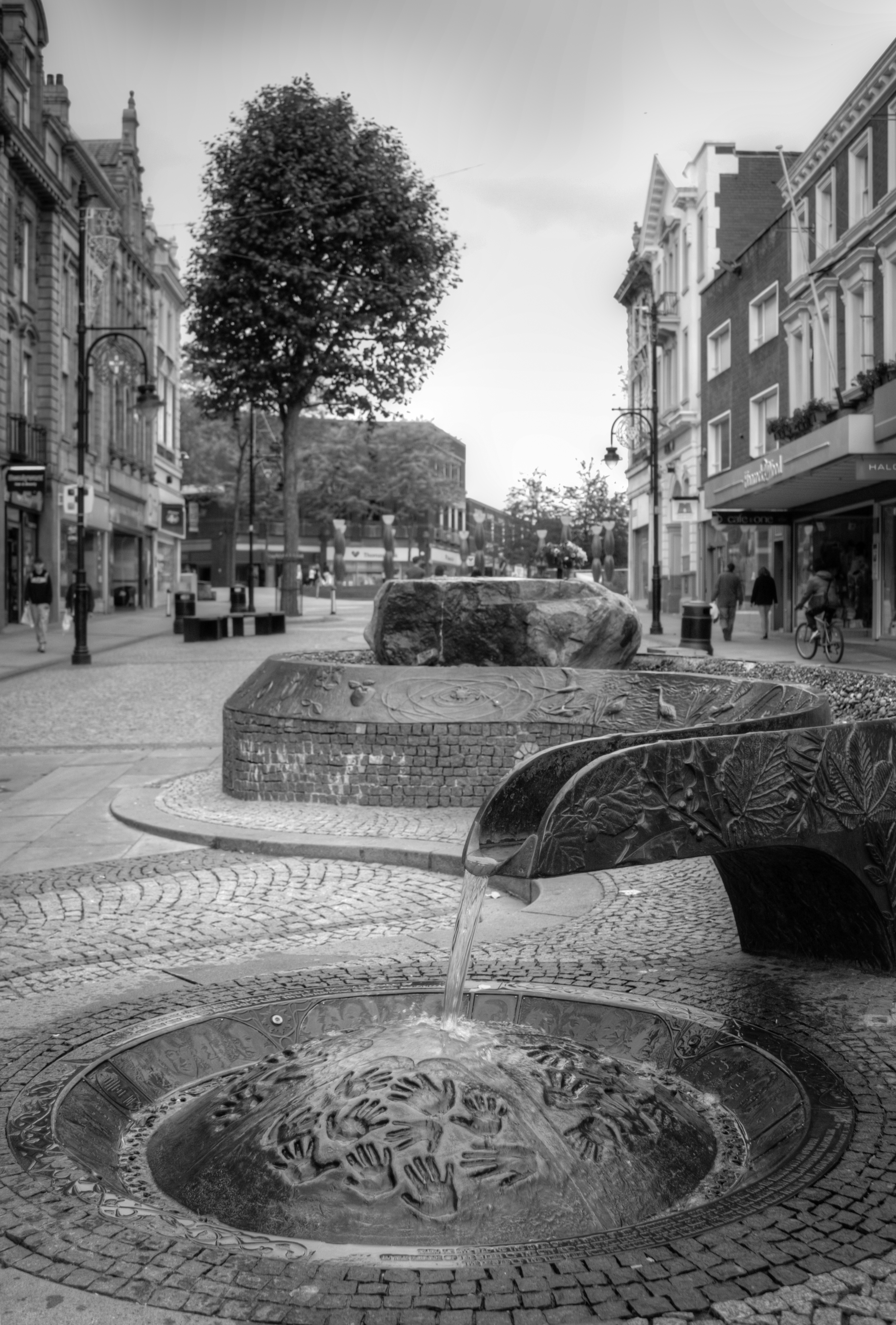
When I read that verse this week my mind went to a sculpture called The River of Life which runs down the main shopping street in Warrington. The sculpture was built by Warrington Council after two bombs were detonated by the IRA, killing 3 year old Johnathan Ball and 12 year old Tim Parry and injuring 56 others. It was the day before Mothering Sunday, March 20th, 1993.

The city council turned to a sculptor to discuss a memorial. Stephen Broadbent was the sculptor. He saw that the street was not just physically broken, but spiritually broken as well. He wanted to design something that would be “a symbol of renewal and faith in the power of the human spirit to triumph over adversity and to invest the future with hope.”

His inspiration was the image of the river of life in Revelation 22.
The angel showed me the river of the water of life, as clear as crystal, flowing out from the throne of God and of the Lamb down the middle of the great street of the city. On each side of the river stood the tree of life, bearing twelve crops of fruit, yielding its fruit every month. And the leaves of the tree are here for the healing of the nations.

And so it is. Now, flowing down that street is the River of Life  he made and on either side of the streaming water are trees, one for each month, each bearing fruits of the Spirit for the healing of the nations, for all times and seasons.

And so it is in Psalm 1 where the blessed are like a tree planted by streams of water bearing fruit in due season. I wonder that Stephen Broadbent himself is one of those trees, planted by the stream of tragedy and violence, leaving blessings of hope and healing through the season of trauma and grief.

I’ve seen photocards with these verses from Psalm 1. In them the stream is picturesque with sunlight reflecting from its gentle flow. The psalm doesn’t say the water is safe. 

The stream may be dangerous, fast flowing floodwater, a tidal wave, or deep or toxic. 

Or with a stretch of the imagination, the waters could be the waters that have to break for us to be born or baptised. 

Or the stream and the metaphor may be a metaphor for life.

Does the law of the Lord raise up people who delight in the law that there should be people by all the rough waters of life, that there should be lifesavers of healing, hope and blessing bearing fruit for all seasons of difficulty and danger?

It’s worth visiting that sculpture in Warrington. It’s on Bridge Street. It was always Bridge Street. The street hasn’t been renamed because of the sculpture and its intention to bridge the awful violence that tore people’s lives apart.

And here we are. The Bridges Group of Parishes – so called because of the bridges of the villages that make up the group of parishes. And the bridges are there to bridge the waterways that cut through the landscape.

We’ve reflected on Jesus’ position in relation to the crowds that streamed to him. We’ve reflected on the Psalmist’s position on those who delight in the law of the Lord.
We’ve reflected on the sculptor’s position in relation to the trauma of a community.
What about our own position?

Are we bridge builders and lifesavers? Do we delight in the law of the Lord, meditating on his law day and night? Are we blessed as agents of blessing, healing and hope? Or are we a curse on the poor, the stranger, the refugee, and all those vulnerable to losing their life at sea because we take our cues from the scornful, lingering in the way of sinners, taking the counsel of sinners?

Where are we as the river of life flows through our lives? Are we bridgebuilders offering healing where there has been division, hope where there has been despair? Are we like trees that bear the fruits of God’s Spirit, the fruits of love, joy, peace, forbearance, kindness, goodness, faithfulness, gentleness and self-control (against which no other law can stand) (Galatians 5:22f)? 

What is our position in relation to those Jesus blesses? Are we on their side, or are we on the side condemned by Jesus, with those who’ve grown rich at the expense of the poor, those who have stuffed themselves while so many go hungry, those who can afford to laugh while the rest of the world is in bits, those who walk the corridors of powers and still exclude, insult and reject others?

For as long as we delight in the law of the Lord, for as long as we seek to understand it, we will be on the side of those in the roughest of waters.


Fruit for all seasons

January

Why would anyone come to Kelsall?
I know they come for the steam fair and the folk festival. But most come to Kelsall for the fruit, from Windsors Fruit Farm at Willington and Eddisbury Fruit Farm on the Yeld.
One of the greatest pleasures of my childhood was picking fruit – picking our own strawberries from the field, scrumping apples and gathering conkers. What added to the pleasure was the sight of the fruit – the colour of the apples, the texture and coating of the conker and the size and softness of the strawberry the ones that were just ripe enough.
No home is complete without its basket of fruit. Albert Einstein said: A table, a chair, a bowl of fruit and a violin; what else does a man need to be happy?
Well times have changed. Now it’s an ipad, an iphone and anything else apple!
But for the sick, one of the go to gifts is a basket of fruit. It is healthy, it is cheerful, it is thoughtful and it is tempting.
Paul (Galatians 5) presents us with two baskets of fruit this morning. One basket is full of rotten fruit: strife, jealousy, anger, quarrels, dissension, factions, envy … and things like these. This is an everyday diet – many people only have bitter fruits which leave a nasty taste in the mouth.
The other basket is filled with good fruit: love, joy, peace, patience, kindness, generosity, faithfulness, gentleness and self-control.

These are of course metaphorical fruits. They are the fruits of people’s lives – what people have to offer through their seasonal cycle of being planted, born, growing, fruiting and going to seed.
The two baskets represent the harvest of two very different people – a good basket which anyone who is sick, or who needs encouragement would welcome. The one is the harvest of lifestyles which are self seeking: the other is a range of gifts to enrich relationships with real human quality that affects reactions and responses. They are the fruits of the very Spirit of God.
The Bible begins with fruit trees and ends with fruit trees.
There will be a time when the fruitfulness of God’s creation will sustain people in all the seasons of their lives. Revelation 22, the last chapter of the Bible, refers to the fullness of time with the river of the water of life flowing from the throne of God through the middle of the street of the city. On either side of the river, as at the beginning, so at the end, is the tree of life with its twelve kinds of fruit, producing its each month, for all the seasons of life. And the leaves of the trees will be for the healing of the nations.

A sculpture was offered as consolation to the grieving, shell shocked people of Warrington after the IRA bombings that killed two young boys. It is by Stephen Broadbent and is at the scene of the litter bin outside Boots where the bomb was placed. It is the retelling of this vision of the work of God’s Spirit. The river flows through the middle of the street of the city, and on either side there are bronze plaques planted wither side of the river – twelve in all, each with their fruit to sustain people through all the seasons of their life, including the times when they even walk through the valley of the shadow of death. The one shown is for January, for a cold, dark, depressing and lonely time. The fruit offered for the season is JOY – and underneath the month Stephen has written the words “and the leaves of the trees will be healing of the nations” – every month, for all the seasons of our lives.
The Warrington sculpture, the hope and consolation that it represents, is the there and then of the promise found in Revelation in the here and now of violence, enmity and strife. It is a basket of spiritual fruit offered to a world that is feeling very sick.
Another basket of fruit was offered to a world of bitterness and anxiety by a mosque in York recently. Well it wasn’t so much a basket of fruit so much as the offer of a cup of tea and a game of football.

Apparently members of the Mosque heard that the English Defence League were gathering for a protest outside their Mosque – members of the mosque retaliated by putting the kettle on, invited the protesters inside, drank tea together and played football together.

But how does such fruit grow? How are some people able to offer such good fruit when everyone else seems only able to respond with anger, cynicism and despair?
The Bible is full of talk about fruitfulness. It begins at a fruit tree in the garden of Eden, and it ends with a fruit tree
Psalm 1 describes the process:
Blessed are they that have not walked in the way of the wicked,
Nor lingered in the way of sinners,
Nor sat in the assembly of the scornful.

Their delight is in the law of the Lord
And they meditate on this day and night.
Like a tree planted by streams of water
Bearing fruit in due season, with leaves that do not wither,
Whatever they do, it shall prosper.

Similarly Psalm 92. There the Psalmist suggests that
It is a good thing to give thanks to the Lord
and to sing praises to your name, O Most High.
To tell of your love early in the morning
and of your faithfulness in the night-time.
…… The righteous shall flourish like a palm tree,
and shall spread abroad like a cedar of Lebanon.
Such as are planted in the house of the Lord shall flourish in the courts of our God.
They shall still bear fruit in old age; they shall be vigorous and in full leaf.

For the writer of John’s Gospel it is about being born again
The fruit of our lives can be the work and creation of the Spirit of God. It is the Spirit of God which helps us respond, react and hope with love. It is the Spirit of God which helps us to bear fruit in all the seasons of life, when faced with sorrow, disappointment, betrayal, enmity, jealousy. It is the Spirit of God which helps us to speak, act and think with love, joy, peace, patience, kindness, generosity, faithfulness, gentleness and self control. It is through the Spirit of God we have a basket of fruit for a world that craves fruit – five a day – our neighbours, family, community and enemies.
Isn’t that a healthy lifestyle? Isn’t that a winning way?
How many pray for more strife, more jealousy, more quarrels, more factions? Haven’t we got enough of them?
How many pray for more patience, more kindness, more generosity, more gentleness and more self-control in their homes, workplace and community? My guess is that we may have an answer to their prayer: a basket of fruit for all tastes.

A sermon preached at St Philip’s Kelsall on June 30th 2013

Resilience and efficiency

ImageWhen I had a study I wished I worked in an office. Now I work in an office and I wish I had a study. (Interesting that I use the verb “work” only in relation to the “office”). I was shy about the “study” because I didn’t think it had the street cred of the offfice. Like many of my peers I referred to my study as the office. Now I find myself fighting for the place of the study in ministry which seems to have less time for it.

In a recent blog post, Sam Charles Norton has some wise words as he contrasts efficient and resilient systems. An efficient system “is one in which each resource is being utilised to the greatest possible extent.” We love efficiency and worship its icon of the (upwardly mobile) graph which is the prerequisite of any office wall. Norton suggests that the Church of England is hell-bent (my words) on a drive towards efficiency which is (mis)-guided by a spirituality “which is based upon a fear that all that seems to be going wrong will continue to go wrong.” According to Norton, we have forgotten what it means to believe in God. “The Church of England will only be saved by those who are not consumed with conviction about how to save it, and who sit lightly at the prospect of the Church of England not being saved – simply because they are utterly committed to the sovereignty of the living God, and they trust in his provision, rather than our own choices.”

A “resilient system” is what the Church of England has been as it “has emphasised the importance of the local and the different, the queer and the inefficient”. Resilient systems have resources within them which enable them to withstand shocks and trauma.  These “unexploited” resources aren’t built or stored in offices. That would be too inefficient. Many of our offices stand empty with their enterprise blown away by the latest economic shocks to the system. Offices are only open for business and efficiency. They are closed to resilience and their house is blown down with but one puff.

“Happy are those who delight in the law of the Lord, and on his law they meditate day and night. They are like trees planted by streams of water, which yield their fruit in its season, and their leaves do not wither. In all they do, they prosper.” (Psalm 1).