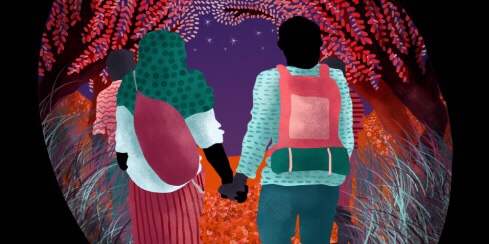
We’re all at sea in our small boats

This is a reflection on the sea and the troubled waters we call life for the 4th Sunday after Trinity (B).

I spotted “the other boats” in the gospel reading for the day, from Mark 4:35-end (text below). They played on my mind as we prepare for a UK election which some want to turn into an election on immigration. It made me think – “we’re all at sea” and the forecast is for more storms. This sermon comes with a health warning – it is metaphor heavy.

The first verse we see when we open our Bibles is “In the beginning when God created the heavens and the earth, the earth was a formless void and darkness covered the face of the deep while the spirit of God swept over the face of the waters.” (Genesis 1:1-2) 

The last verses in our Bibles are also about water – the “river of the water of life, bright as crystal, flowing from the throne of God and of the Lamb, through the middle of the street of the city, feeding trees bearing fruit for all seasons and leaves for the healing of the nations”. (Revelation 22:1-2)

In the beginning of the Bible there is total darkness. In the end, there is only light – no darkness and no hiding.

The Bible begins in water and ends in water. And between the two there is all the difference in the world – as different as night and day.

The Bible begins in water. The water is chaos. The first thing God does is make light. The second thing he does is sort the waters out. He separates the waters of heaven and earth, gathered the water together and let dry land appear. That’s how it began. 

This is a theological view of life. This is how we open our Bibles. We open them with an understanding that we are all at sea. From the very beginning we have been surrounded by water, the sea, the deep. We’ve been on flood alert since the time of Noah.

Probably all of us here have had times in our lives when we have felt overwhelmed, engulfed or drowning – and used these metaphors to describe how we felt, using so many metaphors drawn from our collective experience down the ages of chaos and the sea. So much of our language reflects this. Like “we’re out of our depth”, or “we’re in it up to our neck”, or “we’re all at sea”.

The Bible begins with water and ends with water. From day one there is storm after storm. The waves crash all around us until that day when the waters become calm and do God’s bidding of giving life and healing to the whole of creation.

These are the times we live in, when there is one storm on top of another. For the time being we are between the devil and the deep blue sea. (Another popular saying.)

These are the times Jesus lived in as well. The storms he faced were different to ours. With his contemporaries he was assaulted by religious oppression and exclusion, a taxation poor which kept them in poverty and debt, and an occupation by a foreign power which robbed them of their freedom.

His attitude at times like these is captured in the snapshot we have of him in today’s gospel reading. They’re all at sea. A great gale arose, and the waves were beating the boat and swamping it. And Jesus slept. Calm as you like.

There were other boats. It’s strange how you miss details like this. I must have read this passage hundreds of times, but I’ve never seen those four words before. There were other boats. Have I never noticed these other boats because the focus has always been on Jesus’ boat? Have I only spotted these boats now because of the small boats that desperate refugees are taking to to escape to safe havens. 

(Isn’t it terrible that some people are turning the election into an election about immigration and the people in these small boats?) It is Refugee Week – and we need to spot their boats, not stop their boats. There is a growing refugee crisis – that means a crisis for a growing number of refugees. 1 in 69 of the world’s population is now displaced, largely because of conflicts around the world. It’s important we respond to their Mayday.  M’aidez. Help me! It is, after all, the refugees who have the problem – all those who have no safe routes for escape. They have enough problems without being turned into a political football.

We’re all at sea. We’re not all in the same boat. We’re not in the same boats as the refugees. We’re all in our different small boats. We’re all at the mercy of troublemakers, powers-that-be, the forces that make waves, and the sea so dangerous. 

There’s a well known fisherman’s prayer that captures our plight. It’s become known as the Breton Fisherman’s Prayer: 

Dear God,
be good to me;
the sea is so wide, and my boat is so small. 
Amen.

They’re words from a poem by Winfred Ernest Garrison.

It’s not surprising that so many make that prayer their own. The words fit the experience we call “being all at sea”.

The sea is our life with its currents and tides, its ferocity and deceptive charm constantly eroding and undermining us. The challenge of our lives is how we navigate these waters.

We are like those who, in the words of Psalm 107 “go down to the sea in ships and ply their trade in great waters”, who have seen the works of the Lord and his wonders in the deep. While they were at their wit’s end as they reeled and staggered like drunkards, they cried to the Lord in their trouble and he brought them out of their distress. He made the storm be still and the waves of the sea were calmed.

Our lifetime at sea is summed up in our baptism. We are soaked in deep water, and brought through water as if this is an acknowledgement of our life at sea, weathering the storms faced by us all, Jesus included. The question we’re asked in baptism is, “Do you turn to Christ?” Our response then is “I turn to Christ”. It’s stated as a promise. Perhaps it should be stated as a habit. 

In the storms of life, when you’re all at sea, when you feel you’re drowning, do you turn to Christ? The faithful ones, like the ones in the psalm, will say, “Yes, I turn to Christ. He’s the one who can sleep in the storm. He’s the non-anxious presence. We turn to him to hear him say ‘Peace! Be still!’ – and when we do, the wind dies down and we feel the calm.”

It’s easier said than done because in the midst of things it is too easy to panic.

The waves that have panicked me have been so slight compared to what others have faced. Dare I say I’ve done enough doom scrolling to sink a battleship? I am only beginning to learn to wake Jesus in my mind, to hear him in the head of the storm, to find better things to think about, to take his word as gospel. 

I know that when the sea calms for me, it calms also for all the other small boats.

Here we gather. We call this gathering place the NAVE – the Latin word for ship. We are shipmates in our small boat.

Here we are, all at sea, our metaphorical sea. The metaphorical weather is awful. Even though the long term forecast is for beautiful, calm weather, immediately, all we can expect is one storm after another. There are dark forces within us, and all around us, threatening us – driving so many from their homes, driving them to the edge, condemning them/us to their/our fate on the sea of life.

We are shipmates. We’ve been through it before. We’ve been through the waters of baptism. We’re used to turning to Christ – who in today’s gospel we see in the same boat as ourselves. In the rage of the storm he makes himself heard. We hear him call us “beloved”. The wind and the sea hear him. ‘Peace! Be still!’ they hear him say. For the moment they obey him.

Here we are, churches in the Bridges Group of Parishes – like a bridge in troubled water for all those who live in these six parishes. When we’re weary, feeling small, when times get tough, when we’re down and out, when darkness comes and pain is all around – we know the words of the one even the wind and sea obey.

Mark 4:35-end
On that day, when evening had come, he said to them, ‘Let us go across to the other side.’ And leaving the crowd behind, they took him with them in the boat, just as he was. Other boats were with him. A great gale arose, and the waves beat into the boat, so that the boat was already being swamped. But he was in the stern, asleep on the cushion; and they woke him up and said to him, “Teacher, do you not care that we are perishing?” He woke up and rebuked the wind, and said to the sea, ‘Peace! Be still!’ Then the wind ceased, and there was a dead calm. He said to them, ‘Why are you afraid? Have you still no faith?’ And they were filled with great awe and said to one another, ‘Who then is this, that even the wind and the sea obey him?’

Refugees: a poem by Brian Bilston

Refugees can be read two ways. Every refugee story can be read two ways. Usual media accounts tell the story such as “migrants have been prevented” – or, as here, “Illegals have landed”. Little is told of the desperate back stories of the refugees. Their voice is unheard.

Refugees can be read two ways. It can be read as if you don’t care. And it can be read as if you do. You can read it from top to bottom, or you can turn the world upside down and read it from bottom to top, depending on how you read the world. This poem can be read two ways. That is the way with this poem exploring two very different ways of reading the situation.

Brian Bilston is known as the Twitter Laureate. You can find more of his poems at his Poetry Laboetry

North Star Fading – a poem to watch for Refugee Week

During Refugee Week I have been posting a poem a day. Today’s poem is one to watch. It highlights misleading promises, extreme dangers and dashed hopes than many refugees have to face.

Please click the image to see and hear North Star Fading – a zoom comic from PositiveNegatives who tell true stories drawn from life – this from the lives of Eritrean refugees.

Karrie Fransman did the visuals and Lula Mebrahtu was responsible for the words and sound. Interviewed about the work Karrie explained “I’m Jewish and my grandfather was a political refugee. Our festival Passover commemorates our history as refugees, so there is a personal link.”

Lula has this to say. “My own experiences play a big role when I am creating. I remember a few years back, I watched a news report about a ship that had caught on fire and sunk near the border of Italy. A lot of ‘illegal immigrants’ onboard died. There were no names, pictures or interviews with those who survived, just factual news, and the narrative was focused on the immigration crises. That same day, my mother got a phone call. It transpired that a family friend had a son on that ship, and he died. His mother didn’t even know he made the voyage. My mother had to break the news to her.”

There is more from their interview at https://www.soas.ac.uk/blogs/study/north-star-fading/

Some poems I have posted for Refugee Week are shown below this post.

The British – and our refugee stock

Benjaminzephaniahcamff (cropped)

Benjamin Zephaniah describes himself as a “Rasta Folkie”. He’s a well known British poet who plays the part of Jeremiah Jesus in Peaky Blinders (I love Peaky Blinders!). He comes from Wandsworth, Birmingham, which he describes as the “Jamaican capital of Europe”.

I am posting a poem a day for Refugee Week. This poem is called The British and is about what makes us tasty. I am from Leicester which has a long tradition of welcoming refugees (as in this welcome the city gave to Basque refugees in 1937). But even there, I remember signs in pub windows in the late 50’s and early 60’s which said “no blacks, no gypsies, no Irish”. Little did they know, and little did they understand that they were from a long standing melting pot with some good, hearty refugee stock.

Here’s the recipe:

The British

Take some Picts, Celts and Silures
And let them settle,
Then overrun them with Roman conquerors.
Remove the Romans after approximately 400 years
Add lots of Norman French to some
Angles, Saxons, Jutes and Vikings, then stir vigorously.


Mix some hot Chileans, cool Jamaicans, Dominicans,
Trinidadians and Bajans with some Ethiopians, Chinese,
Vietnamese and Sudanese.
Then take a blend of Somalians, Sri Lankans, Nigerians
And Pakistanis,
Combine with some Guyanese
And turn up the heat.
Sprinkle some fresh Indians, Malaysians, Bosnians,
Iraqis and Bangladeshis together with some
Afghans, Spanish, Turkish, Kurdish, Japanese
And Palestinians
Then add to the melting pot.
Leave the ingredients to simmer.
As they mix and blend allow their languages to flourish
Binding them together with English.
Allow time to be cool.
Add some unity, understanding, and respect for the future,
Serve with justice
And enjoy.

Note: All the ingredients are equally important. Treating one ingredient better than another will leave a bitter unpleasant taste.
Warning: An unequal spread of justice will damage the people and cause pain. Give justice and equality to all.

Hungry Chair – a fourth poem for Refugee Week

Hungry Chair is my fourth poem to mark Refugee Week – picking up the “chair” theme of inclusion from Nicola Davies’s poem I posted yesterday, The Day the War Came. A common response to the refugee crisis is “there isn’t any room” – sometimes there is an apology about it, but usually not. Once in a while someone will make room in their home, school or community. Hungry Chair, like The Day the War Came, is a poem which thanks and praises those who do make room.

Denel Kessler is the author of Hungry Chair. The principal she refers to is Maha Salim Al-Ashgar, Principal of Khawla Bint Tha’alba Elementary School for Girls, Jordan. The poem is a “thank you for showing the world what compassionate action looks like”. The Principal’s action challenges my lack of compassion. The video is well worth watching.

Hungry Chair

Let’s talk about heroes
the everyday kind
a Jordanian principal
at a school for girls
offering a simple solution
rather than slamming the door
in the faces of children
who have done nothing
to create the war
forcing the families to flee
or die in the hateful dust
clouding the world’s vision

the school is overcrowded
but when Syrian mothers beg
for their children to be taught
instead of saying     no room
the principal asks each girl
to bring a chair and she will
find room for one more
students walk to school
carrying multi-hued chairs
so many eager daughters
classrooms full beyond bursting
but the principal keeps her promise
none are turned away

a loving heart refusing
to be the lock on the gate
offering instead a key
a  mother’s simple wish
for her daughter to write her own name
becoming “maybe she will be a doctor”
a seven-year-old girl declaring
“I want to be smart”
the world begins anew
with open arms, willing minds
perched on the edge
of bright plastic chairs
asking only teach me

I am hungry to learn

I found The Hungry Chair here

What poem would you choose for Refugee Week?

The Day War Came – another poem for Refugee Week

I am posting a poem a day during Refugee Week. I have already posted Home by Warsan Shire and My Hazara People by Shukria Rezaei.

The Day War Came was written by Nicola Davies in 2016 when she heard that the British government was refusing to allow lone refugee children entry into the UK. Nicola Davies is a children’s author and zoologist. The poem has been published as a book with illustrations by Rebecca Cobb.

it is striking how many of these poems I have selected for Refugee Week are about children. Here the child’s safe space is undermined in a split second: the place where they belonged becomes lost to them and they have no choice other than to go on the run.

One person responded to this poem by drawing a chair – I suppose there is a real welcome in our phrase “draw up a chair”. That idea grew into parading #3000chairs across the internet for 3000 child refugees alone and fleeing “all kinds of ghastliness” to “make the people who voted to shrug their shoulders and throw those kids to the traffickers hang their heads in shame”. Posting this is my offer of a chair – but as well I asked Vincent to draw one up for me as my way of saying “refugees welcome”.

The day war came

The day war came there were flowers on the windowsill
and my father sang my baby brother back to sleep.
My mother made my breakfast, kissed my nose
and walked with me to school.

That morning I learned about volcanos,
I sang a song about how tadpoles turn at last to frogs
I made a picture of myself with wings.

Then just after lunch,
while I watched a cloud shaped like a dolphin,
war came.
At first, just like a spattering of hail
a voice of thunder …
then all smoke and fire and noise, that I didn’t understand.

It came across the playground.
It came into my teacher’s face.
It brought the roof down.
and turned my town to rubble.

I can’t say the words that tell you
about the blackened hole that has been my home.

All I can say is this:

war took everything

war took everyone

I was ragged, bloody, all alone.

I ran. Rode on the back of trucks, in buses;
walked over fields and roads and mountains,
in the cold, the mud and the rain;
on a boat that leaked and almost sank
and up a beach where babies lay face down in the sand.

I ran until I couldn’t run
until I reached a row of huts
and found a corner with a dirty blanket
and a door that rattled in the wind.

But war had followed me.
It was underneath my skin,
behind my eyes,
and in my dreams.
It had taken possession of my heart.

I walked and walked to try and drive war out of myself,
to try and find a place it hadn’t reached.
But war was in the way that doors shut when I came down the street.
It was in the way the people didn’t smile and turned away.

I came to a school.
I looked in through the window.
They were learning all about volcanos
And drawing birds and singing.

I went inside. My footsteps echoed in the hall.
I pushed the door and faces turned towards me
but the teacher didn’t smile.
She said there is no room for you,
you see there is no chair for you to sit on,
you have to go away.

And then I understood that war had got here too.

I turned around and went back to the hut, the corner and the blanket
and crawled inside.
It seemed that war had taken all the world and all the people in it.

The door banged.
I thought it was the wind.
But a child’s voice spoke.
“I brought you this,” she said, “so you can come to school”.
It was a chair.
A chair for me to sit on and learn about volcanos, frogs and singing
And drive the war out of my heart.

She smiled and said:
“My friends have brought theirs too, so all the children here can come to school.”

Out of every hut a child came and we walked together
on a road all lined with chairs,
pushing back the war with every step.

Nicola Davies

van-gogh-chair-1888-89-the-chair-and-the-pipe-6252763

My Hazara People – a poem by Shukria Rezaei (15)

shukria-rezaei

The theme of Refugee Week 2019 is You, me, and those who came before. It is an invitation to explore the lives of refugees, and those who have welcomed them – throughout the generations.

I’m observing Refugee Week with a poem a day. This poem highlights the horrors faced by children – such horrors and distress that they can’t find the words to describe what has happened to them. This poem, brought to our attention by Kate Clanchy, is by Shukria Rezaei (pictured right) who “can’t write” about her Hazara people – she just can’t find the words. I read her poem side by side this report on the growing outrage over the separation of children from their parents at the southern US border.

Shukria’s Hazara people have been persecuted for centuries. They settled in Afghanistan in the thirteenth century but for much of that time have lived on the edge of economic survival, being driven from their land and being sold as slaves. They are Shi’a and have been persecuted by the majority Sunni population. The Taliban declared jihad on the Hazaras when they seized power in 1996.

This is the first poem Shukria wrote when she came to the UK aged 15.

I can’t write about my Hazara people
who have suffered for decades
in Afghanistan where they come from
in Pakistan where they are murdered
in Iran where they offend
because of their almond-shaped eyes
my mind is blank!

I can’t write about how loud the shooting was
just two miles from my house.
How my aunt fainted.
How nervous my mom got,
how the cup fell from her hand.

I can’t write about how innocent people died,
how the Martyr’s necropolis gets bigger and bigger,
how my people suffer,
how cruel this world can get,
how frightening it is

for kids like me.

Shukria Rezaei (15)