The glory of Jesus, the bullied and the shamed standing side by side

Sermon for Trinity 21B – Oct 20th 2024

This sermon is for the shamed, the bullied, the ostracised, the oppressed as we get to grips with our readings for today from Isaiah 53:4-end and Mark 10:35-45. I am increasingly aware that the gospel of Jesus Christ and the work of the Holy Spirit is for the shamed, bullied, ostracised and oppressed. God takes his place with them.

We may well have been bullied, shamed or ostracised.

And/or we may have been the bullies responsible for shaming and ostracising. Or we may have joined in because we were afraid that if we stood out from the crowd we, ourselves, would be bullied, shunned and ostracised.

To jog your memories, let me take you back to school. I’ll take you to my school all those years ago. It was an all boys school. Then, as now, the slightest difference was picked up and became opportunity for mockery and worse.

There was a boy we called Cheggers, even though he hated that name. We were probably 12 or 13 at the time. We’d do monkey impressions in front of him, making fun of the way his jaw was set slightly differently and the way he walked differently. Of course, I joined in. I joined in because that was the safest thing for me to do. It wasn’t that I didn’t like Cheggers. I didn’t know him – and the bullying kept it that way. How could he ever make himself known in those circumstances?

There’s a six part series on Sky Atlantic called Sweetpea featuring a young woman who was bullied and neglected. She becomes a “ghost” of her former self – always feeling invisible. People keep bumping into her, saying, “I didn’t see you”.

The bullied and ostracised are never seen for who they are. We see that in the fear-ful treatment of refugees when they’re not seen as people but as a threat. We didn’t “see” Cheggers. We only saw his difference and the opportunity for joking and banter – at his expense. We didn’t know who he was. We didn’t want to know how he felt. It didn’t matter that he probably felt awful. We didn’t know that, perhaps he was the bravest boy amongst us – brave enough to keep coming back, lining up with us to brave the taunts and humiliation again and again.

And here’s where it matters – in the scriptures we treasure, to the Jesus we follow.

In those days, my schooldays, he, Cheggers, was the one who bore our sin. Our hatred, anxiety and fear was turned on him and he suffered because of us. In the language of our reading from Isaiah, he was wounded for our transgressions. “He was oppressed” by us. “He was afflicted” by us, myself included. 

Such is the emotional and physical suffering of the scapegoat.

We usually read this passage from Isaiah with Jesus in mind. It is normally read on Good Friday when we turn our minds to the suffering servant bearing the shame and pain of crucifixion. This is how we have come to know Jesus – mocked, bruised, afflicted and even numbered as one of the transgressors, one, two, three of them in the crucifixion scene.

But what we say of Jesus from this passage we can surely say of any we’ve scapegoated that he/she/they have borne our sin – our hatred, anxiety and fear. They are oppressed and afflicted when we, like sheep, have gone astray, turning to our own way of doing things. They are wounded by our transgressions and crushed by our iniquity. 

It’s not clear who Isaiah is referring to as the scapegoat in this passage.  He might have  someone in mind, or a community used to suffering persecution (such as the Jewish people down the centuries) or any sufferer of bullying. We don’t need to narrow the scapegoat’s identity down to Jesus, though, certainly the choice of Jesus was to join the afflicted, tormented and bruised, becoming one such himself.

In the book of Acts we find this very same passage from Isaiah being read, and Luke takes us scripture readers to this particular scripture reader. (It’s Acts 8:26-40). It’s an angel who directs Philip to the reader who is on the road from Jerusalem to Gaza. He is  an official in the court of the queen of Ethiopia. So important. But he was a eunuch. Historians of the period point out that although eunuchs could be given great responsibilities they were seen as “monstrosities”, stigmatised for being morally and sexually distorted and the objects of suspicion and derision. They were seen as sexual deviants. They were a laughing stock scapegoated for no fault of their own.

So, here, on the road to Gaza, we have a man who was seen as “not a man” reading of one who was “oppressed and afflicted”, who was “wounded for our transgressions” and “crushed for our iniquities” – and an angel of the Lord, from the realm of glory, had directed one of Jesus’s disciples to help him to read, mark and inwardly digest that he was reading about himself, and that he was also reading about Jesus – and there and then, he was baptised.

God’s realm of glory is very different to the realms of glory we have in the world, where glory is measured in wealth and winning, in power and popularity – and in importance. This is the way of thinking of James and John when they come to Jesus and ask him for the best seats in the house. Their request, “Grant us to sit, one at your right hand and one at your left, in your glory.” 

The disciples are always getting it wrong according to Mark’s gospel. They’ve missed the point of Jesus and his mission. Jesus points out the ways of the world and underlines the suffering caused by the ways of the world. He points out that those we recognise as our rulers so often lord it over us, making themselves exceptions to their rule, enjoying the power they have over others – and in so many cases turning out to be tyrants, striking fear into people, upsetting their lives and causing suffering.

He said, It is not so among you: but whoever wishes to become great among you must be your servant, and whoever wishes to be your servant must be slave of all. This is not what James and John had in mind when they came to Jesus with their request to be one up on everyone else. (Nor is it what we have in mind when we choreograph our ecclesiastical processions or when we excuse the abuses of power in a culture of deference.)

No, scripture points us to another way of doing things. Glory in the kingdom of God is for those, in the words of Isaiah, afflicted, wounded and oppressed by the powers that be, just as Jesus was afflicted, wounded, mocked and shamed by those rulers of Jerusalem and Rome, the rulers of religion and empire – just as the eunuch would have been, just as whole groups of people are, just as certain ethnic groups continue to be.

Who will be on Jesus’ left, and who will be on Jesus’ right in his glory? Is it James? Is it John? Mark gives us the answer. The glory of Jesus is first witnessed by the Roman centurion, who, faced with Jesus, said “truly this man was God’s son!”. And on his left hand and on his right were neither James or John. They were nowhere to be seen. They’d deserted him. Instead, on his left and on his right were two “bandits” – together with Jesus – the three of them shamed, mocked, scorned and killed by empire and those who want the glory of being empire builders.

This, brothers and sisters, is where the gospel of Jesus Christ takes us – to the cross where one oppressed, afflicted and wounded was hung out to die – with one on his left and another on his right, neither of whom are James or John. They’re still glory seeking – they’re in hiding, saving their own skin. The glory of the kingdom is the salvation of those who bear the sins of the world – victims of shame, injustice and empire (maybe ourselves included).

With our ear to the ground – down to earth preaching for the Season of Creation

This sermon was written for the 3rd Sunday in the Season of Creation and is dedicated to Earth and those who suffer along with her. Genesis 2:4b-23 and Romans 8:19-23 were the chosen readings.

September 15th 2024

It’s not all about us. Sometimes it seems like it is, either about the congregation or about people in general. We may be forgiven for thinking its all about us. But it isn’t.

Psalm 148 calls the whole creation to praise the Lord – the sun and moon, the stars, sea monsters and the deeps, fire and hail, snow and frost, stormy wind, mountains and hills, fruit trees and cedars, wild animals and all cattle, creeping things and flying birds, kings of the earth, princes and rulers, young men and women, old and young together – let them all praise the Lord.

It’s not all about us. The whole creation is called to praise the Lord together. Its all about us being joined in praise together.

Today is the 3rd Sunday of the Season of Creation. This Season of Creation is a reminder of our joint vocation; that It’s not all about us, but is for the whole of God’s creation. It’s a reminder of our separation, egocentricity, selfishness and sin.

The Season of Creation is a relatively new variation to the liturgical year, dating back to 1989 when Patriarch Demetrios (of the Orthodox Church) invited all people of goodwill to dedicate September 1st as a special day of prayer for the preservation of the natural environment. It became an ecumenical project backed by the World Council of Churches, the Roman Catholic Church and the Anglican Communion and turned into a season beginning on September 1st and ending on the Feast of St Francis of Assisi – October 4th.

You will see that this sermon sticks out like a sore thumb from today’s liturgy. And we’ve changed the readings so that they fit the Season of Creation better than the ones we are supposed to be reading today. There is a lot of work to be done to develop theological and liturgical resources to respond to the crises we see all around us, and the cries which come from the heart of creation. It’s not something I’ve done before either – it’s all new to me – but I do feel a strong sense of vocation to make this start – including penance for our neglect of the subject.

We have to begin somewhere. Your Harvest festivals and Pet Services are something of a start and echo the faith of the psalmist in Psalm 148.

I suggest we begin by putting our ear to the ground. Hebrew is the language of most of our scriptures. Adamah is the Hebrew for ground/earth. Adam bears that image in his name. God planted a garden.

We may have the Monty Python question. What has the earth ever done for us?

It was from the ground of the garden that God grew “every tree that is pleasant to the sight and good for food” (Genesis 2:9). From the ground God formed every animal of the field and every bird of the air. (Genesis 2:19). From the dust of the earth God made humanity. There is no other way. Earth is the mother of all living creatures. Everything comes from the earth – except woman. The Genesis tradition has it that she was formed from the rib of the one born of earth.

Those who play with words will know that HEART is an anagram of EARTH. Earth is the heart of creation..

Aboriginal poet Mary Duroux laments:

My mother, my mother,
what have they done?
Crucified you
like the Only Son?
Murder committed
by mortal hand!
I weep, my mother,
my mother, the land. 

The primitive and aboriginal understanding of the elements of creation is that we are caretakers of them. But over the centuries earth has become an increasingly abused and exploited partner, subject to human violence and carelessness. 

We’ve denuded her. We’ve stripped her, scarred her and left her exposed to the elements. We have fought over her and left her covered with blood. We have dug into her and taken her jewels, mining her with human greed. Mine, mine, mine! People fighting over her coal, gold and diamonds, pulling her one way and another – land grabbing. She’s mine, mine, mine.

If we put our ear to the ground we will hear her deep sigh of suffering.

The story of the Fall in Genesis is also the story of Earth. God said ‘because you … have eaten of the tree which I commanded you ‘You shall not eat,’ cursed is the ground because of you’ The curse on the ground may strike us as grossly unjust. What has earth done wrong. But the story of the Fall tells the deep truth that earth is cursed because of us, because of our disobedience, because of our greed, because of our abusive behaviours. Earth bears her curse like so many mothers bear the curse brought on them by their children.

We live in the midst of beautiful countryside. We enjoy looking over it. Our ear to the ground may be deceived by the restfulness of this patch of earth. But don’t be deceived. I bet the politics of the land round here is as contested here as anywhere – planning permissions, boundary disputes – not to mention the ripping apart of the earth to make way for HS2. Earth is cursed because of us – and Earth hasn’t been given her say. The voice of Earth in pain has been suppressed – just as the voices of so many exploited and abused remain suppressed.

When we have our ear to the ground we hear the Earth. She has her say. It’s not a human voice. She screams and groans her own way – and many of her groans and screams will be joining the groans and screams of others. Very often people are suffering grave injustice in those places where Earth hurts. People are hurt most where Earth hurts most, and Earth is hurt most where people hurt most because of the extremes of injustice, poverty and war. Think Ukraine. Think Holy Land. Think fire and flood where Earth and human life are cursed together, crying and screaming together in their own ways.

The prophets of the Old Testament had their ear to the ground. Jeremiah understood her desolation and heard her mourning and crying. Isaiah sees Earth “languishing”. Joel hears the groaning of the animals after fire has devoured Earth’s pasture and burned all the trees of the field.

Paul has his ear to the ground in the passage we’ve listened to from his letter to the Romans. He knows that creation has been subjected to futility and that the whole creation has been groaning … not only creation but we ourselves, who have the fruits of the Spirit, groan inwardly. This Season of Creation takes us down to Earth. As the Earth groans, we groan as the Spirit of God groans within us to urgently pray for God’s kingdom to come on earth as it is in heaven.

Faith takes our ear to the ground. She keeps us down to earth. Humility is a word which finds its meaning from humus, the soil. The rule of God is that the humble are blessed. How blessed are the humble. They shall inherit the earth. (Matthew 5:5). In their care Earth will find her peace. Her curse will be lifted and with all the redeemed her voice will be full of praise.

Note: The poem by Mary Duroux appears in her collection Dirge for Hidden Art

The congregation is the point

I don’t think I have ever preached a sermon where the point has been the congregation before. The congregation seems to be the point of the readings set for the 8th Sunday after Trinity (year B). They are Jeremiah 23:1-6, Psalm 23, Ephesians 2:11-end and Mark 6:30-34, 53-end (text below). I’m covering a long term “vacancy” in a group of churches. I’m hoping these congregations will find encouragement here.

July 21st 2024

The point of today’s readings is the gathering after the scattering – the scattering of people. I don’t think I have ever preached a sermon where the point has been the congregation before, but that seems to be the point that links the readings appointed for today. All four: the reading from Jeremiah, the Psalm, the reading from Ephesians and the gospel reading from Mark – they all build the point. The congregation is the point. The gathering after the scattering is the point.

Never has there been so many people on the move as now. By the end of last year 1 person out of every 69 was forcibly displaced, having been forced to flee persecution, conflict, violence, human rights violations and events seriously disturbing public order. That is double the number of a decade ago.

I in 69. 

Last year the global refugee population increased by 7% to over 43 million people. 73% of them came from just 5 countries: Afghanistan, Syria, Venezuela, Ukraine and Sudan.

As well as those 43 million people another 63.3 million people who were forced to flee remain in their own countries. They are known as internally displaced people. Can you imagine this? Over 9 million people in Sudan, over 7 million people in Syria, 6.9 million people in Columbia, 6.3 million people in the Democratic Republic of the Congo and 4.5 million people in Yemen – all internally displaced, mostly due to conflict and violence, and some due to natural disasters.

1 in 69.

Every bomb dropped on a village or a housing block in Ukraine and Gaza displaces the families who live there. Every military push forces out those in its path.

I in 69 people displaced and scattered. Poet Warsan Shire, herself a British poet born to Somali parents in Kenya, begins her poem called Home with the lines:
No one leaves home unless
home is the mouth of a shark.

Home by Warsan Shire, read here by Sir Jonathan Pryce

1 in 69 people forcibly displaced – according to the United Nations High Commissioner for Refugees recent report on global trends. 1 in 69 – and it’s getting worse. 1 in 69 displaced and scattered because of the failure of governments to guarantee their peace and security.

This is the world we live in. Our scriptures reflect the same realities – the failure of government to secure peace and security. Our scriptures come from the heart of people displaced by persecution, oppression and exile – and those moved with compassion for them.

Jeremiah is one such person used to address the tragedy of his contemporaries being displaced in large number and scattered far and wide. Just as the UNHCR report puts the blame on the failure of governments to safeguard peace and security, so does Jeremiah all those centuries ago.

Woe to the shepherds who destroy and scatter the sheep of the pasture! Says the Lord. Shepherd was a term used to describe the king. Jeremiah’s “woe to the shepherds” is a judgement on the line of kings who have failed the people. 

In the previous chapter Jeremiah protests against the succession of rulers whose eyes and hearts have been set on “dishonest gain, for shedding innocent blood and for practising oppression and violence” (22:17) in contrast to the good king (Josiah) who “judged the cause of the poor and needy” (22:16). 

It was the failure of the rulers to “execute justice and deliver from the hand of the oppressor anyone who has been robbed” which resulted in the scattering of people. The promise in Jeremiah is to gather the scattered, the ones lost, to raise up shepherds who will shepherd them, so that they shall fear no longer, nor be dismayed, nor go missing.

Similarly, in our gospel reading, Jesus sees the crowd coming to him. (Is Mark here seeing the fulfilment of the promise of Jeremiah?) Mark writes that Jesus had compassion on the crowd because they were like sheep without a shepherd. 

The verses of today’s gospel immediately follows the beheading of John the Baptist in prison – the beheading of Jesus’s own cousin by Herod at the request of his dancing daughter and wife. Herod, as king, was supposed to shepherd the people, but left the people like sheep without a shepherd. Mark pictures Herod partying with his courtiers and the “leaders of Galilee” – the very ones who should have been keeping watch of the people. Another Partygate. Mark pictures Herod and his court getting fat at the expense of the poor. 

The lost and scattered, then as now, are always the victims of failed government, self-serving leaders (misleaders) and corrupt shepherds. The lost and scattered are always the people on whom God shows compassion, through the prophets, through Jesus and through the work of the Holy Spirit.

All we see in today’s gospel is people gathering and coming together around Jesus and the disciples. The intention was that Jesus and his disciples were going to find a deserted place so that they could get some rest. They went by boat. But they were spotted. Many saw them and recognised them, and they hurried on foot from the towns and got there before the boat landed. There were five thousand of them – an unimaginable number of people, like sheep without a shepherd.

Again, later, when they landed at Gennesaret in the second section of our gospel reading), people recognised Jesus and they rushed about that whole region and began to bring the sick on mats to wherever they heard he was.

Notice the rush people were in. Mark underlines their hurry. They rushed about that whole region bringing the sick to wherever he was. Wherever he went, into villages or cities or farms, they laid the sick in the market-places, and begged him that they might touch even the fringe of his cloak.

Jesus doesn’t let them go. He has compassion on them.
He heals them. He makes clean what the religious (mis)leaders had made unclean He restores them to their communities – no longer outcasts.

He feeds them – yes, the crowd in today’s gospel is the crowd he feeds with just the five loaves and two fish.
And he began to teach them many things.

Here is the good shepherd doing what good shepherds do: gathering the scattered, the least, the lost, the sick and helpless – making right the people the bad shepherds and corrupt leaders had wronged.

This is the point: the gathering after the scattering. The crowding together is the point. 

And here we are – gathered, a congregation.
How do we see ourselves?
Do we see ourselves as among those on whom Jesus has compassion?
Do we see ourselves as held together by his love?
Do we see that without our gathering we would (in the words of the epistle) remain as strangers and aliens, hopeless and far off?
Do we see that we are brought to this point “by the blood of Christ”? 
Do we see that we are citizens with the saints and members of the household of God?
Do we see ourselves built together spiritually as a dwelling-place for God?
Do we see that Jesus feeds us – even as we walk together through the valley overshadowed by death?
Do we see that Jesus has begun to teach us many things?
Do we see this as the rule of heaven, his will on earth, as it is in heaven?
Do we see ourselves as the lucky ones, even as the ones the world counted least, or last or even lost, who by amazing grace have become among the first gathering of Jesus?
Do we see ourselves being joined by others, including some of the many others who make up the 1 in 69 people currently on the move, without a shepherd?
Do we see this as our place of belonging – after all our longing?

Is this not home, where we belong – counted, fed, healed, restored?
Do we see our congregation as the point that proves Jeremiah’s promise, the gathering that justifies our faith in the Lord our shepherd?

Mark 6:30-34, 53-end

The apostles gathered around Jesus, and told him all that they had done and taught. He said to them, ‘Come away to a deserted place all by yourselves and rest a while’. For many were coming and going, and they had no leisure even to eat. And they went away in the boat to a deserted place by themselves. Now many saw them going and recognised them, and they hurried there on foot from all the towns and arrived ahead of them. As he went ashore, he saw a great crowd; and he had compassion for them, because they were like sheep without a shepherd; and he began to teach them many things.

When they had crossed over, they came to land at Gennesaret and moored the boat. When they got out of the boat, people at once recognised him, and rushed about that whole region and began to bring the sick on mats to wherever they heard he was. And wherever he went, into villages or cities or farms, they laid the sick in the market-places, and begged him that they might touch even the fringe of his cloak; and all who touched it were healed.

An uprising – the mustard seed and the seed growing secretly

Here’s a sermon for the 3rd Sunday after Trinity focusing on Jesus’s parables of the seed growing secretly and the mustard seed. They speak of uprisings and encouragement, perseverance and patience.

June 16th 2024

Our scriptures are the creation of a bruised and battered people, treasured and passed on by bruised and battered people for the sake of other bruised and battered people. It is a troubled people who have chosen the scriptures we inherit, and who have handed them on.

I keep saying this to remind myself whose these scriptures are and to remind myself to read the scriptures from that point of view.

Today’s gospel features a couple of parables used by Mark to end a sermon by Jesus. The sermon is given from a boat, to a crowd of people on the shore.

Their place on the shore is significant. Jesus and the crowd are from poor peasant communities, subsistence farming communities pushed to the edge by the taxation policies of the temple and Roman authorities. They were clinging on to life in any way they could. Jesus is one of them. 

His sermon was  particularly for them, the least and the frequently lost in the kingdoms of the world. Appropriately, for an audience of the least Jesus uses what is the least to make his points. Today, he picks a seed that grows secretly, and a mustard seed, “the smallest of all seeds”, which amazingly grows to be the “greatest of all shrubs” – and that picks up the prophecy of Ezekiel in our first reading. 

Ezekiel points us to a “lofty tree”.
In his mind it stands for empire and the highness and might of emperors and kings and all those who problematically lord it over others.
Ezekiel sees God cutting a sprig from the lofty top and planting it on a high mountain so that it produces boughs, fruit and shelter for all kinds of bird.
He calls this a “noble” tree rather than a “lofty tree”.
What makes the lofty tree is its highness, whereas the nobility of the noble tree rests in the shelter it gives.

Jesus is the sower.

He sowed seeds in his preaching – seeds of faith, hope and love – seeds of imagination which would grow in the hearts and minds of those poor enough in spirit to have the ears to hear and the eyes to see Jesus’ meaning of love in these parables. 

They will have loved his talk of the seeds for him highlighting the smallest of things as being full of life. They will have known that about themselves though generations of occupation, foreign rule and religious oppression will have eaten at their self belief.

Jesus takes two seeds. That in itself reveals so much about the kingdom of God, namely that the rule of God focuses on the smallest of things, the miniscule, on the least. When did you last hear an emperor, or a Mr Big, or a gang leader wondering about the smallest and least in creation?

Jesus casts the mustard seed as the smallest seed, which grows to become the greatest of shrubs giving shelter, shade and blessing to all the birds of the air. His hearers will have loved that. This is what can become of us is what Jesus is leading them to imagine. This is what can happen to the least of us. The least of us can become the most hospitable. The least of us can be the shelter, shade and blessing for so much and so many.

These are parables for the poor in spirit, for the weary, for the belittled.

They encourage us to believe
life will change for the better for the least, the lost and the last –
that the little, least, lost are great in the eyes of God and come first in his kingdom,

They remind us that the seeds of the kingdom are already embedded in the world
by Jesus the sower,
in our own paths and ways
a seed in edgeways

And those seeds have a life of their own.
We don’t know the effect of them – and we can’t control the effects of a kind word, or affirming gesture.

And they make small beautiful.

Small is beautiful in the eyes of the one who puts the least, the lost and last first.
We don’t need to lie
about how little we are
or what little we have
when Jesus sees the kingdom in a seed.

These parable have always encouraged the church,
particularly encouraging us these days
when the church is struggling,
when you’re feeling like there is so much to do
with fewer and fewer people – in a vacancy as well
we can love being small,
being the unlikely seed of the kingdom,
for ever unsure how it’s going to turn out,
just going day to day
with our small seed of faith
our small seed of hope
and our small seed of love,
sprigs cut from the high and mighty,
cut down to size and carefully planted
to be noble in the kingdom.

These parables encourage us to persevere with patience,
to carry on scattering seed in our small ways along the paths of our lives,
never put off by the idea of a harvest we will never see,
to carry on with those small things
that come naturally to those with a joyful heart:
a smile,
a touch,
a word of welcome,
small kindnesses
in all our ways
scattered like seed.

There was a song Jesus heard at home. He’d heard his Mum singing it. We know it as the Magnificat. It goes like this:

Her song praises the work of God showing mercy on those that fear him from generation to generation, scattering the proud in their conceit, casting down the mighty from their thrones, lifting up the lowly, filling the hungry with good things, sending the rich away empty.

This is the song that seeded Jesus’ imagination.

It is no wonder that he turns to the smallest in his preaching, to seeds to show us faith, hope and love. The seed growing secretly and the mustard seed represent an uprising – an uprising of the least, the tired and the broken.

Mark 4:26-34
He also said, ‘The kingdom of God is as if someone would scatter seed on the ground, and would sleep and rise night and day, and the seed would sprout and grow, he does not know how. The earth produces of itself, first the stalk, then the head, then the full grain in the head. But when the grain is ripe, at once he goes in with his sickle, because the harvest has come.’
He also said, ‘With what can we compare the kingdom of God, or what parable will we use for it? It is like a mustard seed, which when sown upon the ground, is the smallest of all the seeds on earth; yet when it is sown it grows up and becomes the greatest of all shrubs, and puts forth large branches, so that the birds of the air can make nests in its shade.’
With many such parables he spoke the word of to them, as they were able to hear it; he did not speak to them except in parables, but he explained everything in private to his disciples.

Ezekiel 17:22-end
Thus says the Lord God:
I myself will take a sprig
from the lofty top of a cedar;
I will set it out,
I will greek a tender one
from the topmost of its young twigs;
I myself will plant it
on a high and lofty mountain.
On the mountain height of Israel
I will plant it
in order that it may produce boughs and bear fruit,
and become a noble cedar.
Under it every kind of bird will live;
in the shade of its branches will nest
winged creatures of every kind.
All the trees of the field shall know
that I am the Lord.
I bring low the high tree,
I make high the low tree;
I dry up the green tree
and make the dry tree flourish.
I the Lord have spoken;
I will accomplish it.

A fierce gospel for savage times – reflecting on the Good Shepherd

A sermon for two rural churches without a “pastor”. The gospel for the day is John 10:11-18 (text below).

I am, I am, I am.

This is the name that rolls round the mind of the beloved community.
I AM, the very being of God as disclosed to Moses. Simply, I AM who I AM.
I AM, I AM, the name given even to Jesus by the community of beloved disciples as they explore the meaning of the God they find in Jesus.
I AM
This is what being is all about.

I am, I am, I am.
There are seven I AM sayings of the beloved community in John’s gospel.
Seven, as in the days of the week, as in the sign of perfection and completion.
This is how they loved Jesus. This is how they found God. This is how they saw salvation.
I am, I am, I am.

I am the bread of life,
the light of the world I am.
I am the door,
the good shepherd I am.
I am the resurrection,

the way, the truth and the life I am.
I am the vine.
I am.

This is how the beloved community singles Jesus out, in these seven sayings. Jesus is who we say he is. Jesus is who he says “I am”. This is who Jesus is to the beloved disciple – incidentally ruling out who he is not. 

Today is the fourth Sunday of Easter, known as Good Shepherd Sunday. These are the words ringing in the ears of the beloved community this morning. “I am the good shepherd”.

I know how important sheep and lambs are in your lives round here – how much you care for them and how you’ve worried for their welfare through these months of exceptionally wet weather. You know what good shepherding is all about.

I also know that you are waiting patiently for good shepherds to pastor you, and that you are praying that those the diocese appoints to these parishes will be good shepherds who will themselves have ruled out what the beloved community know Jesus isn’t – the opposite of the hired hand, the opposite of the one who leaves the sheep and runs away as soon as he sees the wolves coming, thinking only of themselves and abandoning the  sheep.

That’s not the Lord, our shepherd, who stays with his people even while they walk through the valley overshadowed by death, spreading a table before us so we can eat even while others trouble us.

I am the good shepherd. The Lord is my shepherd. These are the words at the heart of the people God makes his beloved community. And we, the beloved community know the truth of what makes a good shepherd. 

The good shepherd lays down his life for the sheep he owns and knows.

Have you thought about this? The good shepherd lost his life to the wolves. The wolves circled and he didn’t run.
The wolves licked their lips and he didn’t budge.
The wolves scented blood and he gave them his own.

These are metaphorical wolves. Actual wolves have virtues and they have their rightful place in our animal kingdom. Metaphorical wolves have none. They are devious and deceitful. They are around us and they are savage.

They can eat your grandma and then disguise themselves as grandma to little Red Riding Hood. “Grandma, what a deep voice you have!” “All the better to greet you with”. “Grandma, what big eyes you have!” “All the better to see you with.” “And what big hands you’ve got!” “All the better to embrace you with.” “Grandma, what a big mouth you have!” “All the better to eat you with.”

These metaphorical wolves are masters of disguise. The good shepherd sees their danger. He knows wolves come in sheep’s clothing and infiltrate his beloved community. Sometimes the wolf even takes on the shepherd’s clothing and grooms the metaphorical sheep, (beloved disciples) for his wicked ways. (I believe that is a storyline currently being explored in Eastenders.)

The wolves are around us in their many disguises. I don’t know where you’re at in your personal journeys. Some of you may be enjoying  a relatively easy path in your lives. Others may be on rockier roads, in the pits, even walking the valley in the shadow of death. 

For some, their road is very dangerous. They are particularly vulnerable to attack from those who would groom them, harm them, ridicule them, profit from them, even kill them. 

We must never forget the long and really difficult journeys refugees from around the world are having to take. Hounded from their homes by metaphorical wolves, they are prey to wolves in every twist and turn of their journey as they put their lives into the hands of one agent after another – each wanting their cut and their piece of flesh. And there are those living in the crossfire of wolves in warzones, such as Gaza and Ukraine.

I’m reading a book set in England in the middle of the 14th century – the time of the plague. Is plague one of the wolf’s disguises? Was Covid?

Good shepherds stand with their sheep. They don’t run away when they see the wolf coming. They sound the alarm. They take precautions. They stand firm.They take the front line. They absorb the shocks. They become shelter. And sometimes they lose their life.

Like Jesus. The wolves savaged him. They were disguised as religious leaders and political leaders. The following he was getting (the sheep and the size of the flock) frightened them. They came for him, so that they could get at them. They took him away. They accused him. They mocked him. They stripped him. They slashed him. They crucified him.

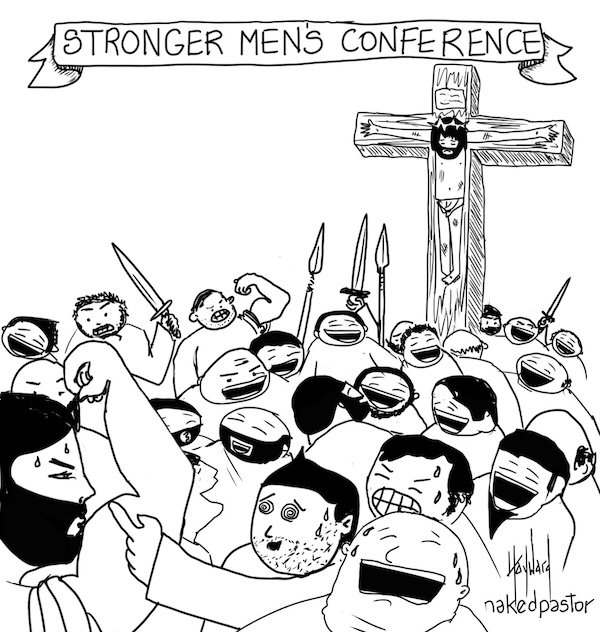
by David Hayward at http://www.Nakedpastor.com

The Naked Pastor draws many gospel cartoons. His name is David Hayward. This cartoon by the Naked Pastor is of the naked pastor. Pastor means shepherd, and here we see the good shepherd, the pastor stripped naked on the cross. In the foreground we see the wolves. They are taunting Jesus, making fun of him. They’re laughing at him, gritting their teeth at him, flexing their muscle against him, and raising their arms, their weapons of war, showing their killing teeth.

This is Jesus being savaged by a pack of wolves.

Over and over again we marvel. The good shepherd does not run away when the wolves come. He lays down his life for the sheep so that the wolves can’t scatter and snatch the sheep. I dare say we have sweetened this gospel over time – but what John is describing here is fierce. The opposition to the beloved community is fierce, but the attachment of the good shepherd to the flock is just as fierce. Blood is spilled and life is lost. But just as the good shepherd has the power to lay down his life, so he has the power to take it up again. And that places this gospel in our Easter liturgy – this fourth Sunday of Easter.

It’s a fierce gospel for savage times when metaphorical wolves roam our streets in their many disguises. It’s a gospel for our times – our mean time in which we need the protection of good shepherds – the sort who will give their lives for the sheep – the sort you wait to be pastor in your community.

At the moment, wolves and sheep remain enemies. The wolf continues to prey on the  sheep who rely on the protection of good shepherds – the sort who will give their lives for the sheep – the sort you wait for to be pastor in this community. But the time will come when there will be a peace way beyond our understanding and way beyond our imagination when the wolf will lie with the sheep. That’s what God lives for. The time will come when the wolf will live with the lamb, the leopard will lie down with the goat, the calf, the lion and the yearling together, and instead of tyrants and empire builders, a little child will be the leader. (Isaiah 11:9) Until that time we follow the call of the good shepherd as he leads us through the valleys and low points overshadowed by wolves and our fear of them.

John 10:11-18
‘I am the good shepherd. The good shepherd lays down his life for the sheep. The hired hand, who is not the shepherd and does not own the sheep, sees the wolf coming and leaves the sheep and runs away – and the wolf snatches them and scatters them. The hired hand runs away because a hired hand does not care for the sheep. I am the good shepherd. I know my own and my own know me, just as the Father knows me and I know the Father. And I lay down my life for the sheep. I have other sheep who do not belong to this fold. I must bring them also, and they will listen to my voice. So there will be one flock, one shepherd. For this reason the Father loves me, because I lay down my life in order to take it up again. No one takes it from me, but I lay it down of my own accord. I have power to lay it down, and I have power to take it up again. I have received this command from my Father.’

Inspired by love and anger – a sermon for Passion Sunday

A reflection on our own passion (or lack of passion) for Passion Sunday. The readings (Jeremiah 31:31-34 and John 12:20-33) are below. It’s St Patrick’s Day, 2024, and we’re in two churches in the heart of England, in rural Warwickshire. The quotes from Cole Arthur Riley are from her book, Black Liturgies.

Today is known as Passion Sunday. 

I have given this sermon a title – Inspired by love and anger. They are words of a hymn from two members of the Iona Community, John Bell and Graham Maule. (Hear it sung here)

The author of our first reading, Jeremiah was inspired by love and anger to hope in hopeless times when his people had lost everything – their home, their land, their institutions and their identity. At great cost to himself, he reiterates the promise of God to make himself known in a way that people could relate to. They would know God by heart, not by head and teaching or by law and obedience. He promises to write his law (or rule) in the heart of his people – the rule of God, self-imposed by God, the only rule of God, that he will only love, and that we will only know him in his love – in his passion. From that point the relationship between God and his people becomes an affair of the heart – where all our passions stir.

Jesus has this rule of God in his heart, living his life with this rule, and passionate for this rule of God’s love to be the rule of life on earth, just as it is in heaven. He taught his followers to make that our constant prayer. Thy kingdom come, on earth, as it is in heaven.

And as he resisted the temptations of an easier life so he insisted that we who are his followers should follow him in similar all-consuming passion, resisting the temptations of an easier life, to passionately engage with the rule of God for our lives – that rule being, only love.

Normally, on Passion Sunday, we would focus on Jesus’s passion without questioning our own. Jesus’ passion is well known. 

But what of our own passion? Are we passionate? Are we inspired by love and anger? Are we passionate for the kingdom of God, in the way of Jesus? Are we passionate for, and compassionate with those who are always counted first in the kingdom of God who  as a rule in the world are counted last or least, or not counted at all and get lost and disappear? The rule of God is that they come first.

Or are we too preoccupied and too easily distracted? Or, are our passions just about our selves? Or, has our passion become too domesticated so that our passion stays at home never reaching beyond our front doors?

Or have we been worn down and out by a hopelessness leading us to believe that there is no point in our passion because we can’t make any difference or we can’t change anything? Has our experience embittered our hearts?

Have we become numb? The opposite of passion is apathy. Apathy literally means without feeling, without passion.

Or have we never been helped to direct our passions? Have we ever had friends to help us safely explore the things of our heart – both the love and the anger?

Or have we become too nice for that sort of thing becoming the sort of people who never get angry? I looked up the meaning of nice. Apparently it is from the Latin nescire. Nescire means not knowing or ignorant. Nice became a word in Middle English to mean stupid?

How do we help one another to be more than the nice people we undoubtedly are?

Jesus wasn’t nice. He was fiery, fierce and furious – as we see in what happened when he went to the temple in the last days of his life, turning the tables on the moneychangers and condemning the religious authorities for their exploitation of the poor – the very people who come first in the rule of God.

We only have to listen to what the spirit says to the churches to realise that nice doesn’t even cut the mustard.

Hear the words of the Amen, the faithful and true witness, to the church of Laodicea (revelation 3:14-22): “I know your works: you are neither cold nor hot. I wish that you were either cold or hot. So, because you are lukewarm, and neither cold nor hot, I am about to spit you out of my mouth. For you say, “I am rich, I have prospered, and I need nothing.” You do not realise that you are wretched, pitiable, poor, blind and naked.”

We need to what what the spirit is saying to the churches.

Nothing good comes from being nice. Nothing changes if we remain apathetic. Nothing comes from being lukewarm, If we aren’t passionate and compassionate.

Passion is never served cold. It is heated by love and anger. Anger, rage and fury are part of our created order. They are very much part of ourselves. And they are very much part of our passionate selves. 

Those counted last and least as a rule, those usually discounted and lost need the anger, rage and fury of those who have taken the rule of God to their heart. They need that encouragement from fresh hearts.

It is anger, rage and fury which wins wars, defends the abused and bullied, defeats fascism, establishes justice, rights wrongs – it is never done cold and it is never done by being nice. It’s how the rulers of this world are driven out.

We have a problem. We are schooled to be nice. In the playground we were told to be nice, particularly to those who weren’t nice. We have demonised anger. Who wants us to be nice? Powers that be do. Controlling people do. They prefer us not to know. They don’t want to hear us. They don’t want our disruptions and protests. They want to keep us in the dark – the very place Jesus doesn’t want to keep us. His whole mission was to shed light in our darkness.

Cole Arthur Riley puts it like this: “Happiness and sadness and even fear are met with tenderness, understanding; they are permitted to speak without constant scrutiny. But anger we require to use the back door – to come and go quietly without attracting too much attention to itself… The oppressors of this world have told you to play nice, be civil. They tell you to control yourself. But by this they only mean they want you easy to be controlled.”

She confesses “We have exalted being nice and calm as a pinnacle of character, repressing that which stirs our souls so deeply we must shout” and she prays to God to “release us from the kind of niceness that only serves and protects the oppressor”. 

There is so much wrong, so many things are broken. There’s plenty to be furious about. How are things going to change without our fury, anger and passion? 

We can’t take it all on, but we can let love lead us. (Hatreds can also make us angry – they’re the furies we don’t want. They’re the furies we will fight with a passion).

I suspect that few of us are any good at being angry or furious. It often comes out wrong, doesn’t it? We often finish up only hurting those we love. This isn’t surprising because we have repressed anger. We’ve kept it hidden and not given it voice. We haven’t kept up our practice.

Here we can practice that love, among friends, through our prayer, learning all the time how to be angry better, how to balance anger with love, how to live passionately in the rule of God which is only love, how to live compassionately with those Jesus always counts first.

Can we help one another redirect our passion to join the passion of Jesus for the rule of God, and so that our whole lives are inspired by love and anger?

Jeremiah 31:31-34
The days are surely coming, says the Lord, when I will make a new covenant with the house of Israel and the house of Judah. It will not be like the covenant that I made with their ancestors when I took them by the hand to bring them out of the land of Egypt – a covenant that they broke, though I was their husband, says the Lord. But this is the covenant that I will make with the house of Israel after those days, says the Lord: I will put my law within them, and I will write it on their hearts; and I will be their God, and they shall be my people. No longer shall they teach one another, or say to each other, ‘Know the Lord’, for they shall all know me, from the least of them to the greatest, says the Lord, for I will forgive their iniquity, and remember their sin no more.

John 12:20-33
Now among those who went up to worship at the festival were some Greeks. They came to Philip, who was from Bethsaida in Galilee, and said to him, ‘Sir, we wish to see Jesus’. Philip went and told Andrew; then Andrew and Philip went and told Jesus. Jesus answered them, ‘The hour has come for the Son of Man to be glorified. Very truly, I tell you, unless a grain of wheat falls into the earth and dies, it remains just a single grain; but if it dies it bears much fruit. Those who love their life lose it, and those who hate their life in this world will keep it for eternal life. Whoever serves me must follow me, and where I am, there will my servant be also. Whoever serves me, the Father will honour.
‘Now my soul is troubled. And what should I say – “Father, save me from this hour”? No, it is for this very reason that I have come to this hour. Father glorify your name.’ Then a voice came from heaven, ‘I have glorified it, and I will glorify it again.’ The crowd standing there heard it and said it was thunder. Others said, ‘An angel has spoken to him.’ Jesus answered, ‘This voice has come for your sake, not for mine. Now is the judgement of this world; now the ruler of this world will be driven out. And I, when I am lifted up from the earth, will draw all people to myself.’ He said this to indicate the kind of death he was to die.

We have nothing to prove and everything to love

Here’s a sermon for two rural churches in Warwickshire for the first Sunday in Lent. I’ve wondered whether Jesus only went into the wilderness for 40 days, or was his whole life there? Is wilderness a way to see “life”? The gospel for the day is Mark 1:9-15.

Catching my eye this week were these words of a benediction by Cole Arthur Riley; “May you rest in the immanence of your own worth, knowing you have nothing to prove and everything to love.”

Know you have nothing to prove and everything to love.

It’s the first Sunday of Lent and we’re just getting started. The question is, do we begin with shame, or do we begin with love? When/if we choose to give up chocolate or social media is it because it’s a shame we eat too much chocolate or spend too much time on social media? Do we begin with shame or do we begin with love?

Lent is the opportunity to intensify the awareness in our lives – our behaviours and the life around us. But do we begin with shame, or do we begin with love? Perhaps we begin with shame, and perhaps we begin again with love.

We are fond of thinking that Jesus went into the wilderness for 40 days – to be tempted by Satan. And that is what the gospels tell us. But were those 40 days an intensification of the wilderness experience which was to consume his whole life? The temptations didn’t stop after 40 days. The wild beasts didn’t go away – they bruised him, beat him and crucified him. They were hard times in a harsh and barren landscape – a lifetime in the wilderness. 

His 40 days in the wilderness with the wild beasts were part of his whole life in a wilderness with the wild beasts of empire and religious authority baying for his blood.

Our gospel tells us it began with love, not shame.

Mark gives the sequence of events – and his sequence is his version of “in the beginning”. Beginning the gospel, beginning the good news of Jesus Christ, the Son of God, Mark gives this sequence of events:

  1. First, John appeared in the wilderness, proclaiming a baptism of repentance, and crowds came out to the wilderness to be baptised by him.
  2. Jesus, from a backwater village in Galilee was one of them. Just as he came out of the water he saw the heavens torn apart and the Spirit descending like a dove on him, and a voice came from heaven, “You are my Son, the Beloved, with you I am well pleased.”
  3. Immediately the Spirit drove Jesus deeper into the wilderness
  4. Then John was arrested

The Spirit drove Jesus into the wilderness. It began with love. “You are my Son, the Beloved, with you I am well pleased.” He was driven into the wilderness by love ringing in his ears, giving him the resilience for devilish temptation and for a life with the beasts. 

And with love he walked the wilderness for the rest of his life, facing the wilder-ness of human nature and the be-wilderment of the victims of that wilder-ness and beastliness.

Resounding above all the voices of that wilder-ness, the beasts baying for his blood, the crowds shouting “crucify him”, the mockery – above all that din is the voice of heaven: “you are my Son, the Beloved, with you I am well pleased”, and the sound of the angels who waited on him in the wilderness, whose only sound is the sound of heaven and their lyric, “do not be afraid”.

The wilderness is our world too. We are in serious denial if we ignore the wilder-ness of our human nature and the beastliness that so many suffer: if we ignore the beasts that force themselves on us and the beasts that we entertain. 

Lent is our opportunity to intensify our awareness of the wilderness of our lives, to take stock of the wars around us, the greed that threatens us, the environment we’ve neglected, the injustice that is suffered, the emptiness of so much of life, the distance between us, and the isolation which is so much a feature of life. 

Life is wilderness. The wilderness is so much bigger than any of us can ever imagine – too big for our hearts and minds. We have a problem if we reduce Lent to a personal remedy for our over-use of social media or our over-indulgence of chocolate. Lent will have been a waste of time if all we do at the end is reach out for a Cadbury’s cream egg. The devil will have won big time then.

Just as it was the love shown to Jesus in his baptism that drove him into the wilderness, to love in the wilderness, to do wonders in the wilderness, so it can be the love shown to us in our baptism that drives us into the wilderness, into these 40 days, into the rest of our lives.

We’ve got nothing to prove and everything to love. The wilderness isn’t an easy place to be. Heaven knows we’ve suffered enough there already. The landscape is often bleak and unforgiving. We may be tested to our limits. We will take wrong turns. There will be complicated choices for which there are no easy answers. We will be be-wildered and bothered by the wilder-ness around us and within us

The wilderness isn’t easy. But it’s the only place to be – or, the only place to be is where love drives us, where God’s Spirit takes us. Just don’t make it a guilt trip. Don’t let shame take you there these 40 days, and into the rest of your lives. Let love take you.

From the beginning God brought love to the wilderness. That is clear to us when we open our scriptures. “In the beginning when God created the heavens and the earth, the earth was a formless void and darkness covered the face of the deep.” In other words there was nothing but wilderness and chaos – and a wind from God swept over the face of the waters, and he did wonders in that wilderness and chaos.

Similarly, at the beginning of Mark’s gospel, there are all the signs of wilderness and chaos – that is why the crowds came to John, for his baptism of repentance as a way through the wilderness and chaos they were facing. It is the Spirit of God which drove Jesus into the wilderness and chaos which has never gone away. It’s our wilderness, our chaos – and he begins with love.

When we are baptised, we are christened – becoming one in Christ, driven by love into wilderness. St Teresa of Avila gave us this blessing which will surely help us follow Jesus in his love into the wilderness, far from the easy life some of us may have been tempted to choose. It is the truth of our christening and being in Christ.

Christ has no body but yours, no hands, no feet on earth but yours.
Yours are the eyes with which he looks compassionately on this world.
Yours are the feet with which he walks to do good.
Yours are the hands, with which he blesses the world.
Yours are the hands.
Yours are the feet.
Yours are his eyes.
You are his body.
Christ has no body now but yours, no hands, no feet on earth but yours.
Yours are the eyes with which he looks compassionately on this world.
Christ has no body now on earth but yours.

Jesus began with love in the wilderness. We don’t need to begin with anything other than love. We don’t have anything to prove but we have everything to love.

Mark 1:9-15

In those days Jesus came from Nazareth of Galilee and was baptised by John in the Jordan. And just as he was coming up out of the water, he saw the heavens torn apart and the Spirit descending like a dove on him. And a voice came from heaven, ‘You are my Son, the Beloved; with you I am well pleased.’

And the Spirit immediately drove him out into the wilderness. He was in the wilderness for forty days, tempted by Satan; and he was with the wild beasts; and the angels waited on him.

Now after John was arrested, Jesus came to Galilee, proclaiming the good news of God, and saying, ‘The time is fulfilled, and the kingdom of God has come near; repent, and believe in the good news.’

Cole Arthur Riley’s book from which the opening benediction is taken is Black Liturgies, published in 2024 by Hodder and Stoughton

Setting Mary free to be herself – listening to her song

This is something for the 3rd Sunday of Advent, Gaudete Sunday, in a country church in Warwickshire dedicated to Mary, I have focused on Mary’s Magnificat.

Have any of you been put on a pedestal?

I can imagine it’s hard and you can be brought to earth with a bang. You’re not allowed to be yourself, always having to be what others want you to be.

The church hasn’t done Mary any favours. Above all women she has been put on a pedestal for so long that we’ve forgotten what she was really like. It’s what men have done to her over the centuries.

This morning I want us to listen to her song.

My aim in preparing this sermon is that you and I get a better idea of who Mary was. This, I believe will help us into the Christmas gospel and will help us better understand the son who spent most of his life with her in their village and home of Nazareth.

As a church dedicated to Mary, I suggest we dedicate ourselves to her liberation so that she can be herself, rather than what we have made her over the centuries, whether we have devoted ourselves to her as within the catholic traditions if the church, or whether we have been critical of such devotions, as within the protestant traditions.

When we look at her, what do we see? What we see is what people have made of her over the years. We see all the images laid on top of one another as she has been used for this or that purpose. 

She has become stereotyped. She comes to us well dressed in her blue flowing gown looking like a beauty queen. She usually has pale skin, blue eyes. She looks peaceful. She looks heavenly. She’s usually on her own, surrounded by quiet. She has her hands together, eyes closed, praying. Often her setting is the architecture of a palace. She is often reading. And in all of this there is no sign of trouble. There is no sound of her song and no sign of her joy. There isn’t much sign that she has done anything at all. 

But the gospels give us a very different view of Mary.

She was a woman of history. She was Mary, Mary of Nazareth, a small village of about 300 people off the beaten track to the sophisticated nearby city of Sepphoris. This was the village people scoffed at – “can anything good come out of Nazareth?” 

Archaelogists there have pieced together a picture of rural poverty, with people living in one and two roomed houses clustered around courtyards shared with extended families with shared cooking facilities. They’ve found no signs of any wealth. 

This was a small peasant community. Mary was married to the village carpenter. This wouldn’t have been a small business as we know them. He wouldn’t have had the status we give to small businesses. He would have been an artisan, the class below the peasants, earning less than the peasants and serving their needs. They probably would have had a small plot of land for growing food to eke out a living. They would have made their own clothes from their sheep.

They were poor. They were taxed three times. They paid 10% to the Temple. They paid tribute to the Roman emperor. And then they also had to pay tax to fund the vanity projects of Herod, such as the building of nearby Sepphoris, the equivalent of our HS2.

They would have been very poor, barely scraping a living together. Many of them would have been in debt to the wealthy and would have their land taken off them. Resentments grew and  there were frequent rumblings of revolt. Many days they would have gone hungry.

Life didn’t treat any of them gently.

It takes a village to raise a child. That village raised Mary and Jesus, Jewish babies having to grow up very quickly. Their village meetings would have dwelt on the different ways their people had suffered in Egypt, in persecution, in exile and the way that God had graced these suffering servants. She picks up the song of Hannah and makes it her song.

My soul does magnify the Lord, she sings. “My spirit rejoices in God my Saviour for he has looked with favour on the lowliness of his servant. The Mighty One has done great things for me. His mercy is on those who fear him. He has shown strength with his arm, he has scattered the proud in the thoughts of their hearts. He has brought down the powerful from their thrones and lifted up the lowly. He has filled the hungry with good things and sent the rich away empty.”

This isn’t the song of the woman we have put on the pedestal for so long. This is the song of a woman who lives with the day to day challenge of survival. It’s a song Jesus will have heard from his mother and from the scriptures shared in their village meetings. This isn’t a song of the docile, or of those who take things lying down. This is the song of those who rejoice that the proud are scattered, the powerful dethroned and the rich sent away empty. 

This is the song which prompted one artist to portray Mary in the style of Russian communist posters, muscular, all boiler suited and booted.

You are a church dedicated to Mary. Can I suggest that we all try to get to know her better and that we talk about her more? Can you let her be herself rather than forcing her to be somebody she isn’t?

As we get to know her better we will know better where God plants his seed and where the baby Jesus grew, side by side with his mother as he joined her in her prayer, magnifying the Lord and praying for their daily bread and the forgiveness of their debts, joining her and watching her in the household tasks, digging the soil, planting seeds, baking bread – funding his imagination for sharing with those who followed him the images of the kingdom of the one he magnified in the song of his mother.

I am indebted to my Advent reading – to the work of Elizabeth A Johnson, in her book Truly our Sister: a Theology of Mary in the Communion of Saints

Magnificat

My soul proclaims the greatness of the Lord,
my spirit rejoices in God mySaviour;
he has looked with favour on his lowly servant.

From this day all generations will call me blessed;
the Almighty has done great things for me
and holy is his name.

He has mercy on those who fear him,
from generation to generation.

He has shown strength with his arm
and has scattered the proud in their conceit,

Casting down the mighty from their thrones
and lifting up the lowly.

He has filled the hungry with good things
and sent the rich away empty.

He has come to the aid of his servant Israel,
to remember his promise of mercy,

The promise made to our ancestors,
to Abraham and his children for ever.

Three people walk into a parable

Thinking through the parable of the talents for the 2nd Sunday before Advent I wondered what sort of life the cast of Jesus’ parables had in his mind and whether they featured in his other parables, and whether the same happened in the mind of Jesus’ hearers. It did for me and led me to preach this. The text of the parable of the talents is printed below.

Who does the one who hid his talent remind you of from the gospels?

While the parable of the talents is deadly serious there is something jokey about it.

There were three people walked into a parable. One was given five talents. The second was given two talents. And the third was given one. It’s the classic: there was an Englishman, a Scotsman and an Irish man ……..

There is a light-heartedness in the parable as you would expect from the one who preaches from the heart and who is the light of the world. He uses exaggeration and the absurd to create a comic effect to engage and challenge us, his hearers and disciples. 

We’ve misheard the parable if we think it’s about the sort of talents which make Britain’s Got Talent. The talents Jesus is talking about here is a unit of measurement used for weighing silver. We have our strange units of measurement too. Like a yard of cloth, or a pint of beer. Here we have talents of silver.

Three people walked into a parable. Each given a weight of silver. Here’s the funny bit. A talent weighed 80 lbs (about half my weight) and was worth 6000 denarii. How would you even carry it? 

Typically one denarius was the wage for a day’s work. So one talent was the equivalent to 20 years labour at a denarius a day for a six day week. Five talents of silver was worth 100 years labour, two talents was worth 40 years labour. The slave given the one talent wasn’t given a little. He was given less but it was still a small fortune. He was set up for life.

Jesus gives us something here that is hard to imagine because it is so preposterous. The slave with the one talent hid it. Where can you hide so much? How deep do you have to dig the hole to bury it?

So, who does he remind you of, this one who walked into a parable and was given a talent of silver?

He reminds me of the labourers who worked the whole day in the vineyard only to find that the landowner paid those who worked the last hour the same as them. In that parable the landowner hires workers throughout the day – including some at the last hour. He instructs the manager to pay the last first and to pay them all the same. They each get their one denarius. The ones working the longest, and used to being paid the most, complained. But they could have been delighted that the last and least chosen had, for once, been paid what they needed.

These disgruntled ones were probably always used to being the first chosen. There are those who are used to coming first. Coming first is beyond most of us. It requires hard work: the greasing of palms, the pulling of strings, the favour of friends in high places, the use of elbows to stay ahead of the game. They were ahead of the queue on the labour market and the first to be taken on by the landowner. But then they got nothing more than the ones who came last.

Is the one who is given the one talent one who is used to always being amongst those first chosen – and one of the complainers that the last chosen and the least chosen are paid the same? Is he one of those who complain about the state of affairs in the kingdom of heaven where the last always come first and the first always seem to come last?

Something has happened to make him misjudge the master. Something has happened to make him afraid. He says: “Master, I knew that you were a harsh man, reaping where you did not sow, and gathering where you did not scatter seed; so I was afraid, and I went and hid your talent in the ground.” Whatever led him to think he was a harsh man? There must have been something that made him disgruntled and that coloured his judgement. Was he amongst those used to being first who now were last?

That’s who he reminds me of – of all those who misjudge God, who fear his judgement, rather than loving his judgement because it is full of mercy and love for the last and the least and for those who have suffered the wrongs of how things are.

The Psalmist wrote this into what became the prayer book for millions, including Jesus:
With the loyal you show yourself loyal.
With the blameless you show yourself blameless.
With the pure you show yourselves pure.
With the crooked you show yourselves perverse. (Psalm 18:25-26)

However kind, generous or good the master is, the crooked will always have a perverse view of him. Often, when we read this parable we say we don’t like the sound of the master. What I am suggesting is that this fearful one has got the master wrong. He isn’t actually a harsh man, reaping where he has not sown and gathering where he has not scattered. And that is particularly so if the master is actually God, as he has been for so many who have heard this parable. We surely don’t share in this perverse view of those who complain about the master and are afraid of him.

If we’re not like him then we are like the other two who walked into the parable: those given so much by a generous master who trusted them with all that he had. He trusted them with his life, and his generosity and trust were their stock in trade. That is what makes me think that the one who knew the master to be a harsh man had got him so wrong. He was anything but harsh.

I read this parable with a group of residents of a fairly prosperous retirement village this week. One of them had found it difficult to adjust to a life where she was no longer so high profile and where she was limited by health issues. Being of a similar age I sympathised with her, realising that our power dwindles as we age. We could say that we become less “talented”. But in the gospel where the least, the last and the smallest count for so much, even a little talent, a lightweight born from the thankful heart of a person is good enough for the kingdom of heaven. 

Complaints and resentment, on the other hand, bury what little talent we may have ended up with.

I don’t know whether you’ve noticed that the number of talents match the number of loaves and fish with which Jesus fed the five thousand. There were five loaves and two fish. No one went hungry, and there was enough left over to feed a nation. In the right hands so much can be made of so little – a smile, a word, a touch, a seed. This is the currency of the kingdom, the currency of grace, our weight of silver.

There were three people walked into a parable, ourselves included because we have been given our weight of silver, our talent. We have been given enough to set us up for life. It’s not money, that would only be small change. It’s grace. That is what we trade in – unless, like the least talented in the parable we perversely fear God and God ceases to be gracious in our eyes.

Three people walked into a parable. And the punch line is that the worthless slave gets thrown into the outer darkness, the darkness that is beyond darkness, where there is no light, and where there is only the weeping and the gnashing of teeth of his fellow complainants.

But fear and threats is not what the gospel leaves us with. What we are left with is a generous spirit which goes to the heart of our lives. That is the talent given to the church. He sets us up for life to trade in the affairs of the kingdom of heaven, putting the last and least first and forgiving one another. No other talent compares to this.

We are his beloved. We are his trusted ones. He trusts us with his life. (We celebrate that when we receive his body in our hands at Communion). 

We are the ones to whom God shows himself loyal, blameless and pure. For us there is nothing perverse about God. There is nothing for us to complain about. There is no reason to fear his judgement. His ways are not perverse, but straightforward love.

Matthew 25:14-30

For it as if a man, going on a journey, summoned his slaves and entrusted his property to them; to one he gave five talents, to another two, to another one, to each according to his ability. Then he went away. The one who received the five talents went off at once and traded with them, and made five more talents. In the same way, the one who had the two talents made two more talents. But the one who received the one talent went off and dug a hole in the ground and hid his master’s money.
After a long time the master of those slaves came and settled accounts with them. Then the one with the five talents came forward bringing five more talents, saying, “Master, you handed over to me five talents; see I have made five more talents.” His master said to him, “Well done, good and trustworthy slave; you have been trustworthy in a few things, I will put you in charge of many things; enter into the joy of your master.”
And the one with the two talents also came forward bringing two more talents, saying, “Master, you handed over to me two talents; see I have made two more talents.” His master said to him, “Well done, good and trustworthy slave; you have been trustworthy in a few things, I will put you in charge of many things; enter into the joy of your master.”
Then the one who had received the one talent also came forward, saying, “Master, I knew that you were a harsh man, reaping where you did not sow, and gathering where you did not scatter seed; so I was afraid, and I went and hid your talent in the ground. Here you have what is yours.”
But his master replied, “Yu wicked and lazy slave! You knew, did you, that I reap where I do not sow, and gather where I did not scatter? Then you ought to have invested your money with the bankers, and on my return I would have received what was my own with interest. So take the talent from him, and give it to the one with ten talents. For to all those who have, more will be given, and they will have an abundance; but from those who have nothing, even what they have will be taken away. As for this worthless slave, throw him into the outer darkness, where there will be weeping and gnashing of teeth.”

Reading the Bible and learning from lessons – a sermon for Bible Sunday

October 29th 2023

The last Sunday after Trinity – also Bible Sunday. The readings for the day are printed below: Leviticus 19: 1-2, 15-18 and Matthew 22:34-end

Today is Bible Sunday. My aim in this sermon follows the words of our collect for Bible Sunday. We pray to God, who caused all holy scriptures to be written for our learning. My aim is to encourage you to confidently expect to learn from the Bible and that we can confidently expect to read, mark, learn and inwardly digest them.

My first point is simple. The Bible isn’t one book – seeing it as one book would make it daunting and off putting. It’s a library and a boxed set. For most of our centuries most of the readers of scripture have been people who couldn’t read or who didn’t like reading. They will only have heard scripture being read. They certainly would never have had their own copy of the book version. That only became possible with the invention of the printing press – until then you could buy a house for the cost of a Bible.

The Bible and Christianity isn’t for the clever. In Paul’s first letter to the Corinthians he reminds his brothers and sisters: “think of what you were when you were called. Not many of you were wise by human standards; not many were influential; not many were of noble birth. But God chose the foolish things of the world to shame the wise, God chose the weak things of the world to shame the strong”. (I Cor 1:26f).

It’s not about being clever, influential or posh. In fact, the clever, influential and posh are going to be the last people to “get” scripture. Hear Mary singing in her song we call the Magnificat of the rich (presumably the rich and clever) being turned empty away while he lifts up the humble and fills the hungry with good things. (Luke 1).

It’s not about being clever. It’s not the clever writing clever things for clever people. It’s people who share the experience of being bruised and battered helping those who are poor in spirit get through the experiences of being bruised and battered – and those who go to their aid. You don’t need a degree. Jesus didn’t teach in a university. He taught in the heart. 

And he taught in the heart of a people who were bruised and battered by centuries of bitter experience of empire. They’d been enslaved, persecuted, occupied, exiled, crucified. The conflict we are witnessing in Israel and Gaza has a long and complicated history and we do well to remember that Jesus taught at the heart of this history.

Those of us who read the Bible who have never known exile, persecution, poverty or who have never been at the wrong end of identity politics do well to remember that we are reading the scriptures of those who have. We read over their shoulders – at best, as their guests.

A large part of our scriptures is focused on Jesus – even a lot of the Old Testament is about Jesus, and the books of the Old Testament were Jesus’s scriptures with Psalms being his prayer book. Jesus is always understandable. He made it so. Even his enemies understood him and that is why they were so infuriated by him.

He was always casting around for images that would speak to people about his passion – his passion for the kingdom of heaven. He spoke of things his followers would know, of seeds and weeds, of leaven in loaves, of losing things and finding them again. He aimed to be understood.

The difficulty of following Jesus isn’t that he is hard to understand. The difficulty in following Jesus is facing the challenge of his teaching and accepting the cost. The response of those who want to hear Jesus has never been that they have felt mystified and lost, but have been amazed and felt found.

Today’s gospel (at least the first half) is typically simple and straightforward. A lawyer, a Pharisee, asks Jesus what the most important commandment is. (There are 613 commandments in the Old Testament.) It wasn’t hard for Jesus to choose because the answer was well known. It was what they were told to talk about at home, when they walked along the road, when they lay down and when they got up. They impressed it on their children. It was wrapped around their heads and hands and pinned to their doors, and it’s a verse from Deuteronomy: “You shall love the Lord your God with all your heart, and with all your soul, and with all your mind.” The lawyer gets a straightforward answer to a straightforward question, until …

Jesus adds a second which twists the meaning. Again he answers from scripture – it’s the other reading we have had, from Leviticus: “a second is like it” he says. “You shall love your neighbour as yourself.”

That’s not hard to understand is it? But it’s hard to put into practice isn’t it? The lawyer will have known where the reference came from and what the commandment spells out. We’ve heard it ourselves this morning (from our OT reading from Leviticus) what loving your neighbour means “you shall not render an unjust judgement; you shall not be partial to the poor or defer to the great: with justice you shall judge your neighbour. You shall not go around as a slanderer among your people, and you shall not profit by the blood of your neighbour.”

This is where it gets more difficult as we deal with culture and context that isn’t ours. It all needs translating for us so that each of us hears in our own language – which is God’s intention made plain at Pentecost when everyone heard the preaching of the apostles in their own language.

Scripture always raises questions and those questions are taken up by scripture itself in many cases. Jesus adds the second commandment about loving our neighbour to the first and then says everything, the whole law and the prophets, hang on these two. But then the question is raised (in Luke’s gospel) “but who is my neighbour?” How do we translate that?

Jesus translates for us by drawing a picture of a man, bruised and battered lying in a gutter. He takes three people by this helpless victim and asks which of them was the real neighbour. The answer we all know to be the one who stopped and so generously and tenderly helped. And that person turned out to be a Samaritan – who the Jews despised. Jesus gave that lawyer and all who have shared that story ever since, a new meaning, a new twist, a new challenge and new translation to the question of “who is my neighbour?” – something along the lines that you don’t really know who your neighbour is until you’re in trouble and that your neighbour can be a total stranger reaching across all sorts of barriers.

We might argue that Jesus’ parable of the Good Samaritan doesn’t have the same impact on us as it would have had on those who first heard it because they were Jewish people caught up in the prejudice against the Samaritans. 

We might also be tempted to think about who we are good neighbours to – who is going to receive our kindness and generosity. Our own national history tends to cast us as winners, generally not knowing exile, occupation or poverty, so our focus may be on the helper rather than the victim. So, we could tell the story differently – such as imagining you’re in the metaphorical gutter, bruised and battered, you don’t know where to turn. You have neighbours but they don’t know you and you don’t know them. They are no help. You have family, but they’re all busy with their own lives and they’ve mostly moved away. But there was one person who saved me – and here we full in the blanks. S/he was a ——- I’d never met them in my life. They were so brave. They never left my side. There was nothing that was too much trouble.

We never know who is going to come to our help do we? And we would turn none of them away would we? And we would be forever grateful to them wouldn’t we? And we would call them our neighbour, our good samaritan. In that one person we come to understand what it means to be a neighbour – and nothing less will do.

Jesus makes it easy for his followers to understand his teaching about the kingdom of heaven. He was hardly going to make it difficult was he? He’s a teacher who loves his followers, and his followers love him for his teaching.

For those whose heart is set on God’s kingdom the Bible is easy reading and those who are powerful, rich and clever according to the kingdoms of this world are always going to find our scriptures mystifying unless they have a change of heart.

I want to finish with a word for those who read our scriptures in our worship on Sundays.

First of all, do you realise that Jesus was also asked to read scripture in worship? You’re on the same rota. So much depends on the public reading of scripture. 

Our attitude to the Bible is shaped by the way the Bible is read in worship. Those of you who take on the role of readers are translating the text from the lectern into our hearts and minds. Every word counts and will carry its own resonance, so each word needs to be heard. 

It’s important to be as inclusive as possible for the sake of the hard of hearing and the sake of those easily distracted. It’s important that the language we use is as inclusive as possible – try not to use exclusive language. Yes, at one point, “men” and “brothers” may have been inclusive terms but they no longer are and exclusive language is offensive because we can do better if we care. Our call is to love our neighbours, not to unnecessarily offend or exclude them.

Our great translators have loved us with their efforts to bring God’s word alive. It cost some their lives. We owe a huge debt to our translators. Those who read in public worship are our translators. They need our prayer. I’ll ask them to stand while we pray for them.

Let us pray: 

Loving Lord, in Jesus you make plain your word,
we pray for our readers,
that you may give them boldness of spirit
to compensate for shyness and self-consciousness.
We pray that you will be with them in their preparations
that they may translate the word of the page to the heart of our communities
through love for our neighbours,
so that all of us come to help one another
to hear, read, mark and inwardly digest
your word of salvation.

Leviticus 19: 1-2, 15-18
The Lord spoke to Moses, saying:
Speak to all the congregation of the people of Israel and say to them; you shall be holy, for I the Lord your God am holy.
You shall not render an unjust judgement; you shall not be partial to the poor or defer to the great: with justice you shall judge your neighbour. You shall not go round as a slanderer among your people, and you shall not profit by the blood of your neighbour: I am the Lord.
You shall not hate in your heart anyone of your kin; you shall reprove your neighbour, or you will incur guilt yourself. You shall not take vengeance or bear a grudge against any of your people, but you shall love your neighbour as yourself: I am the Lord.

Matthew 22:34-end
When the Pharisees heard that he had silenced the Sadducees, they gathered together, and one of them, a lawyer, asked him a question to test him. ‘Teacher, which commandment in the law is the greatest?’ He said to him, “You shall love the Lord your God with all your heart, and with all your soul, and with all your mind.” This is the greatest and first commandment. And a second is like it: “You shall love your neighbour as yourself.” On these two commandments hang all the law and the prophets.’
Now while the Pharisees were gathered together, Jesus asked them this question: ‘What do you think of the Messiah? Whose son is he?’ They said to him, ‘The son of David’. He said to them, ‘How is it then that David by the Spirit calls him Lord, saying,
“The Lord said to my Lord,
‘Sit at my right hand,
until I put all your enemies under your feet’”?
If David thus calls him Lord, how can he be his son?’ No-one was able to give him an answer, nor from that day did anyone dare to ask him any more questions.