Making choices, making life

A reflection on the stories of creation in Genesis 2 and the storm on the lake in Luke 8:22-25. These are the readings set for the 2nd Sunday before Lent (C).

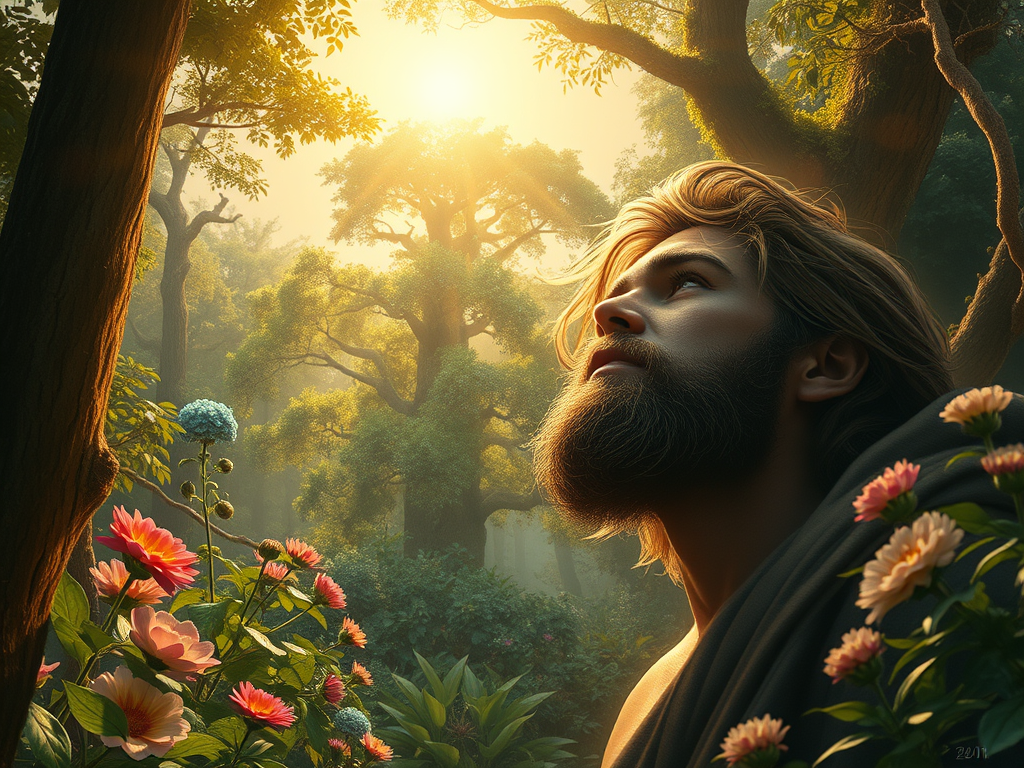
This image was created by AI from the words of the sermon. Interestingly and controversially AI has made a choice for a white Adonis – more filmstar than gardener!

In the beginning everything was so good, and so well made.
Everything was generated from the heavens and the earth when they were created, when the Lord God made the earth and the heavens.

This story of creation is not the history of creation – as if this happened, then that happened, and the rest is history, sort of thing.
This story of creation is the theology of creation, and is true.
It is true for those who believe in God, who see God in all our beginnings, who trust in God’s blessing. It is spiritually true, not scientifically true.
Spiritual truth stands the test of time.
It is so true that it moves us to wonder and reverence.

It comes from a faith that sees God’s blessing in the beginnings of all life, that sees heaven and earth knitted together by a God who in the first place only ever wanted to give life. It comes from a faith that sees God loving everything he has made, delighting in what he has so well made.

It is a faith which realises that without God we are nothing.
Here God brings man to life by getting into his face and breathing into his nostrils the breath of life, and the first breath of language.

God brought to the man in the garden everything he’d made from the dust of the ground.
This was to see what he’d call them and whatever he called them, that became their name. 

God wanted to see what he called them.
That is something we’ve stopped imagining isn’t it?
Do we imagine God being interested in the names we call things, and the names we call people?
How different our world would be if we did have that imagination to name others in a way that would please God.
How different our world would be if, with that imagination, we didn’t demean the creatures of God’s making.

Our naming, our calling, the language we use, is part of the choice that is fundamental to the book of Genesis. In a world where language so much divides us we could usefully reflect on the choices of words and names we make and how they reflect our relationship with God and creation. 

The choices we make about language can be mighty acts of creation.
But remember, it takes time to call someone “lovely” in a way they will understand and take to heart.
It takes no time at all to voice a hurtful call that will break the heart of a relationship.
Our words have creative power and they have destructive power.
The choice is ours to make.

From the beginning there is choice.
There’s always been choice. 

Besides our naming and calling there’s the choice of obedience and disobedience.
The choice is there for the couple in the garden.
Can we get away with eating the fruit from the tree of the knowledge of good and evil?
There was only one thing forbidden by God and that was it.
The man and the woman only had to be obedient in that one thing and they weren’t.
They were disobedient and took the law into their own hands. 

This was their first bad choice, and the rest they say is history.
One bad choice led to another, and then another and then another in rapid succession.
They got dressed to cover their shame (bad choice, but perhaps necessary), they ducked their responsibility and blamed something else (the serpent) and they hid themselves from God.

One rotten choice after another.
Hot on the heels of these choices comes the story of the children of the first procreation, the story of Adam and Eve’s two sons, Cain and Abel, the story of the first murder, a shocking murder, fratricide, the killing of brother by brother.
God had tried to help Cain. “Why are you angry?”
(Perhaps we all need God to ask us that question in our anger.)
“Why are you angry? Why is your face downcast?
If you do what is right, will you not be accepted?
But if you do not do what is right, sin is crouching at your door; it desires to have you, but you must rule over it.” (Genesis 4:6-7).

That’s the choice.
That’s the choice for Cain and it’s the choice for us.
Sin crouches at the door.
We must rule over it.
That’s the way with sin, isn’t it?
It makes itself small and then looms large.
It makes itself seem so small that we often think that we have done little wrong. 

The book of Genesis concludes with stories about Joseph and the right choices he made.
He goes from being a tactless 17 year old (37:2) to become a powerful and self-disciplined man by the choices he make.
He refuses sex when it’s offered him on a plate, and he refuses to retaliate against his brothers for their jealous bullying, instead he saves their lives and the lives of all in Egypt.
Sin was always at his door, but he nails it.
His good choices undo some of the harm caused by the bad choices of his brothers – including their jealousy of Joseph, their intention to kill Joseph (another fratricide) and their intention to deceive their father into believing his son was dead.

The picture painted by Genesis is that in all our beginnings is God’s love of life, love for our life and blessing in abundance.
There are all the blessings of creation, all the animals, the flora and fauna, and all living beings – all to enjoy.
There is almost too much to choose from and choices become challenging and difficult decisions have to be made. 

From the beginning it’s the choices we make that intrigue God.
He wants to see what we will call others.
He wants to see how we will manage the passions he has given us to work the garden and take care of everything.
He wants to see how we manage our emotions.
He wants to see the choices we make when all around us people are choosing to hate and despise others.
He wants to see the choices we make about brotherhood and sisterhood. He wants to love all the choices we make.

Genesis is a book about beginnings, but is also about the mean time, when times get mean in the midst of life, when life gets challenging and difficult, like the time depicted in today’s gospel in the crossing of the lake (Luke 8:22-25).
At first, it’s all plain sailing, so much so that Jesus fell asleep.
Then a squall came down on the lake, and the boat was swamped and they were in danger.
They panicked.
“We’re going to drown!”

Isn’t this the way life goes?
First it’s plain sailing – then as we grow up life gets rough and we have choices to make.
The choice is whether we become doomsayers – “we are drowning in this, or in that”, or whether we remain hopeful, constant in love, believing our blessing.
When the storm subsided, when all was calm, Jesus asked those who were with him, “where is your faith?”

They were amazed.
“Even the winds and the water obey him”.
Their choice was to follow him.
How do the choices we make show our faith and our choice to trust that God is with us in the storms of our lives, longing to love the choices we make within those storms – whether we choose life, whether we choose peace, whether we choose kindness, whether we choose obedience?

Here’s the link to the readings

For the shamed and ashamed

Here’s a sermon for the 5th Sunday after Trinity (year B) for a group of churches who on the 5th Sunday of the month come together for their “Gathering”, together with a poem which inspired me for this – Harry Baker reading Unashamed. The gospel for the day is Mark 5:21-end.

June 30th 2024

The preacher’s task is to bring the gospel to life. The test is whether you love the gospel more after the sermon than before and whether it has a greater power.

To start, I wondered whether we could spend a few moments hearing from one another any words or phrases that particularly struck you, shouted at you or surprised you ……….

Just as today’s gospel comes to us in two parts, so this sermon has two parts. In the first we will look for Mark’s meaning. The second is an application to us.

Mark 5:21-end
When Jesus had crossed again in the boat to the other side, a great crowd gathered around him, and he was by the lake. Then one of the leaders of the synagogue named Jairus came and, when he saw him, fell at his feet and begged him repeatedly, ‘My little daughter is at the point of death. Come and lay your hands on her, so that she may be made well, and live.’ So he went with him.

And a large crowd followed him and pressed in on him. Now there was a woman who had been suffering from haemorrhages for twelve years. She had endured much under many physicians, and had spent all that she had; and she was no better, but rather grew worse. She had heard about Jesus, and came up behind him in the crowd and touched his cloak, for she said, ‘If I but touch his clothes, I will be made well’.
Immediately her haemorrhage stopped, and she felt in her body that she was healed of her disease. Immediately aware that power had gone forth from him, Jesus turned about in the crowd and said ‘Who touched my clothes?’ And his disciples said to him, ‘You see the crowd pressing in on you; how can you say, “Who touched me?”’ He looked all around to see who had done it. But the woman, knowing what had happened to her, came in fear and trembling, fell down before him, and told him the whole truth. He said to her, ‘Daughter, your faith has made you well; go in peace, and be healed of your disease.’

While he was still speaking, some people came from the leader’s house to say ‘Your daughter is dead. Why trouble the teacher any further?’ But overhearing what they said, Jesus said to the leader of the synagogue, ‘Do not fear, only believe’. He allowed no one to follow him except Peter, James, and John, the brother of James. When they came to the house of the leader of the synagogue, he saw a commotion, people weeping and wailing loudly. When he had entered, he said to them, ‘Why do you make a commotion and weep? The child is not dead but sleeping’. And they laughed at him. Then he put them all outside, and took the child’s father and mother and those who were with him, and went in where the child was. He took her by the hand and said to her, ‘Talitha cum’, which means, ‘Little girl, get up!’ And immediately the girl got up and began to walk about (she was twelve years of age). At this they were overcome with amazement. He strictly ordered them that no one should know this, and told them to give her something to eat.

The gospel has two parts – as expressed by our two readers. There’s the story of an unnamed woman and the story of a girl who we know as Jairus’s daughter. Both of them are healed by Jesus. The story of the woman’s healing is sandwiched into the story of Jairus’s daughter. The story of one interrupts the other.

By arranging the stories in this way, Mark, the gospel writer makes sure that we read them in the context of each other. He downplays one in relation to the other, leaving the reader with the task of amplifying the other.

There’s an overlapping timeline. Unusually Mark gives us precise detail about how old Jairus’s daughter is. She’s 12 years old. And he tells us that the woman had been haemorrhaging for 12 years. Their stories overlap. The woman  became ill just when Jairus’s daughter was born. 12 years ago. 

We always need to prick our ears up when we hear the number 12 in the gospels. It’s a number pattern that sums up Israel’s identity. The 12 tribes of Israel. The 12 disciples. 12 baskets of food left over at the feeding of the 5000. By including these details Mark is wanting us to realise that these two stories are about Israel and the kingdom of God.

The woman had suffered 12 years of haemorrhaging. Mark tells us she endured much under many physicians. They’d taken all her money. She had nothing, and far from getting better she’d got worse. This is what the institutions of Israel did to people.

It was worse than that. There were strict rules for people like her. They were listed in their scriptures. “When a woman has a discharge of blood for many days at a time other than her monthly period … she will be unclean as long as she has the discharge … Any bed she lies on will be unclean … anything she sits on will be unclean … anyone who touches them will be unclean. They must wash their clothes and bathe with water. (Leviticus 15:25-31)

For 12 years this woman would have been told she was unclean, and would have known those who came into contact with her would have been unclean. Not only is she poor, she’s in pain – and she is isolated and cast out because people had to be kept separate from things that made them unclean. She reminds me of the widow in the temple who Jesus watched as she put two coins into the treasury. It angered Jesus to think that her religious leaders had taken everything from her. She was left with nothing. Here, too, this woman is left with nothing. Her physicians had taken everything.

The rules of society were kept by the synagogue – people meeting together to observe the rules and be bound by them. Jairus was the ruler of the synagogue, the ruler of the rule-keepers, that ruled people in or ruled people out, that ruled people like our friend in the story out, and that made all women like her unclean, untouchable outcasts of society. Jairus had the power, privilege and prestige of being the ruler of the synagogue – and his daughter will have benefitted all her life from the prestige and protection of bring his daughter. There is such a contrast between the woman and the girl.

Did you notice how the crowd outside Jairus’s house laughed at Jesus? I was hurt when I read that. How dare they? But then I realised that this was the ruler’s family, his house, his daughter. They were used to being the most important. They were used to being first. They were probably offended that Jesus had put them last because he had allowed the least to interrupt him and make him late.

He was late because he wanted to know who had touched him. He’d felt something. She comes forward and tells him “the whole truth”. It was this that made Jesus late for his next appointment. He had put the last first. He had been touched by the least, the outcast – this poor woman. He listened to the whole truth from her. I love that phrase “the whole truth” – the truth of her suffering, the truth of her isolation, the truth of her treatment, the truth of her poverty, the truth of her loneliness and the truth of her faith in Jesus, that he, of all people could bear her touch.

This would have taken time. Jesus listens to her whole truth and finds in her faith the whole truth. He loves her. He calls her “daughter”. She is a true daughter of Israel. Her faith has made her such. She has been last but she comes first. She comes before the daughter of the ruler of the synagogue. The one who was used to coming first was going to have to wait. They were all going to have to wait while the last came first.

Where does this leave us? Loosely connected to all this I wanted to dwell on one of the words that struck me when I was reading this in preparation for today – that is the the word “crowd”. It’s mentioned three times in this passage. Hearing performance poet Harry Baker prompted me on this. He’s touring with his show he’s calling “Wonderful”.

Harry Baker performing Unashamed at his favourite place, Margate

For a moment I want to put us in the crowd around Jesus. We are, after all, here for “the gathering” (all the churches coming together). Gathering is a more genteel way of saying crowd. We’re not quite in the Glastonbury league, but we are a crowd. 

We’re with the woman who wants to reach Jesus. We’re with all those who believe Jesus can bear our touch – however unclean we may feel, or however ashamed we’ve been made to feel. We’re with all those who believe they’re a lot better for knowing Jesus than if they’d not. We’re careful not to crowd people out, particularly those others who know they only need to touch Jesus to feel better.

Shall we tell Jesus the whole truth of our lives, knowing he welcomes the interruptions of the poor, in spirit or otherwise? Or just the edited version? Or just our best side?

Shall we see in each other the whole truth, the whole truth of those we see around us, the whole truth seen by Jesus – that in the words of the psalmist (Psalm 139), that we are “fearfully and wonderfully made”? Is that how we are going to see each other? Is that how we are to make others feel? Not “unclean and ashamed”. There are already enough people making us feel like that. But “fearfully and wonderfully made” – not many see that in us, and not many are interested in “the whole truth” about ourselves – except, we hope, this crowd, these our brothers and sisters, claimed by Jesus as his sons and daughters – children in the kingdom of God, people in whom Jesus sees the truth that despite all appearances we are fearfully and wonderfully made.

On Druids, Trees and Truth

Eiche und Basaltsäule, Joseph Beuys, Düsseldorf (1)
One of the 7000 Oaks inspired by artist Joseph Beuys with basalt stone
Friend Lewis asked me about “druids”. They are much maligned (is it, I wonder, mainly by the English?). They don’t understand their honourable history in ancient Celtic cultures where they were members of the professional class including religious leaders, legal authorities, lorekeepers, medical professionals and political advisors.

The modern word druid comes from the Latin druides, but behind that Latin word is Old Irish, Old Cornish and Middle Welsh words which hypothetically might be based on a proto-Celtic word reconstructed as druwids (plural is druwides). Druid is thought to come from the Celtic word for the oak tree, duir. A drewid is a “knower of oak trees”.

What led me to this clearance of understanding was a look at one of Joseph Beuys’s works (1982) which consisted of the planting of 7000 oak trees in Kassel in Germany. in conversation with Richard Demarco, Beuys said:

I think the tree is an element of regeneration which in itself is a concept of time. The oak is especially so because it is a slowly growing tree with a kind of really solid heart wood. It has always been a form of sculpture, a symbol for this planet ever since the Druids, who are called after the oak. Druid means oak. They used their oaks to define their holy places. I can see such a use for the future … The tree planting enterprise provides a very simple but radical possibility for this when we start with the seven thousand oaks.

Other words derived from this root (excuse pun) include the Old English treow from which we have tree, truce, truth, troth, tryst – what a vast array of fruit those words represent! And that leads me to the moment Jesus was hung from the remains of a felled tree and, with true love, excruciatingly transformed the Tree of Death to the Tree of Life.

Druid

PS You may be interested in a series of poems written by Jim Bridgman called The Tree Cycle, for example, this Nightmare of the Rood

So, what about truth?

I share Simon Marsh’s reservations about those who insist on the authority of truth. I am not sure that the question of “what is truth?” is on many people’s minds (contrary to what some think). Pontius Pilate is an exception: he couldn’t see truth when he was staring him in the face (John 18:38). We are all too preoccupied for such philosophical discussion that the question of truth is left as a luxury for a small elite. The rest of us know when our interactions ring true.

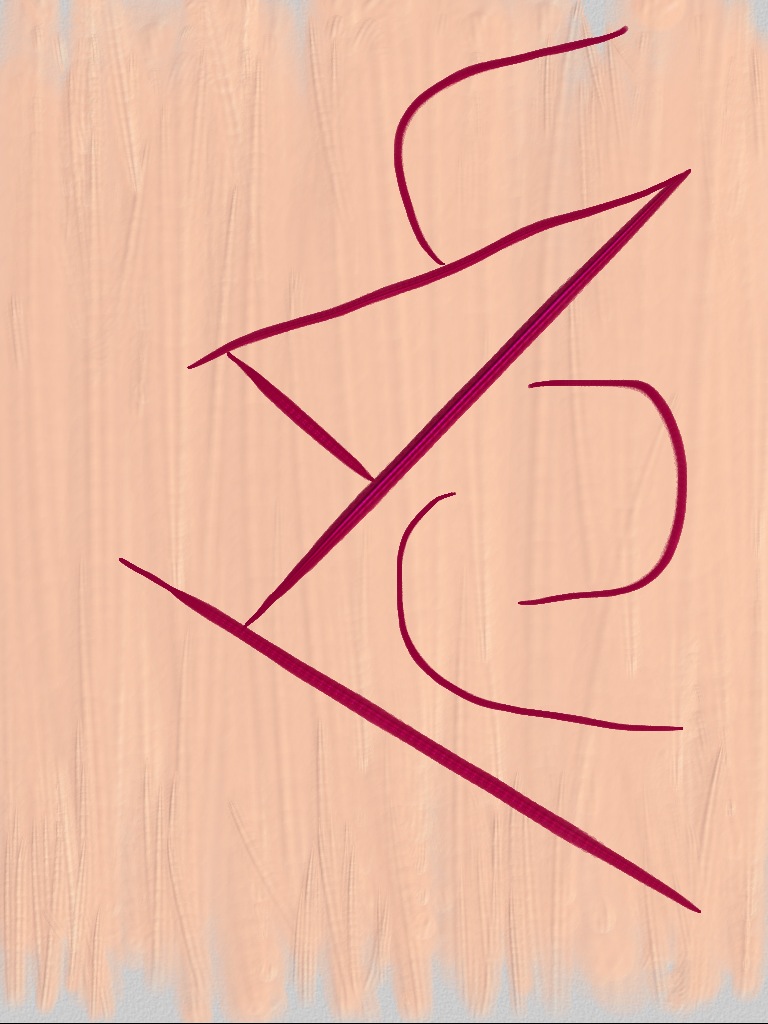
I have been playing round with my new ArtSet app. Collapsing truth, as some people suggest is happening, I came up with a very different picture of truth. It is a picture which asks the question of whether my truth hurts – funny how we have that expression “truth hurts”. It’s a picture which raises the question about the quality of shelter, about whether there is hospitable space and about whether u r cared for.

It’s a picture which presents us with Ruth as well as truth. The book of Ruth is a story of loving-kindness. Ruth shows herself to be full of loving kindness to Naomi, her grief-stricken mother in law, and Ruth receives the loving kindness of Boaz who becomes her kinsman-redeemer. Ruth means compassion and pity. (Ruthlessness describes the absence of those qualities.) Boaz and Ruth are counted as sowing the seed of Jesus. Even though she was a Moabitess, and therefore foreigner, she is Jesus’ great (times many) grandmother – according to Matthew. It’s Ruth’s story which is often chosen by couples getting married. Ruth “plights her troth” to her mother in law:

Where you go, I will go; where you lodge, I will lodge; your people shall be my people, and your God my God. Where you die, I will die …

Truth is questionable. Just like Saint Paul, “we now see, only dimly in a mirror. As yet, we only partially know.” (1 Corinthians 13:12). We have only one pair of eyes and limited perspective. That is something that is factually true. But the truth that ignores the perspective of others, that hurts, that welcomes no stranger, that cares for no-one, is blatantly false. Truth is measured by what we do.

Signed: Yours truly