Hope Before Dawn: An Advent Imagination

Live for that day when God’s peace is all in all.
Love for that day when God’s light leaves no shadows.

These are the darkest days of our lives.
December draws a long shadow,
and we find ourselves longing for light.

These days seem to go on without end.

These are the days Isaiah fought through and hoped through
3000 years ago:
the same old, the same old.
the dark ages all over again.
This is the mean time.

This is the time to cherish those who’ve kindled hope,
those we’ve bound in scripture
who hoped in God when the world felt just as heavy as ours.
This is the time to pray.
This is the time to keep watch.
This is the time to live for another day,
to love towards another day
when the times will finally be a-changing.

These are very mean days
when nations make war on nations,
There may be no world war,
But there are too many wars
for us to call this peace.
The world is at war,
and we are all caught up
in a global propaganda war.

These are very mean days when dark forces
create a hostile environment for those seeking asylum and sanctuary,
days which leave so many children hungry
and too many families poor, 

when budget after budget
miss the opportunity to make things better.

These days, however bright the weather may be,
are dark days to too many people.

And so –
these are the very days to keep hope alive,
to pray for the day when God’s kingdom comes on earth, as it is in heaven,
to live for the day when God’s word settles disputes;
to love for the day when nation will not take up sword against nation,
and nor will we need to train for war any more.

Imagine that.
Imagine the difference
when the weapons of war,
the resources of war,
become tools for farming and feeding and healing.

Imagine the difference
if the resources of war were turned to farming.
Not just in the fields of our own villages,
but in Gaza’s broken orchards,
in Ukraine’s shelled wheatlands,
in every place where the soil has been scorched,
and the hands that sow can no longer harvest.

Isaiah’s dream has dirt under its nails.
It is a farmer’s dream,
a peacemaker’s dream –
swords hammered into ploughshares,
spears repurposed as pruning hooks,
the earth tended again.

And here’s another theme none of us can avoid,
if we care about justice and peace:
we need to be prepared in these days of darkness.
Advent comes with a wake up call.
The time has come for us to wake up, says Paul, (Romans 13)
and be ready for the Day of the Lord –
the day we live for,
the day we pray for,
the day we love for.

For Advent I’ve downloaded an app which notifies me of Fajr –
the prayer Muslims offer from dawn to sunrise.
So, this morning, at 6.05,
my phone buzzed to tell me it was time to pray,
and I was reminded of all those
who rise while the world is still dark
to end the night and hope for the day.

First they wash,
then raise their hands to acknowledge the greatness of God.
They then recite the Surah:

In the name of Allah – the Most Compassionate, Most Merciful.
All praise is for Allah – Lord of all worlds.
the Most Compassionate, Most Merciful,
Master of the Day of Judgment.
You ‘alone’ we worship and You ‘alone’ we ask for help.
Guide us along the Straight Path
the Path of those you have blessed
– not those You are displeased with, or those who are astray.


Then they bow
They stand and say, “God hears the one who praises him.”
They prostrate themselves, grounding their forehead, palms, knees and toes on the earth –
and from the ground they praise God.
They finish by turning their head
to the right and to the left
with a prayer of peace in both directions.
Then they are ready for the day
(and, dare I say, they’ve given themselves a good work out!).

There is something holy about any people
who pray before the sun comes up.
They remind us what Advent is for:
ending the night,
and hoping for the day.

And we are among those holy people
imagining that day which will end all days of wrongdoing,
when God’s word is truly heard.

That is why our time of prayer
is taken up with praying for the coming of God’s kingdom,
on earth, as it is in heaven.
Christians will always use their prayer time for that –
It’s what Jesus taught us.

It is a prayer of imagination.
It is a prayer for dawn in the dark.
It is a prayer for the day when ….
the day God’s peace is all in all,
the day God’s light leaves no shadows.

And so we live for that day —
when, as Revelation imagines,
there will be no more mourning, crying or pain,
the day that will see an end to night.

Until that day
we keep watch,
keep warm,
and keep hope alive
these dark days.

The Day War Came – another poem for Refugee Week

I am posting a poem a day during Refugee Week. I have already posted Home by Warsan Shire and My Hazara People by Shukria Rezaei.

The Day War Came was written by Nicola Davies in 2016 when she heard that the British government was refusing to allow lone refugee children entry into the UK. Nicola Davies is a children’s author and zoologist. The poem has been published as a book with illustrations by Rebecca Cobb.

it is striking how many of these poems I have selected for Refugee Week are about children. Here the child’s safe space is undermined in a split second: the place where they belonged becomes lost to them and they have no choice other than to go on the run.

One person responded to this poem by drawing a chair – I suppose there is a real welcome in our phrase “draw up a chair”. That idea grew into parading #3000chairs across the internet for 3000 child refugees alone and fleeing “all kinds of ghastliness” to “make the people who voted to shrug their shoulders and throw those kids to the traffickers hang their heads in shame”. Posting this is my offer of a chair – but as well I asked Vincent to draw one up for me as my way of saying “refugees welcome”.

The day war came

The day war came there were flowers on the windowsill
and my father sang my baby brother back to sleep.
My mother made my breakfast, kissed my nose
and walked with me to school.

That morning I learned about volcanos,
I sang a song about how tadpoles turn at last to frogs
I made a picture of myself with wings.

Then just after lunch,
while I watched a cloud shaped like a dolphin,
war came.
At first, just like a spattering of hail
a voice of thunder …
then all smoke and fire and noise, that I didn’t understand.

It came across the playground.
It came into my teacher’s face.
It brought the roof down.
and turned my town to rubble.

I can’t say the words that tell you
about the blackened hole that has been my home.

All I can say is this:

war took everything

war took everyone

I was ragged, bloody, all alone.

I ran. Rode on the back of trucks, in buses;
walked over fields and roads and mountains,
in the cold, the mud and the rain;
on a boat that leaked and almost sank
and up a beach where babies lay face down in the sand.

I ran until I couldn’t run
until I reached a row of huts
and found a corner with a dirty blanket
and a door that rattled in the wind.

But war had followed me.
It was underneath my skin,
behind my eyes,
and in my dreams.
It had taken possession of my heart.

I walked and walked to try and drive war out of myself,
to try and find a place it hadn’t reached.
But war was in the way that doors shut when I came down the street.
It was in the way the people didn’t smile and turned away.

I came to a school.
I looked in through the window.
They were learning all about volcanos
And drawing birds and singing.

I went inside. My footsteps echoed in the hall.
I pushed the door and faces turned towards me
but the teacher didn’t smile.
She said there is no room for you,
you see there is no chair for you to sit on,
you have to go away.

And then I understood that war had got here too.

I turned around and went back to the hut, the corner and the blanket
and crawled inside.
It seemed that war had taken all the world and all the people in it.

The door banged.
I thought it was the wind.
But a child’s voice spoke.
“I brought you this,” she said, “so you can come to school”.
It was a chair.
A chair for me to sit on and learn about volcanos, frogs and singing
And drive the war out of my heart.

She smiled and said:
“My friends have brought theirs too, so all the children here can come to school.”

Out of every hut a child came and we walked together
on a road all lined with chairs,
pushing back the war with every step.

Nicola Davies

van-gogh-chair-1888-89-the-chair-and-the-pipe-6252763

Chaplaincy

Poppies painted by Pam Kelly
Today is a day to remember.
 
They went with songs to the battle, they were young.
Straight of limb, true of eyes, steady and aglow.

They were staunch to the end against odds uncounted,They fell with their faces to the foe.We will remember them.
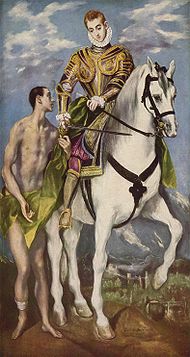
Also it is the day we celebrate St Martin of Tours – patron saint of France. Martin was a soldier who changed sides. He was a Roman soldier who became a “soldier of Christ” whereupon he declared, “I cannot fight”.Martin is famous for having halved his cloak to share it with a beggar. The cloak became an important relic which was specially cared by a priest in its reliquary. Wikipedia tells us that this priest was called “acappellanu” and “ultimately all priests who served the military were called cappellani. The French translation is chapelains, from which the English word chaplain is derived.”

St Martin and the Beggar by El Greco

This gives a fascinating insight into Christian ministry with “chaplaincy” grounded in this act of love – the sharing of the cloak. There is a further twist to the story in that Martin discovered his cloak restored when he woke one morning. Love defies the accountant and moves us into a world of magic and mystery. How can one cloak become one and a half cloaks, or even two cloaks? (Because I bet it wasn’t only Martin who was so blessed). Jesus defies accountancy logic when he declares that “whoever wants to save his life will lose it, but whoever loses his life me will find it” (Matt 16:25). This mystery means that those who are determined to give of themselves don’t need to count the cost.


Those who give their life for their friends have a love which is supreme. There is no greater love than this – and there is no waste in such love. Simon Marsh has a wonderful story on his blog about the war veteran being greeted by a grandchild from one of the villages he helped to liberate. Such stories highlight the life-giving commitment of people who share Martin’s vocation as soldiers and chaplains. But Martin’s declaration sounds a warning at a time when we tend to avoid the hard questions of war – when life is wasted and brutalised. “I am a soldier of Christ. I will not fight.”


> What is Remembrance Sunday about? How has it changed over the 90 years since Armistice Day?
These were some of the questions we looked at yesterday.
Remembrance Sunday remains a day of mourning. One day that we have set aside in our year to remember the victims of war, human nature and its consequences. But our thoughts will not be the same as those celebrating the hard fought peace of 1918.

Significant changes include
• The development of international institutions like the United Nations and the EU – great political achievements representing a cooperative relationships instead of the colonialism of the past.
• War has changed and its weapons have changed. Now civilian casualties are far higher. In WW1 civilian casualties were 5% of total casualties. Now that figure is 75%.
• Communications have changed. We now live in the “global village” where “everyone is networked and nobody is in control” – which makes wars far less winnable. As a child of the 50’s I was told how lucky I was that the wolrd was at peace. Now, because of news media and globalisation, we know that there isn’t likely to have been a moment of our human history when we haven’t been fighting one another.
• We know – especially as awareness of post traumatic stress disorder has increased – that, in the words of Jose Narosky “in war there are no unwounded soldiers”.
• We know more about “child soldiers”. Children as young as 8 are involved in conflicts in at least 17 countries – acting as spies, messengers and brandishing rifles.
• We know that there are over 34 million people displaced by war.
These are some of the things that come to mind as “I remember” – the thoughts for my two minute silence. I carry on remembering the “fallen”, those killed, their loved ones, parents and communities. I remember all those who have been on the front line. I remember the civilian casualties, the child soldiers and the refugees. I remember the violence that is part of being human and I remember that we are made in God’s image – and called to pray:

God our refuge and strength,
bring near the day when wars shall cease
and poverty and pain shall end,
that earth may know the peace of heaven
through Jesus Christ our Lord.

(the poppy picture was pianted by friend Pam Kelly – member of St Andrew’s Painters’ Group)