The Negative Spaces We Forget

I didn’t know what “negative space” was until I joined an art class and discovered just how important negative space is. Negative space is the space that surrounds an object in an image. Negative space helps to define the boundaries of positive space and brings balance to a composition.

We highlight what we do. In conversations we talk about what we do, showing some things, hiding others. In our work meetings we report on what we are doing. But what is going on in the negative spaces? Do we get asked to share what we are conscious of not doing? What are the things that lie in the shadow of those things we highlight? What about those things we don’t have time for, or can’t find time for? What happens when we scrutinise the composition of our negative space?

When I think of my own negative space I am conscious of the thinking, the theology, the sharing I could be doing but can’t because of a mixture of my laziness and my preoccupation with other things. I also become conscious of the people I have forgotten and who have receded into the shadows, the neighbours I should know, the circumstances I should understand and empathise with.

It is not a pretty picture. Like many in pastoral ministry I am sure that I failed to take account of negative space. It was the people in front of me who got my attention – those who could talk, those who could demand a hearing. It was the people who were privileged enough, well enough to walk the same streets as me. The assumption was made that if you didn’t see someone they were OK. So we judged how well bereaved were coping from what we saw – the evidence before our eyes, sometimes forgetting that the very reason we don’t see some people is because they are hiding (or being hidden), because they are not well enough to be “out”, because they don’t want to be a burden or because they are shamed by a society that only seems to know positive space.

We forget that positive space is a privileged space, a space for those who are able to stand proud. Negative space, on the other hand, is a much larger space – a pit of not knowing, ignored and forgotten by those who don’t occupy such space. In the dazzle of positive space it is easy to forget God’s light shines in darkness. It is easy to forget that there is much love in that negative space.

The image of The Bomb, is by Israeli artist Noma Bar

Praying simply

A poor life this, if full of care,
We have no time to stand and stare.

These are the closing lines of W H Davies’s so simple poem, Leisure.

I bet I’m not the only one to be brought up sharp by this. Could this be a Lenten discipline: to take time?

Mary Oliver’s simple lines in Praying might help us to take time in the everyday – just to wonder and wander in prayer. Prayer doesn’t have to be difficult.

It doesn’t have to be
the blue iris, it could be
weeds in a vacant lot, or a few
small stones; just
pay attention, then patch

a few words together and don’t try
to make them elaborate, this isn’t
a contest but the doorway

into thanks, and a silence in which
another voice may speak.

Photo credit: Vilseskogen


Punctuating the night

Waking in the middle of the night,
say, midway between lying and rising,
just then, is not always curse and cue
for raking old worries to no effect.

just sometimes we awake with a blessing,
precious memories shine our consciousness:
not one, but two lights beam in darkness,
a colon before rest.

where do they come from? they travel far
but arrive fresh. they head straight for me
because only I will know the pair they are.
they come for me, a blessing, a colon before rest.

both were recalls of what was barely
registered at the time of their birth.
one a scholar defining remembrance of Him:
the other, of trouble taken to meet

a paedophile prisoner released
from his sentence. the one the very point
of the other, remembering a man lost
in the darkness of our collective sleep.

After the colon comes the sense, the blessing.
There are some things only we will know,
only alight when they come to see us,
treasure to take us to rest of night.

Some power lines as powerful as can be

electrical-power-lines (1)

Sometimes what comes out in conversation takes our breath away doesn’t it? Conversations are wonderful ways of learning and realising stuff deep within our experience.

At a recent workshop on power leaders in ministry were sharing empowering stories and exploring ways of empowering others. What emerged was a radical question, very simply expressed: don’t we want everyone to be as powerful as they can be?

There is, of course:

  1. a huge “as long as”,
  2. and a qualification who the “we” is who so want us all to be powerful as can be
  3. as well as a health warning.

The health warning is that power can be so dangerous and all of our perceptions of power are coloured by our experiences and the extent to which we have been overpowered or empowered.

The “we”, of course, is not everyone. There are those who want to protect their “superpower” status and they depend on belittling and demeaning behaviours to manipulate dependence and fear in others. They have a vested interest – and they often are vested, dressed up in uniform – in a status quo in which they are favoured. To be part of the band of “we” we need to ask the question about how we can be disarming – to unilaterally disarm as an initial step to deescalate unhealthy power dynamics.

The “as long as” of the question “don’t we want everyone to be as powerful as they can be?” is as long as it is the right sort of power. We know what the wrong sort of power looks and feels like. It either makes us feel big (aka arrogant) or small – either way it is dehumanising. Our workshop conversation had begun with a consideration of a typology of power developed by French and Raven back in 1959. They identified five (later expanded to six) bases of power. Those bases are of two sorts. The first sort is the power that is handed on with authority, hierarchically and is based on position. The second sort is the power that is given by “followers”. Followers turn to people who they believe are competent (“experts”) and to people they like or respect (“referent”). Those we turn to may have positional power, or they may not.

Power

What we wish for when we want everyone to be as powerful as they can be is:

  1. for them to be freed from oppressive power, and
  2. for us to help one another into habits (not vests!) and disciplines in which virtues grow to the extent that we inspire confidence in one another

This is a tall order. We are all broken power brokers and we all come to the conversation with temptations to, such as, protect our position, make ourselves look big/clever, win. We can only help one another. This is a community endeavour in which we can help one another uncover our abuses of power and re-member those excluded by our executive powers.

NB Spoken by a white middle class university educated priest with well reinforced positional power but convinced that the communities I care for should be as powerful as they can be and eternally grateful for those communities which have been empowering and made this life worth more that it otherwise would have been.

A problem with individualism: the cost of privilege

Liberation comes through community. Everyone who has been oppressed, excluded, impoverished knows that according to poet Danez Smith. Yet so much of our discourse is about the individual. Could it be that those who shape that discourse are those who already have their rewards, already feeling entitled to the cream?

Here’s what Danez Smith has to say in an interview with Kate Kellaway:

You don’t have the luxury of being an individual. To be black, queer or poor – to be an individual has always meant death for us. To be a woman alone is dangerous – we teach our daughters that, we teach black people that. Our liberation comes through community, organising, collectivising. Individuality has meant death. Individuality has meant being marooned. Individuality is a privilege, right? The only people who can think of themselves as separate from the other people who have made their lives possible are straight white dudes

The Guardian January 28th 2018 https://www.theguardian.com/books/2018/jan/28/danez-smith-interview-poetry-dont-call-us-dead-dear-white-america?CMP=Share_iOSApp_Other

Opening the community chest

la vagabondeuse

I love that tweet @la_vagabondeuse and know the feeling of opening up a box of treasures. There are so many jewels out there. Of course, this has more to do with la_vagabondeuse’s willingness to open her ears and heart to others. Twitter is just the means to that end – one of many social media and other means.

I spent an hour and a half reading through my Twitter feed this morning. Call it a birthday indulgence if you like, but I know it is something I should be doing more of (listening, that is). There are whole boxes of treasure and so many jewels. Here’s some of what dazzled me this morning:

  • John Sutherland’s robust response @policecommander to Daily Mail’s lazy front page report on the nation being hooked on happy pills
  • the recall by Michelle Eyre @MichelleDEyre of the 9th day of Christmas, her true love’s gift of “nine ladies dancing” and her thanksgiving for the nine fruits of the Holy Spirit
  • some lines from Hafiz relayed by Ramblings @ramblingsloa: “Ever since happiness heard your name, it’s been running through the streets trying to find you.”
  • a beautiful image of Naomi and Ruth shared by Jacqueline Durban @radicalhoneybee together with a simply three word sentence: “Love made rock”
  • a 50 second video @HSBC_UK with hashtag #togetherwethrive shared by Michael Sadgrove @sadgrovem in praise of the word “together” in the spirit of Bonhoeffer

I do realise that Twitter is a preserve of the chattering classes, but it is one way of listening to others. We can choose our newsfeed and who we listen to. I choose the twitterati who have their ear to the ground, the ones who are sensitive to the rumblings of down to earth living (over, for example, the Daily Mail and its presumption of daily fail). And I discover, through that listening, the huge amount of treasure in the community chest – treasure graphically portrayed in another tweet from Paul Wright @LeanLeft_Wright this morning.ABCD

This shows the energy bubbling under the surface of community making the point that community develops through the appreciation of its members. You have to live there to know that. It is about opening our ears to hear the voices of others, and opening our hearts to the passion of others and celebrating the community bounty – the treasures and jewels of the community chest, just like la vagabondeuse is trying to do. This is loving the voice of our neighbour and discovering our commonwealth. Put technically this is “asset based community development”. But for those who live there, it is simply the love that makes the rock on which community builds (to paraphrase @radicalhoneybee).

You want it darker? I’m ready, my lord

Leonard Cohen, tenant of the Tower of Song, born with the gift of a golden voice wanted it even darker on his last album. Darkness is keenly felt by many, particularly at this time of year when the darkness reinforces experiences of isolation and grief. The fairy lights that bedeck so many houses is an act of defiance against the darkness. Nowadays these artificial lights double up as Halloween and Christmas lights, intended to brighten our winter days and to jolly up the darkness.

But there is a sense in which we need it to be darker. Advent is a season to be rescued from the light-hearted. It is a time of year to get serious about the darkness that is part of our lives in our relationships, in our despair, in our anxiety, in our jealousy. It is a time to get real about the suffering so many endure, the millions forced from their homes, the many who suffer the consequences of economic austerity.

Those for whom this is too serious, those who are afraid of the dark, do us no favours when they say “lighten up”. Their merriment is like the fairy lights which don’t diminish the darkness but only pollute the night sky. We need it darker to realise that we are not all sweetness and light wherever, whatever and whoever we are.

Vincent van Gogh lived through some dark times. He wrote to his brother Theo: “I am so angry with myself because I cannot do what I should like to do, and at such a moment one feels as if one were lying bound hand and foot at the bottom of a deep dark well, utterly helpless”. Like Leonard, Vincent did dark. And yet, in another letter to Theo, he wrote:

“It is true that I am often in the greatest misery, but still there is within me a calm, pure harmony and music. In the poorest huts, in the dirtiest corner, I see drawings and pictures. And with irresistible force my mind is drawn towards these things. Believe me that sometimes I laugh heartily because people suspect me of all kinds of malignity and absurdity, of which not a hair of my head is guilty — I, who am really no one but a friend of nature, of study, of work, and especially of people.”

In his darkness he saw the most beautiful stars, some of which he painted and gifted to us. (Do see Loving Vincent if you get the chance.)

1280px-Van_Gogh_-_Starry_Night_-_Google_Art_Project

In ancient times the stars were guides to the wise and inspiration to the faithful. These days it’s Cowell-made stars that draw us. Stellar constellations are lost on most of us, mainly because we can no longer see them. The light in which we trust is artificial. We need it darker for a time.

PS You may be interested in Jenny Bridgman’s Advent blog exploring Dark Spaces

On Druids, Trees and Truth

Eiche und Basaltsäule, Joseph Beuys, Düsseldorf (1)
One of the 7000 Oaks inspired by artist Joseph Beuys with basalt stone
Friend Lewis asked me about “druids”. They are much maligned (is it, I wonder, mainly by the English?). They don’t understand their honourable history in ancient Celtic cultures where they were members of the professional class including religious leaders, legal authorities, lorekeepers, medical professionals and political advisors.

The modern word druid comes from the Latin druides, but behind that Latin word is Old Irish, Old Cornish and Middle Welsh words which hypothetically might be based on a proto-Celtic word reconstructed as druwids (plural is druwides). Druid is thought to come from the Celtic word for the oak tree, duir. A drewid is a “knower of oak trees”.

What led me to this clearance of understanding was a look at one of Joseph Beuys’s works (1982) which consisted of the planting of 7000 oak trees in Kassel in Germany. in conversation with Richard Demarco, Beuys said:

I think the tree is an element of regeneration which in itself is a concept of time. The oak is especially so because it is a slowly growing tree with a kind of really solid heart wood. It has always been a form of sculpture, a symbol for this planet ever since the Druids, who are called after the oak. Druid means oak. They used their oaks to define their holy places. I can see such a use for the future … The tree planting enterprise provides a very simple but radical possibility for this when we start with the seven thousand oaks.

Other words derived from this root (excuse pun) include the Old English treow from which we have tree, truce, truth, troth, tryst – what a vast array of fruit those words represent! And that leads me to the moment Jesus was hung from the remains of a felled tree and, with true love, excruciatingly transformed the Tree of Death to the Tree of Life.

Druid

PS You may be interested in a series of poems written by Jim Bridgman called The Tree Cycle, for example, this Nightmare of the Rood

The Little Boy who bombed the Little Girl: a prayer for transfiguration

2336374171_1abb948e89_b
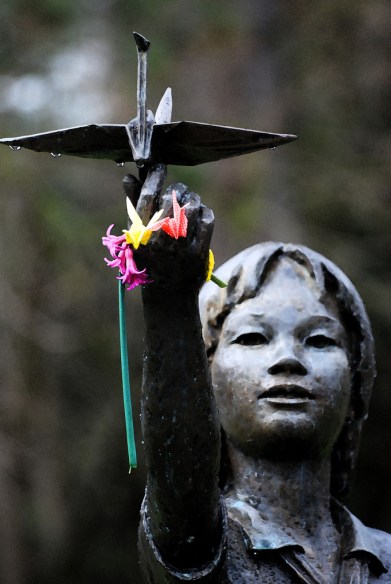
I did look for photos to illustrate this post. What I found were so awful and distressing – and what I would have used seemed so trivial in comparison. So I have posted Scott Butner’s photo of the statue of one of the so many tragic victims, Sadako Sasaki – she seems to be beckoning us into her “wishing well”.

Sadako Sasaki died when she was 12. She spent her life praying for peace. A sculpture of her in Seattle (pictured) shows her beckoning us to join her prayer. She was two years old when an atomic bomb was dropped on her town of Misasa Bridge in Hiroshima on August 6th 1945. This little girl survived the bomb but developed leukaemia. She is remembered for the thousand cranes she (nearly) folded before her death in 1955.

Her first crane was made by her best friend when she visited her in hospital and told her about the Japanese saying that one who folded 1000 cranes would be granted a wish. Legend has it that Sadako only managed to fold 644 cranes before she died, and that the other 356 were made by her friends after she died and buried them with her.

Ironically the bomb was called “Little Boy”.

Many people have made the connection between the Feast of the Transfiguration which the church celebrates every August 6th, and this act of disfiguration which took place on that August 6th. People in Japan celebrate August 6th as a national peace day.

Matthew (17:1-13) describes the Transfiguration and how disciples saw how Jesus’ face shone when he was seen on the mountain with Elijah and Moses. This was a meeting of three visionaries which not only transfigured Jesus’ appearance but also strengthened him for his journey to Jerusalem.

Many people will be taking their holidays at this time of year including some who, like Jesus, will be taking to the mountains. Can we pray that they will see life afresh and gain strength for the next stage of their journeys back to work against all that disfigures their own lives and the lives of others?

Besides the Seattle statue there is another in Hiroshima Peace Memorial Park. It has a plaque that reads: “This is our cry. This is our prayer. Peace in the world.” That is a prayer of lament, a visionary prayer and a prayer that we may see the world anew.

This is based on words originally written for the Chester Diocesan Cycle of Prayer

Patara Beach

Patara

On this beach sound and sand we lay ourselves to rest:
an annual punctuation, a colon and breathing space,
kindling and basking delighted by overlapping waves
of welcome: a silver thread in tiredness’ tapestry.

Tourists and turtles take their turns digging to cool sand
for new generation; young engineers make their marks
and build playful fortifications without calculation,
fear or hope of castles not withstanding nature’s storms.

Backed by wholesome sun I chase my shadow along the shore.
The load lightens. My trace disappears. Crabs sidle home.
A stranger nods a Merhaba in my direction looking out
another place and pace: life less dash or need for colon.

A far cry comes from the harbour, long silted and stranded
in history and imagination. “Phoenicia bound?”,
the ship’s master’s call to those piering their next purpose
and horizon, and those otherwise beached and bedraggled.

Luke, a passenger, packs a gospel for this new ark
with his two by twos, his hims and hers, his young and old,
his Jew and Greek, and Paul, his complementary pair embark,
Turks off Patara beach, where the sun shines after storms.

PS. References:
Merhaba is the Turkish greeting “hello”.
Luke and Paul changed ships at Patara.

And so, with the tearful good-byes behind us, we were on our way. We made a straight run to Cos, the next day reached Rhodes, and then Patara. There we found a ship going direct to Phoenicia, got on board, and set sail. Cyprus came into view on our left, but was soon out of sight as we kept on course for Syria, and eventually docked in the port of Tyre. While the cargo was being unloaded, we looked up the local disciples and stayed with them seven days. (Acts 21:1ff)