Psalms and Their Wretched Authors and Readers

Foxes Book of Martyrs 1851I have been thinking increasingly that the Psalter has fallen into the wrong hands – into my hands, and that, in my hands,  those who Frantz Fanon referred to as The Wretched of the Earth have been betrayed
The psalmists (I’m assuming many, or at least several) describe the wretchedness of their lives. Take the psalm appointed for today (March 31st), Psalm 102 as an example. The psalmist talks about her/his crying and distress. S/he isn’t just downhearted, but is smitten-down-hearted. Her enemies rage at her all day and every day and have ganged up on her to bully her. S/he is alone, hungry and thirsty. This is how s/he pours out the wretchedness of her situation:

Hear my prayer, O Lord;
    let my cry come to you.
Do not hide your face from me
    on the day of my distress.
Incline your ear to me;
    answer me speedily on the day when I call.

For my days pass away like smoke,
    and my bones burn like a furnace.
My heart is stricken and withered like grass;
    I am too wasted to eat my bread.
Because of my loud groaning
    my bones cling to my skin.
I am like an owl of the wilderness,
    like a little owl of the waste places.
I lie awake;
    I am like a lonely bird on the housetop.
All day long my enemies taunt me;
    those who deride me use my name for a curse.
For I eat ashes like bread,
    and mingle tears with my drink,
10 because of your indignation and anger;
    for you have lifted me up and thrown me aside.
11 My days are like an evening shadow;
    I wither away like grass.

But this isn’t self-pity: the psalmist is just telling it like it is. There is no room for self-pity because the psalmist knows God and his history. He knows that he turns to the prayer of the destitute, that he hears the sighs of the prisoner. This is an uprising of prayer and outpouring of trust that her enemies will be short-lived while “the children of your servants shall continue, and their descendants shall be established in your sight”.

This is a prayer of the down-hearted and an act of defiance in the face of her enemies. It is but one page of a prayer book that comes from the hands of those who have fallen on hard times and belongs in their hands. I am sorry to have snatched it from them. I hope I don’t take their words from them, and that I might hear their lament and join their Amen.

This is how this prayer (Psalm 102) turns out, from hard pressed people to their God:

12 But you, O Lord, are enthroned for ever;

    your name endures to all generations.
13 You will rise up and have compassion on Zion,
    for it is time to favour it;
    the appointed time has come.
14 For your servants hold its stones dear,
    and have pity on its dust.
15 The nations will fear the name of the Lord,
    and all the kings of the earth your glory.
16 For the Lord will build up Zion;
    he will appear in his glory.
17 He will regard the prayer of the destitute,
    and will not despise their prayer.

18 Let this be recorded for a generation to come,
    so that a people yet unborn may praise the Lord:
19 that he looked down from his holy height,
    from heaven the Lord looked at the earth,
20 to hear the groans of the prisoners,
    to set free those who were doomed to die;
21 so that the name of the Lord may be declared in Zion,
    and his praise in Jerusalem,
22 when peoples gather together,
    and kingdoms, to worship the Lord.

23 He has broken my strength in mid-course;
    he has shortened my days.
24 ‘O my God,’ I say, ‘do not take me away
    at the mid-point of my life,
you whose years endure
    throughout all generations.’

25 Long ago you laid the foundation of the earth,
    and the heavens are the work of your hands.
26 They will perish, but you endure;
    they will all wear out like a garment.
You change them like clothing, and they pass away;
27     but you are the same, and your years have no end.
28 The children of your servants shall live secure;
    their offspring shall be established in your presence

The image is from The Book of Martyrs, John Foxe, 1516-1587, Goodrich, Charles, 1790-1862.

Grains of Sand

Grains of Sand is a rebrand. I originally called this blog The Jog. That has run its course. The blog was The Jog but now it’s just Grains of Sand. Why?

  1. Grains ain’t heavy and take themselves lightly
  2. I like my questions blowing’ in the wind
  3. I like the sound of sand sifting in the sea
  4. There are too many to count
  5. Jesus did all his best writing in sand

There’s rocks and then there is sand. Or is it the other way round? Time managers insist on getting to the rocks first but that suggests we don’t have to make time for the grains of sand. I get concerned that the blogosphere will be taken over by experts with their weighty opinions. Am I wrong in thinking that posts are getting longer and look more like journal articles? It’s as if they’re uttering the last word. I’m wanting space for the first words of consciousness and wonder.

They’re too many count. Nobody in their right mind would ever dream of counting grains of sand (although it might be a better way of getting sleep than counting sheep). In the Bible grains of sand stand for plenty. They stand for the extent of his love and the extent of his amazing grace. When we say “how much?”, we hear “so much, you can’t even begin to count”. His love and his mercy is measured in grains of sand.

How precious to me are your thoughts, God!
How vast is the sum of them!
Were I to count them,
they would outnumber the grains of sand (Psalm 139:17f)

The angel of the Lord called to Abraham from heaven and said “… I will surely bless you and make your descendants as numerous as the stars in the sky and as the sand on the seashore.” (Genesis 12:17)

The sins I have committed against you
are more in number than the sands of the sea. (Manasseh 1:9)

Jesus did his best writing in the sand. I say that because there’s no evidence that he did any writing other than the writing he did in the sand (John 8:1-12). In this passage Jesus subverts the judgments of his community.His opponents framed a woman – they said “caught in adultery”. They want Jesus to confirm the judgement that she should be stoned to death but Jesus refuses. He writes in the sand. He says the first stone should be cast by the one without sin – at which her (and his) accusers put their stones down and leave. Jesus, as the one without sin, should have been the one to cast the first stone. Instead he says, “I don’t condemn you”.

We don’t know what Jesus wrote in the sand. Instead we read into his writing his merciful love and his despair at those who don’t realise the damage they are doing when they judge others. There is one  fanciful suggestion (Derrett) that what Jesus did write was two verses from scripture. He was sitting down when he wrote – the theory is he would have been able to reach as far as being able to write only 16 Hebrew characters, which might have been:

“Do not follow the crowd in doing wrong… do not pervert justice by siding with the crowd.”(Exodus 23:2) and
“Have nothing to do with a false charge.” (Exodus 23:7)

We just don’t know what he wrote. But if the suggestion is true, or if he wrote something similar, it is clear that it was the malice of the chargers that bothered Jesus, not the alleged wrong of the woman. I would say that this is beautiful writing, calligraphy that spares the ones the world accuses (rightly or wrongly) – writing for salvation.

That is the way to write, with the grain of that sand. So Grains of Sand it is. Just a few grains, a tiny part of a large harvest. Just grains, secreted and buried in the blogosphere. It’s not for me to know what happens next. Thanks for reading and thanks to all fellow sifters.

The Guest House

The Guest House

This being human is a guest house.
Every morning a new arrival.

A joy, a depression, a meanness,
some momentary awareness comes
as an unexpected visitor.

Welcome and entertain them all!
Even if they’re a crowd of sorrows
who violently sweep your house
empty of its furniture,
still treat each guest honourably.
He may be clearing you out
for some new delight.

The dark thought, the shame, the malice,
meet them at the door laughing,
and invite them in.

Be grateful for whoever comes,
because each has been sent
as a guide from beyond.

I am grateful to Ivonprefontaine for reminding me about Rumi’s wonderful poem, The Guest House. It seems perfect for Lent in that it explores an important dimension of hospitality in a way that reminds me of Jesus’s temptations in the wilderness.
Rumi was a 13th century Persian poet. He was a Sunni Muslim, theologian and Sufi mystic. He was the “father” of the Whirling Dervishes (founded by his son, Sultan Walad).

The image of the poem is freely available through Pixabay

Take a look at this poor, wise man: reflecting on Ecclesiastes 9

img_0012
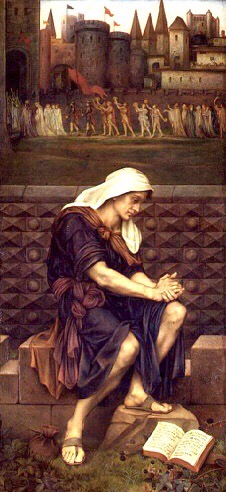
The Poor Man who Saved the City by Evelyn de Morgan (1901)

Like Qoheleth I am rather taken by the poor man in the city. It was a small city with only a few inhabitants. It was besieged but there was one man, a poor and wise man, who, by his wisdom delivered the city.

Not a lot of people know this man. He’s not someone I’ve ever noticed before, but he is there, highlighted in one of the less read books of the Old Testament, Ecclesiastes 9:14f. He doesn’t have a name. His story is told in not so many words:

There was a little city with few people in it. A great king came against it and besieged it, building great siegeworks against it. Now there was found in it a poor, wise man, and he by his wisdom delivered the city.

Like Qoheleth (the Teacher), I want to honour this man and the poor, wise men and women like him, who save their cities (our cities) from destruction by greed, speed and countless other destabilising and dehumanising forces. They are the salt of the earth, far removed from what we refer to as the typical “city gent”. We know he is not well-heeled and we know that he is care-worn (because his wisdom is forged from the attention and care he gives – and that is demanded of him in the challenge of just managing). These are the people we can turn to in times of trouble. They will hear us out, they will offer their wisdom. They become the heart (anagram of earth) of our communities and the springboards to trust and confidence.

But they are so often overlooked. This man reminds me of R.S.Thomas’s “friend”, Iago Prytherch – another man who would have gone unnoticed were it not for Thomas drawing him to our attention. Prytherch is down to earth, hard-working, more peasant than citizen, with an earthly wisdom. Thomas writes in Green Categories:

You never heard of Kant, did you Prytherch?
A strange man! What would he have said
Of your life here, free from the remote
War of antinomies: free also
From mind’s uncertainty faced with a world
Of its own making?
Here all is sure:
Things exist rooted in the flesh,
Stone, tree and flower. Even while you sleep
In your low room, the dark moor exerts
Its pressures on the timbers. Space and time
Are not the mathematics that your will
Imposes, but a green calendar
Your hearts observes; how else could you
Find your way home or know when to die
With the slow patience of the men who raised
This landmark in the moor’s deep tides?

His logic would have failed; your mind too.
Exposed suddenly to the cold wind
Of genius, faltered. Yet at night together
In your small garden, fenced from the wild moor’s
Constant aggression, you could have been at one
Sharing your faith over a star’s blue fire.

I don’t want to say that this man is Christ (because that might prevent us celebrating the ordinary people in ordinary places using their hard won wisdom for the welfare of the city), but I do want to say that man is Christ-like, and that Jesus too was poor and saves the city.

These are the people who are blessed. That is not an idle saying of Jesus (Luke 6:20). The blessing has substance and content, including wisdom that bears so much fruit. These are the people we hear praying in the Psalms. I think Isaiah is talking of a similar poor man in the city when he writes:

He will not cry or lift up his voice,
or make it heard in the street;
a bruised reed he will not break,
and a dimly burning wick he will not quench;
he will faithfully bring forth justice. (Isaiah 42:2f)

I want to remember that poor man and those men and women like him. Qoheleth writes, “No one remembered that poor man … the poor man’s wisdom is despised, and his words are not heeded.” He continues,

The quiet words of the wise are more to be heeded
than the shouting of a ruler among fools (Ecclesiastes 9:17)

But that is the world’s way – to be taken in by the vanities of the rich and powerful. We remember them (we name estates and prizes after them) and forget the poor (and the wisdom of their deep knowledge) – that’s if we ever notice them in the first place.

The Poor Man who Saved the City by Evelyn de Morgan is © De Morgan Collection, courtesy of the De Morgan Foundation, www.demorgan.org.uk

St Brigid of Kildare and other patrons

4178568875_27d0904042_n
A Brigid cross

Today, February 1st, is the day St Brigid of Kildare is honoured and celebrated in the Eastern Orthodox Church, the Roman Catholic Church and in the Anglican Communion (today because it is the day that she died in 523).There isn’t a great deal known about Brigid and in recent times there has been debate as to whether she existed at all. Some have suggested that the name and characteristics of the goddess Brigid were attached to the saint.

In a way her historicity is immaterial. What matters is what people have made of her life and what her life has come to mean. There are plenty of stories about her charity, her faith, her wisdom and her healing powers – the sort of stories that make a saint. For example, she is credited with founding a school of art, including metalwork and illumination. She is said to have been sold by her parents into slavery. It is easy to understand why she has become patron saint of babies, children with abusive parents and printers. But she is also patron saint for blacksmiths, boatmen, brewers, cattle, chicken farmers, dairy maids, fugitives, mariners, nuns, poets, poor, sailors, scholars, travellers, watermen and Ireland!

It is this reach of her legend which interests me. That long list of those to whom she is “patron” is a list of those who come under her care. They become the people she entertained with God’s blessing in her life, whether her actual life or the life as it has come to be in culture. That long list represents an enormous reach in prayer and practice and is a measure of the extent of God’s embrace.

The honouring and celebration of saints are spread liberally through our calendar. They help to make us a people of thanksgiving, and they help to make us a people of prayer. From what we have made of Brigid our prayers can stretch from children in abusive homes to midwives, from boatmen to brewers, from sailors to scholars, from fugitives to poets. All of them are taken in by God. Normally I wouldn’t give them a second thought and would pass them by. But today, thank Brigid, I think again and remember the reach of God’s love, his particular intentions and his call for us to love like him.

The photo is by Amanda Slater, showing what is known as a Brigid cross. These crosses are traditionally made on February 1st. They are made from rushes or straw and hang in many kitchens as protection from fire and evil.

PS. I asked John Bleazard, Rector of St Bridget’s West Kirby to contribute to this piece after being moved by what he was telling me about what is happening in his parish and other parishes he knows dedicated to St Bridget, or St Bride. I’m really grateful for this that he writes on how St Brigid’s tradition is kept alive. John writes:

Good to see you remembering Bridget on 1st February, David.

As rector of the 1,000 years-old St Bridget’s Church here in West Kirby, I find myself planning a patronal festival service each year and researching stories about her. Apparently she was once short of drink to offer proper hospitality to some guests, and so prayed over a bath full of dirty washing up water which happily then turned into beer. Hence Bridget becoming known as the patron saint of beer, and why of course, with that knowledge, we just had to organise a weekend beer festival here at St Bridget’s!

In my introductory notes for the patronal service order of service booklet this year, I wrote: “…it is said that Bridget was the keeper of a sacred flame in the church at Kildare that her nuns kept alight for 1,000 years. In the dark days of early February this notion of Bridget keeping an everlasting light has become entwined with that of Jesus being revealed as the light of all the nations at Candlemas, and also with the old Celtic festival of Imbolc that welcomes the return of light and warmth as Winter turns to Spring.

“Bridget is one of only a very few female saints from Celtic times, so her revered place is testimony to her outstanding leadership and holiness. It is said that when she was taking her vows as a nun a ring of fire appeared over her head. In awe of this, Bridget was ordained a bishop by mistake!”

Knowing this history, (or should I say, hagiography or is it legend?) about Bridget as a pioneer of women’s ministry in a man’s world, perhaps I shouldn’t be surprised that the present day St Bridget’s church congregation have signed up as members of Inclusive Church and campaign for full and equal treatment of everyone within the church regardless of sex, sexuality, or other forms of discrimination.

What is more striking is how many other churches dedicated to St Bridget are also involved in the Inclusive Church movement – indeed I’m going to a meeting of Inclusive Churches next Saturday – where? St Bride’s, Liverpool of course!

How exactly does this patronage or influence remain down the centuries? Robert Warren in Healthy Churches Handbook talks about the angel of the church – and how we might better understand decision making processes and the outlooks of churches if we discovered more about the personality and identity of the church’s angel (or patron?) as first described in the letter to the churches in Revelation chapters 2 and 3. The letters are addressed: “to the angel of the church in…”  Warren quotes from Walter Wink’s book, The Powers That Be, who says that “The angel of the church is the coincidence of what the church is – it’s personality – and what it is called to become – it’s vocation.” We at St Bridget’s need to look back at where we have come from, but also need to look forwards to what we are becoming.

I was very struck by what Revd Dr Peter McGrail of Liverpool Hope University said to us in his Patronal Festival sermon here at our service this year about the potential impact and legacy of St Bridget on how we make decisions in our church. Peter pointed out that Bridget is this ambiguous person with stories of the Christian Abbess of Kildare mingling with the Irish Goddess Briege. He asked: “Where does one stop and the other start?”

Maybe this ambiguous hagiography is one reason why St Bridget’s church was (and is) “…a melting pot of ideas, a liminal, threshold place where human thought and action is extended and broadened.” I would add, too, that maybe the influence of the parish dedication to St Bridget is why a whole range of different views on any given topic are represented among the congregation. If that is the case, then our decision making needs to recognise this diversity.

Peter McGrail concluded his sermon: “The challenge we face is how to engage with issues around … who is the “other” as we follow Jesus who … transgressed humanity’s deepest taboos with regard to the sacred, and who set in motion a radical refusal to be bound by the barriers that humans set against other humans. Perhaps a parish dedicated to St Bridget that in it’s origins straddled boundaries between peoples and traditions might offer some insights?”

What would Jesus do? What would Bridget say? What is St Bridget’s Church here in West Kirby call to be and become under the influence of our patron, Bridget?

John Bleazard, March 2017


Reflecting All The Light We Cannot See

Light
Light
The visible reminder of Invisible Light.
T. S. Eliot

all_the_light_we_cannot_see_doerr_novel

What was intended to be a summer read turned out to be an early winter read – very appropriately because this is a book about light and darkness, perfect for Advent and the darkest time of the year. In All the Light We Cannot See we see the world through the hands of a blind woman, Marie-Laure. As a child she is given a model of her world which helps her to feel her way in spite of all the light she cannot see. In telling her story, Anthony Doerr, is putting a model into our hands to remind us how complex life is and to help us discover the light that can be hidden in the smallest detail.

Anthony Doerr has spun for us a hopeful story that is full of humanity. Besides the blind girl, there is an orphaned German boy who becomes a radio technician. The setting is the Second World War which so divided and devastated Europe. Their lives don’t cross till later but Doerr skillfully weaves their stories together in brief alternating chapters.

With the rise of populist politics as expressed in the Brexit referendum and elsewhere, it seems that we are again in a dark age (and the book is a startling reminder of the institutions that have grown up in post-war Europe which so far have preserved peace – it would be stupid and careless if this were to be unpicked). There is a lot of darkness as we don’t know where we are heading. There is a lot of light that we cannot see as we turn ourselves inwards.

There is so much light we cannot see – from the past and into the future. But in the hands of a blind girl the author has placed a model which can help us through to the light we cannot see. The model maker is her father – significantly a locksmith. I say significantly because of these lines by poet Malcolm Guite in response to one of the Advent antiphons:

Even in the darkness where I sit
And huddle in the midst of misery
I can remember freedom, but forget
That every lock must answer to a key,
That each dark clasp, sharp and intricate,
Must find a counter-clasp to meet its guard,
Particular, exact and intimate,
The clutch and catch that meshes with its ward.
I cry out for the key I threw away
That turned and over turned with certain touch
And with the lovely lifting of a latch
Opened my darkness to the light of day.
O come again, come quickly, set me free
Cut to the quick to fit, the master key.

Julia McGuinness has also written about this book. She captures the ideas of light within limited spaces which is so much part of this story set in the extremes of human existence.

Part of my work is to support newly ordained clergy. One of the cheesy things I do is write to those who have been recently ordained, just before Christmas. I say something like:

Happy first Christmas to you as a “priest”. I hope you enjoy your first Christmas celebrations. It is a wonderful moment – embracing strangers/visitors. One of the ideas that came to me (when I was struggling to find yet another homily in a busy Christmas season) was a play with the word “manger”. Pronounced the French way it’s about eating. Pronounced the Christmas way it’s where Jesus is born. Do we prepare a manger with the hands we offer for the bread? Is this when Jesus is born? As we place the bread in the hands of others, are we laying Jesus in their manger?

When we take the bread into our hands, into the manger we prepare, we take all the light we cannot see. This is the body of Christ, the light of the world. This is the faith we have as Christians, a faith that in the darkest times there is all the light we cannot see. The light that shines in the darkness, makes a difference as to how we recognise one another, how we see one another, how we see our past, how we see our future – as not so dark as maybe we once thought. This too, like Marie-Laure’s model, is something so small that is placed into our hands, to help us discover the light that can be hidden in the smallest detail, in places we would never look into because of their depth of darkness.

Besides preparing a manger with our hands, we often put our hands together to pray (like a candle flame), and we often close our eyes (as if a reminder of the darkness). There are all sorts of reasons for these customs – but in our heart of hearts we know that there is all the light that shines in darkness. By praying we witness to the true light that gives light to everyone.

At the end of his magnificent novel, Doerr imagines:

People walk the paths of the gardens below, and the wind sings anthems in the hedges, and the big old cedars at the entrance to the maze creak. Marie-Laure imagines the electro-magnetic waves travelling into and out of Michael’s (game) machine, bending around them, just as Etienne used to describe, except now a thousand times more criss cross the air than when he lived – maybe a million times more. Torrents of text conversations, tides of cell conversations, of television programmes, of emails, vast networks of fibre and wire interlaced above and beneath the city, passing through buildings, arcing between Metro tunnels, between antennas atop buildings, from transmitters with cellular transmitters in them, commercials … flashing into space and back to earth again, I’m gong to be late and maybe we should get reservations? and ten thousand I miss yours, fifty thousand I love yours, hate mail and appointment reminders and market updates, jewelry ads, coffee ads, furniture ads flying invisibly over the warrens of Paris, over the battlefields and tombs’ over the Ardennes, over the Rhine, over Belgium and Denmark, over the charred and ever-shifting landscapes we call nations.

And is it so hard to believe that souls might also travel those paths? That her father and Etienne and Madame Manec and the German boy named Werner Pfennig might harry the sky in flocks, like egrets, like terns, like starlings? That great shuttles of souls might fly about faded but audible if you listen closely enough? They flow above the chimneys, ride the sidewalks, slip through your jacket and shirt and breastbone and lungs and pass out through the other side, the air a library and the encore of every life lived, every sentence spoken, every word transmitted still reverberating within it.

I am imagining it. I am imagining the map Doerr has drawn of some of the light we cannot see. 

I can’t wait to read this again.

Opening Advent Doors

advent-door

Advent is a time for praying for the coming of Emmanuel, that God may be with us, and for each of the evenings of the week before Christmas there is an “O” antiphon. Each of the seven antiphons is prefaced by “O” and addressed to the Messiah according to the names for him found in Isaiah. The “O” expresses our longing. The seven antiphons are addressed to Wisdom, Lord, Root of Jesse, Key of David, Dayspring, King and Emmanuel.

Doors are very much a theme of Advent. Doors are both barriers and openings. We open a “door” a day on our Advent calendar to signify our willingness to open our hearts to the coming of Christ. Many decorate their front doors in a way that invites the stranger, in a way that begs to be opened (as in the door of one of our neighbours pictured above). Some doors are hard to shift and many are locked behind them.

Malcolm Guite has written a beautiful poem in response to the O Clavis antiphon (based on Isaiah 22:22):

O Key of David and sceptre of the House of Israel;
you open and no one can shut;
you shut and no one can open:
Come and lead the prisoners from the prison house,
those who dwell in darkness and the shadow of death.

This is Malcolm’s response (which is set in a beautiful image by Linda Richardson):

Even in the darkness where I sit
And huddle in the midst of misery
I can remember freedom, but forget
That every lock must answer to a key,
That each dark clasp, sharp and intricate,
Must find a counter-clasp to meet its guard,
Particular, exact and intimate,
The clutch and catch that meshes with its ward.
I cry out for the key I threw away
That turned and over turned with certain touch
And with the lovely lifting of a latch
Opened my darkness to the light of day.
O come again, come quickly, set me free
Cut to the quick to fit, the master key.

The poem senses despair but also senses freedom, if only we could find “the key  I threw away”, that “turned and over turned with certain touch and … opened my darkness to the light of day”. I love the sense of freedom because “every lock must answer to its key” and “each dark clasp … must find a counter-clasp to meet its guard”.

There are so many locks to spring. Back in the 14th century, Hafiz wrote about the sort of people who lock others up, and the sort of people who work in the darkness to set people free. They “drop keys all night long”:

The small person
builds cages for everyone
he
sees.

Instead, the sage,
who needs to duck his head,
when the moon is low
can be found dropping keys, all night long
for the beautiful
rowdy,
prisoners.

What are the cages, catches, vices, locks and blocks that bind us? What needs to be undone for peace to be declared on earth?

You may be interested in the Jesus Doors by Cheshire artist Ali Hutchison and the Advent Haikus Jim Bridgman has written for every day of Advent as part of his blog which is Really Nothing but which is in fact, quite something. You might also be interested in The Advent Door by Jan Richardson.

To Blog or Not – that is the question

linda-and-mary-blogger

Dear Linda and Mary (I’ve changed your names)

I was interested by your question, whether to blog or not. I thought I’d use a blog post to respond. It might seem less personal than an email response, or over the desk conversation, but others might be able to eavesdrop on this conversation if I blog in answer to your question. (And that is just one of the advantages of blogging.)

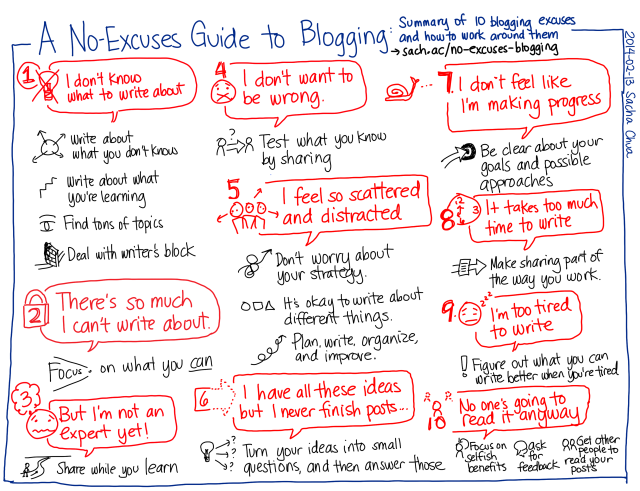
I have hit a brick wall with my blogging recently. I had thought that those who were posting had become more “expert” about their content. That was off-putting and intimidating. That might just have been an excuse I was using because I wasn’t finding the time for blogging (and I didn’t seem to have any inspiration). Here’s a summary of excuses I could have used (and being able to make these links is another advantage of blogging).

But your question has caused me to re-think.

You will notice from blogs you’ve read that there is a lot of learning contained in people’s posts. There is a lot of expertise on technical matters, as, for example, in this post on how to set up a blog (which you may find useful). But then, you really don’t have to be an expert to blog. I regard my blog as a memory bank – a jog for my memory and a way of reflecting on what I notice. It’s a workbench on which I can hammer out a few ideas. They’ll never be finished or finely polished, but I am learning and the blog is a useful place to put some of that learning.

I also don’t see any point in keeping things to myself. I do have a heart for some things and I do have a voice which is not to be kept silent, in spite of my introverted nature. I don’t believe that any of us should hide our light under a bushel (particularly in dark times) and I do believe that we should be sharing what we know in as many ways as we can.

But then, there are people who complain of the noise. They say that there is so much out there – so much noise, but so little sense: so much information but so little wisdom. Probably the same complaint has echoed through human history, from the time we started to talk, to the advent of the postal services, to the current development of online social media (social media is as old as our talk). Unless we use our intelligence to interpret the noise our talk will be babble, our mail will be junk and our conversation meaningless. Blogging is just another way of talking things through together – a way of publishing. Nobody needs to buy into what we have to say – but it is what we have to say, it is our part of the conversation. (I tried working this out in a post I called Chitter-Chatter five years ago – see how I can refer back to what I have done?)

I do have a bit of a problem about how social media fits my work culture. It’s widely seen as a distraction. But if we work by sharing then blogging seems an ideal means to that end.

I would be interested in what you have to say because I know that you are in unique situations and I would love to know what you are making of those situations given your own passions and interests. I won’t promise to keep up with your posts if you do choose to blog though I will click the “follow” button.

It doesn’t really matter to me how many “readers” or followers we have. I think I am the main beneficiary of my own blog because of the opportunity it gives me to do some creative writing, because it gives somewhere to put my stuff, because it helps me work things out of me and because it makes me interesting to me.

Happy blogging
David

PS You might be interested in this no-excuses guide to blogging from Sacha Chua. She suggests that you always start with a question when you blog. So I did. To blog or not to blog – I am grateful that you asked me the question. Why not have a look at Sacha’s blog for some inspiration?

You zig while I zag – reflecting on some Myers-Briggs training

zigzag-mb

The way we make decisions and solve problems was described in terms of a zigzag by Isabel Briggs-Myers. Friend and colleague Julia McGuinness walked a group of us through the zigzag and highlighted how the hierarchy of what Myers-Briggs refers to as our “mental functions” affects the way we make decisions. Typically decisions flow from sensing (defining the problem) to intuition (considering possibilities) to thinking (weighing consequences) to feeling (weighing alternatives). This process reflects the pastoral cycle used for theological reflection (with the process often described as experience > exploration > reflection > response) and Kolb’s Learning Cycle (with accompanying learning styles inventory).

kolbs-learning-styles

Each of us has a hierarchy of mental functions. There are two pairs of functions. The first pair is about how we perceive, and they are sensing (S) and intuition (N). The second pair is about how we judge, and they are thinking (T) and feeling (F). Each of us has a preference one of those functions in each pair – they become the middle two letters in a Myers-Briggs profile. One is known as the “dominant” function, and the other is the “auxiliary”. Anyone who knows their MB profile can work out which is dominant depending on whether they are “judging” (J) or “perceiving” (P) types and whether they are extravert (E) or introvert (I). For example, someone who is ESTJ has thinking as their dominant function, sensing as their auxiliary, intuition as their “tertiary”. The hierarchy for an ESTJ is thus:

  1. thinking
  2. sensing
  3. intuition
  4. feeling

Elise Enriques Touchette at Shine a Light Coaching identifies them as driver, passenger, disengaged child in the back and baby rather than dominant, auxiliary etc, making the point that we have to make an effort to engage the disengaged child (the one less inclined to function). She uses a square to describe the ideal decision making process from sensing to feeling via intuition and thinking. The process is squared and divided into equal quarters.

myers-briggs

But life is not like that. We start our own decision making processes from out positions of strength. We have a mental function that drives us, that gets us going. The driver for the ENFJ and the INFP is pictured at the top of the right hand diagram, and the shape within the triangle is the measure of the time, ability/inclination/preference the driver brings to the process. Thinking is the baby in the car – there is little ability, inclination or preference to “apply logic”. (I know – I am an INFP!)

The hierarchy of mental functions demonstrates that we find some things easier than others (as if we need to be told that). It reinforces the fact that we need each other to complement one another – that we do need to collaborate in ministry, learning, everything. It reminds me that I need to stretch myself in some directions I find difficult and that I need the help of others for what I find well-nigh impossible.

What is true for us as individuals is also true for any group. The hospital chaplains I mentioned above are not the only group in which the mental functions aren’t equally shared. Any congregation, family, business organisation has its strengths and has its weaknesses which they will need to address either by finding help from the right sources or by making the effort of stretching out from my comfort zone. For me that will be concentrating more on the larger picture (N) and learning to look more at the facts (S). The “T” I might have to leave for another life.

Leadership Styles and a Political Divide

lamdin

Sometimes you hear bells ringing all the while through reading a book. There was so many chimes in Finding Your Leadership Style by Keith Lamdin – so many “just so” moments”, so many reminders of other reading – and I so agreed with the direction of Keith Lamdin’s travel.

Two women staffing a train tea trolley lead Lamdin’s book. While passengers on a delayed train were getting upset about missing their connections these “trolley assistants read the emotional climate of the passengers on the train and knew that they needed to stay calm”. They led in that moment offering “something different from those more familiar teachings about leadership, vision and motivation”. Their example demands a second look at “leadership” and suggests that leadership is for all types, leadership is not something special and that all of us have natural ability to lead others – though some make better leaders than others. Lamdin writes:

“leadership, like love, is a natural human capacity and that what makes Christian leaders distinctive is their seeking to live as disciples of Jesus. Discipleship informs our discontent, colours and shapes our vision and strategic purpose, and fuels our courage.”

That discontent, vision and courage is what calls people into leadership.

Lamdin describes six leadership styles: monarch, warrior,  servant, elder, contemplative and prophet. They fall into one of two categories: the politics of salvation or the politics of revelation (h/t Gordon Lawrence for that).

Monarchy exists where one person is in charge. If the buck stops anywhere it stops with the monarch. Lamdin suggests that monarchy and hierarchy can’t be justified from Jesus’ teaching. He says that there is nothing hierarchical about a priest’s walk alongside others in the territory of the holy (Countryman’s language) but “the moment that a priest is appointed and installed as a rector, vicar or priest in charge, he or she is bound into the hierarchy”.

A lot of leadership thinking has taken place within earshot of battle and this has given rise to the warrior category. So, for example, early British writing on leadership was shaped by experience of leadership in World War 2. “They” (for example, Bion and Adair) “developed ideas about officer selection, and the language of strategic objectives, missions, leadership development and battle plans seemed to transfer easily enough into the post-war world of reconstruction.” I remember a time when the Diocese of Chester was led by a Major and a Wing-Commander – not only officers, but also gentlemen – and there was a special room at diocesan HQ marked “hierarchy” with a capital H! This tone of leadership is reinforced by the “heroic warrior paradigm” that is the basis of much of Christian formation (for example, Joshua, Gideon, David, and even Jesus).

The monarch and the warrior belong to the “politics of salvation”. Lawrence understands “politics” as “the sense of influence of one person or party over another”. The politics of salvation is demonstrated through the “isms” – communism, fascism, capitalism and democracy. “The preoccupation of the politics of salvation is with change – that is, others holding power impose it from the outside on individuals and systems”.

The monarchs and warriors within our systems are easily identified and they have their place. In certain contexts they are the right styles of leadership. So, Lamdin comments, “the monarch provides safety and stability and organisational effectiveness” and “many great changes in social welfare and charitable work are fuelled by this sense of energy, vision and sacrifice. Where the enemy can be constructed and named, whether it is slavery, child poverty, capitalism or socialism, Christianity or Islam, then the energies of the warrior leader are released”.

I would suggest that there is a problem in any organisation that organises itself around these two models of leadership because they are only particularly suitable for certain contexts (where there needs to be a rule and where there’s a battle). Lives which become just that are dysfunctional and organisations that become just that are abusive and xenophobic.

These are also male models of leadership. In a paternalistic and patronizing culture the likelihood is that the monarch is going to be male (and does monarchy thrive in cultures that aren’t paternal and patronizing?). Sport is prominent in our culture. So much of the talk within sport is fighting talk (defence/attack, fighting relegation etc etc) that it isn’t surprising that we have so many “warriors”.

Was Jesus not spending time with those who’d had more than enough of monarchs and warriors? He spends his time with those the monarchy cast out and he challenged the very essence of enmity by teaching his disciples to love their enemies. Was he not saying that we’ve had enough? Does he not expose the limitations (and suffering) of the monarchs and warriors, indicating other ways that deepen and transform community? Lamdin writes: “Jesus finds himself in a religious culture which should be liberating but which is stifled by regulation and political compromise. He sets himself against the establishment and seeks to overturn it with his capacity bot to heal people and to teach them about his understanding of the God of Abraham, Isaac and Jacob”.

The politics of revelation is the landscape from which the trolley assistants emerge. Their leadership takes people (eg Lamdin) by surprise. Their leadership is a revelation. For Lawrence, “the politics of revelation is preoccupied with the conditions and resources for the exercise of transformation that come from inside the person or system, and are brought about through the people revealing what may be the truth of their situation to themselves and taking authority to act on their interpretation”.

The move from one politics to the other is, according to Lawrence, a paradigm shift. It is a shift which allows us to notice a wider range of leadership, to allow the emotionally intelligent trolley ladies to lead us and to recast our organisation for more than battle and an imposed rule.

Lamdin recognises the servant, the elder, the contemplative and the prophet. Of servant-leaders, Steven Covey writes:

“It has generally been my experience that the very top people of truly great organisations are servant-leaders. They are the most humble, the most reverent, the most open, the most teachable, the most respectful, the most caring and the most determined.”

They lead by relationships, not by coercion or domination, guiding people, not driving them.

The elder is the source of wisdom in many communities (though in western society the elder is often redundant). The elder is the consultant belonging to the wisdom tradition represented so well by Jesus through his parables. Here there is no interpretation imposed from outside. Lamdin writes beautifully about this:

“Every time you are faced with something that puzzles you and you discuss it with friends and in the end come to your own decision, you are exercising your freedom and your responsibility. You are more fully inhabiting the world that God has given us in which to work out what it means to be made in God’s image. Every time you do what you are told without thinking, you opt out of the calling that the early stories of Genesis seem to indicate God has imagined for us all.”

The contemplative secures the place of the important and the priority for “prayer, meditation and contemplation” in a world that is at it 24/7.

Lamdin’s comments on the prophet are inspired by Arbuckle’s work on leadership, which Lamdin refers to as the “only book on leadership which is about dissent”. Gerry Arbuckle suggests that the “healthy future of any organisation is to be found not only in the leadership of the hierarchy but also in the leadership that emerges in dissatisfaction and dissents, and in the conflicts between them” It is the prophet who raises the voice of the poor and needy, “a voice that cries for justice, an end to evil abuse of power and the redistribution of wealth”.

Some questions:

Where is there monarchy and where are the warriors in my organisation? Are they strictly necessary in these circumstances?
Should we build a whole leadership industry around them?
Do the politics of salvation shape our pedagogy and church? What would they look like if they didn’t?
And where are the servants, elders, contemplatives and prophets through whom our souls really rejoice?