What shape is the Diocese of Chester in? Received wisdom casts the Diocese as a tea pot Following the shape of the old Cheshire. I’ve never quite seen it. I assume that the handle is to the east, and the spout is the Wirral peninsula to the west. It’s like those gestalt pictures through which we jump to conclusions about what we see.
What do you see here?
For me it’s got to be a bird. And the shape it’s in is as a dove. The tail feathers are in the west. It would be better if we could tilt the Wirral down a bit, but we don’t have to be precise. The beak district is in the east, the Peak District. The doves markings are the map pins identifying the churches of the Diocese. One episcopal eye winks at Altrincham. The other suffragan episcopal eye is in the tail feathers giving a steer to issues of poverty and life expectancy exposed by the contrasts between Deeside Wirral and Merseyside Wirral. Chester (with Cathedral and Bishop’s House) is the reproductive egg laying organ.
Or it’s a scary monster waving its hands in the air. You see what you want to see don’t you?
Metaphors generate meaning. The metaphor of the teapot may have been a godsend to those whose concern was to create a sense of fellowship. But would you rather have a diocese which is like a teapot, or a diocese which is like a bird? But not just any bird. Would you like a church that is like a dove?
“We need to “go out”, then, in order to experience our own anointing, its power and its redemptive efficacy: to the “outskirts” where there is suffering, bloodshed, blindness that longs for sight, and prisoners in thrall to many evil masters …. giving what little ointment we have to those who have nothing, nothing at all.
A priest who seldom goes out of himself [herself], who anoints little …. misses out on the best of our people, on what can stir the depths of his [her] priestly heart. Those who do not go out of themselves, instead of being mediators, gradually become intermediaries, managers. ….
It is not a bad thing that reality itself forces us to “put out into the deep”, where what we are by grace is clearly seen as pure grace, out into the deep of the contemporary world, where the only thing that counts is “unction” – not function – and the nets which overflow with fish are those cast solely in the name of the One in whom we have put our trust: Jesus.”
These quotes are taken from a sermon preached by Pope Francis on Maundy Thursday 2013. The full text of Pope Francis’s sermon is here.
“I am against bigness and greatness in all their forms, and with the invisible molecular moral forces that work from individual to individual, stealing in through the crannies of the world like so many soft rootlets, or like the capillary oozing of water, and yet rending the hardest monuments of man’s pride, if you give them time. The bigger the unit you deal with, the hollower, the more brutal, the more mendacious is the life displayed. So I am against all big organizations as such, national ones first and foremost; against all big successes and big results; and in favor of the eternal forces of truth which always work in the individual and immediately unsuccessful way, under-dogs always, till history comes, after they are long dead, and puts them on top.” William James
Richard Beck’s blog is well worth following. He has helpfully organised his blog into series of posts. One of them is A Walk with William James. Richard regards James as one who anticipated the leading ideas of the emergent church movement as well as the “greatest American psychologist”.
I am increasingly struck by the big significance of the small, and the tiny significance of the big. The large institutions are increasingly seen as disappointing. It is the tiniest interactions which constitute nature and these are becoming our trusted teachers. This subversion was already realised in Jesus. His subjects included a mustard seed, a small child, a raven. His relationships were in the margins of the alienating big society.
Seeing red is a turn on for male primates according to a recent survey. The survey suggests that men are more turned on by women in red and that although men like to think that they respond to women “in a thoughtful and sophisticated manner, it appears that at least to some degree their preferences and predilections are, in a word, primitive”. Well!
Elisabeth Schussler Fiorenza playfully argues in Discipleship of Equals that if all the bishops are going to be men, all the cardinals should be women. What would happen to the bishops if they were seeing red? Fiorenza quotes from an article by Congo, Goodwin and Smith called “We Are Catholics and We Are Feminists”:
Perhaps we should wear red. red to acknowledge courage. Red to acknowledge that we are angry. Red to acknowledge that we are passionate. Red to acknowledge that we are sexual and like our sisters of herstory are still officially barred from the sanctuary because we menstruate. red to acknowledge the blood that flows from us with each birth, with each abortion, with each battering and with each assault …
For now, we pray for the election of a Pope who can build leadership which is holy and humble of heart so that bridges can be built and mended. Our Daily Prayer today contains this prayer as response to Psalm 79:
When faith is scorned and love grows cold, then, God of hosts, rebuild your Church on lives of thankfulness and patient prayer; through Jesus Christ your eternal Son.
One of the principle insights of Belbin’s theory of team roles is that all of us have preferences for particular roles within a team. Belbin lists nine of these roles emphasising that all of these roles need to be filled if there is to be a fully functioning team. Our role preferences are governed by our strengths. For example, somebody has to check the bright ideas that come from the team members. That person, is, according to Belbin’s description, a “monitor evaluator”. This will be a preferred role for someone who is “sober, strategic and discerning” and “who sees all options”. But there is a downside to these “strengths”, and for the “monitor evaluator” there are “allowable weaknesses” of lacking drive and being unable to inspire others.
Our default position about weaknesses is complaint and annoyance. The consequence of this is that it is more usual not to publicly acknowledge individual weakness, and internalise the complaint and annoyance. That can’t be good for teamwork! Weaknesses are only usually judged negatively, but some weaknesses are allowable and could be viewed constructively.
Why do we not celebrate our weakness? It seems to me that Belbin gives us permission for that, because there is always a flipside to weaknesses. Instead of complaining about X’s lack of drive, we can recognise that X can play a vital part in our enterprise.
For my part (my preferred role is “plant”), I know that some may find my inability to “communicate effectively” (because I get “too preoccupied”) and my “ignoring of incidentals” frustrating and annoying. But that’s what you get in exchange for someone who can be “creative, imaginative, unorthodox”. Personally I am grateful for those who have seen the potential that I have through those weaknesses.
So, why don’t we talk more openly, and more positively, about weaknesses?
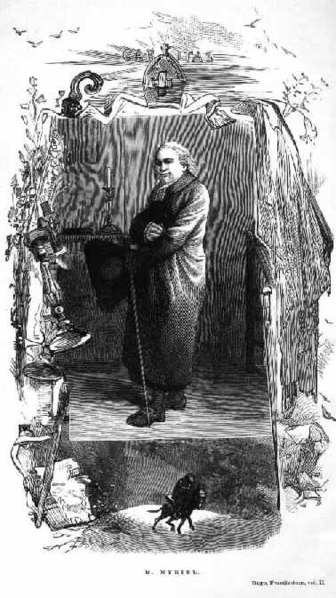
The Bishop of Digne is a key character of Les Miserables. He is the one who offers Jean Valjean refuge, who treats him as an “honoured guest” and a shelter from the rules which allows Valjean to change his mind to the question which echoes through the story: the question of “who am I?” Valjean, or, rather, Prisoner 24601 conforms to type when he abuses the hospitality. He runs off with the silver and is captured by the law enforcers. They deliver Prisoner 24601 to the Bishop. The Bishop seizes the moment (what had he done to be prepared to react with such imaginative compassion?) and lyingly claims he had given the silver to Valjean, dismisses the police, commending them for their duty, and gives Valjean his chance.
Digne is in south-eastern France. I don’t know whether the name Digne had significance for Victor Hugo, but surely some association with dignity was intended. We might say that the Bishop of Digne was a steward (another word for “bishop”) of Dignity. The Bishop is only a marginal character but according to Theresa Malcolm “he is the soul of the novel, he who sowed love where there was hatred, light where there was darkness”. Bishop Myriel (as was the name of the then Bishop of Digne) was also known as “Monseigneur Bienvenu” for his spirit of generosity and welcome.
Victor Hugo dwells on the character of the Bishop of Digne at great length. He describes how he moved out of his episcopal palace so that it could be used as a hospital. He describes how he gave 90% of his stipend to charity, and how he simply lived for the poor. He spent his life for them matching deed to word. He spent time with prisoners. Hugo described how Myriel went with one prisoner, standing side by side with him on the scaffold, having spent the previous day with him, sharing with him “the best truths, which are also the most simple. He was father, brother, friend; he was bishop only to bless.” It was through such a lifestyle that people came to refer to the Bishop as “Monseigneur Bienvenu” – a bishop most welcome and welcoming.
This key character brings freedom. He unlocks Valjean’s soul and “gives him back his life”. Fourteenth century poet Hafiz comments on such great people who “drop keys all night long”:
The small person
builds cages for everyone
he
sees.
Instead, the sage,
who needs to duck his head,
when the moon is low
can be found dropping keys, all night long
for the beautiful
rowdy,
prisoners.
Valjean sums his situation up with these words:
For I had come to hate this world
This world which had always hated me
Take an eye for an eye!
Turn your heart into stone!
This is all I have lived for!
This is all I have known!
One word from him and I’d be back
Beneath the lash, upon the rack
Instead he offers me my freedom,
I feel my shame inside me like a knife
He told me that I have a soul,
How does he know?
What spirit came to move my life?
Is there another way to go?
I am reaching, but I fall
And the night is closing in
And I stare into the void
To the whirlpool of my sin
I’ll escape now from the world
From the world of Jean Valjean
Jean Valjean is nothing now
Another story must begin!
The engraving by Gustave Brion shows the Bishop of Digne – prepared for the first edition of Victor Hugo’s Les Miserables in 1886.
Theological perspectives have changed. Tonight I am meeting with our “Readers’ Council” to hear their concerns about their “Continuing Ministerial (Professional) Development”.These changes in theological perspective will be very much on my mind.
Reader ministry in the Church of England was “revived” in 1561 and in 1866 to minister in poorer parishes “destitute of an incumbent” and to cope with the population explosion in cities in the early 19th century. They had a different point of view from the clergy. The Bishop of Bangor (in 1894) saw the advantage of “Christian men who can bridge the gap between the different classes of society” – And the Dean of Manchester recognised that most Readers were “more in unison with the masses with whom they mixed”. Although the Diocesan Readers came from the professions, the Parochial Readers were described as ‘the better educated from among the uneducated’. Nowadays Readers and clergy train together both before and after licensing and ordination. I have been ordained long enough to remember that this was not always so, and to remember that the idea that Readers and clergy could train together seemed preposterous. Now we take it for granted and appreciate the advantages of learning together.
This movement of theology is reflected in many of our traditions. From a Roman Catholic perspective, Ilia Delio traces the development of theology from the preserve of the priest in his academic study to a vast lay, creative and inter-disciplinary movement. This huge paradigm shift is dated back as recently as the 1970’s when only 5% of theologians were non-priests. That figure has grown to over 60%. Theological education is now well beyond the control of the institutional church. Diarmuid O’Murchu lists features of this shift in his book Adult Faith:
Theology is no longer reserved to the academic domain.
Theology has gone global, even beyond the boundaries acknowledged in multi-faith dialogue.
Theology has become quite multi-disciplinary and interdisciplinary. “The contemporary lay theologian seeks to address the here-and-now of evolutionary creation … [casting] a wide net within a contextual landscape … [seeking] dialogue with partners in various fields of learning, transcending wherever possible the dualistic distinction between the sacred and the secular” (O’Murchu, p66f).
Lay theologians do theology in a vastly different way from their clerical counterparts, who “prioritise the church, its traditions, teachings and expectations” (O’Murchu, p119)
Christian theology has become radicalised as theologians “sought to realign Christian faith with one pervasive theme of the Christian Gospels: the New Reign of God”. (O’Murchu). Christian life is increasingly seen as “empowerment” and “called to be a counterculture to all forms of destructive power … facilitated not by some new benign form of hierarchical mediation, but by dynamic creative communities.” (O’Murchu).
For O’Murchu the “Kingdom of God” is “the companionship of empowerment” with theology being the “servant wisdom” of that companionship, so that “theology once more becomes a subversive dangerous memory, unambiguously committed to liberty from all oppressions and to empowerment for that fullness of life to which all creatures are called.” (O’Murchu, p65).
Theology has changed. In many traditions theology was thought to have been the preserve of the clergy. Readers and other lay ministers helped to open those boundaries, but their tendency remains to “prioritise the church, its traditions, teachings and expectations.” Now we increasingly realise that theology goes beyond the church (why has that taken so long?). Our shared “ministerial development” is to realise this, to overcome the tendency to prioritise the church and to engage with the “companionship of empowerment” wherever that is found.
In Leaving AlexandriaRichard Holloway recalls Virginia Woolf’s tract Three Guineas(originally published in 1937) in which she contrasts the private house (woman’s sphere) with public life (man’s sphere):
Your world then, the world of professional, of public life, seen from this angle, undoubtedly looks queer.
At first sight it is enormously impressive. Within a small space are crowded together St Paul’s, the Bank of England, the Mansion House, the massive if funereal battlements of the Law Courts: and on the other side, Westminster Abbey and the Houses of Parliament. There we say to ourselves, pausing, in this moment of transition on the bridge, our fathers and brothers have spent their lives. All these hundreds of years they have been mounting those steps, passing in and out of those doors, ascending those pulpits, preaching, money making, administering justice. It is from this world that the private house … has derived its creeds, its laws, its clothes and carpets, its beef and mutton. And then, as is now permissible, cautiously pushing aside the swing doors of one of these temples, we enter on tiptoe and survey the scene in greater detail.
The first sensation of colossal size, of majestic masonry is broken into a myriad points of amazement mixed with interrogation. Your clothes in the first place make us gape with astonishment. How many, how splendid, how extremely ornate they are – the clothes worn by the educated man in his public capacity! Now you dress in violet; a jewelled crucifix swings on your breast; now your shoulders are covered with lace; now furred with ermine; now slung with many linked chains set with precious stones. Now you wear wigs on your heads; rows of graduated curls descend your necks. Now your hats are boat-shaped, or cocked; now they mount in cones of black fur; now they are made of brass and scuttle-shaped; now plumes of red, now of blue hair surmount them. Sometimes gowns cover your legs; sometimes gaiters. Tabards embroidered with lions and unicorns swing from your shoulders; metal objects cut in star shapes or in circles glitter and twinkle upon your breasts. Ribbons of all colours – blue, purple, crimson – cross from shoulder to shoulder.
Even stranger, however, than the symbolic splendour of your clothes are the ceremonies that take place when you wear them. here you kneel; there you bow; here you advance in procession behind a man carrying a silver poker; here you mount a carved chair; here you appear to do homage to a piece of painted wood; here you abase yourselves before tables covered with richly worked tapestry. And whatever these ceremonies may mean you perform them always together, always in step, always in the uniform proper to the man and the occasion.
He suggests that groups should be made up of one, three of five people for creative purposes (odd numbers), and made up of two or four people for “settling” purposes (even numbers). There should never be more than six people in a small group because introverts begin to withdraw when groups get to that size and the group then begins to lose the benefits of diversity.
According to Chris, the reason smaller groups work well is because there are more “edges”. The more edges you have, the more diversity you create. The more diversity you create the more resourcefulness and sources you have. This is a principle from nature about how things combine better “when we have more ways of offering ourselves to each other”.
The concept of a group of one sounds odd in our world governed by groupthink. But it does seem reasonable to start counting group size with the number “1”. Not only does that include those who work best alone in the common enterprise, but it also acknowledges the creative tensions of intra-personal interaction. The pendulum is swinging back to recognise that “groups of one are the best way to innovate” and that larger groups are not a “good place for generating innovation”.
I often hear fellow ministers talking about the power of small groups. What we forget is that groups can be as small as one. Already congregations and organisations are made up of small groups without anyone having to try to engineer them. Rarely do the groups of one have their voice heard which means that they may not realise their responsibility or potential.
Extraversion has been the order of the day and the assumption is that we get our creative energy “out there”, through collaboration and with developed “people skills”. But, according to research by psychologists Mihaly Csikszentmihalyi (you’d have to be broad shouldered to have that name on the back of your football shirt!) and Gregory Feist, most creative people in many fields are often introverted. They need solitude as a catalyst to innovation.
Susan Cain is critical of “groupthink” in a New York Times article. She quotes Eysenk’s observation that introversion fosters creativity by “concentrating the mind on the tasks in hand, and preventing the dissipation of energy on social and sexual matters unrelated to work”. She refers to research which suggests that group performance gets worse as group size increases and quotes organisational psychologist Adrian Furnham. “Evidence from science suggests that business people must be insane to use brainstorming groups. If you have talented and motivated people, they should be encouraged to work alone when creativity or efficiency is the highest priority.” Picasso’s take on it was that “without great solitude, no serious work is possible”.
There are already “safe spaces for respectful conversations across partisan divides” which have been developed with great care through community development. They are shockingly liberal and discomforting, but need treasuring and multiplying. The above sign is from St James’ Church, Piccadilly in which rough sleepers mix (and sleep) with other worshippers (gathering from across many partisan divides) under one roof.
Parker J Palmer, in the Huffington Postdraws attention to a project organised by the Wisconsin Council of Churches (with backing from Baha’i, Buddhist, Christian, Muslim and Jewish communities) initiated by a call from thirty-six religious leaders from across the state have called for “a Season of Civility“. Amidst “partisan rancour” they realise that they “must create ‘safe spaces’ for respectful conversations across the partisan divides. And we must move beyond the walls of our congregations to include everyone in our local communities in this dialogue.” They are using Parker Palmer’s Healing the Heart of Democracyto help guide their thinking, focusing on five “habits of the heart”:
understanding that we are all in this together (where have we heard that before?)
an appreciation of the value of “otherness”
an ability to hold tension in life-giving ways
a sense of personal voice and agency
a capacity to create community
Palmer’s Huffington Post article is written with American civility (or, lack of) in mind, but the issues he faces are universal. They transgress partisan divides. “The powers” have ways of discouraging us from rattling cages and discouraging conflict. In workshops (safe spaces?) I have seen that conflict has negative connotations for most people. But Palmer reminds us that conflict has a real place in the development of civility, community and society. “America was founded on the historically novel and radical premise that conflict and tension, rightly held, are the engine, not the enemy, of a better social order.” “The civility we need will come not from watching our tongues, but from valuing our diferences and the creativity that can come when we hold them well.”




 Grits and Grains

