Opening Advent Doors

advent-door

Advent is a time for praying for the coming of Emmanuel, that God may be with us, and for each of the evenings of the week before Christmas there is an “O” antiphon. Each of the seven antiphons is prefaced by “O” and addressed to the Messiah according to the names for him found in Isaiah. The “O” expresses our longing. The seven antiphons are addressed to Wisdom, Lord, Root of Jesse, Key of David, Dayspring, King and Emmanuel.

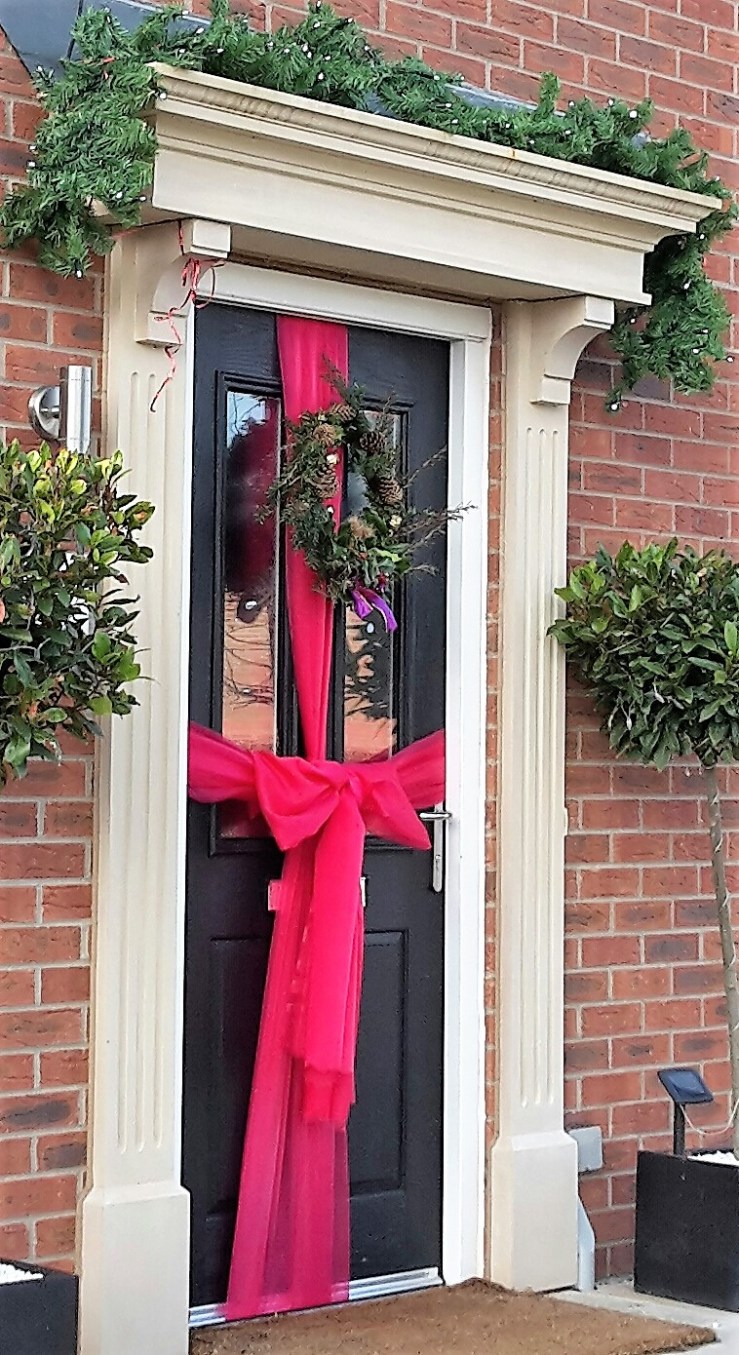
Doors are very much a theme of Advent. Doors are both barriers and openings. We open a “door” a day on our Advent calendar to signify our willingness to open our hearts to the coming of Christ. Many decorate their front doors in a way that invites the stranger, in a way that begs to be opened (as in the door of one of our neighbours pictured above). Some doors are hard to shift and many are locked behind them.

Malcolm Guite has written a beautiful poem in response to the O Clavis antiphon (based on Isaiah 22:22):

O Key of David and sceptre of the House of Israel;
you open and no one can shut;
you shut and no one can open:
Come and lead the prisoners from the prison house,
those who dwell in darkness and the shadow of death.

This is Malcolm’s response (which is set in a beautiful image by Linda Richardson):

Even in the darkness where I sit
And huddle in the midst of misery
I can remember freedom, but forget
That every lock must answer to a key,
That each dark clasp, sharp and intricate,
Must find a counter-clasp to meet its guard,
Particular, exact and intimate,
The clutch and catch that meshes with its ward.
I cry out for the key I threw away
That turned and over turned with certain touch
And with the lovely lifting of a latch
Opened my darkness to the light of day.
O come again, come quickly, set me free
Cut to the quick to fit, the master key.

The poem senses despair but also senses freedom, if only we could find “the key  I threw away”, that “turned and over turned with certain touch and … opened my darkness to the light of day”. I love the sense of freedom because “every lock must answer to its key” and “each dark clasp … must find a counter-clasp to meet its guard”.

There are so many locks to spring. Back in the 14th century, Hafiz wrote about the sort of people who lock others up, and the sort of people who work in the darkness to set people free. They “drop keys all night long”:

The small person
builds cages for everyone
he
sees.

Instead, the sage,
who needs to duck his head,
when the moon is low
can be found dropping keys, all night long
for the beautiful
rowdy,
prisoners.

What are the cages, catches, vices, locks and blocks that bind us? What needs to be undone for peace to be declared on earth?

You may be interested in the Jesus Doors by Cheshire artist Ali Hutchison and the Advent Haikus Jim Bridgman has written for every day of Advent as part of his blog which is Really Nothing but which is in fact, quite something. You might also be interested in The Advent Door by Jan Richardson.

Of Preachers, Poets & Performance, with some inspiration from Sarah Kay

I was blown away by this utterly captivating performance by Sarah Kay telling of things that matter and drawing people into her enterprise. Poetry lifted from the page takes on an entirely different dimension.

Peter Stevenson reminds us that preacher and poet are both performance arts and reminds us of David Schlafer’s encouragement to preachers that they find their own preaching voice as Poet, Storyteller or Essayist.

Now so much performance art is available on the likes of Youtube, more preachers will find their poetic voice. Irish poet Michael O’Siadhail points out that the Irish word for poet, ‘files’, translates as seer.

The prophetic voice is the poetic voice, ordinarily spoken and performed. It’s a tradition that is as old as God’s people as poets have spoken from the heart and to the heart, from the heart of God to the heart of people, from the heart of the people to the heart of God.

Growing Gardens of Love

How disappointing is joyless religion? William Blake captures the disappointment so well in The Garden of Love.

I went to the Garden of Love,
and saw what I never had seen;
a Chapel was built in the midst,
where I used to play on the green.

And the gates of this Chapel were shut,
and ‘thou shalt not’ written over the door;
so I turned to the Garden of Love
that so many sweet flowers bore.

And I saw it was filled with graves,
and tombstones where flowers should be;
and priests in black gowns were walking their rounds,
and binding with briars my joys and desires.

This is big religion and tragic religion. This is religion that perversely keeps watch, that keeps people out of the garden, that cancels playtime. It overpowers many faith communities around the world. Eucharistic religion, on the other hand, rejoices in the present moment, delights in love and hope, and grows new gardens of playfulness. Church planters take note.

The photo has been released into public domain by its author, Chitrapa at the wikipedia project

Maya Angelou as one touched by an angel

Maya Angelou died yesterday, aged 86. She was born poor and black and her gifts were born out of pain and hardship. She knew why the caged bird sings. Her son, Guy, writes: “she was a warrior for equality, tolerance and peace.” She helped many through the passion, hope, humour and compassion of her autobiographies and poetry. She is a wise woman of our age, and eminently quotable. On this Ascension Day I choose her poem Touched by an Angel to remember a woman who had a love with the power to live and see through so much.

Touched by an Angel

We, unaccustomed to courage
exiles from delight
live coiled in shells of loneliness
until love leaves its holy temple
and comes into our sight
to liberate us into life.

Love arrives
and its train come ecstasies
old memories of pleasure
ancient histories of pain.
Yet if we are bold,
love strikes away the chains of fear
from our souls.

We are weaned from  our timidity
in the flush of love’s light
we dare be brave
And suddenly we see
that love costs all we are
and all will ever be.
Yet it is only love
which sets us free.

The List – a poem for World Book Day

The List
By Naomi Shihab Nye

A man told me he had calculated
the exact number of books
he would be able to read before he died
by figuring the average number
of books he read per month
and his probable earth span,
(averaging how long
his dad and grandpa had lived,
adding on a few years since he
exercised more than they did).
Then he made a list of necessary books,
nonfiction mostly, history, philosophy,
fiction, and poetry from different time periods
so there wouldn’t be large gaps in his mind.
He had given up frivolous reading entirely.
There are only so many days.

Oh, I felt sad to hear such an organized plan.
What about the books that aren’t written yet,
the books his friends might recommend
that aren’t on the list,
the yummy magazine that might fall
into his hand at a silly moment after all?
What about the mystery search
through the delectable library shelves?
I felt the heartbeat of forgotten precious books
calling for his hand.

What if every word we say never ends or fades away?

What are the words that wake us? What words wake us, make us and break us? These are the questions rattling round my mind today.

Malcolm Guite has a sobering reflection on words in which he reflects on the shadow side of language – he has called it “What if …” (You can hear Malcolm’s reading here). He prefaces his poem with these words from Matthew’s Gospel:

But I say unto you, that every idle word that men shall speak, they shall give account thereof in the day of judgement. For by thy words thou shalt be justified, and by thy words thou shalt be condemned.” Matthew 12:36-37

What if every word we say
Never ends or fades away,
Gathers volume gathers weigh,
Drums and dins us with dismay
Surges on some dreadful day
When we cannot get away
Whelms us till we drown?

What if not a word is lost,
What if every word we cast
Cruel, cunning, cold, accurst,
Every word we cut and paste
Echoes to us from the past
Fares and finds us first and last
Haunts and hunts us down?

What if every murmuration,
Every otiose oration
Every oath and imprecation,
Insidious insinuation,
Every blogger’s aberration,
Every facebook fabrication
Every twittered titivation,
Unexamined asservation
Idiotic iteration,
Every facile explanation,
Drags us to the ground?

What if each polite evasion
Every word of defamation,
Insults made by implication,
Querulous prevarication,
Compromise in convocation,
Propaganda for the nation
False or flattering peruasion,
Blackmail and manipulation
Simulated desparation
Grows to such reverberation
That it shakes our own foundation,
Shakes and brings us down?

Better that some words be lost,
Better that they should not last,
Tongues of fire and violence.
O Word through whom the world is blessed,
Word in whom all words are graced,
Do not bring us to the test,
Give our clamant voices rest,
And the rest is silence.

Malcolm has a new book of poetry being published this month – The Singing Bowl.

Man of the Match

First half:

Shaking off the tiredness of the day
ushered black skin dayglo into concessionary parking
(it’s not Premier League you understand)
we trudge to Eastlands
side by side strangers
whose separate feelings
we don’t understand
but whose goal we share.
Parking charges upwards
through five poundland to eight poundland.
The crowd thickens, the heartbeat quickens
by pubs and scarf sellers geared and guarded
for their once in a while chance of trade and profit.
Tickets are for sale.
Queues pour from tiny windows like snakes
slowly slithering. We could complain.
It was an hour. But we’re not united.
We are City and what is a missing half?

Second Half:

A boy in the crowd waits to be found
amongst wannabes dreaming catapults
from limelight to spotlight.
Many moons from Titograd
to the moment of his life
a debut, two goals and a loud speaker
hailing the name Stevan Jovetic,
Number 35. Man of the Match
found and fanned to high heaven,
feelings united, everything forgotten.
Five nil.

Eternity

The grave of William Blake (on St George's Day) Approximately 0.87 miles from Haggerston in Hackney, Greater London · © ceridwen Photos kindly supplied by Geograph, and may be reused subject to this creative commons usage licence.

He who binds to himself a joy
does the winged life destroy;
But he who kisses the joy as it flies
lives in eternity’s sunrise.

William Blake

William Blake died on August 12th 1827. The grave of William Blake (on St George’s Day) is at Bunhill Fields Burial ground in Hackney, Greater London. Photo © ceridwen kindly supplied by Geograph, and may be reused subject to this creative commons usage licence.