Retracing our steps to our first vocation

Lent 2a

Draft sermon for March 5th 2023

Readings: Genesis 12:1-4a and John 3:1-17

I begin with a blessing written by Jan Richardson. Jan has written a blessing for every Sunday based on the readings. You can find them on her website called The Painted Prayerbook.

This one is called “Beginning with Beloved – a blessing

Before reading it I have to say that I never know how to pronounce “beloved”. How do you say it?
Is our confusion because we don’t use the word enough?
Is it one word or two? Beloved or be loved?

Here is the blessing:

Is there any other words
needs saying,
any other blessing
could compare
with this name,
this knowing?

Beloved

Comes like a mercy
to the ear that has never
heard it.
Comes like a river
to the body that has never
seen such grace.

Beloved

Comes holy
to the heart
aching to be new.
Comes healing
to the soul
wanting to begin again.

Beloved

Keep saying it
and though it may 

sound strange at first
watch how it becomes
part of you,
how it becomes you,
as if you never
could have known yourself
anything else,
as if you could ever
have been other
than this.

Beloved.

Today is the 2nd Sunday of Lent.

Lent gets its name from the Old English and refers to the lengthening of the days during the spring following our wintering, as in “our days are lentening”.

Ancient wisdom has carved out these gifts of time for us. 

It is journeying time,

time for following the Way of Jesus,
for journeying through our difficult and dark age to the day of resurrection and a day without darkness when every tear will be wiped from our eyes, when death will be no more and when mourning and crying and pain will be no more. (Revelation 21 and 22).

Our readings feature Abram and Nicodemus. They are both setting out on journeys of faith.

God told Abram to leave his country, his kindred, his home.
He was 75 years old when he left everything behind for the sake of “becoming a great nation” and to be the blessing for all the families of the earth. 

(As an aside, it is interesting to note that in our moment of history when there is unprecedented migration that those who count themselves as “children of Abraham” – Muslims, Jews and Christians – owe their identity to Abram who made his name Abraham by leaving his country, kindred and home and became a migrant.)

Abram left his old life behind. He left his old age. He left his identity and he even left his name to become Abraham.

The meaning of the name Abraham is “Father of a crowd” or “Father of multitudes”.

God is the making of him and he becomes his name.

Nicodemus’s journey is very different. Nicodemus is mentioned three times in John’s gospel. This is the first – here he comes to Jesus by night. He may be a teacher of Israel but he doesn’t understand what Jesus is really talking about. He is in the dark.

How can anyone be born again? How can someone who has lived so much life be born again? How can anyone who has travelled so far get back to the beginning?
These are the questions that spring to his mind when Jesus tells him that those who want to see the kingdom of God need to be born again.

In the second passage (John 7:45-51) he is part of the ruling council which wants to condemn Jesus – but Nicodemus emerges from their shadow to stand out against them to defend Jesus.

The third passage (John 19:38-42) shows Nicodemus taking responsibility with Joseph of Arimathea for laying Jesus in the garden tomb after his crucifixion.
He is the last person to touch Jesus’ body before his resurrection – and as such he is celebrated as one of the Myrrhbearers by Orthodox Christians on the 3rd Sunday of Easter.


Like Abraham, Nicodemus is on a journey of faith. But Nicodemus’s journey is measured in light. Here we see him coming to Jesus in the dark. By the end of the gospel we see him in the light of Jesus’ death and resurrection. His movement is from the darkness of not-knowing into the light of knowing. That is how he is born again.

What is true for Nicodemus must be true for us as well. Jesus said, noone can see the kingdom of God without being born from above. We have to be born again to see the kingdom of God. But how? 

How are we born again, and how do we help others to be born from above?

I don’t know about you but I never made anything of the anniversary of my baptism – then I went to the trouble of finding the date and now have that in my diary. This week on March 11th I will have been baptised 72 years. I am sorry for what I have missed by not remembering it. 

Baptism marks the beginning of a journey with God when the church welcomes the new Christian, promising support and prayer for the future. It’s a new life, walking in the light of Christ for the rest of our lives. It’s a new life born by water and Spirit. That’s the theory.

Maybe Lent is an opportunity to retrace our steps to that beginning,
retracing our steps to that time the church started lovingly calling us by name,
when we became precious sister or brother to all the other people of God,
when we were commissioned alongside them,
committing ourselves with all Abraham’s children to grow in friendship with God,
in love for his people,
listening to the word of God and receiving the gifts of God.

If Lent is a journey, maybe it’s time to go backwards in order to move forwards.

Maybe Lent is the time to recall the voice that set us on the path of a new life. 
Maybe Lent is the time to retrace our steps to that beginning when we heard our name called in such a way as to save us, not condemn us – when we heard our name called in such a way as to save us from the old age.

Maybe Lent is the time of recalling ourselves in Christ who was sent into the world only ever to save the world, and never to condemn the world.

Maybe Lent is the time to listen to our name being called without a hint of a curse or judgement.
Henri Nouwen wrote in his book, The Life of the Beloved, “We are beloved. We are intimately loved long before our parents, teachers, spouses, children and friends loved or wounded us….”

Maybe Lent is the time to search for our blessing.

Maybe Lent is the time to listen for the same voice that Jesus heard at his baptism, the voice from heaven which said: “You are my son, whom I love. With you I am well pleased.”
“You are the one whom I love. With you I am well pleased.”

Maybe Lent is the time for us as church to be born again. It is hard for God’s word to be heard when the church is too guarded in blessing and too quick in judgements. 

In Lent we return to the beginning, to what we have forgotten about the making of us. We begin with the inscription of dust on our foreheads to remind ourselves that God makes life out of dust.
We retrace our often mis-taken steps so that we can begin again the journey of our life time.
We read our scriptures to retrace our blessing.

We turn to Abram (who is the beginning of our faith journey) and Nicodemus
We return to the beginning to see ourselves and others as God intends – as “beloved”.

We are never too old for this journey back to the beginning and then onwards with Jesus.
Part of the blessing is never being written off as too old.

Remember, Abram was 75 when he was told to leave everything, when he said good bye to his old age with its curses and judgements.

It’s always time to start again.

And it’s always time to be there for others who want to start again, 

to remind them by word and deed that Jesus’ mission is to save the world, not condemn it,
to reassure them that it is never too late for a fresh start
to bless them by re-calling them      “beloved”.
Tempters and resistance

A sermon draft for Lent 1a – February 26th 2023 at St Mark’s Leamington

Readings: Genesis 2:15-17; 3:1-7 and Matthew 4:1-11

Today is the first Sunday of Lent, one of the seasons of the church’s year. These seasons are gifts of time in which we can grow as disciples. There are 40 days in Lent as there are 40 days in the Easter season, from Easter to Ascension, as there are in the season between Christmas and Candlemas, and as many think that there should be during Advent. 

40 is just how long it takes to wait. In the Bible it is always 40 – years or days. 40 is the measure of waiting and testing. For example,

  • God flooded the earth for 40 days
  • The Israelites wandered in the desert for 40 years before entering the Promised Land after being freed from Egypt
  • Goliath mocked and taunted Israel for 40 days
  • Moses and Jesus fasted 40 days

Lent gets its name from Old English and refers to the lengthening of the days during the spring following our wintering – as in lentening days.

Ancient wisdom has carved out these gifts of time for us. What shall we do with this gift of time? 

Our two readings are both dramatisations
– the dramatisation of what it means to be human and loved by God. 
And Lent is a time for staging the drama. 

There is a beginning which is dramatised in the reading we heard from Genesis, which is reenacted on the first day of Lent, Ash Wednesday, when the dust from which we are made is inscribed on our forehead.
And there is an end in sight, the day of resurrection, and a day without darkness when every tear will be wiped from our eyes, when death will be no more and when mourning and crying and pain will be no more. (Revelation 21 and 22)

Lent holds the drama of the time between, the drama of the everyday and the here and now which, for us today is dramatised in the reading we have just heard about the temptations faced by Jesus.

The time between the beginning and the end is here and now, in the mean time when time can be very mean. 

These are the days of war, hunger, suffering, poverty, corruption, injustice. This is the mean time, a difficult age, a dangerous age when we get anxious about so much and when there is so much temptation. 

It is in this mean time  and in this difficult age that God shows his love for us.

There is no other time for God to show his love for the world.

The gift of Lent is the opportunity to look our time in the eye and face up to the challenge of how we are going to live in this mean time. 

What are our disciplines going to be as we live with temptation in the wilderness and wildness of our lives?
What is our resistance to evil going to look like? 
How shall we build resilience? 
What are the virtues we are trying to inhabit?

There is so much wrong and there is so much broken in our society.

That is what makes this mean-time and a difficult age.

There is temptation everywhere we look.

I know someone who hears the sound of children in the story we know as the story of Adam and Eve. He sees this as a story about growing up, of growing up from an age of innocence and discovering what it is like to be grown up.

We have a new granddaughter. She is two weeks old and she has a sister who is two and a half. The baby is totally innocent. She sleeps mostly. But we know she will soon grow into a toddler who tests boundaries and begins to know right from wrong (and we look forward to her living that life).
The terrible twos will turn into the terrible threes, into the terrible teens, and then terrible old age, sans teeth, sans eyes, sans taste, sans everything.

There isn’t any age of our lives, which isn’t a difficult age.

Temptation takes different forms as we go through all our difficult ages. Temptation in old age is different to temptation for those who are younger.
Temptation when we are tired, run down or ill (which can lead to despair) is different to when we are feeling fresh and on top of things (which can lead to arrogance).
The temptation of those who are poor may be different to the temptation of the wealthy.
The temptation of those living desperately, with disaster, in, for example Ukraine, Northern Syria and SE Turkey is different to when their lives were more comfortable.

Temptation is contextual. We are all tempted differently.

One of our temptations is to trivialise temptation.
Another temptation we fall prey to is the temptation to individualise temptation – temptation isolates us, then shames us. We hide in our shame and focus on our self as the victim of temptation and as the one to resist temptation.

What is wrong is not individualistic but is societal, systemic and thoroughgoing and is of unimaginable scale.
But the tempters who prey on us are socially networked. 
They are in all our systems,

They are inside us – the voices we hear demeaning us and hardening our hearts. 
They are all around us.
They don’t have horns and a pitchfork. They are well groomed to groom us for their own selfish ends.

They come to us as wolves in sheep’s clothing. Tempters look just like us.

The powers in our lives aren’t always kindly intentioned. 
Think of those who try to scam us,
and the bots used to manipulate our thinking and undermine our democracy,
and the empire builders who groom us and use us to profit their purposes. 

They all come with their tempting offers. 

Even those who are kindly intentioned make unreasonable demands which often show that they don’t really understand us.
Work harder, look better, grow faster, spend more.
They’re all orders that disorder us – these are the temptations of our day and age.

These are temptations in our difficult age in which God, even now, shows his love for us.

I have painted a dark picture of our times – and I have done this deliberately because there are so many whose own interest is to persuade us that now is ok – that “we’ve never had it so good”. That is a temptation. The tempters would love us to believe that everything is hunky dory. That way they can get away with anything.

It is tempting to make light of our darkness.

The tempters would love us to believe that giving up chocolate for Lent is enough resistance to temptation. Hopefully we realise that such gestures are only token gestures and that they need to be first steps on the path to building resistance and resilience. 

But many of these gestures are things we take on on our own. And it is not good for us to be on our own in times like these, in mean times and our very difficult age.

If God created our relationships from the beginning to the end of our difficult age, then it is only through those relationships that we can resist. 

It is by being together as a church and as a family that we can resist. 

It is not good for any of us to be alone in our difficult age. 

It is often by talking things through with those who love us in our homes or church – with those who love us with a love that is divine – that we can make sense of things and find the heart to resist.

All of us are living through that “very difficult age”. It’s not good for any of us to be on our own at this time. 

God recognised that from the beginning and created relationships.

Together we can remind ourselves that the only effective resistance to temptation and tempters is through God, that it is only God who can deliver us from evil.
And so we pray, just as Jesus taught us – Lead us not into temptation but deliver us from evil.

This is our greatest act of resistance – to pray together. This is our greatest resistance to the tempters, the powers that be and the wrongs of the difficult age we find ourselves in, however old we are. 

And it is through this particular resistance that we find that God answers our prayer to be led from temptation and to be delivered from evil. That is how we come to know that God loves us – however difficult our age, however mean our times.

This is a reworking of Psalm 139 by Cara Heafey. She had LGBT Christians who may have been wounded by the church in mind when she wrote it. For me, it shows just an example of the importance of our scriptures as texts of resistance. It shows God’s love for us in our mean-time and these words spite the temptation to think that we are not good enough for God’s love.

I made you myself, carefully and lovingly.
I gathered your molecules together,
Scooping them out of the dust, warming them into clay.
I formed you, deftly
With the skill and vision of an artist
Into a unique creation.
A tiny masterpiece.
Your contours bear the imprint of my fingers.
Your imperfections and irregularities are a part of my design;
They are what make you beautiful.
I breathed life into you with my own breath.
To behold what I have brought into being in you
fills me with pleasure and pride.
As I cradle you in cupped hands, how could I feel anything but love?
It is my love for you that brought you into existence.
I know you more intimately than you could ever know yourself.
I know your thoughts before you think them, your words before you speak them,
The pattern and purpose of your days before you live them.
There is no point in hiding or pretending; don’t even try.Who told you that I did not love you?
Who taught you to be ashamed?
Listen to me. Hear the very words that I whispered into you
At the moment of your beginning:
“You are my beloved child, with you I am well pleased.
You are my beloved child, I will never let you go.
You are my beloved child; do not be afraid.”

God is our resistance.

Troubled Times and Mistaken Identities: sermon notes for Trinity 10A

Readings: 1Kings 18:9-18 and Matthew 14:22-33

It is so odd seeing one another in masks isn’t it? It affects our communication because it hides so much of our expression. So much is communicated through the muscles of the lower part of our face. It also makes identification more difficult. I had thought that new guidance would have meant that I would be preaching through a mask this morning – I was thinking how difficult that is going to be.

The idea of masks fit both our readings this morning – because we have two cases of mistaken identity. People thinking that they had seen one thing, but had seen something else altogether.

The first mistaken identity is when the king, Ahab, meets Elijah. Ahab asks Elijah, “Is it you, you troubler of Israel?”

Elijah replies to tell Ahab how wrong he is. He says to Ahab: “I have not troubled Israel; but you have, and your father’s house, because you have forsaken the commandments of the Lord.”

So, who is the troubler? Is the troubler Elijah? Or is it the king who is the troubler? Is Elijah right in claiming that the king’s misrule – the lack of good government is the trouble with Israel?

From Elijah’s point of view (the point of view of scripture), it is Ahab and his wife, “that Jezebel” who had caused all the trouble for Israel by forsaking the commandments and by their fanatical religious persecution, rounding up the “troublemakers”, killing off the prophets and the opposition.

In our own troubled times we have similar identity parades – but with a different cast. People are paraded before us as troublemakers and are made our scapegoats. So within living memory, “Jews”, “blacks”, “gypsies”, those who are gay have all been paraded before us as the troublemakers – and final solutions have been devised to kill them off. But they haven’t been the troublemakers (however militant they may have become). They have been the troubled – and their troublers have been their accusers. The accusers, the persecutors, have been the real troublemakers.

Similar processes are at play when people are demeaned in today’s politics as “doomsters and gloomsters”, or “remoaners”. That is how opposition is dismissed in British society these days. That is how troublemakers are dismissed.

There have always been peacemakers who have been mistakenly identified as troublemakers. Nelson Mandela was despised by the media as a troublemaker. So was Mahatma Gandhi. So was Martin Luther King. So is Greta Thunberg by some. They are not troublemakers but instead have resisted the troublemakers.

John Hume died last week. He lived through that chapter of Irish history we refer to as “the Troubles”. For his political opponents he was regarded as part of the trouble. But he turned out to be a hero of those troubled times refusing to be swayed by the troublers. He was very much one of the architects of the Good Friday Agreement and the peace of the Agreed Ireland.

Martin Kettle, in the Guardian (August 6th) wrote:

He was a political leader who was confronted with a deeply divided society. He was a bridge builder where flag-based identities and community suspicions loomed suffocatingly large. He recognised that building bridges meant talking to, and listening to, the extremes as well as the centre ground. He saw there was no future for a system in which one tradition exercised total power and ignored the excluded. He took the long view about the hard journey that had to be taken. And he never gave up on it.

Do you see how contemporary that exchange between Ahab and Elijah is? “Aren’t you the troublemaker?” “No, you are the troublemaker.”

The Ahabs do not want anyone rocking the boat. They are threatened by them  – not realising it is their monstrous rules which are rocking the boat.

We are living through very troubling times. So many of our landmarks have gone. We can’t touch those we have hold dear. We don’t know what’s going to happen to our jobs. Children don’t know whether they will see their friends in September. Poverty is alarming us. And the World Health Organisation is saying from a global perspective that we haven’t peaked yet. We have never been this way before.

And this brings us to the second case of mistaken identity.

In our gospel reading the disciples are all at sea. All night long the waves have been buffeting their boat. They are all exhausted – so understandably they don’t recognise Jesus when they see him walking towards them. They see him as a ghost, probably as the sea monster, the troublemaker responsible for their troubles and nightmare.

Of course, nothing could have been further from the truth and the disciples realise that when Jesus tells them who he is. He says: “Take heart, it is I. Do not be afraid.” Jesus didn’t refer to himself by his name, Jesus. Instead he said, “It is I” – this is “I AM”, the great I AM – the name by which God chooses to be known to the world.

This is no troublemaker walking on the lake, walking on the water. This is God walking as if a bridge through troubled waters.

This is the one Psalm 89 refers to as the one who rules over the surging sea and who stills the mounting waves. For Job, God alone stretches out the heavens and tramples the waves of the Sea. One commentator, Carol Works, says of this, that “God controls chaos with his toes”. Nobody else does that. And here as they see Jesus walking on the lake they began to see that this must be God – because only God does this.

Chaos is described in terms of “troubled water”. We go through “stormy times”. Nothing is “plain sailing”. We are “all at sea”. How many times do these sort of phrases come to mind in times of trouble? They come from deep in our collective memory – maybe from our birth, or even the waters of the womb.

Jesus calls Peter into troubled water.

“Come” Jesus said to Peter.

“Come” he says to all who would listen to him.

“Step into the water”.

“Get out of your depth”.

“Don’t stay in the shallows”,

“step into the depths, where there is danger, where there is trouble”.

“Join the troubled, don’t be spectators of them.”

“Sail the same waters as the migrants – hear their Sea Prayer (Sea Prayer is a poem by Khaled Hosseini)

“Join Elijah, MLK, Greta Thunberg resisting the evil currents of our culture”

“be prepared to be accused and persecuted as troublemakers”

Those who do are blessed. Jesus said:

 “Blessed are you when people revile you and persecute you and utter all kinds of evil against you falsely on my account.” (Matthew 5:11)

So Peter, the first disciple, responds to Jesus’ “come”. He steps out but becomes frightened by the storm and begins to sink. He cries out to the lifesaver who catches him (remember that Peter was called to be a “catcher of men”).

Other disciples follow. Into the troubled waters of our chaotic times we are called. We are not called to safety but to danger.

I wonder whether this gives us a different understanding about our baptism. What are the waters of baptism other than that stormy lake, or the waters of chaos over which the Spirit of God hovers at the beginning of creation, and hovers at our second birth in baptism – in our re-creation?

We are called into trouble, not away from trouble. We are called into deep water by the one in whom we have the confidence to save us and catch us.

What makes us shy away is we are short of confidence that we can cope. It feels like drowning. We too are people of little faith. But that is OK. Jesus still calls us. “Come” he says to Peter knowing his little faith. “Come” he says to us. “Come, don’t doubt that together we will tread these troubled waters, together we will build bridges. With you in me and you in me we will calm these troubled waters. Don’t be afraid.”

So Jesus calls us in these troubled times. He calls us to join Elijah, Peter. They are not the troublemakers – the trouble has already been made. He calls us in these troubled times and that becomes our vocation – here and now. The gospel reading was intended to hearten those who found themselves in trouble, to accept God’s call to step out in faith. It is the same for us. Peter was the first disciple – we follow as disciples.

We are not called to walk by on the other side, but to get involved. We may not feel that we are very good in trouble, or dealing with conflict. Maybe it is lack of practice. Maybe we have a lot to learn. Maybe we will get that sinking feeling. But Jesus holds his hand out to us at the same time he calls us “Come” – he does show us the way to walk through troubled times.

If we thought it was going to be plain sailing we have probably mistaken God’s call. And if we remain untroubled we may in fact be part of the trouble – a troublemaker.

A New Frame of Mind – some sermon notes for Easter 5A

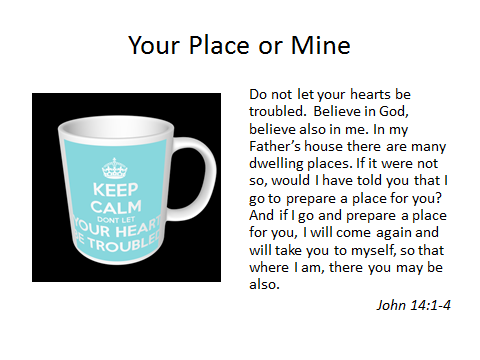
Keep calm 2

Sermon notes for Easter 5A for St Thomas’ Ellesmere Port & St Lawrence Stoak

We often hear the angels say “do not be afraid”. Jesus takes up their heavenly strain. He says “Do not let your hearts be troubled”. It’s as if the whole heavenly host are trying to strengthen us and encourage us.

“Do not let your hearts be troubled. Believe in God, believe also in me. In my father’s house are many dwelling places. If it were not so, would I have told you that I go to prepare a place for you?”

The many dwelling places are places made ready for us to live in, places for us to dwell, abiding places, where we may be where Jesus is.

It is such a well known passage that some of us might know it by heart (it’s certainly good that we should take it to heart). It’s a passage which is often used at funerals – and that has had the effect that apply the passage to our post-mortem state. But what if this isn’t about when we die but is more about where we live?

Jesus is on the way to Jerusalem, on the way to crucifixion and resurrection. That is the preparation of a place for us – and it’s a place which is opened up for us in life, not just in our death.

Suddenly we are given a choice. Jesus is saying to us “your place or mine?” – the choice is between the place in which our hearts are troubled, and the place opened up for us by Jesus where we can be where he is. There is another space, another place for us to live.

Have any of you seen the sculptures by Anthony Gormley at Crosby? It’s called Another Place. It is interesting how the mood of the sculptures changes with different circumstances. Here is the calm – a warm day, just right for a paddle. There are other days, when the tide is high, when the sea is stormy, when these sculptures look like they are drowning, clinging to life.

Put a fence in front of them and the mood becomes very sinister, particularly as the fence divides us from them. They look like prisoners. Are they enemies? Is there a reason we need to be kept safe from them?

My point here is that we have another place – a dwelling place which Jesus has prepared for us where we may be also, day to day in which our hearts would otherwise be troubled.

This has come home to me only recently. I was asked to do a funeral. The person who had died had a really difficult life in which he had suffered from severe mental illness from an early age but had hidden it from everyone except his closest family. His children had to keep the secret. Neither parent could work. They were too proud to claim their rightful benefits …. You can perhaps imagine the very mixed emotions of the family when he died.

They chose the passage we have read this morning for the funeral, presumably for the hope they had for their father. But what if Jesus hasn’t just prepared a place for those who have died, but also for those who grieve? And not just as a consolation in terms of “there is a place in heaven” but in the sense that a new space is opened for us to move into in which we find a more compassionate understanding, a kinder understanding, a gentler understanding, a place generous and forgiving in which we can see our troubles in a new light.

This is a space prepared for those whose hearts are troubled. Those not knowing how to make ends meet. Those who don’t know where to turn. Those who are overwhelmed. Those who know their need of God and a world of his making.

We have a choice. We can let our hearts be troubled, or we can accept Jesus’ invitation and the Spirit’s urging to that other space – the space prepared for us.

This is a space we move into in prayer, or retreat, or moments that just open up for us in which we experience the strengthening and encouragement of God. Prayer and discipleship is how we inhabit the space Jesus has prepared for us.

Our reading from Acts (Acts 7:55-60) describes the stoning of Stephen, the first Christian martyr.

StephenThe Tiffany window showing the Stoning of Stephen focuses on Stephen’s appearance. His face is shining. That is what those looking at Stephen noticed. “They saw that his face was like the face of an angel.” (Acts 6:15)

I would like us to take this in for a moment. This is what happens when we move away from the space that brings trouble to our hearts into that space where we see our troubles in a new light. One of our prayers this week was (the Collect for Julian of Norwich)

Most holy God, the ground of our beseeching, grant that as we are created in your nature and restored by your grace, our wills may be so made one with yours that we may come to see you face to face and gaze on you for ever.  Amen.

A person who survived Auschwitz, Viktor Frankl, has this to say:

“Everything can be taken from a man but one thing: the last of the human freedoms – to choose one’s attitude in any given set of circumstances, to choose one’s own way.”

He remembers: “We who lived in concentration camps can remember the men who walked through the huts comforting others, giving away their last piece of bread”. 

They made their choice in that misery, to not let their hearts become selfish, but to live charitably, even to their last piece of bread.

We also have a choice for the time being. We can choose one place or another. We can choose the place prepared for us by Jesus, or the place that is so troubling. It is the same life.  We don’t escape the troubles. After all, Stephen was stoned to death and Jesus suffered on the cross.

But there is a space that is opened for us to live with a different frame of mind, a different choice of attitude, that chooses to trust the one who doesn’t want our hearts to be troubled. It is on that that we need to dwell.

PS If you’ve read so far (thank you) you might be interested in this Blessing of Many Rooms by Jan Richardson

Training Champions of the Human Race

Yusra Mardini
Notes for a sermon for Christ the King, Birkenhead, August 14th 2016 (Proper 15C, Ordinary 20C, Pentecost +13)

Have you been watching the Olympics?  It’s too easy to watch too much isn’t it? What have been your highlights?

Did you see Yusra Mardini win her 200 metre freestyle swimming heat? Yusra was swimming for the Refugee Olympic team. She got such a cheer. She won her heat, though didn’t qualify for the semi finals because others had swum faster than her.

Yusra is 18 years old. She was born in Damascus, a Syrian Christian and represented Syria in 2012. Her family’s house was destroyed and the roof of her training pool was blown off. She and her sister Sarah decided to flee Syria last summer. They reached Lebanon, then Turkey, and then boarded a boat for Greece. There were 20 of them in a dinghy designed for six. The boat was soon in trouble with the motor failing after 30 minutes. There were only four swimmers in the boat: Yusra, her sister and two others. They had to get out and pushed and pulled for 3 hours until they bought the boat to shore on Lesbos and the lives of the people on board so saving the lives of all their fellow passengers.

Last August, after 25 days, she arrived in Berlin. She gets up at 4 o’clock every morning to train before going to school. That has been her training schedule. That is how she arrived at the Olympics.

Also in the swimming pool was Adam Peaty, our first swimming gold medal since 1988. He’s from Uttoxeter. He used to be scared of water. You couldn’t tell could you?

Besides his own dedication – his story is one of immense and sacrificial support by his mother, the rest of the family and his neighbours – as they have struggled to make the money to pay for the petrol to get him to his training.

His response to winning: “I’m proud to have pushed the boundaries of the human race.” Are we pushing the boundaries of the human race? And if we are thinking to ourselves how old we are, that we are too frail, there will be the Paralympians coming along next month to shame our outlook. And if we are thinking that we are unfit then we have to open our ears and hearts to the good news that God’s love helps us fit for the kingdom, not our strength.

Are any of you successful athletes? Or maybe you’re not medal winners, but you’ve got a life of achievement because of the work that you have put in – you’ve brought up children, you’ve supported a sick relative, you’ve ….

Or, perhaps more of us are conscious of our failings, the missed opportunities, inability to keep our resolve – losing our way in lives full of regrets. Me too.


Our first reading (Hebrews 11:29-12:2) gives honourable mentions to many people – to the prostitute Rahab, to Gideon, Barak, Samson, Jephthah, David, Samuel and the prophets – those who administered justice, those whose weakness was turned to strength, those who endured torture, imprisonment and persecution – destitute, ill-treated, homeless. They are all commended for their faith.

The letter is written in the past tense, but the honourable mention is intended to embrace those who now administer justice, those who endure torture, imprisonment and persecution, those whose faith is commendable. They are all champions of the human race – and we are all encouraged to run with them for a podium finish – at the right hand of God. “Let us run with perseverance the race marked out for us, fixing our eyes on Jesus, the pioneer and perfected of faith.” (Hebrews 12:1f)


We have all been introduced to the pool in our baptism. It might be a long time since we swam in those waters but perhaps it’s worth casting our minds to our baptisms and the call to swim in those waters. That is the training pool for future champions – champions of the human race.

Those who get honourable mentions are commended for the race they ran even though they could hardly make out the tape. According to this letter to the Hebrews, God has planned something far better for us. I don’t know whether any of you have been to the dogs but the greyhounds race after the hare that has been set running. We have Jesus before us, to fix our eyes on, to follow.

Where Jesus goes, our eyes follow. That is where we set our sights. The highways and by-ways, the margins ………… “Let us run with perseverance the race marked out for us, fixing our eyes on Jesus, the pioneer and perfecter of faith.”

Yusra Mardini, in an interview this week says that she has been overwhelmed by the support that she has had and that she hopes that she has “opened the world’s eyes to the plight of those who have been displaced” – which is where eyes will focus if they are fixed on Jesus because we know his time was/is for them and those like them who are strangers (even aliens) to the powers that be.

Jesus is the goal, but what about our training schedule?

The words of Psalm 90 shouted out to me this week:

The days of our life are three score years and ten, or if our strength endures, even four score; yet the sum of them is but labour and sorrow, for they soon pass away and we are gone (verse 10)

How soon life passes. Before we know it we are at the end of our days, and we can easily become overwhelmed by the sense of opportunities missed. Life runs away with us. In this context the psalmist prays:

Teach us to number our days, that we may apply our hearts to wisdom (verse 12). Numbering our days means making our days count, whether we have 3 days, months, weeks, years. How shall we use the time that we have? Shall we train them on the human race we run?

The psalmist continues (verse 15), Give us gladness for the days you have afflicted us, and for the years in which we have seen adversity – a simple plea for a better time than the times wasted or suffered.

Part of my own training schedule is to pick up a poem each day. For me it’s like a protein shake – it builds me up and gives me energy. This poem I picked up this week is by Annie Dillard and is called How we Spend our Days  It is about how we manage our time, structure our time so it helps us keep a good time and a winning time.

How we spend our days
is, of course,
how we spend our lives.

What we do with this hour,
and that one,
is what we are doing.

A schedule
defends from chaos
and whim.

It is a net
for catching days.
It is a scaffolding

on which a worker
can stand
and labor with both hands

at sections of time.
A schedule is a mock-up
of reason and order –

willed, faked,
and so brought into being;
it is a peace and a haven

set into the wreck of time;
it is a lifeboat
on which you find yourself,

decades later,
still living.
Each day is the same,

so you remember
the series afterward
as a blurred and powerful pattern.

So what about a training schedule? (And what would go in that schedule?)

What about aiming for a good time? (And what a good time for you be?)

How about championing the human race and the whole of God’s creation?


Seeing differently, seeing by heart – St John’s Day

A sermon for St John’s Day for St Alban’s, Broadheath

candle_flame_01

Is there anyone here named John …… or Jonathon, or Joan, or Jean, or Jeanette, or Janet, or Ian or Joanne or Johnson, or Jones ……?

We light a candle to you today, because it is your name day – it is St John’s Day.

Do you know what the name means?

It’s from the Hebrew, Yohanan, which means “Yahweh is gracious”.

What a lovely name to carry. (I often wonder how our names shape our outlook and who we are.)

John is the one (and there could be several people rolled into one – but let’s not complicate things too much), John is the one who proclaims Jesus as the Word made flesh, the Light of the world, and who was “the disciple Jesus loved”. He was one of the sons of Zebedee, follower of Jesus, with Jesus at the Transfiguration, with Jesus at the Last Supper, with Jesus in his agony in the garden, with Jesus and his mother at the foot of the cross, with Jesus as a witness of the resurrection and was with Jesus in the church in the proclamation of his gospel.

There is no birth story in John’s gospel. There’s no Bethlehem, Nazareth, shepherds, wise men or baby Jesus. Simply and wonderfully John begins his gospel:

In the beginning was the Word, and the Word was with God, and the Word was God. He was in the beginning with God. All things came into being through him, and without him not one thing came into being. What has come into being in him was life, and the life was the light of all people. The light shines in the darkness, and the darkness did not overcome it.

That is a birth story of a different kind.

And the Word became flesh and lived among us.

That’s a different way of telling the story of Jesus’ birth

hunt_light_of_the_world

One of our most favourite paintings is the painting by Holman Hunt of the Light of the World – which pictures Jesus standing at the door of our dark lives, knocking. Holman Hunt painted the picture – John gave us the picture: a picture of the light which shines in the darkness – a picture of hope, warmth and tenderness.

As John talks about the Light of the world he talks about seeing. Time and again there is the invitation in his gospel “Come and see”. While the people in Matthew’s gospel are divided as sheep and goats, in John’s gospel the division is between those who see and those who don’t see.

Those who see don’t just see with their eyes. They see with their hearts. John uses three different words for seeing. There’s the seeing with the eyes, as in John 20:1 when Mary Magdalen went to the tomb and SAW that the stone had been moved from the tomb. That was something she noticed, that she saw with her eyes.

A little later in that same chapter (John 20:4) Peter looks into the tomb and sees the linen wrappings there. John uses a different word for seeing – it’s a seeing with the mind as when we say “the penny dropped”. It began to dawn on Peter. He began to understand what had happened.

Then finally, just a few verses on in that chapter, 20:8, the other disciple, the one Jesus loved, went in the tomb. “He saw and believed”.

So John describes three ways of seeing – with eyes, with the mind and with the heart. That’s why we can all see the same thing and come to different conclusions. That’s why when we have different commitments to the same conclusions. We see a lot of things but barely take notice, we understand other things and just a few things we know by heart.

Specsavers doesn’t help.

I knew a man who did see but then became blind. And he was greatly troubled by John’s gospel with its language of light and sight. The world became dark to him – the darkness spread from eyes to mind, from mind to heart, but the darkness did not overcome him. There came a time when he started to see by heart. He called it WBS – “whole body seeing”. Imagine his joy when that darkness lifted.

Specsavers may help us the mistake of stripping in the kitchen (with all its sharp knives) instead of the sauna, or help us to make sure we are snogging the right person on the train platform, but however many pairs of glasses Specsavers give us they are not going to help us make sense or make love with the world.

What is our sight like? The eye tests we get at Specsavers are no measure for what John is talking about. We may be able to read all the letters on the bottom line. That doesn’t guarantee our understanding. There is so much we see that we don’t understand. There is so much that we see that is just prejudice (blind prejudice).

We may have excellent eyesight. We may have three degrees, be clever clever with all the things that we see with our minds, but until we see from our heart we will never be able to read the love that is between the lines.

John tells the story of the man born blind who was helped to see by Jesus. The incident caused a great deal of trouble. Jesus told the man who had been blind “I came into the world for judgement so that those who do not see may see, and those who do see may become blind.” To which, some of the Pharisees said “surely we are not blind, are we?”

But there are things that we don’t see aren’t there? For example, we tend not to see what is happening in the Jungle at Calais. And on the other hand, there are those who are so moved with compassion that they do see the suffering of others, as celebrated by the Christmas Number 1 by the Greenwich and Lewisham NHS Choir.

The Pharisees question is the wrong question. “Surely we are not blind, are we?” They don’t see, do they? The question that we should be asking is “How can we see?” or “how can we see by heart?”

John gives us an answer.

The disciples and Jesus had many meals together. They didn’t use tables and chairs – those of you who have holidayed in Turkey will have seen how people still eat – sat on cushions on the floor around a slightly raised table. John’s gospel refers to “reclining” at the table. In his account of the Last Supper

John 13:23: Now there was leaning on Jesus’ bosom one of his disciples, whom Jesus loved. (KJV)

That’s where the disciple Jesus loved had his head, with his ear to Jesus’ heart – at the bosom of Jesus, so close he could hear the heart-beat, the whisper of Jesus in his ear: seeing by heart what Jesus also knew by heart because he too (1:18) is at the bosom of his father. NRSV translates that verse as “No one has ever seen God. It is God the only Son, who is close to the Father’s heart, who has made him known.

Picture1

The key to vision is being close to Jesus’s heart. The key to Jesus’ vision is that he is that close to his father’s heart.

The disciple who lay like this is not named by John. Some have said that it is John himself. It’s more likely that he chose to leave the identity open – so that all beloved disciples could read themselves into this story. John means us.

How can we see with the heart? The answer is by being close enough that we can hear Jesus’ heart-beat, close enough that we can see what makes him tick, close enough that we can feel the breath of his whisper on our skin.

That’s how we can see better. That is how we can see differently.

Or we could go to another gospel for an answer. We can go to the birth stories of Jesus, to the point of view of the crib, recognising God’s outlook from the vulnerability of a baby, and realising that we see our lives differently in the light of the light of the world, that we see others, even strangers and enemies in a new light, and that helps us to read the love between the lines that the world draws us to divide us.

Readings for the day: Exodus 33:7-11a, 1 John 1, John 21:19b-end

(The Greenwich and Lewisham NHS Choir singing “A Bridge Over You” – something that has been around for two years

Eucharistic community – is it the bearing we’re wearing? Sermon notes Trinity 9B

Notes for a sermon for the saints at St Wilfred Grappenhall – August 2nd 2015 (Proper 13B, Ordinary 18B, Trinity 9)

The text: Ephesians 4:1-16

We all have one letter in our hands – it’s a part of a letter with a prison stamp, which seems to be addressed not just to people in one place, Ephesus, but to all places at all times. This fragment is intriguing because of the wonderfully motivating language, but because it touches on the behaviour of saints. It’s a letter to saints about how saints behave. In the letter WE are called saints so it’s a letter about how we behave.

My sermon is playing for time – time for us to dwell on this fragment – time to gather round three hearths within the fragment. Please feel free to wander round this in your own way at any point, but for those who want to stay with me I start with a question that, for some reason kept bugging me while I was reading this letter. The question is, “Why did the guest have to leave the party?” It’s a question posed by the story from Matthew’s gospel (chapter 22).

I’ve got an email here which might remind you of that story. It’s one of those “complaining” emails.

It begins:

“Hi King”, (isn’t it strange how we don’t use “dear” so much in emails? Does it mean that people are now less dear and precious to us in the days of bulk correspondence?) – anyway, the email goes on:

“I feel I have to complain to you about the way you treated me at the party you organised. First of all, thank you for the invitation. I had thought that I would have been invited to one of your earlier parties because of the work I have done in the community. Anyway, I did manage to rearrange my diary so that I could join you in the palace.

“I was shaken when your flunkies grabbed me and escorted me from the party. I can’t see what I did wrong. They said it was because of what I was wearing, but the invitation did say that the dress code was informal, and other people were wearing t-shirts and shorts as well.

“What’s made matters worse is the media coverage. The headlines are awful and everywhere, and the film showing me weeping and gnashing my teeth has gone viral on youtube. You have made me a laughing stock. It has been so damaging, embarrassing and disrespectful. I demand an immediate apology.

“And one more thing. I don’t know who did the seating plan, but I can’t understand why I wasn’t at one of the top tables. You don’t seem to realise who I am.

Yours, humiliated,
Frank Lee Speaking.”

I’ve got the king’s reply:

“May I speak to you frankly? I do this in love.

I felt honoured that you accepted my invitation, and that you made the time to come (many didn’t – which explains why there were so many people there who you’d probably only seen begging at the city gate). It wasn’t the clothes you wore (I rather liked that t-shirt you wore). No, it was the bearing that you were wearing. You were upsetting the party and upstaging the guests. You were resentful, argumentative and arrogant. You had to go.

I am sorry that you felt embarrassed. That was never my intention. I hope you understand.

Love

Rex X”

Welcome to the party.

As Christians we enjoy ourselves. We use the language of party – a eucharistic language. Sunday by Sunday there is eucharist, celebration, wine, good company, gifts, song and a party Spirit. It’s not a party to be missed for the food – the bread that gives life to the world.

The party spirit of the worshipping community is captured by describing it as “Eucharistic community”. I want to share three hearths with you – the three hearths take us to the heart of what a eucharistic community is – what the party is about.

First:

At the heart of our eucharistic community is our “thank yous”. A eucharistic community meeting is full of thank-yous – count the “thanks” in the liturgy, in our prayers, in our scriptures, in our interactions. We are awash with thanksgiving. Thank you, thank you, thank you. The eucharistic community is raised in appreciation and thanksgiving – indeed, that is the very meaning of the word eucharist.

Alice Walker, author of The Color Purple, says that “Thank you” is the best prayer that anyone could say. She says that she gets to say that prayer a lot: “thank you expresses extreme gratitude, humility and understanding.” Is that our prayer?

Ephesians talks of “thank yous”. Here’s how The Message translates another verse (5:4) in the letter: “Though some tongues just love the taste of gossip, those who follow Jesus have better uses for language than that. Don’t talk dirty or sill. That kind of talk doesn’t fit our style. Thanksgiving is our dialect.” Thanksgiving is our dialect.

Positive psychologists are also talking about the importance of gratitude and thankfulness as a transformative and converting behaviour…..

Second:

In the depths of Eucharistic language there is gifting – and that is the basis of our gratitude and thankfulness. It is how “eucharist” is spelled. CHARIS comes in the middle of that word. “Charis” is left when you peel away the “eu” and the “t” from the beginning and end of “eucharist”. “Charis” is the heart of “eucharist”. “Charis” means “gift” and “grace”. We have words that are recognisably derived from CHARIS, for example “charity”, “charism” and “charismatic”.

Someone who wears a charm bracelet wraps gifts around her wrist (– a charm arm) – celebrating charming life, an acknowledgement of being charmed and a vocation to be charming, generous and gracious. Grace is the word that is used in the “thank you” letter addressed to the Ephesians. “Each of us was given grace according to the measure of Christ’s gift.”

I wonder if the wedding guest was told to leave because he had no charm.

According to our reading, there are two groups of people within a Eucharistic community. One group is made up of saints, the other group is made up of apostles (they are advocates), prophets (they speak from the heart of God to the heart of the people), evangelists (they are angels with only have good news to share), pastors (they shepherd) and teachers (guess what they do). Those are charisms that form a ministry team – and you can bet that some people here are part of a team like that – the beginnings of a team of people who are gifted and charmed to help this other group of saints, so that all of us are equipped for ministry until we find the unity that God has in store for us. All of us are charmed and gifted – but some are charmed and gifted to help the rest of us – be saints.

The gifts God gives can only be valued by a Eucharistic community. They are gifts of ministry for the sake of the saints who live for the sake of the world. That’s the party spirit.

Third:

The third hearth of a Eucharistic community is that we are communities in formation.

We are still growing up, with growing pains which show in our joints and the way we join each other. Our relationships are always less than perfect. Outsiders often call us hypocrites because we so often don’t walk the talk.

We often forget that we are still growing, that we have so much to learn, that we are building one another up. We often speak the truth to one another (try to teach one another a lesson) forgetting that the responsibility within the Eucharistic community is to speak the truth in love. That is the party spirit.

I wonder if the wedding guest had to leave because he only spoke the truth, or because he was a know-all, not humble enough to realise that he had so much to learn. Paul said, “we must no longer be children … but speaking the truth in love, must grow up in every way into him who is the head, into Christ ..”

I wonder if it was something about the guest’s bearing. Was it the bearing he was wearing? I wonder whether it is something about the church’s bearing which, in some quarters, has become branded as toxic. Thanksgiving isn’t always what hits people in the eyes. it’s not always obvious that we see ourselves only as children, only as “growing up”. Nor is it always apparent that we are thankful party people, or that we are always charming and blessing.

Each place needs a community of thanksgiving, a community which is intentionally growing up, and a community which is charming and blessing, so that the ways of the world can be changed, so that so that life can be different, so that those who walk through the valley of the shadow of death may find hope, and may find a welcome at the table where all their hungers are satisfied, so that they may share the bread of life.

(The drawing is by Cerezo Barredo, part of series of illustrations for the Revised Common Lectionary – this one is of the parable of the wedding feast (Matthew 22).

A better frame of mind – sermon notes for Proper 10B

Sermon notes for July 12th 2015
St Thomas & All Saints, Ellesmere Port and St Lawrence’s, Stoak
Ordinary 15B, Proper 10B

Ephesians 1:3-14

What is your frame of mind? What frame of mind are you in?

Where are you on a scale of -5 to +5, where -5 is very negative and +5 is very posiitve?

Is it grim? Is it ecstasy?

What frame of mind are your loved ones in?

What frame of mind is your church in?

Where, on the scale -5 to +5?

What frame of mind is our society in? (Thinking of austerity, migrants, refugees, people on welfare)

What creates that frame of mind?

Things that happened to us as children, while we were still in the womb, things that happened to our parents, attitudes to learning, to school, to work, to neighbours, friendships, the opportunities that have been open to us, our health, our wealth

Where we live, whether in Belgravia with life expectancy of 91 or Stockton on Tees with life expectancy of 67,

Whether we are thriving, or just surviving, flourishing or languishing.


Can we change the frame of mind that we are in? Or does the frame of mind box us in, and box us round the ears? Can we be saved from a frame of mind, can we be reframed?

These are questions for the angels (all of whom are positive thinkers).

All those who are positive thinkers think we can change our frame of mind.

All those who are negative thinkers think they can’t – but the positive thinkers know they can change the frame of mind of the most negative, and that is the good news that Paul is talking about in the letter to the churches of Ephesus.

Listen to him again,

“Long ago, even before he made the world, God loved us and chose us in Christ, to be holy and without fault in his eyes. His unchanging plan has always been to adopt us into his own family by bringing us to himself through Jesus Christ. And this gave him great pleasure.” That’s how and where he wants to see us – his frame.

But stuff happens to us doesn’t it? And it’s easy to think as the world thinks, or as the world tells us to think – to worry about tomorrow, to fret about what we’ll wear and how we present ourselves to others. We hurt, we suffer, we protect ourselves and our loved ones, we get angry, we get jealous.

Apparently, the more somebody thinks angry thoughts, the angrier they become. Anger narrows our thinking. When angry, people expect life to throw more annoyances at them. Angry people become more judgemental, their threshold for provocation is lowered, and they become negative about people who are not like them etc etc.

The negatives in our lives are so much more powerful than the positives.

Did you know, that to flourish, you have to have a ratio of 5 positives to 1 negative. That’s how strong the power of negative experiences are. Teachers have got it wrong – the guidance for feedback is “3 stars and a wish”. That’s only 3:1. We can get the possible feedback at work, we can be told we are doing a grand job, but the thing we leave with can be one negative comment. “There is one area of weakness that you need to work on”. That will bother us.

The negatives have far more power than the positives, and that is why they need to be so heavily outnumbered. We can live with a ratio of 3:1, but we don’t thrive. Anything less than 3:1 and we are nosediving, we’re languishing, just surviving.

These ratios work on a personal level, but they also work in all organisations – families, work, neighbourhoods, churches.

And that raises the question of how we can help one another, how can we help one another into a better frame of mind? How can we help our loved ones thrive? How can we help ourselves? How can we help our church?

5:1 – Anything from 5:1, but less than 11:1. Anything over 11:1 is going overboard – there needs to be critical awareness. The naysayer is good – we don’t want to be surrounded by yes men and women.

The summary list of positive emotions is: love, joy, gratitude, contentment, interest, hope, pride, amusement, inspiration and awe. They are the Big 10. How can we help others and ourselves to more of these, so that we flourish, so that we bless and know our blessing?

The summary list of negative emotions is: fear, anger, sadness, disgust, contempt, shame, jealousy and envy. There only needs to be eight of them because of their power. It sounds like a description of the Daily Mirror doesn’t it? (I pick on the Daily Mirror only because it fits in with what I want to share in a minute). How do we limit their frequency and intensity?

It seems to me that Paul and Jesus were amazing encouragers in their preaching and teaching. It’s as if they want to get into our hearts and minds to turn the tables so that those voices which deal in fear, anger, sadness, disgust, contempt, shame, jealousy and envy are driven out.

The power of that encouragement is there in Paul’s letter to the churches of Ephesus. Paul layers it on in spades.

“God is so rich in kindness”, he says.

“He has showered his kindness on us, along with all wisdom and understanding”, he says.

He wants us to believe in the one who wants to reframe our lives so that when he looks at us he sees his very image and likeness, to be framed by God’s purpose which is to bring everything together, even everything in heaven and everything on earth.

This is positive thinking, positive preaching – to change our minds.

But he doesn’t just want to change our minds. That isn’t good enough. He doesn’t just want us to believe, because that isn’t good enough.

There’s a connection between the words “believe” and “beloved”. Say them often enough and your hear the likeness. John’s gospel talks about the beloved disciple. Believing can be all in the head – it can be about things that have passed. He wants us to be beloved and be-loving. That’s when we believe from the heart. That’s when we are truly in a new frame of mind.

So we need big words, grand gestures in all the small steps of our lives. God is SO rich in kindness. God SHOWERS his kindness on us, along with all wisdom and understanding.

What can we do for ourselves? How can we help one another? How can we help one another to flourish? What can we do as believing and beloved?

When you look in the mirror, what do you see? What frame of mind are you in?

When you look in the Daily Mirror, what do you see?

The picture is called Tabula Rasa – which means a “clean slate”. It’s by Cecil Collins. We get a glimpse of a woman brushing her hair. Would she win a beauty contest? I don’t think so. Would she be wishing sho could have her roots done? Would she be counting the wrinkles? I don’t think so. She sees in her daily mirror her life transformed. Staring back at her is beauty with all her emotions of love, joy, gratitude, contentment, interest, hope, pride, amusement, inspiration and awe – the very image of God – heaven and earth coming together in a frame of mind – a frame of mind to praise God.

Achers of space – sermon notes for Easter 2

Into the wound
Easter 2B – Bromborough
Text – John 20:19-31

Jesus said: “In my house there are many rooms” (John 14:2). That is a mark of his hospitality. It’s the sort of thing that any good host will say to his/her guest. “We’ve got loads of room. We can easily make up a bed.” Good hosts say these things because they want their guests to feel at home – they want their guests to stay with them – they look forward to their company.

As Christians we love what Jesus said. We draw strength from the generous hospitality which says “In my house there are many rooms” – we want to dwell in that house where there is so much room and where there are so many openings.

Today’s Easter gospel is set in one room in which there are an abundance of openings – too many for us to get our heads round.

There’s

  • The opening of the door
  • The opening of Jesus’ mouth
  • The opening of Jesus’ hands and side

Each of them begs for an opening up of ourselves.

In Jesus there is so much opportunity for openings and the resurrection begs of us a reformed hospitality within ourselves. An RSVP is called for from each of us.

A little about each of the openings – the openings could well be a whole sermon series – but today a little on each.

Opening the door

The opening of the door –  the disciples had locked themselves in because they were afraid. And Jesus stands amongst them. How did that happen? The open door is a powerful Christian image because of this resurrection appearance.

I have fought a couple of battles in parish ministry. One was about church keys (and who should hold them) and the other was about trying to keep the church open. Like the disciples in today’s gospel the two churches were afraid – they wanted to lock themselves in because they were afraid of their communities.

I don’t know whether you keep this church open. I hope you do. And if you don’t, I hope that you give it some thought allowing Jesus’ words to those first disciples to ring in your ears. “Do not be afraid.” Just imagine the signage – “this church is open” (and all the ambiguity of such a sign!)

There are many metaphorical rooms that we retreat to – in fear, in shame. This gospel story is told time and again to encourage us to open up, to not be so afraid, to not be so ashamed – to let the spaces we move in reverberate to the sound of Jesus’ words.

RSVP

And that takes us to another opening.

Opening his mouth

Jesus’s opening words were “Peace be with you” . Three times in this short passage Jesus greets the disciples with “Peace be with you”. To his anxious and frightened friends he says “peace be with you”. We repeat those words in our greetings in the Peace. “The peace of the Lord be always with you”. (Always try to exchange the peace with at least three people to remember this Easter exchange that we celebrate this morning).

John doesn’t just say that Jesus spoke to his friends. He also tells us that he breathed on them. When he breathed on them they received the Holy Spirit. “The Lord is here. His Spirit is with us.”

Some ancient liturgies included a mouth to mouth kiss as part of the Peace to pass the breath of the Spirit, the breath of the post-resurrection meeting room  – a recall of the intimacy of that meeting with the risen Jesus. (See here.)

And what does that make of our hospitality?

RSVP

The third opening is that demanded by Thomas, doubting Thomas, Thomas the scientist who wouldn’t believe without seeing the evidence. Thomas said “I won’t believe until I see the mark of the nails in his hands, put my finger in the mark of the nails, and my hand in his side.” And Jesus showed Thomas the nail wounds in his hands, and the spear wound in his side.

I have copied a picture of the wounded side (pictured above) by Jan Richardson from her Painted Prayerbook. It is called “Into the Wound” and I offer it as an invitation for your prayer and wonder. I see it as a tear, as an opening, as a doorway.

Medieval artists gave great attention to Jesus’ wounds. They were often the subject of their art. Such attention for us seems gruesome – but we might be missing an opening.

Eamon Duffy, writing in 15th/16th century England: “the wounds of Christ are the sufferings of the poor, the outcast, and the unfortunate” – according to which acts of charity (foodbanks, nursing, hospitality) become a tending of the living, wounded, corporate body of Christ.

The wound is on his side. Maybe those of us who are on his side can see our own wounds in the wound of Jesus (the ones we’ve inflicted and the ones inflicted on us). Is there an invitation on this door? Is Jesus inviting Thomas, the disciples and all those on his side into the wound, to feel around the space, to know the love, to know the other side?

And is there a reciprocal arrangement, whereby we don’t hide our wounds but invite others into our hurting world so that we might find wholeness and healing? Jesus stands at the door and knocks. If his wound is our way into him, are our wounds his doorway to us?

This is what Jan Richardson writes:

“In wearing his wounds—even in his resurrection—he confronts us with our own and calls us to move through them into new life.

The crucified Christ challenges us to discern how our wounds will serve as doorways that lead us through our own pain and into a deeper relationship with the wounded world and with the Christ who is about the business of resurrection, for whom the wounds did not have the final word.

As Thomas reaches toward Christ, as he places his hand within the wound that Christ still bears, he is not merely grasping for concrete proof of the resurrection. He is entering into the very mystery of Christ, crossing into a new world that even now he can hardly see yet dares to move toward with the courage he has previously displayed.”

Thomas’s RSVP was “My Lord and my God” – his mind blown open, he believed.

Belief in resurrection is often thought of as a rational process. That is how Thomas approached it. But belief isn’t only about our heads. Belief isn’t a rational response but an emotional one. Belief comes from the German word which gives us beloved. “Belief” is “belove” – a believing disciple is a beloving and beloved disciple. When Thomas believes he doesn’t just open his mind, he  opens his mouth (as RSVP), his heart and his very gut where all our anxiety and fear find their home.

Jesus opens the room, he opens his mouth, he opens his wounds. We are invited through these open doorways, into a new life that without this gospel would be unimaginable.

Please RSVP.

The image Into the Wound is copyrighted to Jan Richardson and is used with permission – www.janrichardson.com

How high can you go without falling down? – a sermon and temptation for Lent 3B

A sermon for Guilden Sutton. Lent 3B. March 8th 2015.

On top of the World Trade Centre: how high can you go without falling down?

Well. Top of the morning to you.

Ever hear that expression? An Irish greeting – “top of the morning to you”, meaning “the best of the morning to you” – for which the response is “and the rest of the day to you”.

It’s a bit like our responses, “Peace be with you”, “and also with you”.

So “top of the morning to you” …………………

It’s a greeting of energy isn’t it – someone who’s got up at 5.30 and stolen a march on everyone else. “The top of the morning to you”. It’s the greeting of someone who is full of beans, feeling “on top of the world”: “On top of the world” as opposed to being “under the weather”.

I have a theory that we usually only ever see people who are “on top of the world”. People who are “under the weather” keep themselves to themselves in a self-imposed hiding, unless the weather they’re under is “fine”.

“How are you today?” “I’m fine thanks.”

But we see very few people who are really under the weather – those with depression, those who are drowning are hidden.

We are in a time of discipline. This is Lent when our consciousness of temptation is heightened and we are more likely to respond to the call to resist.

There are a number of temptations for those who feel “on top of the world”. Those “on top of the world” can be so annoying. “Cocky” is the word we’ll often use – the cock, who really is “top of the morning to you”.

Jesus had this temptation when he felt “on top of the world”. Do you remember the story (Luke 4:9-12)?

The devil had Jesus stand on the highest point of the temple and said “if you are the Son of God, throw yourself down from here”. He said “you’ll be all right because God will send his angels to make sure you don’t get hurt.”

Here is the temptation to be wonder-full, the temptation to be Mr High and Mighty, the temptation to be Mr Big. It’s a temptation that takes place on the pinnacle of the temple – on the height of religious experience and achievement. Many people stand at that same spot, on top of the world, on to the height of religious experience and achievement … and they think they’re wonderful, proud that they’ve got there, looking down on others, judging and despising.

I work at Church House. We have staff prayers on Mondays. The person leading those prayers asked us to have some moments of quietness to reflect on how we were doing in Lent, where we were up to in our Lenten discipline. This came as a bit of a shock to me because at that stage, 5 days into Lent, I hadn’t got round to thinking about my Lent.

I had read a reflection that morning on Jesus’ 3rd temptation. That made my decision for me for this Lent – to be disciplined to keep my feet on the ground, to count the blessings of being down to earth, to appreciate the lowly, and to remember who I am when, as sometimes happens, I am lured on to high ground. The question, the very real question for me (and for all of us) is how we behave when we are on high ground, when we are on the moral high ground, when we are on top of the world, how do we behave?

I was reminded of a story by G K Chesterton about a curate who had taken to praying, “not on the common floor with his fellow men, but on the dizzying heights of its spires”. Father Brown goes up to rescue him. He says: “I think there is something rather dangerous about standing on these high places even to pray. Heights were made to be looked at, not to be looked from.”

He tells the curate: “I knew a man who began by worshipping with others before the altar, but who grew fond of high and lonely places to pray from, corners or niches in the belfry or the spire. And once in one of those dizzy places, where the whole world seemed to turn under him like a wheel, his brain turned also, and he fancied he was God. So that, though he was a good man, he committed a great crime. He thought it was given to him to judge the world and strike down the sinner. He would never have had such a thought if he had been kneeling with other men upon a floor.”

You may ask what all this has to do with today’s readings. Paul (1 Cor 1:18-25) asked the Christians at Corinth to consider their own calling. He tells them “not many of you were wise by human standards, not many were powerful, not many were of noble birth. But God chose what is foolish in the world to shame the strong”.

The problems that Paul was addressing in his letter to the Corinthians are outlined in the same chapter. The Corinthian church is a divided community, torn apart by quarrels and people taking sides with Paul, Apollos or Cephas.

Paul’s response is that no one should boast about human leaders (3:21). He tells them that he came to them in weakness, in fear and trembling. “My speech and my proclamation were not with plausible words of wisdom, but with a demonstration of the Spirit and of power, so that your faith might rest not on human wisdom but on the  power of God.” (2:4)

So when we’re feeling “top of the world”, on top of our game, doing well, think again. That feeling is the doorway of temptation. God chose what is foolish in the world to shame the strong. How will you stand when you’re on top of the world? How will you behave? Will you resist the temptation to look good?

A Baptist minister talks about the robe that he puts on every Sunday. He says that it stands for his professional expertise and training. But he also says that it signals that “we’re all fools for Christ”. He says “I think of myself as a kind of court jester and freelancer in life.” He says that he is always wondering, wondering about God. He is an expert who knows his foolishness and his limits. This makes him a good facilitator of community and friendship.

What are we like? Whether we spend a lot of our time on the high ground, in high places, along corridors of power; or whether we are occasional visitors, what are we like? What do we do? How do we behave?

Do we remember our calling, to be salt of the earth, a calling of the foolish to shame the wise, a calling of the weak to shame the strong?

Do we remain down to earth, with feet on the ground? Or do we pride ourselves on our position?

Do we remain full of wonder? Or do our ways shout to those beneath us, “look at me, how wonderful I am”?

Oh, the temptations of high places and of doing well.

References:
Malcolm Guite. 2015. Word in the Wilderness: 3rd Temptation https://malcolmguite.wordpress.com/tag/temptation/
Celia Allison Hahn. 1994. Growing in Authority, Relinquishing Control. The Alban Institute.