The Fourth of July

There are already “safe spaces for respectful conversations across partisan divides” which have been developed with great care through community development. They are shockingly liberal and discomforting, but need treasuring and multiplying. The above sign is from St James’ Church, Piccadilly in which rough sleepers mix (and sleep) with other worshippers (gathering from across many partisan divides) under one roof.

Parker J Palmer, in the Huffington Post draws attention to a project organised by the Wisconsin Council of Churches (with backing from Baha’i, Buddhist, Christian, Muslim and Jewish communities) initiated by a call from thirty-six religious leaders from across the state have called for “a Season of Civility“. Amidst “partisan rancour” they realise that they “must create ‘safe spaces’ for respectful conversations across the partisan divides. And we must move beyond the walls of our congregations to include everyone in our local communities in this dialogue.” They are using Parker Palmer’s Healing the Heart of Democracy to help guide their thinking, focusing on five “habits of the heart”:

  • understanding that we are all in this together (where have we heard that before?)
  • an appreciation of the value of “otherness”
  • an ability to hold tension in life-giving ways
  • a sense of personal voice and agency
  • a capacity to create community

Palmer’s Huffington Post article is written with American civility (or, lack of) in mind, but the issues he faces are universal. They transgress partisan divides. “The powers” have ways of discouraging us from rattling cages and discouraging conflict. In workshops (safe spaces?) I have seen that conflict has negative connotations for most people. But Palmer reminds us that conflict has a real place in the development of civility, community and society. “America was founded on the historically novel and radical premise that conflict and tension, rightly held, are the engine, not the enemy, of a better social order.” “The civility we need will come not from watching our tongues, but from valuing our diferences and the creativity that can come when we hold them well.”

Get me crying again

Crying Giant

The Old Testament book of Deuteronomy reminds us, “Open your hand to the poor and needy neighbour in your land”. The reading community is told “If there is anyone of you in need, a member of your community in any of your towns within the land that the Lord your God is giving you, do not be hard-hearted or tight-fisted towards your needy neighbour. You should rather open your hand, willingly lending enough to meet the need, whatever it may be.”

This remarkable passage (Deut 15:1-11) adds a further twist implying that it’s worth keeping on the right side of your neighbour in case “your neighbour might cry to the Lord against you.” I may not have noticed this had I not read Psalm 56 alongside the Deuteronomy passage. There the Psalmist says “”You have counted up my groaning; put my tears into your bottle.” Tears count for God and he favours the one who cries.

David Runcorn reminded a group of us this week that tears count, and that they should be regarded as a spiritual gift. For Orthodox Christians they are a gift as important as the ability to speak in tongues. Bishop Kallistos Ware, in a chapter in Holy Tears: Weeping in the Religious Imaginationrefers to Abba Makarios beginning an address with “Brethren, let us weep”. For Bishop Kallistos, it is only tears that count at the Last Judgement. (We can weep inwardly).

Dominus Flevit Church

Hezekiah, king of Judah, prayed with tears. God prompts Isaiah to respond to Hezekiah’s prayer. He says, “I have heard your prayer, I have seen your tears; I will heal you”. Jesus wept over Lazarus and Jerusalem, and one of Jerusalem’s sacred sites, the church of Dominus flevit (Jesus wept) treasures that moment. There is a time to cry, and that is this time. The Psalmist says “those who sow in tears will reap with songs of joy” (Ps 126:5) and it is only in the fullness of time that God will wipe every tear from every eye (only those who are crying?), and “there will be no more death or mourning or crying or pain.” (Rev. 21:4)

My own concern is my own increasing difficulty to cry. I am not easily enough moved to tears. Have my tears stopped because I have been used to managing grief and to managing lament and complaint? Have I preferred a quiet life? Have I changed sides? Do I side with the oppressor? And, as a society, have we put our fingers in our ears against the cries of the poor? Have we justified our tight-fistedness by austerity measures? The counting of tears doesn’t seem to be part of the economic measures we adopt, in stark contrast to the measures outlined in Deuteronomy, the Psalms and throughout scripture. Sadly, in our culture, crying is a shame.

I think I am ready, for the moment at least, to pray. “O Lord, hear our prayer, and let our cry come to you.”

PS. The photo of the church of Dominus Flevit is by Gashwin and shows clearly the tear bottles on the corners of the building used for measuring and treasuring tears. The photo of the Crying Giant is by Chris Murphy.

Parable

I love this poem/parable of Jan Dean’s and the way she/kingdom undermine the man made house building enterprise.

Jan Dean's avatarshinystuff

the kingdom of God is like
a man who buys a bargain basement shrub
and plants it in his garden
and when it grows
it is not a small and tidy thing
it is horse chestnut
alive with lime green leaves
and tall pink candle flowers
its roots will wreck the footings
of his house
and when he sees this great tree
shoot into the air
a solid fountain
pouring shushing foliage
and sparking blossom flames
the man’s eyes widen
and he roars with laughter
such is the kingdom of God

View original post

Ordinations

28 Farbenfroh
Chester Cathedral was the setting for a remarkable ordination service yesterday. All ordination services are remarkable.

The service begins with a reminder that God “calls his people to follow Christ, and forms us into a royal priesthood … to declare the wonderful deeds of him who has called us out of darkness into his marvellous light.” That “royal priesthood” is the church. “To serve this royal priesthood, God has given particular ministries. Priests are ordained to lead God’s people in the offering of praise and the proclamation of the gospel. They share with the Bishop in the oversight of the church, delighting in its beauty and rejoicing in its well-being.”

The prayer of the people is that “in their vocation and ministry each may be an instrument of your love” and then particularly “the needful gifts of grace” should be given to those being ordained.

Their responsibilities are spelt out.

  • Priests are called “to be servants and shepherds among the people to whom they are sent.”
  • “With their Bishop and fellow ministers, they are to proclaim the word of the Lord and to watch for the signs of God’s new creation.”
  • They are to be “messengers, watchmen and stewards of the Lord”.
  • “They are to teach and admonish, to feed and provide for his family, to search for his children in the wilderness of this world’s temptations, and to guide them through its confusions.”
  • They are to call people to repentance and declare “in Christ’s name the absolution and forgiveness of their sins”
  • “With all God’s people, they are to tell the story of Gods love.”
  • “They are to baptise new disciples”
  • “They are to unfold the scriptures, to preach the word in season and out of season …”
  • “They are to preside at the Lord’s table and lead his people in worship …”
  • “They are to bless the people in God’s name”
  • “They are to resist evil, support the weak, defend the poor, and intercede for all in need.””
  • “They are to minister to the sick and prepare the dying for their death.”
  • “Guided by the Spirit, they are to discern and foster the gifts of all God’s people, that the whole Church may be built up in unity and faith.”

A tall order.

But they and the church have every confidence that they are able to do it. There is a “Will you?”, and a response “By the help of God, I will.” There is a clear understanding that “they cannot bear the weight of this calling in their own strength, but only by the grace and power of God.” And there is a commitment made by the church to continually pray for them, and to “uphold and encourage them in their ministry”. The church praises God for giving “his gifts abundantly, to equip your holy people for the gift of ministry” and prays “Renew them in holiness and given them wisdom and discipline … In union with their fellow servants in Christ, may they reconcile what is divided, heal what is wounded and restore what is lost.”

This follows a previous post for those being ordained

Simon Marsh has also blogged about the ordination.

The photo is of the Creation Window in the Cathedral Refectory. The photo is by JuliaL49. The window was created by artist Ros Grimshaw. Its story is told here.

Harrowing

Harrowing experience !
There are some words you just want to roll around in your mind isn’t there? “Harrowing” did its work on me when I saw this poem by Parker Palmer, which he describes as “taking form” within him.

Harrowing

The plow has savaged this sweet field
Misshapen clods of earth kicked up
rocks and twisted roots exposed to view
last year’s growth demolished by the blade.
I have plowed my life this way
turned over a whole history
looking for the roots of what went wrong
until my face is ravaged, furrowed, scarred.

Enough. The job is done.
Whatever’s been uprooted, let it be
seedbed for the growing that’s to come.
I plowed to unearth last year’s reasons –
The farmer plows to plant a gleaning season.

This poem from Let your life speak by Parker J Palmer.

The photo is from Biltho’s photostream

For those being ordained

Man on the beach head

I wanted to write a post for those who are being ordained at Chester Cathedral on Saturday. They are Avril Ravenscroft, Collette Jones, Grant Cohen, Heather Buckley, Heather Pang, Lorraine Reed, Nikki Eastwood, Patches Chabala, Paul Cumming, Rob Wardle, Sandra Langerhuizen, Stephen Callis, Steven Hildreth, Tim Watson and Trevor Legge. They will be preparing for this great event in God’s mission over the next few days. My own priesting was in Sheffield 38 years ago. I have to say that I am as enthralled today as I was then.

People are ordained as a response to vocation. This is a call for and in the church for the enabling of God’s mission. It is a call to the church that is heard within the church, and it is the church which tries to discern who is best to respond to that call and which then goes on to support and equip them. The discernment is concerned with whether the person has the gifts to minister to others given the needs of a situation in the capacity of an ordained minister or whether they are gifted for ministry in another form.

God’s call and his gifts are all God’s ministry to the world and his way of serving the needs of his creation. They are also God’s ministry to us personally. Ordination focuses on God’s ministry in and to his church, and on his ministry to and through us. The joy in this realisation is, for me, personified in the great laughter of Desmond Tutu.

Sadly, for all of us, the pressures and responsibilities can be overwhelming. Worldly pressures, anxiety and fear can be allowed to get the better of us. I joined this morning’s prayer of the church and read what Jesus said to his disciples. “Don’t worry about your life.” (Luke 12:22) I then joined the church’s response based on Psalm 73. “Lord, you will guide me with your counsel and afterwards receive me with glory. For I am always with you; you hold me by my right hand.” (That has to be the left hand for those who are left handed).

This hand in hand counselling reminded me of the consultancy model painted by Charles Margerison as “arm in arm consulting”. There is considerable responsibility in ministry, but that responsibility is not given to us to overwhelm us or weigh us down. It is given in love and for love. Those with heavy burdens are invited to yoke themselves to Christ to make light work, to lighten heavy hands and hearts and to be blessed and blessing. “Take my yoke upon you and learn from me, for I am gentle and humble in heart, and you will find rest for your souls. For my yoke is easy, and my burden is light.” (Matthew 11:28-30). (Yoke and yoga have the same Sanskrit root denoting union).

Jan Richardson’s If the Yoke Fits would make a wonderful design for stoles or chasubles. The traditional yoked chasuble is a visual reminder of the light work of ordained ministry and God’s ministry to his ministers, ordained and lay.

Here’s the link to the Service of Ordination.

The photo is of one of Gormley’s figures in Another Place on Crosby beach. It is by Lou Murphy.

Friends Meeting

Untitled

Witton Church Council had their first “awayday” yesterday and used marbling to learn about  flow, influence and interaction. We decided that it doesn’t take much to make something beautiful – just a lot of flow and some interaction. We used straws to blow the ink, and we realised that in our lives there is a time to blow, and a time to refrain from blowing. For everything there is a season. Though marbling may seem a bit random, it actually isn’t. It’s just that the outcome is unpredictable, and is, thereby, a good reflection of life which refuses attempts to control and regiment it.

Untitled

It was a great pleasure to be involved with facilitating the day. Together we explored “the ground on which they stand” – a question that had more significance than I was anticipating. Northwich is a place undermined by salt works in which subsidence has been a problem. St Helen’s Church, apparently, is the only house built on rock. The day was full of encouragement as they explored how they would step out from the ground on which they stand – and they built up a good head of steam.

This was a cheerful group of “friends” who met at the Friends’ Meeting House in nearby Frandley. The house dates back to the early days of George Fox, founder of the Religious Society of Friends. George was born in 1624 (at Fenny Drayton, near Leicester) and travelled the country preaching as a dissenter. Along with other dissenters Fox had several periods of imprisonment as he challenged religious authority and the attempts to crush the movement that he had started.

Untitled

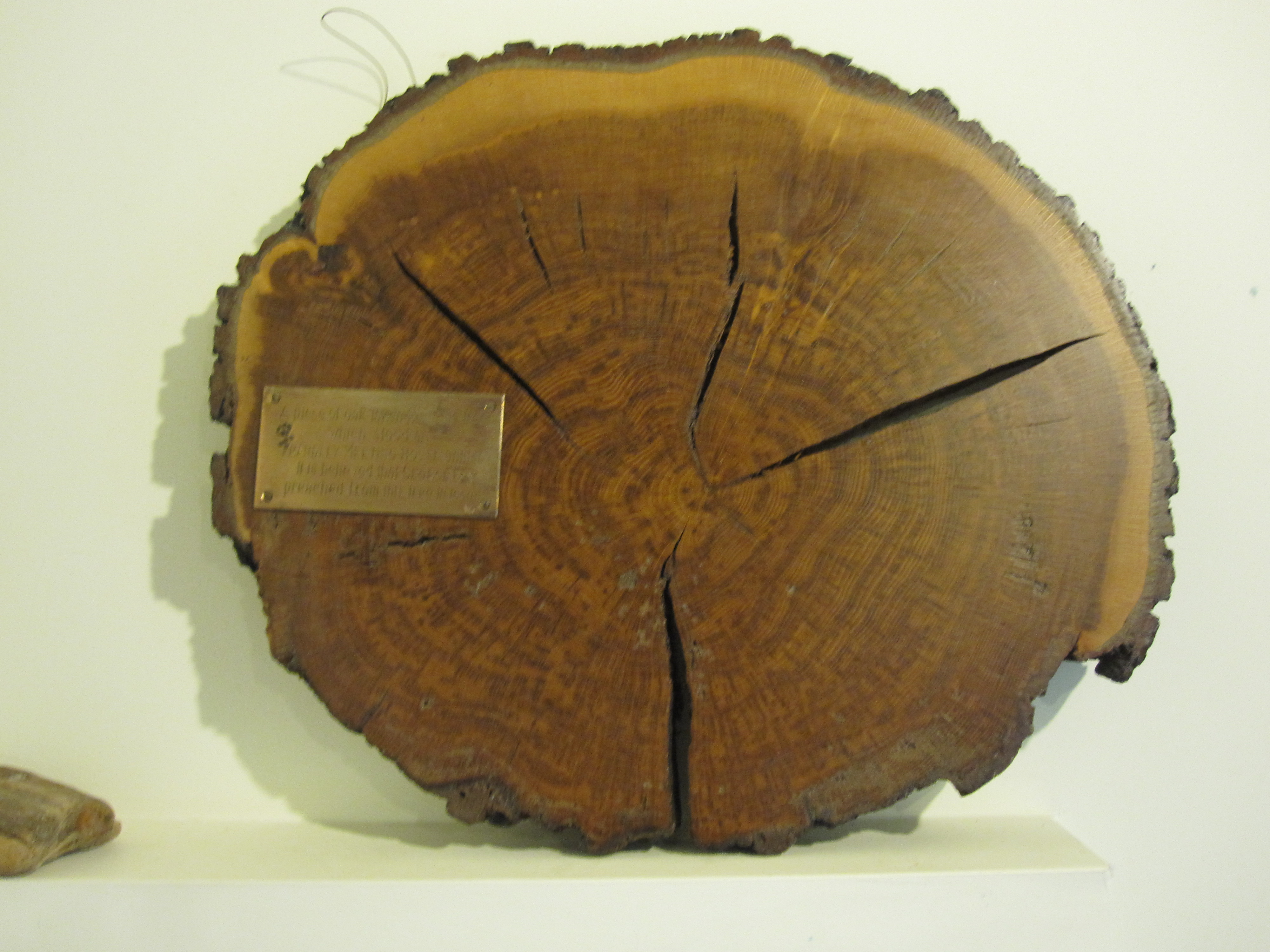
Fox appears to have preached at Frandley at 1657, when he was 33. He resisted the idea that religious experience was limited to ecclesiastical buildings. He refused to call them “churches” and referred to them as “steeplehouses” instead. He knew that God meets people in their heart of hearts, and preferred Friends’ meetings to be in the open air. There is a plaque at Frandley of the oak tree at which Fox preached to the gathering of Friends.

William Gandy is reputed to be the founder of the first local “society”. He farmed at Sevenoaks in Frandley. Interestingly there is a plaque on the meeting house commemorating the planting of seven oaks to celebrate the Diamond Jubilee of Queen Victoria in 1897 (sounds like the local Friends had become friendlier to the monarchy with the passage of time).

The PCC decided it was their spring. The “Witton Spring” may not have the same ring to it as the Arab Spring, but we did have some thoughts from Friend and Quaker, Parker Palmer.

In my own life, as winters turn into spring, I find it not only hard to cope with mud but also hard to credit the small harbingers of larger life to come, hard to hope until the outcome is secure. Spring teaches me to look more carefully for the green stems of possibility; for the intuitive hunch that may turn into a larger insight, for the glance or touch that may thaw a frozen relationship, for the stranger’s act of kindness that makes the world seem hospitable again.

Some quotes from George Fox – maybe from under the oak:

The Lord showed me so that I did see clearly, that he did not dwell in these temples which men had commanded and set up, but in people’s hearts … his people were his temple and he dwelt in them.

Why should any man have power over any other man’s faith, seeing as Christ himself is the author of it?

Where are you heading?

red bricks wall
It’s a week for appreciating leadership and for scrutinising leadership. Roy Hodgson’s leadership will be under scrutiny as England’s campaign in Euro ’12 begins, and nation and Commonwealth have been jubilating in appreciation of the Diamond Jubilee of Queen Elizabeth’s reign. Leaders often make the mistake of thinking that they know what is good for those who are their followers. Parents trying to get children to do homework often meet their own French resistance. Congregational leaders trying to introduce change “because it’s good for them” often feel like they are banging their head against a brick wall. The response to resistance is to try even harder and be rewarded with even greater frustration. For Edwin Friedman, in Generation to Generation: Family Process in Church and Synagogue, “In such situations, the motivators function as though their followers did not know what was good for them, and, furthermore, would never change were it not for their efforts.”

Traditional models of leadership focus on individualism on a continuum of charisma/concensus. None of these models can effectively combat resistace and inertia, according to Friedman. He suggests that a family systems approach which focuses on the organic nature of the leadership/follower relationship as constituent parts of the same organism is far more effective. “The family approach to leadership, precisely because it is systemic, offers a more effective, less enervating, way of dealing with such resistance to change because it considers the paradoxes of resistance not as something blocking efective leadership, but, as part and parcel of the leadership process itself.” (p.225)

Friedman emphasises the importance of position. “If a leader will take prime responsibility for his or her own position as “head” and work to define his or her own goals and self, while staying in touch with the rest of the organism, there is a ore than reasonable chance that the body will follow.” (p.229) “It is in the capacity of the leader to maintain a position and still stay in touch that the organism’s potential growth resides.”

What Friedman is here saying about “self-differentiation” is a reminder of Dee Hock’s advice that we should invest our time in self care and managing “up” rather than “down”.  Hock suggests that we should spend 50% of our time managing ourselves and 25% on managing those who have authority over us. Instead of concentrating on the functioning of others, the “self-differentiating” leader’s focus is their own functioning.

For Friedman, the effects of dependency are reversed when the leader is concentrating on where we are “headed”. “It is the leader who now becomes the resistant one as he or she, instead of having to work to change others, now works to resist their (the followers) efforts to change him or her back.”

Photo by Ezioman.

Father’s Pride

It was a great privilege to be at the Degree Show of Nottingham Trent University to see what a really talented group of youngsters is making of things. We saw a really creative engagement with the issues of everyday, contemporary life. It made me realise that good design has great ethical responsibility as well as a heart of love.

I was there as a proud Dad with Leo showing the fruits of his labour, including a project book  on creative photography and some fine creative deskwork.

Dusk life guard

Haven’t desks changed! I remember my first desk – three drawers each side of the leg space. Even then the drawers were overflowing and chaotic even though the intention was to have a drawer for notepaper and envelopes, another for pens, stapler, hole puncher, paper clips and ink. But no more. They are things of the past in the paperless office – yes, my filing cabinet has gone too!

So, what to put in those Fine desk drawers in Leo’s sleek design. One could be a confectionery drawer. Ooh, and the other could be the safe place for the dongle. What else is there? But then, why does Dave Walker’s desk look not too dissimilar to mine?