Hope Before Dawn: An Advent Imagination

Live for that day when God’s peace is all in all.
Love for that day when God’s light leaves no shadows.

These are the darkest days of our lives.
December draws a long shadow,
and we find ourselves longing for light.

These days seem to go on without end.

These are the days Isaiah fought through and hoped through
3000 years ago:
the same old, the same old.
the dark ages all over again.
This is the mean time.

This is the time to cherish those who’ve kindled hope,
those we’ve bound in scripture
who hoped in God when the world felt just as heavy as ours.
This is the time to pray.
This is the time to keep watch.
This is the time to live for another day,
to love towards another day
when the times will finally be a-changing.

These are very mean days
when nations make war on nations,
There may be no world war,
But there are too many wars
for us to call this peace.
The world is at war,
and we are all caught up
in a global propaganda war.

These are very mean days when dark forces
create a hostile environment for those seeking asylum and sanctuary,
days which leave so many children hungry
and too many families poor, 

when budget after budget
miss the opportunity to make things better.

These days, however bright the weather may be,
are dark days to too many people.

And so –
these are the very days to keep hope alive,
to pray for the day when God’s kingdom comes on earth, as it is in heaven,
to live for the day when God’s word settles disputes;
to love for the day when nation will not take up sword against nation,
and nor will we need to train for war any more.

Imagine that.
Imagine the difference
when the weapons of war,
the resources of war,
become tools for farming and feeding and healing.

Imagine the difference
if the resources of war were turned to farming.
Not just in the fields of our own villages,
but in Gaza’s broken orchards,
in Ukraine’s shelled wheatlands,
in every place where the soil has been scorched,
and the hands that sow can no longer harvest.

Isaiah’s dream has dirt under its nails.
It is a farmer’s dream,
a peacemaker’s dream –
swords hammered into ploughshares,
spears repurposed as pruning hooks,
the earth tended again.

And here’s another theme none of us can avoid,
if we care about justice and peace:
we need to be prepared in these days of darkness.
Advent comes with a wake up call.
The time has come for us to wake up, says Paul, (Romans 13)
and be ready for the Day of the Lord –
the day we live for,
the day we pray for,
the day we love for.

For Advent I’ve downloaded an app which notifies me of Fajr –
the prayer Muslims offer from dawn to sunrise.
So, this morning, at 6.05,
my phone buzzed to tell me it was time to pray,
and I was reminded of all those
who rise while the world is still dark
to end the night and hope for the day.

First they wash,
then raise their hands to acknowledge the greatness of God.
They then recite the Surah:

In the name of Allah – the Most Compassionate, Most Merciful.
All praise is for Allah – Lord of all worlds.
the Most Compassionate, Most Merciful,
Master of the Day of Judgment.
You ‘alone’ we worship and You ‘alone’ we ask for help.
Guide us along the Straight Path
the Path of those you have blessed
– not those You are displeased with, or those who are astray.


Then they bow
They stand and say, “God hears the one who praises him.”
They prostrate themselves, grounding their forehead, palms, knees and toes on the earth –
and from the ground they praise God.
They finish by turning their head
to the right and to the left
with a prayer of peace in both directions.
Then they are ready for the day
(and, dare I say, they’ve given themselves a good work out!).

There is something holy about any people
who pray before the sun comes up.
They remind us what Advent is for:
ending the night,
and hoping for the day.

And we are among those holy people
imagining that day which will end all days of wrongdoing,
when God’s word is truly heard.

That is why our time of prayer
is taken up with praying for the coming of God’s kingdom,
on earth, as it is in heaven.
Christians will always use their prayer time for that –
It’s what Jesus taught us.

It is a prayer of imagination.
It is a prayer for dawn in the dark.
It is a prayer for the day when ….
the day God’s peace is all in all,
the day God’s light leaves no shadows.

And so we live for that day —
when, as Revelation imagines,
there will be no more mourning, crying or pain,
the day that will see an end to night.

Until that day
we keep watch,
keep warm,
and keep hope alive
these dark days.
Hope Has Hooves: Keeping Faith When the World Feels Mean

This sermon was preached for the Second Sunday before Advent — sometimes called Kingdom Sunday, and this year also marked as Safeguarding Sunday.
It begins with the prophet Malachi’s vision of a day when “the sun of righteousness will rise with healing in its wings,” and when God’s people “will go out and frolic like well-fed calves.”
It’s a vivid, earthy picture of freedom — hope that doesn’t float above the world but thunders joyfully across it.
Hope, as it turns out, has hooves.


‘Surely the day is coming; it will burn like a furnace.
All the arrogant and every evildoer will be stubble,
and that day that is coming will set them on fire,’ says the Lord Almighty.
‘Not a root or a branch will be left to them.
But for you who revere my name,
the sun of righteousness will rise with healing in its rays.
And you will go out and frolic like well-fed calves.’ (Malachi 4:1-2a)

I thought I’d let Malachi do the talking this morning. 

He did his talking 450 years before Christ after the Jewish community had returned from exile.
They thought everything was going to be hunky-dory.
The Temple had been restored, the worship re-established,
and people hoped – and expected – that Israel would be great again.

But the glorious renewal never materialised. It rarely does.

The community Malachi is speaking to is one that had expected to be spared the ways of the arrogant and the evildoers.
Instead they found themselves small, struggling and disillusioned.
They are weary. They are disappointed. They’ve had enough.

And into that discouragement, Malachi tells them not to give up.

In my last parish we lived next door to a dairy farm.
The farmer knew how much we loved the moment when the cows were released into the fields after winter – those first few minutes when they leap and dance and frolic before settling down to graze away their days.
On our final day there, as a goodbye, he freed the cows (earlier than he normally would) just so we could watch them. A little gesture of joy and encouragement.

Watch the moment when these animals are released and leap into life.
This is the kind of hope we’re talking about — wild, earthy, triumphant (From the Funky Farmer)

That’s the image Malachi gives us: “You will go out and frolic like well-fed calves.”
Imagine that, he implies.
Feel it.
Let that joy into your bones.

The day is coming,
the day to end all days,
the day we’ve prayed for,
the end of wrongdoing, the end of misery, the end of oppression,
the end of the arrogant, the end of the evildoer.

But between the promise and its fulfilment, they still had to live through some very tough times indeed.
They still lived between a rock and a hard place.

He’s speaking to a community who’ve given up waiting for times to change,
who’ve lost hope.
And he may as well be speaking to us.

Things haven’t changed that much. His times are still our times.
The arrogant and the evildoers still seem to carry the day,
and we too can feel like a struggling and disillusioned generation.
We get weary. We get disappointed.

This is one of the readings appointed for today.
And its words speak, with beautiful conciseness and clarity, of the day we all pray for –
the day when everything broken will finally be set right.

And what Malachi offers is not a vague or floaty hope.
Not a “pie in the sky when you die” kind of hope.
Not the sort of hope that shrugs and says,
“Well, it won’t happen in my lifetime—maybe someday, somewhere else.”

No.
Malachi’s hope is earthed.
It has muscle and movement.
It has sun-warmed skin and strong legs.
It leaps. It runs. It frolics.

Hope, in Malachi’s vision, is not an idea.
It’s an animal set free.

Hope has hooves.

And because hope has hooves, it doesn’t wait politely for the world to improve.
It doesn’t sit still until things get better.
It doesn’t retreat into a dream or escape into the clouds.

Hope is not about leaving this world behind;
it’s about this world being set right.

The freedom Malachi imagines does not happen “up there” or “somewhere else”
but here—in the fields of our own lives,
in the soil beneath our feet,
in the communities that have grown tired and heavy with disappointment.

Hope is grounded.
Hope is embodied.
Hope is movement.

And that is why those who have given up hope
so often spiritualise it, soften it, postpone it.
They make it so distant that it no longer touches the earth.
They reduce it to wishful thinking or to a future reward
instead of a promise that breaks into the present.

But real biblical hope always has dirt on its feet.
It always has skin in the game.
It always demands something of us.

It is a hope with hooves—
a hope that will not stand still
because God will not stand still.

And so we pray for that day.
Every time we say the Lord’s Prayer — “your kingdom come” — we are praying Malachi’s prayer.
We’re praying for the day when wrong is ended, when justice rises,
when the oppressed stand tall,
when the broken are made whole,
when healing breaks out like sunlight over a cold field.

But praying for that day is not passive.
It is not waiting-room spirituality.
It is preparation.
It is participation.
It is permission for God to rearrange our lives as well as the world.

Paul, writing to the Thessalonians, puts it plainly:
“Never tire of doing good.”

Never tire.
Not when we get weary.
Not when hope feels heavy.
Not when the world seems to resist every effort toward kindness, justice, truth.

Because if hope has hooves, we need to keep ours moving.

Doing good is not an extra.
It is not the garnish on Christian faith.
It is the shape of hope lived out.
It is the daily, steady work of aligning our lives with the world God is bringing into being.

And Jesus, in the Gospel reading, speaks of upheaval—
nations in uproar,
wars and rumours of wars,
the ground trembling beneath our certainties.

But then he says something deeply strengthening:
“Do not be afraid.”

Not because everything is fine — it isn’t.
Not because everything will suddenly get better — it may not.
But because God is with us in the meantime,
and it is precisely in these mean times
that our hope matters most.

The world being turned the right way up is bound to be unsettling.
Those who profit from cruelty won’t like it.
Those who cling to power will resist it.
Those who prefer darkness will fear the light.

But discipleship has always been lived with courage.
Courage to do good when others give up.
Courage to tell the truth when lying is easier.
Courage to protect the vulnerable when it costs something.
Courage to embody hope when cynicism is fashionable.

And that brings us to Safeguarding Sunday.

We haven’t mentioned it until now —
and that’s intentional —
because safeguarding isn’t a special theme for one Sunday,
or a box to tick,
or a duty we dust off once a year.

Safeguarding is simply hope in practice.
It is the grounded hope Malachi speaks of,
the persevering hope Paul commends,
the courageous hope Jesus prepares us for.

Safeguarding says:
in this community,
in this place,
every person matters.
The vulnerable are protected.
The wounded are listened to.
The frightened are safe.
This is a place where harm is named, not hidden,
and where healing is made possible.

Safeguarding is part of the way we pray “your kingdom come.”
It is part of the way we “never tire of doing good.”
It is part of the way we “do not be afraid.”

It is hope with hooves —
hope that moves,
hope that watches over,
hope that makes room,
hope that keeps all God’s people safe
until that promised day dawns
and we go out and frolic like well-fed calves.

So today we keep our hope alive,
we keep our feet moving,
and we keep one another safe.

Hope doesn’t just have feathers,
as Emily Dickinson writes in her poetry.
Hope has hooves.

The calling of God’s people in every generation
is to keep faith in these mean times,
to never give up hope in these mean times,
to never stop loving in these mean times.
These are the things we need to keep going forever,
faith, hope and love,
until the day comes which sees the end of the arrogant and the evildoer,
the day the sun of righteousness will rise
with healing in its wings.

Until then, we keep faith.
We keep hope.
We keep love.

Our call is to live for that day.

Egged on by Mary and Elizabeth, here I go again

Here I go again, egged on by Elizabeth, Mary and Micah – a reflection for Advent 4C. I don’t seem able to help myself. I can’t stop preaching that small is so beautiful, thanks to God who raises the lowly, graces the dis-graced and scatters the proud. Maybe it’s because I’ve been helping small churches this year.

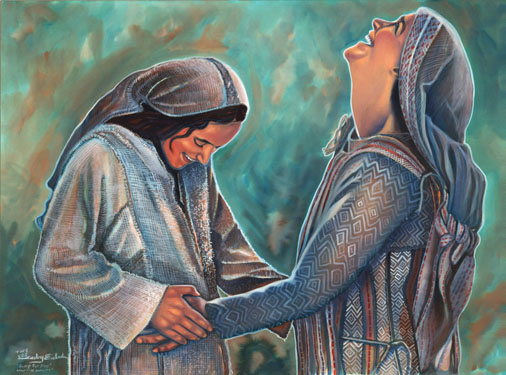
Jump for Joy by Corby Eisbacher reproduced with permission

In these Sundays of Advent we come face to face with the faith of Israel. It is not the faith of all Israel. If everyone agreed in their faith Jesus would not have had to face such opposition. The faith we come face to face with in Advent is the faith that has been passed down the generations in our scriptures, and lived out by so many. The faith of Israel is about what we expect and what we live for.

It’s a faith which celebrates God’s opposition to the proud and Gods’ favour for those who are lowly, humble and poor in spirit.

So we have today’s readings, from the prophet Micah (5:2-5a) and Luke (1:39-55).

But first, a diversion. 

When the wise men went looking for the one born king of the Jews they stupidly went about it the wrong way. They went looking in Jerusalem. They did not know the rule of the kingdom of God that the first come last and the last come first. The capital wouldn’t cradle the Messiah. In fact, the capital did nothing other than scoff and plot against the one born king of the Jews. Their satnav took them to Jerusalem, nine miles wide of the mark, the cross on the map where Jesus was born.

It was the chief priests and scribes that directed Herod’s attention to Bethlehem as the place where the ruler to shepherd Israel would be born. It was Herod who sent the wise men to Bethlehem to search for the child.

That’s probably the way most of us would go. You could be excused for expecting to find what you’re looking for in the capital, the seat of power.

But the faith of Israel knows different, Micah expresses that prophetic faith, implicitly warning us not to look for leadership in the usual places but to expect the one to rule in Israel to come from one of the little clans of Judah, one of the little clans of Jews, even from Bethlehem of Ephrathah.

Ephrathah is the old name for Bethlehem. It means fruitfulness and Bethlehem means the house of bread. It was the place of fruitfulness that Micah directs us to – not to Jerusalem. The thing about fruitfulness is its abundance but the abundance is the fruit of tiny seed, scattered by the fall and the wind and pollinated by the humble bee. 

The faith of Israel is found in the tiny, the lowly and the humble. This is the faith that follows the rule of the kingdom of God.

We know where Jesus was born, but we don’t know where John was. All we know is that Mary set out to a “judean town in the hill country”, to Zechariah’s house, to greet her cousin Elizabeth. Luke doesn’t tell us the town’s name, but it sounds like it was a place off the beaten track and follows the rule that the kingdom of God is hidden in small places, in the smallest of clans and in the most barren of landscapes.

It is in these places that God grows a kingdom. From the smallest of clans, from the dust of the earth, from the least and the last God works wonders. This is the faith of Israel. This is the faith of Israel which even now leaves many Jews horrified by what is being done in the name of Israel as it uses its military might. Those Jews who are horrified need our prayers as they protest and resist what is going on. The faith in Israel they see in Netanyahu is not the faith of Israel they treasure in their scripture.

The faith in Israel that has stood the test of time is, in the words of the epistle of James (4:6) that God scatters the proud, but gives grace to the humble.

Elizabeth and Mary come together in our gospel reading. There aren’t many readings where we listen to women talking together. Together they represent the truth that God gives grace to the humble. It is written loud and clear in their body language. Their joy is undeniable.

Luke describes how both Zechariah and Elizabeth were both “getting on in years” (1:7) and that theirs was a childless marriage. In those days that was the woman’s fault and that explains the “disgrace” she felt among her people even though she had lived a blameless life. Now with the promise of a son Elizabeth knows God’s favour for the dis-graced. In her pregnant body God’s favour for the dis-graced, humiliated and humble is told yet again. Elizabeth looks at her body, feels her baby and says, “this is what the Lord has done for me when he looked favourably on me and took away the disgrace I have endured among my people.” (1:25).

Then Luke has us look at Mary’s body through the eyes of Elizabeth and we hear her praise. It comes from the heart of Israel’s songbook about how her soul magnifies the Lord. Mary calls herself a lowly woman. That was no mere figure of speech. Her lowliness wasn’t her mental attitude. It was  that she truly was a poor woman. She occupied a place of poverty and powerlessness in her society. She rejoices in the favour God has shown to her, the great things he had done for her, the way he lifts up the lowly and fills the hungry with good things, while all the time opposing the proud and powerful, scattering the proud and bringing down the powerful from their thrones.

This was the faith of Israel that Mary was repeating. This was the song Jesus heard when he was growing up: Mary magnifying the Lord, praising God for his favour for the lowly.

This is the faith of Israel. This is the faith of Jesus that we hear time and again in his preaching. This is the faith we follow, not taking the foolish way of the wise men to the powerhouses, but feeling our way to find God’s favour in the insignificant, humiliated, disgraced, lowly, poor and powerless.

Inasmuch as he did for Mary and Elizabeth he does for all his people. He lifts up the lowly. He gives grace to the disgraced, scattering the arrogant and proud and the disgraceful.

This is the faith of Israel. This is the faith of Mary and Elizabeth. This is the faith of Jesus. This is our faith, the faith of the church, though sometimes you’d hardly know it infected as we are with the imperial spirit which wants to see us bigger than we are. God grows a kingdom and works wonders from the smallest of clans, from the dust of the earth, from the least. That is the reason the lowly and humble rejoice and the proud and arrogant just scoff.

Note: The artwork is by Corby Eisbacher and reproduced with her permission. Prints are available from her www.artbycorby.etsy.com

The readings:

Micah 5:2-5a
But you, O Bethlehem of Ephrathah, who are one of the little clans of Judah, from you shall come forth for me one who is to rule in Israel, whose origin is from of old, from ancient days. Therefore he shall give them up until the time when she who is in labor has brought forth; then the rest of his kindred shall return to the people of Israel. And he shall stand and feed his flock in the strength of the Lord, in the majesty of the name of the Lord his God. And they shall live secure, for now he shall be great to the ends of the earth; and he shall be the one of peace. If the Assyrians come into our land and tread upon our soil, we will raise against them seven shepherds and eight installed as rulers.

Luke 1:39-55
39In those days Mary set out and went with haste to a Judean town in the hill country, 40where she entered the house of Zechariah and greeted Elizabeth. 41When Elizabeth heard Mary’s greeting, the child leaped in her womb. And Elizabeth was filled with the Holy Spirit 42and exclaimed with a loud cry, “Blessed are you among women, and blessed is the fruit of your womb. 43And why has this happened to me, that the mother of my Lord comes to me? 44For as soon as I heard the sound of your greeting, the child in my womb leaped for joy. 45And blessed is she who believed that there would be a fulfillment of what was spoken to her by the Lord.” 46And Mary said, “My soul magnifies the Lord, 47and my spirit rejoices in God my Savior, 48for he has looked with favor on the lowliness of his servant. Surely, from now on all generations will call me blessed; 49for the Mighty One has done great things for me, and holy is his name. 50His mercy is for those who fear him from generation to generation. 51He has shown strength with his arm; he has scattered the proud in the thoughts of their hearts. 52He has brought down the powerful from their thrones, and lifted up the lowly; 53he has filled the hungry with good things, and sent the rich away empty. 54He has helped his servant Israel, in remembrance of his mercy, 55according to the promise he made to our ancestors, to Abraham and to his descendants forever.”

What should we do? Everybody’s asking according to Luke

This sermon is for the 3rd Sunday in Advent (C) prompted by a question everyone seems to be asking in Luke. The question being what should we do? It’s prepared for two small churches I’m helping out in a vacancy. The gospel reading is Luke 3:7-18 (the text is at the end of the post).
December 15th 2024

What should we do? That question keeps cropping up.

Three times we hear that question in today’s reading. Luke pictures three audiences of John the Baptist. There’s the “the crowds”, there’s the “tax collectors” and there’s “the soldiers”. Each of those audiences ask the same question. “What should we do?”

Before being specific John had already told them to bear fruits worthy of repentance while also saying they couldn’t take their place in God’s kingdom for granted just because they had Abraham as their ancestor. They needed to repent.

“What should we do?” It’s a question which keeps cropping up in Luke/Acts. As well as the crowd, the tax collectors and the soldiers featured in today’s gospel, it’s a question asked by:

  • A lawyer asking “what must I do to inherit eternal life?” (Luke 10:25)
  • A rich man worrying about his abundant crops, “what should I do, for I have no place to store my crops?” (Luke 12:17)
  • An unscrupulous agent  getting sacked: “what will I do, now that my master is taking the position from me?” (Luke 16:3)
  • A rich ruler asking Jesus “what must I do to inherit eternal life?” (Luke 18:18)
  • The owner of the vineyard asks “what shall I do?” (Luke 20:13)
  • The Jews in Jerusalem for Pentecost asking the disciples “what shall we do?” (Acts 2:37)
  • A jailer asking Paul and Silas (what must I do to be saved?” (Acts 16:30)
  • Saul (aka Paul) asking Jesus “What am I to do Lord” (Acts 22:10)

I list these examples to highlight how important this question is to the people of God. The same question asked time and again through Luke/Acts: “What should I do?” And every time the answer comes back that they have to do things differently, and radically so. 

Significantly the question crops up at the beginning of both volumes of Luke’s work. It’s there in today’s gospel, and it’s there at the beginning of Acts. John the Baptist answers the question in the gospel. Peter answers the question in Acts.

John’s answer is that they should bear fruits worthy of repentance. Peter’s answer is that they should be baptised, and that day, 3,000 were, and they devoted themselves to the apostles’ teaching and fellowship. Luke comments: “all who believed were together and had all things in common; they would sell their possessions and goods and distribute the proceeds to all, as any had need.” In other words, here were people bearing fruits worthy of repentance.

I’m sure that Luke wanted this question to hang over all his readers. Why else would he keep repeating it? What should we do?

What should we do to count in the kingdom of God where the rule is to love God wholeheartedly, to love our neighbour as ourselves (whether we are like them or not) and to realise that those who come last in the ways of the world, and those who are counted least come first, and those usually first, come last?

Repentance means that we make a turn in our lives, that we turn ourselves round from self-ishness, self-satisfaction, self-absorption and self indulgence so that we see God and our neighbours face to face. Repentance means turning back, re-turning to where we started – loved by God from the beginning. Repentance means we change our ways and our minds with the result that we will do things very differently and see one another very differently.

I was saying last week that we might have focused so much on our forgiveness that we don’t see anything wrong with us. We might feel that we have done little wrong. But there are those we’ve wronged, those we’ve hurt, those we’ve taken advantage of, those we’ve demeaned and those we’ve neglected – and those who are frightened of us. Yes, the question is for us too. What are we to do?

I’ve looked at the three groups of people featured in today’s gospel. They have something in common. They are all potentially menacing, dangerous and harmful. The soldiers were obviously in a position where they could extort money by threats, could take backhanders and could blackmail people – and many probably did. Woe betide their vulnerable victims. John tells them to be satisfied with their wages and not to extort money from anyone by threats or false accusation.

The tax-collectors were obviously in a position where they could collect more in tax and make money for themselves at the expense of people who were reduced to poverty by the excessive triple tax demands of empire, state and temple. Woe betide you if you were on the wrong side of the tax-collector. Remember Zacchaeus. He admitted to Jesus that he’d wronged people – and in penitence offered to repay what he’d wrongly taken four times over. John tells the tax-collectors to collect no more than is their due.

Then there’s the crowd. How menacing is the crowd. How quickly can a crowd turn nasty by a single word, or a rumour? How toxic can groupthink be – how fearful it can be – and how demeaning and controlling the supposed crowd can be. You know when you’re told “everyone is saying”, “everyone thinks”, “everyone knows” that the virtual crowd has your back against the wall. Even when Christians say “Christians believe in x, y or z” when they know not all Christians do – that is crowd behaviour designed to intimidate and control others into conformity.

The crowd is the place to hide in. The crowd is what we follow so often. The crowd is what condemned Jesus – one day praising him and the next cursing him. The way John tells them to change is to be kind and generous: “whoever has two coats must share with anyone who has none; and whoever has food must do likewise”.

So, what should we do? What does repentance mean for us? It means we have to keep changing, changing our minds, our attitudes and our behaviours. And there is no place better to start than with our gospel reading.

We’ve noted how dangerous and harmful those three groups are – and why. The crowd, the tax-collectors, the soldiers were all people that those who come first in the kingdom of God – the last and the least – the most vulnerable are the most likely to be a major cause of their suffering. In other words, they were their enemies.

But watch what Luke does with them in the telling of his gospel. He shows that they’re not written off. He shows that they are capable of repentance. He shows them redeemed. They (at least some of them) come to be saved and become “true children of Abraham”. 

Here is one of the “enemy”.

Several soldiers feature in Luke’s writing. There was the centurion who asked Jesus for help whose faith, Jesus said, was like the faith he’d ever seen in Israel. It was one of the centurions at the crucifixion who stood out from the crowd  who praised God for Jesus believing “certainly this man was innocent.” (23:47) And right at the end of Luke’s work it was a soldier who stood up against his fellow soldiers to spare Paul’s life after their ship had run aground off the shores of Malta. (Acts 27:42, 43).

Here are some of the enemy.

Luke can even demonstrate the repentance of the crowd, those thousands who heard the word from Peter at Pentecost. They repented and produced fruits worthy of repentance. They devoted themselves to the apostles’ teaching and fellowship. They were united and held everything in common. They would sell their possessions and goods and share the proceeds as any had need.

Here was a crowd to love. And Luke comments that they had “the goodwill of all the people”. The gospel of Luke is so inclusive. There is good news especially for our enemies. 

For that very reason we need to change the way we see our enemies.

What shall we do?

Here’s something we can do.
Those who can harm us,
those who can exploit us,
do not condemn them
with our fearful judgement
(dangerous though those enemies are).

Instead, leave a window open
for the word of God
which from the beginning
spreads the table
even with my enemies present
so making all things possible.

Yes, we’ve been drilled
to hate our enemies,
but don’t let that fool us
or crowd our minds
so we can’t see
the possibility of change.

The word made flesh
suffered all his enemies
could throw at him.
Every stone became a prayer
as the word of God

came near for us to hear
that word “Repent” and change.
It’s our turn to turn Jesus’ way.
That’s what we can do this day
love the enemies that come our way
till some turn the kingdom way, the only way
to save ourselves from ourselves.

Luke 3.7-18
7   John said to the crowds that came out to be baptized by him, ‘You brood of vipers! Who warned you to flee from the wrath to come?
8  Bear fruits worthy of repentance. Do not begin to say to yourselves, “We have Abraham as our ancestor”; for I tell you, God is able from these stones to raise up children to Abraham.
9  Even now the axe is lying at the root of the trees; every tree therefore that does not bear good fruit is cut down and thrown into the fire.’
10   And the crowds asked him, ‘What then should we do?’
11  In reply he said to them, ‘Whoever has two coats must share with anyone who has none; and whoever has food must do likewise.’
12  Even tax-collectors came to be baptized, and they asked him, ‘Teacher, what should we do?’
13  He said to them, ‘Collect no more than the amount prescribed for you.’
14  Soldiers also asked him, ‘And we, what should we do?’ He said to them, ‘Do not extort money from anyone by threats or false accusation, and be satisfied with your wages.’
15   As the people were filled with expectation, and all were questioning in their hearts concerning John, whether he might be the Messiah,
16  John answered all of them by saying, ‘I baptize you with water; but one who is more powerful than I is coming; I am not worthy to untie the thong of his sandals. He will baptize you with the Holy Spirit and fire.
17  His winnowing-fork is in his hand, to clear his threshing-floor and to gather the wheat into his granary; but the chaff he will burn with unquenchable fire.’
18   So, with many other exhortations, he proclaimed the good news to the people.

Christmas and the cost of living

This poem was inspired by a small and mighty Christmas cards designed by a friend.

Christmas and the cost of living

Why do we make
Christmas so big
when joy’s so short,
innocence lost,
when baby’s squeezed
in a one star place?

Why do we make
Christmas so big
when the word,
from the beginning
was just a whisper
kissed of God?

Why do we make
Christmas so big
when we hang the tree,
lynch the light and
tinsel tight tie
the hostage angel?

Do we there nail
our hope that in
Advent edgeway
such baby-talk
may faithful grow
mercy, love, peace?

©David Herbert

The First Photograph – a poem for these sort of times

The First Photograph

When Aylan Kurdi’s photo splashed across the waves,
it was a scoop, a spotlight on refugees, a beacon of hope
for better treatment, more welcome ways. It became
Sea Prayer for parents casting their children to sea in light vessels.
But nothing changed. It was a false dawn. Children keep drowning.
Here in Bethlehem, lives are poor, government weak.

A concrete cordon of wall dominates, not for our security mind,
but as shutter and blind to lives despised. We are occupied
by those whose minds pre-occupied by counting our threat,
known by numbers, never names. Our lives are poor,
our movement restricted, often imprisoned for raising flag,
hand or stone, getting by with our whittled olive tourist trade.

When reporters came from way out east, that was our moment,
that Aylan Kurdi flash. Three came. They’d heard our plight.
and noted our views, their reports were carried in paper news.
Their attraction, they said, was a star, a pin prick in a night sky,
inspiration for their camera and that first photograph, a baby
captured, strangely focused, fast exposed as a flash of light.

That was the image of us. It sold and sold. going world-wide,
framed, kissed and even enshrined, the light of the world,
while we still in darkness lie. There was a child, a shot in the dark.
Because of that aperture in this little Goliath walled town
where streets stay dark and soldiers still count their enemy,
we picture endurance in that light relief, that blink of an eye,
that pin prick in the night.

©David Herbert

Links to Khaled Hosseini’s Sea Prayer and the photo of Aylan Kurdi’s body

You want it darker? I’m ready, my lord

Leonard Cohen, tenant of the Tower of Song, born with the gift of a golden voice wanted it even darker on his last album. Darkness is keenly felt by many, particularly at this time of year when the darkness reinforces experiences of isolation and grief. The fairy lights that bedeck so many houses is an act of defiance against the darkness. Nowadays these artificial lights double up as Halloween and Christmas lights, intended to brighten our winter days and to jolly up the darkness.

But there is a sense in which we need it to be darker. Advent is a season to be rescued from the light-hearted. It is a time of year to get serious about the darkness that is part of our lives in our relationships, in our despair, in our anxiety, in our jealousy. It is a time to get real about the suffering so many endure, the millions forced from their homes, the many who suffer the consequences of economic austerity.

Those for whom this is too serious, those who are afraid of the dark, do us no favours when they say “lighten up”. Their merriment is like the fairy lights which don’t diminish the darkness but only pollute the night sky. We need it darker to realise that we are not all sweetness and light wherever, whatever and whoever we are.

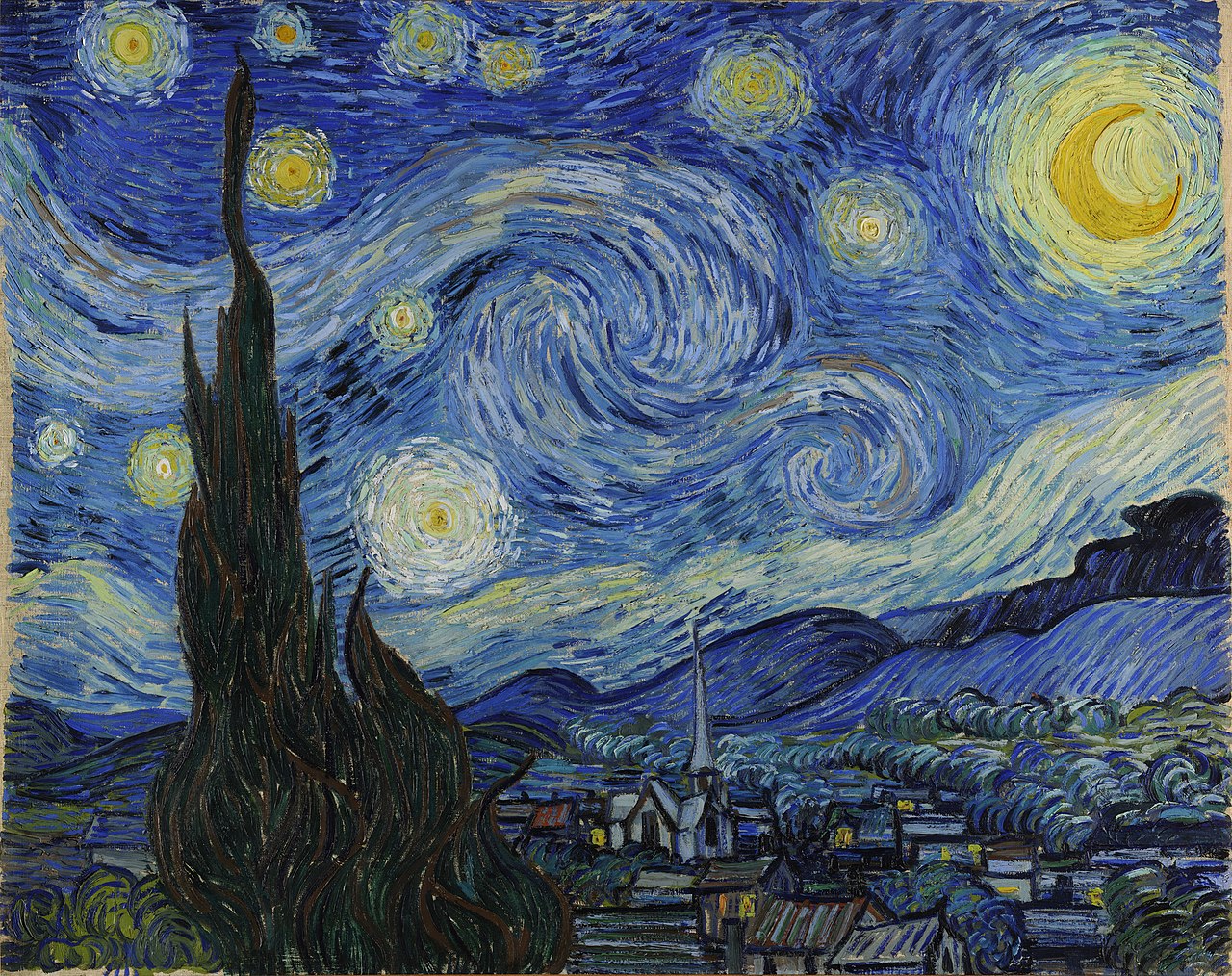
Vincent van Gogh lived through some dark times. He wrote to his brother Theo: “I am so angry with myself because I cannot do what I should like to do, and at such a moment one feels as if one were lying bound hand and foot at the bottom of a deep dark well, utterly helpless”. Like Leonard, Vincent did dark. And yet, in another letter to Theo, he wrote:

“It is true that I am often in the greatest misery, but still there is within me a calm, pure harmony and music. In the poorest huts, in the dirtiest corner, I see drawings and pictures. And with irresistible force my mind is drawn towards these things. Believe me that sometimes I laugh heartily because people suspect me of all kinds of malignity and absurdity, of which not a hair of my head is guilty — I, who am really no one but a friend of nature, of study, of work, and especially of people.”

In his darkness he saw the most beautiful stars, some of which he painted and gifted to us. (Do see Loving Vincent if you get the chance.)

1280px-Van_Gogh_-_Starry_Night_-_Google_Art_Project

In ancient times the stars were guides to the wise and inspiration to the faithful. These days it’s Cowell-made stars that draw us. Stellar constellations are lost on most of us, mainly because we can no longer see them. The light in which we trust is artificial. We need it darker for a time.

PS You may be interested in Jenny Bridgman’s Advent blog exploring Dark Spaces

Reflecting All The Light We Cannot See

Light
Light
The visible reminder of Invisible Light.
T. S. Eliot

all_the_light_we_cannot_see_doerr_novel

What was intended to be a summer read turned out to be an early winter read – very appropriately because this is a book about light and darkness, perfect for Advent and the darkest time of the year. In All the Light We Cannot See we see the world through the hands of a blind woman, Marie-Laure. As a child she is given a model of her world which helps her to feel her way in spite of all the light she cannot see. In telling her story, Anthony Doerr, is putting a model into our hands to remind us how complex life is and to help us discover the light that can be hidden in the smallest detail.

Anthony Doerr has spun for us a hopeful story that is full of humanity. Besides the blind girl, there is an orphaned German boy who becomes a radio technician. The setting is the Second World War which so divided and devastated Europe. Their lives don’t cross till later but Doerr skillfully weaves their stories together in brief alternating chapters.

With the rise of populist politics as expressed in the Brexit referendum and elsewhere, it seems that we are again in a dark age (and the book is a startling reminder of the institutions that have grown up in post-war Europe which so far have preserved peace – it would be stupid and careless if this were to be unpicked). There is a lot of darkness as we don’t know where we are heading. There is a lot of light that we cannot see as we turn ourselves inwards.

There is so much light we cannot see – from the past and into the future. But in the hands of a blind girl the author has placed a model which can help us through to the light we cannot see. The model maker is her father – significantly a locksmith. I say significantly because of these lines by poet Malcolm Guite in response to one of the Advent antiphons:

Even in the darkness where I sit
And huddle in the midst of misery
I can remember freedom, but forget
That every lock must answer to a key,
That each dark clasp, sharp and intricate,
Must find a counter-clasp to meet its guard,
Particular, exact and intimate,
The clutch and catch that meshes with its ward.
I cry out for the key I threw away
That turned and over turned with certain touch
And with the lovely lifting of a latch
Opened my darkness to the light of day.
O come again, come quickly, set me free
Cut to the quick to fit, the master key.

Julia McGuinness has also written about this book. She captures the ideas of light within limited spaces which is so much part of this story set in the extremes of human existence.

Part of my work is to support newly ordained clergy. One of the cheesy things I do is write to those who have been recently ordained, just before Christmas. I say something like:

Happy first Christmas to you as a “priest”. I hope you enjoy your first Christmas celebrations. It is a wonderful moment – embracing strangers/visitors. One of the ideas that came to me (when I was struggling to find yet another homily in a busy Christmas season) was a play with the word “manger”. Pronounced the French way it’s about eating. Pronounced the Christmas way it’s where Jesus is born. Do we prepare a manger with the hands we offer for the bread? Is this when Jesus is born? As we place the bread in the hands of others, are we laying Jesus in their manger?

When we take the bread into our hands, into the manger we prepare, we take all the light we cannot see. This is the body of Christ, the light of the world. This is the faith we have as Christians, a faith that in the darkest times there is all the light we cannot see. The light that shines in the darkness, makes a difference as to how we recognise one another, how we see one another, how we see our past, how we see our future – as not so dark as maybe we once thought. This too, like Marie-Laure’s model, is something so small that is placed into our hands, to help us discover the light that can be hidden in the smallest detail, in places we would never look into because of their depth of darkness.

Besides preparing a manger with our hands, we often put our hands together to pray (like a candle flame), and we often close our eyes (as if a reminder of the darkness). There are all sorts of reasons for these customs – but in our heart of hearts we know that there is all the light that shines in darkness. By praying we witness to the true light that gives light to everyone.

At the end of his magnificent novel, Doerr imagines:

People walk the paths of the gardens below, and the wind sings anthems in the hedges, and the big old cedars at the entrance to the maze creak. Marie-Laure imagines the electro-magnetic waves travelling into and out of Michael’s (game) machine, bending around them, just as Etienne used to describe, except now a thousand times more criss cross the air than when he lived – maybe a million times more. Torrents of text conversations, tides of cell conversations, of television programmes, of emails, vast networks of fibre and wire interlaced above and beneath the city, passing through buildings, arcing between Metro tunnels, between antennas atop buildings, from transmitters with cellular transmitters in them, commercials … flashing into space and back to earth again, I’m gong to be late and maybe we should get reservations? and ten thousand I miss yours, fifty thousand I love yours, hate mail and appointment reminders and market updates, jewelry ads, coffee ads, furniture ads flying invisibly over the warrens of Paris, over the battlefields and tombs’ over the Ardennes, over the Rhine, over Belgium and Denmark, over the charred and ever-shifting landscapes we call nations.

And is it so hard to believe that souls might also travel those paths? That her father and Etienne and Madame Manec and the German boy named Werner Pfennig might harry the sky in flocks, like egrets, like terns, like starlings? That great shuttles of souls might fly about faded but audible if you listen closely enough? They flow above the chimneys, ride the sidewalks, slip through your jacket and shirt and breastbone and lungs and pass out through the other side, the air a library and the encore of every life lived, every sentence spoken, every word transmitted still reverberating within it.

I am imagining it. I am imagining the map Doerr has drawn of some of the light we cannot see. 

I can’t wait to read this again.

Opening Advent Doors

advent-door

Advent is a time for praying for the coming of Emmanuel, that God may be with us, and for each of the evenings of the week before Christmas there is an “O” antiphon. Each of the seven antiphons is prefaced by “O” and addressed to the Messiah according to the names for him found in Isaiah. The “O” expresses our longing. The seven antiphons are addressed to Wisdom, Lord, Root of Jesse, Key of David, Dayspring, King and Emmanuel.

Doors are very much a theme of Advent. Doors are both barriers and openings. We open a “door” a day on our Advent calendar to signify our willingness to open our hearts to the coming of Christ. Many decorate their front doors in a way that invites the stranger, in a way that begs to be opened (as in the door of one of our neighbours pictured above). Some doors are hard to shift and many are locked behind them.

Malcolm Guite has written a beautiful poem in response to the O Clavis antiphon (based on Isaiah 22:22):

O Key of David and sceptre of the House of Israel;
you open and no one can shut;
you shut and no one can open:
Come and lead the prisoners from the prison house,
those who dwell in darkness and the shadow of death.

This is Malcolm’s response (which is set in a beautiful image by Linda Richardson):

Even in the darkness where I sit
And huddle in the midst of misery
I can remember freedom, but forget
That every lock must answer to a key,
That each dark clasp, sharp and intricate,
Must find a counter-clasp to meet its guard,
Particular, exact and intimate,
The clutch and catch that meshes with its ward.
I cry out for the key I threw away
That turned and over turned with certain touch
And with the lovely lifting of a latch
Opened my darkness to the light of day.
O come again, come quickly, set me free
Cut to the quick to fit, the master key.

The poem senses despair but also senses freedom, if only we could find “the key  I threw away”, that “turned and over turned with certain touch and … opened my darkness to the light of day”. I love the sense of freedom because “every lock must answer to its key” and “each dark clasp … must find a counter-clasp to meet its guard”.

There are so many locks to spring. Back in the 14th century, Hafiz wrote about the sort of people who lock others up, and the sort of people who work in the darkness to set people free. They “drop keys all night long”:

The small person
builds cages for everyone
he
sees.

Instead, the sage,
who needs to duck his head,
when the moon is low
can be found dropping keys, all night long
for the beautiful
rowdy,
prisoners.

What are the cages, catches, vices, locks and blocks that bind us? What needs to be undone for peace to be declared on earth?

You may be interested in the Jesus Doors by Cheshire artist Ali Hutchison and the Advent Haikus Jim Bridgman has written for every day of Advent as part of his blog which is Really Nothing but which is in fact, quite something. You might also be interested in The Advent Door by Jan Richardson.

O come, Wisdom

This is what wisdom looks like. It is not as we have come to know wisdom which so often comes dressed in cap and gown. Wisdom so often looks serious, powerful and distant. But here, wisdom looks personal, merciful, charitable and child-like. This icon of Our Lady, Seat of Wisdom is by Slovenian artist and theologian Marko Rupnek, and was commissioned by Pope Paul II. This is what wisdom looks like for those who feel betrayed by those who have impersonated Wisdom and for those whose only hope is in a Wisdom, the likes of which we have never seen before.

The prayer for Wisdom is the first of the Advent Antiphons. They are for those who live in lamentable times. There are seven of them, and they are part of Common Worship Daily Prayer for the seven days starting today.

The prayer goes:

O Wisdom, coming forth from the mouth of the Most High,
reaching from one end to the other mightily,
and sweetly ordering all things:
Come and teach us the way of prudence.

Malcolm Guite has composed an appeal for Wisdom as part of his reflections on the Advent Antiphons. This is part of his collection of Sonnets, Sounding the Seasons.

O Sapientia

I cannot think unless I have been thought,
Nor can I speak unless I have been spoken.
I cannot teach except as I am taught,
or break the bread except as I  am broken.
O mind behind the mind through which I seek,
O light within the light by which I see,
O Word beneath the words with which I speak,
O founding, unfound Wisdom, finding me,
O sounding Song whose depth is sounding me,
O Memory of time, reminding me,
My Ground of Being always grounding me,
My Maker’s Bounding Line, defining me,
Come, hidden Wisdom, come with all you bring,
Come to me now, disguised as everything.

When we pray for Wisdom we recognise that we are still seeking her. We know Folly sure enough, but Wisdom is yet to be found. In Matthew’s story of Jesus’ birth we are reminded just how elusive Wisdom is. There, the so-called Wise Men got their directions so wrong that they travelled to Jerusalem before realising their mistake. Worldly wise they expected the special birth to be at the seat of power, and not in a stable. As Brueggemann says, they were nine miles wide of the mark.

But we act as if we are “spot on”.

I am heartened by the attention being given to how we can share concerns about how we are failing (the Harvard Business Review has published its Failure Issue). We tend to protect ourselves by saying what a good job we are doing, and how we are meeting our targets, like Little Jack Horner sat in his corner. Too often we just list our successes to promote ourselves and our organisation. This is hiding the truth. This is foolish. Further questions need asking such as “in what ways are we (am I) failing to do what we feel we should be doing?” That question is far more likely to uncover the truth. Realising the lamentable truth of our lives is the start of our quest for Wisdom. Wisdom’s absence makes our hearts grow fonder for her.

Here is a link to a general post I wrote about the Advent Antiphons which you may like to read.