Mercy’s embrace and the scandal of grace

a sermon for the 4th Sunday in Lent (C) reflecting on the readings for the day, 2 Corinthians 5:16-end and Luke 15:1-3, 11b-end – the parable of the Prodigal Son (and Merciful Father)

Today’s Gospel presents a well-known story about a father and his two sons. 

(It is ironic that on Mothering Sunday our gospel is about a father and his two sons. The story may, just as easily, be about a merciful mother, wayward daughters and resentful sisters.)

Beyond being just a family drama, this is a story about the Kingdom of God.

How do we know that?
Because in God’s Kingdom, the last come first, and the first come last.
The world’s order favours the eldest son, granting him the inheritance and privilege.
Yet, in this parable, it is the younger son who finds blessing, while the older son stands in the shadows, sulking in resentment.

This reversal is a hallmark of the Kingdom of God. It is a theme woven throughout Scripture, going back to Genesis, where God repeatedly upends human expectations.

Consider Cain and Abel. Cain, the elder, offers his sacrifice, but it is the younger, Abel, whose offering finds favor with God, igniting Cain’s jealousy and leading to the first murder.

Think of Jacob and Esau. Esau, as the firstborn, should have received the blessing, yet through divine mystery and human cunning, it is Jacob, the younger, who carries God’s promise forward.

Look at Joseph, the eleventh son of Jacob—his brothers despised him, sold him into slavery, but in God’s providence, he rises to power and saves them all from famine.

And then there is David, the youngest of Jesse’s sons, overlooked by his family but chosen by God to be king of Israel.

This is the pattern of the Kingdom of God—a new order where grace, not entitlement, reigns. And so we return to today’s parable, which could rightly be called “The Parable of the Merciful Father.” Here again, we see contrast: the younger and the older, the old and the new.

Paul captures this contrast beautifully when he writes: “If anyone is in Christ, the new creation has come: the old has gone, the new is here!” (2 Cor 5:17). In the Kingdom of God, status, wealth, and achievement count for nothing. The new creation does not weigh merits but pardons offences. This is the amazing grace that calls us out of darkness and into light.

That’s what’s new. And we often still don’t get it.
Still the picture lingers in our minds of Peter at the pearly gates, standing like an examiner, ruling people in or out of heaven on the basis of what they’ve done. Jesus, in this parable, shatters that image. 

What’s the prodigal to say for himself other than that he has squandered his wealth in wold living (and we all know what that means)? 

And the older brother.
What has he to say for himself other than “I’ve worked like a slave for my father. I have never disobeyed orders.”
But it is the reckless, wayward son who is embraced, and the rule-keeping, responsible older brother who distances himself from his father’s joy.

“The Return of the Prodigal Son”, by Rembran(d)t Harmenszoon van Rijn, c. 1669

Rembrandt has painted the contrast brilliantly.
You see the older and the younger. You see the light and the dark, you see the old and the new. Rembrandt highlights the father and the prodigal younger son. His boy has nothing on him – no weight, not even a pair of shoes, utterly dishevelled, totally loved.
This is the new order, the order of the kingdom of God, where, in the words of the psalm appointed for today (Psalm 32 v11), mercy embraces those who trust in the Lord and happy are those whose transgression is forgiven.

The other son, the prodigal’s older brother, Goody, goody two shoes, has been painted into a very dark corner. His body language is so different to his father’s. He is wringing his hands in anger and despair and looking down his nose in judgement at the scene he is witnessing. He is standing over the merciful reconciliation of father and son and resisting it with all his might.

This is the dark corner we all paint ourselves into when we self righteously resist the new which doesn’t weigh our merits but pardons our offences. It’s the corner where we so easily let anger and resentment take hold of our heart, where we insist on our righteousness and our just desserts.

The resistance of the older son/brother puts him at such an emotional distance from his merciful father, as distant from his father as his younger prodigal brother had ever been in terms of physical distance. He has rejected the new order. He is far from the kingdom of God. He has cast himself out into utter darkness.

Imagine the father’s grief. He has seen the return of his youngest, now he has to grieve for his older son who has put such distance between them. He now has to wait for his return, for him to see sense, for him to join his brother in mercy’s embrace. The family will remain broken until that happens. But what joy there will be when both sons have returned, brotherhood united in mercy’s embrace. What joy. What a party!

Where do we see ourselves in this picture? Are we wringing our hands with the older brother? Or, are our hands stretched out in mercy ready to embrace those who come first in the new rule of the kingdom of God, the lost, the least and the last? Or, are we like the prodigal – once far off, but now glad, rejoicing in the Lord, happy in mercy’s embrace? 

Quite likely we see ourselves all over the place. Perhaps we see ourselves in the older brother – yes we can be like him. Perhaps we wish ourselves to be like the merciful father. Perhaps we know there’s joy in heaven when we’ve allowed ourselves to fall into the arms of love.

As I looked at Rembrandt’s painting this week I remembered my confirmation and my ordination. Do you remember your confirmation and kneeling just like the prodigal is kneeling in Rembrandt’s painting? It’s the same scene isn’t it?

It’s as if Rembrandt has painted me out of the dark shadows into the light, onto my knees in mercy’s embrace. I can feel the hands of mercy on my shoulders confirming God’s love for me, discounting all my sins – and myself confirming my commitment to the rule of God that puts the last, the least and the lost first in his heart. And from those hands I take the ministry of reconciliation that he commits us to, according to Paul in his letter to the Corinthians.

Jesus leaves us with a question. How does the family find healing? How can the brothers be reconciled? Is it only through the ministry of reconciliation that the father has committed his younger son to. Surely the younger brother has to share the same longing for his brother as his merciful father had for him. Surely the younger brother has to wait, his arms ready to embrace his long lost brother, discounting his anger and resentment and pardoning the ways he has offended.

The questions we are left with:
Will we join the work of reconciling love?
Will we stand together with Christ as people of mercy?
Will we set aside resentments?
Will we choose the scandal of grace?
Will we make way for joy?

Opening Advent Doors

advent-door

Advent is a time for praying for the coming of Emmanuel, that God may be with us, and for each of the evenings of the week before Christmas there is an “O” antiphon. Each of the seven antiphons is prefaced by “O” and addressed to the Messiah according to the names for him found in Isaiah. The “O” expresses our longing. The seven antiphons are addressed to Wisdom, Lord, Root of Jesse, Key of David, Dayspring, King and Emmanuel.

Doors are very much a theme of Advent. Doors are both barriers and openings. We open a “door” a day on our Advent calendar to signify our willingness to open our hearts to the coming of Christ. Many decorate their front doors in a way that invites the stranger, in a way that begs to be opened (as in the door of one of our neighbours pictured above). Some doors are hard to shift and many are locked behind them.

Malcolm Guite has written a beautiful poem in response to the O Clavis antiphon (based on Isaiah 22:22):

O Key of David and sceptre of the House of Israel;
you open and no one can shut;
you shut and no one can open:
Come and lead the prisoners from the prison house,
those who dwell in darkness and the shadow of death.

This is Malcolm’s response (which is set in a beautiful image by Linda Richardson):

Even in the darkness where I sit
And huddle in the midst of misery
I can remember freedom, but forget
That every lock must answer to a key,
That each dark clasp, sharp and intricate,
Must find a counter-clasp to meet its guard,
Particular, exact and intimate,
The clutch and catch that meshes with its ward.
I cry out for the key I threw away
That turned and over turned with certain touch
And with the lovely lifting of a latch
Opened my darkness to the light of day.
O come again, come quickly, set me free
Cut to the quick to fit, the master key.

The poem senses despair but also senses freedom, if only we could find “the key  I threw away”, that “turned and over turned with certain touch and … opened my darkness to the light of day”. I love the sense of freedom because “every lock must answer to its key” and “each dark clasp … must find a counter-clasp to meet its guard”.

There are so many locks to spring. Back in the 14th century, Hafiz wrote about the sort of people who lock others up, and the sort of people who work in the darkness to set people free. They “drop keys all night long”:

The small person
builds cages for everyone
he
sees.

Instead, the sage,
who needs to duck his head,
when the moon is low
can be found dropping keys, all night long
for the beautiful
rowdy,
prisoners.

What are the cages, catches, vices, locks and blocks that bind us? What needs to be undone for peace to be declared on earth?

You may be interested in the Jesus Doors by Cheshire artist Ali Hutchison and the Advent Haikus Jim Bridgman has written for every day of Advent as part of his blog which is Really Nothing but which is in fact, quite something. You might also be interested in The Advent Door by Jan Richardson.

Changing the order of things

It is a privilege to be supporting newly ordained ministers: a group of people in short-term posts on their way to taking on posts of greater responsibility. They are a people in transition who manage remarkably well to avoid being anxious about what might or might not happen to them. They are going through the appointment process, which is also, of course, often a disappointment process. The process of appointment and disappointment is a confusing one. There is not always an apparent justice.

I have always been intrigued by the element of surprise in (dis)appointments and the more exciting appointments I have been involved with have had an element of surprise. Ruth was overwhelmingly surprised when she was appointed churchwarden. Jack was surprised when he wasn’t, though to his credit, he came to terms with his disappointment with great grace.

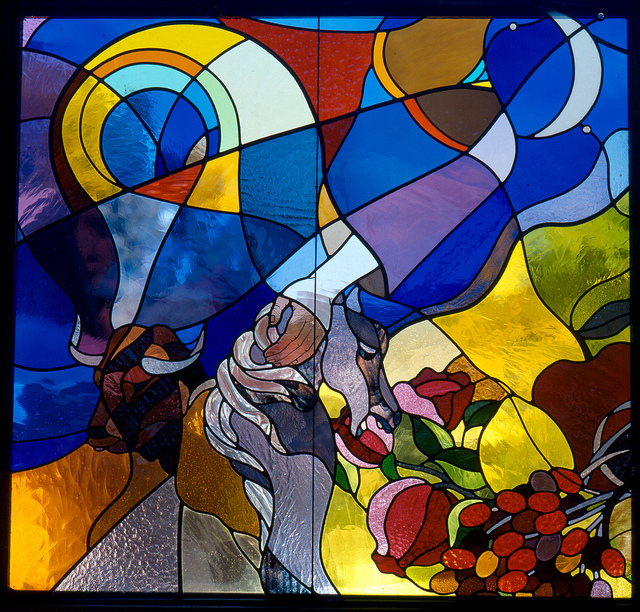
Ordinarily, there should be justice in appointments, and succession planning should follow well understood procedures. But there needs to be processes of disruption. I have been reading the story of Jacob’s blessing of Joseph’s two sons Manasseh and Ephraim (Genesis 48). They were born in that order and should, by rights, have been blessed in that order. Jacob himself “stole” his father’s blessing from his older twin Esau. Of Jacob’s twelve sons, Joseph was the last in line, inspiring murderous resentment amongst his brothers. (The stained glass pictured above shows Joseph’s blessing). Disappointments abound in the Bible. The choice of David by the prophet Samuel was a surprise to David’s father. David was not the first-born, but the last-born – and still so young. Each of his older brothers was presented to Samuel. Each was dis-appointed as Samuel turned the line of succession on its head (1 Samuel 16:1-13).

The New Testament takes up the theme. Everything is in the wrong order. Even the birth of Jesus is in the wrong place. The wise ones went for Jerusalem and finished up nine miles wide of the mark. (Matthew 2). Jesus, himself set the cat among the pigeons by describing the disappointment process. He said “The last will be first, and the first will be last” (Matthew 20:16) before being challenged by the Mum who claimed her two sons had the right to the best seats in the house (Matthew 20:20-24).

All these stories are a reminder that there has to be room for manoeuvre and that there have to be processes of disruption. Prayer before appointments is an invitation for the Holy Spirit to confirm or disrupt the natural order of things. Sometimes the order of things has to change if things are going to change. The story of Manasseh and Ephraim, (or is it Ephraim and Manasseh?) is a reminder of that. It represents the hope of a new order, in which those whose appointment comes as a surprise live for the sake of others and not for themselves. That is why the order is changed.

A new order is one in which all those who come last in things come first – a great disappointing for some.

The stained glass is by Maria Stolz of Renaissance Glassworks Howard Lake, MN 55349

Here is another post on the theme of disappointment and leadership.

Little David

> Thinking about David …. God seems to overlook qualifications and eligibility. Today’s psalm (89) refers to how David was chosen to be king of Israel. “I have set a youth above the mighty; I have raised a young man over the people.” God’s man, Samuel was sent to Jesse’s family to anoint the one indicated. The first in line was bruought in – and Samuel gets told “Do not consider his appearance or his height, for I have rejected him. The Lord does not look at the things people look at.” (1 Sam 16). Seven of Jesse’s sons were introduced to Samuel, but it was the last and youngest in the presentation line who was the one Samuel anointed. This seems to be the way with God. He prefers the small, the last and the least. He overlooks qualifications and eligibility. Centuries later Paul rejoices in his weaknesses because he hears God: “My grace is sufficient for you, for my power is made perfect in weakness.” (2 Cor 12:9)

There were not many people who put money on David beating Goliath – boy against giant. But there are a lot of people who have been made to look small by the world who believe that their victory is assured because their God is one who overlooks qualifications and eligibility and has a preference for the lost, last and least.

Belbin is better known for his theories about team role preferences. His theories are also applicable in terms of recruitment. He too is prepared to overlook qualifications and eligibility. These things look backwards and eligibility does not equate to suitability. Looking at suitability is forward looking to what a person can become.

So those are eligible and suitable are an ideal fit but may be short stayers.
Those who are eligible but unsuitable are a poor fit and problems occur.
Those who are barely eligible and unsuitable are total misfits and become leavers.
Those who are barely eligible but suitable are a surprise fit and become long stayers.

Now, I only have limited experience of recruitment but I can safely say that both David and Paul come into the category of “barely eligible but suitable” – with the right sort of help. And that’s how Goliath got his comeuppance.