Love comes home – picking up Lydia’s purple thread

A reflection for the 6th Sunday of Easter based on the readings for the day, Acts 16:9-15 and John 14:23-29.

I love preaching that brings Scripture to life—and that brings Scripture back to life, and I hope you do too. I say this every time as a reminder that when we open scripture together we are bringing it back to life. What matters today is that love comes home. In both our readings today, love comes home.

Hear the promise in John 14:23-29 as Jesus promises that both the Father and himself as Son will make their home with anyone who loves Jesus and obeys his teaching. Love comes home and makes a resurrection appearance.

In our reading from Acts (16:9-15) we begin to understand from Lydia how the Spirit of God opens our hearts for us to open our homes. Our heart is our home, our hearth is our home.

Paul and Silas met Lydia at Philippi. When he set out Paul was expecting to meet a man from Macedonia. Instead he meets a bunch of women.

Philippi was a Roman colony. She wasn’t from Philippi but was from a city called Thyatira. She wasn’t at home in Philippi. Her name emphasizes that. Lydia wouldn’t have been her real name. She was called Lydia because that’s where she was from, where her home far from Philippi was. She was from Thyatira which is in the Turkish province of Lydia. Hence Lydia.

Perhaps Lydia was on a business trip. She was a dealer in purple cloth. Purple cloth would have been in demand in a Roman city.

It was Cleopatra that made purple popular. Julius Caesar travelled to Egypt in 48BC and met Cleopatra. He saw how she loved purple, and embraced it himself, decreeing that only Caesars could wear togas dyed completely purple. It became the colour of imperial power for both the Roman and Byzantine empires. (I got that from the Jamaica Observer – something I’ve never referenced before!) So we begin to build a picture of Lydia as a successful businesswoman who would probably have been dealing with the court representatives of Caesar’s empire. Purple was reserved for royalty, priests and nobles. These are the people Lydia would have been dealing with.

Paul and his group met Lydia at a place of prayer by the river. The storyteller tells us it was outside the city gate. These are details to underline the fact that none of these people, Paul, Silas, Lydia (and perhaps her household), none of them were at home. This is wild praying. They were all travellers.

We don’t know whether Lydia was a Jew or a Gentile. And we don’t know whether that place by the river was a recognised place of prayer, or whether it became a place of prayer because people prayed there. What we do know is that Lydia puts herself in the place of listening Israel as she listened to Paul. The Lord opened her heart to respond to Paul’s message. When she and the members of her household were baptised, she invited Paul and Silas to her home. She persuaded them to come and stay at her house. She was insistently hospitable. But she doesn’t just host the missionaries, she hosts the mission of God by taking love home.

When love comes home she turns our homes inside out. Lydia is a powerful woman, a successful woman. Instead of building her business empire she puts everything at the disposal of God’s mission for the sake of the world.

The Light of the World by Holman Hunt

Holman Hunt paints the picture for us of love coming home, making a resurrection appearance.
It’s Jesus standing at the door and knocking (cf Revelation 3:20).
It is said that one of the reasons the Conclave elected Francis Pope in 2013 was because of a reflection on that passage when he suggested that when Jesus stands at the door and knocks, he’s not only wanting to come in and join us, he’s wanting us to come out to join him.
He calls us out of our comfort zones to embrace the “peripheries” of society in the world he is already loving and calling home.
When love comes home, she casts out fear, knocks down walls and rearranges the furniture of our minds.
Love turns our home inside out.

Holman Hunt’s image fits Lydia’s story perfectly. Her heart opens, and her home follows suit.

Scripture doesn’t usually give us the details of the jobs women did, but we’re told that Lydia was a dealer in purple cloth, the colour of empire, power and status.
I don’t know whether you’ve ever noticed but purple is the Church of England has adopted.
The signage and letterheads are all purple. The shirts our bishops wear are purple.
What does it mean when the church wears purple?
Are we signalling prestige? Or is it Lydia we recall?

Our new Pope, Leo XIV seems to suggest that the church should be more like a home than a palace.
Addressing those who no longer believe, no longer hope and no longer pray, and including those who are fed up with scandals, with misused power, with the silence of a Church that seems more like a palace than a home, he committed the church to being a home for the homeless where the weary find rest and refreshment.

He said that God doesn’t need soldiers. He needs brothers and sisters. We all know that it’s brothers and sisters that make a home.

Following that purple thread, are we then, when we wear purple, reminding ourselves that our calling, like Lydia’s, is to put everything – status, power, influence -at the service of love, to make love feel at home in our world? Purple was the colour Lydia laid down on the table of hospitality to welcome  love home. She dealt in purple and traded it for the gospel.

In a recent speech on immigration Sir Keir Starmer suggested that we are “becoming a nation of strangers”. He’s got himself into a lot of trouble. But what if there is a grain of truth in what he says? It doesn’t mean we should pull up the drawbridge and tighten our controls. Our scriptures tell us that love will come home to those who love Jesus and love often comes in the form of a stranger. Paul thought he was going to meet a man from Macedonia. Instead he met someone stranger, Lydia, a dealer in purple, a worshipper, a listener. She opened her home to him and love came home to her.

Love comes home, and when it does, it never leaves things as they are but turns us inside out. It opens hearts, it opens homes, it opens the Church. It rearranges our priorities, flips our ideas of power and calls us to join Jesus outside the gate – by the river, in the wild places, wherever people are listening.
Seeing the wounds Jesus shows us

A sermon for the 2nd Sunday of Easter – Year C for two small churches. The gospel for the day is John 20:19-end.

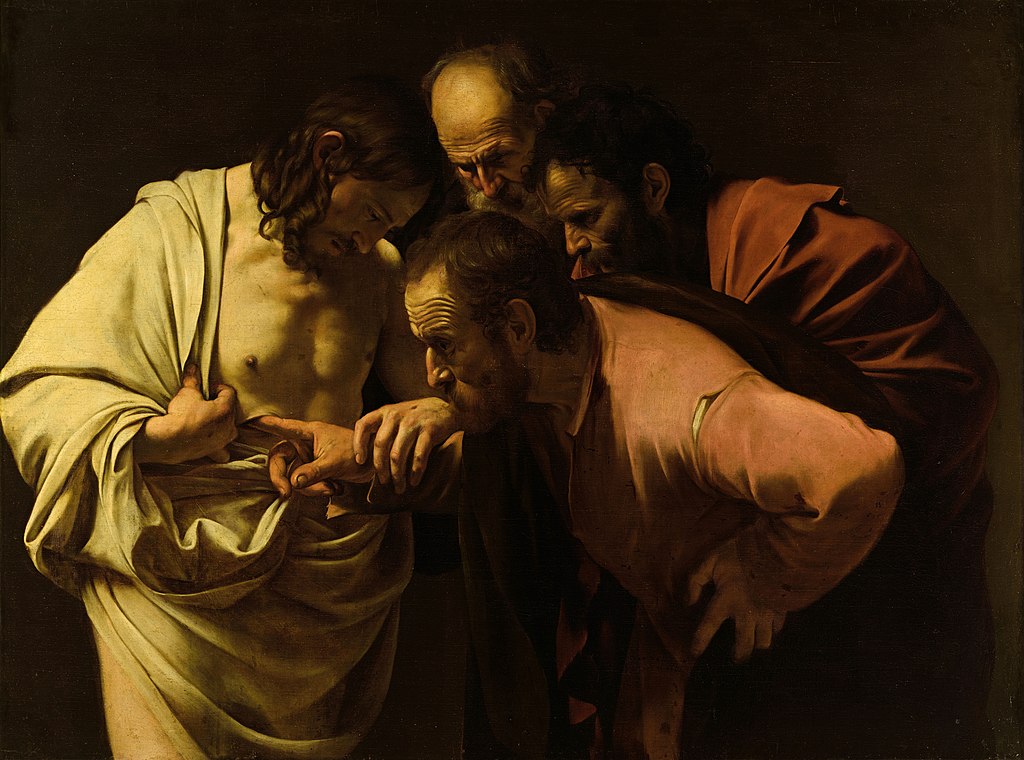
The Incredulity of St Thomas by Caravaggio – or should it be called Jesus showing Thomas his wounds?

I love preaching that brings Scripture to life—and that brings Scripture back to life.

That’s a line I’m going to repeat each week to remind us that every time we open Scripture together we are bringing it back to life.

This morning we return to John’s Gospel, still caught up in the wonder of that first Easter day (John 20:19-end). It’s a story only he tells.

John himself brings scripture back to life.
Particularly we see the influence of the creation story from the 1st chapter of our scriptures.
We can see that in the way that he tells us the time.
On the evening of that first day of the week.
It’s like last week’s gospel reading which began: Early on the first day of the week, while it was still dark. (John 20:1)
We are still on that first day which was like the first day of creation, when, according to Genesis 1:2, earth was a formless void and darkness covered the face of the deep.
That’s the time in today’s gospel. It was the first day of the week, and it was evening.
In other words, darkness was forming.
Taking our cue from Genesis, John’s readers can expect God’s wonders on this new day of creation.

Thomas wasn’t with the disciples when Jesus came on that first day, the day of resurrection.
It was the other disciples who had to let him know that they had seen the Lord.
Thomas told them that he would never believe “unless I see the nail marks in his hands and put my finger where the nails were, and put my hand into his side”.
It is this I suggest we focus on in our worship today.

Thomas is the patron saint of those who are blind because seeing wasn’t enough for him.
He needed to examine Jesus’s wounds by touching them and feeling them.
And the wonderful thing on that second Sunday, the first day of the week following, was that Jesus came and stood among them again and showed Thomas his wounds.
He welcomed his touch. He guided his hand. He let him explore his body.
Thomas is the patron saint of those who struggle to believe what they can’t see—or even what they can.
He shows us that resurrection faith isn’t just about seeing.
Sometimes it’s about touching, questioning and wrestling with God.

Jesus showed Thomas his scars. He wants his disciples to see them.


In the Last Supper, he took a loaf of bread and he broke it.
He wanted them to see his body in the brokenness of the bread.
“Take, this is my body,” he said. (Mark 14:22).
Then he gave them a cup for all of them to drink from.
In that cup he wanted them to see his blood.
“This is my blood of the covenant poured out for many.”
Even before he was wounded he wanted to show his disciples the wounds he was going to suffer.
And in today’s gospel, in one of his resurrection appearances, he invites Thomas to have a look at those wounds – to examine, inspect and see with his hands as well as his eye.

Thomas recognises Jesus through his wounds, just as Jesus wanted him to.
And this is how we come to know Jesus.
Just as Thomas encountered the risen Christ in his wounds, so too we encounter him today in the bread and wine of the Eucharist.
Every Communion we have with Jesus we have this invitation to examine the wounds of Jesus. Every time the bread is broken we are invited to see the brokenness of the body of Christ and to feel that brokenness in our mouths.
Every time we take this cup we are invited to taste the blood of Christ shed for us.

What is it that Jesus showed Thomas?
What did he want his disciples to see?
What does he want us to see when he shows us his wounds, when he invites us to see his body and his blood?

The first things we see are the wounds to his hands and feet where the nails were driven into his body by the hammer blows of empire.
Then, if he turns we see the wounds of the whipping scored into his back for being the scourge of empire and religion.
Then we see the scars on his head where they pressed the crown of thorns and added insult to injury, to press home the point that this “pretender” was nothing.

The rule of the kingdom of God is that the last, the lost and the least come first and those who are first in the kingdoms of this world come last.
The rule of the kingdom of God turns the rules of the world upside down.

In the wounds of Jesus, his disciples see a man who embodies that rule of the kingdom of God. In the brokenness of his body, in the bloodshed, we see a man the religious and political capital tried to reduce to nothing.
The plots against him and his crucifixion were intended to humiliate him and his followers – to make them least, last and lost – GONE for ever.

The problem for them was that the rule of the kingdom of God puts the least, last and lost – those lost and broken by the ways of the world – first.
When Jesus stood among his disciples, first without Thomas, then with him, he was the living proof of the fundamental rule of the kingdom of God.
Here was the humiliated, crucified and killed one.
You can’t get more “least, last and lost” than that.
Here he was, “the first fruits of those who have died”, Christ raised from the dead (1 Corinthians 15:20).

This is what Jesus showed Thomas –
the scars are the living proof of the rule of the kingdom of God.
Jesus stood among them as living proof of the rule he’d always followed,
that puts the last first and the first last.
Here is the one they put last made first.
This is what Thomas saw. This is what he said:
“My Lord, my God” – the rule of the kingdom of God realised in those few words.
“My Lord and my God” – Jesus comes first for Thomas.

So Jesus stands among us still, not with condemnation, but with scars.
What do we see? What difference does it make? Does Jesus come first?

Jesus doesn’t shame Thomas for his questions. He meets him in them.
He doesn’t rush belief. He invites it — gently, patiently, personally.

And he does the same with us.
To all who doubt, who ache, who long to see and touch and know — he says,
“Here I am. Peace be with you.”

He doesn’t hide his wounds. He offers them.
He lets us trace the pain and the mystery of a love that suffers with us and for us.
And in that wounded, risen body, we find our hope.

This morning, he says again:
“This is my body. This is my blood.”
This is how I choose to be known.
Look closely. Taste carefully.
And, if you are among the broken,
do not be afraid.

The Cruel Sea is on its way out – a reflection for All Saints Sunday

All Saints Sunday

Some made heavy weather through this sermon for All Saints Sunday in spite of the very well read scripture for the day – Revelation 21:1-6a. (My fault.) It was the detail in the text of the sea being no more which caught my eye and triggered my imagination. It’s not often we preach from Revelation. It’s the last word in our scripture, the last book that graphically seems to sum up the ways in which the Bible as a whole reveals God in the troubles of our lives.

All Saints Sunday – November 3rd 2024

Every grandparent of young children knows the Disney film Moana – probably word for word. Moana is the daughter of the village chief on a remote island where no one goes beyond the reef because of the dangers of the wider sea.

The wider sea is a place of danger. It’s not a place for poor islanders if they want to stay safe. Their boats were for fishing in the shallow seas. The seas are dangerous particularly for those who are poor, as we have been seeing in the attempted channel crossings that desperate people are making. The seas swallow the poor who dare to go beyond the reef.

It’s only the empires of the world that have conquered the seas with their vast ships and wealth of engineering. Rule Britannia and all that. 

Rule, Britannia! Britannia, rule the waves!
Britons never, never, never will be slaves.

Rule Britannia was written in 1740 just at the time when the British empire did rule the waves – as it did for two centuries until the First World War. While it may be true that empires bring some benefit, so often the ships of empire only brought trouble, bringing occupation and taking land, minerals and people for empires own purpose.

This is how Revelation sees the sea. Revelation is the last book of our scriptures. It wraps it all up and wraps it all up so graphically. It’s like a graphic novel. 

Revelation 21.1-6a
21  Then I saw a new heaven and a new earth; for the first heaven and the first earth had passed away, and the sea was no more.
2  And I saw the holy city, the new Jerusalem, coming down out of heaven from God, prepared as a bride adorned for her husband.
3  And I heard a loud voice from the throne saying, ‘See, the home of God is among mortals. He will dwell with them; they will be his peoples, and God himself will be with them;
4   he will wipe every tear from their eyes. Death will be no more; mourning and crying and pain will be no more, for the first things have passed away.
5   And the one who was seated on the throne said, ‘See, I am making all things new.’ Also he said, ‘Write this, for these words are trustworthy and true.’
6  Then he said to me, ‘It is done! I am the Alpha and the Omega, the beginning and the end. To the thirsty I will give water as a gift from the spring of the water of life.

John sees a new heaven and a new earth, for the first heaven and the first earth had passed away, and the sea was no more.

In the graphics of his revelation, John sees “the beast” rising out of the sea with ten horns and seven heads bearing blasphemous names. The beast comes from the darkness and the vastness of the sea. The beast had authority over every tribe and people and language and nation. In other words it was “empire”. The beast/empire made war on everyone who threatened its power, including trying to conquer the saints. All the suffering of the first heaven and the first earth comes from the beastliness of what comes out of the seas – those who rule the waves cause poverty, pain and tears “for the peoples of the world”. This is John’s revelation – what God revealed to John.

John himself was a victim of the beast of the sea. In his introduction, in chapter 1, he tells us that he is a victim of the persecution of Christians and that he was on an island called Patmos “because of the word of God and the testimony of Jesus”. 

Pliny and Tacitus tell us that prophecy, particularly prophecy with political implications, was seen as a threat by the Roman empire. Those guilty of such prophecy were deported. So, here is John, having been deported across the sea of empire to an island surrounded by cruel sea, living in exile. More graphically, empire swallowed John up and spewed him on an island – cast away.

Just as empire was doing its worst for John, those earliest Christians and other peoples of the world John has this revelation of the end of empire – the ending of the first earth ruled by empire. He sees a new heaven and a new earth, for the first heaven and the first earth had passed away, and the sea was no more, because evil empire is no more.  He sees the end of the old rules and the beginning of a new rule in the form of the holy city, new Jerusalem, coming down out of heaven from God, and he heard a loud voice coming from the throne of the new rule saying the “home of God is among mortals. He will dwell with them; they will be his peoples, and God himself will be with them.”

The point about empire and the sea underlines the political context of this revelation of God’s work. We still live in a political context which causes untold suffering. It is within that political context that God lives, moves and has his being. This is how God has revealed himself, time and time again, ever present in the troubles of the peoples of the world. This is the revelation that is treasured in our scriptures in book after book.

He comes to us. The Lord is here. His Spirit is with us – in the here and now, helping us through times of trial, strengthening our fight against injustices, making saints out of sinners. “See” said the one seated on the throne so different from those of worldly empires to John. “See, the home of God is among mortals. He will dwell with them; they will be his peoples, and God himself will be with them.”  

This is down to earth. It’s not pie in the sky when we die, as when we say “she’s gone to be with Jesus”. No. The point of God’s revelation is that he is with us now. The Lord is here. His Spirit is with us.

Down to earth, not pie in the sky.  God makes his dwelling with us. He stands at the door and knocks – and waits, and waits till we answer his call – and all is revealed as soon as we let our hearts, minds, hands and eyes be opened.

It’s in our lives here and now that God reveals himself – as Father, Son and Holy Spirit. As father, making good things of earth, fashioning us for now, answering our prayer. In Jesus proving himself down to earth. As Holy Spirit breathing new life into us, inspiring us, encouraging us, strengthening us here and now.

Then the one seated on the throne made John see again. “See, I am making all things new.” This is heavenly Repair Shop stuff – making new the stuff of our lives. This brings hope here and now. This is the age we are living in – (the same as John’s, the same as everyone’s). We see so much that is broken – around us, and within us. But it is really the beginning of the end with God making all things new. Here’s the alpha, the beginning that leads to the end, the omega when there will be no darkness for shame to hide in.

This is how the book of Revelation came down to us. The one enthroned in love said to John, “Write this. Write this for these words are trustworthy and true” These words being “the home of God is with mortals” (those who will die), and “I am making all things new”.

This is how we have received the revelation of the love of God. Those words are trustworthy and true. We need to guard them with our lives and never let our Godtalk be pie in the sky when we die, but always the love from above, down to earth, here and now. Insist the Lord is here and his Spirit is with us, making all things new as we battle the beast.

We began our worship by remembering all the saints using this list circulated by Sheffield Manor Parish on their Facebook page. They credit Nel Shallow and Pete Phillips for the words.

We remember Lord today all Your saints
the brave and bold
the faithful and fearless
the pursued and persecuted
the imprisoned
the impoverished
the murdered
the martyred
the grace-full and generous
the poets and the prophets
the wonderers and the wise
the healers and the helpers
the preachers
the paupers
the cloistered
the commoners
the foolish and floundering
the unready and unsteady
the careless and the cautious
the following
the hopeless
the hopeful
the faithless yet forgiven
the faithful yet flawed
the wandering and wayward
the lost and longing
We remember today Lord all Your saints
called and chosen
beloved and beheld
holy and human
Amen

Blessing the small, the least, the last and all those suffering empire.

A sermon for Trinity 20A. I focus on Jesus takes a people bruised and battered by empires to a whole new realm. The readings are printed below. They were Isaiah 45:1-7 and Matthew 22:15-22. It was the emperor in each of the readings which first grabbed my attention.

October 22nd 2023

My Bible

These are the writings of a bruised and battered people who have lived through the worst of times.

This is the reading of a bruised and battered people.

This is their literature. They have treasured it. They have handed it on for the sake of other bruised and battered people.

As always our scriptures are brought to us by a troubled people. It is a troubled people, inspired in the Spirit of God who have chosen the scriptures we inherit and hand on. It is a troubled people who have treasured them and bottled them for us because they have been a a very present help in times of trouble.

They are a people who have had all kinds of suffering inflicted upon them by dominating empires, from slavery in the hands of the Egyptian empire, to destruction of their institutions, to exile, persecution and occupation by the Assyrian, Babylonian, Greek and Roman empires. Their imperial domination, at various times, took their labour, their homes, their institutions, their land, their networks, their lives. Our scriptures give us the very best trauma literature and survival resources. 

For those dominated by powers which are not their own there is always the question, “how do we get through this?”

This morning’s readings, brought to us by a traumatised people feature two emperors. In the red corner we have Cyrus whose Persian empire survived a mere 7 years in the 6th century BC. He is the golden boy amongst emperors. He shows us that it is possible for those rich in power to enter the kingdom of heaven by allowing God to take his hand (and arms) to dismantle empire and repair its damage. He is called the Lord’s anointed in our reading from Isaiah – provides a happy and short interlude.

In the blue corner we have the unnamed Caesar, the Roman emperor. 

The question the unlikely alliance of Herodians and Pharisees ask Jesus is a trick question. The answer Jesus gives isn’t a simple “pay your taxes”. It’s a trick answer. Pay Caesar what is his. What is his? What is rightfully the emperor’s in a land which he has taken from others. It’s a trick question with a trick answer. Underlying both is that harder question of how do we live with this overwhelming, stifling foreign power?

When we read our scriptures we are always bumping into emperors and hearing of the troubles and damage that they bring. That is the context.

I don’t know whether you will agree with this assessment of our own context – that most of us have shared the benefits and privileges of empire, that we might feel uneasy in the aftermath of empire, uncomfortable about what we might have taken from others and unsure about how we begin to repair the damage. 

Empire is always our context. They are built all around us. We may be one of their builders. The superpowers operate imperial models. There are global empires like Amazon and Google (and who should they pay taxes to?) There are the media empires and their hidden persuaders with their bots affecting our habits and views. These are large empires. There are other empires operating the other side of the law – the drug cartels with their barons, the warlords, people traffickers, as well as the little empire builders we see around us. Mr Big always brings favours to some and trouble to many. He is always self serving.

This is our context. And this is the context for Jesus’ teaching about a kingdom and way of life so radically different from the ways of empire. Jesus was tempted by the ways of empire – world domination, stunts and political popularity were not going to be his way. He saw the devil in them.

Instead he helped his followers explore a different realm – a realm in which there is no domination and only amazing grace. To these troubled people Jesus offered an alternative vision of hope. He opens up a kingdom in which everything is small and vulnerable rather than mighty and impregnable.

He casts around for images that we will all understand. To what shall I liken the kingdom of heaven?  To people so often belittled by empires, to people who can so easily be lost or disappeared, to a people whose lives are hidden and voice unheard he likens the kingdom to things that are hardly noticed and that can so easily disappear. Like the mustard seed, the smallest of all seeds. Like the leaven folded into the loaf. Like the scattering of seed.

He trains our eye on the birds of the air and the lilies of the field and says there is no glory in empire, nothing like the glory of the lilies of the field. To those who have little, he shows what can be done with little – feeding 4000, feeding 5000.

He turns the world’s rule upside down by saying to those used to coming last that the rule of his kingdom is that the last come first and the first come last. He turns the world upside down by putting children central to the kingdom of heaven, the qualification for entry being that we have to become small and just like a child.

We love to remember that the son of God came to us as smaller than a child, a baby. The teaching he shares is his learning to be a child. In John’s gospel, Jesus teaches that we have to be born again, to seize the opportunity of a second chance of being children. 

In that gospel Jesus is just a ray of light that shines in overwhelming darkness, the word of God in edgeways. The words that come to mind when we think of God’s kingdom – if we have learned anything from Jesus – is small and vulnerable.

Maybe it is only as I have retired from the church’s institutions and put some distance between myself and the systems and thinking which mimic the ways of empires and powers, that I have seen, as if for the first time, that the kingdom of heaven is only to be understood in things small, hidden and vulnerable, and that the kingdom of heaven is for those who are the last and least chosen in the kingdoms of this world – for the hidden and vulnerable, and for those who are prepared to make themselves small for the sake of the kingdom.

I have noticed this particularly in this year’s successive gospel readings from Matthew.

At the beginning of his gospel Matthew gives us a name for Jesus, Emmanuel. That name means “God with us”. At the end of his gospel he gives us a promise to remember. “I am with you always, to the end of the age.” He shows the battered, bruised and bloodied people the battered, bruised and bloodied face of Jesus – joined with them in their suffering – and he shares Jesus’s blessing of them.

How blessed are you who are poor in spirit – yours is the kingdom of heaven.

How blessed are you who mourn – you will be comforted.

How blessed are you who are meek – the earth will be yours.

How blessed are those of you who hunger and thirst for righteousness. You will be well satisfied.

How blessed are you who are merciful. Mercy will be shown to you as to no other.

How blessed are the pure in heart. You will see God in the smallest and most vulnerable.

How blessed are those of you who are persecuted. Yours is the kingdom of heaven.

This is the blessing of a bruised and battered community. Today we join them in reading their scripture, in their prayer, in their struggles, in their blessing and in the kingdom prepared for them.

Isaiah 45:1-7

Thus says the Lord to his anointed, to Cyrus,
whose right hand I have grasped
to subdue nations before him
and strip kings of their robes,
to open doors before him –
and the gates shall not be closed:
I will go before you
and level the mountains,
I will break in pieces the doors of bronze
and cut through the bars of iron,
I will give you the treasures of darkness
and riches hidden in secret places,
so that you may know that it is I, the Lord,
the God of Israel, who call you by your name.
For the sake of my servant Jacob,
and Israel my chosen,
I call you by your name,
I surname you, though you do not know me.
I am the Lord, and there is no other;
besides me there is no god.
I arm you, though you do not know me,
so that they may know, from the rising of the sun and from the west, that there is none besides me;
I am the Lord, and there is no other.
I form light and create darkness,
I make weal and create woe;
I the Lord do all these things.

Matthew 22:15-22

Then the Pharisees went and plotted to entrap him in what he said. So they sent their disciples to him, along with the Herodians, saying, “Teacher, we know that you are sincere, and teach the way of God in accordance with truth, and show deference to no one; for you do not regard people with partiality. Tell us then, what you think. Is it lawful to pay taxes to the emperor, or not?” But Jesus, aware of their malice, said, “why are you putting me to the test, you hypocrites? Show me the coin used for the tax.” And they brought him a denarius. Then he said to them, “Whose head is this, and whose title?” They answered, “The emperor’s”. Then he said to them, “Give therefore to the emperor the things that are the emperor’s, and to God the things that are God’s.” When they heard this they were amazed, and they left him and went away.

Pentecost and the love of language

This is the second of a series of reflections inspired by readings from the Book of Acts. Acts is a book of beginnings and the focus of this reflection is on what began at Pentecost through the gift of language.

This is Acts 2:1-6 (I’m using the New Revised Standard Version Updated Edition):

When the day of Pentecost had come, they were all together in one place. And suddenly from heaven there came a sound like the rush of a violent wind, and it filled the entire house where they were sitting. Divided tongues, as of fire, appeared among them, and a tongue rested on each of them. All of them were filled with the Holy Spirit and began to speak in other languages, as the Spirit gave them ability.
Now there were devout Jews from every people under heaven living in Jerusalem. And at this sound the crowd gathered and was bewildered, because each one heard them speaking in the native language of each.

In short, Luke describes a violent rush of wind that shakes up our settled ways of living and possessing. Life can never be the same again. Settled structures are blown apart and the apostles together with some women and some others (Acts 1:14) are blown to join thousands of others through the gift of language and a miracle of hearing.

Language has always been a barrier between people (from Babel) but this miracle brings people together who would have been stranger to each other. Here words are translated by love and the words are taken to heart by people from all parts of the world – “here at last, someone speaking my language”. Alongside that violent rush of wind there is this enormous sigh of people understood – the sigh of relief that here at last, someone is speaking my language.

What does it take to speak the language that makes sense to others, that makes their heart sing? To speak to people in a language they understand requires us to keep silent while we listen to them, while we learn from their words and the emotional history that lies behind them. To speak to a people in any way that makes sense requires an emotional intelligence and empathy that inspires the confidence in one anther that we have something worth saying to one another, and worth hearing from one another. Words on their own will never do because body language communicates far more in the bearing we bring to our words. For a miracle of hearing there needs to be nothing short of love.

The language of vulnerable people is often lost on people of power and many a language has been lost. The English used to forbid the use of Irish in the Irish pig markets insisting that English is the perfect language to sell pigs in. “That English is the perfect language to sell pigs in” is a line from Michael Hartnett’s poem A Farewell to English in which he announced to the world that he would no longer write in English. He did this as resistance and as a way of treasuring the Irish language.

When we think of the languages we are taught in school, they are all the languages of empire, the languages that are supposed to help us get on in life, that help us to get jobs in successful companies. Compulsory language education takes many forms. In the UK language education is benign, but Willie James Jennings writing from an Afro-American perspective, invites us to imagine something far more sinister. In his commentary on Acts he writes: “Imagine centuries of submission and internalised hatred of mother tongues and in the quiet spaces of many villages, many homes, women, men and children practising these new enlightened languages not by choice but by force.”

What of those who insist on the language of empire, who insist on the Queen’s English (should that now be King’s English)? They deprive people of language and understanding : their values, practical wisdom and subtlety are imperilled by a colonising power which conscripts the other for empire. They rob people of their past, present and future. They are responsible for the loss of language. Language makes the store and story of history and all of us want to have ourselves heard and understood. But so many have lost their language, and with it the store and story of their histories.

The book of Genesis sees languages as the curse of empire builders. The story of the Tower of Babel is a story of powerful people thinking they could build all the way to heaven. The seeds of confusion that were sown through their different languages were intended to prevent them getting above themselves.

The way of the empire is not the way of the Spirit or of Spirited people. The Spirit uses the languages long forgotten by the powers that be. In the beginning of this book of beginnings which is Acts Luke goes into detail where everyone has come from. Often readers skip over this long list. They shouldn’t because everyone of them heard the disciples speaking their language. Every one counts and not one of them should be overlooked by us readers.

Imagine this:

Amazed and astonished, they asked, “Are not all these who are speaking Galileans? And how is it that we hear, each of us, in our own native language? Parthians, Medes, Elamites, and residents of Mesopotamia, Judea and Cappadocia, Pontus and Asia, 10 Phrygia and Pamphylia, Egypt and the parts of Libya belonging to Cyrene, and visitors from Rome, both Jews and proselytes, 11 Cretans and Arabs—in our own languages we hear them speaking about God’s deeds of power.” Acts 2:7-11.

We might add other language barriers that would have been present – the young, the old, men, women, deaf, disabled – “we all hear them speaking our language”. This is a beginning for all of them. Now that they have heard God spoken to their heart they now have their own language for God-talk to take back home to their villages and communities. That was a beginning for them.

But we live in a world where divisions won’t go away, where little empires everywhere build their walled communities of exclusion. How do we make sense to one another through the thick walls of separation and in environments made increasingly hostile? What is the way of the Spirit of God? There is a promising beginning in this miracle of Pentecost. The gift of language, the gift in their tongues, is not for one way communication. It is a gift which enables the believers to join others and to enter into their language and life. It is for the act of living together, for the art of heartfelt conversation and for the creation of new relationships.

This is the way with God, embracing others with a love that is utterly understandable. Love translates, and only translates as good news.

Acts 2:1-21 is read in churches at Pentecost.