This Is How It Began – in the middle of winter

Preached on the Fourth Sunday of Advent, this sermon sits with Matthew’s telling of Jesus’ birth at midwinter — when the light is weakest and hope can feel thin. It explores how God chooses to begin again not in tidiness or certainty, but in the mess, risk, and vulnerability of ordinary human lives.


This is how the birth of Jesus the Messiah came about.
These are the words Matthew uses to describe the birth of Jesus.
This is how it happened.
This is how it began.

When I say,
“these are the words Matthew uses,”
what I really mean is,
“this is how we have translated the words Matthew wrote.”
Matthew wrote in Greek,
and the key word in that opening sentence is a Greek word we know very well, the word genesis.

Τοῦ δὲ Ἰησοῦ Χριστοῦ ἡ γένεσις οὕτως ἦν· μνηστευθείσης γὰρ τῆς μητρὸς αὐτοῦ Μαρίας τῷ Ἰωσήφ, πρὶν ἢ συνελθεῖν αὐτοὺς εὑρέθη ἐν γαστρὶ ἔχουσα ἐκ πνεύματος ἁγίου

Genesis.
Beginning.
Origin.
The start of something that will change everything.

Matthew is not just telling us how a baby was born.
He is taking us back to the very beginning.
Back to the beginning of the world.
Back to the beginning of God’s work with humanity.
Back to what begins with Jesus.

It is no accident that we hear this reading now
— on the shortest day of the year,
at midwinter,
when the light is at its thinnest and the night feels longest.

Because beginnings often come like that.
Quietly. In the dark.
When the ground looks bare and the fields seem empty.
When nothing much appears to be happening at all.
This is when God makes his presence felt.

Matthew takes us back to a beginning that looks very small.
Just as in Genesis, there is a young boy and a young girl.
But they’re not Adam and Eve. They are Joseph and Mary.
Ordinary people with complicated lives.

Adam and Eve walked freely with God.
They had no backstory.
No reputation to protect.
No neighbours to worry about.

But Joseph and Mary live in a world where things are already tangled.

Mary is pledged to be married, but not yet married.
Joseph is a good man, but suddenly faced with a situation that could cost him his standing, his future, his place in the community.
This is not a beginning without consequences.
This is a beginning that arrives already burdened.

And God does not wait for a cleaner moment.
God begins again here — not in freedom, but in constraint;
not in clarity, but in confusion;
not in daylight, but in the deepening darkness.

This is how the birth of Jesus comes about.
Not by sweeping the mess away, but by entering it.
Not by restoring the world to how it once was,
but by beginning something new within the world as it is.

in a teenage love story,
in the vulnerability of these two youngsters.

Both are vulnerable.
Mary is pledged to Joseph but not living with him.
She’s pregnant. People are going to talk.
If she’s not been with Joseph, who has she been with?
She is at risk of being shamed, isolated and abandoned –
a public disgrace.

Joseph is vulnerable too.
He has the reputation of being a righteous man
because he tries to do the right thing.
If he stays with Mary he risks his reputation
(costly to his business and his standing).
If he leaves her she is exposed.
There is no clear path.

And here God begins.
In this mess framed by confusion, risk and fear.
God begins again by stepping into lives that are already complicated
— and trusting them with something holy.

Genesis does not wait for spring.
It begins when the light is weakest
in the midst of winter,
and slowly grows from there.

When God begins here, it is not with explanations.

Matthew tells us that Joseph makes up his mind.
He decided what he will do.

And then God speaks.
Not in public,
not with spectacle,
but in the dark night,
In a dream.

The angel does not tidy the situation.
He does not remove the risk.
He does not promise that everything will be all right.

He says only this:
Do not be afraid to take Mary as your wife.

Do not be afraid to stay.
Do not be afraid to be seen.
Do not be afraid to let your life be changed.

And then Matthew gives the child a name.
Emmanuel.
God with us.

Not God with us when the mess is sorted.
Not God with us when the rumours stop.
Not God with us when life feels safe again.

But God with us, here,
in confusion,
in vulnerability,
in teenage love that chooses faithfulness over self-protection.

When Joseph wakes up,
he does what the angel has told him.

And that is how the story moves forward.
Not through certainty.
Not through control.
But through trust.

And this is the genesis Matthew chose to share with his readers,
how God begins his work
these days that are long with darkness.

He begins with a boy and a girl,
with ordinary people inspired to trust.
Slowly, quietly, faithfully the light begins to grow.

This is how the birth of Jesus comes about.
God begins again –
with us –
in the dark.


NOTE
I make no secret of the fact that I’m greatly helped by AI when preparing sermons. Used well, it doesn’t write sermons for me, but helps me listen more closely — to Scripture, to season, and to the lives of the people I’m preaching among. This sermon is better than it would otherwise have been, and I’m grateful for the help.
Luke’s Last Surprise: One Condemned Man Joining Another as the First in Paradise

This Sunday marks the end of the Christian year.
Next Sunday we hop on the next liturgical cycle of readings – it will be Year A.
Each year focuses on a particular gospel. Next year it will be Matthew’s. This year it has been Luke’s.

When I began this preaching year, I wondered what Luke would offer us.
I wondered how he might inspire us, challenge us, lead us.
And now, at the end of the year, I find myself saying one thing above all: WOW.
Luke has surprised us. Luke has stretched us.
Luke has shown us the kingdom of God in places we would never have thought to look.

This Sunday is a WOW moment,
a hinge on which we hang our wonder,
before the new year opens again.
Next week we begin again,
not from cold, not from scratch,
but already warmed by hope,
already knowing what God’s kingdom looks like
in the dominion of darkness.

We will return to the manger
knowing now what Luke has shown us all year –
that God’s kingdom begins with the smallest,
with the least, with the last instead of the first,
in a vulnerable baby held by exhausted parents
on the edges of empire.

These are the readings (Colossians 1:11-20 and Luke 23:33-43) that crown our year.
And this is where Luke has been leading us all along:
not to a palace, but to the place of the skull,
Not to a gold throne, but to a wooden cross.
A king.
A sign nailed above his head.
And a thief beside him.
That’s the gospel picture.
That’s where Luke brings us when the year ends and we crown Christ our King.

Our other reading, from Colossians, may seem difficult at first –
until we recognise it as a hymn.
A hymn praising the God who rescues us from the dominion of darkness,
who strengthens us with endurance,
who qualifies us for the kingdom of his beloved Son –
the kingdom of light,
the kingdom where Christ is King.

Luke paints the scene.
It is the “dominion of darkness” (to use the phrase from Colossians).
The place is the place of the skull,
Death Row in the Dominion of Darkness:
there is the smell of death
and the overpowering smell
of cruelty, injustice and wrongdoing.
There are three crosses.
One is for Jesus, the others for two criminals crucified either side of him.

Luke gives them very different voices.
One sneers – placing him with those who mock, jeer and insult Jesus.
“He saved others, let him save himself if he is who he says he is.”
(In other words, he isn’t who he says he is.)
“Aren’t you the Messiah? Save yourself and us!”

The other criminal rebukes him, saying the two of them deserve their punishment.
Then he protests Jesus’ innocence. “This man has done nothing wrong.”
And in that moment he is just right.
He is right to defend the defenceless
against the forces which have conspired against Jesus.
“This man has done nothing wrong,”
and yet he is facing the same sentence, only worse,
because insult is added to injury.

Then he turns to Jesus.
“Jesus, remember me when you come into your kingdom”

This criminal is the first to defend Jesus publicly.
He is the first to take his stand with Jesus.
And Luke wants us to see him.
This figure.
This last, least, condemned man
who becomes the first to declare Jesus innocent
and the first to receive a royal promise.

He is the last person in the world you’d expect
to be the first to defend Jesus –
(we are led to believe that there is no honour amongst thieves),
but here he is in the picture of paradise – alongside Jesus.
The last becomes the first in paradise,
that kingdom of love –
a relationship, not a place.

And here – right here – you can almost see it happen:

And perhaps this is Luke’s final surprise for us:
that the first to enter paradise with the King is not a saint or a scholar or a faithful disciple,
but a criminal who can offer Jesus nothing but honesty and trust.

He offers no record of virtue.
No proof of goodness.
No last-minute achievements.
He can’t even lift his hands in prayer.
All he can do is speak the truth —
about himself, about Jesus, about the kingdom.
And Jesus takes that truth, that tiny seed of faith,
and makes it bloom.

“Today you will be with me in paradise.”

And that paradise begins there,
in the dominion of darkness,
with a king crowned not with gold but with thorns,
and a wrongdoer who sees more clearly than anyone else.

The only crown Jesus could ever wear is a crown of thorns.
They’re the thorns of scorn, the barbs of bitterness.
They’re our failures, our wounds, our complicity,
our inability to rule even ourselves.

But the kingdom Luke has been showing us week after week
is a kingdom where the last come first,
the lost are found
and where the crucified King gathers in his arms
those the world’s unjust powers condemn.

This is the WOW moment.
Everything has led to this,
when the thorns begin to flower.
This is what Luke is intent on showing us.

His sequel, Acts,becomes the story
of the cross in bloom.
The frightened disciples become bold and generous.
The failures become witnesses.
A crippled beggar stands up and walks.
An Ethiopian outsider becomes the first fully Gentile convert.
A persecutor becomes an apostle.
Prisoners sing hymns; jailers are baptised;
enemies share bread.

Again and again the thorns flower.
Again and again the barren places bear fruit.
Again and again the last become first.

This is where the King of Love leads us:
into a rule of life that puts the last first
and sees thorns flower with grace.

All year long Luke has shown us a kingdom that grows in unlikely places,
and now at the last,
he shows us the unlikeliest place of all,
the place of the skull, Death Row.
Yet even here, if we look through Luke’s eyes,
Something ]begins to bloom.

At the place of the Skull grows the tree of life.
The crown of thorns flowers with grace.
The King of Love
and the convicted criminal
become the first couple in the new creation –
the first to walk the way of mercy,
the first to step into the garden of God’s future.

This is how the Christian year ends:
not with worldly triumph,
but with this strange, saving beauty –
a King who makes the last first,
who turns a place of execution into a place of promise,
who opens paradise to the least likely of all.

This is the kingdom of God and the gentle thorn-crowned rule of Jesus.

Luke 23:33-43

When they came to the place called the Skull, they crucified him there, along with the criminals – one on his right, the other on his left. Jesus said, ‘Father, forgive them, for they do not know what they are doing.’ And they divided up his clothes by casting lots.

The people stood watching, and the rulers even sneered at him. They said, ‘He saved others; let him save himself if he is God’s Messiah, the Chosen One.’

The soldiers also came up and mocked him. They offered him wine vinegar and said, ‘If you are the king of the Jews, save yourself.’

There was a written notice above him, which read: this is the king of the jews.

One of the criminals who hung there hurled insults at him: ‘Aren’t you the Messiah? Save yourself and us!’

But the other criminal rebuked him. ‘Don’t you fear God,’ he said, ‘since you are under the same sentence? We are punished justly, for we are getting what our deeds deserve. But this man has done nothing wrong.’

Then he said, ‘Jesus, remember me when you come into your kingdom.’

Jesus answered him, ‘Truly I tell you, today you will be with me in paradise.’

This is where mercy takes her stand: far off, in the distance

Readings: Luke 18:9–14; Ecclesiasticus 35:12–17

The clocks have changed. The weather’s changed.
And we stand now on the bridge between seasons.

Today is the last Sunday after Trinity.
Next Sunday is the first in the new Kingdom season –
when we see the darkness of the kingdoms of this world,
and pray again for the world to be turned the right way up
with the rule of God’s Kingdom founded in heaven.

As the light shortens and we cross that bridge between seasons,
it feels right to pause and ask what endures –
what stands firm when the world tilts and turns.

And Jesus gives us this story;
a parable about where mercy truly stands.

This is where mercy takes her stand: far off, in the distance.

I want us to notice this morning
the two men Jesus talks about in the parable –
a story he addressed to some
who were confident of their own righteousness
and looked down on everyone else.

Notice how the Pharisee did what was expected of him,
just as he was supposed to,
obedient to the teachings of his religion.

He tithed and he fasted.
He did just what was right.
He was a religious success –
the sort of success to make a temple proud.

He stood confidently still,
as if he owned the place –
the temple where he was the perfect fit,

And he smugly gave thanks
that he wasn’t like the others:
robbers, evildoers, and adulterers.

In fact, he put himself first,
the best he could be,
better than all the rest,
better than the tax collector they all despised,
standing over there, at a distance.

He gave himself the prize,
he was the pride of the temple –
the one to catch the eye
of those like him on centre stage:
the success stories,
the ones who come first in their own eyes
and the eyes of the world,
those who are proud of their achievement,
who look down on those who can’t match them.

But he’s not the one who catches Jesus’ eye.
Mercy’s gaze has turned elsewhere.

This is where mercy takes her stand —
not in the proud posture of the Pharisee,
but with the one who stands at a distance,
head bowed, heart open,
praying only, “God, be merciful to me, a sinner.”

The tax collector hasn’t much to commend him.
He’s made a living making compromises,
lining his own pocket when he must,
doing the bidding of an empire,
taxing his people, cheating his people,
keeping them poor.

He too has come to pray.
He stands apart.
He knows he’s not fit
to join those who look down on him.
He knows the weight of those eyes
and their condemnation, surely justified.

But still he prays where he’s been pushed aside –
in that low place, in that honest place –
and he finds the only prayer he can manage:
“God, be merciful to me, a sinner.”

That’s all.

There are people good at praying, like the Pharisee.
It comes easy to them.

But this tax collector has nothing to claim.
He can’t make comparisons; he can’t claim to be good.
He has no list of good intentions.
All he has are these few words –
and that’s enough for Jesus.

Jesus has highlighted two men –
two types, one self-righteous and sure of himself,
the other “worse” by some distance.

There’s only one who goes home justified,
and it’s not the one we expected,
the one who thanks God he’s better than all the rest,
the one who thinks he’s the best he can be.

It’s the other one, the one on the edge,
the one in the distance, going home justified
(whatever “going home” might mean).

That’s quite some punchline from Jesus,
punching the pride of the temple,
and those confident in their own goodness,
who look down on everyone else.

“All who exalt themselves will be humbled,
and those who humble themselves will be exalted.”


That’s turning the world upside down,
and the truth inside out.

And it still happens today,
whenever we’re brave enough to look beyond ourselves.

There’s a man who sits under the bridge in our town.
I’ve passed him many times,
hesitating, not sure what to say,
worried about what it might cost to engage.
But this week, I stopped.
I’d found my opening line.
We talked.
He had plenty to say.
I found him articulate, intelligent, resilient,
unhealthy, unlucky.
I went away thankful.

I wasn’t thankful I wasn’t like him –
God forbid.
Rather, I was thankful that I am.
Thankful that mercy makes us kin,
that empathy builds bridges and common ground.

I had stood my distance – the shame was all mine.
The shame that it’s taken me so long
to learn how to join those down and those out.

This is where mercy takes her stand —
on the bridges, in the margins,
in the hearts of those who stand at a distance.

And maybe this is a small thing to notice,
but it strikes me that the Pharisee, in his way,
is saying what we so often hear today —
“I’m feeling blessed.”
Blessed that life’s gone well,
blessed that I’m not struggling,
blessed that I’m not like those who’ve fallen on hard times.
But the tax collector doesn’t say that.
He doesn’t feel blessed —
he only feels the weight of mercy.
And yet he’s the one who goes home justified,
seen, forgiven, restored.
Maybe that’s what blessing really looks like —
not success, but mercy meeting us
when we’ve nothing left to boast about.

Today is Bible Sunday,
a reminder that Scripture isn’t just something we read —
it’s something that reads us.
The Pharisee knew his Bible well,
but he used it to build himself up.
The tax collector may not have known a verse,
yet he lived the truth of one we’ve heard this morning:
“The prayer of the humble pierces the clouds” (Ecclesiasticus 35).
God’s Word lands where mercy already waits.

And that is what this parable shows us —
the way God’s kingdom comes:
not through pride or perfection,
but through mercy that stoops low
and finds us where we are.

For God sides with the penitent sinner,
with the humble, with the broken,
with those the world overlooks.
And when we begin to see as God sees —
when we recognise the brother under the bridge,
the sister on the edge —
we discover that the kingdom has already drawn near.

This is where mercy takes her stand:
far off, in the distance,
on the edge where humility meets hope,
and where God is already at work,
turning the world the right way up.

All who exalt themselves will be humbled,
and all who humble themselves will be exalted.
That’s not a threat.
That’s a promise.
That’s the way the world is set right.

Luke 18:9-14
To some who were confident of their own righteousness and looked down on everyone else, Jesus told this parable: ‘Two men went up to the temple to pray, one a Pharisee and the other a tax collector. The Pharisee stood by himself and prayed: “God, I thank you that I am not like other people – robbers, evildoers, adulterers – or even like this tax collector. I fast twice a week and give a tenth of all I get.”
‘But the tax collector stood at a distance. He would not even look up to heaven, but beat his breast and said, “God, have mercy on me, a sinner.”
‘I tell you that this man, rather than the other, went home justified before God. For all those who exalt themselves will be humbled, and those who humble themselves will be exalted.

Border Crossing: the dangerous way of grace

Our politics, like our hearts, are haunted by borders and fear. But Luke’s gospel shows Jesus walking the edge — not to keep people out, but to draw them in. Preached in a week when fragile talk of a ceasefire in Gaza flickers across the news, this reflection on Luke 17:11–19 and 2 Timothy 2:8–15 explores what happens when the unchained word of God crosses the lines we draw, healing what fear divides.


Jesus is on his way to Jerusalem, travelling along the border between Samaria and Galilee.
This is what Luke wants us to notice —
that Jesus is on the edge, not in the middle.
He’s on the edge where belonging is uncertain.

In nature, the edge is often where life is richest.
When two landscapes meet — forest and field, land and river —
there’s a place called an ecotone.
It’s a place of tension, yes,
but also of surprising life,
where species from both sides mingle
and new life appears.

Perhaps that’s why Jesus walks the edge —
because that’s where new life is breaking out.

We’ve all walked that edge:
in the playground,
the first days in a new job,
moving into a new community —
will we be included, will we settle?

Luke introduces us to ten lepers,
forced to live on that edge
by their communities who have wrenched them from home,
from all they’ve ever known, by one word — Unclean.

They are the wrong side of the border,
cast over the edge —
and that’s why they have to shout to Jesus.
They have to get their word across that boundary.

This is how Jesus gets to Jerusalem —
by walking the edge,
the dangerous way,
where grace and fear meet,
where the kingdom begins to break through.

But not every edge is walked the same way.
Our leaders keep pointing us to the edge too —
the edge of our borders, our safety, our identity.
They edge us with fear.
They tell us who to blame, who not to trust,
who belongs, and who should stay outside.

And we see again what happens
when fear builds its own borders.
Across the news this week —
the fragile talk of ceasefire,
the first steps toward peace in Gaza —
we glimpse what it costs to live so long
behind walls of pain and suspicion.

Every side has its wounds,
every border its fear.
And yet even there,
the smallest word of peace,
the tiniest crossing of compassion,
is a holy thing.
It’s where grace dares to walk the edge again.

And that’s the challenge for us, too.
Because we all have borders of our own —
those quiet lines we draw in our hearts,
between those we find easy to love
and those we keep at a distance.

The question is:
whose edge are we walking?
The one that fear builds,
or the one Jesus blesses —
the edge where healing begins?

Fear has its own language,
and it spreads easily.
You can hear it in the way people talk,
the way headlines shout,
the way words build walls
long before bricks ever do.

That’s what happened to the ten lepers.
They were pushed to the edge by words —
words that said Unclean,
words that exiled them from home,
from family, from touch.

And now they have to shout from a distance,
just to be heard —
their voices straining across the border,
trying to bridge the gap
that other people’s words created.

And Jesus sends a word back.
No touch, no ceremony —
just a word that crosses the border:
“Go, show yourselves to the priests.”

And as they go, they are made clean.
The word runs free.
It doesn’t stop at the boundary;
it heals as it goes.

Paul once wrote, chained in a prison cell:
“I may be in chains,
but the word of God is not chained.”

It’s the same truth here.
The unchained word runs ahead of Jesus,
crossing the lines that fear has drawn,
healing what twisted speech has broken.

This isn’t the first time Luke shows us Jesus on the edge.
From the very beginning, his gospel has been about
the outsiders God draws in.
It’s Luke who tells of the shepherds —
night workers, unclean in their own way —
hearing angels sing of peace on earth.
Luke remembers the woman who wept on Jesus’ feet,
the prodigal welcomed home,
the beggar Lazarus lifted up,
and another Samaritan —
the one who stopped on the roadside to bind up wounds.

In Luke’s world,
the people we push aside
become the very ones who show us what mercy looks like.
And here again, it’s the Samaritan —
the one no one expected —
who becomes the model of faith,
the first to come home to God.

But one turns back.
One crosses the border again.
He’s the foreigner —
the one who, by every rule, should have stayed outside.
Yet he comes closer,
falls at Jesus’ feet,
and his first word isn’t a cry for help,
but a word of thanks.

Ten were made clean —
but only this one is made whole.
Because healing isn’t complete
until it finds its voice in thanksgiving.

That’s the word Jesus has been waiting for —
not Unclean, not Go away,
but Thank you.
A word that restores relationship,
that binds what fear has torn apart.

The Samaritan becomes the first citizen
of this new borderland kingdom —
a kingdom without fences,
where mercy is the mother tongue.

And maybe this is what it means
to follow Jesus on his way to Jerusalem —
to walk the edge,
not the safe, well-marked path,
but the dangerous way,
where love meets fear
and refuses to turn back.

Because that’s where the unchained word still runs free —
crossing borders,
breaking through divisions,
making strangers into neighbours,
and outcasts into brothers and sisters.

Prayer

May the Christ who walks the edges
find us there —
where fear builds walls
and grace dares to cross.
May his word set us free
to speak peace,
to live thanks,
and to walk the dangerous way of grace.

Here, where the lost are found

A reflection for a small church on Luke 15:1-10 and 1 Timothy 1:12-17

Why are we here?
We are here to hear Jesus.

Our gospel reading introduces us to a gathering to hear Jesus:
“The tax collectors and sinners were all gathering round to hear him.”
That is the gathering we join,
and we do that alongside Paul,
who in our first reading names himself the worst of all sinners,
an ex-blasphemer, persecutor and violent man.

That is the context of every worshipping community.
In our gospel, it caused trouble for Jesus.
The Pharisees and the teachers of the law muttered their opposition:
“This man welcomes sinners and eats with them.”

So Jesus told them two parables.
Luke pairs them: a man’s story and a woman’s story.
A shepherd leaves the ninety-nine to search for the one lost sheep.
A woman lights a lamp, sweeps the house, and searches carefully until she finds her lost coin.
Luke underlines the quality of their searching.
They both show “immense patience”,
a patience that refuses to give up,
a patience that never says “it’s not worth it”.
The shepherd goes after the sheep until he finds it.
The woman spares no effort until she finds it.

They are finders.

Jesus tells these parables against those who were muttering.

The tax collectors and sinners gathered to hear Jesus were also finders.
They had found in him the word of life.
Luke even arranges his gospel so that this gathering follows immediately after Jesus says: “Let anyone with ears to hear listen.”
Who is it that comes to listen?
The tax collectors and sinners.
They are the finders.
The Pharisees and the teachers of the law are also within earshot, but they refuse to listen.
They just scoff.

Luke keeps staging this confrontation.
The tax collectors and sinners are outcasts –
lost by the systems of the world governed by the rich and powerful,
represented here by the Pharisees and lawyers.
The Pharisees and lawyers are respected, secure, and honoured.
In the kingdom of their own making, they are the winners.
They have the best seats. They decide who is in and who is out.

But Jesus sees them differently,
not as winners, but as losers.
They lose people.
They’re dismissive of those who don’t fit.

And isn’t that the way of the world?
We keep losing people
through contempt and neglect,
through systems that write off the poor, the dishonoured, the inconvenient.

These two parables aren’t just about a sheep and a coin,
but about everyone lost in the games of the rich and powerful.

We live in the kingdom where scoffing, exclusion and arrogance are normalised.
But we live for the kingdom where the winners are seen as losers,
and the lost, the last and the least become finders.

And here we are: gathered, like them, not by merit,
but by the word of Jesus,
finders of the way.

The church is the fellowship of the found:
found by Jesus, founded on his word.

I don’t know whether any of you are watching the new series of Freddie Flintoff’s Field of Dreams.
He sets up cricket teams in some of the most deprived areas.
He visits a pupil referral unit in Liverpool,
boys permanently excluded from school,
written off as trouble. Lost boys.
And he makes a team of them.

Flintoff refuses to let them stay lost.
With immense patience, he works with them,
coaxes them, encourages them,
hoping they might find purpose, dignity, hope.

If one man can give such patience to boys dismissed by the system,
how much more will Christ Jesus seek and find the lost?

That is what Paul says in our first reading.
He calls himself “the worst of sinners”—
a blasphemer, persecutor, violent man.
If anyone was beyond hope, it was him.
Yet Christ Jesus showed him mercy,
so that in him the immense patience of God might be displayed,
the patience of the shepherd,
the patience of the searching woman
magnified in Christ’s patience for us.

Paul is proof that no one is too far gone,
no one is finally lost to God.

And that is why we are here.
We may feel small, even overlooked,
like a congregation easily written off.
But in Christ’s kingdom, no congregation, no gathering is lost,
and no person is forgotten.

We are not the society of the scoffers,
drawing lines and writing people off.
We are the fellowship of the found,
found by Christ’s immense patience,
gathered by his mercy,
called to practise the same humility and hospitality:
ready to search, to welcome, to rejoice
whenever one who was lost is found.

Jesus still eats with tax collectors and sinners.
He still makes room for the poor, the marginalised, the left-behind.

And here we are,
the ones he has found,
gathered at his table.
Here we are,
the fellowship of his patience,
the people of his joy.

Every welcome we give is a share in heaven’s joy.

Every time the overlooked are honoured,
the lonely embraced,
the written-off given a place,
we join the joy of the finders of God
and the joy of God in the lost God has found.

Here we are. Found, forgiven, rejoicing.

When prayer gets risky: what Abraham and Jesus teach us

There are lessons to be learned about how to pray in both readings appointed for the 6th Sunday after Trinity (Proper 12C). This sermon explores what it means to pray like Abraham and Jesus. The readings are Genesis 18:20-32 and Luke 11:1-13.

I want to begin, as I so often do, by saying how much I love preaching that brings the scriptures back to life. Surely that is the point of preaching — to let these ancient words breathe again, so they speak into our lives with all their surprising grace and challenge.

Today we have lessons in prayer.
One from Abraham and one from Jesus — both treasured in scripture,
both handed down through generations as pearls of love.

As I’ve grown older, I’ve become more and more aware of something about our scriptures.
They are not the comfortable writings of comfortable people.
They are the scriptures of a people who know what it’s like to be beaten,
to be hated, to be exiled and poor.

They are the treasures of those who have discovered the good news of a kingdom
so different from the kingdoms that rule over them —
kingdoms of injustice and indifference.

I had a small taste of that kind of indifference this week — two and a half hours on the phone with the TalkTalk supposed helpdesk, after an engineer had supposedly fixed our broadband the day before.
It was one of those maddening, circular conversations where no one seems able to help and your time seems to mean nothing.
And I found myself thinking: in the empires we live under today, it’s often shareholder profits that come first — and customers, ordinary people, come last.
It’s a small thing, a First World problem, but it reminded me how easily we’re made to feel powerless, unheard, even invisible.

The kingdoms of this world haven’t changed that much.

And that’s what makes the scriptures so precious.
They are not polite reflections from the powerful. They are the prayers and stories of those who know what it’s like to be last — and who dare to believe that in God’s kingdom, the last are first.
A kingdom that lifts up the last, the least, and the lost.
A kingdom that puts the bullies and tyrants last and sends the rich away empty.

It’s against that background that we hear Abraham’s prayer and the prayer we have always said Jesus taught us.


Think of Abraham’s life.
It was no easy road.
God singled him out and called him into migration — forced him to leave everything he knew for a future he could not see.
He endured famine.
He had to make his way, as many migrants still do, with deception and lies just to survive.
His faith was tested to its limits.

And here we see him in conversation with God about Sodom —
a violent and corrupt city, a city whose sins cry out to heaven.
Abraham could have said, “Yes, Lord, wipe them out. They deserve it.” But he doesn’t.
Instead, Abraham pleads for Sodom.
He bargains with God for the sake of any righteous people who might live there.
“What if there are fifty righteous? Forty? Thirty? Twenty? Ten?”
Each time God agrees to spare the city for their sake.

Do you see what’s happening?
Abraham stands in the gap for a city most would have written off.
He prays out of love — even love for an enemy city.
This is no detached, polite prayer.
This is bold, persistent intercession.

Abraham dares to hope that God’s mercy might outweigh God’s judgment. And God listens.

This is how the beaten, hated, and poor pray:
not from a place of superiority,
but from within the mess of the world.
They pray not only for themselves
but for their neighbours, even their enemies.


And then we come to Jesus.
His life, too, was marked by difficulty.
Born into a world ruled by empire,
he knew poverty, rejection, and violence.
When his disciples ask him to teach them to pray,
he gives them words shaped by that reality:
“Father, hallowed be your name.
Your kingdom come.
Give us each day our daily bread.
Forgive us … for we ourselves forgive.
Do not bring us to the time of trial.”


This is not a safe or sentimental prayer.
It is a radical act of trust and love.
It longs for a kingdom where tyrants no longer rule,
where the hungry are fed, where debts are forgiven,
and where the trials of this world are ended.

And notice: it’s not “give me my daily bread” but “give us our daily bread.”
This is the prayer of a people —
a community that knows its dependence on God and on one another.

This is the prayer of those who, like Abraham, refuse to give up on the world.

And Jesus doesn’t just teach this prayer — he lives it.
From the cross, he prays, “Father, forgive them; for they do not know what they are doing.”
Even in the moment of his own suffering, Jesus intercedes for his enemies.
He shows us that to pray in the midst of trouble is to love in the midst of trouble.


So what do we learn from Abraham and Jesus?
We learn that prayer is not for the strong and self-sufficient but for those who know their need.
Prayer is not an escape from the world’s mess but an entry into it.
Prayer is where we bring the beauty and the brokenness of the world before God and ask for nothing less than its redemption.

This is the radical love at the heart of prayer:
love that prays for the beaten and the poor,
but also for the violent and corrupt.
Love that does not give up on God’s mercy, even for Sodom.
Love that says, “Your kingdom come,”
even when the kingdoms of this world seem unshakable.


So today, as we join together,
lifting our voices in the prayer Jesus taught,
let us remember:
this is not a polite religious exercise.
This is the prayer of Abraham bargaining for Sodom.
This is the prayer of Jesus calling down the kingdom of heaven.

It is the prayer of those who dare to love their enemies and pray for those who persecute them.
It is the prayer of those who believe that God’s mercy is wider than we can imagine.

It is where we have a say, particularly those who come first in the kingdom of God –
those who otherwise have too little say in anything else to do with them.

These are the pray-ers we join when we dare to pray as Jesus and Abraham have taught us.

So let us pray boldly.
Let us pray persistently.
Let us pray with hearts full of love –
for the world, for our enemies, for the kingdom that is coming.
Let us be one with those Jesus counts first –
joining the last, the least and the lost in their prayer.
Amen.

Seeing the wounds Jesus shows us

A sermon for the 2nd Sunday of Easter – Year C for two small churches. The gospel for the day is John 20:19-end.

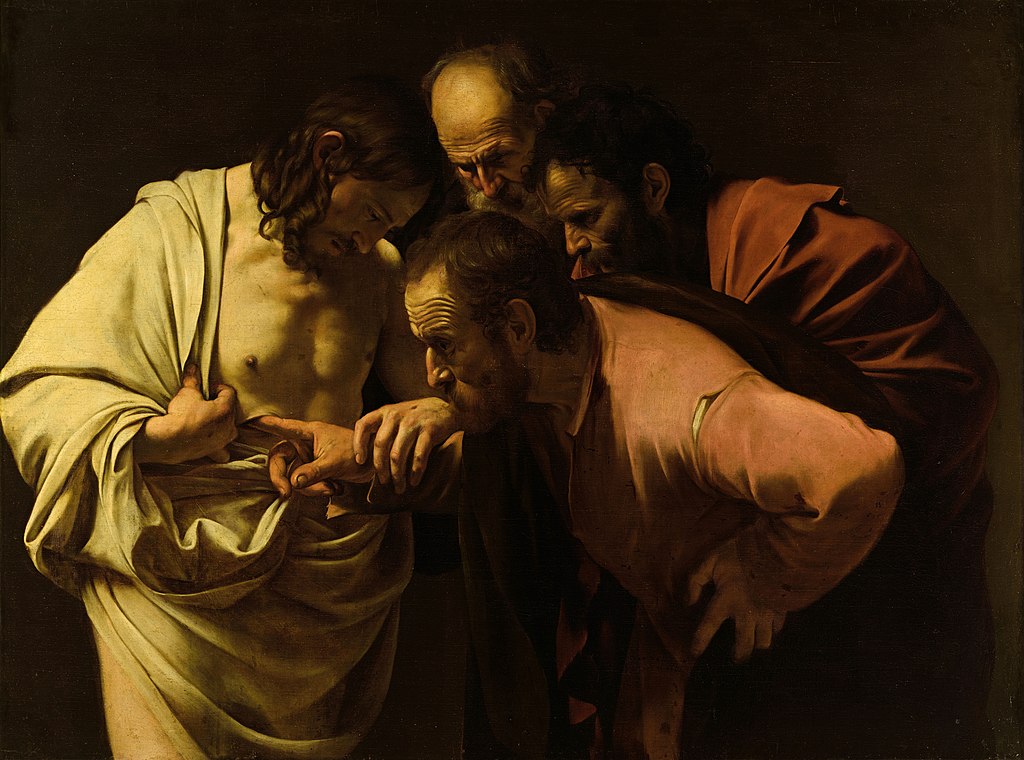
The Incredulity of St Thomas by Caravaggio – or should it be called Jesus showing Thomas his wounds?

I love preaching that brings Scripture to life—and that brings Scripture back to life.

That’s a line I’m going to repeat each week to remind us that every time we open Scripture together we are bringing it back to life.

This morning we return to John’s Gospel, still caught up in the wonder of that first Easter day (John 20:19-end). It’s a story only he tells.

John himself brings scripture back to life.
Particularly we see the influence of the creation story from the 1st chapter of our scriptures.
We can see that in the way that he tells us the time.
On the evening of that first day of the week.
It’s like last week’s gospel reading which began: Early on the first day of the week, while it was still dark. (John 20:1)
We are still on that first day which was like the first day of creation, when, according to Genesis 1:2, earth was a formless void and darkness covered the face of the deep.
That’s the time in today’s gospel. It was the first day of the week, and it was evening.
In other words, darkness was forming.
Taking our cue from Genesis, John’s readers can expect God’s wonders on this new day of creation.

Thomas wasn’t with the disciples when Jesus came on that first day, the day of resurrection.
It was the other disciples who had to let him know that they had seen the Lord.
Thomas told them that he would never believe “unless I see the nail marks in his hands and put my finger where the nails were, and put my hand into his side”.
It is this I suggest we focus on in our worship today.

Thomas is the patron saint of those who are blind because seeing wasn’t enough for him.
He needed to examine Jesus’s wounds by touching them and feeling them.
And the wonderful thing on that second Sunday, the first day of the week following, was that Jesus came and stood among them again and showed Thomas his wounds.
He welcomed his touch. He guided his hand. He let him explore his body.
Thomas is the patron saint of those who struggle to believe what they can’t see—or even what they can.
He shows us that resurrection faith isn’t just about seeing.
Sometimes it’s about touching, questioning and wrestling with God.

Jesus showed Thomas his scars. He wants his disciples to see them.


In the Last Supper, he took a loaf of bread and he broke it.
He wanted them to see his body in the brokenness of the bread.
“Take, this is my body,” he said. (Mark 14:22).
Then he gave them a cup for all of them to drink from.
In that cup he wanted them to see his blood.
“This is my blood of the covenant poured out for many.”
Even before he was wounded he wanted to show his disciples the wounds he was going to suffer.
And in today’s gospel, in one of his resurrection appearances, he invites Thomas to have a look at those wounds – to examine, inspect and see with his hands as well as his eye.

Thomas recognises Jesus through his wounds, just as Jesus wanted him to.
And this is how we come to know Jesus.
Just as Thomas encountered the risen Christ in his wounds, so too we encounter him today in the bread and wine of the Eucharist.
Every Communion we have with Jesus we have this invitation to examine the wounds of Jesus. Every time the bread is broken we are invited to see the brokenness of the body of Christ and to feel that brokenness in our mouths.
Every time we take this cup we are invited to taste the blood of Christ shed for us.

What is it that Jesus showed Thomas?
What did he want his disciples to see?
What does he want us to see when he shows us his wounds, when he invites us to see his body and his blood?

The first things we see are the wounds to his hands and feet where the nails were driven into his body by the hammer blows of empire.
Then, if he turns we see the wounds of the whipping scored into his back for being the scourge of empire and religion.
Then we see the scars on his head where they pressed the crown of thorns and added insult to injury, to press home the point that this “pretender” was nothing.

The rule of the kingdom of God is that the last, the lost and the least come first and those who are first in the kingdoms of this world come last.
The rule of the kingdom of God turns the rules of the world upside down.

In the wounds of Jesus, his disciples see a man who embodies that rule of the kingdom of God. In the brokenness of his body, in the bloodshed, we see a man the religious and political capital tried to reduce to nothing.
The plots against him and his crucifixion were intended to humiliate him and his followers – to make them least, last and lost – GONE for ever.

The problem for them was that the rule of the kingdom of God puts the least, last and lost – those lost and broken by the ways of the world – first.
When Jesus stood among his disciples, first without Thomas, then with him, he was the living proof of the fundamental rule of the kingdom of God.
Here was the humiliated, crucified and killed one.
You can’t get more “least, last and lost” than that.
Here he was, “the first fruits of those who have died”, Christ raised from the dead (1 Corinthians 15:20).

This is what Jesus showed Thomas –
the scars are the living proof of the rule of the kingdom of God.
Jesus stood among them as living proof of the rule he’d always followed,
that puts the last first and the first last.
Here is the one they put last made first.
This is what Thomas saw. This is what he said:
“My Lord, my God” – the rule of the kingdom of God realised in those few words.
“My Lord and my God” – Jesus comes first for Thomas.

So Jesus stands among us still, not with condemnation, but with scars.
What do we see? What difference does it make? Does Jesus come first?

Jesus doesn’t shame Thomas for his questions. He meets him in them.
He doesn’t rush belief. He invites it — gently, patiently, personally.

And he does the same with us.
To all who doubt, who ache, who long to see and touch and know — he says,
“Here I am. Peace be with you.”

He doesn’t hide his wounds. He offers them.
He lets us trace the pain and the mystery of a love that suffers with us and for us.
And in that wounded, risen body, we find our hope.

This morning, he says again:
“This is my body. This is my blood.”
This is how I choose to be known.
Look closely. Taste carefully.
And, if you are among the broken,
do not be afraid.

In the thick of things – a sermon for Palm Sunday

On Palm Sunday we celebrate Jesus’ humble entry into the thick of things where we say he is very welcome. This sermon for a small Warwickshire church picks up that theme. The readings appointed for the day are Luke 19:28-40 and Philippians 2:5-11.

Entry of Christ into Jerusalem by Pieter Coecke van Aelst Bonnefantenmuseum 1246

I love preaching that brings scripture to life, and we are in the thick of it, aren’t we? We’re in the thick of it, with one thing after another.

We’re always in the thick of things with things going on in families, things that prevent us having a balance in our lives, worries about our health, pressures in our relationships. We are in the thick of things. In the thick of things our reptilian fear threatens to overwhelm us.

We can hardly believe what we are seeing of what’s going on for the people of Ukraine.
We can’t believe our eyes when we see news of the destruction of lives and communities in Gaza.
And now we’re on the edge of a trade war brought on by the obscenity of a billionaire President’s complaint that the wealthiest nation on earth feels cheated and that they are going to get their own back on nations that are poorer.

And in the thick of things, we are, like Jesus’s generation, “an unbelieving generation” (Mark 9:19). We are people of unclean lips, living among a people of unclean lips. (Isaiah 6:5). How can we be any other? We live in the thick of things. The thick of things take their toll on the way we are, our minds and our behaviours.

Today of all days, Palm Sunday, we look to Jesus who was, and is, always in the thick of things. When he rode into Jerusalem he rode into the thick of things. (Not that he wasn’t already in the thick of things in his ministry in Galilee.) But in setting his mind to go to Jerusalem he was setting his mind to get to the thick of things – Jerusalem, the place of religious and political capital, the place of those who made the rules, the place of turmoil, the place which had such an effect on people’s lives – on their fortune, their anxiety, their shame.

When we reenact the welcome of Jesus by the crowds in Jerusalem we are saying how welcome Jesus is in the thick of things for us. In the thick of things we turn to Christ. That’s the choice we made at baptism. “Do you turn to Christ?” “I turn to Christ”. We turn to Christ in the thick of things because there really is no choice.

Isn’t there?

The truth is that we are spoilt for choice. There are so many contenders, so many who want to govern us, to rule over us, to be our landlords, presidents, press barons and manipulators. That’s why there are so many power struggles. It’s surprising what an unbelieving generation believes. It’s surprising (and alarming) who an unbelieving generation will follow..It is shockingly easy to be misled when we are in the thick of it. We are sheep in the midst of wolves.

There is a choice. Who will we choose?

African-American writer Octavia E Butler wrote this in her Parable of the Talents:

Choose your leaders with wisdom and forethought.
She went on:
To be led by a coward is to be controlled by all that the coward fears.
To be led by a fool is to be led by the opportunists who control the fool.
To be led by a thief is to offer up your most precious treasures to be stolen.
To be led by a liar is to ask to be told lies.
To be led by a tyrant is to sell yourself and those you love into slavery.

Choose your leaders with wisdom and forethought, because when we don’t we find ourselves in the thick of things.

Who do we choose to lead us in the thick of things?

While Butler warns us of bad leaders, another voice—from an unexpected place—tells us what does hold evil in check. This is from The Hobbit.

“Some people believe it is only great power that can hold evil in check, but that is not what I have found. It is the small everyday deeds of ordinary folk that keep the darkness at bay. Small acts of kindness and love.”

In the thick of things we look for a messiah, someone to save us, usually an alpha male, a charismatic leader, someone with great power – a disaster who leads us into war, or poverty, or slavery, or hatred and fear.

Today, we wave our palms as Jesus comes before us, as in Jerusalem, so in our lives. (Incidentally, we see the deaf community waving the palms of both hands in the air – that is silent sound of welcome applause.)
Our palm waving is the sign of our choice, the welcome of Jesus into our lives.

We are at the beginning of the week.
When we get into the thick of the week we find out how Jesus was when he was in the thick of it,
the way that he hung out to the end,
the way he turned the tables on the religious leaders in the cleansing of the temple,
his refusal to justify himself in front of Caesar’s representative, Pilate,
his non-violence when he told Peter to put down his sword
the greeting of his betrayer with a kiss
the promise of paradise to the thief at his side, the way he made a brother of him

All these things add up, and in the thick of the crowd people changed their mind.
They didn’t like the choice they’d made by welcoming Jesus.
They preferred Barabbas.
When they were given a choice about who should be saved,
Barabbas or Jesus,
they chose Barabbas.
They mocked Jesus.
They insulted him, spat at him, and hung him out to die.

It shall not be so with us.
We have saved Jesus for when we are in the thick of things,
all those moments when we are searching
for a better way for our work, for our love,
we have welcomed Jesus into the thickness of our lives
and inclinations, when our tempers flare
when hatreds and jealousies might prevail
when our worries keep us awake
we have chosen Jesus as our saviour.

Let Jesus always be our choice
whenever we are tempted
by the ways of the world
in the thick of things,
in our relationships with one another
have the same mindset as Christ Jesus.
He never considered equality with God something to be used for his advantage,
but chose instead the way of a servant,
joining the suffering of the last and least
always following the rule of the kingdom
that puts love first and the last first.

That’s the way we choose when we wave our palms to welcome Jesus into our thick of things.

So let us wave our palms not as decoration, but as declaration. That in the thick of things—today, this week, this world—Jesus is still our choice, our way to go.

White Lotus – a parable of vanity and futility

I enjoyed catching up with the last episode of White Lotus – the last episode of the 3rd series. There was much to admire. Also, there was much for the devil to admire from his hideaway above the White Lotus resort in Thailand—a place he’d convinced the wealthy was a paradise they had somehow earned.

“Good things happen to good people”. That is what we are tempted to believe. And they’re the words used by a son to persuade his newly minted mother to break a promise she’d made to a prospective business partner.

A mother follows the same line of thought as she encourages her daughter to get over unease at the unfairness of the world. Wealth and comfort are a matter of luck, she suggests. “Enjoy it” becomes the best advice that she can offer her daughter as she lowers her resistance to the smug arrogance of her mother and elder brother.

Of course, the opposite must also be true in this mindset. If good things only happen to good people then bad things only happen to bad people. Follow that line of thought and you’re already looking down your nose at those who suffer bad things – refugees, the poor and all those who suffer the abuse and neglect of the powerful and wealthy.

I watched White Lotus with Holy Week on my mind. This is a week which undermines the devil’s myth that good things happen to good people. Jesus’ crucifixion turns that on its head. In this world bad things happen to good people because of people behaving badly. Jesus’ crucifixion embodies the suffering of the good. His love endures the suffering and has become the constant encouragement for those who have no resort to any sort of paradise island.

These are bad people at the White Lotus. I wouldn’t want to be in the same pool as any of them. These are people who think they come first, who think they’re entitled to comfort. Don’t turn to them if you need help because all appeals for help will fall on deaf ears. Theirs is a wealth without commitment. These are selfish people who do nothing right and everything wrong. This is a paradise where noone listens to anyone. This is the devil’s playground. It’s not paradise..

White Lotus is a great watch on the vanity and futility of our times. When the wealthy succumb to the temptation that confuses wealth with worth so many suffer devastating consequences.

Citizens of heaven behind enemy lines

A reflection for the 2nd Sunday of Lent on the readings, Psalm 27, Philippians 3:17-4:1 and Luke 13:31-end

If we were to get a tattoo, and if we were to choose from the texts of today’s readings, I wonder what you would choose? These are some of the words that are held at the heart of the church. I am sure many have tattooed over scars of harm and hurt some of the verses we’ve heard today. What are the words you would inscribe on your skin because you want to take them to heart?

It is the second Sunday in this season we have been given for repentance,
It’s time to look at ourselves,
to change our minds
and reimagine ourselves as children of God
and behave, as citizens of heaven.

It’s a time to look at ourselves,
not so much to remind ourselves that,
in the words of the psalmist,
we are fearfully and wonderfully made,
but to wonder at ourselves,

at the habits of our hearts and minds,
to ask ourselves why we are inclined to do this and that,
and when we do this or that,
whose side are we on?

Are we on the side of God,
are we on the side of the angels?
Or, are we on the side of those our scriptures
so loudly call out as enemies?

What are we like
when we are tired.
when we are hungry,
when we have too little to do,
when we have too much to do,
when we are in a confrontation,
when we are facing criticism,
when we are struggling with our finances,
or our health,
when we look at ourselves in the mirror,
when we’re alone
or when we are with certain others?
What are our responses?
What’s our inclination?

Are we inclined to be anxious,
or hateful,
or judgemental,
or selfish,
or proud?
Why? How?
How come so many voices got into our heads
to incline us to self-doubt?
Where did they come from?

What are the habits of our hearts?
What is our natural inclination?
Why? How?

What has spoiled us?
Who has spoiled us?
Why did they spoil us?
How did they spoil us?
What is spoiling us?
What is spoiling our lives?

Can we change?
Can we be born again, reimagining ourselves behaving differently?
Can we be saved from our harmful habits of our hearts and minds?
Can we lean another way?
Are we bound to be the way we are,
and to think the way we do?

These are urgent questions.
They’re getting more urgent by the minute
in these mean times which are so mean to those God puts first,
those who are last, the first victims
of our carelessness, pride and selfishness.

These are urgent questions,
more urgent by the minute
as we get older and our habits
more ingrained

We made a decision at some point in our lives to turn to Christ,
to be on his side and to be sided by him.
We are on his side. He’s on our side.
Side by side we go through our lives 

just as Jesus called it,
as sheep amongst wolves.

The deacon has the doubtful privilege of sending us out,
telling us to go in peace
to love and serve the Lord
wherever we go.

In the name of Christ, we go,
just as in the name of Christ
the deacon sends us
as sheep amongst wolves,
citizens of heaven
operating behind enemy lines.

Our scriptures today remind us of the enemy fire,
their stones pounding the prophets to death.
The Psalmist knows enemies amongst the wicked surround us to make trouble amongst us,
to make war against us, to spoil our life.

We feed each other with the news of enemies
(often neglecting those dark psychological forces within us)
and the devastation of their atrocities,
yet somehow we miss the heat of their fire,
the tragedy in their enemy power
preventing us from caring enough.

Only this week we heard how young children are becoming addicted to vaping. This is just one example of the powers that overwhelm us. How dare anyone put our children in harm’s way with the risks of nicotine addiction, risks to brain development, to concentration, to learning and to their overall wellbeing? These are just some of the enemies our children have to face – and need to be sheltered from.

This is our life, surrounded by enemies,
enemies around us and enemies within us,
forces within us inclining us more to fear and anxiety,
to competitiveness and spite,
to live more selfishly
to ignore the cries of the poor.


Our citizenship is in heaven.
Please note the present tense.
Our citizenship is in heaven.
It’s not “will be in heaven”,
our citizenship IS in heaven
and it is only the enemies of the people
who want to rob the present of its heaven.

We are citizens of heaven
and we live our lives behind enemy lines.

In Lent, we journey to Jerusalem with Jesus.
Jesus stays in the city, behind enemy lines.
He cries for the state of the city and what it does to people.
His cry is one of lament and longing.
He laments the killings and the stonings,
the violence and the injustice
and longs to provide shelter for those made vulnerable.

Where is our shelter?
Where is the shelter that Jesus longed for?
Where is the shelter we can join the psalmist in
in our days of trouble when we are surrounded
by enemy forces undermining us?

Here is my shelter. The Lord is my light and salvation,
proclaims the psalmist.
The Lord is the strength of my life,
of whom then shall I be afraid?

He has been my helper.
In all the days of my trouble
He has had me in his shelter.

Here is our shelter.
Look around, not at the walls, but at the people who love us,
in whom we have trust.
Within our hearing is the sound of heaven, the call of God and the love of Jesus,
in the hearing of our scripture,
in the talk that makes for peace
in the prayers which voice the longings
of citizens of heaven.

This is where we need to be to recover if ever we are going to be more than we are ever inclined to be by the enemy forcing us to hatreds, anxiety and despair.

The Lord is here, his Spirit is with us.
We are under the shelter of his wings.
Under his shelter, all the forces behind
the  I COULDN’T HELP ITS lose their power.

When we pray to our Lord in heaven,
who is so different from our everyday lords,
our overlords, warlords, empire builders and media moguls,
when we pray to our Lord God, the psalmist joins us,
the psalmist who knows the Lord his helper,
helping us, when,
because of the odds against us,
we just couldn’t help it,
helping us to change to be true citizens of heaven.