Finding Unity in January’s Gloom

2nd Sunday of Epiphany (C) – part of the Week of Prayer for Christian Unity. The readings for the day are 1 Corinthians 12:1-11 and John 2:1-11.
January 18th 2025

How’s your January going?

I’ve heard January described as “one long Monday”.

Dare I ask, how are the new year’s resolutions going? Are you keeping them, have you lapsed or have you forgotten what they even were?

We’re quite self-centred in our resolutions aren’t we? They tend to be centred on what we are going to do for ourselves and on our own. We tend to set the resolutions on our own. On our own we tend to set personal goals without deeper reflection on the greater needs around us. Our resolutions can be shockingly disconnected from our shared reality, such as the climate crisis, the migration crisis and the cost of living crisis.

And we make the resolutions at the time of the year we’re in the worst shape to keep them, in the gloom of January, when we’re often under the weather, whether the “weather” be the worst cold of the year, or whether “the weather” be our personal health, suffering flu or the worst cold of the year. Our resolutions are fragile. Our resolutions, if they could choose, would appreciate a February start, not a January one!

Tomorrow is Blue Monday, supposedly the most depressing day of the year. I wonder whether the likely failure of our resolution is a factor in this, alongside the cold, the credit card bills, the dark nights etc etc.

Our Sunday worship is our opportunity to reorientate ourselves in these days of darkness. The season of Epiphany takes us through January to February 2nd and gives us one epiphany after another, to help us to find our way and strengthen our resolve. There is one revelation after another.

Last Sunday it was the voice of revelation from the heavens when Jesus was baptised. Today it’s the changing of the water into wine and Mary’s instruction to the stewards to do what Jesus tells them that is the revelation. John writes: “What Jesus did here in Cana of Galilee was the first of the signs through which he revealed his glory.” These signs are revelations of God’s glory in the world – a new way of seeing and being in the world.

And, in our reading from Paul’s letter to the Corinthians, all the gifts of the Spirit to a troubled community are a manifestation of the Holy Spirit of God working through that community for the common good. “There are different kinds of service but the same Lord. There are different kinds of working, but in all of them and in everyone it is the same God [we see] at work”.

Paul sets out his reason for writing to the Corinthians (in 1:10). His purpose was “to appeal to you, brothers and sisters, by the name of our Lord Jesus Christ, that all of you be in agreement and that there be no divisions among you, but that you be united in the same mind and the same purpose. Paul’s appeal for unity isn’t just a call for believers to find agreement, but for them to see beyond their own individual desires and divisions. 

The gifts of the Spirit Paul talks about are not meant to isolate or empower individuals but to strengthen the body of Christ. The gifts of the Spirit are for the common good. Paul’s list reminds us that unity is not about sameness, but about recognising and celebrating the diversity of God’s work in us. Seeing that is a revelation of God’s glory in the church. Not seeing that reveals God’s powerlessness, even in the church where Jesus is supposedly lord.

Yesterday marked the beginning of the Week of Prayer for Christian Unity, a week of prayer when we pray that we will pray along with Jesus for all who believe in him that they (we) may be one and that they (we) “may be brought to complete unity”. That was Jesus’s prayer that we are called to join this week in particular. It’s a prayer to withstand our horrible histories and to find resolutions to all that divides us. It’s not a prayer for doctrinal unity but is a practical commitment to reconciliation and understanding. The prayer for unity which we are called to join Jesus in is prayer for the kind of unity which reveals God’s love to the world, a unity which transcends the personal, political, racial and denominational divisions of our horrible histories.

Jesus knew that then, when his prayer for unity was answered that that would be epiphany and revelation. “Then the world will know that you sent me and have loved them even as you have loved me.” (John 17:20-23)

The Roman Catholic Church are keeping 2025 as a Jubilee year. It sounds notes of joy and jubilation in our calendar. Every 25th year is kept in jubilee picking up on Jubilees referred to in Leviticus when the 50th year became a time for putting the economy right. Indentured servants were released from servitude, debts were forgiven and everyone was returned to their property. Imagine the jubilation!

This 2025 Jubilee was proclaimed in the papal bull, the title of which translates as “Hope does not disappoint”.  The motto for the year is “Pilgrims of Hope”. That is to be their resolution. Jubilee begins with the opening of the doors of the basilica in the Vatican. On Christmas Eve, Pope Francis knocked on the holy door of St Peter’s basilica. The door was swung open and Francis rolled through in his wheelchair.. There are four such doors in the Vatican. On the Feast of Stephen, December 26th, a fifth door was opened. This was the door of the prison in Rebibbia in Rome and this was intended to serve as a symbol “inviting all prisoners to look to the future with hope and a renewed sense of confidence”. In other words, this was another epiphany – a revelation of how the prisoners, and ourselves, can see ourselves and one another differently because of the glory of God in the world.

I have included their logo of the Jubilee on the sheet of readings. The four figures come from all corners of the world. They represent all people that on earth do dwell. They embrace each other as they hold on to the cross which anchors them in hope as they (we) navigate rough seas as pilgrims of hope.

Is this an image we can take with us into this special week of prayer and even, with fresh resolution, into the rest of the year? How will we embody the unity which Jesus prayed for? How can we be signs of his love? How can we resolve our differences and conflicts? How can we align ourselves with God’s greater purpose? It won’t be in our own strength. None of us are resolute enough for that. To change the world God’s Spirit wants to work through us, strengthening our resolve to do his will.

A final judgement: the parable of the sheep and goats

The last Sunday of the Christian year (liturgically speaking, the celebration of Christ the King, the Sunday before Advent (Year A)). The readings from Ezekiel 34 and Matthew 25 (the parable of the sheep and goats) are printed below.

The liturgical year leads us to this. Today is the last Sunday before the new year starts next Sunday, the first Sunday of Advent, when we start a new round of readings, rediscovering the gospel for our dark times. The liturgical year with all its readings and reflections leads us to the kingdom of heaven, to the coronation of Christ the King and the admission that the love and mercy that makes his majesty should be the rule of our lives. It is our final judgement.

Jesus sees himself with those who are hungry, thirsty, stranger, naked, sick and in prison. They are his brothers and sisters. He calls them his family. “Just as you did it to the least of these who are members of my family, you did it to me”. (Matt 25:40). 

Many of us will be starting to write Christmas cards – some may be of the “holy family” but this passage shakes up our preconceptions of the holy family. The holy family, (the royal family if we accept Christ the King), is made up of those who are hungry, thirsty, stranger, naked, sick and prisoner. Jesus is a king like no other, his kingdom is like none other, his royal family is like no other royal family.

It is just like us to idealise the nuclear family – Mum, Dad, baby (and the pet, the wee donkey!), but Jesus “extends” the family. Matthew has already told us of the time when Jesus’ mother and brothers stood waiting to speak to Jesus while he was talking to the crowd. He was told that his Mum and brothers were outside but he said “who is my mother, and where are my brothers?”, and pointing to the disciples he said “here are my mother and brothers”. 

So, here we are in this parable of the sheep and the goats with the family Jesus has extended – with his brothers and sisters, those who are hungry, thirsty, naked, stranger, sick and prisoner and our final judgement is based on whether we have sided with them or whether we have walked by on the other side joining with those who won’t be bothered, or who are too busy, or who think they have enough to bother about, or who join those who scoff at the last and the least pretending that their state is a “lifestyle choice”.

Our final judgement is about our kindness to the last and least who Jesus claims as members of his long lost family. Jesus identifies with them all and it’s his gratitude which places those who follow him and his family on his right hand. 

You gave me food when I was hungry. You gave me drink when I was thirsty. You welcomed me when I was a stranger. You gave me clothes when I had nothing. You took care of me when I was sick. You visited me when I was in prison. 

It’s acts of kindness such as these that sorts the sheep from the goats, that puts some on the right hand of God – the right hand being the the hand of God’s power, the hand of righteousness, the hand that puts things right – and puts some on the wrong hand of God, the dismissive hand, the hand that discards, the hand that says ‘to hell with you’.

(A note on prisons. They served a different purpose in Jesus’ day. It’s where they put people waiting for trial – as with Jesus before his trial, as with Paul, Stephen and John and so many of his brothers and sisters.)

It is about kindness. Kindness appreciates our kinship, that we are one of a kind, humankind. We could say that this final judgement in this parable of the sheep and goats is about the KINDOM extended by Jesus – the kindom (without the g) of the kingdom of heaven. The KINDOM (no G) of God rescues the vulnerable. In the language used by Ezekiel, these too are like sheep and the Lord is their shepherd, searching out those who have become lost, who have strayed, who are injured and who are too weak to withstand the cruelty of the “fat sheep” who “push with flank and shoulder, and butt at all the weak animals with their horns until they have scattered them far and wide.” The kindom of God centres around the victims of the powers that be and those who suffer from the way things are.

Timpsons, the cobblers, is a business that organises itself around kindness. 10% of their workforce is recruited directly from prisons. There are just two rules for staff members: “look the part” and “put the money in the till”. James Timpson is the company’s CEO. He tweets @jamestcobbler, last week listing random acts of kindness of Timpson staff members. It gives some food for thought for those who hunger for kindness.

  • Nigel at Solihull engraved a memorial plaque for a grieving mother
  • Thom at Cambridge cleaned a suit for a customer attending their child’s funeral
  • Raymond at Ponders End donated bone marrow to a stranger
  • Dave at Loudwater gave an elderly couple a lift home with some heavy curtains
  • Darren in Henley bought someone a coffee who was sitting in the middle of the road
  • Terri at Paddock Wood stopped whilst dropping garments back to a branch to help save a person from jumping off a bridge
  • Etc etc

Then the righteous will answer him, “when was it that we saw you?”. It’s as if this final judgement comes as a total surprise to those who are counted as sheep, to those who find themselves on the right side. Nigel, Thom, Raymond and the rest may also be totally surprised to find themselves on the “right side”. “Just as you did it to the least of these who are members of my family, you did it to me.” What they did in kinship and kindness for the grieving mother, the parents who had lost their child, the stranger, the elderly couple, the one thinking of suicide, “you did it to me”, says Jesus.

I don’t know about you but the questions posed by the sheep (on the right side) and the goats (on the wrong side) weigh heavy with me. “When was it that we saw you hungry and gave you food, or thirsty and gave you something to drink?” I struggle to remember when I ever did any of those things, but I can remember so many times when I have walked by on the wrong side, avoiding their troubles.

How do I justify myself in the final judgement? I can’t and perhaps you can’t. Part of it may be that we are pre-occupied with ourselves. And part of it may be that we just don’t know what to do in the midst of so much trouble.

So what do we do?

We can put in plenty of practice. Practice seeing Christ at the heart of his extended family, a heavenly kin(g)dom on earth amongst brothers and sisters who, in the way of the world, are hungry, thirsty, stranger, naked, sick or in prison. Practice seeing Christ not at the heart of a nuclear family, the so-called “holy family”, but at the heart of the family he has extended by his search and rescue as the good shepherd of those scattered, lost and bruised.

Put in the practice of prayer. Grow your prayer from the love of your own nuclear family to this kin(g)dom of God and let the people of his extended family populate our prayers. 

Pray for those who go hungry, depending on food banks. Pray for your brothers and sisters who are parched and who don’t have easy access to water. Pray for your brothers and sisters who come amongst us as strangers, newcomers and refugees, that we may welcome them and that they feel at home. Carry on praying for those who are sick and for your brothers and sisters in prison. 

These are the people to populate our prayers – the brothers and sisters of Christ the king – his royal family. And give thanks for all those who join them, on their side, the right side, in their various practical acts of kindness.

We can never do enough. We are not asked to do enough to save the world. The kingdom of God, with Christ as king, is the kingdom where the last and the least are prized. We may be surprised that Christ makes so much of the little we do, even a cup of water for the thirsty, or a knitted blanket for the poorly clad, or just a smile, a word, or a touch. They are the seeds that grow.

Ezekiel 34:11-16, 20-24

For thus says the Lord God: I myself will search for my sheep, and will seek them out. As shepherds seek out their flocks when they are among their scattered sheep, so I will seek out my sheep. I will rescue them from all the places to which they have been scattered on a day of clouds and thick darkness. I will bring them out from the peoples and gather them from the countries, and will bring them into their own land; and I will feed them on the mountains of Israel, by the watercourses, and in all the inhabited parts of the land. I will feed them with good pasture, and the mountain heights of Israel shall be their pasture; there they shall lie down in good grazing land, and they shall feed on rich pasture on the mountains of Israel. I myself will be the shepherd of my sheep, and I will make them lie down, says the Lord God. I will seek the lost, and I will bring back the strayed, and I will bind up the injured, and I will strengthen the weak, but the fat and the strong I will destroy. I will feed them with justice.

Therefore, says the Lord God to them: I myself will judge between the fat sheep and the lean sheep. Because you pushed with flank and shoulder, and butted at all the weak animals with your horns until you scattered them far and wide, I will save my flock, and they shall no longer be ravaged; and I will judge between sheep and sheep.

I will set up over them one shepherd, my servant David, and he shall feed them: he shall feed them and be their shepherd. And I, the Lord, will be their God, and my servant David shall be prine among them; I, the Lord have spoken.

Matthew 25:31-end

When the Son of Man comes in his glory, and all the angels with him, then he will sit on the throne of his glory. All the nations will be gathered before him, and he will separate people one from another as a shepherd separates the sheep from the goats, and he will put the sheep at his right hand and the goats at the left.

Then the king will say to those at his right hand, “Come, you that are blessed by my Father, inherit the kingdom prepared for you from the foundation of the world; for I was hungry and you gave me food, I was thirsty and you gave me something to drink, I was a stranger and you welcomed me, I was naked and you gave me clothing, I was sick and you took care of me, I was naked and you gave me clothing, I was sick and you took care of me, I was in prison and you visited me.”

Then  the righteous will answer him, “Lord, when was it that we saw you hungry and gave you food, or thirsty and gave you something to drink? And when was it that we saw you a stranger and welcomed you, or naked and gave you clothing? And when was it that we saw you sick or in prison and visited you?”

And the king will answer them, “Truly I tell you, just as you did it to one of the least of these who are members of my family, you did it to me.” Then he will say to those at his left hand, “You that are accursed, depart from me into the eternal fire prepared for the devil and his angels; for I was hungry and you gave me no food, I was thirsty and you gave me nothing to drink, I was a stranger and you did not welcome me, naked and you did not give me clothing, sick and in prison, and did not take care of you?”

Then he will answer them, “Truly I tell you, just as you did not do it to one of the least of these, you did not do it to me.” And these will go away into eternal punishment, but the righteous into eternal life.”

Opening Advent Doors

advent-door

Advent is a time for praying for the coming of Emmanuel, that God may be with us, and for each of the evenings of the week before Christmas there is an “O” antiphon. Each of the seven antiphons is prefaced by “O” and addressed to the Messiah according to the names for him found in Isaiah. The “O” expresses our longing. The seven antiphons are addressed to Wisdom, Lord, Root of Jesse, Key of David, Dayspring, King and Emmanuel.

Doors are very much a theme of Advent. Doors are both barriers and openings. We open a “door” a day on our Advent calendar to signify our willingness to open our hearts to the coming of Christ. Many decorate their front doors in a way that invites the stranger, in a way that begs to be opened (as in the door of one of our neighbours pictured above). Some doors are hard to shift and many are locked behind them.

Malcolm Guite has written a beautiful poem in response to the O Clavis antiphon (based on Isaiah 22:22):

O Key of David and sceptre of the House of Israel;
you open and no one can shut;
you shut and no one can open:
Come and lead the prisoners from the prison house,
those who dwell in darkness and the shadow of death.

This is Malcolm’s response (which is set in a beautiful image by Linda Richardson):

Even in the darkness where I sit
And huddle in the midst of misery
I can remember freedom, but forget
That every lock must answer to a key,
That each dark clasp, sharp and intricate,
Must find a counter-clasp to meet its guard,
Particular, exact and intimate,
The clutch and catch that meshes with its ward.
I cry out for the key I threw away
That turned and over turned with certain touch
And with the lovely lifting of a latch
Opened my darkness to the light of day.
O come again, come quickly, set me free
Cut to the quick to fit, the master key.

The poem senses despair but also senses freedom, if only we could find “the key  I threw away”, that “turned and over turned with certain touch and … opened my darkness to the light of day”. I love the sense of freedom because “every lock must answer to its key” and “each dark clasp … must find a counter-clasp to meet its guard”.

There are so many locks to spring. Back in the 14th century, Hafiz wrote about the sort of people who lock others up, and the sort of people who work in the darkness to set people free. They “drop keys all night long”:

The small person
builds cages for everyone
he
sees.

Instead, the sage,
who needs to duck his head,
when the moon is low
can be found dropping keys, all night long
for the beautiful
rowdy,
prisoners.

What are the cages, catches, vices, locks and blocks that bind us? What needs to be undone for peace to be declared on earth?

You may be interested in the Jesus Doors by Cheshire artist Ali Hutchison and the Advent Haikus Jim Bridgman has written for every day of Advent as part of his blog which is Really Nothing but which is in fact, quite something. You might also be interested in The Advent Door by Jan Richardson.

Francis reports: a Maundy Thursday sermon

Picture1

Today, Pope Francis has been celebrating Mass at Casal de Marmo, a juvenile detention center on the outskirts of Rome, and washing the feet of the prisoners there.

This is one of the many gestures that has captured the imagination of people around the world, along with his willingness to get out of his car to shake hands with people without the fear of getting shot, wanting to pay off his hotel bill, and choosing to live in a simpler apartment. I don’t know about you, but I find all of this very exciting. In recent years the Roman Catholic Church has had problems with its PR (rightly so, because of the ways in which it has covered up abuse scandals). But with the white smoke has come a whiff of excitement. Maybe, the church in its impoverished state, can become the church of the poor, for the poor. And, without doubt, what the world needs is, according to Pope Francis, a wounded church that goes out onto the streets, rather than a sick church that is withdrawn into its own world.

There has been far too much inspiration and charity from within the Roman Catholic Church for it to be hidden behind a smokescreen of scandal.

The juvenile detention centre has 48 prisoners. The majority of them are Muslims. Pope Francis will wash the feet of 12 of the prisoners.

I wonder how they will feel. I wonder what will go through their minds. I wonder what sensations will travel from their feet and from the ground of their being. Will they know, through this action, that God loves them? Will they know that they are dear to him? Will they know that they are forgiven for the wrong paths those feet have taken them?

I wonder what Pope Francis will feel through his hands, in his mind and at his heart. Will he feel the journey those feet have made? Those feet of young people. Will he feel inside their shoes, their trainers, their boots, their bootees to the life they have led? Will he understand their running away from their homes, rival gangs, the police? Will he feel the cramping of life in those shoes and why they have kicked off?

This is what Maundy Thursday is about, that we love one another. It is a new commandment which is fleshed out in Jesus example of foot washing, and which is reenacted across the world this evening, including prisons and a detention centre in Rome. This is a love which is prepared to lovingly tend the other, whatever the state of the other’s feet may be, wherever those feet have been. This is a love which feels for the other, and which forms the foundation for a community of vulnerability, compassion and love with the least, the last and the lost.

It is a transformative act. The two parties will never feel the same about each other again. He felt for me. He understood me. He held me dear. He loved me.

Another Francis has hit the news this week. The Francis Report is the independent inquiry into what has gone wrong with the NHS in the light of the Mid Staffs Hospital. The important thing highlighted is the question of how to restore compassion to the National Health Service, and how safe care can be given to every patient every time. The publication of the report had nurses ringing in to Radio 5’s phone in, frustrated that they are unable to provide the level of care that they should be providing. Their hearts were going out to those who have been neglected, but their hands were tied up in so much other work.

I looked for a response to the Francis Report on Twitter from nurses. Mara Carlyle, now singer, but was a NHS nursing assistant for 7/8 years, mostly on wards so understaffed, tweeted:

If you give nurses enough resources and time to do their jobs properly, guess what? They will and they do. Because there weren’t enough staff for everyone’s basic needs to be attended to which inevitably led to some poor standards of care, that we often had to choose between attending to patients who were (variously) crying, dying, hungry, thristy, dirty, fallen out of bed …

Alison Leary, a registered nurse and macmillan lecturer in oncology writes of the work of a nurse (work described by Florence Nightingale as “women’s work which should be done quietly and in private”) and she asks:

How would you feel about dealing with a stranger in such an intimate way? A stranger who is so humiliated at his or her inability to control their own bodily functions that they weep? Then imagine having to care for him or her and 29 other patients with only two colleagues to help you.

So we have the juxtaposition of the Francis Report and its admissions about compassion, and Pope Francis and his expression of compassion, feeling for the other, loving the other.

Nurses want to alleviate suffering – physical, psychological, social and spiritual.

The dilemma for nurses is how they can show compassion in a system which expects so much from them.

If that is the dilemma of the nursing profession, it is perhaps the dilemma of our society. Don’t we want to be the answer to the problem of suffering, however that is experienced?

But how?

How does the NHS recover its capacity for compassion? How do we become compassionate? How do we feel for one another? How do we love one another?

The answer is repeated in story after story – from the story of the care of the Good Samaritan, to the story of the nurse most likely referred to as an angel. All of them are touching stories.

The answer is hinted at in tonight’s liturgy, and in Jesus own example of footwashing and his encouragement (“should”- is that command or encouragement?) for us to do just the same. This is the practice of loving one another, just as Jesus loves us.

It is taking one step at a time, one gesture at a time.

If the time has come for you to be asking where compassion has gone from our dealings with one another, if society has become so complicated that you don’t know where to start, I can tell you the place to start is HERE. It always has been. The first step is in the here and now, in truly local initiatives like Jesus washing the feet of his dearest friends, like Francis washing the feet of the prisoners in a Rome detention centre, like the nurse holding the hand of a patient who is afraid – who through that touch reaches beyond the physical condition of the patient to her heart of hearts.

The Bishop of Digne and dropping keys for prisoners

The Bishop of Digne

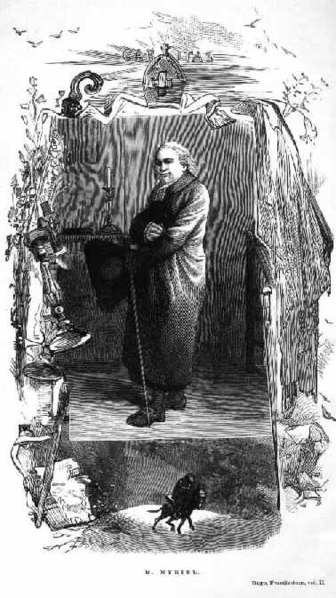
The Bishop of Digne is a key character of Les MiserablesHe is the one who offers Jean Valjean refuge, who treats him as an “honoured guest” and a shelter from the rules which allows Valjean to change his mind to the question which echoes through the story: the question of “who am I?” Valjean, or, rather, Prisoner 24601 conforms to type when he abuses the hospitality. He runs off with the silver and is captured by the law enforcers. They deliver Prisoner 24601 to the Bishop. The Bishop seizes the moment (what had he done to be prepared to react with such imaginative compassion?) and lyingly claims he had given the silver to Valjean, dismisses the police, commending them for their duty, and gives Valjean his chance.

Digne is in south-eastern France. I don’t know whether the name Digne had significance for Victor Hugo, but surely some association with dignity was intended. We might say that the Bishop of Digne was a steward (another word for “bishop”) of Dignity. The Bishop is only a marginal character but according to Theresa Malcolm “he is the soul of the novel, he who sowed love where there was hatred, light where there was darkness”. Bishop Myriel (as was the name of the then Bishop of Digne) was also known as “Monseigneur Bienvenu” for his spirit of generosity and welcome.

Victor Hugo dwells on the character of the Bishop of Digne at great length. He describes how he moved out of his episcopal palace so that it could be used as a hospital. He describes how he gave 90% of his stipend to charity, and how he simply lived for the poor. He spent his life for them matching deed to word. He spent time with prisoners. Hugo described how Myriel went with one prisoner, standing side by side with him on the scaffold, having spent the previous day with him, sharing with him “the best truths, which are also the most simple. He was father, brother, friend; he was bishop only to bless.” It was through such a lifestyle that people came to refer to the Bishop as “Monseigneur Bienvenu” – a bishop most welcome and welcoming.

This key character brings freedom. He unlocks Valjean’s soul and “gives him back his life”. Fourteenth century poet Hafiz comments on such great people who “drop keys all night long”:

The small person
builds cages for everyone
he
sees.

Instead, the sage,
who needs to duck his head,
when the moon is low
can be found dropping keys, all night long
for the beautiful
rowdy,
prisoners.

Valjean sums his situation up with these words:

For I had come to hate this world
This world which had always hated me
Take an eye for an eye!
Turn your heart into stone!
This is all I have lived for!
This is all I have known!
One word from him and I’d be back
Beneath the lash, upon the rack
Instead he offers me my freedom,
I feel my shame inside me like a knife
He told me that I have a soul,
How does he know?
What spirit came to move my life?
Is there another way to go?
I am reaching, but I fall
And the night is closing in
And I stare into the void
To the whirlpool of my sin
I’ll escape now from the world
From the world of Jean Valjean
Jean Valjean is nothing now
Another story must begin!

The engraving by Gustave Brion shows the Bishop of Digne – prepared for the first edition of Victor Hugo’s Les Miserables in 1886.

Do you see me? Or are you just looking?

We are drawing to the end of Prisons Week (Nov 20th-26th) – something organised to promote prayer for all those involved in the nation’s prisons. The theme of the week this year is “Do you see me? Or are you just looking?”. This draws attention to the fact that prisoners are constantly watched and under surveillance, they are rarely seen. It is indeed very difficult to “see” someone in prison. There is a real security rigmarole involved in visiting and visiting rights are severely limited (part of the punishment). But the most fundamental obstacle preventing the prisoner being seen is that in being locked up they are locked out of society.

Guard Tower and Prison Walls

Guard Tower & Walls of Robben Island
which locked Nelson Mandela out for
18 years but which didn’t prevent him
from being brother through
walls of prejudice and hatred.

(photoby Joe Barbosa)

I have often invited prayer for prisoners (there are currently 87,652 men and women in UK prisons – a rise of 2424 from 12 months ago). I am usually met with the hostility of a few who insist we should be only praying for the victims of crime. They follow the sight line of the secular media: the prisoner should not be seen and his or her cry should not be echoed in our prayer.

This week, someone was telling me of her pre-ordination placement experience in a “category A” women’s prison. She recalls her feelings of consternation after her first Communion in the chapel with a congregation of about eight when she was introduced to her table companions – including a much villified serial killer. This group of women have been seen by God. They have heard good news and a certain freedom even though they now they must be locked out of a society that wishes for them only to have bad news for a harsh and punishing sentence.

This is profoundly challenging because we share the same bread, and we drink from the same cup. We have been called companions (companions are friends who particularly share bread) and brothers and sisters. It is usually hard to imagine sitting at a table with people who aren’t our friends but God’s choice challenges these preconceptions. Instead we are challenged to see and recognise brothers, sisters and companions on the far side of dividing walls.