Hope Has Hooves: Keeping Faith When the World Feels Mean

This sermon was preached for the Second Sunday before Advent — sometimes called Kingdom Sunday, and this year also marked as Safeguarding Sunday.
It begins with the prophet Malachi’s vision of a day when “the sun of righteousness will rise with healing in its wings,” and when God’s people “will go out and frolic like well-fed calves.”
It’s a vivid, earthy picture of freedom — hope that doesn’t float above the world but thunders joyfully across it.
Hope, as it turns out, has hooves.


‘Surely the day is coming; it will burn like a furnace.
All the arrogant and every evildoer will be stubble,
and that day that is coming will set them on fire,’ says the Lord Almighty.
‘Not a root or a branch will be left to them.
But for you who revere my name,
the sun of righteousness will rise with healing in its rays.
And you will go out and frolic like well-fed calves.’ (Malachi 4:1-2a)

I thought I’d let Malachi do the talking this morning. 

He did his talking 450 years before Christ after the Jewish community had returned from exile.
They thought everything was going to be hunky-dory.
The Temple had been restored, the worship re-established,
and people hoped – and expected – that Israel would be great again.

But the glorious renewal never materialised. It rarely does.

The community Malachi is speaking to is one that had expected to be spared the ways of the arrogant and the evildoers.
Instead they found themselves small, struggling and disillusioned.
They are weary. They are disappointed. They’ve had enough.

And into that discouragement, Malachi tells them not to give up.

In my last parish we lived next door to a dairy farm.
The farmer knew how much we loved the moment when the cows were released into the fields after winter – those first few minutes when they leap and dance and frolic before settling down to graze away their days.
On our final day there, as a goodbye, he freed the cows (earlier than he normally would) just so we could watch them. A little gesture of joy and encouragement.

Watch the moment when these animals are released and leap into life.
This is the kind of hope we’re talking about — wild, earthy, triumphant (From the Funky Farmer)

That’s the image Malachi gives us: “You will go out and frolic like well-fed calves.”
Imagine that, he implies.
Feel it.
Let that joy into your bones.

The day is coming,
the day to end all days,
the day we’ve prayed for,
the end of wrongdoing, the end of misery, the end of oppression,
the end of the arrogant, the end of the evildoer.

But between the promise and its fulfilment, they still had to live through some very tough times indeed.
They still lived between a rock and a hard place.

He’s speaking to a community who’ve given up waiting for times to change,
who’ve lost hope.
And he may as well be speaking to us.

Things haven’t changed that much. His times are still our times.
The arrogant and the evildoers still seem to carry the day,
and we too can feel like a struggling and disillusioned generation.
We get weary. We get disappointed.

This is one of the readings appointed for today.
And its words speak, with beautiful conciseness and clarity, of the day we all pray for –
the day when everything broken will finally be set right.

And what Malachi offers is not a vague or floaty hope.
Not a “pie in the sky when you die” kind of hope.
Not the sort of hope that shrugs and says,
“Well, it won’t happen in my lifetime—maybe someday, somewhere else.”

No.
Malachi’s hope is earthed.
It has muscle and movement.
It has sun-warmed skin and strong legs.
It leaps. It runs. It frolics.

Hope, in Malachi’s vision, is not an idea.
It’s an animal set free.

Hope has hooves.

And because hope has hooves, it doesn’t wait politely for the world to improve.
It doesn’t sit still until things get better.
It doesn’t retreat into a dream or escape into the clouds.

Hope is not about leaving this world behind;
it’s about this world being set right.

The freedom Malachi imagines does not happen “up there” or “somewhere else”
but here—in the fields of our own lives,
in the soil beneath our feet,
in the communities that have grown tired and heavy with disappointment.

Hope is grounded.
Hope is embodied.
Hope is movement.

And that is why those who have given up hope
so often spiritualise it, soften it, postpone it.
They make it so distant that it no longer touches the earth.
They reduce it to wishful thinking or to a future reward
instead of a promise that breaks into the present.

But real biblical hope always has dirt on its feet.
It always has skin in the game.
It always demands something of us.

It is a hope with hooves—
a hope that will not stand still
because God will not stand still.

And so we pray for that day.
Every time we say the Lord’s Prayer — “your kingdom come” — we are praying Malachi’s prayer.
We’re praying for the day when wrong is ended, when justice rises,
when the oppressed stand tall,
when the broken are made whole,
when healing breaks out like sunlight over a cold field.

But praying for that day is not passive.
It is not waiting-room spirituality.
It is preparation.
It is participation.
It is permission for God to rearrange our lives as well as the world.

Paul, writing to the Thessalonians, puts it plainly:
“Never tire of doing good.”

Never tire.
Not when we get weary.
Not when hope feels heavy.
Not when the world seems to resist every effort toward kindness, justice, truth.

Because if hope has hooves, we need to keep ours moving.

Doing good is not an extra.
It is not the garnish on Christian faith.
It is the shape of hope lived out.
It is the daily, steady work of aligning our lives with the world God is bringing into being.

And Jesus, in the Gospel reading, speaks of upheaval—
nations in uproar,
wars and rumours of wars,
the ground trembling beneath our certainties.

But then he says something deeply strengthening:
“Do not be afraid.”

Not because everything is fine — it isn’t.
Not because everything will suddenly get better — it may not.
But because God is with us in the meantime,
and it is precisely in these mean times
that our hope matters most.

The world being turned the right way up is bound to be unsettling.
Those who profit from cruelty won’t like it.
Those who cling to power will resist it.
Those who prefer darkness will fear the light.

But discipleship has always been lived with courage.
Courage to do good when others give up.
Courage to tell the truth when lying is easier.
Courage to protect the vulnerable when it costs something.
Courage to embody hope when cynicism is fashionable.

And that brings us to Safeguarding Sunday.

We haven’t mentioned it until now —
and that’s intentional —
because safeguarding isn’t a special theme for one Sunday,
or a box to tick,
or a duty we dust off once a year.

Safeguarding is simply hope in practice.
It is the grounded hope Malachi speaks of,
the persevering hope Paul commends,
the courageous hope Jesus prepares us for.

Safeguarding says:
in this community,
in this place,
every person matters.
The vulnerable are protected.
The wounded are listened to.
The frightened are safe.
This is a place where harm is named, not hidden,
and where healing is made possible.

Safeguarding is part of the way we pray “your kingdom come.”
It is part of the way we “never tire of doing good.”
It is part of the way we “do not be afraid.”

It is hope with hooves —
hope that moves,
hope that watches over,
hope that makes room,
hope that keeps all God’s people safe
until that promised day dawns
and we go out and frolic like well-fed calves.

So today we keep our hope alive,
we keep our feet moving,
and we keep one another safe.

Hope doesn’t just have feathers,
as Emily Dickinson writes in her poetry.
Hope has hooves.

The calling of God’s people in every generation
is to keep faith in these mean times,
to never give up hope in these mean times,
to never stop loving in these mean times.
These are the things we need to keep going forever,
faith, hope and love,
until the day comes which sees the end of the arrogant and the evildoer,
the day the sun of righteousness will rise
with healing in its wings.

Until then, we keep faith.
We keep hope.
We keep love.

Our call is to live for that day.

Safeguarding is the Mission of God

I had thought that this Sunday was Safeguarding Sunday. It’s not.
That’s November 16th.
But shouldn’t every Sunday be Safeguarding Sunday?
When we look at our readings for the day, (Amos 8:4-7 & Luke 16:1-13),
they are all about safeguarding,
and they expose our current safeguarding focus as hopelessly inadequate.

Safeguarding isn’t just reacting to scandals of abuse,
but is the mission of the church.
Our calling is to protect the vulnerable,
to care for creation and to defend the excluded.

And safeguarding begins with the little things.
The soil beneath our feet.
The worm in the allotment.
The bee that pollinates our food.
The sparrow that falls unnoticed to the ground.
Creation itself is vulnerable,
and safeguarding must mean cherishing the earth, not exploiting it.

If we cannot be faithful with the earth — the very ground of our life —
how can we expect to be trusted with the riches of the kingdom?

Safeguarding has a political edge which is being overlooked.

We are in the Season of Creation,
a season for highlighting the needs of the earth and the environment
and our responsibilities for safeguarding the planet.

And we are in the season of disenchantment and political turmoil
when we are seeing thousands of people taking to the streets
to protest against immigration,
who want to turn the clock back
to make Britain Great again,
or America great again,
or make themselves great again.

There are safeguarding issues here as well,
challenges to safeguard those who are vulnerable,
those in the firing line, those claiming asylum,
those terrified in the targeted hotels,
those who are scared to be seen in public.

My son told us of his experience last weekend.
He was in London during the protests.
Protesters surrounded the Uber they were in,
banging the windows, shaking the car
and shouting to the driver, “GO HOME”.
He was a Bangladeshi who has lived here for twelve years.
His home is here. That requires safeguarding.

And there is the other side.
Those protesting aren’t all fascist or racist.
They are people who feel they don’t belong,
who feel they’ve been left behind
by a society which has put financial gain above everything,
where the gap between rich and poor has grown ever wider.
It is hard for me to speak for them,
but have they had enough of “rip off Britain”,
have they lost hope? Have they been safeguarded?
Is what we are seeing on the streets a consequence
of the lack of safeguarding for these least and last,
with a poverty of opportunity?
I will not demean these people as racists or fascists.
I have lived in their communities.
Most of them have just reached the end of their tether.

They become easy prey for those who would exploit them for their own ends,
false shepherds who would mislead them with false promises.
You know who I mean.

And into this world — our world — comes the voice of Amos (Amos 8:4-7 – printed below),
eight centuries before Christ.
Because his scripture has been treasured,
we have been hearing Amos for nearly 3000 years!
He names what safeguarding failure looks like in his time:
people trampling on the needy, treating the poor as expendable,
twisting religion to cover up exploitation.
Are we any different now?
He cries out against a society where profit matters more than people,
and where the very ones who most need protection are sold for a pair of sandals.
Amos is God’s safeguarding officer, raising the alarm.

And then Jesus, in Luke’s gospel, gives us this line:

Whoever is faithful in very little is faithful also in much.

It’s a complicated parable, but this is the heart of it: the little matters.
Whoever is faithful in very little is faithful also in much.
The small ones matter.
The least matter.
The soil matters.
The worm matters.
The daily, unnoticed acts of honesty and care matter.
Because in the little, the kingdom begins.

Being faithful in the little means safeguarding creation itself:
tending the soil, honouring the creatures that work unseen,
the worms, the insects, the birds —
each one part of God’s great economy of life,
the web of life that holds us.

Being faithful in the little means safeguarding people:
the child, the refugee, the neighbour
who feels they don’t belong.

Being faithful in the little means safeguarding our choices,
managing ourselves in those moments
which could turn into flash points when we fly off the handle.

Being faithful in the little means safeguarding our community:
choosing honesty when it would be easier to cut corners,
choosing care when it would be easier to look away.

The little matters – because in the little the kingdom begins.

Jesus speaks of being our shepherd,
the true shepherd
who safeguards the last, the least and the lost.
That must include those who have been misled
by opportunistic shepherds who trade in fear.
They, too, are vulnerable, though they don’t always see it.
They are last and least in ways that make them lash out.
But they are still little ones Jesus longs to safeguard.
So safeguarding is not just paperwork or policy.
It is the mission of God, entrusted to us:
to safeguard the earth, to safeguard the poor,
(and protest against the causes of poverty and exclusion).
It is the mission of God
to safeguard even those who have lost their way.

Every time we join this mission,
we are being faithful in the little,
and the little is what God treasures.
The little are the treasures of the kingdom.

Our commonwealth is woven together
from moments of safeguarding the vulnerable,
moments of honouring the smallest,
moments of choosing care over indifference.

This is what God entrusts to us.
This is what it means to live for the kingdom.

The little matters,
because in the little, the kingdom begins.


Amos 8:4-7

Hear this, you that trample on the needy,
  and bring to ruin the poor of the land,
saying, ‘When will the new moon be over
  so that we may sell grain;
and the sabbath,
  so that we may offer wheat for sale?
We will make the ephah small and the shekel great,
  and practise deceit with false balances,
buying the poor for silver
  and the needy for a pair of sandals,
  and selling the sweepings of the wheat.’

The Lord has sworn by the pride of Jacob:
Surely I will never forget any of their deeds

The blessing of being alongsides

A reflection on Psalm 1 and Luke 6:17-26 for two small congregations in a group of parishes in vacancy.
The 3rd Sunday before Lent – Year C

In last week’s gospel (Luke 5:1-11) crowds surrounded Jesus so much that to find space for himself Jesus needed to get into a boat on the lake as crowds gathered around Him to hear His teachings.

We have another crowd in today’s gospel (Luke 6:17-26). There’s a large crowd of his disciples (including the twelve he called “apostles”), and “a great number of people from all over Judea, from Jerusalem, from the coastal region around Tyre and Sidon” who had come to hear him and be healed of their diseases.

In the context of safeguarding we need to note that Luke has underlined where Jesus was in relation to the crowd. He is not “high up”, over others. 

In the boat on the lake he would have been lower than his hearers. 

And in today’s gospel Luke paints a different picture to Matthew’s Sermon on the Mount. Luke has them all on a level place – Jesus on the level with all the people. 

In this, and so many other ways, Luke is wanting to show how Jesus stands in relation to others – never overbearing, never patronising, always side by side – as typified by walking incognito with disciples to Emmaus. 

There is no distance between Jesus and the people. He was there with them, eye to eye, shoulder to shoulder, side by side, valuing relationship over hierarchy.

That’s the position you’re hoping to fill, isn’t it? You’re hoping for a priest who will ask your permission to come alongside, as your helper. It’s probably also the position we long to be ourselves, alongside others with others alongside us.

None of us are ever safe when people look down on us, and nobody is safe from us as long we look down on them. Jesus’ physical positioning in relation to others guarantees safety. He is the good shepherd.

That’s how Jesus positioned himself, alongside us, always on the side of those he blesses. What is our position? Where do we stand?

The psalmist points to those who take a very different position. They “walk in the counsel of the wicked”, “linger in the way of sinners” and join “the assembly of the scornful”. They’re condemned. They won’t stand the judgement of the law of the Lord or stand in the “congregation of the righteous”.

There is another way. That is the way of Jesus and all those who delight in the law of the Lord, meditating on his law day and night. They’re the ones blessed and the psalmist sees them like trees “planted by streams of water, bearing fruit in due season”.

There is a clear choice: the way of the wicked, or the way of the Lord. It’s either blessings or curse.

I had to go to a two column format to get our two readings on one sheet of paper. But in so doing I have shown the pairings: 

Blessed are all you who are poor, but woe to you who are rich
Blessed are you who hunger now, but woe to you who are well fed now
Blessed are you who weep now, but woe to you who laugh now
Blessed are you when people hate you, exclude you and insult you, and woe to you when everyone speaks well of you

This is the law of the Lord. This is Jesus’ teaching. This is the law of the Lord according to Luke who has already given us Mary’s song celebrating the ways of God in scattering the proud, toppling rulers from their thrones, raising the humble and humiliated, filling the hungry with good things and sending the rich empty away. This is the law of the Lord. (Luke 1:46-53).

This is the law of the Lord brought to us by Luke who has already told us how Jesus preached in the synagogue about the law of the Lord being good news for the poor: freedom for prisoners, recovery of sight for the blind and liberation for the oppressed. (Luke 4:18-19).

This is the law of the Lord our scriptures describe as blessed. This is the law that delights the blessed but which the wicked, the sinners and the scornful scorn. This is the law that those who are blessed think on day and night, according to Psalm 1.

They are like a tree planted by streams of water, bearing fruit in due season, with leaves that do not wither.

When I read that verse this week my mind went to a sculpture called The River of Life which runs down the main shopping street in Warrington. The sculpture was built by Warrington Council after two bombs were detonated by the IRA, killing 3 year old Johnathan Ball and 12 year old Tim Parry and injuring 56 others. It was the day before Mothering Sunday, March 20th, 1993.

The city council turned to a sculptor to discuss a memorial. Stephen Broadbent was the sculptor. He saw that the street was not just physically broken, but spiritually broken as well. He wanted to design something that would be “a symbol of renewal and faith in the power of the human spirit to triumph over adversity and to invest the future with hope.”

His inspiration was the image of the river of life in Revelation 22.
The angel showed me the river of the water of life, as clear as crystal, flowing out from the throne of God and of the Lamb down the middle of the great street of the city. On each side of the river stood the tree of life, bearing twelve crops of fruit, yielding its fruit every month. And the leaves of the tree are here for the healing of the nations.

And so it is. Now, flowing down that street is the River of Life  he made and on either side of the streaming water are trees, one for each month, each bearing fruits of the Spirit for the healing of the nations, for all times and seasons.

And so it is in Psalm 1 where the blessed are like a tree planted by streams of water bearing fruit in due season. I wonder that Stephen Broadbent himself is one of those trees, planted by the stream of tragedy and violence, leaving blessings of hope and healing through the season of trauma and grief.

I’ve seen photocards with these verses from Psalm 1. In them the stream is picturesque with sunlight reflecting from its gentle flow. The psalm doesn’t say the water is safe. 

The stream may be dangerous, fast flowing floodwater, a tidal wave, or deep or toxic. 

Or with a stretch of the imagination, the waters could be the waters that have to break for us to be born or baptised. 

Or the stream and the metaphor may be a metaphor for life.

Does the law of the Lord raise up people who delight in the law that there should be people by all the rough waters of life, that there should be lifesavers of healing, hope and blessing bearing fruit for all seasons of difficulty and danger?

It’s worth visiting that sculpture in Warrington. It’s on Bridge Street. It was always Bridge Street. The street hasn’t been renamed because of the sculpture and its intention to bridge the awful violence that tore people’s lives apart.

And here we are. The Bridges Group of Parishes – so called because of the bridges of the villages that make up the group of parishes. And the bridges are there to bridge the waterways that cut through the landscape.

We’ve reflected on Jesus’ position in relation to the crowds that streamed to him. We’ve reflected on the Psalmist’s position on those who delight in the law of the Lord.
We’ve reflected on the sculptor’s position in relation to the trauma of a community.
What about our own position?

Are we bridge builders and lifesavers? Do we delight in the law of the Lord, meditating on his law day and night? Are we blessed as agents of blessing, healing and hope? Or are we a curse on the poor, the stranger, the refugee, and all those vulnerable to losing their life at sea because we take our cues from the scornful, lingering in the way of sinners, taking the counsel of sinners?

Where are we as the river of life flows through our lives? Are we bridgebuilders offering healing where there has been division, hope where there has been despair? Are we like trees that bear the fruits of God’s Spirit, the fruits of love, joy, peace, forbearance, kindness, goodness, faithfulness, gentleness and self-control (against which no other law can stand) (Galatians 5:22f)? 

What is our position in relation to those Jesus blesses? Are we on their side, or are we on the side condemned by Jesus, with those who’ve grown rich at the expense of the poor, those who have stuffed themselves while so many go hungry, those who can afford to laugh while the rest of the world is in bits, those who walk the corridors of powers and still exclude, insult and reject others?

For as long as we delight in the law of the Lord, for as long as we seek to understand it, we will be on the side of those in the roughest of waters.

A fierce gospel for savage times – reflecting on the Good Shepherd

A sermon for two rural churches without a “pastor”. The gospel for the day is John 10:11-18 (text below).

I am, I am, I am.

This is the name that rolls round the mind of the beloved community.
I AM, the very being of God as disclosed to Moses. Simply, I AM who I AM.
I AM, I AM, the name given even to Jesus by the community of beloved disciples as they explore the meaning of the God they find in Jesus.
I AM
This is what being is all about.

I am, I am, I am.
There are seven I AM sayings of the beloved community in John’s gospel.
Seven, as in the days of the week, as in the sign of perfection and completion.
This is how they loved Jesus. This is how they found God. This is how they saw salvation.
I am, I am, I am.

I am the bread of life,
the light of the world I am.
I am the door,
the good shepherd I am.
I am the resurrection,

the way, the truth and the life I am.
I am the vine.
I am.

This is how the beloved community singles Jesus out, in these seven sayings. Jesus is who we say he is. Jesus is who he says “I am”. This is who Jesus is to the beloved disciple – incidentally ruling out who he is not. 

Today is the fourth Sunday of Easter, known as Good Shepherd Sunday. These are the words ringing in the ears of the beloved community this morning. “I am the good shepherd”.

I know how important sheep and lambs are in your lives round here – how much you care for them and how you’ve worried for their welfare through these months of exceptionally wet weather. You know what good shepherding is all about.

I also know that you are waiting patiently for good shepherds to pastor you, and that you are praying that those the diocese appoints to these parishes will be good shepherds who will themselves have ruled out what the beloved community know Jesus isn’t – the opposite of the hired hand, the opposite of the one who leaves the sheep and runs away as soon as he sees the wolves coming, thinking only of themselves and abandoning the  sheep.

That’s not the Lord, our shepherd, who stays with his people even while they walk through the valley overshadowed by death, spreading a table before us so we can eat even while others trouble us.

I am the good shepherd. The Lord is my shepherd. These are the words at the heart of the people God makes his beloved community. And we, the beloved community know the truth of what makes a good shepherd. 

The good shepherd lays down his life for the sheep he owns and knows.

Have you thought about this? The good shepherd lost his life to the wolves. The wolves circled and he didn’t run.
The wolves licked their lips and he didn’t budge.
The wolves scented blood and he gave them his own.

These are metaphorical wolves. Actual wolves have virtues and they have their rightful place in our animal kingdom. Metaphorical wolves have none. They are devious and deceitful. They are around us and they are savage.

They can eat your grandma and then disguise themselves as grandma to little Red Riding Hood. “Grandma, what a deep voice you have!” “All the better to greet you with”. “Grandma, what big eyes you have!” “All the better to see you with.” “And what big hands you’ve got!” “All the better to embrace you with.” “Grandma, what a big mouth you have!” “All the better to eat you with.”

These metaphorical wolves are masters of disguise. The good shepherd sees their danger. He knows wolves come in sheep’s clothing and infiltrate his beloved community. Sometimes the wolf even takes on the shepherd’s clothing and grooms the metaphorical sheep, (beloved disciples) for his wicked ways. (I believe that is a storyline currently being explored in Eastenders.)

The wolves are around us in their many disguises. I don’t know where you’re at in your personal journeys. Some of you may be enjoying  a relatively easy path in your lives. Others may be on rockier roads, in the pits, even walking the valley in the shadow of death. 

For some, their road is very dangerous. They are particularly vulnerable to attack from those who would groom them, harm them, ridicule them, profit from them, even kill them. 

We must never forget the long and really difficult journeys refugees from around the world are having to take. Hounded from their homes by metaphorical wolves, they are prey to wolves in every twist and turn of their journey as they put their lives into the hands of one agent after another – each wanting their cut and their piece of flesh. And there are those living in the crossfire of wolves in warzones, such as Gaza and Ukraine.

I’m reading a book set in England in the middle of the 14th century – the time of the plague. Is plague one of the wolf’s disguises? Was Covid?

Good shepherds stand with their sheep. They don’t run away when they see the wolf coming. They sound the alarm. They take precautions. They stand firm.They take the front line. They absorb the shocks. They become shelter. And sometimes they lose their life.

Like Jesus. The wolves savaged him. They were disguised as religious leaders and political leaders. The following he was getting (the sheep and the size of the flock) frightened them. They came for him, so that they could get at them. They took him away. They accused him. They mocked him. They stripped him. They slashed him. They crucified him.

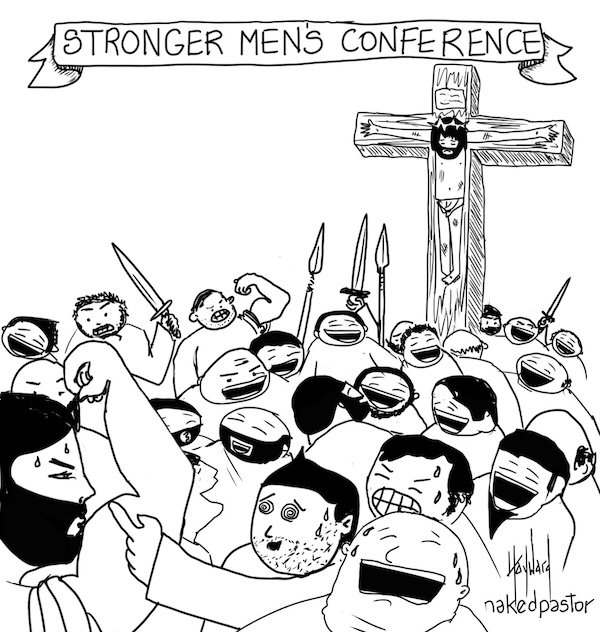
by David Hayward at http://www.Nakedpastor.com

The Naked Pastor draws many gospel cartoons. His name is David Hayward. This cartoon by the Naked Pastor is of the naked pastor. Pastor means shepherd, and here we see the good shepherd, the pastor stripped naked on the cross. In the foreground we see the wolves. They are taunting Jesus, making fun of him. They’re laughing at him, gritting their teeth at him, flexing their muscle against him, and raising their arms, their weapons of war, showing their killing teeth.

This is Jesus being savaged by a pack of wolves.

Over and over again we marvel. The good shepherd does not run away when the wolves come. He lays down his life for the sheep so that the wolves can’t scatter and snatch the sheep. I dare say we have sweetened this gospel over time – but what John is describing here is fierce. The opposition to the beloved community is fierce, but the attachment of the good shepherd to the flock is just as fierce. Blood is spilled and life is lost. But just as the good shepherd has the power to lay down his life, so he has the power to take it up again. And that places this gospel in our Easter liturgy – this fourth Sunday of Easter.

It’s a fierce gospel for savage times when metaphorical wolves roam our streets in their many disguises. It’s a gospel for our times – our mean time in which we need the protection of good shepherds – the sort who will give their lives for the sheep – the sort you wait to be pastor in your community.

At the moment, wolves and sheep remain enemies. The wolf continues to prey on the  sheep who rely on the protection of good shepherds – the sort who will give their lives for the sheep – the sort you wait for to be pastor in this community. But the time will come when there will be a peace way beyond our understanding and way beyond our imagination when the wolf will lie with the sheep. That’s what God lives for. The time will come when the wolf will live with the lamb, the leopard will lie down with the goat, the calf, the lion and the yearling together, and instead of tyrants and empire builders, a little child will be the leader. (Isaiah 11:9) Until that time we follow the call of the good shepherd as he leads us through the valleys and low points overshadowed by wolves and our fear of them.

John 10:11-18
‘I am the good shepherd. The good shepherd lays down his life for the sheep. The hired hand, who is not the shepherd and does not own the sheep, sees the wolf coming and leaves the sheep and runs away – and the wolf snatches them and scatters them. The hired hand runs away because a hired hand does not care for the sheep. I am the good shepherd. I know my own and my own know me, just as the Father knows me and I know the Father. And I lay down my life for the sheep. I have other sheep who do not belong to this fold. I must bring them also, and they will listen to my voice. So there will be one flock, one shepherd. For this reason the Father loves me, because I lay down my life in order to take it up again. No one takes it from me, but I lay it down of my own accord. I have power to lay it down, and I have power to take it up again. I have received this command from my Father.’