A motley crew of cheerleaders

Sometimes one sermon leads to another. The focus here is Hebrews 11:29-12:2, very much picking up from last week’s sermon commending those who never give up and never settle for the way things are, always hoping for justice and love. Here we join the author of Hebrews in looking more closely at who these people are because they really are our cheerleaders. The gospel reading is Luke 12:49-56.

This morning I want to bring to your attention the great cloud of witnesses who surround us.
It is such an evocative image that the author of this letter to the Hebrews has brought to the church.
It is a piece of art.

(The authorship of Hebrews has been kept a mystery.
There is a strong case that the author is a woman – perhaps Priscilla, named as a church leader in Paul’s letters.
Her authorship may have been suppressed because she was a woman.
To avoid repeatedly saying “the author” I’ll be using the pronouns, she/her.
I think it’s helpful to picture the hand of the person writing this letter.
It may well be a woman’s hand.)

Last week we heard from her letter the closest the Bible comes to defining faith:
“Faith is confidence in what we hope for and assurance about what we do not see” (Hebrews 11:1).

She then gave us a list of people who lived faithfully in hope and love, never settling for anything less that what God had promised.
She commends them for their faith.

She lists some by name:
Abel, the first of many victims of resentment and murder,
Enoch, the first of “the disappeared” – those who vanish without a trace,
Noah, the first of many victims of flooding and climate change, and
Abraham, the archetypal migrant, forever moving from place to place, a stranger and foreigner wherever he went, refusing to settle for the world as it was, forever following a call into a future he could not yet see.

They’re the patriarchs of faith.

But she goes on to name others, and, in today’s reading (Hebrews 11:29–12:2),
to hold up a whole host of unnamed witnesses.
These, too, are the people she commends for their faith.

The technology she has at her disposal was words, and she uses them like a camera lens – zooming in so we see them vividly.
She populates the crowd. They are not faceless.
She wants us to see them for who they are.
She has given us a series of close-ups of them.

Here they are.
They faced jeers and flogging, even chains and imprisonment.
They were put to death by stoning, they were sawn in two, they were killed by the sword.
They went about in sheepskins and goatskins,
destitute, persecuted and ill-treated,
They wandered the desert and mountains, living in caves and in holes in the ground.

These are the people commended for their faith.

Have a look at them. They won’t mind you taking their photo.
See the man in the torn sheepskin,
and the woman whose wrists still bear rope marks.
See the exile who carries home only in memory
and the young man with a limp and joy in his eyes.

Take those photos to heart. Treasure them.
None of them are ever going to make the front cover of Vogue.
They are the last people anyone would think of.

But this is the kingdom of God we are talking about,
where there is one rule
that the first shall be last, and the last first.

And this is sacred scripture,
the treasure of those who are last, lost and least in the kingdoms of this world,
whose hope is stubborn, resilient, never-say-die,
and will settle for nothing less
than the justice and mercy of God’s kingdom.

This cloud of witnesses surrounds us:
not a polished gallery of saintly portraits,
but a motley crew — scarred, weathered, unkempt, unruly.

They are our cheerleaders.
Imagine them as the author of Hebrews wants us to.
Imagine each and every one of them cheering you on.
Come on Margaret, Come on Niki.
“Don’t give up”, “Don’t get downhearted”, “Don’t beat yourself up”, “Keep hope alive”.

We look after our grandchildren two days a week.
One of them is soon to be 5, the other is 2.
The days are long and hard.
These days highlight my weaknesses, especially as we all tire towards the end of the day. 
Patience wears thin. I can feel mean, and I hate myself for feeling like that.
But there are other times when I see how good I can be and how helpful I can be to them.
I love that, and they love that.

I suspect many parents, grandparents and carers know what I’m talking about, especially in the long summer holidays.

In moments like those, moments of temptation, weakness and vulnerability we need the right voices in our heads and ears.
We need to hear these cheerleaders who’ve come through their trials.

But there are other cheerleaders too, if we can call them that,
The voices of dog whistlers and fearmongers
egging us on in a different race altogether:
the race to be anxious about everything,
to fear the stranger,
to protect our own at the expense of others,
to trade trust for suspicion and love for self-preservation.

They sound persuasive because they speak the language of fear — and fear is loud.
But it is not the language of the kingdom.

Hope is the language of the kingdom.
Mercy is the language of the kingdom.
Love is the language of the kingdom.

The gospel ends with Jesus asking a question, more or less wondering to himself,
“How is it that you do not know how to interpret this present time?” (Luke 12:56)

It may be that we have got it wrong, that we are seeing things the wrong way,
through the wrong eyes.
The author of Hebrews has given us a different picture,
a picture of the last and least who lived for hope, mercy and love.
They’re the eyes through which we need to see the present time,
the mean time that we are called to live through with faith.

They’re the cheerleaders who love us,
who want us to run well the race that is set before us,
who cry out “Don’t give up! Keep hope alive!”

Don’t give in to those who put themselves first.
Don’t give in to those who want to lose you and confuse you.
Don’t give in to those for whom you matter least.

They are the ones who have come last, been least, and got lost,
who were beaten, broken and jeered,
but who persevered, running their race,
and are commended for their faith.
They never gave up, and they don’t want us to either.
They want us to keep running forward
till mercy, justice and love become the rule of the day.
Theirs are the cheers we need to hear.

Wherever is Jesus? Where in the world is Jesus? Where on earth is he? Questions for the search team

A reflection on the loss of Jesus for the first Sunday of Christmas (year C). The gospel is from Luke 2:41-end when Joseph and Mary lost Jesus.

Crèche, December 2023, Evangelical Lutheran Christmas Church, Bethlehem. Photo: Munther Isaac

Today is the 1st Sunday of Christmas. Christmas is far from over as we revel in its meaning for us. Tradition has given us the 12 days of Christmas. Today is the 5th day.

What did my love give me on the 5th day? I’m sure someone will sing the answer.

What’s that all about? Maybe we can guess the significance of the 4 calling birds, the 3 French hens, the 2 turtle doves, and the partridge in the pear tree. Can we?

But what are those 5 gold rings, the four calling birds, the three French hens, the two turtle doves and the partridge in a pear tree?

We see the five rings flying on the Olympic flags, bringing separated nations to play games to bring the world together. Five gold rings, each one representing a continent, all of them representing the whole world. On this 5th day of Christmas, has my true love given me the whole world?

On this 5th day of Christmas our true love gives us this story of Jesus staying behind in Jerusalem and the worry he caused. It leaves us with the question “where in the world is Jesus?” “Where on earth is he?”

This story isn’t told in the other gospels. Luke uses the story to transition from the story of Jesus’ birth to the bigger story of Jesus’ ministry. Instead of staying with his parents for their journey home to Nazareth from the temple festival in Jerusalem Jesus stays behind.

The story gives us Jesus’ first words and they’re the words I suggest we focus on this morning – just in case we lose Jesus and struggle to find him.

We can perhaps all relate to the panic of losing someone in the crowd – so we can relate to what Mary and Joseph must have felt when they realised that Jesus was no longer with them. They thought he was walking back with their relatives or friends but he wasn’t to be found amongst them. They had to go back to Jerusalem to search for him. After three days they found him in the temple courts, among the teachers, listening to them and asking questions.

Remember, this is the beginning of Luke’s gospel. What’s at the beginning of the gospel should remind us of what’s at the end and fulfilment of the gospel, and vice versa. In the end there is another walk – from Jerusalem to Emmaus. Two people walking along the road, talking together about what had happened  – and joined by a third person who turns out to be Jesus. At the beginning of the gospel there were two walking together only because one had separated himself from them. In the fulfilment of the gospel there are three only because one had joined the two.

This is the gospel of Jesus being found in the gospel of the lost and found.

In both stories it takes three days to find Jesus, and three days is a hell of a long time to have lost someone. It was in the breaking of the bread that Jesus had become known to the two disciples in Emmaus. Subsequently he is found in his speech of just four words: “Peace be with you” (24:36) and recognised in his wounds. And this is where Jesus has been found in the church ever since: in the breaking of bread, wherever the greetings of peace are heard, and in the wounds he bravely bears These are the places to look for Jesus. This is where we find Jesus.

Now, that’s a lot to say about the end of his life, particularly as it’s the fifth day of Christmas and we’ve still got the nativity set up in our homes and minds. But already at Christmas we have a birth as well as a death and resurrection. One draws attention to the other in Luke’s telling of them.

Back to the beginning with Mary and Joseph being cross with Jesus. “Son, why have you treated us like this?” And Jesus’s reply to them, “Why were you searching for me? Didn’t you know I had to be in my Father’s house?” These are Jesus’ first words in the gospel of Luke. “Didn’t you know I had to be in my Father’s house?” But they didn’t know what he was saying to them.

This is the question I hope stays with us on this 5th day of Christmas, as we leave one secular year behind and are about to enter another – with fresh resolution to find Jesus wherever he may be – with a commitment to finding him and following him.
Where do we find Jesus?
Where do we find Jesus when we’ve lost him?
Where do we find Jesus when he’s stayed behind?
Why does he stay behind rather than going with us?

Mary and Joseph didn’t understand Jesus’ question. Luke tells us they didn’t understand what he was saying to them. Translators have struggled to capture Jesus’ meaning and have offered an alternative in the footnotes of the NIV – Did you not know I had to be about my Father’s business? But they thought he was in the family business – carpenters for the poor families of Nazareth – Joseph & Son.

But we don’t read the question “did you not know I had to be about my Father’s business? “. We read “Didn’t you know I had to be in my Father’s house?” The question is important because it is a question about where in the world Jesus can be found.

The translation in my Father’s house doesn’t quite seem right. Firstly it suggests the place Jesus can be found is so limited, and secondly it suggests Jesus can be found in a building and that leads us to churchianity rather than Christianity – with church buildings and the institution of church being the place to find Jesus when we know there are so many who love Jesus who’ve not joined a church.

Does this work as a question of Jesus for all his followers, for those who’ve lost him and those looking for him? “Did you not know you’d find me in what my Father is building?” Or, “did you not know you’d find me in whatever my Father is building?” Is that the guiding question? Is that the question to guide our search? As we build our resolution for the New Year, is that the clue to intensify our search for Jesus in what his father, our father, is building?

A couple of chapters further on in Luke’s gospel we come to what is called The Nazareth Manifesto when Jesus read in the synagogue in Nazareth from Isaiah the words, “The Spirit of the Lord is upon me to bring good news to the poor. He has sent me to proclaim release to the captives and recovery of sight to the blind, to let the oppressed go free.” He commented afterwards, “Today this scripture has been fulfilled in your hearing.”

The word manifesto  means showing. Here is Jesus showing what he is about. He is about his father’s business. He is in whatever his father is building. It is on that building site we will find him.

They’ve built a shrine for Jesus in Bethlehem. It shows baby Jesus lying in a pile of rubble in the devastation of his people while Mary, Joseph, the shepherds, the wise men and ourselves search for him. It’s on the side of the altar at Bethlehem’s Lutheran Church. The pastor there, Munther Isaac, a prominent Palestinian peacemaker says that he wants the world to know that is what Christmas looks like in Palestine these days.

Where in the world is Jesus? Where on earth is he? These questions going through the minds of Mary and Joseph go through our minds too.

This is where to find Jesus, in the devastation, wherever there is oppression and suffering, captivity and blindness. 

He’s in the news – in the good news for the poor.
He’s in the sharing of bread.
He’s in the making of peace.
He’s among the wounded.
That is where to find him.

We need look no further.

The Cruel Sea is on its way out – a reflection for All Saints Sunday

All Saints Sunday

Some made heavy weather through this sermon for All Saints Sunday in spite of the very well read scripture for the day – Revelation 21:1-6a. (My fault.) It was the detail in the text of the sea being no more which caught my eye and triggered my imagination. It’s not often we preach from Revelation. It’s the last word in our scripture, the last book that graphically seems to sum up the ways in which the Bible as a whole reveals God in the troubles of our lives.

All Saints Sunday – November 3rd 2024

Every grandparent of young children knows the Disney film Moana – probably word for word. Moana is the daughter of the village chief on a remote island where no one goes beyond the reef because of the dangers of the wider sea.

The wider sea is a place of danger. It’s not a place for poor islanders if they want to stay safe. Their boats were for fishing in the shallow seas. The seas are dangerous particularly for those who are poor, as we have been seeing in the attempted channel crossings that desperate people are making. The seas swallow the poor who dare to go beyond the reef.

It’s only the empires of the world that have conquered the seas with their vast ships and wealth of engineering. Rule Britannia and all that. 

Rule, Britannia! Britannia, rule the waves!
Britons never, never, never will be slaves.

Rule Britannia was written in 1740 just at the time when the British empire did rule the waves – as it did for two centuries until the First World War. While it may be true that empires bring some benefit, so often the ships of empire only brought trouble, bringing occupation and taking land, minerals and people for empires own purpose.

This is how Revelation sees the sea. Revelation is the last book of our scriptures. It wraps it all up and wraps it all up so graphically. It’s like a graphic novel. 

Revelation 21.1-6a
21  Then I saw a new heaven and a new earth; for the first heaven and the first earth had passed away, and the sea was no more.
2  And I saw the holy city, the new Jerusalem, coming down out of heaven from God, prepared as a bride adorned for her husband.
3  And I heard a loud voice from the throne saying, ‘See, the home of God is among mortals. He will dwell with them; they will be his peoples, and God himself will be with them;
4   he will wipe every tear from their eyes. Death will be no more; mourning and crying and pain will be no more, for the first things have passed away.
5   And the one who was seated on the throne said, ‘See, I am making all things new.’ Also he said, ‘Write this, for these words are trustworthy and true.’
6  Then he said to me, ‘It is done! I am the Alpha and the Omega, the beginning and the end. To the thirsty I will give water as a gift from the spring of the water of life.

John sees a new heaven and a new earth, for the first heaven and the first earth had passed away, and the sea was no more.

In the graphics of his revelation, John sees “the beast” rising out of the sea with ten horns and seven heads bearing blasphemous names. The beast comes from the darkness and the vastness of the sea. The beast had authority over every tribe and people and language and nation. In other words it was “empire”. The beast/empire made war on everyone who threatened its power, including trying to conquer the saints. All the suffering of the first heaven and the first earth comes from the beastliness of what comes out of the seas – those who rule the waves cause poverty, pain and tears “for the peoples of the world”. This is John’s revelation – what God revealed to John.

John himself was a victim of the beast of the sea. In his introduction, in chapter 1, he tells us that he is a victim of the persecution of Christians and that he was on an island called Patmos “because of the word of God and the testimony of Jesus”. 

Pliny and Tacitus tell us that prophecy, particularly prophecy with political implications, was seen as a threat by the Roman empire. Those guilty of such prophecy were deported. So, here is John, having been deported across the sea of empire to an island surrounded by cruel sea, living in exile. More graphically, empire swallowed John up and spewed him on an island – cast away.

Just as empire was doing its worst for John, those earliest Christians and other peoples of the world John has this revelation of the end of empire – the ending of the first earth ruled by empire. He sees a new heaven and a new earth, for the first heaven and the first earth had passed away, and the sea was no more, because evil empire is no more.  He sees the end of the old rules and the beginning of a new rule in the form of the holy city, new Jerusalem, coming down out of heaven from God, and he heard a loud voice coming from the throne of the new rule saying the “home of God is among mortals. He will dwell with them; they will be his peoples, and God himself will be with them.”

The point about empire and the sea underlines the political context of this revelation of God’s work. We still live in a political context which causes untold suffering. It is within that political context that God lives, moves and has his being. This is how God has revealed himself, time and time again, ever present in the troubles of the peoples of the world. This is the revelation that is treasured in our scriptures in book after book.

He comes to us. The Lord is here. His Spirit is with us – in the here and now, helping us through times of trial, strengthening our fight against injustices, making saints out of sinners. “See” said the one seated on the throne so different from those of worldly empires to John. “See, the home of God is among mortals. He will dwell with them; they will be his peoples, and God himself will be with them.”  

This is down to earth. It’s not pie in the sky when we die, as when we say “she’s gone to be with Jesus”. No. The point of God’s revelation is that he is with us now. The Lord is here. His Spirit is with us.

Down to earth, not pie in the sky.  God makes his dwelling with us. He stands at the door and knocks – and waits, and waits till we answer his call – and all is revealed as soon as we let our hearts, minds, hands and eyes be opened.

It’s in our lives here and now that God reveals himself – as Father, Son and Holy Spirit. As father, making good things of earth, fashioning us for now, answering our prayer. In Jesus proving himself down to earth. As Holy Spirit breathing new life into us, inspiring us, encouraging us, strengthening us here and now.

Then the one seated on the throne made John see again. “See, I am making all things new.” This is heavenly Repair Shop stuff – making new the stuff of our lives. This brings hope here and now. This is the age we are living in – (the same as John’s, the same as everyone’s). We see so much that is broken – around us, and within us. But it is really the beginning of the end with God making all things new. Here’s the alpha, the beginning that leads to the end, the omega when there will be no darkness for shame to hide in.

This is how the book of Revelation came down to us. The one enthroned in love said to John, “Write this. Write this for these words are trustworthy and true” These words being “the home of God is with mortals” (those who will die), and “I am making all things new”.

This is how we have received the revelation of the love of God. Those words are trustworthy and true. We need to guard them with our lives and never let our Godtalk be pie in the sky when we die, but always the love from above, down to earth, here and now. Insist the Lord is here and his Spirit is with us, making all things new as we battle the beast.

We began our worship by remembering all the saints using this list circulated by Sheffield Manor Parish on their Facebook page. They credit Nel Shallow and Pete Phillips for the words.

We remember Lord today all Your saints
the brave and bold
the faithful and fearless
the pursued and persecuted
the imprisoned
the impoverished
the murdered
the martyred
the grace-full and generous
the poets and the prophets
the wonderers and the wise
the healers and the helpers
the preachers
the paupers
the cloistered
the commoners
the foolish and floundering
the unready and unsteady
the careless and the cautious
the following
the hopeless
the hopeful
the faithless yet forgiven
the faithful yet flawed
the wandering and wayward
the lost and longing
We remember today Lord all Your saints
called and chosen
beloved and beheld
holy and human
Amen

The glory of Jesus, the bullied and the shamed standing side by side

Sermon for Trinity 21B – Oct 20th 2024

This sermon is for the shamed, the bullied, the ostracised, the oppressed as we get to grips with our readings for today from Isaiah 53:4-end and Mark 10:35-45. I am increasingly aware that the gospel of Jesus Christ and the work of the Holy Spirit is for the shamed, bullied, ostracised and oppressed. God takes his place with them.

We may well have been bullied, shamed or ostracised.

And/or we may have been the bullies responsible for shaming and ostracising. Or we may have joined in because we were afraid that if we stood out from the crowd we, ourselves, would be bullied, shunned and ostracised.

To jog your memories, let me take you back to school. I’ll take you to my school all those years ago. It was an all boys school. Then, as now, the slightest difference was picked up and became opportunity for mockery and worse.

There was a boy we called Cheggers, even though he hated that name. We were probably 12 or 13 at the time. We’d do monkey impressions in front of him, making fun of the way his jaw was set slightly differently and the way he walked differently. Of course, I joined in. I joined in because that was the safest thing for me to do. It wasn’t that I didn’t like Cheggers. I didn’t know him – and the bullying kept it that way. How could he ever make himself known in those circumstances?

There’s a six part series on Sky Atlantic called Sweetpea featuring a young woman who was bullied and neglected. She becomes a “ghost” of her former self – always feeling invisible. People keep bumping into her, saying, “I didn’t see you”.

The bullied and ostracised are never seen for who they are. We see that in the fear-ful treatment of refugees when they’re not seen as people but as a threat. We didn’t “see” Cheggers. We only saw his difference and the opportunity for joking and banter – at his expense. We didn’t know who he was. We didn’t want to know how he felt. It didn’t matter that he probably felt awful. We didn’t know that, perhaps he was the bravest boy amongst us – brave enough to keep coming back, lining up with us to brave the taunts and humiliation again and again.

And here’s where it matters – in the scriptures we treasure, to the Jesus we follow.

In those days, my schooldays, he, Cheggers, was the one who bore our sin. Our hatred, anxiety and fear was turned on him and he suffered because of us. In the language of our reading from Isaiah, he was wounded for our transgressions. “He was oppressed” by us. “He was afflicted” by us, myself included. 

Such is the emotional and physical suffering of the scapegoat.

We usually read this passage from Isaiah with Jesus in mind. It is normally read on Good Friday when we turn our minds to the suffering servant bearing the shame and pain of crucifixion. This is how we have come to know Jesus – mocked, bruised, afflicted and even numbered as one of the transgressors, one, two, three of them in the crucifixion scene.

But what we say of Jesus from this passage we can surely say of any we’ve scapegoated that he/she/they have borne our sin – our hatred, anxiety and fear. They are oppressed and afflicted when we, like sheep, have gone astray, turning to our own way of doing things. They are wounded by our transgressions and crushed by our iniquity. 

It’s not clear who Isaiah is referring to as the scapegoat in this passage.  He might have  someone in mind, or a community used to suffering persecution (such as the Jewish people down the centuries) or any sufferer of bullying. We don’t need to narrow the scapegoat’s identity down to Jesus, though, certainly the choice of Jesus was to join the afflicted, tormented and bruised, becoming one such himself.

In the book of Acts we find this very same passage from Isaiah being read, and Luke takes us scripture readers to this particular scripture reader. (It’s Acts 8:26-40). It’s an angel who directs Philip to the reader who is on the road from Jerusalem to Gaza. He is  an official in the court of the queen of Ethiopia. So important. But he was a eunuch. Historians of the period point out that although eunuchs could be given great responsibilities they were seen as “monstrosities”, stigmatised for being morally and sexually distorted and the objects of suspicion and derision. They were seen as sexual deviants. They were a laughing stock scapegoated for no fault of their own.

So, here, on the road to Gaza, we have a man who was seen as “not a man” reading of one who was “oppressed and afflicted”, who was “wounded for our transgressions” and “crushed for our iniquities” – and an angel of the Lord, from the realm of glory, had directed one of Jesus’s disciples to help him to read, mark and inwardly digest that he was reading about himself, and that he was also reading about Jesus – and there and then, he was baptised.

God’s realm of glory is very different to the realms of glory we have in the world, where glory is measured in wealth and winning, in power and popularity – and in importance. This is the way of thinking of James and John when they come to Jesus and ask him for the best seats in the house. Their request, “Grant us to sit, one at your right hand and one at your left, in your glory.” 

The disciples are always getting it wrong according to Mark’s gospel. They’ve missed the point of Jesus and his mission. Jesus points out the ways of the world and underlines the suffering caused by the ways of the world. He points out that those we recognise as our rulers so often lord it over us, making themselves exceptions to their rule, enjoying the power they have over others – and in so many cases turning out to be tyrants, striking fear into people, upsetting their lives and causing suffering.

He said, It is not so among you: but whoever wishes to become great among you must be your servant, and whoever wishes to be your servant must be slave of all. This is not what James and John had in mind when they came to Jesus with their request to be one up on everyone else. (Nor is it what we have in mind when we choreograph our ecclesiastical processions or when we excuse the abuses of power in a culture of deference.)

No, scripture points us to another way of doing things. Glory in the kingdom of God is for those, in the words of Isaiah, afflicted, wounded and oppressed by the powers that be, just as Jesus was afflicted, wounded, mocked and shamed by those rulers of Jerusalem and Rome, the rulers of religion and empire – just as the eunuch would have been, just as whole groups of people are, just as certain ethnic groups continue to be.

Who will be on Jesus’ left, and who will be on Jesus’ right in his glory? Is it James? Is it John? Mark gives us the answer. The glory of Jesus is first witnessed by the Roman centurion, who, faced with Jesus, said “truly this man was God’s son!”. And on his left hand and on his right were neither James or John. They were nowhere to be seen. They’d deserted him. Instead, on his left and on his right were two “bandits” – together with Jesus – the three of them shamed, mocked, scorned and killed by empire and those who want the glory of being empire builders.

This, brothers and sisters, is where the gospel of Jesus Christ takes us – to the cross where one oppressed, afflicted and wounded was hung out to die – with one on his left and another on his right, neither of whom are James or John. They’re still glory seeking – they’re in hiding, saving their own skin. The glory of the kingdom is the salvation of those who bear the sins of the world – victims of shame, injustice and empire (maybe ourselves included).

An uprising – the mustard seed and the seed growing secretly

Here’s a sermon for the 3rd Sunday after Trinity focusing on Jesus’s parables of the seed growing secretly and the mustard seed. They speak of uprisings and encouragement, perseverance and patience.

June 16th 2024

Our scriptures are the creation of a bruised and battered people, treasured and passed on by bruised and battered people for the sake of other bruised and battered people. It is a troubled people who have chosen the scriptures we inherit, and who have handed them on.

I keep saying this to remind myself whose these scriptures are and to remind myself to read the scriptures from that point of view.

Today’s gospel features a couple of parables used by Mark to end a sermon by Jesus. The sermon is given from a boat, to a crowd of people on the shore.

Their place on the shore is significant. Jesus and the crowd are from poor peasant communities, subsistence farming communities pushed to the edge by the taxation policies of the temple and Roman authorities. They were clinging on to life in any way they could. Jesus is one of them. 

His sermon was  particularly for them, the least and the frequently lost in the kingdoms of the world. Appropriately, for an audience of the least Jesus uses what is the least to make his points. Today, he picks a seed that grows secretly, and a mustard seed, “the smallest of all seeds”, which amazingly grows to be the “greatest of all shrubs” – and that picks up the prophecy of Ezekiel in our first reading. 

Ezekiel points us to a “lofty tree”.
In his mind it stands for empire and the highness and might of emperors and kings and all those who problematically lord it over others.
Ezekiel sees God cutting a sprig from the lofty top and planting it on a high mountain so that it produces boughs, fruit and shelter for all kinds of bird.
He calls this a “noble” tree rather than a “lofty tree”.
What makes the lofty tree is its highness, whereas the nobility of the noble tree rests in the shelter it gives.

Jesus is the sower.

He sowed seeds in his preaching – seeds of faith, hope and love – seeds of imagination which would grow in the hearts and minds of those poor enough in spirit to have the ears to hear and the eyes to see Jesus’ meaning of love in these parables. 

They will have loved his talk of the seeds for him highlighting the smallest of things as being full of life. They will have known that about themselves though generations of occupation, foreign rule and religious oppression will have eaten at their self belief.

Jesus takes two seeds. That in itself reveals so much about the kingdom of God, namely that the rule of God focuses on the smallest of things, the miniscule, on the least. When did you last hear an emperor, or a Mr Big, or a gang leader wondering about the smallest and least in creation?

Jesus casts the mustard seed as the smallest seed, which grows to become the greatest of shrubs giving shelter, shade and blessing to all the birds of the air. His hearers will have loved that. This is what can become of us is what Jesus is leading them to imagine. This is what can happen to the least of us. The least of us can become the most hospitable. The least of us can be the shelter, shade and blessing for so much and so many.

These are parables for the poor in spirit, for the weary, for the belittled.

They encourage us to believe
life will change for the better for the least, the lost and the last –
that the little, least, lost are great in the eyes of God and come first in his kingdom,

They remind us that the seeds of the kingdom are already embedded in the world
by Jesus the sower,
in our own paths and ways
a seed in edgeways

And those seeds have a life of their own.
We don’t know the effect of them – and we can’t control the effects of a kind word, or affirming gesture.

And they make small beautiful.

Small is beautiful in the eyes of the one who puts the least, the lost and last first.
We don’t need to lie
about how little we are
or what little we have
when Jesus sees the kingdom in a seed.

These parable have always encouraged the church,
particularly encouraging us these days
when the church is struggling,
when you’re feeling like there is so much to do
with fewer and fewer people – in a vacancy as well
we can love being small,
being the unlikely seed of the kingdom,
for ever unsure how it’s going to turn out,
just going day to day
with our small seed of faith
our small seed of hope
and our small seed of love,
sprigs cut from the high and mighty,
cut down to size and carefully planted
to be noble in the kingdom.

These parables encourage us to persevere with patience,
to carry on scattering seed in our small ways along the paths of our lives,
never put off by the idea of a harvest we will never see,
to carry on with those small things
that come naturally to those with a joyful heart:
a smile,
a touch,
a word of welcome,
small kindnesses
in all our ways
scattered like seed.

There was a song Jesus heard at home. He’d heard his Mum singing it. We know it as the Magnificat. It goes like this:

Her song praises the work of God showing mercy on those that fear him from generation to generation, scattering the proud in their conceit, casting down the mighty from their thrones, lifting up the lowly, filling the hungry with good things, sending the rich away empty.

This is the song that seeded Jesus’ imagination.

It is no wonder that he turns to the smallest in his preaching, to seeds to show us faith, hope and love. The seed growing secretly and the mustard seed represent an uprising – an uprising of the least, the tired and the broken.

Mark 4:26-34
He also said, ‘The kingdom of God is as if someone would scatter seed on the ground, and would sleep and rise night and day, and the seed would sprout and grow, he does not know how. The earth produces of itself, first the stalk, then the head, then the full grain in the head. But when the grain is ripe, at once he goes in with his sickle, because the harvest has come.’
He also said, ‘With what can we compare the kingdom of God, or what parable will we use for it? It is like a mustard seed, which when sown upon the ground, is the smallest of all the seeds on earth; yet when it is sown it grows up and becomes the greatest of all shrubs, and puts forth large branches, so that the birds of the air can make nests in its shade.’
With many such parables he spoke the word of to them, as they were able to hear it; he did not speak to them except in parables, but he explained everything in private to his disciples.

Ezekiel 17:22-end
Thus says the Lord God:
I myself will take a sprig
from the lofty top of a cedar;
I will set it out,
I will greek a tender one
from the topmost of its young twigs;
I myself will plant it
on a high and lofty mountain.
On the mountain height of Israel
I will plant it
in order that it may produce boughs and bear fruit,
and become a noble cedar.
Under it every kind of bird will live;
in the shade of its branches will nest
winged creatures of every kind.
All the trees of the field shall know
that I am the Lord.
I bring low the high tree,
I make high the low tree;
I dry up the green tree
and make the dry tree flourish.
I the Lord have spoken;
I will accomplish it.

A fierce gospel for savage times – reflecting on the Good Shepherd

A sermon for two rural churches without a “pastor”. The gospel for the day is John 10:11-18 (text below).

I am, I am, I am.

This is the name that rolls round the mind of the beloved community.
I AM, the very being of God as disclosed to Moses. Simply, I AM who I AM.
I AM, I AM, the name given even to Jesus by the community of beloved disciples as they explore the meaning of the God they find in Jesus.
I AM
This is what being is all about.

I am, I am, I am.
There are seven I AM sayings of the beloved community in John’s gospel.
Seven, as in the days of the week, as in the sign of perfection and completion.
This is how they loved Jesus. This is how they found God. This is how they saw salvation.
I am, I am, I am.

I am the bread of life,
the light of the world I am.
I am the door,
the good shepherd I am.
I am the resurrection,

the way, the truth and the life I am.
I am the vine.
I am.

This is how the beloved community singles Jesus out, in these seven sayings. Jesus is who we say he is. Jesus is who he says “I am”. This is who Jesus is to the beloved disciple – incidentally ruling out who he is not. 

Today is the fourth Sunday of Easter, known as Good Shepherd Sunday. These are the words ringing in the ears of the beloved community this morning. “I am the good shepherd”.

I know how important sheep and lambs are in your lives round here – how much you care for them and how you’ve worried for their welfare through these months of exceptionally wet weather. You know what good shepherding is all about.

I also know that you are waiting patiently for good shepherds to pastor you, and that you are praying that those the diocese appoints to these parishes will be good shepherds who will themselves have ruled out what the beloved community know Jesus isn’t – the opposite of the hired hand, the opposite of the one who leaves the sheep and runs away as soon as he sees the wolves coming, thinking only of themselves and abandoning the  sheep.

That’s not the Lord, our shepherd, who stays with his people even while they walk through the valley overshadowed by death, spreading a table before us so we can eat even while others trouble us.

I am the good shepherd. The Lord is my shepherd. These are the words at the heart of the people God makes his beloved community. And we, the beloved community know the truth of what makes a good shepherd. 

The good shepherd lays down his life for the sheep he owns and knows.

Have you thought about this? The good shepherd lost his life to the wolves. The wolves circled and he didn’t run.
The wolves licked their lips and he didn’t budge.
The wolves scented blood and he gave them his own.

These are metaphorical wolves. Actual wolves have virtues and they have their rightful place in our animal kingdom. Metaphorical wolves have none. They are devious and deceitful. They are around us and they are savage.

They can eat your grandma and then disguise themselves as grandma to little Red Riding Hood. “Grandma, what a deep voice you have!” “All the better to greet you with”. “Grandma, what big eyes you have!” “All the better to see you with.” “And what big hands you’ve got!” “All the better to embrace you with.” “Grandma, what a big mouth you have!” “All the better to eat you with.”

These metaphorical wolves are masters of disguise. The good shepherd sees their danger. He knows wolves come in sheep’s clothing and infiltrate his beloved community. Sometimes the wolf even takes on the shepherd’s clothing and grooms the metaphorical sheep, (beloved disciples) for his wicked ways. (I believe that is a storyline currently being explored in Eastenders.)

The wolves are around us in their many disguises. I don’t know where you’re at in your personal journeys. Some of you may be enjoying  a relatively easy path in your lives. Others may be on rockier roads, in the pits, even walking the valley in the shadow of death. 

For some, their road is very dangerous. They are particularly vulnerable to attack from those who would groom them, harm them, ridicule them, profit from them, even kill them. 

We must never forget the long and really difficult journeys refugees from around the world are having to take. Hounded from their homes by metaphorical wolves, they are prey to wolves in every twist and turn of their journey as they put their lives into the hands of one agent after another – each wanting their cut and their piece of flesh. And there are those living in the crossfire of wolves in warzones, such as Gaza and Ukraine.

I’m reading a book set in England in the middle of the 14th century – the time of the plague. Is plague one of the wolf’s disguises? Was Covid?

Good shepherds stand with their sheep. They don’t run away when they see the wolf coming. They sound the alarm. They take precautions. They stand firm.They take the front line. They absorb the shocks. They become shelter. And sometimes they lose their life.

Like Jesus. The wolves savaged him. They were disguised as religious leaders and political leaders. The following he was getting (the sheep and the size of the flock) frightened them. They came for him, so that they could get at them. They took him away. They accused him. They mocked him. They stripped him. They slashed him. They crucified him.

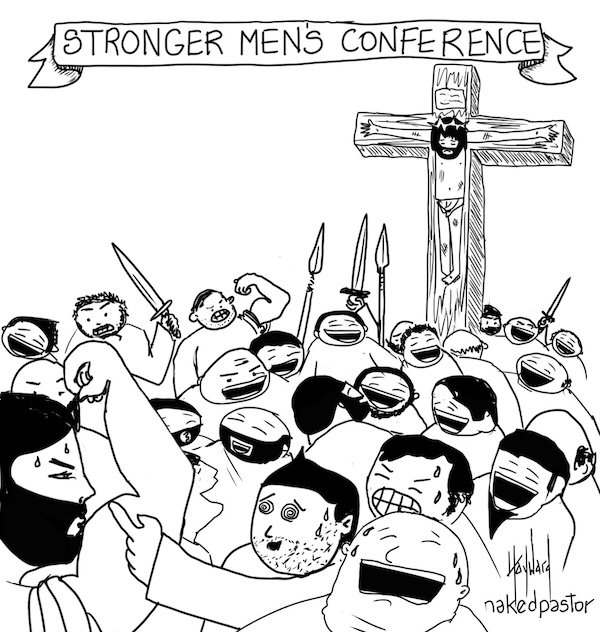
by David Hayward at http://www.Nakedpastor.com

The Naked Pastor draws many gospel cartoons. His name is David Hayward. This cartoon by the Naked Pastor is of the naked pastor. Pastor means shepherd, and here we see the good shepherd, the pastor stripped naked on the cross. In the foreground we see the wolves. They are taunting Jesus, making fun of him. They’re laughing at him, gritting their teeth at him, flexing their muscle against him, and raising their arms, their weapons of war, showing their killing teeth.

This is Jesus being savaged by a pack of wolves.

Over and over again we marvel. The good shepherd does not run away when the wolves come. He lays down his life for the sheep so that the wolves can’t scatter and snatch the sheep. I dare say we have sweetened this gospel over time – but what John is describing here is fierce. The opposition to the beloved community is fierce, but the attachment of the good shepherd to the flock is just as fierce. Blood is spilled and life is lost. But just as the good shepherd has the power to lay down his life, so he has the power to take it up again. And that places this gospel in our Easter liturgy – this fourth Sunday of Easter.

It’s a fierce gospel for savage times when metaphorical wolves roam our streets in their many disguises. It’s a gospel for our times – our mean time in which we need the protection of good shepherds – the sort who will give their lives for the sheep – the sort you wait to be pastor in your community.

At the moment, wolves and sheep remain enemies. The wolf continues to prey on the  sheep who rely on the protection of good shepherds – the sort who will give their lives for the sheep – the sort you wait for to be pastor in this community. But the time will come when there will be a peace way beyond our understanding and way beyond our imagination when the wolf will lie with the sheep. That’s what God lives for. The time will come when the wolf will live with the lamb, the leopard will lie down with the goat, the calf, the lion and the yearling together, and instead of tyrants and empire builders, a little child will be the leader. (Isaiah 11:9) Until that time we follow the call of the good shepherd as he leads us through the valleys and low points overshadowed by wolves and our fear of them.

John 10:11-18
‘I am the good shepherd. The good shepherd lays down his life for the sheep. The hired hand, who is not the shepherd and does not own the sheep, sees the wolf coming and leaves the sheep and runs away – and the wolf snatches them and scatters them. The hired hand runs away because a hired hand does not care for the sheep. I am the good shepherd. I know my own and my own know me, just as the Father knows me and I know the Father. And I lay down my life for the sheep. I have other sheep who do not belong to this fold. I must bring them also, and they will listen to my voice. So there will be one flock, one shepherd. For this reason the Father loves me, because I lay down my life in order to take it up again. No one takes it from me, but I lay it down of my own accord. I have power to lay it down, and I have power to take it up again. I have received this command from my Father.’

Three people walk into a parable

Thinking through the parable of the talents for the 2nd Sunday before Advent I wondered what sort of life the cast of Jesus’ parables had in his mind and whether they featured in his other parables, and whether the same happened in the mind of Jesus’ hearers. It did for me and led me to preach this. The text of the parable of the talents is printed below.

Who does the one who hid his talent remind you of from the gospels?

While the parable of the talents is deadly serious there is something jokey about it.

There were three people walked into a parable. One was given five talents. The second was given two talents. And the third was given one. It’s the classic: there was an Englishman, a Scotsman and an Irish man ……..

There is a light-heartedness in the parable as you would expect from the one who preaches from the heart and who is the light of the world. He uses exaggeration and the absurd to create a comic effect to engage and challenge us, his hearers and disciples. 

We’ve misheard the parable if we think it’s about the sort of talents which make Britain’s Got Talent. The talents Jesus is talking about here is a unit of measurement used for weighing silver. We have our strange units of measurement too. Like a yard of cloth, or a pint of beer. Here we have talents of silver.

Three people walked into a parable. Each given a weight of silver. Here’s the funny bit. A talent weighed 80 lbs (about half my weight) and was worth 6000 denarii. How would you even carry it? 

Typically one denarius was the wage for a day’s work. So one talent was the equivalent to 20 years labour at a denarius a day for a six day week. Five talents of silver was worth 100 years labour, two talents was worth 40 years labour. The slave given the one talent wasn’t given a little. He was given less but it was still a small fortune. He was set up for life.

Jesus gives us something here that is hard to imagine because it is so preposterous. The slave with the one talent hid it. Where can you hide so much? How deep do you have to dig the hole to bury it?

So, who does he remind you of, this one who walked into a parable and was given a talent of silver?

He reminds me of the labourers who worked the whole day in the vineyard only to find that the landowner paid those who worked the last hour the same as them. In that parable the landowner hires workers throughout the day – including some at the last hour. He instructs the manager to pay the last first and to pay them all the same. They each get their one denarius. The ones working the longest, and used to being paid the most, complained. But they could have been delighted that the last and least chosen had, for once, been paid what they needed.

These disgruntled ones were probably always used to being the first chosen. There are those who are used to coming first. Coming first is beyond most of us. It requires hard work: the greasing of palms, the pulling of strings, the favour of friends in high places, the use of elbows to stay ahead of the game. They were ahead of the queue on the labour market and the first to be taken on by the landowner. But then they got nothing more than the ones who came last.

Is the one who is given the one talent one who is used to always being amongst those first chosen – and one of the complainers that the last chosen and the least chosen are paid the same? Is he one of those who complain about the state of affairs in the kingdom of heaven where the last always come first and the first always seem to come last?

Something has happened to make him misjudge the master. Something has happened to make him afraid. He says: “Master, I knew that you were a harsh man, reaping where you did not sow, and gathering where you did not scatter seed; so I was afraid, and I went and hid your talent in the ground.” Whatever led him to think he was a harsh man? There must have been something that made him disgruntled and that coloured his judgement. Was he amongst those used to being first who now were last?

That’s who he reminds me of – of all those who misjudge God, who fear his judgement, rather than loving his judgement because it is full of mercy and love for the last and the least and for those who have suffered the wrongs of how things are.

The Psalmist wrote this into what became the prayer book for millions, including Jesus:
With the loyal you show yourself loyal.
With the blameless you show yourself blameless.
With the pure you show yourselves pure.
With the crooked you show yourselves perverse. (Psalm 18:25-26)

However kind, generous or good the master is, the crooked will always have a perverse view of him. Often, when we read this parable we say we don’t like the sound of the master. What I am suggesting is that this fearful one has got the master wrong. He isn’t actually a harsh man, reaping where he has not sown and gathering where he has not scattered. And that is particularly so if the master is actually God, as he has been for so many who have heard this parable. We surely don’t share in this perverse view of those who complain about the master and are afraid of him.

If we’re not like him then we are like the other two who walked into the parable: those given so much by a generous master who trusted them with all that he had. He trusted them with his life, and his generosity and trust were their stock in trade. That is what makes me think that the one who knew the master to be a harsh man had got him so wrong. He was anything but harsh.

I read this parable with a group of residents of a fairly prosperous retirement village this week. One of them had found it difficult to adjust to a life where she was no longer so high profile and where she was limited by health issues. Being of a similar age I sympathised with her, realising that our power dwindles as we age. We could say that we become less “talented”. But in the gospel where the least, the last and the smallest count for so much, even a little talent, a lightweight born from the thankful heart of a person is good enough for the kingdom of heaven. 

Complaints and resentment, on the other hand, bury what little talent we may have ended up with.

I don’t know whether you’ve noticed that the number of talents match the number of loaves and fish with which Jesus fed the five thousand. There were five loaves and two fish. No one went hungry, and there was enough left over to feed a nation. In the right hands so much can be made of so little – a smile, a word, a touch, a seed. This is the currency of the kingdom, the currency of grace, our weight of silver.

There were three people walked into a parable, ourselves included because we have been given our weight of silver, our talent. We have been given enough to set us up for life. It’s not money, that would only be small change. It’s grace. That is what we trade in – unless, like the least talented in the parable we perversely fear God and God ceases to be gracious in our eyes.

Three people walked into a parable. And the punch line is that the worthless slave gets thrown into the outer darkness, the darkness that is beyond darkness, where there is no light, and where there is only the weeping and the gnashing of teeth of his fellow complainants.

But fear and threats is not what the gospel leaves us with. What we are left with is a generous spirit which goes to the heart of our lives. That is the talent given to the church. He sets us up for life to trade in the affairs of the kingdom of heaven, putting the last and least first and forgiving one another. No other talent compares to this.

We are his beloved. We are his trusted ones. He trusts us with his life. (We celebrate that when we receive his body in our hands at Communion). 

We are the ones to whom God shows himself loyal, blameless and pure. For us there is nothing perverse about God. There is nothing for us to complain about. There is no reason to fear his judgement. His ways are not perverse, but straightforward love.

Matthew 25:14-30

For it as if a man, going on a journey, summoned his slaves and entrusted his property to them; to one he gave five talents, to another two, to another one, to each according to his ability. Then he went away. The one who received the five talents went off at once and traded with them, and made five more talents. In the same way, the one who had the two talents made two more talents. But the one who received the one talent went off and dug a hole in the ground and hid his master’s money.
After a long time the master of those slaves came and settled accounts with them. Then the one with the five talents came forward bringing five more talents, saying, “Master, you handed over to me five talents; see I have made five more talents.” His master said to him, “Well done, good and trustworthy slave; you have been trustworthy in a few things, I will put you in charge of many things; enter into the joy of your master.”
And the one with the two talents also came forward bringing two more talents, saying, “Master, you handed over to me two talents; see I have made two more talents.” His master said to him, “Well done, good and trustworthy slave; you have been trustworthy in a few things, I will put you in charge of many things; enter into the joy of your master.”
Then the one who had received the one talent also came forward, saying, “Master, I knew that you were a harsh man, reaping where you did not sow, and gathering where you did not scatter seed; so I was afraid, and I went and hid your talent in the ground. Here you have what is yours.”
But his master replied, “Yu wicked and lazy slave! You knew, did you, that I reap where I do not sow, and gather where I did not scatter? Then you ought to have invested your money with the bankers, and on my return I would have received what was my own with interest. So take the talent from him, and give it to the one with ten talents. For to all those who have, more will be given, and they will have an abundance; but from those who have nothing, even what they have will be taken away. As for this worthless slave, throw him into the outer darkness, where there will be weeping and gnashing of teeth.”

Do I look good in this? Thinking about the wedding guest who got kicked out

This is a sermon on the parable of the wedding banquet (or the wedding guest) from Matthew 22:1-15 (the text is below).

Do I look good in this?

You all look very well turned out, if I may say so.

But not a patch on how people dressed for worship, say 50/60 years ago. Then people had their “Sunday best”. If you saw someone in the street in their Sunday best you knew they were on their way to the church.

What was that all about?

Was there a sense you had to look your best? Who for? Was it that you had to look your best for the neighbours (or look better than the neighbours, or look better than you really were)? Or, was it looking your best for God?

By and large God doesn’t do clothes.

In the Sermon on the Mount Jesus taught his followers not to worry about what they should wear. “Consider the lilies of the field, how they grow, they neither toil or spin, yet I tell you, even Solomon in all his glory was not clothed like one of these.” (Matthew 6:28f) When Jesus sent out the 70 he told them not to take purse, bag or sandals. Adam and Eve didn’t wear so much as a stitch. It was only when they started to be ashamed that they put something on. Their clothing, which didn’t hide much, is associated with shame.

But then there is the guest who turns up at a wedding without a wedding robe. He sticks out like a sore thumb to the king who had invited him. He is thrown out. Not just thrown out, but bound hand and foot, thrown into the outer darkness where there is weeping and gnashing of teeth. He’s not just thrown out, he’s thrown out, out. He’s not thrown out into the dark where there would still have been some light coming from the windows. He’s thrown out into the darkness beyond that, where there is no light and just the piercing screams and howling and the sound of weeping and gnashing of teeth. In other words, this was a serious expulsion.

For wearing the wrong clothes? I don’t think so!

This was a wedding feast the good, the bad and the ugly had been invited to. These are the ones who accepted the invitation that others had refused. They weren’t the first to be invited, they were the last to be invited, as is fitting for the rule of the kingdom of heaven which puts the last first and the first last.

Think who they might have been from the streets of Leamington, this mixture of good and bad. Borrowing from Ralph McTell, have you seen the old man from the closed down market, the old girl, dirt in her hair and her clothes in rags? The street vendors, Big Issue sellers, the Deliveroo guys, the shoppers, the drunks, the pensioners who usually meet on one of the benches, children and their harassed mothers …….these are the people the king chooses to invite – anyone they met on the street, the good and the bad who happened to be there.

Maybe the custom was for the host to give the guests a wedding garment – sort of overalls – and this man had refused and made an exception for himself. Could this parable be a judgement on the “exceptional man”, those who think they can be an exception to all the rules, including the rule of the kingdom of heaven which puts the first last and the last first? We’ve known political leaders and serial abusers like that haven’t we? And the outer darkness is where they need to be.

Maybe the garment has greater meaning. What if the wrong garment was not so much about wearing the wrong clothes but other things he had on?

For example, did he have a cob on? What was the bearing he was wearing? What if he had a face on? What if he had a face on him which showed his disgust for the host, the king, who had invited the good, the bad, the ugly off the streets?

In which case, this parable becomes a judgement on judgement itself.

Of all the wrongdoings of those partygoers the only crime that is singled out is judgementalism. It’s the judgemental one who is cast out. All the others remain, the whole company, good and bad. The disgusted face was a face set against his fellow guests.

The face he had on him was the face of hypocrisy – accepting the invitation of the king for himself but throwing it back in the king’s face. It’s the face of one who is hyper-critical of the king. And if it is the kingdom of heaven the parable is likening the wedding feast to, then the king the guest is offended by is none other that the ruler of the kingdom of heaven.

Is it the judgemental (and their air of arrogance and superiority) who are singled out for that outer darkness? Is that place of outer darkness where the judgemental are – where the light of grace cannot pierce because of the pride at their heart? Was it his blasphemy against the spirit of the king?

We don’t always know what Jesus means in his parables. As disciples we are always looking to understand, with our ears, eyes, minds and hearts open to the challenges of the life of the kingdom on earth, as it is in heaven. We have to have a go at what this parable means for us.

Here’s my go.

Remembering that the last are first in the kingdom of heaven and the first last we can assume that this is a celebration for those who were invited last, not first. It’s for down to earth people gathered from the streets and we are to assume that we are amongst them, as one of them, the last chosen.

It’s about the bearing we’re wearing. It’s a lot more than clothes. It’s about our attitudes, particularly whether we show grace and mercy. It’s about how we set our faces to our neighbours, both the good and the bad. It’s about how we honour the host, the king and ruler of heaven. It’s about our love and understanding.

Have we got it in our locker to avoid the fate of the guest who was bound hand and foot and cast into outer darkness?

The language of clothing can be helpful. The parable uses the language of the wedding garment. Religious garments are often called habits. As novices for the kingdom of heaven, what habits do we need to put on? What habits do we need to have to grow as disciples? What are the habits that are going to set our faces right? What is the lifestyle we need to in-habit to help us fit the company God has chosen.

We’re best letting the host of the wedding feast choose for us. Listen to him as he says “put this on”, “put this on”, “try this”. Paul, in Galatians 3, talks about us being “clothed with Christ” so that we are all one in Christ and there are no longer the divisions of Jew and Greek, slave and free, male and female. We could say it’s cross-dressing. The author of the letter to the Ephesians talks about us putting on the whole armour of God for our struggle against the rulers and authorities of this present darkness – the belt of truth, the breastplate of righteousness, the helmet of salvation.

Jan Richardson has this prayer for getting dressed:

In your mercy
clothe me

in your protection
cloak me

in your care
enfold me

in your grace
array me.

With your justice
dress me

for your labour
garb me

by your love
envelop me and fit me
for your work.

Matthew 22:1-14
Once more Jesus spoke to them in parables, saying: 2‘The kingdom of heaven may be compared to a king who gave a wedding banquet for his son. 3He sent his slaves to call those who had been invited to the wedding banquet, but they would not come. 4Again he sent other slaves, saying, “Tell those who have been invited: Look, I have prepared my dinner, my oxen and my fat calves have been slaughtered, and everything is ready; come to the wedding banquet.” 5But they made light of it and went away, one to his farm, another to his business, 6while the rest seized his slaves, maltreated them, and killed them. 7The king was enraged. He sent his troops, destroyed those murderers, and burned their city. 8Then he said to his slaves, “The wedding is ready, but those invited were not worthy. 9Go therefore into the main streets, and invite everyone you find to the wedding banquet.” 10Those slaves went out into the streets and gathered all whom they found, both good and bad; so the wedding hall was filled with guests.
11 ‘But when the king came in to see the guests, he noticed a man there who was not wearing a wedding robe, 12and he said to him, “Friend, how did you get in here without a wedding robe?” And he was speechless. 13Then the king said to the attendants, “Bind him hand and foot, and throw him into the outer darkness, where there will be weeping and gnashing of teeth.” 14For many are called, but few are chosen.’