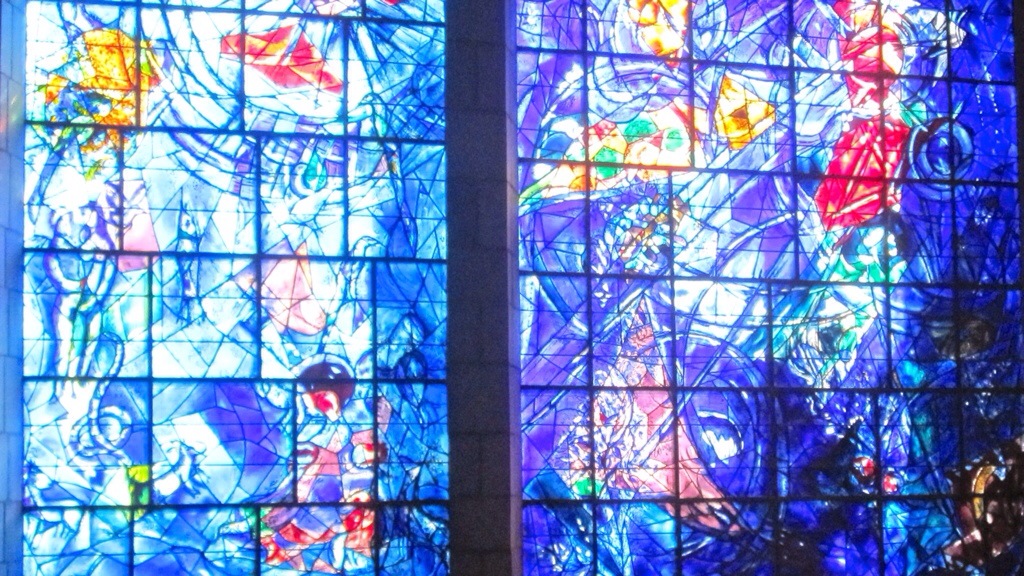
Thomas’s Twin – a sermon for Easter 2A

Sermon notes for Easter 2A for St Alban’s, Broadheath. Again, it could be said better, and I hope it will be. I share it anyway. The Gospel reading is John 20:19-31
Who likes ants?

We are told to learn from the ants. Proverbs 6:6 – “Go to the ant, you sluggard: consider its ways and be wise.”

It’s true. We can learn a lot about community and industry from ants. We can also learn that if they get lost they die. When ants get lost, they follow a simple rule. The rule is to follow the ant in front. But they don’t know that the ant in front of them is only following the ant in front of him. They finish up going round and round in circles, blindly following the one in front until …. They die.

There is a famous example of this deathmill from the Guyana jungle. The ants were just going round in circles – it was a trail of ants which just kept marching in a column 400 yards long (the length of a running track). It took them 2 days to complete a circuit. On and on till they died from exhaustion.

Consider its ways, and be wise. What do we learn from the ant? We learn the importance of thinking for ourselves. We learn the importance of seeing for ourselves.

“Seeing is believing.” That’s what we say, isn’t it?

“We have seen the Lord” is what the disciples say in today’s gospel reading. “We believe”. “We have seen the Lord” is what the disciples say to Thomas, who wasn’t there to see and believe. He is the odd one out.

He was in the wrong place at the wrong time and missed seeing Jesus.

Seeing is believing is the theme of John’s gospel. Time and again John refers to the disciples “coming to see”. The frequency increases as we move to the end of John’s gospel.

  • Mary Magdalen came to the tomb and saw that the stone had been removed,
  • Peter and the beloved disciple ran to the tomb and saw the linen wrappings lying there. They went into the tomb, and saw and believed.
  • Mary Magdalen told the disciples that she had seen the Lord.
  • Mary Magdalen, Peter, the beloved disciples come to see the Lord.
  • And then, that same evening of the day of resurrection, the disciples “see the Lord” – apart from Thomas. Where was he? What was he doing?

Seeing is believing.

But if seeing is believing, what about those who are not there to see, like Thomas?

And what about those who can’t see? What about those who not even Specsavers can save?

This was a problem for a friend of mine who became blind. He was troubled about all that the Gospels say about “seeing” and “believing”, and about “light” (good) and “darkness” (bad). How could he believe when he couldn’t see? How could he be saved when he had been cast into outer darkness?

Do you see his problem?

He worked it out in the end, eventually realising that there are other ways of seeing. He called it “whole body seeing” and wrote the story of his blindness and his later whole body seeing in a book called Touching the Rock.

This is how he discovered his “whole body seeing” (WBS for short). He was staying at Iona. He had been told about the altar there by people who had described it to him. Then he saw it for himself. This is what he wrote:

 “After several nights, I discovered the main altar.

I had been told about this, and I easily recognised it from the description. It was a single block of marble.

Finding one corner, I ran my fingers along the edge, only to find that I could not reach the other.

I worked my way along the front and was amazed at its size.

The front was carved with hard, cold letters. They stood out baldly, but I could not be bothered reading.

The top was as smooth as silk, but how far back did it go?

I stretched my arms out over it but could not reach the back. This was incredible.

It must have a back somewhere. Pushing myself upon to it, my feet hanging out over the front, I could reach the back. I did this again and again, measuring it with my body, till at last I began to have some idea of its proportions. It was bigger than me and much older.

There were several places on the polished surface which were marked with a long, rather irregular indentations, not cracks, but imperfections of some kind.

Could it have been dropped? These marks felt like the result of impact. The contrast between the rough depressions and the huge polished areas was extra ordinary.

Here was the work of people, grinding this thing, smoothing it to an almost greasy, slightly dusty finish which went slippery when I licked it. Here were these abrasions, something more primitive, the naked heart of the rock.”

When I read that I just went WOW. He had seen things which would not have been noticed by the casual observer with her naked eye. With his whole body seeing he had found things there which I am sure he’d be telling others about over breakfast the next day. “Come and see” he’d have been telling everyone.

I mention this because I think there is something in today’s gospel about the importance of seeing things for ourselves. When we see things for ourselves we are not seeing through other people’s eyes. We are not conforming to their vision, and we are seeing things that nobody else sees.

This brings us to the beauty of Thomas who is the focus of our gospel reading.

Thomas is a disciple who captures our imagination, isn’t he? That’s shown in the number of Thomases there are. (How many here are called Thomas, or have a Thomas in their family?)

Two of our children have Thomas in their names, after their grandfather.

We often talk about “doubting Thomas” and then refer to him as typical of us, who are often “doubters” like him.

I’m not sure that this is helpful. Thomas is actually someone who sees and believes, but in a different way. Isn’t that a more helpful way to remember Thomas?

Thomas sees things differently. This is brought out in the gospel. He wants to see through his hands and fingers. He uses his body. He doesn’t just see with his eyes. He inspects. He uses his senses and his sense. He sees with feeling. He sees from the heart.

That is the way that Thomas comes to see.

He puts his hand into Jesus’ wounds. He reaches beyond first impressions. And then he sees. He feels the love in those scars and jumps to his joyful conclusion that he is seeing our Lord and our God. This is the staggering realisation which comes from seeing from the heart, which comes from seeing with feeling, which comes from his insistence that he should see things for himself.

Thomas is not the doubter. He is one who was willing to see.


Thomas is a twin. That is how he is introduced in the gospel. “Thomas the twin”. We don’t know whether Thomas had a twin brother or sister. IT’s more likely that “twin” was Thomas’s nickname because the meaning of the name Thomas is “twin”. But if Thomas had a twin, who might it be?

That  might have been a question that entertained John’s community. “If Thomas is the twin, who is his twin brother or sister?”

They could have played with that question and wondered “is that me?”

We can play with the same question. If Thomas is like us in his doubting, can we be like him in his seeing and believing? How much like him can we be? Can we be his twin brother or sister in the way that we are so much like him in wanting to see Jesus from the heart?


Jesus made many “resurrection” appearances – or should I say that Jesus makes many “resurrection” appearances. John admits that there are so many ways that Jesus showed himself and supposed that “if every one of them were written down the world itself could not contain the books that would be written.” Jesus wants us to see him for ourselves. He wants us to be witnesses.

Mary Magdalen, Peter, the disciple (disciples?) Jesus loves/loved, Thomas and ourselves come to see in their different ways. Together we are a body of believers who through our whole body seeing see things differently.

It is in such company that Jesus shows himself so that we might see life differently – with compassion that is able to feel for scars and wounds, and with the hope that love is stronger than death.

It is in such company that Jesus shows himself to us so that we might follow him in a way of life that is life giving, instead of blindly following others till, like the ants, we drop from exhaustion.

the quote is from Touching the Rock by John Hull
I found the picture of Still Doubting at Mattseyeshaveseen – with some interesting reflection.
Visions, leaders and ants – feeling my way

If army ants are wandering around and they get lost, they start to follow a simple rule: Just do what the ant in front of you does. The ants eventually end up in a circle. There’s this famous example of one that was 1,200 feet long and lasted for two days; the ants just kept marching around and around in a circle until they died.

James Surowiecki in The Wisdom of Crowds

We learn a lot from ants. “Go to the ant, you sluggard; consider its ways and be wise.”  (Proverbs 6:6). The death mill of the ants remind us of another biblical truth, that “where there is no vision the people perish.” (Proverbs 29:18). Helen Keller remarked that “the most pathetic person in the world is someone who has sight but no vision.”

The lesson we learn from the ants is that blindly following our leader is no guarantee of better times. We might just be going round in circles. The person in front of us might not have a clue where we are heading. Call him/her a leader? I don’t think so. But in bad times we will look round for the people we think can get us out of the mess. We will not always search out the same person. Someone who can get us through a forest of emotions may not be the same person to get us through deep water.

We talk about vision in leadership as if there is only one vision to be had, and as if there is only one person to have it. But we don’t have a single vision, we have visions. Some of those visions are immediately relevant, but other visions will only be useful once we have got over the hill we are currently climbing, for which we are depending on someone else who can help pace our climb and who can help us envisage cresting the hill. A community will thrive on the visions of its visionaries, not on the vision or hallucinations of its appointed leader.

Intelligent living means picking up information from the data around us. Where have you been? What have you seen? What have you found? Why do we see what we see? Why do we see it that way? These questions of curiosity shape what we see into something wiser. Vision is 360 degrees, and arises from looking all around us. My own work is supporting ministers in their parish ministries. Looking all around is so important for them if they are to be numbered among the visionaries (and leaders) of their communities. They have to look behind them to be aware of how they have arrived at their current position and to appreciate the journeys made by the people who make up their communities. They have to look round them to listen to the visions of those around them and the longings they represent. And they have to look forward with all these horizons in their mind’s eye to try to discern their foci.

David Runcorn underlines the importance of looking backwards in a sermon he preached at Lee Abbey. He comments that the best pastoral counsellors have learned to be “careful historians”.  We all live in and from our history and none of us can leave our past behind. He said: “The need for understanding and healing of memories; to be reconciled to people, events and hurts there, remains one of the most commonly expressed needs. It is also vividly illustrated through the experience of asylum seekers and victims of abuse or torture in our time. Before they can embrace any kind of new life they must find a way of recovering their past from the horrors they have endured. What is not remembered cannot be healed.”

There are many histories, longings and visions in a community. Vision needs to be celebrated as a complex process. It should not be reduced to a leadership task but should be allowed to develop as the height of intelligence.

What we learn from the ants is the importance of independence. According to Surowiecki “independent individuals are more likely to have new information rather than the same old data everyone is familiar with. The smartest groups are made up of people with diverse perspectives who are able to stay independent of each other. Independence doesn’t imply rationality or impartiality, though. You can be biased and irrational, but as long as you’re independent, you don’t make the group any dumber.”

Oppressed communities have leaders and views imposed on them, but when we are free we are able to choose the leaders who will help us. Those choices aren’t based on position and status. Instead we turn to those who have deep knowledge and understanding of where we are. They are our wise guides. In their hands we feel safe. They will help us find our way.

The Fault in our Stars by John Green

The Fault in our Stars is the first book I have read by John Green. It is a book that gets in the skin of teenage cancer survivors who under varying degrees of duress attend a support group “at the heart of Jesus”. They are a community set apart by their cancer. The book is about Hazel and her friends Augustus and Isaac. Their relationships are intense, beautifully romantic and tragically short-lived. Their conversation is full of witty repartee and honesty. Each of them is a “grenade”. They are well supported by their parents whose own pre-mortem and post-mortem plights are understood through Hazel’s sensitive understanding and fear of them. The book is a delight.

Spoiler alert: Gus’s funeral doesn’t go as well as the pre-funeral in which Isaac and Hazel had been able to speak their hearts out in front of Gus. The funeral is constrained by inter generational expectations and the priest is seen to totally miss the mark with his pious platitudes. What could he have done differently? (That is the same question as what could I have done differently so many times in similar situations?) He took the easy road to consolation, which of course is a road that goes nowhere. He could have taken his directions from Hazel and Isaac. He could have listened to them. He could have read the book that had inspired first Hazel and then Gus, and he could have had his eyes opened by their discovery that some infinities are bigger than other infinities.

Hazel, in her pre-funeral eulogy didn’t know what to say. “I can’t talk about our love story, so I will talk about math. I am not a mathematician, but I know this: there are infinite numbers between 0 and 1. There’s .1 and .12 and .112 and an infinite collection of others. Of course there is a bigger infinite set of numbers between 0 and 2, or between 0 and a million. Some infinities are bigger than other infinities. A writer we used to like taught us that. There are days, many of them, when I resent the size of my unbounded set. I want more numbers than I’m likely to get, and of, I want more numbers for Augustus Waters than he got. But, Gus, my love, I cannot tell you how thankful I am for our little infinity. I wouldn’t trade it for the world. You gave me a forever within the numbered days, and I’m grateful.”

The book has been turned into a film which is due to be released in June. I can’t believe that the film is going to be able to match the book, but here’s a trailer anyway.

A Romero celebration in Alsager

Sermon preached at the lovely reordered St Mary’s Alsager for the meeting of Congleton Deanery Synod. It commemorates Archbishop Oscar Romero. It could have been said better – but I share it anyway.

27 bishops wrote to the Daily Mirror a couple of weeks ago complaining about the Government’s welfare reforms. They pointed out that recent cuts have forced tens of thousands of people into a painful choice of “heat or eat” and reminded us that half a million people visited a food bank last year, and 5.5 people were admitted to hospital with malnutrition.

The letter caused a minor stir. Why? Was it because the bishops were dabbling in politics? Was it that they chose the Mirror rather than the Times? Was it because they knew what was lamentable and lament?

The letter raises the question of the place of church in society. What is this place?

Is it at the centre of things? Hopefully the answer to that is “yes”, so long as that means the “heart of the community”, as opposed to wanting to look big.

Is its place to be on the side, on the edge? Hopefully the answer to that question is “yes”, if by yes we are meaning that we are on the side of those who are overlooked – those who are overlooked because of their poverty, because they don’t fit in, because they are shied away.

On this day 34 years ago Archbishop Oscar Romero was shot dead while celebrating Mass. He was Archbishop of San Salvador, Archbishop of a church which took the people of El Salvador to heart, a church which had been edged out by a violent government, a church which was on the side of the landless poor. He spoke out on their behalf and became known as the Voice of the Voiceless. His voice became stronger. People packed into the Cathedral to hear him. They listened to him on the Archdiocese’s radio station. And then he was silenced, by a gun fired from the doorway of the chapel in a cancer hospital as he celebrated Mass.

He was the third bishop to have been murdered in the sanctuary. Bishop Stanislaus of Krakow was killed in 1079 (for scolding the Polish king for his sins), Thomas Becket was killed in 1170 for defending the Church’s rights and freedoms. Oscar Romero was killed in 1977 as an outspoken opponent of injustice and defender of the poor.

Oscar Romero, other martyrs, other ministers, remind us what these spaces are for. They are spaces where we become occupied with God and by God. They are spaces where we occupy ourselves with what occupies God – spaces for the sinner (rather than the righteous), for Lazarus (not the rich man Dives, or the celebrity Divas), for those whose cries are heard by God (and ignored by others). It is the poor, who, according to Romero, “are the ones who tell us what the world is and what service the church must offer to the world.”

We need to safeguard these spaces of blessing and salvation, where truth is told and lives are rebuilt. They are dangerous, countercultural breathing spaces in which lives are lost for the sake of gaining the kingdom.

Romero said this in one of his sermons: “An accommodating church that seeks prestige without the pain of the cross is not the authentic church of Jesus Christ.”

This is the Jesus who comforts his followers in the face of the hatred of the world. He reminded followers then, as he reminds us in this evening’s gospel, that the world didn’t love him, but hated him. “If they persecute me, they will persecute you.” But “if you belonged to the world, the world would love you as its own.” Going the way of the world is not following Jesus’ way. That’s not the way Jesus had in mind when he calls people to follow him.

There has been a lot of ink spilt about the identity of the “beloved disciple” in John’s gospel. Was it John Zebedee, Lazarus, Thomas, Nathanael, John the Elder, or even Paul? Or, was it none of these people? Whoever it was had a special place in Jesus’ life. That place is stated as “the place nearby” at the cross (John 19:25), and “reclining next to him” (13:23).

The beloved disciple is the one who “leant back against Jesus”. He is the one who had the physical contact. He is the one who was at Jesus’ side. 

Who is the beloved disciple? Is it you? Is it me?

The beloved disciple is THERE, just there (indicating heart/shoulder). The beloved disciple is at the side of Jesus, and because of that SEES and understands what the others couldn’t. That closeness means that he/she is able to hear the whisper of Jesus. (13:23).

Oscar Romero was at that place. He could see, understand and articulate the truth of what was happening. He was able to name the injustice and the suffering.

The place is the “kolpos” or “bosom” of Jesus.

There is one other use of the word “kolpos” in the gospel, and that is at 1:18, where it is Jesus who is described as being at his Father’s bosom, or “close to the Father’s heart”.

The beloved disciple is the one who is at the heart of Jesus, who is close to the Father’s heart, who hears what occupies Jesus’ heart – who sees and hears as Jesus hears.

That is the space we are called to be in as beloved disciples.

It’s the space Oscar Romero occupied as he celebrated Mass in the chapel of a cancer hospital (a place at the edge and on the edge of life). His place was close to the Father’s heart, occupied with what occupies God.

In that most dangerous of places he was shot – a life given for the sake of the kingdom.

A prayer to finish with, from Oscar Romero:

“Let us be today’s Christians. Let us not take fright at the boldness of today’s church. With Christ’s light let us illuminate even the most hideous caverns of the human person: torture, jail, plunder, want, chronic illness. The oppressed must be saved, not with a revolutionary salvation, in mere human fashion, but with the holy revolution of the Son of Man.”

Here’s a sermon preached by ++Rowan Williams on the 30th anniversary of Romero’s assassination.

Maggi Dawn has posted a prayer closely associated with Oscar Romero.

A Rev review


It was the long awaited return of Rev to BBC2 last night. You can watch last night’s episode here. The clip above shows one of the many moving pastoral encounters from the previous series which are typical of ministry.

Rev is poetry, not prose. It is inner city parish life dramatised, moving and comic. It rings so many bells.

There is a wonderful cast of actors playing a wonderful range of characters. This series introduces the Area Dean, the Diocesan Secretary, the local Imam and Baby Smallbone. Colin is still there, staking a claim as godparent for baby Smallbone, and crack addict Mick offers to babysit for money to visit his dying Mum in Southend (hasn’t she already died three times?).

There are signs that Reverend Adam Smallbone is an endangered species as the Area Dean and Diocesan Secretary scent blood and are on the tracks of pastorally reorganising St Saviour in the Marshes out of existence. There are signs that there is no room in ministry for the Micks and Colins of the world. Presence and engagement are what satisfies the Adam Smallbones of the Church of England. Up and down the country clergy are present, engaged and overwhelmed by the poverty and deprivation of their parishes. (And research suggests that clergy have the most satisfying occupation.)

Area Dean, Diocesan Secretary and Archdeacon all scoff at Adam’s “presence and engaging”. They probably think that Adam has had his chance. If he was any good he would have a larger congregation. (Archbishop Justin later apologised for the impression he gave that good vicars mean growth. It’s not as predictable as that.) I hope the Area Dean and Diocesan Secretary don’t win. There aren’t many people who Colin can talk to, and there aren’t many doors that Mick can knock on. Presence and engagement ought to be the measure of ministry in such communities, not bums on seats.

It is true that Adam is out of his depth. He probably did do better in his previous country parish. But here he is in inner-city London. He and his achievements look very small when compared to the Imam and his achievements. Adam wonders whether his ministry would be more successful if there were more rules. But, unlike Islam, little Christianity is very short on rules and perhaps feeling out of our depth should be typical for clergy. Isn’t it natural to feel overwhelmed by the dilapidated children’s playground, the crushing poverty and the huge culture gap between church and community?

Adam Smallbone, Reader Nigel, the congregation of St Saviour in the Marshes and the community they are a part of need our support. They need a pastoral reorganisation that makes their presence and engagement more sustainable and fruitful. Area Dean and Diocesan Secretary please take note.

A message from Oscar Romero

Embed from Getty Images

Today marks the anniversary of Archbishop Oscar Romero’s martyrdom. He was shot dead on March 24th 1980 when celebrating Mass in the cancer hospital where he lived. This is from one of his sermons:

Those who have listened to me here in church on Sundays
with sincerity,
without prejudices,
without hatred,
without ill will,
without intending to defend indefensible interests,
those who have listened to me here cannot say
I am giving political or subversive sermons.
All that is simply slander.
You are listening to  me at this moment,
and I am saying what I have always said.
What I want to say here in the cathedral pulpit
is what the church is,
and in the name of the church
I want to support what is good,
applaud it,
encourage it,
console the victims of atrocities, of injustices,
and also with courage
disclose the atrocities,
the tortures,
the disappearance of prisoners,
the social injustice.
This is not engaging in politics;
this is building up the church
and carrying out the church’s duty
as imposed by the church’s identity
My conscience is undisturbed,
and I call on all of you:
Let us build up the true church!

Sermon preached on September 10th 1978, from Oscar Romero: the Violence of Love

Love and knowledge embrace one another

Sam Wells suggests that it is very hard to believe “that if someone truly knows you, they will truly understand and love you.”

That is because of the sense of shame that we feel.

Sam Wells is reflecting on Psalm 139 which begins with the words “You have searched me and known me.” He points out that we make knowing and loving enemies of one another. God, on the other hand unites them.

The separation of knowing and loving is an everyday experience for us. Lovers of Coronation Street are seeing that played out through the interplay between Phelan, Gary and Owen. Phelan “knows” Gary was prepared to leave him for dead, and uses that knowledge vindictively for his profit.

Jesus also knew that people were prepared to leave him for dead, but his knowledge is full of love, just as his love is full of knowledge. That love showed itself in Jesus’ absolute passion to forgive those responsible for his suffering.

With us, knowing and loving are separate, and there’s always the fear that if someone really knew us, they’d have a power over us that they could use to hurt us, or that they’d see through us and cease to love us. But God’s knowing is different. God’s knowing and loving are indistinguishable. There’s never a moment when God knows but doesn’t love, or loves but doesn’t know. That is the gospel we can hardly begin to imagine. God wholly knows because God wholly loves; and God wholly loves even though God wholly knows.

from Learning to Dream Again p24

The List – a poem for World Book Day

The List
By Naomi Shihab Nye

A man told me he had calculated
the exact number of books
he would be able to read before he died
by figuring the average number
of books he read per month
and his probable earth span,
(averaging how long
his dad and grandpa had lived,
adding on a few years since he
exercised more than they did).
Then he made a list of necessary books,
nonfiction mostly, history, philosophy,
fiction, and poetry from different time periods
so there wouldn’t be large gaps in his mind.
He had given up frivolous reading entirely.
There are only so many days.

Oh, I felt sad to hear such an organized plan.
What about the books that aren’t written yet,
the books his friends might recommend
that aren’t on the list,
the yummy magazine that might fall
into his hand at a silly moment after all?
What about the mystery search
through the delectable library shelves?
I felt the heartbeat of forgotten precious books
calling for his hand.

Love on the rocks

Heartwarming: Nice beach
Heartwarming on Nice beach

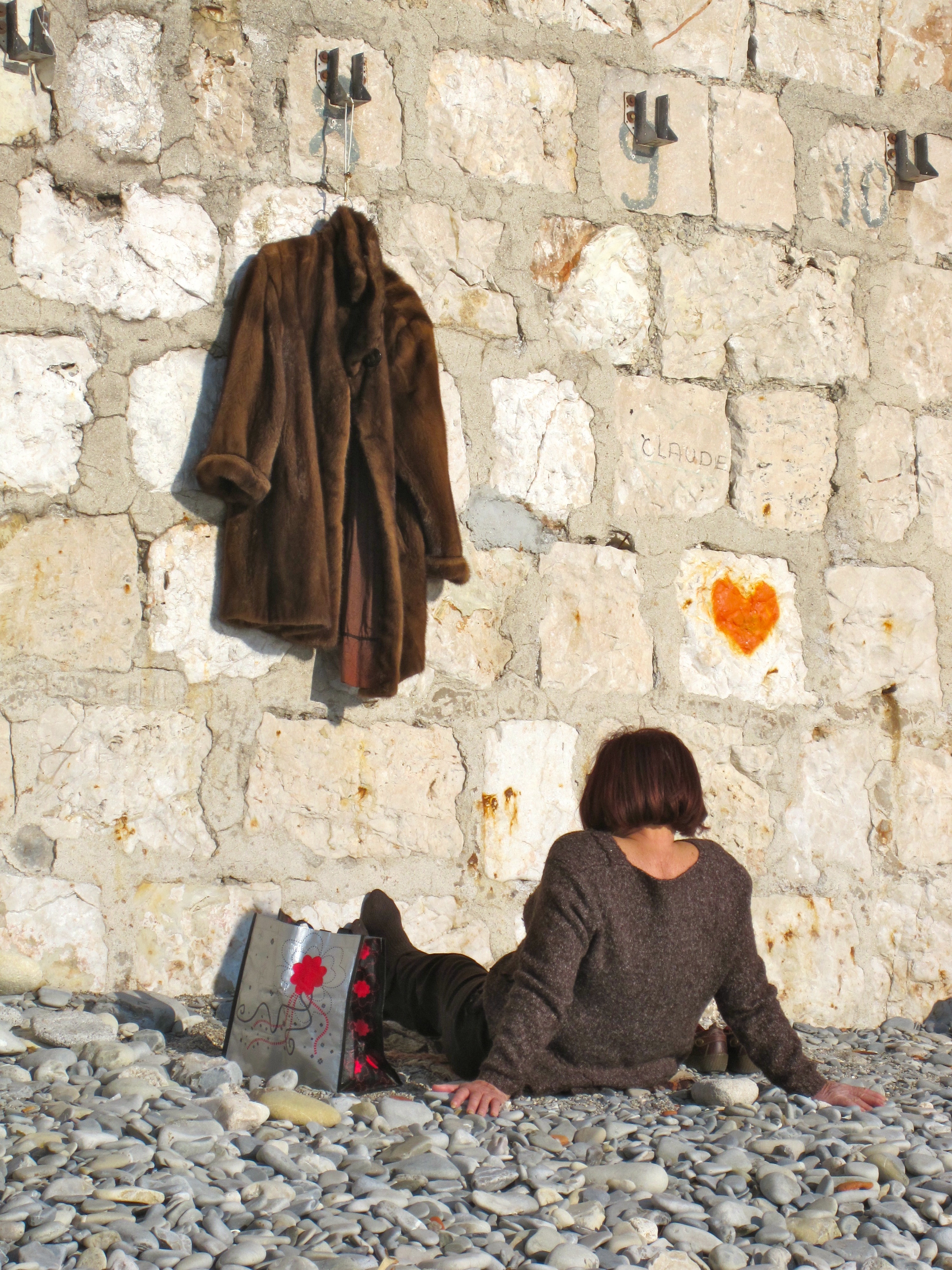
I couldn’t resist taking this photo when on Nice beach for St Valentine’s Day ’12. I don’t know the woman. She never noticed me taking the photo and my lovely wife was sunbathing further along the beach.

St Valentine’s Day was perhaps popularised by Geoffrey Chaucer in the late 14th century, though, according to this blog post, the Valentine’s Day may refer to May 3rd, the feast day of the wrong Valentine, Valentine of Genoa. Legend has it that Valentine, Bishop of Rome, was imprisoned and executed for performing weddings for soldiers (they were forbidden) and for ministering to Christians (they were persecuted). While in prison he is supposed to have healed the jailer’s daughter, and gave a letter to her on the day he was executed signed with “Your Valentine”. He is said to have given heart shapes cut from parchment to the soldiers to remind them of their loves and vows.

The heart is used as a measure for our dealings with one another. The measure isn’t beats per minute, but a blood-red thermometer with hard-heartedness being the coldest, and the soft-hearted being at the top of the human scale.

Many live with the dire consequences of hard-heartedness. There is an ancient promise for the sake of the loveless victims of hard-heartedness in which God promises a heart transplant. The people will have a change of heart when their heart of stone will be replaced by a “heart of flesh”. “A new heart I will give you, and a new spirit I will put within you; and I will remove from your body the heart of stone and give you a heart of flesh.” (Ezekiel 36:26)

Hearts of stone can never be broken. They have to be removed. The transplants don’t come with any guarantees. They are soft. They are made to be responsive to the feelings of others. They are made to be sensitive. They are made for moving. They are made for love. They are made to be broken. (There is a beautiful Blessing for the Broken-hearted by Jan Richardson)

Too many of us have been hurt, and too many of us have heeded the advice “don’t be soft”. We can become hard to know and we can be hard on others. Our responsiveness, flexibility and ability to change can be non-existent. We stop listening and we stop learning. Our cause isn’t lost in that condition. Many hearts have been changed though history by tender hearted care and by brave hearts such as Nelson Mandela. The sexualisation of Valentine’s Day may prevent us remembering all those people and moments that might have heartened us. But the extent to which we have been touched  and softened by them will affect our loveliness and our eagerness to be a true lover.

A friend who was a high school teacher was a real advocate of the “unlovely” young people. She said that they had been hardened into it, and that “they’d be lovely if they were loved”.

Secrets hidden in plain sight: accounts to treasure in the heart

20140130-105838.jpg

If I create from the heart, nearly everything works; if from the head, almost nothing.  Marc Chagall, who created the stained glass window at the Chagall Museum in Nice.

There’s counting and there is counting. There’s bean counting, and there is what counts as “ourstory”.

In an interview with UC Observer, on his book Healing the Heart of Democracy, Parker Palmer has this to say:

I once worked with a group of Episcopal churches in Texas. They were mostly small, rural churches, and collectively they felt like they were dying. Their budgets and membership had fallen off. I listened for a while, and then I said, “You know, it’s interesting to me that the only books you’re keeping have to do with dollars and numbers and members. Can you imagine another kind of book that has to do with the resourcefulness of the people in your congregations, the gifts they have to offer, the needs of the communities they serve in, and how those gifts and those needs might intersect?” I said, “You could actually do an inventory of that.”

There are accounts of measurable items, and there are accounts of wonder. The former are required reading for our “managers” and are lodged in safe places. Jobs, futures and political gain are staked by these measures which are often massaged into a healthy glow. Where is that other kind of book kept, as spoken of by Parker Palmer?

They are kept in the hearts of people. Luke rounds the story of the Annunciation with the beautiful expression, “and Mary treasured these things in her heart” (Luke 2:19). Things treasured in hearts are full of wonder, love and heart-felt story. Such stores are never emptying and never exhausted. They sustain communities and help them to thrive.

The accounts we are asked to keep of pounds, numbers and members are heartless and don’t change a thing. That is book-keeping for managers and survival. There is a different book-keeping and accountancy which takes account of gifts and needs, memories and longings. These are the accounts that are worth having. These are the accounts which give fresh heart to communities and churches. Our leaders need to treasure them in their hearts. They are “secrets hidden in plain sight”.