Author: David Herbert
My name is David Herbert. I started growing up in Leicester. I’m currently growing up in Ellesmere Port. I am a priest in the Church of England. I was ordained in Sheffield in 1974. I have been privileged to serve in communities in Sheffield (Manor and Gleadless Valley) and communities near to Chester (Ellesmere Port and Tarvin). I am a keeper of learning spaces and support continuing ministerial/professional development in the Diocese of Chester.
Ero Cras
The Antiphons are one of the cool features of Advent prayer as Christians look forward to the coming of the Kingdom of God. There are seven Antiphons. They all begin with “O”, which is then followed by a title or attribute of Christ. There is one antiphon for each day of the week from December 17th. The Christian faith is spelled out in the initials of the Latin titles in the antiphons. Each title is drawn from Isaiah’s prophecy. Here’s the list (thank you wikipedia), together with reference to Isaiah:
- December 17th: O Sapientia (O Wisdom) – Isaiah 11:2f; 28:29
- December 18th: O Adonai (O Lord) – Isaiah 11:4-5; 33:22
- December 19th: O Radix Jesse (O Root of Jesse) – Isaiah 11:1 and 10
- December 20th: O Clavis David (O Key of David) – Isaiah 22:22, 9:7 and 42:7
- December 21st: O Oriens (O Dayspring) – Isaiah 9:2
- December 22nd: O Rex Gentium (O King of the nations) – Isaiah 9:6 ; 2:4
- December 23rd: O Emmanuel (O God who is with us) – Isaiah :14
The initials read backwards from the 7th to the 1st antiphon. They spell out ERO CRAS which means “Tomorrow, I will be there.” This faith in tomorrow is borne out of the compassionate response to the realities of the present tense/tensions which are rightly seen as lamentable. Richard Beck, in an Advent meditation, describes Advent as “sort of like a lament. Advent is being the slave in Egypt, sitting with the experience of exile. Advent is about looking for God and hoping for God in a situation where God’s promises are outstanding and yet to be fulfilled.” In a world where everything is “now”, we sometimes lose patience and sight of the fact that now was never intended to be the time, when our churches were to be full, when kingdom was to come in all its fullness. Now is a time of exile, a time of alienation, a time for not being at home in the world, a time of waiting for tomorrow, a time of lament, a time for hope.
Enya captures the spirit of waiting and the hope of tomorrow as she sings the 7th of the antiphons – part of the hymn O come, O come Emmanuel .which paraphrases the seven antiphons.
You may be interested to read about the long now.
Holding hands and climbing
Exploring the habits of the heart crucial for sustaining a democracy Parker J Palmer, in Healing the Heart of Democracy, highlights this poem by Hafez, a 13th century Persian poet . The poem is called Out of a Great Need
Out
of a great need
we are holding hands
and climbing.
Not loving is a letting go.
Listen,
the terrain around here
is
far too
dangerous
for
that.
Our errors
“Our errors are surely not such awfully solemn things. In a world where we are so certain to incur them in spite of all our caution, a certain lightness of heart seems healthier than this excessive nervousness on their behalf.”
William James
The Long Now
I didn’t realise just how many ways there are of telling the time until I read Jay Griffith’s A Sideways Look at Time a few years ago. She drew attention to the way in which the clock came to tower over our lives with an oppressive power which meant that this has dominated the way of telling the time in our culture. She contrasted this with different ways time is told in cultures that have not fallen under the spell of Captain Clock. For example, she tells of the scent calendars of the Andaman Islands which uses the smell of the flowers and trees to tell the time. She demonstrates how our sense of time separated from our sense of nature. She quotes a conversation with Mateo Jicca, an Arakmbut leader in Peru who complains that “your (westernised) people are all planification and punctuality. In the cities everything has to be at the hour, punto, precise. By contrast, here in the mountains we give things time, sin limitari, without limits.”
His criticism rings alarm bells. It perhaps is true that we squeeze things into our plans, rather than giving things/people the time they need. But then there is a rush isn’t there? We only have “now”, or “just a minute”. We think that “time is running away with us” and that time is scarce as the sands of time run out on us. Why can’t “now” be longer? Why can’t we take longer? Why can’t we be more generous with our time? Refreshingly, there are those who want to give us pause for thought – seconds out.

The 10,000 Year Clock (above) is part of the Long Now Project. It challenges our obsession with immediacy. The clock is designed as a symbol for long term thinking, and is being built inside a mountain in the Sierra Diablo Mountain Range in West Texas. Danny Hillis is the clockfather. He wanted to design a clock that will keep time for 10,000 years and that:
- ticks once a year
- will generate a different chime sequence each day for 10,000 years
- where the century hand moves once every one hundred years
- and the cuckoo comes out on the millennium
Introducing the idea of the clock, Danny Hillis said:
I cannot imagine the future, but I care about it. I know I am part of a story that starts long before I can remember and continues long beyond when anyone will remember me. I sense that I am alive at a time of important change, and I feel a responsibility to make sue that the change comes out well. I plant my acorns knowing that I will never live to harvest the oaks.
The first prototype of the clock began working on December 31st 1999 in time to display the transition to the year 2000, shown as moving from 01999 to 02000 (because it’s a 10000 year clock). The chime struck twice.
The requirements for the clock include ensuring future generations can keep the clock working with nothing more advanced than Bronze Age tools, and should not contain valuable parts that can be looted. The clock is a shy clock which hides its face. The time it displays is the time asked for by the last visitor. It’s a clock that is locked away, that takes the visitor a day’s pilgrimage to reach. It’s a clock that knows that it will be overlooked in the hustle and bustle of everyday life. Stewart Brand, a founding member of the Long Now Foundation,
“Such a clock, if sufficiently impressive and well-engineered, would embody deep time for people. It should be charismatic to visit, interesting to think about, and famous enough to become iconic to the public discourse. Ideally it would do for thinking about time what the photographs of Earth from space have done for thinking about the environment. Such icons reframe the way people think.”
The photo is by piglicker.
Last Beatitude
Our celebrity culture even affects how we celebrate the saints. The phrase “all saints” often only brings to mind the celebs and heroes, rather than those who have grown in holiness in quiet and less dramatic ways.
Malcolm Guite has added a sonnet to his collection along these lines. It’s called A Last Beatitude. He suggests that the holiness of many is overlooked, even at All Saints tide.
And blessèd are the ones we overlook;
The faithful servers on the coffee rota,
The ones who hold no candle, bell or book
But keep the books and tally up the quota,
The gentle souls who come to ‘do the flowers’,
The quiet ones who organise the fete,
Church sitters who give up their weekday hours,
Doorkeepers who may open heaven’s gate.
God knows the depths that often go unspoken
Amongst the shy, the quiet, and the kind,
Or the slow healing of a heart long broken
Placing each flower so for a year’s mind.
Invisible on earth, without a voice,
In heaven their angels glory and rejoice.
You can hear Malcolm reading the sonnet by clicking A Last Beatitude
This is something to make All Saints Day. Thank you Simon for posting it.
It’s not just common sense

Horse sense is the thing a horse has which keeps it from betting on people. W C Fields
The cradle rocks above an abyss, and common sense tells us that our existence is but a brief crack of light between two eternities of darkness. Vladimir Nabokov
Ivonprefontaine has a nice phrase from his wife Kathy in a comment on my last post about telling the time when the clocks change. He refers to “uncommon common sense”, a phrase from Kathy’s farming culture. “Common sense” was a phrase I woke up with this morning. Such telepathy across the world. This stream of consciousness comes from my having to justify the value of the common sense of a group of highly intelligent people (and the knowledge and understanding that their common sensing has developed over a period of time) against inflexible bureaucratic procedures.
I grew up in a house of common sense. My questions were often answered with “it’s just common sense”. That is a frustrating answer for someone too young to understand how common sense is developed and who wants to question cultural forms.
Common sense approaches are developed from evidence that reaches beyond proscribed data bases, that are pre-conscious, sub-conscious and conscious; from our gut, our core, our thinking; from all our senses and sensing; from our relationships and our timing.
Common sense may often defy logic and challenge reason because it draws on deepest seated learning. It grows through communities of practice and cultural interactions which sometimes transform common sense out of all recognition.
I suggest that there is a common sense about common sense.
- it makes sense
- it frustrates the young
- it builds intelligence
- it represents a practical wisdom
- it networks
- it represents more than words can ever tell
- it has its own ethic which is to be always open to learning (that is what senses do: they learn and sense)
- its capacity for learning is infinite – each and every sense has mind blowing intelligence gathering capacity
- it is the culture of community and home
- it makes community wonderful.
The image is via Gail Bottomley
Extra time and the end of BST
This is a sermon prepared for some of the good people of Guilden Sutton and Plemstall for the end of British Summer Time.
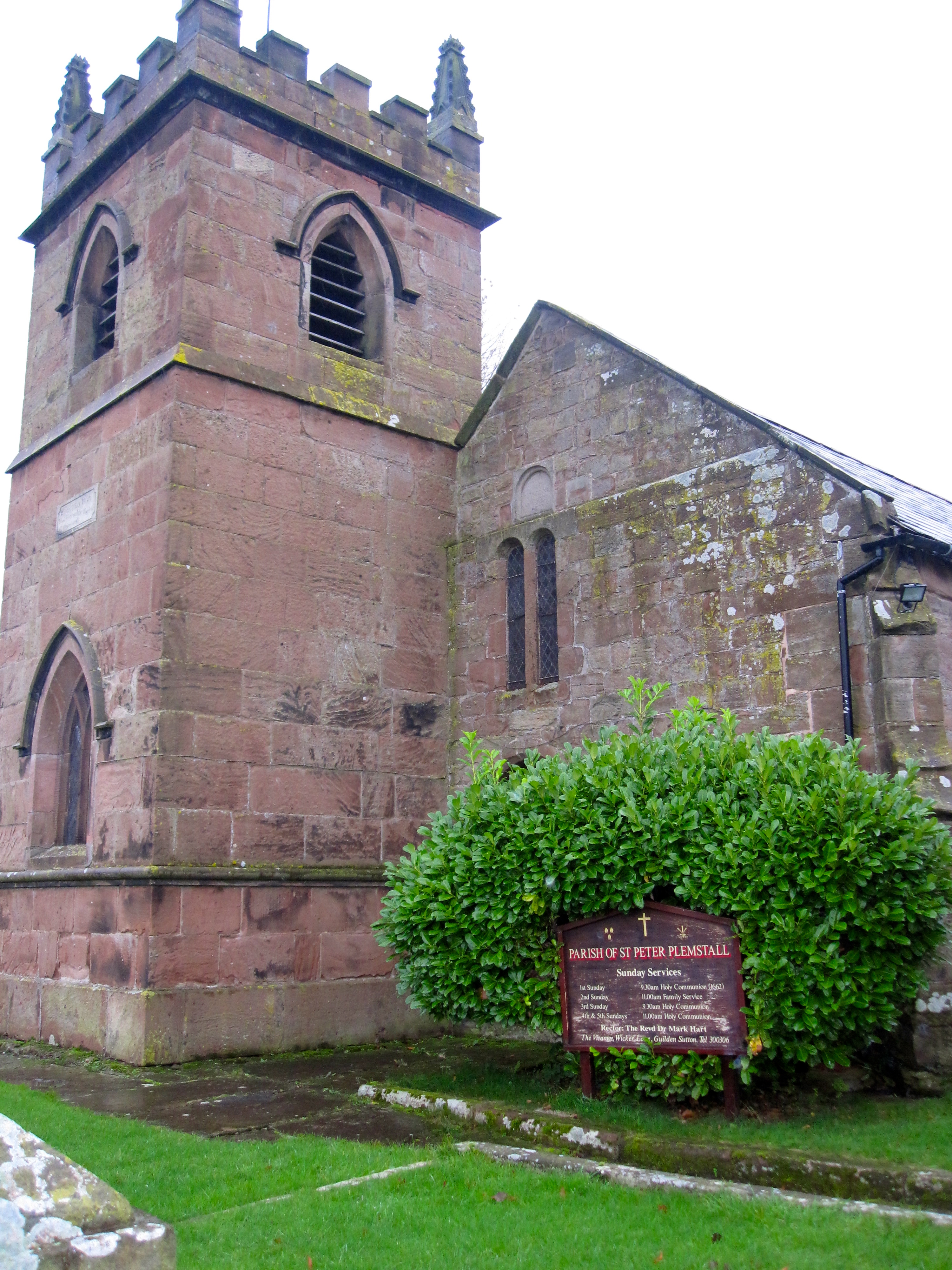
SS Simon and Jude – Sermon for October 28th 2012.
Well done for remembering to change your clocks!
The question we ask when the clocks change is “Do we gain an hour, or do we lose it?”
Well, this time, we “gain” an hour. We have an extra hour.
What have you done with it?
The same question was raised about the Leap Day earlier this year. February 29th. We got an extra “day”. Many people spotted the opportunity and planned extra events – I finished up with three competing commitments that day. One man used the day creatively. He had lost contact with his brother. He hadn’t seen him for over 30 years. He used the Leap Day as a day for the work of reconciliation.
What have you done with the extra hour?
I hope that some of you managed an extra hour of sleep – after all so many of us are suffering from having too much to do and handle. Phrases that we hear of time and time again are “work-life balance” and “time management”. We find it so difficult to manage time. We are stressed by it – I really do hope that some of you managed to get your own back on time by stealing another hour of sleep.
What do we do with time, and what does time do with us? These are questions I want to focus on.
Firstly, what does time do to us?
The short answer is that he terrifies us. Old Father Time, the Grim Reaper, terrifies us. Change and decay in all around I see.
Time is always running away with us and with our loved ones.
Time, like an ever rolling stream,
Bears all its sons away;
They fly, forgotten, as a dream
Dies at the opening day.
The clock is ticking, and we know that there is a countdown for our last chance, whether on the TV quiz show, or the science fiction that the earth is going to be destroyed, unless the superhero manages to “beat the clock”. Wasn’t there a TV programme called “Beat the Clock”?
Time stresses us out. We race against time. Time robs us of our youth, innocence and health and we are left wondering whether there is any point. Try as we like, we can’t manage time and we are left feeling that time is managing us. We are in his hands, and in his hands many are really anxious. What if, all the time, our lives count for nothing?
So, what do we make of time?
Actually, as Christians, we make a lot of Time.
In the Eucharist, in the end, through our faith, in our practice we trust that the One “who changest not” abides with us, even though it is often only change and decay that we see all around.
Our biblical myths of time confront the despair that grips so many. I have been reading a book written in the year I was born – an old book, by Rabbi Abraham Heschel. His view was that Judaism is a religion of time, aiming at the sanctification of time. That view spans both Testaments.
This holiness of time is expressed in the story of creation. Each day is a day because God says so. There is this present moment because God is present.
The work of creation did not finish after the sixth day. The work of creation goes on. Every moment is an act of creation and a new beginning. Heschel writes: “there are no two hours alike. Every hour is unique and the only one given at the moment, exclusively and endlessly precious”. This is such a contrast to the way in which time is something just to be killed by those who see no quality time, and who are simply bored by the flatline of time.
Our story of time encourages us to see every moment as significant. But our story of time also gives us the means to survive the times of our life when there is evil, violence, suffering, pain and crying. The Bible begins at Day One. It ends with the Last Day, when, in the end, there will be Shalom, and all will cry glory.
I mentioned the six days of creation. There is also the 7th day which God called holy, and which we are commanded to call holy. This is how we are called to tell the time. Observing the Sabbath is a resistance to the powers of the world, the powers that be, our business and the things that rule our lives “Monday to Friday”. It is a breathing space with strict rules for its protection. There is no work to be done (for some even flicking a switch is too much). One rule is “ye shall kindle no fire” – applied by Heschel to also not kindling the fire of righteous indignation. Sabbath observance demands great disciplines which build up through generations.
Heschel writes: “With the Sabbath comes a miracle: the soul is resurrected.” For him “the world’s survival depends on the holiness of the Sabbath”. The task is how to convert time into eternity, how to fill our time with spirit.
As Christians, we have a different story to tell. We see two different hands on the clock. The hands of Christ crucified, the hands of Jesus risen from the dead.
For us the holy day of Sabbath becomes the holy Day of Resurrection. Each week begins with holiday of the new creation by which all our days are numbered.
The discipline of people like yourselves coming together to celebrate resurrection is making something of time and resisting a tide of hopelessness. By celebrating the Day of Resurrection, by remembering all God’s works of redemption, we make something of time for ourselves and alternative calendar for the world, which can only be good news for all those who have grown tired, or bored, or who are oppressed day by day.
The Bible is more concerned with time than space. It pays attention to generations and events. We follow that tradition. Our year is full of grace as we move from one great celebration to another. This week we celebrate all the saints. Today we celebrate Saints Simon and Jude. We don’t know much about them. We know that Jude write one of the epistles, and that he is patron saint of hospitals, hospital workers, desparate situations and forgotten, impossible and lost causes.
There are many who feel desparate in their battle against Time. They feel overwhelmed and exhausted. They fear the end. They worry they are a waste of time, and feel that time has wasted them. All of us, from time to time, have shared the same despair – but we know there is another way of telling time.
That way is made through the resurrection, through faith, hope and love, and through the practice and devotion of local communities of Christians who tell the time differently – who manage time not by months and minutes, but by eternity and a love that never dies.
The last word belongs to the patron saint of desparate situations and forgotten, impossible and lost causes. In his epistle, Jude addresses people like ourselves – inclined to anxiety and desperation in the passage of time. He writes: “Dear friends, build yourselves up in your most holy faith and pray in the Holy Spirit. Keep yourselves in God’s love as you wait for the mercy of our Lord Jesus Christ to bring you to eternal life.”
All tweets great and small

“Best bagel ever this morning” (via Twitter).
That sums up a recent conversation thread I was involved with. There is a lot of chatter about the ratio of noise to significance in our social media. The criticism behind the bagel reference was there being such little significance and too much noise in that sort of conversation. That was their excuse not to tweet. (Is it their excuse not to talk, as well?) It is strange how one tweet a winter of discontent makes.
Refuseniks are missing the party. Here are some of my (not by me) top tweets. @nancyWhite collected some from the Applied Improvisation Network Conference in a post that make me wish I had been there:
- #AIN12 @brentdarnell Traditional training is a conspiracy create by sellers of 3 ring binders
- #ain12 Matt Smith: “do what you can to get into a sense of gratitude before you perform” … or teach, or host, or lead, or ….
- “You have to find people who are broken and help them heal. Laughter is my weapon of mass construction.” Genie Joseph #AIN12
Others are funny, like this from @theMiltonJones: Roman numerals to be phased out – not on my watch. (Retweeted 1467 times!)
Favourites showing when I wrote this:
- From @alaindebotton: People who want to be famous generally had parents who took the media a bit too seriously
- Again from@alaindebotton: How needlessly mean to buy only as many books as one actually has time to read
Without a tweet from @theosoc I would not have been alert to it being World Mental Health Day today, and there being a global crisis of depression affecting >350 million people. Without @first4LCFC I wouldn’t get score updates for my team.
Some tweets are profound and stimulating. They are clever. Other tweets are delivered without such pretension.
The taste of my bagel (in less than 140 characters) is not insignificant. It is a fact of life that some people do record their bagel consumption as a “status update” on Facebook. It is another fact of life that others give them their thumbs up because they care. Many do. They “like” it.
I wonder what it was like when there were other technological breakthroughs in social media. There have been famous letters. Some letters were kept, some thrown straight on the fire. But the triviality of some didn’t prevent people replying with “it was lovely to hear from you” and “please write back”.
We don’t always have something of earth shattering importance. I wonder, with the development of speech (early social media), whether Adam and Eve really did turn to each other and say “Just listen to you. All you go on about is your bagels. Can’t we talk about something more important? Just tell me, do I look big in this? And, how about this big apple?”
Conversations great and small build community and relationships. One of the reasons we go back to Patara for our holidays (maybe you’re not interested in that!) is the way everyone greets us with “gunaydin” (good morning). I would rather walk a street where people say “Hi” than walk a street where there is no expression because people think such apparently meaningless banter is beneath them. I am likely to go back to a cafe with waiting staff anxious to know whether I was pleased with their bagel.

