In-built learning dynamic of church – or not

This quote from Roger Walton about Christian education landed on my desk today. I thought it was worth sharing because it says well that the organisation, system and church of which we are members is already a learning and teaching organisation before any training courses are ever thought of. We are learning all the time. We flourish and engage if the organisation is working well, but we shy away or shrink in an organisation that is not working well at a relational level. Some estimates suggest that as much as 80% happens informally, and that only 20% occurs through formal training. Canadian researcher Allen Tough uses the idea of the iceberg as a metaphor about learning. The bit above the surface is the formal training situation in which some learning happens, but the rest is under the surface. “You just don’t see it. You could forget it’s there unless you keep reminding yourself that it’s there.”

“Stanley Hauerwas once wrote: ‘The church does not “do” religious education…..The church is a form of education.’  Because it is a group of people in relationship with God through Christ, because it tells a story about how the world is, based on the life, death and resurrection of Jesus, because it is engaged in living together as a radical new and alternative community, it has a built-in pedagogical dynamic…….
This is not an excuse for not planning or running programmes or courses…..It is important, however, to make this broader claim about Christian education before turning to specific suggestions and ideas or we may miss the most critical aspect of Christian education.  Before any Alpha course is put on, small group is formed, or Lent programme devised, Christian education is operating in a church, either attracting, forming and transforming people or leaving them untouched, unengaged or even driven away…
In its practice of gathering together for worship and ordering its life, in its people and their relationships with each other, in its simple routines for sharing bread and wine, welcoming newcomers or using its financial resources, in the quality of spirituality and its expressions of compassion, forgiveness and delight, it offers a potent learning environment.”
Roger Walton, The Reflective Disciple (2009, Epworth) pp158 – 9

Tiki Taka

One of the highlights of my week has been spending time with a group of clergy committed to developing more leaderful communities and congregations, but facing the problems of working with those who don’t see leadership as their responsibility. How do we bridge that gap?

Leadership models have focused on individuals and individualism. New models of leadership inspired by “new science” focus on process and what goes on between people (this has coincided with a renewed awareness of the interplay and community of the Trinity). Other facilitators, like Viv McWaters and Chris Corrigan talk about developing play. The result is that leadership develops as a community activity rather than a one man (often gender specific) band.

Tomorrow is Cup Final Day. Kenny Dalglish and Roberto di Matteo, managers of Liverpool and Chelsea respectively will be giving their team talks. The winning team will most likely be the team that plays better together, and that is less like a collection of interviews. As we play together, we grow together. As we play together, we take more risks together. Chris Corrigan picks up the theme of football teamwork when he refers to a style of play called Tiki Taka:

A style of play characterised by short passing and movement, working the ball through various channels, and maintaining possession.” With Tiki Taka the ball is continuously passed between team members in a way that the whole team operates as one intelligent field, rather than sum total of talented individuals.

Is that it? Do we need a rich passage of interplay to become a successful team? Is it the short passes, working the channels, the give and go which turns an unresponsive group of individuals into one intelligent field and a leaderful organisation.

If you liked this post, you may also like this recent post: https://davidherbert.me/2012/05/03/leadership-lessons/

Clocking Hugo

On the one hand there are clocks like this.

On the second hand there are clocks like this – click on it. It’s worth it.

Clocks and clockmakers have featured as metaphors in theological understandings down the centuries. Hugo is a lovely film based on the book by Brian Selznick which gets the metaphor of the clock ticking again. 12 year old Hugo Cabret lives in the huge clock at the Gare du Nord in Paris. Clocks are the family business. His father was a clockmaker, his inebriated uncle is the clockkeeper at the Paris station.
A present from my ValentineHugo is fascinated by the workings of the clock and how the parts all fit together. He knows that there are never any spare parts, so anything left over has to fit somewhere, and has a vital part to play in working the clock. (Flatpack furniture is packed along similar lines – it’s a sign that the assembly has gone wrong if there is anything left over).
Not only does Hugo apply this principle to the art of clockmaking, he also applies it to people. Georges Méliès was a pioneering film maker who found his skills not wanted as technology moved on. His life disintegrated and Hugo helps put George’s life together again – working like clockwork.
What if there are no spare parts? What if every part of our biodiversified universe has its part to play? What if nothing or no-one is redundant? While our human drives are shaped by the principles of the “survival of the fitting” our organisational thinking should be challenged by working out the role of the square peg, and not just the round peg for the round hole. Neither round pegs or square pegs are spare parts.There are no misfits. Even the orphan in his secret hideaway in the clock tower is no misfit, but has his vital part to play.


Nothing but an idea

Any organisation … is nothing but an idea. All institutions are no more than a mental construct to which people are drawn in pursuit of common purpose; a conceptual embodiment of a very old, very powerful idea called community. All organisations can be no more than the moving force of the mind, heart and spirit of people, without which all assets are just so much inert mineral, chemical, or vegetable matter, by the law of entropy steadily decaying to a stable state.

Dee Hock, 1999. Birth of the chaordic age, p.119

learning organisations

learning organisations are “organizations where people continually expand their capacity to create the results they truly desire, where new and expansive patterns of thinking are nurtured, where collective aspiration is set free, and where people are continually learning to learn together.” (Senge, 1990, p.3). 
Senge, P.M.    1990    The Fifth Discipline     London: Century Business

>Dog nose

>Dog nose macro close up

With ears pricked and nose to the ground, dogs create a mental map which we can never know. Dee Hock asks the question: “how many ways of knowing are there which escape human perception?” His probing of organisation is spurred on by such considerations – together with the awareness that institutional failure will continue to escalate, and the prediction of social carnage and the development of even more dictatorial institutions in response to that carnage.

Organisations, organisers, institutions would benefit from following the dog’s nose, in realising that there are many ways of knowing, that progress isn’t along straight lines. Scratch beneath life’s surface and we see a totally different reality which defies the truths of our mechanistic planning. We know in our heart of hearts that “life isn’t that simple” and we become more intolerant of institutions and responses that pretend that it is. Hock writes (after he scratches the forest debris under his do’s nose):

Billions upon billions of self-organising interactions are occurring second by second in the square yard of soil, each inter-connecing, relating, creating,and shaping self and others. Every particle is inseparable interacting and relating to others, and they still to others, unto the remote reaches of the universe and beyond – beyond knowing – but not beyond awareness, respect and love. The mystery of it all is overwhelmingly beautiful. Birth of the Chaordic Age. page 288.

>ticklicious

>

Ken Dodd

We took my disabled mother in law to see Ken Dodd at Parr Hall, Warrington a few weeks ago – thank you Warrington for the parking ticket. Ken Dodd is still wielding his tickling stick aged 83. On this occasion his concert ended at 1.00 in the morning – perhaps rather insensitive given the age and circumstances of his audience. He still has the ability to make people laugh – we should always give thanks for people who can make others laugh, even if, by  now, the joke “have you ever had a tickle, missus” is wearing extremely thin.

His tickling stick reminds me of Dee Hock’s maxim:

You can’t tickle yourself. It’s a social act.

So, who’s tickling me today? I think it haas to be Hock’s reflection on his efforts to develop a new sort of organisation (from the same page as his maxim – p284: Birth of the Chaordic Age):

In the darkest times, and there were many, I could never look out at so many wonderful people and engage with them in laughter and give and take without walking from the room filled with wonder at the human spirit. They could do anything! Anything! And so can everyone, everywhere, if our minds are open enough, and our spirits strong enough to conceive of institutions that enable us to do so.

I’m not giggly, but giddy with that. It’s very ticklicious.

>a story worth telling

>

I was in tears re-reading Dee Hock’s account of the efforts to create an international banking organisation now known as VISA. His own passionate commitment had helped to take the process so far, but then an impasse was reached when certain people were not felt to be operating contructively and openly. It looked like the effort was going to end in failure. At that point Hock reflected about what had helped “such a complex, diverse group over insurmountable obstacles”. It was that “at critical moments, all participants had felt compelled to succeed. And at those same moments, all had been willing to compromise.”

In the teeth of failure a plan was hatched.  A fine jeweller was asked to create a set of cufflinks for each member of the organising committee. On one half of the committee was inscribed, in Latin, “the will to succeed” set around half of the earth. The other half of the cufflink was inscribed “the will to succeed” set around the other half of the earth. The cuff links were presented at a slap up meal on the final evening of the conference which seemed to be heading for failure. Here’s what Dee Hock said to them:

“We wanted to give you something that you could keep for the remainder of your life as a reminder of this day.” He then explains the gift, saying “We meet tomorrow for the final time to disband the effort after an arduous two years. There is no possibility of agreement. As organising agent, we have one last request. Will you please wear your cufflinks to the meeting in the morning? When we part, each of us will take them with us as a reminder for the remainder of our lives that the world can never be united through us because we lack the will to succeed and the grace to compromise. But, if by some miracle, our differences dissolve before morning, this gift will remind us to the day we die that the world was united because we had the will to succeed and the grace to compromise.”

There was silence which was shattered by one member exclaiming “You miserable b…….!” at which the room dissolved in laughter. Members did arrive to the morning’s meeting wearing their cufflinks. Within one hour agreement was reached on every issue – and a few months later the international organisation (which was to become VISA International) came into being.

chitter-chatter

>

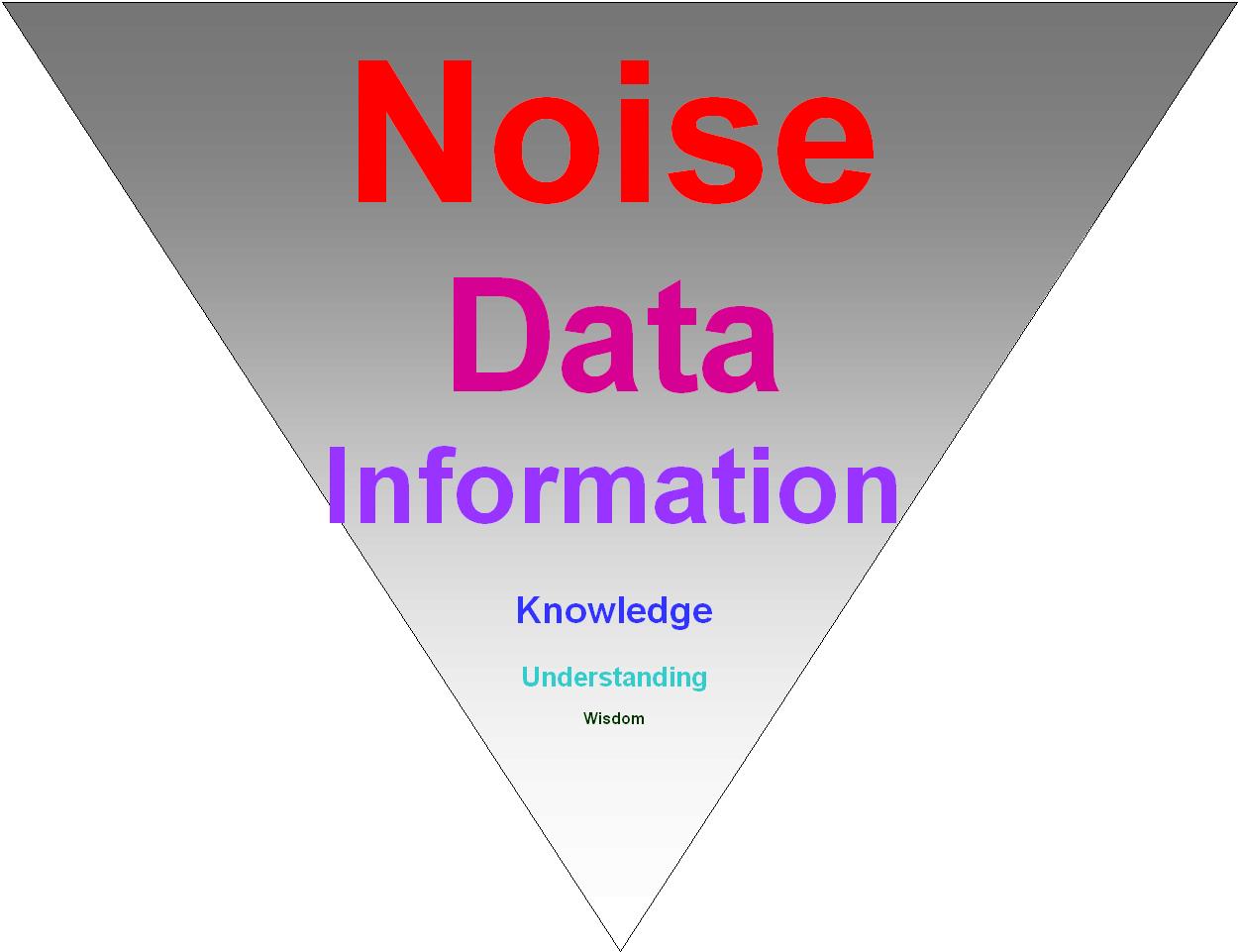
This diagram describes the ratio of noise to wisdom and the descending volume and value from noise to wisdom. According to Dee Hock “Noise becomes data when it transcends the purely sensual and has cognititve pattern.
Data becomes information when it can be related to other information in a way that adds meaning.
Information becomes knowledge when it is integrated with other information in a form useful for deciding, acting or composing new knowledge.
Knowledge becomes understanding when related to tother knowledge in a manner useful in conceiving, anticipating, evaluating and judging.
Understanding becomes wisdom when informed by purpose, ethics, principle, memory of the past, and projection into the future.” 

At one end of the spectrum, data is increasingly abundant, whereas wisdom (which is “holistic, subjective, spiritual, conceptual, creative”) seems to becoming scarcer.
 
We watched Lark Rise to Candleford last night. Based on life in bygone Buckingham (Candleford) and Juniper Hill (Lark Rise) the series reflects a time when there seems to have been a far higher ratio of understanding and wisdom to data and information. Wise counsel seems to have been part of being in settled communities slowly facing up to change. The wisdom is captured in the winning entry to last night’s poetry competition:
 
     As I went on my way,
     Gossamer threads span from bush to bush like barricades,
     As I broke through one after another
     I was taken by a childish fear
     They are trying to bind and keep me here
     But as I grew from girl to woman, I knew
     The threads that bind me were more enduring than gossamer.
     They were spun of kinship and love
     Given so freely that it could never be taken away from me. 
 
They were the days before the coming of the railway – a back story of Lark Rise. The coming of the railway meant increased communication, which meant more noise, which meant more data, which meant more information – and before we know it, we are too tired and overwhelmed to process it any further. Now we contemplate rail journeys of  only two hours from London to Glasgow – though wisdom may have gone out the window.
 
I am in the process of exploring the world of Facebook and Twitter. I now have the knowhow – now I am looking for the understanding and the wisdom to discern how to use it. Though there is a lot of noise and chatter going on I think I can now see a point to Twitter – I travel slowly! So I have changed my profile to “Cascading Insight – a dealership in second hand views” – and I am thankful for the tweets of others which have pointed me in the direction of understanding and wisdom. I will not be tweeting about my moods, where I am, and what time I’ve gone to bed. That is definitely too much information and just adds to the volume of noise we haven’t got a hope in hell of managing.