Jesus also said, ‘The kingdom of God is as if someone would scatter seed on the ground, and would sleep and rise night and day, and the seed would sprout and grow, he does not know how. The earth produces of itself, first the stalk, then the head, then the full grain in the head. But when the grain is ripe, at once he goes in with his sickle, because the harvest has come.’
He also said, ‘With what can we compare the kingdom of God, or what parable will we use for it? It is like a mustard seed, which, when sown upon the ground, is the smallest of all the seeds on earth; yet when it is sown it grows up and becomes the greatest of all shrubs, and puts forth large branches, so that the birds of the air can make nests in its shade.’
Jesus said: “In my house there are many rooms” (John 14:2). That is a mark of his hospitality. It’s the sort of thing that any good host will say to his/her guest. “We’ve got loads of room. We can easily make up a bed.” Good hosts say these things because they want their guests to feel at home – they want their guests to stay with them – they look forward to their company.
As Christians we love what Jesus said. We draw strength from the generous hospitality which says “In my house there are many rooms” – we want to dwell in that house where there is so much room and where there are so many openings.
Today’s Easter gospel is set in one room in which there are an abundance of openings – too many for us to get our heads round.
There’s
The opening of the door
The opening of Jesus’ mouth
The opening of Jesus’ hands and side
Each of them begs for an opening up of ourselves.
In Jesus there is so much opportunity for openings and the resurrection begs of us a reformed hospitality within ourselves. An RSVP is called for from each of us.
A little about each of the openings – the openings could well be a whole sermon series – but today a little on each.
Opening the door
The opening of the door – the disciples had locked themselves in because they were afraid. And Jesus stands amongst them. How did that happen? The open door is a powerful Christian image because of this resurrection appearance.
I have fought a couple of battles in parish ministry. One was about church keys (and who should hold them) and the other was about trying to keep the church open. Like the disciples in today’s gospel the two churches were afraid – they wanted to lock themselves in because they were afraid of their communities.
I don’t know whether you keep this church open. I hope you do. And if you don’t, I hope that you give it some thought allowing Jesus’ words to those first disciples to ring in your ears. “Do not be afraid.” Just imagine the signage – “this church is open” (and all the ambiguity of such a sign!)
There are many metaphorical rooms that we retreat to – in fear, in shame. This gospel story is told time and again to encourage us to open up, to not be so afraid, to not be so ashamed – to let the spaces we move in reverberate to the sound of Jesus’ words.
RSVP
And that takes us to another opening.
Opening his mouth
Jesus’s opening words were “Peace be with you” . Three times in this short passage Jesus greets the disciples with “Peace be with you”. To his anxious and frightened friends he says “peace be with you”. We repeat those words in our greetings in the Peace. “The peace of the Lord be always with you”. (Always try to exchange the peace with at least three people to remember this Easter exchange that we celebrate this morning).
John doesn’t just say that Jesus spoke to his friends. He also tells us that he breathed on them. When he breathed on them they received the Holy Spirit. “The Lord is here. His Spirit is with us.”
Some ancient liturgies included a mouth to mouth kiss as part of the Peace to pass the breath of the Spirit, the breath of the post-resurrection meeting room – a recall of the intimacy of that meeting with the risen Jesus. (See here.)
And what does that make of our hospitality?
RSVP
The third opening is that demanded by Thomas, doubting Thomas, Thomas the scientist who wouldn’t believe without seeing the evidence. Thomas said “I won’t believe until I see the mark of the nails in his hands, put my finger in the mark of the nails, and my hand in his side.” And Jesus showed Thomas the nail wounds in his hands, and the spear wound in his side.
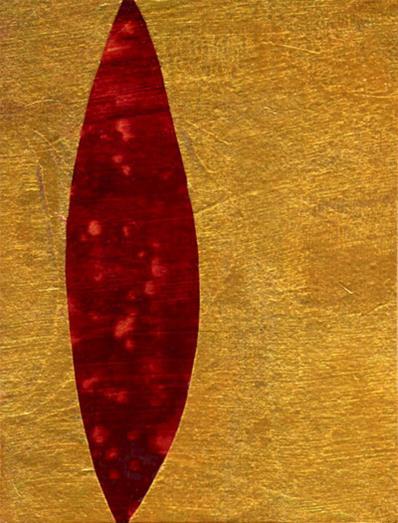
I have copied a picture of the wounded side (pictured above) by Jan Richardson from her Painted Prayerbook. It is called “Into the Wound” and I offer it as an invitation for your prayer and wonder. I see it as a tear, as an opening, as a doorway.
Medieval artists gave great attention to Jesus’ wounds. They were often the subject of their art. Such attention for us seems gruesome – but we might be missing an opening.
Eamon Duffy, writing in 15th/16th century England: “the wounds of Christ are the sufferings of the poor, the outcast, and the unfortunate” – according to which acts of charity (foodbanks, nursing, hospitality) become a tending of the living, wounded, corporate body of Christ.
The wound is on his side. Maybe those of us who are on his side can see our own wounds in the wound of Jesus (the ones we’ve inflicted and the ones inflicted on us). Is there an invitation on this door? Is Jesus inviting Thomas, the disciples and all those on his side into the wound, to feel around the space, to know the love, to know the other side?
And is there a reciprocal arrangement, whereby we don’t hide our wounds but invite others into our hurting world so that we might find wholeness and healing? Jesus stands at the door and knocks. If his wound is our way into him, are our wounds his doorway to us?
“In wearing his wounds—even in his resurrection—he confronts us with our own and calls us to move through them into new life.
The crucified Christ challenges us to discern how our wounds will serve as doorways that lead us through our own pain and into a deeper relationship with the wounded world and with the Christ who is about the business of resurrection, for whom the wounds did not have the final word.
As Thomas reaches toward Christ, as he places his hand within the wound that Christ still bears, he is not merely grasping for concrete proof of the resurrection. He is entering into the very mystery of Christ, crossing into a new world that even now he can hardly see yet dares to move toward with the courage he has previously displayed.”
Thomas’s RSVP was “My Lord and my God” – his mind blown open, he believed.
Belief in resurrection is often thought of as a rational process. That is how Thomas approached it. But belief isn’t only about our heads. Belief isn’t a rational response but an emotional one. Belief comes from the German word which gives us beloved. “Belief” is “belove” – a believing disciple is a beloving and beloved disciple. When Thomas believes he doesn’t just open his mind, he opens his mouth (as RSVP), his heart and his very gut where all our anxiety and fear find their home.
Jesus opens the room, he opens his mouth, he opens his wounds. We are invited through these open doorways, into a new life that without this gospel would be unimaginable.
Please RSVP.
The image Into the Wound is copyrighted to Jan Richardson and is used with permission – www.janrichardson.com
According to Hebrew Word Meaningspalal has at its root the word “fall”: “The word palal literally means to “fall down to the ground in the presence of one in authority pleading a cause””.
Kenneth Bailey (in Jesus through Middle Eastern Eyes) doesn’t quite make the connection between the Greek word for meek and prayer. In discussing the Beatitudes he does point out the word prays (praïs)as the Greek translation of “meek”. So, is this where the word “pray” comes from? Or, put it another way, do the words of prayer come from the meek, the prays? Are they the pray-ers whose prayers and praise are acceptable to God?
The meek, the prays, are, according to Jesus, the poor and humble, the little ones, and they will inherit the earth. The pray-ers will be answered. “Blessed are the meek, for they shall inherit the land.” (Matthew 5:5)
The term meek comes from one of the psalms (Psalm 37:11) where it shows its meaning as “slow to anger” and “gentle with others”. For Aristotle, virtue lies between two extremes. In his Nicomachean Ethics, according to Bailey, “The one who is truly prays (meek) is the one who becomes angry on the right grounds against the right person at the right moment and for the right length of time”.
Is that what prayers do? Is that what prayers are? Is that how prayers are? Is that where prayers come from?
Today is the International Day of Happiness, a day dedicated to happiness by the United Nations. The International Day of Happiness website makes the point that our “happiness is part of something bigger”, wanting me “to create more happiness in the world around me”, “to connect”, “to help make the world a more connected place by sharing something positive with others”. My contribution to that is to share the brilliant TED talk by Martin Seligman on “positive psychology”.
Happiness is something to aim at, but the selfish pursuit of happiness will be self-defeating and will thwart personal happiness. My guess is that the UN intention is that we should be concerned for everyone else’s happiness – and that we should make that our business. The General Assembly passed this resolution on June 28th 2012:
Conscious that the pursuit of happiness is a fundamental human goal,[…] Recognizing also the need for a more inclusive, equitable and balanced approach to economic growth that promotes sustainable development, poverty eradication, happiness and the well-being of all peoples, Decides to proclaim 20 March the International Day of Happiness, Invites all Member States, organizations of the United Nations system and other international and regional organizations, as well as civil society, including non-governmental organizations and individuals, to observe the International Day of Happiness in an appropriate manner, including through education and public awareness-raising activities
Many people have written about happiness and how we find it. Christopher Jameson, Abbot of Worth Abbey and author of Finding Happiness, finds happiness in the way of life based on the Rule of Benedict. He writes:
All too often, happiness is narrowed down to mean feeling good. There is of course nothing wrong with feeling good but such a narrow definition leaves little room for the delight of virtue and the joy of grace. To find happiness, we need to broaden our definition so that feeling good is put into the wider context of doing good and knowing good.
Where do we find happiness? Viktor Frankl was a leading psychiatrist in Vienna, working at the Rothschild Hospital. There he risked his life and career by falsely diagnosing those who were mentally ill so that they would not be euthanized by the Nazis. He had a visa to move with his new wife to America, but, by then in 1941, the Nazis had already started rounding up the Jews to take them to concentration camps. The focus was on the elderly and Frankl knew that it wouldn’t be long before his parents would be taken away. He had to decide between a new (and “happy”) life in America, or staying to be with his parents so that he could help them adjust to the trauma of camp life. He decided to stay. He survived the camps and found there much that confirmed his theories of meaning in life (logotherapy). He wrote Man’s Search for Meaning. He describes his work in the camps as a continuation of his work in Vienna, working, for example to establish suicide prevention centres for young people. It was all about helping people to find meaning in their lives, helping them to discover what they wanted to live for. For Frankl, happiness ensues – it comes after meaning.
What sets people apart is the pursuit of meaning. Happiness without meaning is shallow, selfish and short-lived because it depends on “happinings” (I just noticed the “pinings” in that word). I think this is what the United Nations intend: that we find happiness through (in the words of Christopher Jameson) “knowing good” and “doing good”. To underline that the UN Foundation and Pharrell Williams are inviting people to sign the Live Earth Petition to persuade world leaders to commit to tackling climate change.
Happiness is blessing. It is the subject of Jesus’ sermon in Matthew 5. For Jesus there is no happiness without meaning. Happiness is life giving, not life-taking. He begins many phrases with the words “you are blessed when ….. you’re poor in spirit, when you mourn, when you’re meek, when you hunger and thirst for righteousness, when you’re merciful, when you’re a peacemaker ….”
PS There is a rare clip from 1972 of Viktor Frankl delivering a powerful message about the the search for meaning.
On top of the World Trade Centre: how high can you go without falling down?
Well. Top of the morning to you.
Ever hear that expression? An Irish greeting – “top of the morning to you”, meaning “the best of the morning to you” – for which the response is “and the rest of the day to you”.
It’s a bit like our responses, “Peace be with you”, “and also with you”.
So “top of the morning to you” …………………
It’s a greeting of energy isn’t it – someone who’s got up at 5.30 and stolen a march on everyone else. “The top of the morning to you”. It’s the greeting of someone who is full of beans, feeling “on top of the world”: “On top of the world” as opposed to being “under the weather”.
I have a theory that we usually only ever see people who are “on top of the world”. People who are “under the weather” keep themselves to themselves in a self-imposed hiding, unless the weather they’re under is “fine”.
“How are you today?” “I’m fine thanks.”
But we see very few people who are really under the weather – those with depression, those who are drowning are hidden.
We are in a time of discipline. This is Lent when our consciousness of temptation is heightened and we are more likely to respond to the call to resist.
There are a number of temptations for those who feel “on top of the world”. Those “on top of the world” can be so annoying. “Cocky” is the word we’ll often use – the cock, who really is “top of the morning to you”.
Jesus had this temptation when he felt “on top of the world”. Do you remember the story (Luke 4:9-12)?
The devil had Jesus stand on the highest point of the temple and said “if you are the Son of God, throw yourself down from here”. He said “you’ll be all right because God will send his angels to make sure you don’t get hurt.”
Here is the temptation to be wonder-full, the temptation to be Mr High and Mighty, the temptation to be Mr Big. It’s a temptation that takes place on the pinnacle of the temple – on the height of religious experience and achievement. Many people stand at that same spot, on top of the world, on to the height of religious experience and achievement … and they think they’re wonderful, proud that they’ve got there, looking down on others, judging and despising.
I work at Church House. We have staff prayers on Mondays. The person leading those prayers asked us to have some moments of quietness to reflect on how we were doing in Lent, where we were up to in our Lenten discipline. This came as a bit of a shock to me because at that stage, 5 days into Lent, I hadn’t got round to thinking about my Lent.
I had read a reflection that morning on Jesus’ 3rd temptation. That made my decision for me for this Lent – to be disciplined to keep my feet on the ground, to count the blessings of being down to earth, to appreciate the lowly, and to remember who I am when, as sometimes happens, I am lured on to high ground. The question, the very real question for me (and for all of us) is how we behave when we are on high ground, when we are on the moral high ground, when we are on top of the world, how do we behave?
I was reminded of a story by G K Chesterton about a curate who had taken to praying, “not on the common floor with his fellow men, but on the dizzying heights of its spires”. Father Brown goes up to rescue him. He says: “I think there is something rather dangerous about standing on these high places even to pray. Heights were made to be looked at, not to be looked from.”
He tells the curate: “I knew a man who began by worshipping with others before the altar, but who grew fond of high and lonely places to pray from, corners or niches in the belfry or the spire. And once in one of those dizzy places, where the whole world seemed to turn under him like a wheel, his brain turned also, and he fancied he was God. So that, though he was a good man, he committed a great crime. He thought it was given to him to judge the world and strike down the sinner. He would never have had such a thought if he had been kneeling with other men upon a floor.”
You may ask what all this has to do with today’s readings. Paul (1 Cor 1:18-25) asked the Christians at Corinth to consider their own calling. He tells them “not many of you were wise by human standards, not many were powerful, not many were of noble birth. But God chose what is foolish in the world to shame the strong”.
The problems that Paul was addressing in his letter to the Corinthians are outlined in the same chapter. The Corinthian church is a divided community, torn apart by quarrels and people taking sides with Paul, Apollos or Cephas.
Paul’s response is that no one should boast about human leaders (3:21). He tells them that he came to them in weakness, in fear and trembling. “My speech and my proclamation were not with plausible words of wisdom, but with a demonstration of the Spirit and of power, so that your faith might rest not on human wisdom but on the power of God.” (2:4)
So when we’re feeling “top of the world”, on top of our game, doing well, think again. That feeling is the doorway of temptation. God chose what is foolish in the world to shame the strong. How will you stand when you’re on top of the world? How will you behave? Will you resist the temptation to look good?
A Baptist minister talks about the robe that he puts on every Sunday. He says that it stands for his professional expertise and training. But he also says that it signals that “we’re all fools for Christ”. He says “I think of myself as a kind of court jester and freelancer in life.” He says that he is always wondering, wondering about God. He is an expert who knows his foolishness and his limits. This makes him a good facilitator of community and friendship.
What are we like? Whether we spend a lot of our time on the high ground, in high places, along corridors of power; or whether we are occasional visitors, what are we like? What do we do? How do we behave?
Do we remember our calling, to be salt of the earth, a calling of the foolish to shame the wise, a calling of the weak to shame the strong?
Do we remain down to earth, with feet on the ground? Or do we pride ourselves on our position?
Do we remain full of wonder? Or do our ways shout to those beneath us, “look at me, how wonderful I am”?
Oh, the temptations of high places and of doing well.
References:
Malcolm Guite. 2015. Word in the Wilderness: 3rd Temptation https://malcolmguite.wordpress.com/tag/temptation/
Celia Allison Hahn. 1994. Growing in Authority, Relinquishing Control. The Alban Institute.
All moments, past, present and future, always have existed, always will exist… It is just an illusion we have here on Earth that one moment follows another one, like beads on a string, and that once a moment is gone it is gone forever.
– Kurt Vonnegut, Slaughterhouse 5
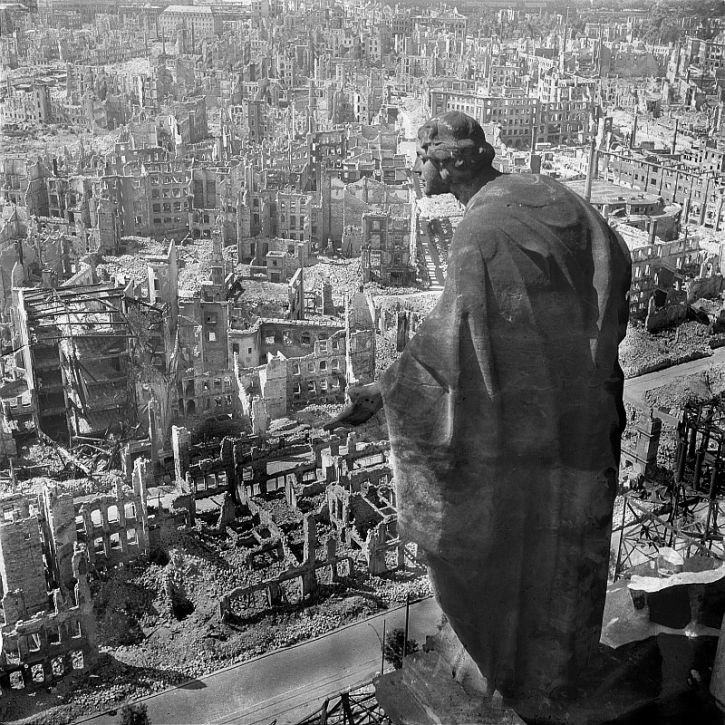
In Dresden on 13 February, they commemorated the 70th anniversary of the RAF air raid that reduced the city to rubble. The RAF attack – carried out by 800 bombers on a cloudless night – was the most destructive raid of the second world war. In the firestorm that was unleashed around 25,000 people, mainly civilians, were killed in a few hours. It remains by far the most controversial British wartime act.
The horror of that night is almost over now. The ruined buildings and the mounds of roasted bodies and blackened skeletons exist in the memories of those who survived, but they…
Itay Talgam uses the faces of conductors to talk through different leadership styles. On one extreme is the face of Riccardo Muti. He is shown as very commanding and competent. He has the expression of one who is responsible for Mozart. He wants the music to be played his way, the proper way. As competent as he was, 700 music employees of La Scala wrote to him (2005) asking him to resign because, they felt, he was using them as instruments.
Talgam uses the expressions of Herbert von Karajan, Leonard Bernstein and Carlos Kleiber to explore other ways of leading without commanding. In those expressions there is the encouragement for the orchestra to exercise their own responsibility, to express themselves, to add interpretation, to become storytellers themselves. They are expressions that energise their fellow professionals. Kleiber is shown as rejoicing in the play, joining with the orchestra in spreading happiness. Great conductors and leaders are playmakers. Just watch from 19:27 to see leaderful joy.
This happy and blessed state is the product of hard work. There are hours of meticulous practice as the music gets under the skin of the musicians. They are led and lead each other to this ecstasy through the practice of the community, by listening to one another, by responding to each other, by loving each other. They all know their place in the social system and play their responsible part in it, with their abilities, goals and wills, according to the boundaries of the organisation. It’s hard work that works magic.
Conducting has often been used as a metaphor for leadership. The metaphor raises the importance of listening and negotiating the parts we want to play, the level which we want to work together and practice together. It shows the possibilities of engagement and empowerment which dissolves organisational boundaries as play pleases, drawing others in pleasure.
Gaby Hinsliff has suggested that the newly appointed chair of the inquiry into historic child abuse looks at Louise Casey’s inspection report on the Rotherham child abuse scandal. Louise Casey points out the failings of council, police, childrens’ services suggesting that people and agencies were far more concerned about their reputations than about the victims. For Hinsliff the tragedy in Rotherham was made possible by the most ordinary of things. By this, she means that it is ordinary organisation that makes for such tragedies: “Ordinary people, doing ordinary jobs, ordinarily badly”. She writes, “what leaps out from the report isn’t the influence of politics with a big P so much as office politics; all the surprisingly humdrum, niggling things about status and hierarchy and process that determine who counts in an organisation and who is heard.”
The Rotherham Council who presided over the whole very sorry affair have been accused of being over-sensitive in a politically correct sort of way. They were, in fact, not sensitive enough. They were dismissive of uncomfortable truth and bullied disagreeable voices into silence and hundreds of girls and families have suffered as result of these ordinary people doing ordinary jobs ordinarily badly.
But how far are we from Rotherham? Uncomfortable truth and disagreeable voices are hard to hear and easy to ignore. We like the sound of our own voice, and we like the ones who are like us and form them into our company. So, how far removed is our ordinary organising (intrapersonal and interpersonal) from the folly of Rotherham?
Louise Carey’s report focusses on Rotherham, but is more than Rotherham. It’s about all ordinary organisation that doesn’t listen to the “wrong” people and that is insensitive to the plight of the wronged people. It’s about government, institutional life, the office, family and my own self-ish ways. It’s about intentional and unintentional victims and how we listen to them and how we listen to each other.
The church also, and perhaps particularly, is not a million miles from Rotherham in doing an ordinarily bad job of not listening to uncomfortable truth and allowing abuse to flourish unchecked. Pope Francis, in his exhortation The Joy of the Gospel (just reading)is conscious of this background. He encourages a better sort of organisation in which the right and wronged people are heard, in which the poor are the evangelisers and in which the church and pastoral workers continue to be evangelised and changed. He yearns for a a church which is poor (not so bothered by its own reputation?) and for the poor (198) and he begs the Lord “to grant us more politicians who are genuinely disturbed by the state of society, the people, the lives of the poor”. Hinsliff’s appeal rings the same bells: “all institutions need faintly oddball, stubborn, counter-cultural people who may well be irritating to work with but ask the questions others don’t.”
Rotherham is our own backyard. Rotherham is in our mind. Rotherham is only extraordinary in the scale of its terrible consequences. A lot of our organisation is ordinarily bad, lacking sensitivity, intelligence and curiosity.
What do clergy do? Well, the joke goes that they work on Sundays. And they joke when someone thoughtlessly asks “what are you doing for Christmas”. Whatever they do puts clergy on top of the pile when it comes to job satisfaction.
What do clergy do, especially when it looks like nothing? That’s the title of an excellent book on ministry by Emma Percy that leaves the impression that clergy should actually find it difficult to answer the question, “what do clergy do?” It’s a reminder, for Emma, of what many mothers ask at the end of a busy day – “What have I done all day?” They don’t see the answer themselves. In fact, they have done a lot but it feels like nothing.
What does a doula do? That was a man question on Radio 5 yesterday as Nicky Campbell asked a doula from Somerset what she did. She found it difficult to answer. She tried. “A doula does a whole range of things”, she said. “She is just there”, she said. She is there for the family, helping women to have the birth they want. I got the impression that a doula can’t narrow their job to one thing, or the other, or the many – but only the every thing that is needed. And Nicky Campbell asked, “what does a doula do in the birthing room?” “Well” she said. “Sometimes I do nothing, or knit and drink tea, sometimes I give massage for 15 hours at a time – whatever is needed.”
And that is what a doula does. And that is what a minister does. And that is what anyone does who respects the life-giving power of another. Here’s how another doula explains that a doula is “somebody on the journey who will be there for you no matter what”. “Rather Christ-like” is what I have to say, and, rather overwhelmed with the obsession with leadership talk as I am, I’d also want to say that it’s a view of ministry in which leadership talk is laid to rest in wisdom and helpfulness.
The word “doula” originates in the ancient Greek word δούλη which is the feminine form of “slave”. The doula is non-technical, non-medical – her only qualification is her experience as a woman and her willingness to share her practical wisdom.
Shiphrah (her name means “brightness”) and Puah (her name means “splendid”) are outstanding women who get a mention in Exodus 1:15-20. They are really doulas, although they are known as midwives who trick the Pharoah and resist his final solution to the Hebrew problem. He ordered them to kill the boy babies but Shiphrah and Puah have a reverence for life and carry on their work of bringing life into the world. They show themselves as wise women and they show the Pharoah up as totally stupid. Ackerman writes that rather than cower before the most powerful man on earth they “defend themselves with straight faces against Pharoah’s charge of insubordination. Their lives are at stake, and yet their sly comparison between the vigorous Hebrew women and the pampered Egyptians comes through as totally credible to the ‘wise’ king: ‘Oh yes, of course, that would be a problem, wouldn’t it?’ There is a great relish in this uneven conflict between the effete elite and the crude, but shrewd, vital, and resourceful, oppressed. The king fails to realise that not only is he being deceived, but he is also being mocked.”
That’s what doulas can do. That’s what ministers can do – but never just that.

 Where does the word “pray” come from, and who are the pray-ers?



_with_newborn_and_mother.jpg#mediaviewer/File:Doula_(L)_with_newborn_and_mother.jpg)
 Grits and Grains