Big ain’t beautiful

Richard Beck, in Experimental Theology, quotes William James:

“I am against bigness and greatness in all their forms, and with the invisible molecular moral forces that work from individual to individual, stealing in through the crannies of the world like so many soft rootlets, or like the capillary oozing of water, and yet rending the hardest monuments of man’s pride, if you give them time. The bigger the unit you deal with, the hollower, the more brutal, the more mendacious is the life displayed. So I am against all big organizations as such, national ones first and foremost; against all big successes and big results; and in favor of the eternal forces of truth which always work in the individual and immediately unsuccessful way, under-dogs always, till history comes, after they are long dead, and puts them on top.” William James

Richard Beck’s blog is well worth following. He has helpfully organised his blog into series of posts. One of them is A Walk with William JamesRichard regards James as one who anticipated the leading ideas of the emergent church movement as well as the “greatest American psychologist”.

I am increasingly struck by the big significance of the small, and the tiny significance of the big. The large institutions are increasingly seen as disappointing. It is the tiniest interactions which constitute nature and these are becoming our trusted teachers.  This subversion was already realised in Jesus. His subjects included a mustard seed, a small child, a raven. His relationships were in the margins of the alienating big society.

Exile

By_the_Rivers_of_Babylon

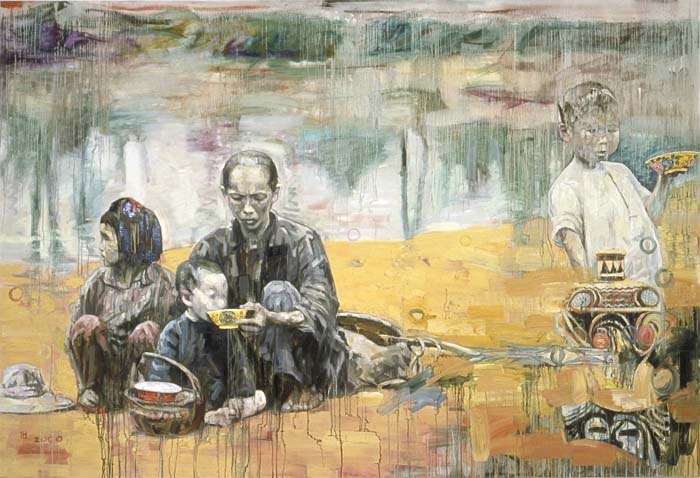
This beautiful photo By the Rivers of Babylon is by HungLiu. By the rivers of Babylon we sat down and wept.

This is one of the most poignant lines in Scripture (Psalm 137:1) recalling such sad times of exile. Those exiles wondered “how can we sing the Lord’s song in a strange land”.

Ben Quash, in Abiding, reminds us of the wisdom that the people of God are nearer to God “when they are in some sort of exile”. The Letter to Hebrews reminds us that “we have no abiding city” and Jesus has warning for those who feel too much at home in this world. Exile and the loss of home(land) must be an awful experience, shaking people to the roots of their identity. I don’t know whether it would be possible to sing any sort of song in such a strange land.

Quash, and many others, suggest that Christians should choose exile. This is “some sort of exile” which may, or may not have the brutality of violent removal and fearful flight. Quash refers to Hauerwas and Yoder who commend life lived “out of control”, “without the compulsion to hold on to the strings of power”. This is some sort of exile which is a walking with God who showed himself in Jesus as having nowhere to lay his head and who finished his days on the dump outside Jerusalem’s city wall.

The Jewish prophet Jeremiah points the way to vocation found in exile. He makes the “prison” of exile into a far more constructive way of life. He writes: “Seek the welfare of the city where I have sent you into exile, and pray to the Lord on its behalf, for in its welfare you will find your welfare.”

It is countercultural and strange to live “out of control”, accepting exilic status and praying for our enemies. It means that we are no longer to see ourselves as “host” but as “guest”. (It may be that the Church can’t be trusted with being “host”. There have been so many complaints about the abuse of power by the Church “in control”). When Jeremiah suggests that the exiles “pray for the welfare of the city” he is encouraging them to be “good guests”. The exiles’ vocation was, and is, how to be a blessing to a host culture on territory which is strange, without losing heart.

I have loved justice and hated iniquity, therefore I die in exile.
Pope Gregory VII

Our own culture is strange. There are many things that go on in society which are strange ways. Many aspects of social policy (I am thinking of the “bedroom tax” and other impending welfare reforms and the impoverishment of families and children) are out of our control. We don’t see the world in the same way. Our values are different. In many ways, we are in a strange land. Most of us don’t bear the physical hardships of those in refugee camps, but there is much that we lament. How do we sing the Lord’s song in a strange land?

Singing the Lord’s song in this strange land is something Jeremiah and Quosh insist that we do. The worship offered by exiles is, according to Quash, both resistance and gift. Quash writes:

God’s will to restore people to freedom before him, to overturn the idolatrous service of other gods, needs people who will use their voices to ‘sing his new song’ …

The early Christians may have handled the currency of the Empire each day, but before any of that, before sunrise, they met as the people of God, as the Church. That was their true city, their real ‘kingdom’, their Jerusalem. Christians’ present challenge too, is to live and work in the world in such a way that the song they sing as people in the Church is strong enough and beautiful enough to relativise ad transform other less sacred songs.

In chaotic times

TU ES PETRUS!!!

I know that leaders today are faced with enormous challenges, most of them not of their own doing. As times grow more chaotic, as people question the meaning (and meaninglessness) of this life, people are clamouring for their leaders to save and rescue them…. People press their leaders to do anything to end the uncertainty, to make things better, to create stability. Even leaders who would never want to become dictators, those devoted to servant leadership, walk into this trap. They want to help, so they exert more control over the disorder. They try to create safety, to insulate people from the realities of change. They try to give answers to dilemnas that have no answers.

Today is the inauguration of Pope Francis’s papacy. We pray for him. This quote on the temptations and spirituality of leadership in times of chaos (all times) is from Meg Wheatley’s Finding our Way. It struck me as helpful on a day when many will be thinking through issues of leadership.

Frazzled institutions

NetWork

The photograph by Cea is Branching Morphogenesis, a walk-through installation by Jenny Sabin, consisting of 75,000 cable ties resembling neural net of the brain. This is a pattern and organising structure at the heart of our nature – and a far cry from institutional patterns highlighted by the likes of Virginia Woolf in an earlier post.

Diarmuid O’Murchu calls institutions “frazzled” in Adult FaithThe financial crisis of 2008 has reminded us that “banking institutions are more vulnerable than anybody had suspected”. O’Murchu’s observation that “all major institutions are in a state of identity crisis” reflects Dee Hock’s view of “organisations increasingly unable to achieve the purpose for which they were created, yet continuing to expand as they devour scarce resources, demean the human spirit and destroy the environment.” (Birth of the Chaordic Age, p 28). He lists:

  • Schools that can’t teach
  • universities far from universal
  • corporations that can neither cooperate or compete, only consolidate
  • unhealthy health-care systems
  • welfare systems in which no one fares well
  • farming systems that destroy soil and poison food
  • families far from familial
  • police that can’t enforce the law
  • judicial systems without justice
  • governments that can’t govern
  • economies that can’t economise

Hock’s comment on this is that “such universal, ever accelerated institutional failure suggests there is some deep, pervasive question we have not asked.”

One question I often bear in mind in relationships is “how big or small do I now feel?” Our usual answer is “small” in relation to institutional life. There’s not much we feel we can do except for the institution in which we walk tall and big ourselves up in relation to everyone else. We walk away, in increasing numbers, where we can.

For Hock, the problem is our “Industrial Age organisational concept” which is “a wrong concept of organisation and leadership based on a false metaphor with which we must deal. Until our consciousness of the relational aspect of the world and all life therein shall change, the problems that crush the young and make grown people cry will get progressively worse.”

For O’Murchu “all the major institutions we know today evolved as instruments for the implementation of patriarchal power. Many are beaking down and losing credibility, giving way to networks with a greater potential for collaboration and adult empowerment”. For O’Murchu institutions “inherently disempower” however democratic they may try to be. “No matter how democratic a hierarchical system is, it will fail to do justice to the aspirations of the people. People want to participate. They want to be involved; in a word, they want to exercise their adult creativity. And when that goal is jeopardised, it is then we need policing … the prevailing power – culturally, politically, religiously – feeds power. Only in a minimal and superficial way does it empower.”

Competition and control are the assumed guiding principles for institutions and our evolutionary history. But work done by micro-biologist Lynn Margulis suggests a paradigm shift to our thinking and our organisation. Margulis’s theory of symbiogenesis highlights an orientation for cooperation rather than competition.

Human imagination has been “domesticated” by institutions, according to O’Murchu, so that the “human being is seen primarily as a deviant creature whose behaviour has to be tightly controlled. Instead of being perceived as creative adults, whose long evolutionary history verifies … a heavy commitment to conviviality and collaboration, humans have been subjected to highly destructive imperial control.”

O’Murchu suggests that there are other “structural strategies” besides institutions with their “top-down hierarchical line of control, usually with clear distinctions between “us” (at the top) and “them” (at the base)”.

I suppose that our institutional framework has been shaped by the myth of The Fall. But there is a dangerous circularity to that assumption. The argument may be that the Fall accounts for human sinfulness which needs to be controlled (by institutions). But institutions (religious) account for the Fall. One depends on the other as is being increasingly recognised. The emperor/institution really is in the all together.

In some ways the church has been tarred with the same brush and there is decline in confidence and “bums on seats”. But then there is another more hopeful sense in which some Christians are behaving less like institutionalised “bums on seats” who are envisaging alternative structures for the sake of the least, last and lost.

Developing viable alternative structures seems vital (as well as inevitable) in a world in which  institutions have become so devalued. Alternative structures are already emerging in the form of networks but the context for that emergence is still governed by institutions who become ever more fearful and seem ever more remote from a (human) nature that is essentially cooperative, collaborative and convivial.
 

Cardinals

Seeing red is a turn on for male primates according to a recent survey. The survey suggests that men are more turned on by women in red and that although men like to think that they respond to women “in a thoughtful and sophisticated manner, it appears that at least to some degree their preferences and predilections are, in a word, primitive”. Well!

Elisabeth Schussler Fiorenza playfully argues in Discipleship of Equals that if all the bishops are going to be men, all the cardinals should be women. What would happen to the bishops if they were seeing red? Fiorenza quotes from an article by Congo, Goodwin and Smith called “We Are Catholics and We Are Feminists”:

Perhaps we should wear red. red to acknowledge courage. Red to acknowledge that we are angry. Red to acknowledge that we are passionate. Red to acknowledge that we are sexual and like our sisters of herstory are still officially barred from the sanctuary because we menstruate. red to acknowledge the blood that flows from us with each birth, with each abortion, with each battering and with each assault …

For now, we pray for the election of a Pope who can build leadership which is holy and humble of heart so that bridges can be built and mended. Our Daily Prayer today contains this prayer as response to Psalm 79:

When faith is scorned
and love grows cold,
then, God of hosts, rebuild your Church
on lives of thankfulness and patient prayer;
through Jesus Christ your eternal Son.

Loving weaknesses

ImageOne of the principle insights of Belbin’s theory of team roles is that all of us have preferences for particular roles within a team. Belbin lists nine of these roles emphasising that all of these roles need to be filled if there is to be a fully functioning team. Our role preferences are governed by our strengths. For example, somebody has to check the bright ideas that come from the team members. That person, is, according to Belbin’s description, a “monitor evaluator”. This will be a preferred role for someone who is “sober, strategic and discerning” and “who sees all options”. But there is a downside to these “strengths”, and for the “monitor evaluator” there are “allowable weaknesses” of lacking drive and being unable to inspire others.

Our default position about weaknesses is complaint and annoyance. The consequence of this is that it is more usual not to publicly acknowledge individual weakness, and internalise the complaint and annoyance. That can’t be good for teamwork! Weaknesses are only usually judged negatively, but some weaknesses are allowable and could be viewed constructively.

Why do we not celebrate our weakness? It seems to me that Belbin gives us permission for that, because there is always a flipside to weaknesses. Instead of complaining about X’s lack of drive, we can recognise that X can play a vital part in our enterprise.

For my part (my preferred role is “plant”), I know that some may find my inability to “communicate effectively” (because I get “too preoccupied”) and my “ignoring of incidentals” frustrating and annoying. But that’s what you get in exchange for someone who can be “creative, imaginative, unorthodox”. Personally I am grateful for those who have seen the potential that I have through those weaknesses.

So, why don’t we talk more openly, and more positively, about weaknesses?

The Monday morning question

The whole globe is shook up, so what are you going to do when things are falling apart?

You’re either going to become more fundamentalist and try to hold things together, or you’re going to forsake the old ambitions and goals and live life as an experiment, making it up as you go along.

Perma Chödrön as quoted by Meg Wheatley in Finding our Way

Kevin Bennett wrote Psalm 35

On August 17th last year a man was kicked to death in by three teenagers on a dare. The man was Kevin Bennett, 53 year old who slept rough at the back of Iceland in Walton, Liverpool. He suffered a fractured eye socket, collapsed lung and a broken ribcage. His attackers were convicted of his murder yesterday.

This blurry photo seems to be the best of him.

According to Tommy Allman and others abuse of rough sleepers is common. As former rough sleeper Allman described what happened to him and others he knows through his work with the Basement, a Liverpool homelessness charity. He describes how rough sleepers get stamped on, crushed, urinated on and even set fire to. To add to that list, we now have someone who has been kicked to death as dare. In a TV interview Allman highlighted the importance of education and increasing awareness of the back stories causing people to become homeless. Homelessness does not happen in isolation and can be caused by financial difficulties, health issues, relationship breakdown or addictions.

Shelter Scotland has found that one in four of is just one paycheck away from homelessness, and that 5300 children were homeless last Christmas. Not all homeless people are rough sleepers, but rough sleepers is the public face of homelessness, and that public face is often not seen in human and humane terms. For many, they are just “bums” to be kicked, sometimes to death.

This was the story that held my attention as I read the ancient wisdom we call Psalm 35. The Psalm could have been written by murdered Kevin Bennett. Or it could have been written by one of the many people whose “back story” and heart of love is ignored and trampled on. The psalmist prays: “Contend, O Lord, with those who contend with me; fight against those that fight against me”. It could be Kevin Bennett praying “let those who seek after my life be shamed and disgraced; let those who plot my ruin fall back and be put to confusion … They reward me evil for good.

Friend Rob yesterday observed “we don’t know what people think”, and it is likely that there weren’t many people who bothered what Kevin thought. Certainly the psalmist’s abusers had no idea what the psalmist thought. They couldn’t see a heart that loved them. The hands they trod on weren’t apparently praying hands. Little did they realise that “when they were sick he put on sackcloth, fasted for them and prayed”. The psalmist writes out his agony when his prayer for them seem to be unanswered:

When my prayer returned empty to my bosom,
it was as though I grieved for my friend or brother;
I behaved as one who mourns for his mother,
bowed down and brought very low.”

In spite of that, the mocking continued. “When I stumbled, they gathered in delight; they gathered together against me; as if they were strangers I did not know, they tore at me without ceasing.”

They carried on kicking him in.
As a dare
to look big
they blindly crushed scum,
unable to see the man.
Forgive them, they don’t know what they do.

As for me,
I would not have seen.
It would have been a vague impression,
from the very edge of averted, defensive gaze,
of a blur with no depth of feeling.

I did not know him.