More like the voice of angels

I am not sure why angel voices are those of women or of boys when the named angels are Michael, Raphael and Gabriel. But if I am not very much mistaken, the voice of the Webb Sisters is absolutely heavenly as it bears the gravelly voice of Leonard Cohen to the heights of beauty. For me this voice of the angel from John Tavener’s Eternity’s Sunrise sounds like it’s from the very heart of heavenI wonder if this is how angels sound. They seem to have all the time in the world.Friends Christopher Burkett and Jayne Shepherd have shared this story illustrating the power of words – surely the touch of an angel. (I wonder why Church of England bishops can’t sound and look like this).

For the record, the Webb Sisters sing (and pray) on Leonard Cohen’s new album Old IdeasWith Raphael (angel of healing) they sing Come Healing.

O gather up the brokenness
and bring it to me now
the fragrance of those promises
you never dared to vow
The splinters that you carry
the cross you left behind
come healing of the body
come healing of the mind
And let the heavens hear it
the penitential hymn
come healing of the spirit
come healing of the limb
Behold the gates of mercy
in arbitrary space
and none of us deserving
the cruelty of the grace
O solitude of longing
where love haas been confined
come healing of the body
come healing of the mind
O see the darkness yielding
that tore the light apart
come healing of the reason
come healing of the heart
O troubled dust concealing
an undivided love
the heart beneath is teaching
to the broken heart above
O let the ehavens falter
and let the earth proclaim:
come healing of the Altar
come healing of the name
O longing of the branches
to lift the little bud
o longing of the arteries
to purify the blood
And let the heavens hear it
the penitential hymn
come healing of the spirit
come healing of the limb

Reflections

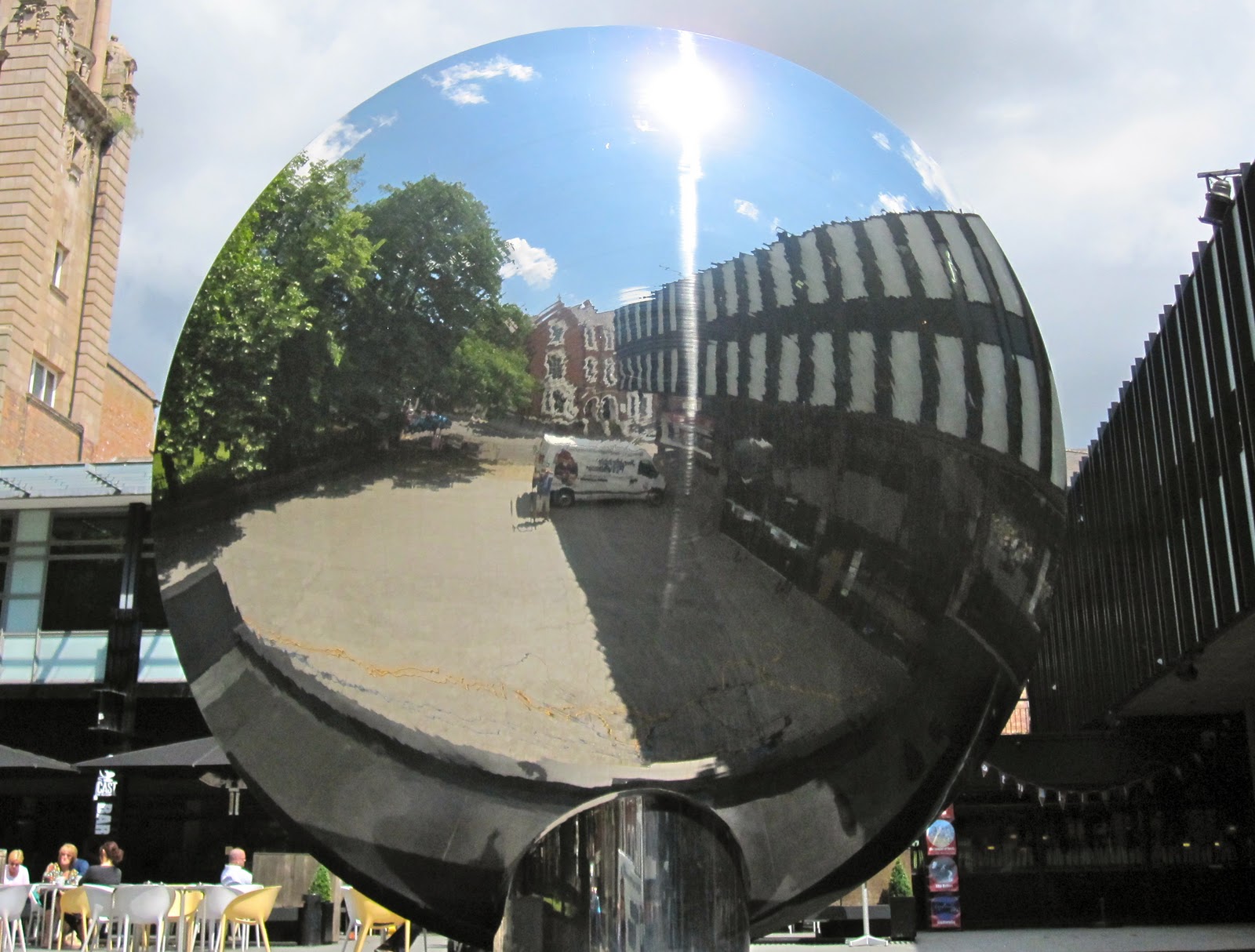
Anish Kapoor Sky Light at Nottingham

Alan Smith & Peter Shaw provide some helpful advice about the importance of reflection in The Reflective Leader. They remind us that the “greatest sea changes that have come about in human history have been rooted in reflection”.

They list six principles:

  1. Record first impressions, thoughts and reflections systematically, particularly when we are new to a situation.
  2. Reflect when things are going well. I suppose that we are not defensive at that point.
  3. Prepare for times of reflection. We need as much data and information as possible (there’s never too much information!) including comments and feedback from others.
  4. Ask questions. Curiosity is essential for reflection.
  5. Seek out those who are gifted at reflection, then nurture this gift in them, then tell others about them to encourage a culture of reflection.
  6. Bridgewater Canal, Warrington
    Reflecting on the Bridgewater Canal near Warrington
  7. Reflect regularly. It’s hard work but gets easier with practice.
My response:
  1. Go easy.
  2. Shower longer.
  3. Use feedback.
  4. Use ripples.
  5. Welcome surprise.
  6. Be prepared to change – all the time.

And the award for the best …. is

Occupy London

Now is the time of many retrospectives including Charlie Booker’s Words of the Year 2011. I imagine the awards being announced. Best newcomer: “Merkozy”, with the word trailing its expensive gown onto the stage to accept the award and thanking their producers, the euro crisis, and all those who have used the word. Word of the Year is, apparently, “OCCUPY”. Many of us would agree with that, and with the accompanying nomination of Giles Fraser for the Twurch of England’s Priest of the Year. Mercifully there is no award ceremony. Imagine trying to get Occupy off the stage.

Janine caters for all tastes at
Hollymere

 We have our own Herbert Awards, which reflect a local viewpoint. Community of the Year is awarded to Hollymere for developing a community of care and promoting independent living for those who would otherwise be heavily dependant and cut off from others. Hollymere represents a new design for living for older people, with its own “high street” open to the wider community, community rooms, restaurant and gym. Designers, carers and residents should come to the stage together to receive this award.Our prize for Butcher of our world doesn’t go to some toppled tyrant, but to our local butchers, Drury’s, who bring life, custom, humour and service (as well as some quality fresh food) to our local parade of shops.

In the sports category, Andy Murray has provided many moments when it has been hard to tear ourselves away from the set (!). There is only one team ever up for nomination: Leicester City. This year the only prize they win is Most Disappointing.

Our Concert of the Year was Paul Simon at the Manchester Apollo, though Take That take it for Extravaganza of the Year. Earworm is a word that took my fancy this year, and although I have been introduced to some good new (to me) music, such as Noah and the Whale, John Martyn, P J Harvey, the Earworm Prize goes to Fleet Foxes‘ Helplessness Blues.

Nominations for Film of the Year are disappointingly few. Once again we failed to deliver on our intention to get out more, which for us means going to the cinema. Yet we have seen some outstanding films, including The King’s SpeechBlack Swan, The InbetweenersWe Need to Talk about KevinHugo and The Girl with the Dragon Tattoo. For us there wasn’t anything to choose between them. We enjoyed them all, though not sure enjoyment is the word to use in relation to Kevin.

dunnock's nestWhile everyone was watching Arab Springwatch, we had our own springwatch, which began with the discovery of a dunnock’s nest in the back garden, and then a robin’s nest in the bush at the front of the house. We kept an eye on the hatchlings and fledglings and felt personally responsible when they flew their nests (on the same day).

Theological Find of the Year is awarded to Paula Gooder for sharing her research findings that ancient Hebrew cosmology shows a longstanding theological enterprise to bring God down to earth, and to Ivan Illich and his conspiracy “theory”.

Ginger posing for photoMost Creative Moment was putting together a series of photos for Ginger’s Day Out (in Llandudno) for children at Christ Church School, Ellesmere Port. There’s a book inside everyone – or, so they say. I think I’ve found mine!

Blogging Moment of the Year was getting feedback from Vic Goddard, Headteacher of Passmores Academy, the school featured in Channel 4’s Educating Essex for a post I wrote in response to that series.

There are joint winners of the prize for Most Helpful Intervention in my Thinking about Leadership. Heather Gold helped me to understand the importance of giving in her instructions how to be a tummler. Meg Wheatley is helping me to understand that we have to change our mind about leadership and organisation. Dee Hock led me to her, and also wrote of what he learned about organisation and leadership from the ground beneath his feet:

Billions upon billions of self-organising interactions are occurring second by second in the square yard of soil, each inter-connecing, relating, creating,and shaping self and others. Every particle is inseparable interacting and relating to others, and they still to others, unto the remote reaches of the universe and beyond – beyond knowing – but not beyond awareness, respect and love. The mystery of it all is overwhelmingly beautiful. Birth of the Chaordic Age. page 288.

IMG_0019Comedy of the Year goes to Rhod Gilbert for his routine about the tooth brush. There were many other contenders.

I am going to give my Mum the Lifetime Achievement Award. You have to be frail to qualify for lifetime achievement awards. She is now frail enough and now is more naturally retrospective. I have been surprised by some of the things she has got up to. For example, going into her city centre on her own at 3 in the morning to look for someone addicted to heroin on behalf of her worried parents (and finding her). She has also helped me understand that the delivery of a child isn’t a once in a lifetime event, but a lifetime’s work.

Gimme a man after midnight

Gimme a man after midnight. Today we are given such a man as our liturgical calendar encourages us to celebrate and embrace the life of Saint John of the Cross. Through his writings he speaks to us of things we often deny and of which we are so frightened that we don’t even go there. For Thomas Merton, St John of the Cross is the Father of all those whose prayer is an undefined isolation outside the boundary of “spirituality”. His poem Dark Night of the Soul describes the purification of the senses and the spirit on the journey to union with God. The phrase dark night of the soul is used to describe the experience which many know by the name of Depression, in which all that has supported our lives loses its value and meaning, in which we aren’t so much as letting go of things, as things have let go of us and we are left with barely so much as a thread to hold on to. His example is encouragement for us to not be frightened of chaos and the abyss.

lorenz_640x480_003
Strange attractor from Michael Wassmer

Western culture has been frightened of chaos, and anything which isn’t predictable and stable. We have preferred to think that people, information and change should all be managed and controlled. Even the dark night has been no dark night to us as we have controlled even that with our artificial light. I have been joining others in looking at chaos, and with them have been astounded by its order and beauty. Computers have helped us to model chaos’s behaviour, which in real time is, of course, unpredictable and chaotic. But the computer models help us to see that its behaviour is orderly and within boundaries. 
Gimme a man after midnight. The voice that speaks from the other side of chaos is a powerful voice. That is the voice of leadership, the future beckoning us. St John of the Cross lived through his dark night, and the voice of his experience of that night is a powerful voice. So is the voice of the likes of Nelson Mandela. So is the Word of God which only shines in darkness.
Gimme a man after midnight – one who has had the courage to embrace chaos, to hear its voices and not be afraid of its ambiguities and uncertainty, one who is able to speak from his experience of darkness. With him there is the promise of a new day with its possibilities and potential. Otherwise there is just the tiredness of the old day and our refusals to put our old certainties to bed.
Gimme a man after midnight. The voice of St John of the Cross is a companionable voice to all those who have lost themselves in that awful place of darkness which we call the Abyss or Chaos, and from which there seems no way out. 

Clocking Hugo

On the one hand there are clocks like this.

On the second hand there are clocks like this – click on it. It’s worth it.

Clocks and clockmakers have featured as metaphors in theological understandings down the centuries. Hugo is a lovely film based on the book by Brian Selznick which gets the metaphor of the clock ticking again. 12 year old Hugo Cabret lives in the huge clock at the Gare du Nord in Paris. Clocks are the family business. His father was a clockmaker, his inebriated uncle is the clockkeeper at the Paris station.
A present from my ValentineHugo is fascinated by the workings of the clock and how the parts all fit together. He knows that there are never any spare parts, so anything left over has to fit somewhere, and has a vital part to play in working the clock. (Flatpack furniture is packed along similar lines – it’s a sign that the assembly has gone wrong if there is anything left over).
Not only does Hugo apply this principle to the art of clockmaking, he also applies it to people. Georges Méliès was a pioneering film maker who found his skills not wanted as technology moved on. His life disintegrated and Hugo helps put George’s life together again – working like clockwork.
What if there are no spare parts? What if every part of our biodiversified universe has its part to play? What if nothing or no-one is redundant? While our human drives are shaped by the principles of the “survival of the fitting” our organisational thinking should be challenged by working out the role of the square peg, and not just the round peg for the round hole. Neither round pegs or square pegs are spare parts.There are no misfits. Even the orphan in his secret hideaway in the clock tower is no misfit, but has his vital part to play.


Faith is unpredictable

Faith cannot be taught by any method of instruction; we can only teach religion.  We can know about religion, but we can only expand in faith, act in faith , live in faith.  Faith can be inspired within a community of faith, but it cannot be given to one person by another.  Faith is expressed, transformed, and made meaningful by persons sharing their faith in an historical, tradition-bearing community of faith……the schooling-instruction paradigm works against our necessary primary concern for the faith of persons.  It encourages us to teach about Christian religion by turning our attention to Christianity as expressed in documents, doctrines, history and moral codes”
John Westerhoff ‘Will our children have faith?’ (p 35)

Landlords from hell

The Nativity by Korean artist Woonbo Kim Ki-chang
raises question of “where was Jesus born?”

Coronation Street has a story line about the politics of casting for the local Nativity. (Hopefully Simon will get the role of the innkeeper). The innkeeper is always cast in a good light. He is the one who found room for Mary and Joseph in Bethlehem when everyone else was shouting “there isn’t any room”. For Mary and Joseph this innkeeper is the landlord from heaven. For us, he is one who found room for Jesus.
I suspect that many greet a roof and bed with a sigh of relief, particularly after long travels, or through being made homeless, or through economic migration. Mary and Joseph would be no exception. Often the shine soon rubs off as they realise that they are trapped by landlords from hell.
This week’s Channel 4 documentary Landlords from Hell highlights the shameful conditions many people have to live with. Good housing seems essential for good mental health and physical wellbeing, and it is such a shame that those who are most vulnerable in our society, and have such little control over their living conditions, are subjected to really squalid shelter. I know how much I value my home and how important it is that it is comfortable, clean and reasonably orderly. That means that I have a place to relax and recover. That would seem to be a basic human right. The programme is part of a Channel 4 campaign to expose the Great British Property Scandal. Shelter’s Chief Executive, Campbell Robb writes:

Every day at Shelter we see the devastating impact these landlords have on peoples’ lives as families remain trapped in homes that cause misery, and, in some cases, put lives at risk. What’s more, we believe thousands more families could suffer as changes in the Localism Act will see councils placing more vulnerable homeless households in private rented housing.

Beulah House Hotel featured in Landlords from Hell
(Beulah comes from a Hebrew verb meaning to own– ironic!)

Jon Snow was the presenter of the Channel 4 documentary. Before his career as a journalist Jon Snow worked for New Horizon Youth Centre, a day centre for homeless young people in central London (with which he has remained involved since). At a time when we are so hacked off with journalists and the abuse of their power, Jon Snow’s example is a refreshing reminder of what good journalism is and what good journalism can do to bring to the light of day those things hidden in darkness. He confronted some of the guilty landlords with the grim realities of his findings, and hopefully they will take steps to put things right. I hope they will do that without recriminations, though I fear for those whose landlord threatens his tenants with the baseball bat.

9822_lores.jpg
bedbug from hell (photo by liz.novack)

I wonder how good the landlord in Bethlehem actually was. We aren’t told how much he charged for the room. We aren’t told whether he moved another family in after Mary and Joseph had shown him the potential for letting the room out. And it did have a misleading Michelin star over the door. I suspect that it is more helpful to be shown the rooms in the Apollo Guest House and the Beulah House Hotel (featured in Landlords from Hell) as the place of our Saviour’s birth. After all, they are the places for those for whom there is no room – bed bugs and all.

Friend Karin – @KarinLyle1 wanted to comment to this post with photos – couldn’t, so I add her comments as a PS and with thanks.
Just wanted to reply to your “Landlords from Hell”  Blog with two pictures of “Hospitality from Heaven”. Neither image does justice to the ‘peace’ and  the ‘fragrance’ in these two pictures, nor to the graciousness of the hosts.
If only we could offer a welcome like this to the weary and outcast in our society.
Love Karin
 The Fruits of Sandra’s Garden
Bedroom view from St. Beuno’s

Football supporters

Tributes to Gary Speed

The tragic death of Gary Speed, has, according to Peter Kay, Chief Executive of the Sporting Chance Clinic, prompted other footballers to become conscious of help they need to cope with the issues of footballers’ lives. Kay saysFootballers suffer illness in exactly the same way as the rest of society. They can become more detached from the outside world because of the money they earn. They are as vulnerable as the next man. In the light of Gary Speed’s terribly sad death I hope players who recognise they have a problem will put their hands up to ask for help”.


The issues of footballers’ lives was explored on White Lines with reference to an article on Nigel Reo-Coker’s working week featured in Guardian Money. White Lines summarised the working week:

Monday: A “warm-down training session. You’d probably be out there on the pitch for and hour, an hour and a half.” This runs between 10.30 a.m. and 12 p.m., and is followed by lunch (“prepared by chefs”). After lunch, “the rest of the day is yours”. By 1 p.m., he’s gone.Tuesday: As for Monday.Wednesday: Day off.Thursday: As for Monday and Tuesday.Friday: A light training session, “an hour maximum”.

Entrance to castle at Castle Eden
The drive to Castle Eden

So much time. So much money. So much possible isolation. When Roy Keane was looking for a house for his family in the north-east while he was manager of Sunderland, the Sunday Sun ran an article suggesting that Castle Eden would be worth looking at. One look at the drive shows that there’s not much in the way of neighbours. The house looks the perfect fit for the Downton set, but Downton is anachronistic. The castle of former times would be home for a whole community. Now the castle has been nuked with the nuclear family being king of the castle in isolation from any supporting cast.

The idea that wealth is the cause of isolation is explored by Charles Dickens in Great Expectations and by Fitzgerald in the Great Gatsby. The gated communities of East Cheshire, home to many famous footballers, may be the envy of many, but they are gated communities (if they can be called “communities” defended against others, whether neighbour or prying reporter.

Castle Eden
Castle Eden

We isolate our footballing celebrities on such dangerously high perches. Football supporters cheer them on for their performance. But that support is only for the team. The team members are only cheered for their part in the team’s win. Then adrenalin buzz of turning it on for 40000 people must give such a high, but also be so scary with the knowledge that the winning streak has to end and the recognition of the risk of a slide down the divisions into oblivion.


What are we doing as football supporters? I would suggest that every sad footballing story (and there are so many) should encourage us to become footballer supporters recognising the complications of wealth, time and isolation. Many footballers and celebrities are able to take care of themselves, their time and their wealth. Many have set up charitable foundations, and many prepare themselves for careers beyond their playing days. But others are not so lucky.

Do you see me? Or are you just looking?

We are drawing to the end of Prisons Week (Nov 20th-26th) – something organised to promote prayer for all those involved in the nation’s prisons. The theme of the week this year is “Do you see me? Or are you just looking?”. This draws attention to the fact that prisoners are constantly watched and under surveillance, they are rarely seen. It is indeed very difficult to “see” someone in prison. There is a real security rigmarole involved in visiting and visiting rights are severely limited (part of the punishment). But the most fundamental obstacle preventing the prisoner being seen is that in being locked up they are locked out of society.

Guard Tower and Prison Walls

Guard Tower & Walls of Robben Island
which locked Nelson Mandela out for
18 years but which didn’t prevent him
from being brother through
walls of prejudice and hatred.

(photoby Joe Barbosa)

I have often invited prayer for prisoners (there are currently 87,652 men and women in UK prisons – a rise of 2424 from 12 months ago). I am usually met with the hostility of a few who insist we should be only praying for the victims of crime. They follow the sight line of the secular media: the prisoner should not be seen and his or her cry should not be echoed in our prayer.

This week, someone was telling me of her pre-ordination placement experience in a “category A” women’s prison. She recalls her feelings of consternation after her first Communion in the chapel with a congregation of about eight when she was introduced to her table companions – including a much villified serial killer. This group of women have been seen by God. They have heard good news and a certain freedom even though they now they must be locked out of a society that wishes for them only to have bad news for a harsh and punishing sentence.

This is profoundly challenging because we share the same bread, and we drink from the same cup. We have been called companions (companions are friends who particularly share bread) and brothers and sisters. It is usually hard to imagine sitting at a table with people who aren’t our friends but God’s choice challenges these preconceptions. Instead we are challenged to see and recognise brothers, sisters and companions on the far side of dividing walls.

Jamie’s Great Britain

from Paddy’s Marten Inn, Leicester

I was intrigued by ideas of hospitality and celebration whilst watching Jamie Oliver on Channel 4 last night. I was wearing my metaphorical priest’s hat. Jamie gets everywhere on TV. The British public loves him for his energy and commitment. Last night’s programme focused on my home city, Leicester. Jamie’s comments began by highlighting the prospect of Leicester becoming the first UK city where the majority of the population is non-white. Jamie’s glass is definitely half-full and last night’s programme saw him at the asian veg stall on Leicester market and in the kitchen of Amita Mashru’s Gujerati restaurant eager to celebrate what immigrant communities have brought to us and our cooking and to celebrate the British achievement of entertaining different food cultures, and the spices of our foods picked up from different corners of the world.

Hospitality and celebration are central functions of ministry and defines the people of God, including Jews, Muslims and Christians, and other faith communities. Trace Hathorn reminds us that hospitality defines the people of God. He writes: 

The call to welcome the stranger is anchored in the Torah and was a part of themeasure of the Hebrew community’s faithfulness to God. When a traveler came totown, they waited by the well, and it was incumbent upon the townspeople tohouse and feed the visitor for the night.Of course, these travelers were rarelyfamily. … They were aliens, often foreigners, people who had different foods,different clothes, different languages, different gods. Opening one’s home wasrisky. Today we’d describe such a thing as out and out foolish. … Suchhospitality was central to the Hebrew identity. The risk did not define thepeople; their hospitality did, for they knew such hospitality was central tothe character of their God. The same was true in the early Christiancommunities. Paul reminded the Romans to offer hospitality to the alien, and inthe Letter to the Hebrews the people were reminded to show hospitality to allfor in so doing some entertained angels unaware. In Acts, the early deaconspracticed hospitality throughout the community, bringing welcome to those inneed. And in Matthew’s community, hospitality still measured the faithfulnessof the people. Welcoming prophets, righteous ones and disciples (those whomMatthew called “little ones”) was a disciplined practice of the young churches.

What seems to make Jamie such a good host and celebrant is his joie de vivre, the love of his subjects and his love of what people bring to the table. He seems convivial and congenial. Life tastes both bitter and sweet to Jamie’s palate, but his joy in that concoction is infectious. Being entertained and fed by Jamie is intriguing and is challenging my own hospitality and how I play the role of host.