Spiritual directors

Nouwen in Reaching Out is talking about the lack of spiritual directors. I think I would want to include other consultative roles as well which enable our supervision.
“At least part of the reason for this lack .. is that we ourselves do not appeal to our fellow human beings in such a way as to invite them to become our spiritual leaders. If there were no students constantly asking for good teachers, there would be no good teachers. The same is true for spiritual guides. There are many men and women with great spiritual sensitivity whose talents remain dormant because we do not make an appeal to them. Many would, in fact, become wise and holy for our sake if we would invite them to assist us in our search for the prayer of our heart.
“A spiritual director does not need to be more intelligent or more experienced than we are. If is important that he or she accepts our invitation to lead us closer to God and enters with us into the scriptures and into the silence where God speaks to both of us. Often we will discover that those who we ask for help will indeed receive the gift to help us and grow with us toward prayer.” (98)

Treasure hunt

image
At the table with Annie commented on the New Northerners’ post Occupation of the Heart. Her word treasure glistened at me. I actually misread the word, presuming that there was more treasure there, and decided to dig for treasure in the word treasures. I am sure there are words I have missed, just as there is always more treasure to discover. I did discover that there weren’t enough hissing snakes for STRESS.


Lessons on leadership from nature

“There is a simpler, finer way to organize human endeavor. I have declared this for many years and seen it to be true in many places. This simpler way is demonstrated to us in daily life, not the life we see on the news with its unending stories of human grief and horror, but what we feel when we experience a sense of life’s deep harmony, beauty, and power, of how we feel when we see people helping each other, when we feel creative, when we know we’re making a difference, when life feels purposeful.”
“Over many years of work all over the world, I’ve learned that if we organize in the same way that the rest of life does, we develop the skills we need: we become resilient, adaptive, aware, and creative. We enjoy working together. And life’s processes work everywhere, no matter the culture, group, or person, because these are basic dynamics shared by all living beings.”
“Western cultural views of how best to organize and lead (now the methods most used in the world) are contrary to what life teaches. Leaders use control and imposition rather than participative, self-organizing processes. They react to uncertainty and chaos by tightening already feeble controls, rather than engaging people’s best capacities to learn and adapt. In doing so, they only create more chaos. Leaders incite primitive emotions of fear, scarcity, and self-interest to get people to do their work, rather than the more noble human traits of cooperation, caring, and generosity. This has led to this difficult time, when nothing seems to work as we want it to, when too many of us feel frustrated, disengaged, and anxious.”
“There is no power for change greater than a community discovering what it cares about.”
“To resolve most dysfunctional situations, the first thing to do is flood them with information.”

Educating Essex

Entrance to Gyms
Passmores School, Harlow – the scene for Educating Essex.
This photo from vincentballard

Well done Channel 4 for the Educating Essex series. (Though the Daily Wail has a rather different take on it).We have enjoyed seeing a vibrant learning community built round dedicated professional teachers: Mr Goddard as Head (he has blogged), Mr Drew as Deputy and Miss Conway as Head of Year 11 who seem dedicated to responding to the emotional needs of this group of adolescent teenagers. It was good to hear Mr Drew telling his Year 11 students “You have no idea how much I like teaching you, you have no idea.” Passmores School, near Harlow, is an “outstanding school” according to Ofsted which has more than met its target of students’ GCSE achievements.

Ryan, with Aspergers, is beautiful, and moved us (as well as his fellow students and headteacher) to tears with his impromptu speech on leaving day when he declared the two years spent in school as the happiest of his life, with the school becoming his family. Here the argument about whether Asperger’s is “disease” or “syndrome” is settled in favour of syndrome – a difference rather than a disability to be cured. 


Vinni’s story is told with great senstivity. He is in care twenty miles from school, family and friends. He loses his bet that he will be at the end of year prom by failing to attend school for the last term and so forfeits his right to the prom ticket. He does turn up to see what he is missing. I guess a lot of people would have said “What are you doing here?” Not so Mr Goddard. He greets Vinni with “Great to see you. Sorry you’re not here properly.” Mr Goddard comments that Vinni is only a child – one let down by so many people – including himself.


On a day when  the media had been discussing the depressing findings of ICM research published by Barnardo’s, it was good to see youngsters managing to live and work in a community, and to see dedicated professional teachers flexible enough to work close to the emotional and educational needs of the students. That survey suggests that 44% adults agree that British children are becoming “feral”, and that 47% say that the trouble with young people is that they are “angry, violent and abusive”. Oh, the power of the Daily Wail/Fail as the hidden persuader of our perceptions.


I have often noticed the phrase that dates when there were better times. It is “thirty years ago”, and 30 years ago has always been better than today. 30 years could be the measure of a generation, and a way of expressing our fear of the next generation and how they are going to be as members of “our” society. Steven Pinker observes that one of the effects of ageing is to be negatively judgemental about the next generation, and to be inclined to believe that the past (which is our generation) is always better than the present. In his book, The Better Angels of Nature he demonstrates that the (further) past was a far nastier place than we might have imagined and that the present is far nicer than we might have noticed.

Asperger’s Syndrome Foundation

The adventure of tentin

compost capitalism

The occupations of Occupy London are, according to their website, “about social justice, real democracy and challenging the unsustainable financial system that punishes the many and privileges the few”. But the juxtaposition of the protesters’ camp and St Paul’s is challenging those of us on the inside of the Church of England wearing the vest of vested interests.


saint paul's [1]The juxtaposition highlights the challenge that has faced Christians down the centuries. Juxtaposed is the soft and the hard, the fixed and the flimsy, the playfulness of the tent and the seriousness of established tradition, the movement and the institution. These contrasts are not new. Paul, to whom the Cathedral is dedicated, was, as Giles Fraser pointed out, a tent maker and missioner of no fixed abode. Tonight a friend who is beginning to explore the Christian faith emailed me her puzzlement that “God and religion don’t seem to match”. What has been happening in London seems to be another replay of this mismatch. (Is it either the grace of God, or prophetic imagination and energy that makes more of a match?)


capitalism is a kind of slaveryMadeleine Bunting has written of the spatial aspect of the paradigm shift represented by the protest. For her, the protest is about “seeding questions in thousands of minds, shaking certainties and orthodoxies so that there is space for new alternatives.” It is about “taking key symbolic public space … to use it for conviviality, living, learning and participation.” To me that sounds exciting, and something which Christians should be engaging with. In fact, it represents the very heart and aspiration of Christian practice. Conviviality, living, learning and participation are fundamental to the intention of Christian liturgy.


The British Jewish community seems to have responded to the protest positively. In the statement they have published today, they “welcome the movement’s openness, pluralism and commitment to imagining a more just world.” Their statement includes a reminder that “the Jewish heritage includes a long tradition of reshaping society to help the least fortunate, from the teaching of prophets like Amos and Jeremiah, to Rabbi Hillel, to modern figures such as Abraham Joshua Heschel and Naomi Klein.” The church shares the same Jewish heritage, but the juxtaposition and apparent conflict of tent and Cathedral suggests the ease with which an institution can forget its origin as a movement of liberation.

Preaching for a change

Sermon for today – in which I have chosen to go with theappointed Old Testament text (Exodus 33:12-end) for preaching this morning. The OldTestament is often neglected in our thinking – but I hope you will see whytoday’s reading is important to us, and not only to us, but to all the peopleof God.

Jacob wrestling with angel by Rembandt
Can I remind you that thepeople of God were named Israel, by God after Jacob’s sleepless night of wrestling with the angel of God (or withGod)? After that match Jacob is called ISRAEL – and the name Israel means “onewho wrestles with God”, or “one who is straight, direct with God.”


The people of God wrestlewith him, struggle with him, and are straight and direct with him. This line ofthought suggests that we are not called to be mildly submissive to God, butthat God actually wants us to struggle with him, be direct with him, and begrown up with him. He wants us to get to grips with him.

This straightness anddirectness is reflected in the prayer of the People of God – which might aswell start with “I want to be straight with you God”, in a spirit of challenge. Our reading from Exodus showsMoses engaged in this sort of conversation which consists of challengingdemands.

We are told that “the Lordused to speak to Moses face to face, as one speaks to a friend.” In our readingwe have the privilege of overhearing that conversation in which Moses isnegotiating with God.
We may take it for grantedthat God answers prayer – but in this passage we have the foundation of thatfaith which Scripture wants us to take for granted.
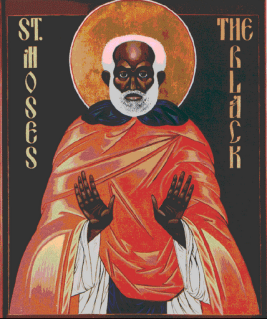
Black Moses

Speaking face to face, as onespeaks with a friend, God hears Moses’ prayer and answers it in the mostpositive way. He doesn’t just answer Moses’ prayer, but gives more than Mosesdares even to imagine – and it isintended that we get used to that, and take it for granted, so that we may toowith trust let God get to grips with us so that he can know our mind and whatis on our heart.

Thebackground to Moses’ demands is that God had told him that he wouldn’t go withthem to the Promised Land because he was so angry with the people for breakingthe agreement that they had.
“Go up to a land flowing with milk andhoney; but I will not go up among you, or I would consume you on the way, foryou are a stiff-necked people.” (Exodus 33:3).
Mosesinsists that God must accompany his people. He recognizes that the relationshipwith God is more important than the real estate of the Promised Land.
Theanswers to Moses’s prayer in these chapters of Exodus are outrageouslygenerous. He is prepared to start again and offers new tablets of commandmentsto replace the agreement and commandment that the people had broken.
Mosesand the Lord stood together on Mount Sinai – as friends so that Mosesunderstands just how God is going to fulfill his part of the bargain, hispromise to his people.
Thisis how God summarized the characteristics of his behavior with his peopleduring that conversation with Moses:
The Lord passed before him, andproclaimed, “The Lord, the Lord, a God merciful and gracious, slow toanger, and abounding in steadfast love and faithfulness, keeping steadfast lovefor the thousandth generation, forgiving iniquity and transgression and sin,yet by no means clearing the guilty, but visiting the iniquity of the parentsupon the children, and the children’s children, to the third and fourthgeneration.” (34:5-7).
Whilethere is mention of punishment the emphasis is on God’s forgiving love. Theguilty aren’t cleared, but the consequences of their guilt only reach to thethird and fourth generation, while steadfast love reaches to the thousandthgeneration – in other words – forever. This is how God is going to be forever:merciful and gracious, slow to anger, abounding in steadfast love andfaithfulness, keeping steadfast love to the thousandth generation.
We have to remember howdifferently God is promising to behave. He had been so angry with his people(and justly so, according to the text) – but now, in response to the demands of his people, he isgoing to be so slow to anger. In response to one of us humans, God changes hismind about his behaviour. In future his behaviour is going to be governed bysteadfast love and faithfulness.
In the section of the storywhich we read this morning we have the summary of God’s response to Moses. “Mypresence will go with you, and I will give you rest.”
All of us can find rest inthe knowledge of the manner of God’s promised presence, particularly when thatpresence is governed by steadfast love and faithfulness. This is how God iswith us. We don’t need to worry that he is any different. We can trust in hisforgiving love. We don’t need to be afraid – the Lord is here, unconditionally.
Moses makes one request toGod that God does not agree to.  Moseswants to see God face to face. God’s response: “You cannot see my face; for noone shall see my face and live.” (33:20)

Instead, we have a ratherpuzzling response.
“Thereis a place by me where you shall stand on the rock; and while my glory passesby I will put you in a cleft of the rock, and I will cover you with my handuntil I have passed by; then I will take away my hand, and you shall see myback.”

WakeSeeing the back of God israther strange. Most people see this as “the WAKE of God” – just as we see theripples and waves in the wake of a boat, so we are given sight of the effectsof God’s love. Seeing the back of God is seeing where God is and has been.

So far, I have mentioned onlyhow God is governing his behaviour in covenant with his people. I haven’t mentionedwhat he promises to do. He said “before all your people I will perform marvels,such as not have been performed in all the earth or in any nation. (34:10).

Seeing the back of God isseeing the wake of marvels, seeing the work of God. And the work of God ismending the broken – the broken in this case, being the very heart of therelationship between God and his people.

Seeing the wake of God isseeing where God is going. Seeing the wake of God is being able to follow hiswork of mending. Seeing the wake of God is being able to follow him and joiningin his most marvellous work of remaking broken relationships, and SHALOM.

Even in this way, Godresponded to Moses request, but gave him, once again, more than he could everdream of. Which is better? To see God face to face, or to be able to followhim, in his wake, and love him for all his ways?

Replacing repairs

Untitled
Cobblers used to be in high demand

Oh dear. “The car’s knackered, we’re going to have to walk”. That was the response of someone whose car had broken down near to us yesterday. He put a brave face on the diagnosis from the RAC man (diagnosis took ten seconds!). I would have at least kicked the tyres. We had our own breakdown the other week. Our two year old washing machine was going to cost £290 to repair – the exact cost of a new replacement. It seems that everything is getting very complicated, and it becomes increasingly difficult to see what’s gone wrong. The problem with our washing machine was the electronic control board, as is the case with most broken equipment these days. Replacing is replacing repair. I used to be a regular visitor to the TV repair man with our Ferguson TX. Where is the TV repair man now?

One of the features of childhood evenings was watching my Mum darning holes in socks, referred to as “doing the mending”. Is it a lost art? Have repairs been replaced? Repairs are easier when you can see how pipes and wires have come apart and how they can be re-paired.

mendingThis quote from Dag Hammarskjold captures the wonder of mending and repair.

Forgiveness is the answer to the child’s dream of a miracle by which what is broken is made whole again, what is soiled is again made clean.

Brokenness featured in conversation yesterday. Relationships are easily broken. Fortunately we get well used to re-pairing ourselves from our temporary separations and breaks. But occasionally, the hurt is profound and the damage irreparable, and the longer it persists the more difficult the repair becomes. It’s as if the broken ligaments of the relationship wither till there is nothing to be re-paired. A stitch in time saves nine.

We may be able to forgive, but that may not be enough to re-pair. Surely a re-pair is impossible without something to throw a line to, something to hold on to – whether that be a word, a gesture, or understanding and remorse?

(Feigned) Remorse
There’s remorse, and then there’s remorse!

A local headteacher was telling me about a small child in his school who had kicked one of the older children. “He showed no remorse” was the head’s comment. That is a problem that child is going to have to overcome. If he doesn’t become remorseful how can those he hurts ever forgive him. What a tragic life he has in front of him unless he can learn remorsefulness. Remorse is what we can get hold of when we want to forgive and be re-paired. Instead of reparation, remorselessness brings separation.

It may be that life is too complicated for us to see how it is broken. It may be that things have become a lot more reliable. It may be that in a blame culture we have to insist that we don’t break, that we are reliable, and not liable. It may be that our business in a consumer culture has lost the hard work and deep satisfaction of repair. It may be that we can’t see how we are broken.