>Holocaust Memorial Day

>I have just been watching Nicholas Winton’s story on Channel 5. What a remarkable man – saving 669 children from Prague and the Nazis in the months leading up the war. The link to the programme is here

I have already done a post about him. Apparently he is not much in favour of Holocaust Memorial Day, saying that we don’t learn from the past – and that it is more important to develop ethics. He wants the world to be aware of other ethnic cleansings – interestingly they are included in this trailer of Untold Stories from the Holocaust Memorial Trust.

>nobility and celebrity

>

'The Judgement of Solomon', oil on canvas painting by Gaetano Gandolfi, mid 1770s
The Judgement of Solomon by Gaetano Gondolfi
(mid 1770’s) reminds us of the wisdom by which Solomon
achieved his noble status. The story is told in I Kings. It
reads like a plotline from Eastenders!

I didn’t know that “noble” literally means “known” – and so “nobility” is a community of persons who have become knowable because of the quality of their lives. Celebrity should similarly be the status of those whose lives are worth celebrating. Through the media (deserved?) we celebrate those who have achieved celebrity status through their ignobility – in spite of their lack of talent and human qualities.

Conversation with friends yesterday led us to reflect on Hitler who we saw as a good leader turned bad. A noble leader turned tyrannical monster. In that he is not alone. Michael Sadgrove, in considering the life of Solomon in Wisdom and Ministry, reflects on the processes and temptations for the noble of “grandiosity”. We know that nobility and grandiosity often go together. It is wisdom that keeps them apart.

Sadgrove writes: “The temptation is to stand as tall as we can so that we fill the institution we lead. Yet Jesus says that true greatness means becoming like a little child. This suggests that true ‘standing’ means not filling the space ourselves but making room for others.”

I shall reflect on how I have become known – how I may even be noble. I shall confess my ignoble sins of grandiosity. The ways of Hitler and Solomon lie open before us.

>Dog nose

>Dog nose macro close up

With ears pricked and nose to the ground, dogs create a mental map which we can never know. Dee Hock asks the question: “how many ways of knowing are there which escape human perception?” His probing of organisation is spurred on by such considerations – together with the awareness that institutional failure will continue to escalate, and the prediction of social carnage and the development of even more dictatorial institutions in response to that carnage.

Organisations, organisers, institutions would benefit from following the dog’s nose, in realising that there are many ways of knowing, that progress isn’t along straight lines. Scratch beneath life’s surface and we see a totally different reality which defies the truths of our mechanistic planning. We know in our heart of hearts that “life isn’t that simple” and we become more intolerant of institutions and responses that pretend that it is. Hock writes (after he scratches the forest debris under his do’s nose):

Billions upon billions of self-organising interactions are occurring second by second in the square yard of soil, each inter-connecing, relating, creating,and shaping self and others. Every particle is inseparable interacting and relating to others, and they still to others, unto the remote reaches of the universe and beyond – beyond knowing – but not beyond awareness, respect and love. The mystery of it all is overwhelmingly beautiful. Birth of the Chaordic Age. page 288.

>ticklicious

>

Ken Dodd

We took my disabled mother in law to see Ken Dodd at Parr Hall, Warrington a few weeks ago – thank you Warrington for the parking ticket. Ken Dodd is still wielding his tickling stick aged 83. On this occasion his concert ended at 1.00 in the morning – perhaps rather insensitive given the age and circumstances of his audience. He still has the ability to make people laugh – we should always give thanks for people who can make others laugh, even if, by  now, the joke “have you ever had a tickle, missus” is wearing extremely thin.

His tickling stick reminds me of Dee Hock’s maxim:

You can’t tickle yourself. It’s a social act.

So, who’s tickling me today? I think it haas to be Hock’s reflection on his efforts to develop a new sort of organisation (from the same page as his maxim – p284: Birth of the Chaordic Age):

In the darkest times, and there were many, I could never look out at so many wonderful people and engage with them in laughter and give and take without walking from the room filled with wonder at the human spirit. They could do anything! Anything! And so can everyone, everywhere, if our minds are open enough, and our spirits strong enough to conceive of institutions that enable us to do so.

I’m not giggly, but giddy with that. It’s very ticklicious.

>a story worth telling

>

I was in tears re-reading Dee Hock’s account of the efforts to create an international banking organisation now known as VISA. His own passionate commitment had helped to take the process so far, but then an impasse was reached when certain people were not felt to be operating contructively and openly. It looked like the effort was going to end in failure. At that point Hock reflected about what had helped “such a complex, diverse group over insurmountable obstacles”. It was that “at critical moments, all participants had felt compelled to succeed. And at those same moments, all had been willing to compromise.”

In the teeth of failure a plan was hatched.  A fine jeweller was asked to create a set of cufflinks for each member of the organising committee. On one half of the committee was inscribed, in Latin, “the will to succeed” set around half of the earth. The other half of the cufflink was inscribed “the will to succeed” set around the other half of the earth. The cuff links were presented at a slap up meal on the final evening of the conference which seemed to be heading for failure. Here’s what Dee Hock said to them:

“We wanted to give you something that you could keep for the remainder of your life as a reminder of this day.” He then explains the gift, saying “We meet tomorrow for the final time to disband the effort after an arduous two years. There is no possibility of agreement. As organising agent, we have one last request. Will you please wear your cufflinks to the meeting in the morning? When we part, each of us will take them with us as a reminder for the remainder of our lives that the world can never be united through us because we lack the will to succeed and the grace to compromise. But, if by some miracle, our differences dissolve before morning, this gift will remind us to the day we die that the world was united because we had the will to succeed and the grace to compromise.”

There was silence which was shattered by one member exclaiming “You miserable b…….!” at which the room dissolved in laughter. Members did arrive to the morning’s meeting wearing their cufflinks. Within one hour agreement was reached on every issue – and a few months later the international organisation (which was to become VISA International) came into being.

chitter-chatter

>

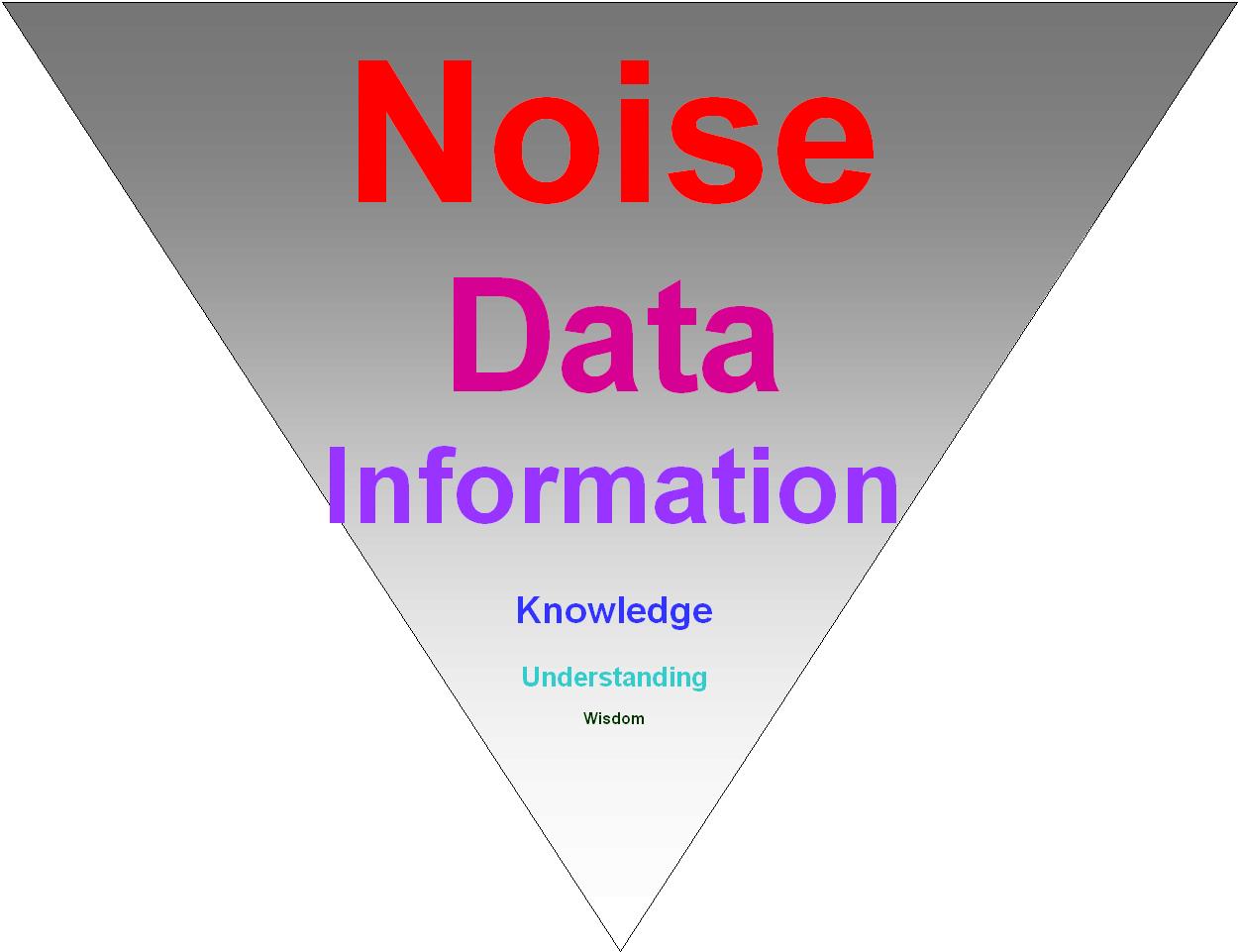
This diagram describes the ratio of noise to wisdom and the descending volume and value from noise to wisdom. According to Dee Hock “Noise becomes data when it transcends the purely sensual and has cognititve pattern.
Data becomes information when it can be related to other information in a way that adds meaning.
Information becomes knowledge when it is integrated with other information in a form useful for deciding, acting or composing new knowledge.
Knowledge becomes understanding when related to tother knowledge in a manner useful in conceiving, anticipating, evaluating and judging.
Understanding becomes wisdom when informed by purpose, ethics, principle, memory of the past, and projection into the future.” 

At one end of the spectrum, data is increasingly abundant, whereas wisdom (which is “holistic, subjective, spiritual, conceptual, creative”) seems to becoming scarcer.
 
We watched Lark Rise to Candleford last night. Based on life in bygone Buckingham (Candleford) and Juniper Hill (Lark Rise) the series reflects a time when there seems to have been a far higher ratio of understanding and wisdom to data and information. Wise counsel seems to have been part of being in settled communities slowly facing up to change. The wisdom is captured in the winning entry to last night’s poetry competition:
 
     As I went on my way,
     Gossamer threads span from bush to bush like barricades,
     As I broke through one after another
     I was taken by a childish fear
     They are trying to bind and keep me here
     But as I grew from girl to woman, I knew
     The threads that bind me were more enduring than gossamer.
     They were spun of kinship and love
     Given so freely that it could never be taken away from me. 
 
They were the days before the coming of the railway – a back story of Lark Rise. The coming of the railway meant increased communication, which meant more noise, which meant more data, which meant more information – and before we know it, we are too tired and overwhelmed to process it any further. Now we contemplate rail journeys of  only two hours from London to Glasgow – though wisdom may have gone out the window.
 
I am in the process of exploring the world of Facebook and Twitter. I now have the knowhow – now I am looking for the understanding and the wisdom to discern how to use it. Though there is a lot of noise and chatter going on I think I can now see a point to Twitter – I travel slowly! So I have changed my profile to “Cascading Insight – a dealership in second hand views” – and I am thankful for the tweets of others which have pointed me in the direction of understanding and wisdom. I will not be tweeting about my moods, where I am, and what time I’ve gone to bed. That is definitely too much information and just adds to the volume of noise we haven’t got a hope in hell of managing.

>Listening and Leadership

>Spending the morning thinking what leadership is I came across some great definitions, including this from the Roman Catholic Diocese of Rochester: leadership is “the process of influencing the behavior of other people toward group goals in a way that fully respects their freedom.” I came to the conclusion that there are as many definitions of leadership as there are leaders.
And then I listened to Tom Peters highlighting the importance of listening in leadership. He says: “The single most significant strategic strength an organisation can have is not a good strategic plan, but a commitment to strategic listening on the part of every member of the organisation.” I suspect that most followers find leaders who don’t listen overpowering and insensitive – and then they find someone else to follow.
To make his point he refers to the amount of data that doctors ignore because they only listen (according to his research) for 18 seconds before interrupting the patient – and suggests that that is true for 7 out of 8 “bosses”.


>I bean a-countin’

>I have been guilty of disparaging accountancy. (For example, see here). I know I am not alone! Ever since Monty Python we have suspected that accountants all need a humerus implant. But, not so. Leicester accountants, Mark J Rees, have their own accountantjokesite with jokes such as:


The doctor comes to see his heart transplant patient. “There is good news. It is very unusual but we have two donors to choose form for your new heart.” The patient is pleased. He asks, “What were their jobs?” “One was a teacher and the other was an accountant.”
“I’ll take the accountant’s heart,” says the patient. “I want one that hasn’t been used.”


I’ve been reminded by Dee Hock this morning that accountancy is an old and honourable profession. In ‘Birth of the Chaordic Age‘ Hock traces the phenomenon of accounting to the tribal storyteller whose role was to accurately portray “their tribe as it was, as it is, as it might become, and as it ought to be”. Unfortunately, the primary language used for accounting for present day community is the language of mathematics and number. Consequently, the story is made up of measurements of what was, what is, and what might happen. The really important issues of what we ought to be is beyond the reach of accountancy speaking only the language of numbers.

Hock quotes H. Thomas Johnson, an economic historian, CPA, and former president of the Academy of Accounting Historians: 

“The language of financial accounting merely asserts answers, it does not invite inquiry. In particular it leaves unchallenged the worldview that underlies the way organisations operate. Thus, management accounting has serbved as a barrier to genuine organisational learning… Never again should management accounting be seen as a tool to drive people with measures. Its purpose must be to promote inquiry into the relationships, patterns and processes that give rise to accounting measures.”

Sorry accountants.

Ringing bells with our wishing wells


World Peace Bell
World Peace Bell – Newport, Kentucky

Dan Clenendin highlights in his post, the outrage of outsiders, repeats depressing research findings from America (Kinnaman 2007) showing how 16-29 year olds regard the church. Here are the percentages of people outside the church who think that the following words describe present-day Christianity:

antihomosexual 91%, judgmental 87%, hypocritical 85%, old-fashioned 78%, too political 75%, out of touch with reality 72%, insensitive to others 70%, boring 68%.

It would be hard to overestimate, says Kinnaman, “how firmly people reject — and feel rejected by — Christians” (19). Or think about it this way, he suggests: “When you introduce yourself as a Christian to a friend, neighbor, or business associate who is an outsider, you might as well have it tattooed on your arm: antihomosexual, gay-hater, homophobic. I doubt you think of yourself in these terms, but that’s what outsiders think of you” (93). This is a far cry from the reception of the first believers, who, according to Luke, “enjoyed the favour of all the people” (Luke 2:47). The church’s message isn’t ringing the right bells for generations of our people.

I wonder if we have forgotten to love our neighbour – that person who lives the other side of the fence with a different lifestyle and set of beliefs. In a fearful culture neighbours are suspect until they prove themselves otherwise  by “coming round” to our way of thinking. The first believers lived a different culture, being sent out to neighbours with the simplest of messages “peace to this house: peace to you” and with a love that was to overcome all sorts of barriers and offences. I wonder if we could ring more bells with more resounding wishing wells to those who now see themselves the other side of the wall – and the wrong side of-fence.

Twelfth Night Tense


Twelfth Night brings the Christmas tree, decorations and cards down, and the world seems to breathe a sigh of relief as life gets back to normal.  But let’s not be too hasty about dis-carding Christmas. Christmas isn’t just for retailers. Christmas is a revelation of our darkness, the depth of winter and the coldness of our hearts. Christmas presents us with guiding light, the promise of peace to thaw our bitterness and hearts that jump from fear to joy.

One last look at the Christmas tree celebrates an evergreen love of the three tenses captured by Dickens in the Christmas Carol. The light of God shone in the darkness (Genesis 1:3) long before there were sun, stars and moon. The light shone and shines in the darkness as our Lord is come. And before too long – just when the time is right – there will be no more darkness or night (Rev. 22:5).

Borg & Crossan, in their book, First Christmas, project a political context for the first Christmas. The darkness was the tyranny of empire with the background being “the day the Romans came” raping and killing in the villages around Sepphoris, including Nazareth. The light has not overcome the darkness. Borg and Crossan rightly point out that empire still exercises its dark powers “to shape the world as the empire sees fit”, achieving peace through war, violence, injustice and oppression. Christmas has its future in shalom – peace through justice, love – and US, because in the words of Augustine: “God without us will not; we without God cannot.”

Here is what Borg and Crossan write as they imagine Mary taking Jesus to the top of the Nazareth ridge:

“We knew they were coming”, Mary said, “but your father had not come home. So we waited after the others were gone. Then we heard the nose, and the earth trembled a little. We did too, but your father had still not come home. Finally we saw the dust and we had to flee, but your father never came home. I brought you up here today so you will always remember the day we lost him and what little else we had. We lived, yes, but with these questions. Why did God not defend those who defended God? Where was God that day the Romans came?” (p.78)