>Gafcon

>How sad is Gafcon?
But Father Christian has a good blog about the Big Pete and Little Pete Show – dummies for ventriloquist Martyn Minns.
Personally I think it’s a battle being waged by those who want a command and control church against those who want something rather more grown up and self organising, where people can be trusted to make spiritual judgements for themselves – not having to rely on a moral dictatorship.

IF

IF you can keep your head when all about you
Are losing theirs and blaming it on you,
If you can trust yourself when all men doubt you,
But make allowance for their doubting too;
If you can wait and not be tired by waiting,
Or being lied about, don’t deal in lies,
Or being hated, don’t give way to hating,
And yet don’t look too good, nor talk too wise:
If you can dream – and not make dreams your master;
If you can think – and not make thoughts your aim;
If you can meet with Triumph and Disaster
And treat those two impostors just the same;
If you can bear to hear the truth you’ve spoken
Twisted by knaves to make a trap for fools,
Or watch the things you gave your life to, broken,
And stoop and build ’em up with worn-out tools:

If you can make one heap of all your winnings
And risk it on one turn of pitch-and-toss,
And lose, and start again at your beginnings
And never breathe a word about your loss;
If you can force your heart and nerve and sinew
To serve your turn long after they are gone,
And so hold on when there is nothing in you
Except the Will which says to them: ‘Hold on!’

If you can talk with crowds and keep your virtue,
Or walk with Kings – nor lose the common touch,
if neither foes nor loving friends can hurt you,
If all men count with you, but none too much;
If you can fill the unforgiving minute
With sixty seconds’ worth of distance run,
Yours is the Earth and everything that’s in it,
And – which is more – you’ll be a Man, my son!

Alcoholics Anonymous

AA twelve steps

1.) We admitted we were powerless over alcohol–that our lives had become unmanageable.

2.) Came to believe that a Power greater than ourselves could restore us to sanity.

3.) Made a decision to turn our will and our lives over to the care of God as we understood Him.

4.) Made a searching and fearless moral inventory of ourselves.

5.) Admitted to God, to ourselves and to another human being the exact nature of our wrongs.

6.) Were entirely ready to have God remove all these defects of character.

7.) Humbly asked Him to remove our shortcomings.

8.) Made a list of all persons we had harmed, and became willing to make amends to them all.

9.) Made direct amends to such people wherever possible, except when to do so would injure them or others.

10.) Continued to take personal inventory and when we were wrong promptly admitted it.

11.) Sought through prayer and meditation to improve our conscious contact with God as we understood Him, praying only for knowledge of His will for us and the power to carry that out.

12.) Having had a spiritual awakening as the result of these steps, we tried to carry this message to alcoholics, and to practice these principles in all our affairs.

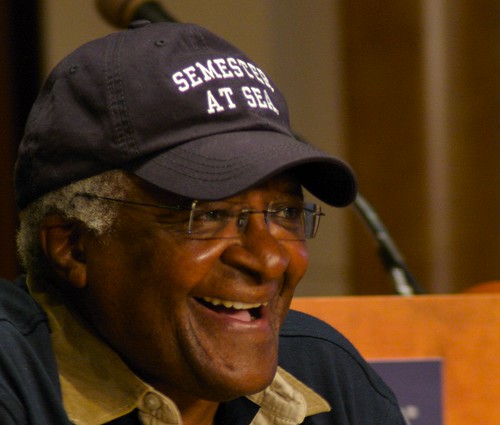
“There is no neutrality in a situation of injustice and oppression. If you say you are neutral, you are a liar, for you have already taken sides with the powerful. Our God is not a neutral God. We have a God who does take sides. . . who will not let us forget the widow and the orphan.”
Desmond Tutu

Photo by gitgat.

>Zimbabwe

>Today’s a day to think about those people in Zimbabwe who can envisage a far better future than anything on offer from Mugabe – in other words – the majority. The fresh vision of Freshlyground’s song struck home powerfully this morning – http://www.youtube.com/get_player
as did these words from Desmond Tutu:

“There is no neutrality in a situation of injustice and oppression. If you say you are neutral, you are a liar, for you have already taken sides with the powerful. Our God is not a neutral God. We have a God who does take sides. . . who will not let us forget the widow and the orphan.”

>Lambeth

>So the Bishop of Rochester has declined Archbishop Rowan’s invitation to the Lambeth Conference and has decided to join the alternative conference oddly called Gafcon (sounds to me like a hot air company). To me it seems rather a strange gesture coming a week after widespread demands for the priest who conducted the “wedding” of two gay priests to be disciplined have been heard. Surely, if we are to be called to be obedient to the church’s teaching – one of the leading advocates of which is the Bishop oif Rochester – then the Bishop of Rochester should be seen not to be undermining the authority of the Archbishop of Canterbury.
Homosexuality is supposedly at the root of the divisions of the Church of England and the Gafcons are apparently united around that one issue – that it should not be tolerated. I think I see it rather differently. I see it as a power struggle – and how shocking that the followers of the one – “who emptied himself taking the form of a slave, being born in human likeness. And being found in human form, he humbbled himself and became obedient to the point of death” (Philippian 2) – should be involved in power struggles. The issue of homosexuality is their rallying call and the point of vulnerability – the chink in the armour – of those they oppose. The way I see it is as a struggle between the old command and control mentality referred to by Dee Hock, founder of Visa and the chaordic type of organisation emerging as part of our information age. Lambeth represents the self-organising – this time there’s no resolutions, just bishops coming together in the hope that by so doing they will be better bishops. The Gafcons will plot and scheme, pass resolutions, flex their muscle, spit fire, trying to “command and control” which is a temptation Jesus steadfastly refused to submit to – and so make a story for the world’s media. The message will not be “God so loved the world …” but “see how these Christians love (is this where a “sic” should go?) one another” – hardly a compelling message.
And those people who are gay get squeezed out. They are the real victims. They are victims of prejudice – cast out into the realms of darkness – the the alleys where, it just so happens, Jesus walked (or should I say “walks”).
I have to say that two of the people I love most dearly are gay. They are both in loving, stable long-term relationships which have enriched them and both relationships shed love and blessing to others. One of them is a civil partnership which rang with as much holiness as any wedding I have ever attended – even though it could not be contracted on “holy ground”. When I think about it, I could be deeply hurt and offended. The offence is to the head – the hurt is to the heart. What those who are gay make of it I shudder to think – I am very sorry to be in an institution that so offends them – but will work to promote a community where people matter and where rules and regulations are seen as “sheer hell”. Dee Hock again:”Heaven is purpose, principle and people. Purgatory is paper and procedure. Hell is rules and regulations.” Pray that Lambeth prepares for heaven, and that the Gafcons realise there’s no future in hell.
Friend Katherine sent me this article from Newsweek on the devil incarnate – Gene Robinson – a different perspective.

>The Information Age (2)

>Noise becomes data when it transcends the purely sensual and has cognititve pattern.
Data becomes information when it can be related to other information in a way that adds meaning.
Information becomes knowledge when it is integrated with other information in a form useful for deciding, acting or composing new knowledge.
Knowledge becomes understanding when related to tother knowledge in a manner useful in conceiving, anticipating, evaluating and judging.
Understanding becomes wisdom when informed by purpose, ethics, principle, memory of the past, and projection into the future.
Dee Hock comments that more primitive societies had a far higher ratio of wisodom and understanding to knowledge and date. They hadn’t got much in the way of data but loads of wisdom. On the other hand our society is high on data and information “but understands very little of what it knows”, leaving us with “separatist, linear, mechanistic institutions, confined with our ever more isolated specialities, constricted by ever narrowing perspectives.”
So, it looks like we are stuck between a rock and a hard place – institutions not fit for purpose in our information age and no time or inclination to understand all the information of our age. Cue – theologian and sage.

>The Information Age

>Listening to friend Carol’s presentation yesterday made me realise how church is tied down by the industrial age. Perception of church is stil very much building based and the church building boom seems to have been part and parcel of the industrial development of the 19th century. Often funded by industrialists churches were places to be seen and seemed to cement people’s place in society.
We have hastily moved from being an industrial society to being an information society, and is it the nature of information which has had such an effect on society and how we organise ourselves into social networks. Yet while factories have closed (and communities coped far better that they thought) our church buildings remain and remain furnished with the trappings (and pews) of the mindset of the industrial age.
According to Gregory Bateson “information is a difference that makes a difference”. Dee Hock makes these points:

Unlike finite physical resources, information multiplies by transfer and is not depleted by use.
Information is a miser of energy. It can endlessly replicate, move ubiquitously at the speed of light, and massively condense in minute space …
Information breeds. When one bit of information is combined with another, the result is new information. It will become the slave and property of noone. Efforts to make information conform to archaic notions of scarcity, ownership and finite physical quantity – concepts that grew out of the agricultural and industrialised age – merely lock humankind into old, mental boxes of constraint and exploitation.
Information is ethically neutral.
Products, services, and organisations in which the value of the mental content begins to dwarf the value of the physical content require wise people of deep understanding.

Dee Hock writes this:

Thinking about a society based on information and one based on physicality requires radically different perspective and consciousness. However, we prefer too often to ignore the fundmental differences nd carry over into the Chaordic Age of managing information, ideas and values, concepts and assumptions that proved useful in the mechanised Industrial Age of machine crafting, the age of managing things; concepts such as ownership, scarcity, spearability, quantifiable measurement, statistical economics, mathematical monetarism, hierarchical structuralism, and command-and-control management.
The birth of the Chaordic Age alls into question virtually every concept of societal organisation, management, and conduct on which we have come to rely. Clinging too rigorously to old concepts, dismissing new concepts too lightly, protecting old forms that resulted from those concepts too fiercely, imposing those forms on a changing society too resolutely, are a certain path to failure.

>Mr and Mrs

>I think I take after my son Leo. From the day he started school he waged a campaign for the freedom to wear his polo shirt outside his trousers. He triumphed by wearing his trousers round his hips – too low for everyone else’s comfort but his own.
Our school governors put in a not so earth-shattering request that minutes of meetings referred to our Christian names and surnames, rather than our titles. As Chair I see it as a nice process issue to break down stuffiness. Guess what. The clerk’s manager says “you can’t do that because the minutes form a historic record”. Can’t do that – to me that’s a red rag to a bull and a reminder of Dee Hock’s theology of chaordic organisations: “Heaven is purpose, principle and people. Purgatory is paper and procedure. Hell is rules and regulations.”
“Can we challenge that?” I said loosening my metaphorical trousers. “Save it for more important battles” was the advice of the clerk. Reaching for my metaphorical gunbelt I have to say that I suspect that these days most people prefer not to be known just by their clan name, but also the name that marks them out as special and as individual, that we want to have power over our name calling (don’t call me that please …) and that we want to see our-self as part of that historic record. So, I’ll reach for the phone to return fire. Now shall I begin “Hello Ruth” or “Hello Mrs Agnew”? It’s good to take after your children – once in a while isn’t it?
Below – too far below – the hazard of low slung trousers.
http://www.youtube.com/get_player

VISA


Today, before any audience in the world, I can hold a VISA card overhead and ask, “How many of you recognise this?” Every hand in the room will go up. When I ask, “How many of you can tell me who owns it, where it’s headquartered, how it operates, or where to buy shares?” a dead silence comes over the room. The audience realses something extraordinary has occurred and they haven’t a clue how it happened. Nor, in my opinion should they. The results of the best organisations are apparent, but the structure, leadership, and process are transparent.
Dee Hock – Birth of the Chaordic Age p189