Border Crossing: the dangerous way of grace

Our politics, like our hearts, are haunted by borders and fear. But Luke’s gospel shows Jesus walking the edge — not to keep people out, but to draw them in. Preached in a week when fragile talk of a ceasefire in Gaza flickers across the news, this reflection on Luke 17:11–19 and 2 Timothy 2:8–15 explores what happens when the unchained word of God crosses the lines we draw, healing what fear divides.


Jesus is on his way to Jerusalem, travelling along the border between Samaria and Galilee.
This is what Luke wants us to notice —
that Jesus is on the edge, not in the middle.
He’s on the edge where belonging is uncertain.

In nature, the edge is often where life is richest.
When two landscapes meet — forest and field, land and river —
there’s a place called an ecotone.
It’s a place of tension, yes,
but also of surprising life,
where species from both sides mingle
and new life appears.

Perhaps that’s why Jesus walks the edge —
because that’s where new life is breaking out.

We’ve all walked that edge:
in the playground,
the first days in a new job,
moving into a new community —
will we be included, will we settle?

Luke introduces us to ten lepers,
forced to live on that edge
by their communities who have wrenched them from home,
from all they’ve ever known, by one word — Unclean.

They are the wrong side of the border,
cast over the edge —
and that’s why they have to shout to Jesus.
They have to get their word across that boundary.

This is how Jesus gets to Jerusalem —
by walking the edge,
the dangerous way,
where grace and fear meet,
where the kingdom begins to break through.

But not every edge is walked the same way.
Our leaders keep pointing us to the edge too —
the edge of our borders, our safety, our identity.
They edge us with fear.
They tell us who to blame, who not to trust,
who belongs, and who should stay outside.

And we see again what happens
when fear builds its own borders.
Across the news this week —
the fragile talk of ceasefire,
the first steps toward peace in Gaza —
we glimpse what it costs to live so long
behind walls of pain and suspicion.

Every side has its wounds,
every border its fear.
And yet even there,
the smallest word of peace,
the tiniest crossing of compassion,
is a holy thing.
It’s where grace dares to walk the edge again.

And that’s the challenge for us, too.
Because we all have borders of our own —
those quiet lines we draw in our hearts,
between those we find easy to love
and those we keep at a distance.

The question is:
whose edge are we walking?
The one that fear builds,
or the one Jesus blesses —
the edge where healing begins?

Fear has its own language,
and it spreads easily.
You can hear it in the way people talk,
the way headlines shout,
the way words build walls
long before bricks ever do.

That’s what happened to the ten lepers.
They were pushed to the edge by words —
words that said Unclean,
words that exiled them from home,
from family, from touch.

And now they have to shout from a distance,
just to be heard —
their voices straining across the border,
trying to bridge the gap
that other people’s words created.

And Jesus sends a word back.
No touch, no ceremony —
just a word that crosses the border:
“Go, show yourselves to the priests.”

And as they go, they are made clean.
The word runs free.
It doesn’t stop at the boundary;
it heals as it goes.

Paul once wrote, chained in a prison cell:
“I may be in chains,
but the word of God is not chained.”

It’s the same truth here.
The unchained word runs ahead of Jesus,
crossing the lines that fear has drawn,
healing what twisted speech has broken.

This isn’t the first time Luke shows us Jesus on the edge.
From the very beginning, his gospel has been about
the outsiders God draws in.
It’s Luke who tells of the shepherds —
night workers, unclean in their own way —
hearing angels sing of peace on earth.
Luke remembers the woman who wept on Jesus’ feet,
the prodigal welcomed home,
the beggar Lazarus lifted up,
and another Samaritan —
the one who stopped on the roadside to bind up wounds.

In Luke’s world,
the people we push aside
become the very ones who show us what mercy looks like.
And here again, it’s the Samaritan —
the one no one expected —
who becomes the model of faith,
the first to come home to God.

But one turns back.
One crosses the border again.
He’s the foreigner —
the one who, by every rule, should have stayed outside.
Yet he comes closer,
falls at Jesus’ feet,
and his first word isn’t a cry for help,
but a word of thanks.

Ten were made clean —
but only this one is made whole.
Because healing isn’t complete
until it finds its voice in thanksgiving.

That’s the word Jesus has been waiting for —
not Unclean, not Go away,
but Thank you.
A word that restores relationship,
that binds what fear has torn apart.

The Samaritan becomes the first citizen
of this new borderland kingdom —
a kingdom without fences,
where mercy is the mother tongue.

And maybe this is what it means
to follow Jesus on his way to Jerusalem —
to walk the edge,
not the safe, well-marked path,
but the dangerous way,
where love meets fear
and refuses to turn back.

Because that’s where the unchained word still runs free —
crossing borders,
breaking through divisions,
making strangers into neighbours,
and outcasts into brothers and sisters.

Prayer

May the Christ who walks the edges
find us there —
where fear builds walls
and grace dares to cross.
May his word set us free
to speak peace,
to live thanks,
and to walk the dangerous way of grace.
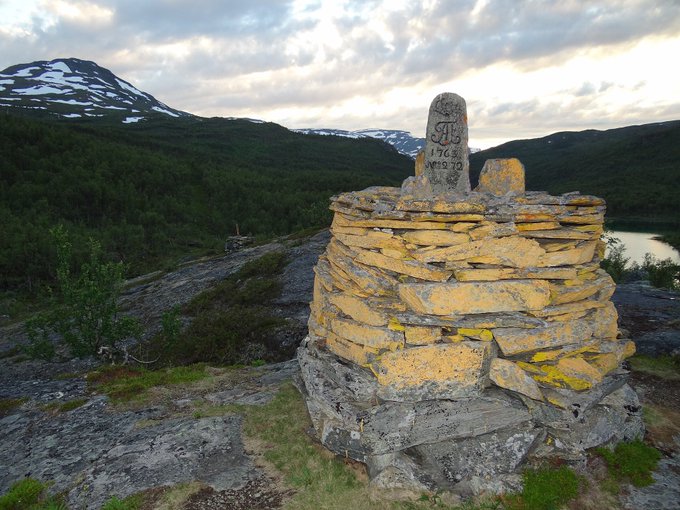
Laban and Jacob have their say on the folly of borders and their control

A cairn marking the boundary between Norway and Sweden in a remote area of the Arctic. Photo by Bjorn Christian Torrissen

The UK Government has announced plans to take “full control” of borders unveiling an Australian-style points system to overhaul immigration law and close our borders to unskilled workers and those who can’t speak English. When we talk about taking “full control of our borders” aren’t we just allowing fear and anxiety to take control of our borders? Are we forgetting that border controls escalate and will be reciprocated? Have we given any thought to who in the end will wipe our bums? Are we not just trading hostility?

This is all part of the deceit of government.

I have been intrigued by the stories about Jacob and Laban from Genesis 29-31. Jacob is the “leg-puller”, the “supplanter”, the “deceiver”. Jacob was born pulling the leg of his older twin brother Esau, trying to stop him being the first-born. Laban is the “white man“. Laban means white.

The story of Laban and Jacob is a saga of deception – the white man deceiving the deceiver, though was Jacob the outsmarter of the two?

The two of them come to terms with each other by building a “witness heap” of stones laid by their families as a commitment to peace. It marked the first bilingual place name recorded in the Bible – Laban called it Jegar Sahadutha and Jacob called it Galeed – the translations of “witness heap” in their respective languages.

Galeed, (we would perhaps call it a cairn) stood as a landmarked prayer. It provided a boundary to their hostility, an end to it. Significantly both Jacob and Laban refuse to take control of their new border. Instead they pray: “The Lord watch between you and me”. The Lord is the one they want to control their border and to watch their limits so that they never cross for harm but only cross for peace.

I wonder when we pray, when we put or hands together, whether we are building a cairn – a knuckle-boned physical structure to mark the limits of our hostility and anxiety, to say “beyond this only peace, beyond this only love”.

Are our churches also cairn-like landscaped prayers – places to confess our hostility, to find better ways to deal with our differences and markers within our communities beyond which we commit to “go in peace”? “This heap is a witness, and this pillar is a witness, that I will not go past this heap to your side to harm you and that you will not go past this heap and pillar to my side to harm me.” (Genesis 31:51f)

Borders are worse for our control when our export is fear. The boundaries of our Brexit mindset become brickset – walls built against others deconstructing differences, obstructing relationships, restricting trade and exchange.

Where are we building our witness heaps and our places of commitment? How are we replacing walls with cairns? How do we lament our nationalism?

Genesis 31:44-54
Come now, let us make a covenant, you and I; and let it be a witness between you and me.’ 45So Jacob took a stone, and set it up as a pillar. 46And Jacob said to his kinsfolk, ‘Gather stones,’ and they took stones, and made a heap; and they ate there by the heap. 47Laban called it Jegar-sahadutha:* but Jacob called it Galeed.* 48Laban said, ‘This heap is a witness between you and me today.’ Therefore he called it Galeed, 49and the pillar* Mizpah,* for he said, ‘The Lord watch between you and me, when we are absent one from the other. 50If you ill-treat my daughters, or if you take wives in addition to my daughters, though no one else is with us, remember that God is witness between you and me.’
51 Then Laban said to Jacob, ‘See this heap and see the pillar, which I have set between you and me. 52This heap is a witness, and the pillar is a witness, that I will not pass beyond this heap to you, and you will not pass beyond this heap and this pillar to me, for harm. 53May the God of Abraham and the God of Nahor’—the God of their father—‘judge between us.’ So Jacob swore by the Fear* of his father Isaac, 54and Jacob offered a sacrifice on the height and called his kinsfolk to eat bread; and they ate bread and tarried all night in the hill country.

The Centre of the Universe

“We must take sides. Neutrality helps the oppressor, never the victim. Silence encourages the tormentor, never the tormented. Sometimes we must interfere. When human lives are endangered, when human dignity is in jeopardy, national borders and sensitivities become irrelevant. Wherever men and women are persecuted because of their race, religion, or political views, that place must – at that moment – become the center of the universe.”

Elie Wieselthe Night Trilogy

Borderlands

>

For the first time in a long time I have been having to stand my ground. This is because of an inter-personal, intra-departmental boundary dispute. In other words, we are not sure what we are each doing. This is not a major international incident, though there are significant tensions at the border. We don’t know where the boundaries are supposed to be, and because of that we haven’t worked out how we live together at the boundary.
The damage of borderlands is beautifully brought out in a poem I have just read by Gloria Anzaldua – who describes herself as a “chicana dyke-feminist, tejana patlache poet, writer, and cultural theorist” and “as a border woman [who] grew up between two cultures, the Mexican (with a heavy Indian influence) and the Anglo (as a member of a colonised people in our own territory). I have been straddling that tejas-mexican border, and others, all my life It’s not a comfortable place to live in, this place of contradictions. hatred, anger and exploitation are the prominent features of this landscape”. (The photo is by Brian Auer)
Here’s the poem – as I read it in Edward Soja’s book, Thirdspace:
                         I press my hand to the steel curtain – 
               chainlink fence crowned with rolled barbed wire –
        rippling from the sea where Tijuana touches San Diego
unrolling over mountains
     and plains
              and deserts,
this “Tortilla Curtain” turning into el rio Grande
      flowing down to the flatlands
           of the Magic Valley of South Texas
      its mouth emptying into the Gulf.
1,950 mile-long open wound
                     dividing a pueblo, a culture,
                     running down the length of my body,
                         staking fence rods in my flesh,
                         splits me   splits me
                         me raja   me raja
                                                                               This is my home
                                                                               this thin edge of
                                 barbwire.
                       But the skin of the earth is seamless.
                       The sea cannot be fenced,
             el mar does not stop at borders.
       To show the white man what she thought of his 
                           arrogance,
                   Yemaya blew that wire fence down.
                     The land was Mexican once,
                          was Indian always
                              and is.
                         And   will be again.

Birds without Wings

You and I used to fancy ourselves as birds, and we were very happy even when we flapped our wings and fell down and bruised ourselves, but the truth is that we were birds without wings. You were a robin and I was a blackbird, and there were some who were eagles, or vultures, or pretty goldfinches, but none of us had wings.
For birds with wings nothing changes; they fly where they will and they know nothing about borders and their quarrels are very small.
But we are always confined to earth, no matter how much we climb to the high places and flap our arms. Because we cannot fly, we are condemned to do things that do not agree with us. Because we have no wings we are pushed into struggles and abominations that we did not seek.
conclusion of Birds without Wings by Louis de Bernieres