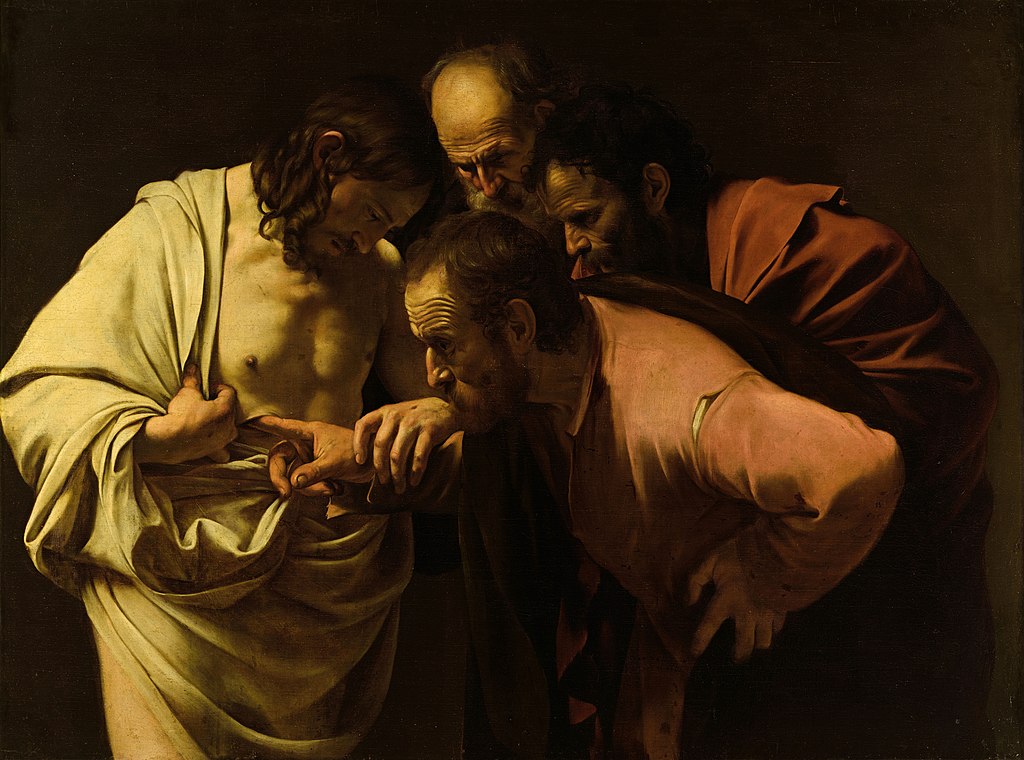
Seeing the wounds Jesus shows us

A sermon for the 2nd Sunday of Easter – Year C for two small churches. The gospel for the day is John 20:19-end.
The Incredulity of St Thomas by Caravaggio – or should it be called Jesus showing Thomas his wounds?

I love preaching that brings Scripture to life—and that brings Scripture back to life.

That’s a line I’m going to repeat each week to remind us that every time we open Scripture together we are bringing it back to life.

This morning we return to John’s Gospel, still caught up in the wonder of that first Easter day (John 20:19-end). It’s a story only he tells.

John himself brings scripture back to life.
Particularly we see the influence of the creation story from the 1st chapter of our scriptures.
We can see that in the way that he tells us the time.
On the evening of that first day of the week.
It’s like last week’s gospel reading which began: Early on the first day of the week, while it was still dark. (John 20:1)
We are still on that first day which was like the first day of creation, when, according to Genesis 1:2, earth was a formless void and darkness covered the face of the deep.
That’s the time in today’s gospel. It was the first day of the week, and it was evening.
In other words, darkness was forming.
Taking our cue from Genesis, John’s readers can expect God’s wonders on this new day of creation.

Thomas wasn’t with the disciples when Jesus came on that first day, the day of resurrection.
It was the other disciples who had to let him know that they had seen the Lord.
Thomas told them that he would never believe “unless I see the nail marks in his hands and put my finger where the nails were, and put my hand into his side”.
It is this I suggest we focus on in our worship today.

Thomas is the patron saint of those who are blind because seeing wasn’t enough for him.
He needed to examine Jesus’s wounds by touching them and feeling them.
And the wonderful thing on that second Sunday, the first day of the week following, was that Jesus came and stood among them again and showed Thomas his wounds.
He welcomed his touch. He guided his hand. He let him explore his body.
Thomas is the patron saint of those who struggle to believe what they can’t see—or even what they can.
He shows us that resurrection faith isn’t just about seeing.
Sometimes it’s about touching, questioning and wrestling with God.

Jesus showed Thomas his scars. He wants his disciples to see them.


In the Last Supper, he took a loaf of bread and he broke it.
He wanted them to see his body in the brokenness of the bread.
“Take, this is my body,” he said. (Mark 14:22).
Then he gave them a cup for all of them to drink from.
In that cup he wanted them to see his blood.
“This is my blood of the covenant poured out for many.”
Even before he was wounded he wanted to show his disciples the wounds he was going to suffer.
And in today’s gospel, in one of his resurrection appearances, he invites Thomas to have a look at those wounds – to examine, inspect and see with his hands as well as his eye.

Thomas recognises Jesus through his wounds, just as Jesus wanted him to.
And this is how we come to know Jesus.
Just as Thomas encountered the risen Christ in his wounds, so too we encounter him today in the bread and wine of the Eucharist.
Every Communion we have with Jesus we have this invitation to examine the wounds of Jesus. Every time the bread is broken we are invited to see the brokenness of the body of Christ and to feel that brokenness in our mouths.
Every time we take this cup we are invited to taste the blood of Christ shed for us.

What is it that Jesus showed Thomas?
What did he want his disciples to see?
What does he want us to see when he shows us his wounds, when he invites us to see his body and his blood?

The first things we see are the wounds to his hands and feet where the nails were driven into his body by the hammer blows of empire.
Then, if he turns we see the wounds of the whipping scored into his back for being the scourge of empire and religion.
Then we see the scars on his head where they pressed the crown of thorns and added insult to injury, to press home the point that this “pretender” was nothing.

The rule of the kingdom of God is that the last, the lost and the least come first and those who are first in the kingdoms of this world come last.
The rule of the kingdom of God turns the rules of the world upside down.

In the wounds of Jesus, his disciples see a man who embodies that rule of the kingdom of God. In the brokenness of his body, in the bloodshed, we see a man the religious and political capital tried to reduce to nothing.
The plots against him and his crucifixion were intended to humiliate him and his followers – to make them least, last and lost – GONE for ever.

The problem for them was that the rule of the kingdom of God puts the least, last and lost – those lost and broken by the ways of the world – first.
When Jesus stood among his disciples, first without Thomas, then with him, he was the living proof of the fundamental rule of the kingdom of God.
Here was the humiliated, crucified and killed one.
You can’t get more “least, last and lost” than that.
Here he was, “the first fruits of those who have died”, Christ raised from the dead (1 Corinthians 15:20).

This is what Jesus showed Thomas –
the scars are the living proof of the rule of the kingdom of God.
Jesus stood among them as living proof of the rule he’d always followed,
that puts the last first and the first last.
Here is the one they put last made first.
This is what Thomas saw. This is what he said:
“My Lord, my God” – the rule of the kingdom of God realised in those few words.
“My Lord and my God” – Jesus comes first for Thomas.

So Jesus stands among us still, not with condemnation, but with scars.
What do we see? What difference does it make? Does Jesus come first?

Jesus doesn’t shame Thomas for his questions. He meets him in them.
He doesn’t rush belief. He invites it — gently, patiently, personally.

And he does the same with us.
To all who doubt, who ache, who long to see and touch and know — he says,
“Here I am. Peace be with you.”

He doesn’t hide his wounds. He offers them.
He lets us trace the pain and the mystery of a love that suffers with us and for us.
And in that wounded, risen body, we find our hope.

This morning, he says again:
“This is my body. This is my blood.”
This is how I choose to be known.
Look closely. Taste carefully.
And, if you are among the broken,
do not be afraid.

Saints and Stains – a sermon for All Saints Sunday

Some churches celebrate All Saints on the Sunday following All Saints Day (November 1st). Here’s a sermon for All Saints Day for our troubled times inspired by the gospel of the day is Matthew 5:1-12, itself a sermon for troubled times.

November 5th 2023

This is how to start a sermon.

How blessed are you who are poor in spirit, for yours is the kingdom of heaven.

There are two clauses in that first sentence – if you like, two lines. We could read between the lines “and those who aren’t aren’t” because Jesus is singling out communities and people who are poor in spirit. Theirs, and only theirs is the kingdom of heaven. 

So reading between the lines of that first beatitude we would have, “How blessed are you who are poor in spirit”, and then brackets (“and those who aren’t aren’t”). But then that doesn’t sound like the gospel until we add another line such as “but grace can change that”. 

I thought we would read the gospel again – reading between the lines. Could one side of the church say between the lines these five words: “and those who aren’t aren’t” with the other side of the church following on with the other five words: “but grace can change that”?

Let’s see how it translates:

  1. How blessed are you who are poor in spirit
  2. (and those who aren’t aren’t)
  3. (but grace can change that)
  4. for yours is the kingdom of heaven
  1. How blessed are the sorrowful and those who mourn
  2. (and those who aren’t aren’t)
  3. (but grace can change that)
  4. for you will be comforted.
  1. How blessed are you who are meek
  2. (and those who aren’t aren’t)
  3. (but grace can change that)
  4. You will inherit the earth
  1. How blessed are you who hunger and thirst after righteousness
  2. (and those who don’t aren’t)
  3. (but grace can change that)
  4. You will be filled
  1. How blessed are you who are merciful
  2. (and those who aren’t aren’t)
  3. (but grace can change that)
  4. Mercy will be shown to you
  1. How blessed are you whose hearts are pure
  2. (and those who aren’t aren’t)
  3. (but grace can change that)
  4. You will see God
  1. How blessed are you who are peacemakers
  2. (and those who aren’t aren’t)
  3. (but grace can change that)
  4. You are true children of God

……………….

The kingdom of heaven isn’t a heavenly space into which the poor in spirit move when they die. The kingdom of heaven isn’t so much a space as a rule. Theirs is the kingdom of heaven because they accept, follow and love the rule of heaven which puts the last first and the first last. They accept, follow and love the rule of heaven on earth.

The Beatitudes has been chosen by the church to celebrate this All Saints Sunday. Across the world, across denominational divides worshippers will be hearing this gospel. 

The passage tells us something important about the saints, and that is that life doesn’t look too good for those Jesus blessed. They were not squeaky clean. They were not like the unsullied in Game of Thrones. They were not untouched by what was going on around them. 

They were in the thick of it, suffering in the thick of it, hoping and praying in the thick of it. Jesus’ blessing comes in the thick of it. Blessed are those of you who mourn – those of you who are upset by the way things are, those who grieve for what’s been lost, those of you who are crying.

Those of you crying out for justice, who hunger and thirst for righteousness, those of you crying because of persecution. These people are in the thick of it, just as God’s kingdom people have always been in the thick of it, suffering trouble and troubled to their heart. 

God’s kingdom is not for the so-called innocent bystander or those who pass by on the other side – it’s for those who get involved in the politics of the gutter, both victims and helpers.

When we gather to hear Jesus’ preaching we join the crowd listening to his sermon begun with his blessings. There, on the mountain, is the throne of God, the majesty of God in the words of grace, blessing, encouragement and love. In Revelation  chapter 7 there is one who looks and marvels at the huge multitude of people around the throne of God. As this one looked he saw that there were people from every nation, from all tribes and peoples and languages. What they had in common was that they had all come through a great ordeal, they had come through the thick of it.

In my mind I gave this sermon the title of Saints and Stains. The author of Revelation sees the multitude robed in white – and that is the way we usually picture them in our stained glass – well dressed. The reality is very different. They’ve been through a great ordeal.They’ve been in the thick of it. They are blood stained, wounded. Their clothing is dishevelled and ripped. They’ve walked the refugee trails. They’ve cared for loved ones to their wit’s end. They’ve been bullied and taunted. They’ve been through great ordeals. What do we expect them to look like?

Here’s what St Paul says of himself and his travelling friends. “We are afflicted in every way, but not crushed; perplexed, but not driven to despair; persecuted, but not forsaken; struck down, but not destroyed… We do not lose heart. Even though our outer nature is wasting away our inner nature is being renewed day by day.” (2 Cor 4)

Not all of us face great ordeals but so many in the world are in the thick of it struggling to get food, keep warm, find rest in the midst of war, famine, flight, poverty, prejudice and health issues. Life is difficult. The challenge and call is about how we live in the thick of it and how we help and care. 

Those first hearers of Jesus’ preaching heard their blessing in their troubled times, in their troubled hearts, while they were in the thick of it, as ones going through great ordeals. How blessed are you who show mercy. How blessed are you who make peace. In the thick of it there is Jesus’ blessing. In the ordeals of the here and now, not pie in the sky when you die, there is the blessing of Jesus who himself is in the thick of it – (who, incidentally, on the throne of God, with a mock crown of thorns pressed on his head by crucifiers until his blood poured looks remarkably like the ram or lamb caught in the thicket as the sacrifice God provides in the story of Abraham and Isaac and the suffering servant pictured by Isaiah).

It was in the thick of it that Jesus knew his own blessing. It is in the thick of it that Jesus’ blessing has been heard down the ages.

A friend’s suggestion was for all of us to identify people who fit these blessings we call the beatitudes. For example, who would we single out as those in the thick of things who hunger and thirst after righteousness? ………….. These people would be our communion of saints.

We can take that further. Not only naming the poor in spirit, the mournful, the persecuted, but also joining Jesus in their blessing, growing our appreciation, our encouragement and our love for the work they do and the way they are, as well as appreciating, encouraging and loving them in the state they are in, in the thick of great ordeals. What would it be to be a church broken and gracious, hearing and  knowing God’s blessing in the thick of things while all the time joining the prayer of others in their ordeals?

Taking up the cross. What on earth does that mean?

This is what I emerged with by way of a sermon for Trinity 3A. The gospel from Matthew 10:24-39 was a tricky one. The sparrows caught my eye when I was preparing. So often in his teaching Jesus picks up on what is seemingly worthless and what usually goes unnoticed by others. I wanted us to explore this in relation to Jesus’s mission and the way disciples join his mission by taking up the cross. My exploration took me to the heart of brokenness and all that is wrong in the world. The text of the gospel is at the foot of this page.

The Sermon:

Has anyone got a penny? Long gone is the penny bazaar. You can’t even spend a penny when you’re desperate, when you’ve got everything crossed. A penny for your thoughts. You wouldn’t even give me the time of day for a penny. What’s the point of a penny?

The point of a penny is that it is the price of worthlessness. Way back in the day, before even the pound in your pocket was something, Jesus took up worthlessness when he took up the cross.

Are not two sparrows sold for a penny?

I imagine Jesus at the market, casting his eyes around the stalls and finding someone so poor that all they had to sell was pairs of sparrows. Two-a-penny. You could get them anywhere – and who wants them anyway? 

Jesus here is talking poverty. His own family was poor. Tradition had it that after the birth of a first born the mother would offer a lamb to the priest as a burnt offering. This was the law, and it applied to both boys and girls. The exception was for those who couldn’t afford a sheep – then it was to be two turtle doves or two pigeons. That is what Mary offered when Jesus was born according to Luke’s gospel (Luke 2:24). They couldn’t afford a sheep.

Are not two sparrows sold for a penny? They’re ridiculously cheep! Put it another way. The cost of sparrows on the open market is nothing, zilch, nada. 

Jesus has an eye for the worthless, for what the world doesn’t even bother counting or noticing, and he uses that in his teaching, like in the parable of the mustard seed and the parable of the leaven. He also picks strands of hair. Nobody counts strands of hair unless they’re folically challenged. Even the hairs of your head are counted.

The point of this passage is not about how precious the sparrow is but about the importance to God of every part of creation, particularly those people overlooked by the powers that be. It’s about those who don’t fit in ……. It’s about those who become “lost” in the system, or the gas chamber, or at sea, those who get lost through the carelessness of others. Most particularly, in this passage, it is about “the lost sheep of Israelall those lost by the religious leaders who were supposed to be good shepherds loving everyone dear to God, but didn’t. It’s about those who count for nothing in the world.

And it’s about the disciples themselves. Jesus is aware of the cost of discipleship – that the disciples will be humiliated, flogged, imprisoned, betrayed (even by members of their families), even killed. This is what Jesus’ talk about the sparrows and the hair is leading up to – the encouragement to the disciples not to be afraid of the opposition which will want to discredit and reduce them to nothing.

Jesus stands at the heart of poverty and there gives his life. This becomes his mission and the consequences are the same for him as for those who live at the heart of poverty and brokenness: rejection, betrayal, humiliation and even death. This is the mission, (and the consequences), he is preparing the 12 for in this morning’s gospel, and this is the mission he would love us to join.

We can summarise the mission of Jesus (and the mission of God) as taking up the cross.

One of the questions that has bugged me while I was preparing this sermon is what this means for us. What does it mean for us to take up the cross? It sounds like it is a lot easier for us to be part of Jesus’ mission than it was for those first disciples, or for Christians who continue to live with the threat of persecution, humiliation and hatred. By and large, we live in a society where Christianity has been a dominating culture. I suspect that none of us imagine being persecuted, imprisoned or killed for joining Jesus’ mission taking up the cross.

So what does it mean for us to be taking up the cross in Jesus’ mission?

I played with the word “cross”. I discovered that it is “the cross” in our gospel this morning. It is not “your cross”. Reading “your cross” gives rise to the expression “everyone has their cross to bear”, which might not be true, and which might lead some to think that they’ve got enough to bear carrying their own cross that they’re not going to help carry anyone else’s. If it’s “your cross” it becomes your own bubble of trouble – individualised, almost self-centred. 

No, Jesus’ mission is to “take up the cross”, and anyone taking up the cross is worthy of him. Ever since God became the God of the Hebrew slaves in Egypt God has been “taking up the cross” – as it were.

So I played with the word cross. I did a word search of my imagination, and I remembered all the crosses marking my homework and the failure they denoted.

I thought about the crossings out we do and was reminded of those who are crossed out for being who they are, for being wrong – the wrong ethnicity, the wrong race, the wrong gender, the wrong sexuality. 

Probably because it was the 75th anniversary of the Windrush landing on Thursday, and probably because it was World Refugee Day on Tuesday, and probably because of the sinking of the boat carrying hundreds of refugees and migrants off the west coast of Greece, I thought of crossings – and the bravery, and the desperation and the exploitation of those who make dangerous crossings.

Already I see the wrong (and who says anyone is wrong?), the wronged, the displaced and the misplaced in the cross. And I see that there is not one cross, with one victim (the object of our worship), but that there are so many crosses and so many for whom Jesus dies to live for in this mission to “take up the cross”.

Black theologians are helping us to understand the folly of not using our imaginations when joining Jesus’ mission of taking up the cross. One of them, James Cone, an American, wonders how ever we managed to divorce the cross from the “lynching tree”. James Cone was a black American theologian. He died in 2018. 

It didn’t take much imagination for him to link the cross to the lynching tree. In the lynching era, between 1880 and 1940, white Christians lynched nearly 5000 black men and women in a manner with echoes of the Roman crucifixion of Jesus. Cone’s comment on this is that these white Christians didn’t see any irony or contradiction in what they were doing. 

Cone writes: “during the course of 2000 years of Christian history, this symbol of salvation [the cross] has been detached from any reference to the ongoing suffering and oppression of human beings – those whom Ignacio Ellacuria, the Salvadoran martyr, called “the crucified peoples of history””.

He continues: “The cross and the lynching tree interpret each other. Both were public spectacles, shameful events, instruments of punishment reserved for the most despised people in society. Any genuine theology and any genuine preaching of the Christian gospel must be measured against the test of the scandal of the cross and the lynching tree.”

I carried on with my wordsearch – my play with the word cross and I remembered that that is how we vote. We put a cross by what we are voting for. And I park that idea – the cross being election and choice. We are free to choose to take up the cross, or we can vote another way.

Then I got my sourdough out of the fridge and got it ready for baking in the oven. Those who have the sourdough baking bug know that you have to score the dough before putting it in the oven. If you don’t score the dough the steam will find the weakest point in the loaf to make its escape. The scoring provides a controlled escape for letting off steam. I score with the cross – and the cross-score becomes the way out, the release, the exodus, as well as the lines along which I would break the bread for sharing with those who are hungry.

And I remember the sign we use for kisses, the cross we choose to show our love for others, and how far we are prepared to go to honour the pledge of our commitment – even to the extent of taking up the cross in our love for them

So, what does it mean to “take up the cross”?  Is it something like this?

To choose (elect) to be at the heart of the age-old brokenness of the world with those bearing the burden of that brokenness? Is it to be there with long-suffering love? Is it to be at the broken heart of creation as typified by all Jesus predicted for the 12 (and suffered in his own person) – flogging, imprisonment, humiliation, betrayal?

This is where we’re at, in the midst of brokenness, grief, pain – at the heart of a poverty where life can be so cheap, and when not enough are held dear, where so many are undervalued and so much taken for granted. There is so much wrong. This is where God wants us to be – at the heart of this brokenness and the forefront of his mission.

But just being there is not enough, because those who follow Jesus in taking up the cross are taking up the cross of Jesus which becomes the gateway to resurrection and the new heart of life. Taking up the cross of Jesus is taking up the promise of deliverance – it is trusting that God is at the heart of brokenness, that he is always with us as light and love in the darkness, and that God gives God’s life in the mission he invites us to join. Taking up the cross means taking up the cross in faith, trusting God who sees his people through terrible times of trauma.

So, here we are, as “sheep among wolves”, just like Jesus called those first disciples. He refers to sheep again when he talks about a judgement (Matthew 25:31-46). He divides people into sheep and goats. The sheep are the righteous. They have fed the hungry, given water to the thirsty, welcomed the stranger, clothed the naked, taken care of the sick and visited the prisoner. 

The difference between sheep and goats is that goats go their own way, leading the goatherd. The sheep, on the other hand follow the shepherd, just as Jesus encourages his disciples to join him in giving their lives in the brokenness and wrong of the world.

Matthew 10:24-39
“A disciple is not above the teacher, nor a slave above the master. It is enough for the disciple to be like the teacher and the slave like the master. If they have called the master of the house Beelzebul, how much more will they malign those of his household! So have no fear of them, for nothing is covered up that will not be uncovered, and nothing secret that will not become known. What I say to you in the dark, tell in the light, and what you hear whispered, proclaim from the housetops. Do not fear those who kill the body but cannot kill the soul, rather fear him who can destroy both soul and body in hell.
Are not two sparrows sold for a penny? Yet not one of them will fall to the ground unperceived by your Father. And even the hairs of your head are all counted. So do not be afraid, you are of more value than many sparrows.
Everyone therefore who acknowledges me before others, I also will acknowledge before my Father in heaven, but whoever denies me before others, I also will deny before my Father in heaven.
Do not think that I have come to bring peace to the earth, I have not come to bring peace, but a sword.
For I have come to set a man against his father, and a daughter against her mother, and a daughter-in-law against her mother-in-law and one’s foes will be members of one’s own household.
Whoever loves father or mother more than me is not worthy of me, and whoever loves son or daughter more than me is not worthy of me, and whoever does not take up the cross and follow me is not worthy of me. Those who find their life will lose it and those who lose their life for my sake will find it.

Kintsugi, the art of scars and the value of repair

kintsugi2Things break. We break things. We break. But what do we do with the pieces?

When I have broken things I have sometimes pretended it’s never happened (playing the innocent) or I have hidden the evidence. When I’ve broken I have pretended it’s never happened, or I have hidden the shame. This is shocking dishonesty.

The prophet Jeremiah knew a thing or two about brokenness and shame. The broken thing he had his eye on was the nation itself. He came to see hope in brokenness – not shame – by studying the work of a potter. The potter was making a vessel of clay and it was spoiled in the making. Instead the potter reworked it into another vessel “as seemed good to him”. He heard God say, “can I not do as this potter has done?”

There is another school of pottery which makes something of broken pieces. This is Kintsugi. Kintsugi is known as “golden joinery” because of the method of using gold dust to mend the broken pieces. The repairs themselves become the work of art. While we might be tempted to use superglue to mend a broken ornament and then turn the damage to the wall, Kintsugi works in a different way. The repair is brazen and flaunted. The breakage gives the object a story and the object becomes more valuable than it ever was before.

The Japanese art of Kintsugi has given rise to a philosophy and metaphor for life. Also known as the “art of scars” it signals a way for us to value what is broken in our lives and to celebrate what has re-paired us.

We can look at the broken pieces of our society. Those broken pieces all have labels to identify one piece from another, and we continue to break into new pieces. We’ve got new labels, more broken pieces with Leavers/Remainers. They go along with more worn labels such as Workers/Shirkers, Gay/Straight, Black/White, North/South, Red/Blue etc etc. I like the suggestion that prayer is like the gold dust of Kintsugi – when we pray we seek to make a-mends and pray for repair and reconciliation. The putting together of the pieces is the answer to that prayer.

Kintsugi is one art of scars. Writing this as we come into Holy Week I am conscious that Christianity too is the art of scars – though crimson rather than gold. Brokenness is taken with utmost seriousness. All the repair work and the reconciliations stand proud as witnesses. Repaired brokenness makes us more precious and valuable than ever.

PS. Here’s more about the spirituality of mending by Laura Everett

PPS. #Visiblemending is trending on Twitter

PPPS. Mending is seen as practice for “tikkun olam” – for the “mending of the world”

Broken: stunning, timely and beautiful BBC drama

For “Broken” read “broke”.
For “Broken” read “society terribly broken”.
For “Broken” read “heartbreaking”.
For “Broken” read “compassion”.

Broken is a six part drama by Jimmy McGovern set in the north of England (filmed in Liverpool). It is Daniel Blake-bleak. You can watch it on BBC iPlayer.

There are many great performances. Sean Bean makes an excellent priest (playing Father Michael Kerrigan) and Anna Friel plays the part of a single mother well past the end of her tether. They do “broken” very well.

We only get hints about the reasons for Father Michael’s brokenness. He has been shamed and shaming and he is willing to break himself for the rest of his life. We see his brokenness mending as he seeks to make amends for his past, and we see the brokenness around him mending through his offering.

The parish could be any urban area in northern England. It is poverty stricken. The people walk, they don’t drive. The shops are closed. The only shops left open are the betting shops – their gaming machines having bled the community dry reducing people to dire debt and desperation.

Sam Wollaston, in his review for the Guardian, is right when he says: “This is a portrait of poverty in forgotten Britain, minimum pay and zero hours, crisis, debt and desperation.”

This is where people live and where they stay. Father Michael also sounds like a man who isn’t going anywhere. He has a strong regional accent. He sounds as if he comes from somewhere. It isn’t surprising that the priest and people love one another dearly. They might be from different places, but they both belong somewhere – as opposed to the urban metropolitans who could belong anywhere and often can’t be trusted because of that. (See note below about the Anywhere and Somewhere tribes.)

Father Michael is the person people turn to – they rely on him. They trust him above all others. But he is not the “heroic leader”. He is wounded himself, shamed and vulnerable, hoping for heaven. He is unassuming, self-effacing. He knows “it’s easy to forget Christ’s here, giving us strength, easing our pain,” and so he lights a candle as he invites people to open the heart of their troubles.

I could be critical. It is very clerical. But is that liberalism speaking? Is that the criticism of a metropolitan who could belong anywhere. There is no criticism from the people who are THERE, broken. He can be trusted. He is there. He is on their side utterly. They need someone to be on their side. The institutions they should be able to rely on repeatedly let them down. They need his ministry.

Christina played by Anna Friel is desperately poor. Just when we think she can go no lower her mother with whom she lives (and who helps share the living costs) dies. She pretends that she is still alive so she can claim her mother’s next pension payment. She’s arrested. Father Michael goes to court as her character witness. He calls her “this wonderful woman” who does everything for her children. I have no doubt that anybody would ever have called her “wonderful” before, but there was evident integrity in Father Michael’s statement. He uncovered the truth through his love and practical wisdom.

There is a moving scene n the confessional. A woman confesses that she is going to kill herself because she has stolen a vast amount from her employer (to feed her gambling addition). She recognises Father Michael’s vulnerability and witnesses his own confession.

We need more drama like this. We need to know more about people like Christina. We need to understand how wonderful they are. We need her to have more of a say in our national life. We need more priests like Sean Bean. We need more people to know they are “wonderful”. We need as much as ever to find our way through brokenness, and we need our Prime Ministers to learn from the witness of the faithful ministers in our broken communities.

I wonder how many priests, having watched this, will be left wondering how far they have moved from their calling – going somewhere else. And I wonder how many will be left wondering whether they are called to be priests – at any rate, whether they are good enough to be a friend broken for others somewhere just like that.

NOTE: David Goodhart in The Road to Somewhere: the populist revolt and the future of politics (2017) claims that there are two tribes, the Anywheres and the Somewheres. The Anywheres are light in their attachments “to larger group identities, including national ones; they value autonomy and self-realisation before stability, community and tradition”.  The Somewheres are grounded in place, uneasy with the modern world, experiencing change as loss. Goodhart used this theory to explain Brexit decision.

Brokenness

Our brokenness is often so frightening to face because we live it under the curse………….
The great spiritual call of the Beloved Children of God is to pull their brokenness away from the shadow of the curse and put it under the light of the blessing…….
When we keep listening attentively to the voice calling us the Beloved, it becomes possible to live our brokenness, not as a confirmation of our fear that we are worthless, but as an opportunity to purify and deepen the blessing that rests upon us. Physical, mental or emotional pain lived under the blessing is experienced in ways radically different from physical, mental or emotional pain lived under the curse. Even a small burden, perceived as a sign of our worthlessness, can lead us to deep depression – even suicide. However, great and heavy burdens become light and easy when they are lived in the light of the blessing. What seemed intolerable becomes a challenge. What seemed a reason for depression becomes a a source of purification. What seemed punishment becomes a gentle pruning. What seemd rejection becomes a way to deeper communion.
Henri Nouwen – Life of the Beloved p 97f