From the Riverbank

– Sister Itchen and the River of Life
A sermon for Harvest Festival at St Lawrence’s Napton, inspired by St Francis’s Canticle of the Creatures, the Warwickshire River Itchen, artist Stephen Broadbent’s River of Life sculpture in Warrington, the writing of Robert Macfarlane and the indigenous wisdom represented by Robin Wall Kimmerer. It’s a thanksgiving for the quiet grace that still flows through creation, and a reminder that we are family with all that lives.


We are brothers and sisters together,
one family, caring for one another.
It’s 800 years this year since St Francis highlighted the interdependence of all things that have life,
and I thought it would be appropriate to have Francis helping us in our Harvest thanksgiving,
when we give thanks for the fruits of God’s creation.

Today we praise God for his creation,
for the nature given to us.

We would be mistaken to think we praise God alone.
For Francis, all creation sings God’s praise —
our whole family: Brothers Sun, Wind and Fire,
Sisters Moon and Water.

If St Francis had walked here,
I think he would have sung of Brother Itchen
the river that rises at Wormleighton and flows its way
past Priors Hardwick through here in Napton.

It seeps quietly through our fields,
watering crops and feeding wildlife,
joining its voice to the River Leam and the Avon beyond.

It’s not a mighty river like the Jordan or the Nile,
but a patient, life-giving one —
a reminder that the grace of God often flows quietly,
unnoticed, yet sustaining everything around it.

Robert Macfarlane asks in a book I’m reading,
“Is a river alive?”
I think the Itchen would answer yes.
It breathes, moves, nourishes —
and if we listen carefully, we can almost hear it praise.

Other songs of the church treasures spell this interdependence of praise out in more detail.
The Benedicite calls
the sun, moon and stars,
every shower of rain and fall of dew,
all winds, and fire and heat,
winter and summer,
the chill and cold,
frost and cold, ice and sleet,
mountains and hills,
everything that grows upon the earth,
springs of water, seas and streams,
whales and everything that moves in the water,
all the birds of the air, the beasts of the wild,
flocks and herds, men and women
all to praise and glorify God,
alongside those of upright spirit,
those who are holy and humble in heart.

Psalm 148 is a call to worship
for the angels, the sun, the moon and stars of light,
for the waters, sea monsters and all deeps,
for fire and hail, snow and mist,
for mountains and hills, fruit trees and cedars,
wild beasts, all cattle, creeping things, birds,
kings of the earth and all people,
men and women, boys and girls
to worship and praise together.

The prophet, Isaiah, anticipated the joy of creation.
He saw the mountains and the hills bursting into song
and the trees of the field clapping their hands.

And, of course, we know that the hills are alive with the sound of music.

This is ancient wisdom that is treasured in many indigenous cultures
but which has been forgotten over the years.
We forget we are called to worship with the whole of creation
and we presume we worship alone — homo sapiens.

Is that why our family ties with the rest of nature have broken?
We’ve stopped caring as brothers and sisters.
Instead, we’ve used our dominance for exploitation of our brothers and sisters.

Robert Macfarlane asks in a book I’m reading (and heartily recommend),
“Is a river alive?”
“Is a river alive?”
I think the Itchen would answer yes.
She breathes, she moves, she nourishes —
and if we listen carefully, we can almost hear her praise.

That same living flow runs through the Bible —
through the river that rises in Eden, watering the garden,
through the waters that break open in the desert,
through the River of Life that Ezekiel and John both saw,
flowing from the throne of God,
their trees bearing fruit each month,
and their leaves for the healing of the nations.

The artist Stephen Broadbent knows something of that healing power.
His River of Life sculpture in Warrington
was created after two boys were killed by a terrorist bomb there in 1993.
In that place of loss and grief,
Stephen imagined a river of life flowing through the heart of the town —
a river that gathers up pain and turns it into hope.

The bronze figures he shaped seem to rise from the water itself.
They are imprinted with the hands of children,
contemporaries of the boys killed,
their hands open in welcome and peace.

By the river are the leaves of trees – 12 of them,
one for each month of the year,
a monthly reminder that the river and her trees
are there for all time, even the worst of times,
always remembering, healing and renewing life.

That is what God’s river does —
whether in scripture, in the heart of a town like Warrington,
or in the quiet fields of Warwickshire.
She carries life wherever she goes.
She invites us to join her flow —
to live as people of blessing, healing, and renewal.

I’ve got an allotment this year.
I see something of that same grace there.

An allotment teaches you that nothing is wasted.
Weeds go on the compost, scraps rot down into soil,
and what looks like death becomes food for life.

The tiniest seed, almost too small to hold,
can multiply into a hundredfold abundance.
And if you care for the soil, safeguard the earth,
you discover her astonishing energy for renewal.

It changes the way you look at things.
You learn the value of everything,
you learn to work with the grain of creation, not against it.
And you discover joy in being part of that family again —
brother soil, sister seed, mother earth,
working alongside us in God’s garden.

So today, at Harvest, our thanksgiving is not a private prayer.
It is part of a chorus with the sun, the moon, the wind, the water —
with rivers that sing and trees that clap their hands,
with a creation that still waits for healing,
yet never stops praising.

St Francis knew it 800 years ago.
The Bible has sung it for thousands of years.
Artists and poets remind us in scarred places.
And even the humble allotment teaches us:
we are family with all creation.

Our calling is to live as grateful brothers and sisters,
giving thanks, safeguarding the earth,
and letting the river of life flow through us
for the healing of the world
Making choices, making life

A reflection on the stories of creation in Genesis 2 and the storm on the lake in Luke 8:22-25. These are the readings set for the 2nd Sunday before Lent (C).

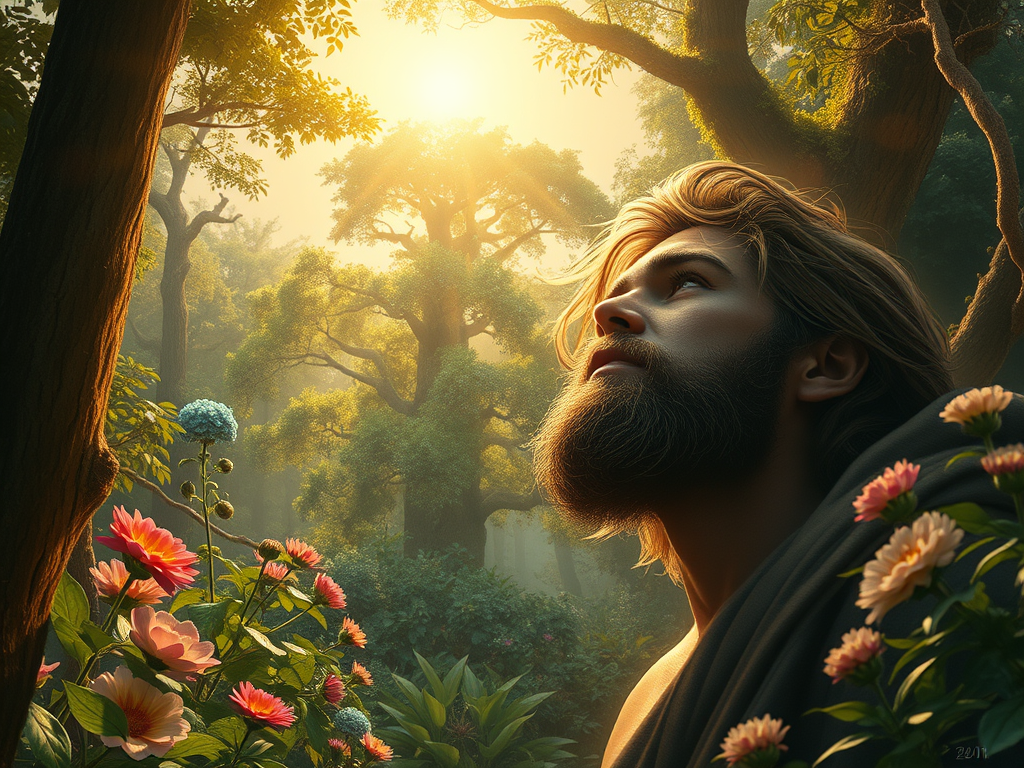
This image was created by AI from the words of the sermon. Interestingly and controversially AI has made a choice for a white Adonis – more filmstar than gardener!

In the beginning everything was so good, and so well made.
Everything was generated from the heavens and the earth when they were created, when the Lord God made the earth and the heavens.

This story of creation is not the history of creation – as if this happened, then that happened, and the rest is history, sort of thing.
This story of creation is the theology of creation, and is true.
It is true for those who believe in God, who see God in all our beginnings, who trust in God’s blessing. It is spiritually true, not scientifically true.
Spiritual truth stands the test of time.
It is so true that it moves us to wonder and reverence.

It comes from a faith that sees God’s blessing in the beginnings of all life, that sees heaven and earth knitted together by a God who in the first place only ever wanted to give life. It comes from a faith that sees God loving everything he has made, delighting in what he has so well made.

It is a faith which realises that without God we are nothing.
Here God brings man to life by getting into his face and breathing into his nostrils the breath of life, and the first breath of language.

God brought to the man in the garden everything he’d made from the dust of the ground.
This was to see what he’d call them and whatever he called them, that became their name. 

God wanted to see what he called them.
That is something we’ve stopped imagining isn’t it?
Do we imagine God being interested in the names we call things, and the names we call people?
How different our world would be if we did have that imagination to name others in a way that would please God.
How different our world would be if, with that imagination, we didn’t demean the creatures of God’s making.

Our naming, our calling, the language we use, is part of the choice that is fundamental to the book of Genesis. In a world where language so much divides us we could usefully reflect on the choices of words and names we make and how they reflect our relationship with God and creation. 

The choices we make about language can be mighty acts of creation.
But remember, it takes time to call someone “lovely” in a way they will understand and take to heart.
It takes no time at all to voice a hurtful call that will break the heart of a relationship.
Our words have creative power and they have destructive power.
The choice is ours to make.

From the beginning there is choice.
There’s always been choice. 

Besides our naming and calling there’s the choice of obedience and disobedience.
The choice is there for the couple in the garden.
Can we get away with eating the fruit from the tree of the knowledge of good and evil?
There was only one thing forbidden by God and that was it.
The man and the woman only had to be obedient in that one thing and they weren’t.
They were disobedient and took the law into their own hands. 

This was their first bad choice, and the rest they say is history.
One bad choice led to another, and then another and then another in rapid succession.
They got dressed to cover their shame (bad choice, but perhaps necessary), they ducked their responsibility and blamed something else (the serpent) and they hid themselves from God.

One rotten choice after another.
Hot on the heels of these choices comes the story of the children of the first procreation, the story of Adam and Eve’s two sons, Cain and Abel, the story of the first murder, a shocking murder, fratricide, the killing of brother by brother.
God had tried to help Cain. “Why are you angry?”
(Perhaps we all need God to ask us that question in our anger.)
“Why are you angry? Why is your face downcast?
If you do what is right, will you not be accepted?
But if you do not do what is right, sin is crouching at your door; it desires to have you, but you must rule over it.” (Genesis 4:6-7).

That’s the choice.
That’s the choice for Cain and it’s the choice for us.
Sin crouches at the door.
We must rule over it.
That’s the way with sin, isn’t it?
It makes itself small and then looms large.
It makes itself seem so small that we often think that we have done little wrong. 

The book of Genesis concludes with stories about Joseph and the right choices he made.
He goes from being a tactless 17 year old (37:2) to become a powerful and self-disciplined man by the choices he make.
He refuses sex when it’s offered him on a plate, and he refuses to retaliate against his brothers for their jealous bullying, instead he saves their lives and the lives of all in Egypt.
Sin was always at his door, but he nails it.
His good choices undo some of the harm caused by the bad choices of his brothers – including their jealousy of Joseph, their intention to kill Joseph (another fratricide) and their intention to deceive their father into believing his son was dead.

The picture painted by Genesis is that in all our beginnings is God’s love of life, love for our life and blessing in abundance.
There are all the blessings of creation, all the animals, the flora and fauna, and all living beings – all to enjoy.
There is almost too much to choose from and choices become challenging and difficult decisions have to be made. 

From the beginning it’s the choices we make that intrigue God.
He wants to see what we will call others.
He wants to see how we will manage the passions he has given us to work the garden and take care of everything.
He wants to see how we manage our emotions.
He wants to see the choices we make when all around us people are choosing to hate and despise others.
He wants to see the choices we make about brotherhood and sisterhood. He wants to love all the choices we make.

Genesis is a book about beginnings, but is also about the mean time, when times get mean in the midst of life, when life gets challenging and difficult, like the time depicted in today’s gospel in the crossing of the lake (Luke 8:22-25).
At first, it’s all plain sailing, so much so that Jesus fell asleep.
Then a squall came down on the lake, and the boat was swamped and they were in danger.
They panicked.
“We’re going to drown!”

Isn’t this the way life goes?
First it’s plain sailing – then as we grow up life gets rough and we have choices to make.
The choice is whether we become doomsayers – “we are drowning in this, or in that”, or whether we remain hopeful, constant in love, believing our blessing.
When the storm subsided, when all was calm, Jesus asked those who were with him, “where is your faith?”

They were amazed.
“Even the winds and the water obey him”.
Their choice was to follow him.
How do the choices we make show our faith and our choice to trust that God is with us in the storms of our lives, longing to love the choices we make within those storms – whether we choose life, whether we choose peace, whether we choose kindness, whether we choose obedience?

Here’s the link to the readings

70 or 72? Do numbers count in Luke 10?

Is is 70 or 72, that is the question? I’m quite fascinated by numbers. Chapter’ 10 in Luke’s Gospel recounts the number Jesus sent out “like lambs in the midst of wolves” with “no purse, bag or sandals” with the greeting “peace to this house”.

Were there 70 or 72? I am just asking for a friend.

Of course, the answer begins with 7. Anything beginning with 7 is the right answer because 7 marks all our time. We have 7 days in a week – as God took 7 days for creation, 6 days work, then a day’s rest. 7 carries with it the meaning of perfection and completion.

According to some texts the answer is 70 – and there is good reason that there should be 70 because there were thought to be 70 nations – the descendants of Noah’s children who settled the earth after the flood. Is then the sending of the 70 the Godsend to all people who on earth do dwell? (And Jesus did send out the “70” two by two, didn’t he?)

According to other ancient texts the answer is 72. And there seems to be good reason for that as well. If there were 72 Luke 10 would read “after this the Lord appointed 72 others”. What is the “after this” referring to, and who are the others? The previous chapter (Luke 9:1-6) recounts Jesus calling “the twelve” together and sending them out with no staff, bag, bread, money. I am putting 2 and 2 together here and thinking that Luke might have intended “72”, because 72 plus the others (12 of them) makes 84.

84=7×12. There is the 7 again, that number signifying completion and satisfaction. But there is also 12, the number of the apostles, the number of the tribes of Israel (because of the number of Jacob’s sons). 84 is mentioned elsewhere by Luke – as the age of Anna the prophetess, who prayed in the temple night and day and who spoke about the child Jesus “to all who were looking for the redemption of Jerusalem”. (Luke 2:36-40). Anna’s age adds further significance to the number 84. It becomes a number of wisdom and proclamation.

If 72+12 = all the people of God, this becomes a passage not just about the sending out of 72, but the sending out of the whole people of God, you and me, sent out two by two.

If the answer is 70 then this become a passage about the destiny of peace’s greeting. “Peace to this house” then becomes a greeting for the whole world.

Is it 70 or 72? I’m just asking for a friend (to whom it matters).

Or do we treasure the happy ambiguity presuming that Jesus and Luke meant both: that the good news of the coming of peace should and would be carried to all nations, and that all God’s people are commissioned to be bearers of peace, even as lambs amongst wolves, even eschewing all the usual self defences?

The Mother and Father of all Song: The Song of Songs

the_kiss_-_gustav_klimt_-_google_cultural_institute
The well known “The Kiss” (1907-08) by Gustav Klimt (in a garden, wrapped in gold)

I don’t count myself a “biblical scholar”. When I come to my daily reading from the Old Testament it is often as if I am reading the section for the first time. (Along with others I tend to tweet my naive responses with the #cLectio hashtag, here, here, here, here and here.) My current intrigue is with the Song of Songs, a tiny book of love poetry. And it is as if I am reading it for the first time. I guess it has always been a closed book to me – closed because of its reputation and the manner of its interpretation possibly as a consequence of its reputation. By reputation it is highly erotic and “saucy”. I’d prefer the description “absolutely delightful”. I wonder if a sense of embarrassment has led to its allegorical interpretations shared by synagogue and church which sees the poetry referring to the love of God for his people. Have such interpretations demeaned the text?

Some people will be surprised the Song of Songs is included in our scripture because there is no mention of God and the content is highly erotic. The Song of Songs is the title of the book. It is a superlative title indicating that this Song is very special. Colloquially we could say that this is the “mother and father of all song”. There are two speakers who are lovers. Later readers have named them Solomon (even David) and “the Shulammite” (someone from Jerusalem which translates as “the place of peace”). Allegorical interpreters have called one of the lovers “God” and the other “Israel” or “Church”. Personally I don’t see why we need to rush to their naming and I have preferred to leave them to themselves as two lovers. One of them, the maiden, has her confidantes. They are “daughters of Jerusalem”. They stand by. They have a view but no say. They stay as readers and celebrants. I have chosen to join them.

To me the couple are young lovers and with the Daughters of Jerusalem we are privileged to watch love building through them. My reading may have been influenced by Trevor Dennis (here is reason why we should reading him) who finds reason to call Adam and Eve children in his reading of Genesis. There are so many references to a garden in the Song of Songs that I couldn’t help going back to the Garden of Eden, to the boy and the girl we find in paradise. We have to be sorry the way they turned out (and the way they were turned out). I can’t help wondering whether The Song of Songs is dreaming a happy ending, building in love rather than falling in love.

In Imagining God Dennis imagines this “childs’ play”:

One hot afternoon Adam and Eve, unselfconsciously naked, sat on the bank of one of the rivers of Eden, dangling their feet in the water. Eve picked up a flat, round stone, stood up and flicked it in twelve graceful bounces right across to the other side.

‘Who taught you to do that?’ asked Adam.
‘God did.’
Adam turned towards God. ‘Did you really?’
‘Yes.’
‘Could you teach me?’
‘Of course. Watch.’

God stood up, chose a stone carefully, kissed it, curled his finger round it, and, with a movement of his wrist too quick to catch, sent it spinning downstream. It went almost as far as Adam and Eve could see, then swung round in a tight circle and came speeding towards them again, till with one last bounce it skipped back into God’s hand. It had hit the water two hundred times, and had left two hundred circles spreading and entwining themselves upon the surface. From the middle of each circle a fish leaped, somersaulted, and splashed back into the river.

‘Now you try!’ said God. Adam pushed him into the water. God came to the surface a few yards out from the bank. ‘That was level ten, by the way,’ he called. ‘Eve’s only at level two at the moment, aren’t you Eve?’ ‘You were showing off, God,’ said Eve. ‘You’ll be walking on the water next!’ ‘That’s level twenty,’ laughed God, and promptly disappeared beneath the surface.

So it was once in Eden. So it can be still. So it is, on rare and precious occasions. But Adam and Eve complicated matters. They grew up to think flicking stones child’s play. They turned in upon themselves, and God remained out of sight, beneath the surface. They did not sit with him on the bank any more. Now and then, realizing their loneliness and overcome with sudden longing, they would gaze out across the water and see the ripples he left behind. But these were soon gone, and the water would resume its customary smoothness, as if nothing had happened, as if he had never been there.

There are so many beautiful images in this Love Song of Love Songs. It is spring time, a time for building love’s nest. The references to spring signify love that is young, lovers for whom relationship is a novel and delicious mystery.

My beloved speaks and says to me:
“Arise, my love, my fair one,
and come away;
for now the winter is past,
the rain is over and gone.
The flowers appear on the earth;
the time of singing has come,
and the voice of the turtle-dove is heard in the land.
The fig tree puts forth its figs,
and the vines are in blossom;
they give fragrance.
Arise, my love, my fair one,
and come away.”
Song of Songs 2:10-13

The song is soaked in pleasant images, images that are so sensual. They are images of body and bed, field and garden. The whole of creation seems to behind their love and a rich harvest is the outcome of their love. With the Daughters of Jerusalem and with the young lovers, we are allowed into a special world. For me, this is a creation story: the mother and father of so many love songs.

(And, of course, it reminded me of another garden, the strange meeting of two people there and the love that never goes cold between them.)

Mary stood weeping outside the tomb … As she wept, she bent over to look into the tomb; and she saw two angels in white, sitting where the body of Jesus had been lying, one at the head and the other at the feet. They said to her, “Woman, why are you weeping?” She said to them, “They have taken away my Lord, and I do not know where they have laid him.” When she had said this, she turned round and saw Jesus standing there, but she did not know that it was Jesus. Jesus said to her, “Woman, why are you weeping? For whom are you looking?” Supposing him to be the gardener, she said to him, “Sir, if you have carried him away, tell me where you have laid him, and I will take him away.” Jesus said to her, “Mary!” She turned and said to him in Hebrew “Rabbouni!” (which means Teacher).                           John 20:11-16

Love has created a world of its own – always has done, always will.

The text of the Song of Songs is laid out here.

a little pure joy

Thanks to Simon Marsh for posting Sparkling WatersAs he says, “a little pure joy for the eyes and ears.” My own reflection, my play on the water, is filtered through questions of those who feel in the doldrums and those who can’t be still.

Stunningly beautiful,
fairly typical
reflecting water
reflecting life
never calm
playground
for light
sparkling, bubbling,
becoming.
Never still.
Only becalmed to the senseless, the dead.

Creation

Our God and Father, you have revealed to us the secrets of the earth, the sea and the sky.
You have enabled us to discover the animal, vegetable and mineral resources of this planet.
Teach us now to use them wisely, effectively and to the benefit of us all, so that we may in unity enjoy the riches which you have provided, in justice, peace and prosperity; through Jesus Christ our Lord.

Gordon McPhate, Dean of Chester Cathedral.

>Side by side by God

>Yesterday we played with our text from John 14:15-21 -particularly “I will ask the Father, and he will give you another Counsellor to be with you for ever – the Spirit of truth.”

At one stage “counsellor” was translated “advocate” or more obscurely “paraclete”. Both those words carry the meaning of “called to the side of” – so Jesus is promising another one to be “on/at our side” (the other one being Jesus himself). It’s quite something to have God “at/on our side”.

Preparing yesterday’s sermon I came across these words: “We observe some people who are seriously ill and marvel at their courage and doggedness. How do they do it?, we wonder. What enables them to go on and not become discouraged and bitter? Then we notice a worn bible and prayer books by their bedside; the regular visits of a eucharistic minister bringing them communion and words of support from parishioners; family and friends who assure the infirmed of regular prayers and visits.” – All these at her side – as advocate, counsellor, paraclete and all those other words we use to describe the effect of God’s work at our side and on our side – encourager, comforter and peace. I wonder how this understanding inspires a more effective ministry of advocacy – the nurse, solicitor, neighbour, friend and priest.

It reminds me of another reference to God being at our side in his creation of companionship and relationship when kneeling on man’s side removed one of his ribs to create a woman. (Genesis 2:21) There’s a good cartoon here with Eve saying “No Adam, I don’t want to see your scar.”

Let people be

> “The beginning of love is to let those we love be perfectly themselves, and not to twist them to fit our own image. Otherwise we love only the reflection of ourselves we find in them.”
~ Thomas Merton
The biggest temptation comes with our children. Their birth becomes even more miraculous when we realise how different they are from us. When we respond to questions about which parent they got this that or the other quality or characteristic from with “they didn’t get it from either of us” we are admitting our wonder at creation.
The myth of Narcissus illustrates the tragedy of self-love. Waterhouse’s painting (from the Walker Gallery) shows Narcissus helplessly in love with himself and totally oblivious of Echo’s desire.