This is where mercy takes her stand: far off, in the distance

Readings: Luke 18:9–14; Ecclesiasticus 35:12–17

The clocks have changed. The weather’s changed.
And we stand now on the bridge between seasons.

Today is the last Sunday after Trinity.
Next Sunday is the first in the new Kingdom season –
when we see the darkness of the kingdoms of this world,
and pray again for the world to be turned the right way up
with the rule of God’s Kingdom founded in heaven.

As the light shortens and we cross that bridge between seasons,
it feels right to pause and ask what endures –
what stands firm when the world tilts and turns.

And Jesus gives us this story;
a parable about where mercy truly stands.

This is where mercy takes her stand: far off, in the distance.

I want us to notice this morning
the two men Jesus talks about in the parable –
a story he addressed to some
who were confident of their own righteousness
and looked down on everyone else.

Notice how the Pharisee did what was expected of him,
just as he was supposed to,
obedient to the teachings of his religion.

He tithed and he fasted.
He did just what was right.
He was a religious success –
the sort of success to make a temple proud.

He stood confidently still,
as if he owned the place –
the temple where he was the perfect fit,

And he smugly gave thanks
that he wasn’t like the others:
robbers, evildoers, and adulterers.

In fact, he put himself first,
the best he could be,
better than all the rest,
better than the tax collector they all despised,
standing over there, at a distance.

He gave himself the prize,
he was the pride of the temple –
the one to catch the eye
of those like him on centre stage:
the success stories,
the ones who come first in their own eyes
and the eyes of the world,
those who are proud of their achievement,
who look down on those who can’t match them.

But he’s not the one who catches Jesus’ eye.
Mercy’s gaze has turned elsewhere.

This is where mercy takes her stand —
not in the proud posture of the Pharisee,
but with the one who stands at a distance,
head bowed, heart open,
praying only, “God, be merciful to me, a sinner.”

The tax collector hasn’t much to commend him.
He’s made a living making compromises,
lining his own pocket when he must,
doing the bidding of an empire,
taxing his people, cheating his people,
keeping them poor.

He too has come to pray.
He stands apart.
He knows he’s not fit
to join those who look down on him.
He knows the weight of those eyes
and their condemnation, surely justified.

But still he prays where he’s been pushed aside –
in that low place, in that honest place –
and he finds the only prayer he can manage:
“God, be merciful to me, a sinner.”

That’s all.

There are people good at praying, like the Pharisee.
It comes easy to them.

But this tax collector has nothing to claim.
He can’t make comparisons; he can’t claim to be good.
He has no list of good intentions.
All he has are these few words –
and that’s enough for Jesus.

Jesus has highlighted two men –
two types, one self-righteous and sure of himself,
the other “worse” by some distance.

There’s only one who goes home justified,
and it’s not the one we expected,
the one who thanks God he’s better than all the rest,
the one who thinks he’s the best he can be.

It’s the other one, the one on the edge,
the one in the distance, going home justified
(whatever “going home” might mean).

That’s quite some punchline from Jesus,
punching the pride of the temple,
and those confident in their own goodness,
who look down on everyone else.

“All who exalt themselves will be humbled,
and those who humble themselves will be exalted.”


That’s turning the world upside down,
and the truth inside out.

And it still happens today,
whenever we’re brave enough to look beyond ourselves.

There’s a man who sits under the bridge in our town.
I’ve passed him many times,
hesitating, not sure what to say,
worried about what it might cost to engage.
But this week, I stopped.
I’d found my opening line.
We talked.
He had plenty to say.
I found him articulate, intelligent, resilient,
unhealthy, unlucky.
I went away thankful.

I wasn’t thankful I wasn’t like him –
God forbid.
Rather, I was thankful that I am.
Thankful that mercy makes us kin,
that empathy builds bridges and common ground.

I had stood my distance – the shame was all mine.
The shame that it’s taken me so long
to learn how to join those down and those out.

This is where mercy takes her stand —
on the bridges, in the margins,
in the hearts of those who stand at a distance.

And maybe this is a small thing to notice,
but it strikes me that the Pharisee, in his way,
is saying what we so often hear today —
“I’m feeling blessed.”
Blessed that life’s gone well,
blessed that I’m not struggling,
blessed that I’m not like those who’ve fallen on hard times.
But the tax collector doesn’t say that.
He doesn’t feel blessed —
he only feels the weight of mercy.
And yet he’s the one who goes home justified,
seen, forgiven, restored.
Maybe that’s what blessing really looks like —
not success, but mercy meeting us
when we’ve nothing left to boast about.

Today is Bible Sunday,
a reminder that Scripture isn’t just something we read —
it’s something that reads us.
The Pharisee knew his Bible well,
but he used it to build himself up.
The tax collector may not have known a verse,
yet he lived the truth of one we’ve heard this morning:
“The prayer of the humble pierces the clouds” (Ecclesiasticus 35).
God’s Word lands where mercy already waits.

And that is what this parable shows us —
the way God’s kingdom comes:
not through pride or perfection,
but through mercy that stoops low
and finds us where we are.

For God sides with the penitent sinner,
with the humble, with the broken,
with those the world overlooks.
And when we begin to see as God sees —
when we recognise the brother under the bridge,
the sister on the edge —
we discover that the kingdom has already drawn near.

This is where mercy takes her stand:
far off, in the distance,
on the edge where humility meets hope,
and where God is already at work,
turning the world the right way up.

All who exalt themselves will be humbled,
and all who humble themselves will be exalted.
That’s not a threat.
That’s a promise.
That’s the way the world is set right.

Luke 18:9-14
To some who were confident of their own righteousness and looked down on everyone else, Jesus told this parable: ‘Two men went up to the temple to pray, one a Pharisee and the other a tax collector. The Pharisee stood by himself and prayed: “God, I thank you that I am not like other people – robbers, evildoers, adulterers – or even like this tax collector. I fast twice a week and give a tenth of all I get.”
‘But the tax collector stood at a distance. He would not even look up to heaven, but beat his breast and said, “God, have mercy on me, a sinner.”
‘I tell you that this man, rather than the other, went home justified before God. For all those who exalt themselves will be humbled, and those who humble themselves will be exalted.
LimpLight

This one’s for all who wrestle in the dark and rise, blessed but limping, inspired by reading Genesis 32:22-31 and Luke 18:1-8 – the Revised Common Lectionary readings for October 19th 2025.

How shall we describe the state of Israel today?

The state of Israel today begins with both our readings —
from Genesis 32, the story of Jacob whose name means twister;
and from Luke 18, the story of the widow struggling for justice.

The state of Israel begins at the end of a night of struggle for the twister,
a night of struggle in which Jacob never discovers
the name of the one he’s wrestling with,
but finds himself called by a new name — Israel.

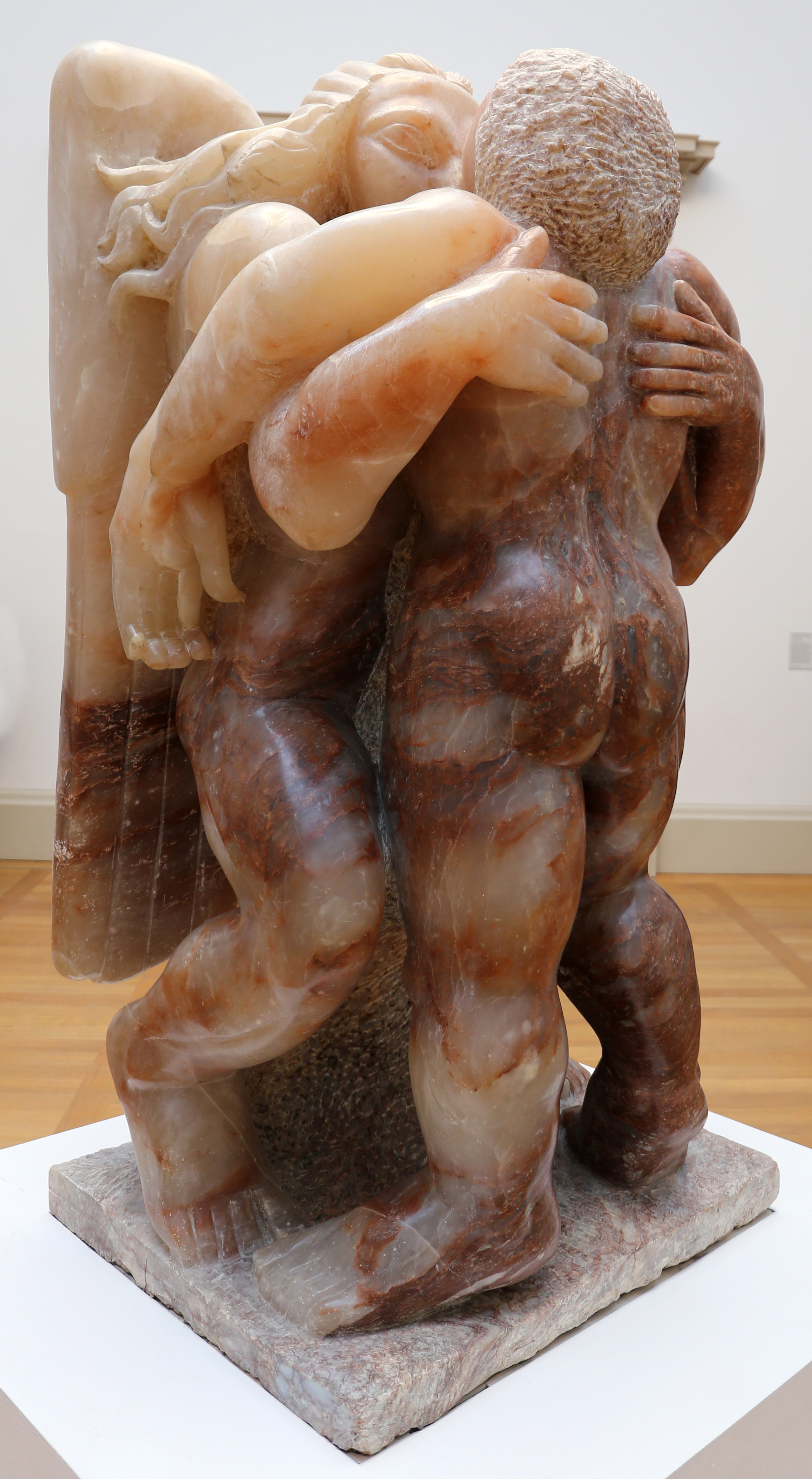
Jacob’s struggle as portrayed by Sir Jacob Epstein (shown in Tate Gallery, London)

Israel struggles with God,
and God struggles with Israel.
That is the very meaning of Israel.
If Israel means anything,
it means struggling with God.

Jacob is the first to be called Israel,
and he is called (renamed) that by the one he struggled with
because he “struggled with God and with people”
and withstood the whole night.

It is the calling of Israel to struggle faithfully through the night.

Jacob is the patriarch of Israel —
the patriarch of those who struggle with God and with people,
and who carry on wrestling through long nights and times of darkness
without being overcome,

people like the widow singled out by Jesus —
a victim of some injustice.
In the face of an utterly unjust justice system,
personified by a judge who neither feared God
nor cared what people thought,
she struggled.

For some time she struggled.
She kept coming at that lousy judge.
She wouldn’t let go until he gave in.

Those who struggle through the night,
with God and with people —
those who struggle to see the night through,
for whom the night is very dark,
and for whom there is little daylight,
those who won’t give up whatever the night brings —
they are the ones whose hope is rewarded.

They carry a blessing for all who wrestle with God
and with the wounds people inflict.

It’s the blessing of God
who himself wrestles through the darkness of the world,
who struggles with people and the suffering they cause,
but who, in spite of all that,
wrestles the whole night long.

This is the love that shines in the darkness
to the break of day.

And yet, the night is long.
Not just one night in Jacob’s life,
not just one night in ours,
but the long night of the world —
a night as long as history.

Through that long night we wrestle,
and God wrestles with us.

There are three struggles woven into this story,
and all three belong to Israel:

We struggle with God.
We struggle with people —
and people struggle with us.
And through it all,
God struggles with us.

That’s what it means to be called Israel:
to live the long night of wrestling,
and to trust that, at the end of it,
there will still be blessing.

The struggle with God

Sometimes it’s the long silence of prayer —
when we ask and wait and hear nothing.
Sometimes it’s the ache of loss,
or the questions that faith won’t easily answer.
We wrestle with God when life doesn’t fit the promise,
when love feels hidden,
when blessing comes only after a wound.

But still we hold on.
Faith is not certainty —
faith is the grip that will not let go until morning.

The struggle with people

And we wrestle with people too.
Not just those who hurt or wrong us,
but in all the difficult ways love tests us —
learning to forgive, to be patient,
to stay kind when we’d rather give up,
to bear with one another’s weakness.

People struggle with us too —
our faults, our sharp words, our stubbornness.
We are all part of each other’s wrestling.

These are the struggles that form the fruits of the Spirit —
the quiet strength that grows only in the dark:
patience, gentleness, self-control,
love that endures through the night.

The struggle with ourselves

And maybe there’s a fourth struggle too —
the one Jacob knew best —
the struggle with ourselves.
The fight to face what we’ve twisted,
to tell the truth about who we are,
and to accept the new name that grace gives us.

Before we can meet God face to face,
we have to face ourselves in the dark —
the parts we’d rather not see,
the wounds we’ve caused as well as borne.
Even that struggle can become blessing.

The struggle of God

And through it all, God struggles too —
not against us, but for us.
God wrestles through the night of the world,
bearing our pain,
refusing to give up on us.
The cross itself is the mark of that struggle —
God’s own wound,
the divine limp that still bears the weight of love.

This is the love that shines in the darkness
to the break of day.

Jacob wanted to know the man’s name,
but the man would not tell him.

Maybe that’s the mercy of God —
that we never get to hold the name too tightly.
The namelessness keeps the struggle open.
It reminds us that this wrestling is for everyone,
that God stands with all who struggle through the night —
beyond borders, beyond certainty, beyond control.

It was not for ease that prayer shall be.
The story of Israel is not the story of the untroubled.
The story of Israel is the story of the very troubled —
the story of slavery, exile, persecution,
the horrors of history, the nightmare.

Amos got it right three thousand years ago.
He condemned the complacent,
those who are at ease in Zion.
He said they put off the day of disaster
and bring near a reign of terror.
They are not fit to be called Israel.
They duck the fight and ignore the struggle.

But Jacob did not.
The widow did not.
And the God who wrestles through the night does not.

Jacob’s blessing comes with a wound.
He carries it into the dawn,
every step a reminder of the night he endured
and the God who would not let him go.

Perhaps this is the mark of the blessed —
not the ones who have had an easy time of it,
but the ones who have been wounded and changed.
The ones who know that life is not straightforward,
that faith is not certainty,
and that love costs something real.

Israel limps into the sunrise,
blessed and broken.

And still, the night is long —
as long as history,
as wide as the world.
Still, God wrestles with us,
still struggles with his people,
still bears our wounds,
and still blesses us.

And when the dawn comes —
as surely it will —
the blessing will not erase the limp,
but redeem it.

For the love that shines in the darkness
will shine until the whole world
limps into the light.

Afterthoughts
What might it mean for a people, or for a church, to be known by its limp – to be blessed not in strength but in struggle?
If God still wrestles through the long night of the world, where do you see that struggle – and that love – happening today?

Making choices, making life

A reflection on the stories of creation in Genesis 2 and the storm on the lake in Luke 8:22-25. These are the readings set for the 2nd Sunday before Lent (C).

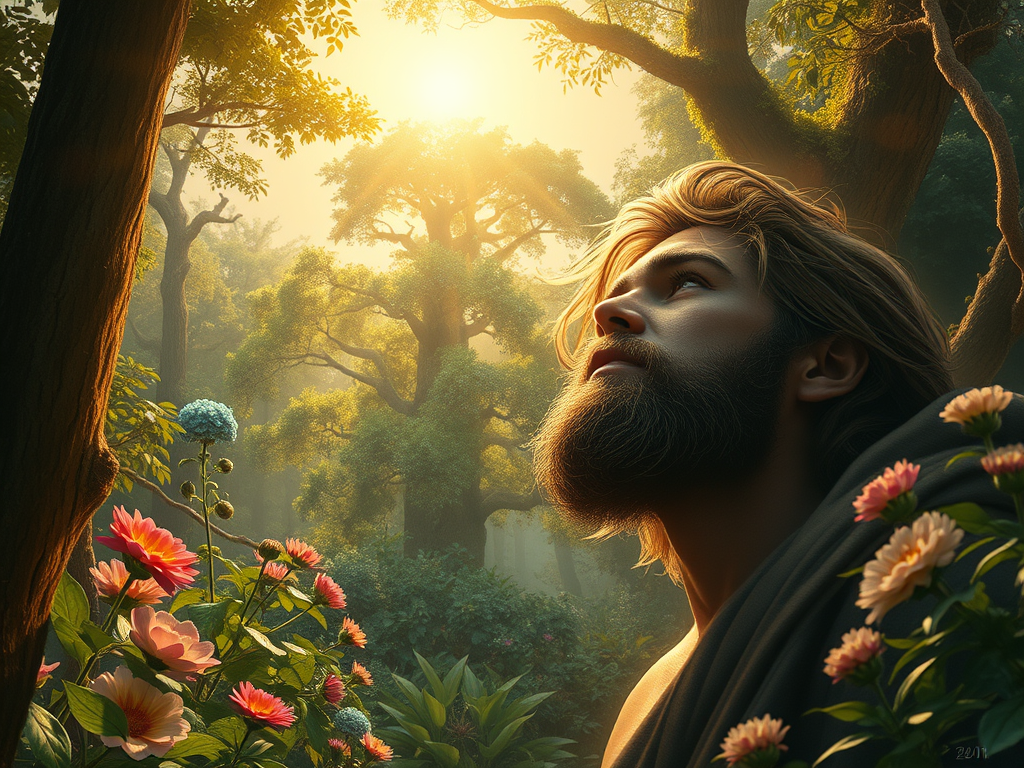
This image was created by AI from the words of the sermon. Interestingly and controversially AI has made a choice for a white Adonis – more filmstar than gardener!

In the beginning everything was so good, and so well made.
Everything was generated from the heavens and the earth when they were created, when the Lord God made the earth and the heavens.

This story of creation is not the history of creation – as if this happened, then that happened, and the rest is history, sort of thing.
This story of creation is the theology of creation, and is true.
It is true for those who believe in God, who see God in all our beginnings, who trust in God’s blessing. It is spiritually true, not scientifically true.
Spiritual truth stands the test of time.
It is so true that it moves us to wonder and reverence.

It comes from a faith that sees God’s blessing in the beginnings of all life, that sees heaven and earth knitted together by a God who in the first place only ever wanted to give life. It comes from a faith that sees God loving everything he has made, delighting in what he has so well made.

It is a faith which realises that without God we are nothing.
Here God brings man to life by getting into his face and breathing into his nostrils the breath of life, and the first breath of language.

God brought to the man in the garden everything he’d made from the dust of the ground.
This was to see what he’d call them and whatever he called them, that became their name. 

God wanted to see what he called them.
That is something we’ve stopped imagining isn’t it?
Do we imagine God being interested in the names we call things, and the names we call people?
How different our world would be if we did have that imagination to name others in a way that would please God.
How different our world would be if, with that imagination, we didn’t demean the creatures of God’s making.

Our naming, our calling, the language we use, is part of the choice that is fundamental to the book of Genesis. In a world where language so much divides us we could usefully reflect on the choices of words and names we make and how they reflect our relationship with God and creation. 

The choices we make about language can be mighty acts of creation.
But remember, it takes time to call someone “lovely” in a way they will understand and take to heart.
It takes no time at all to voice a hurtful call that will break the heart of a relationship.
Our words have creative power and they have destructive power.
The choice is ours to make.

From the beginning there is choice.
There’s always been choice. 

Besides our naming and calling there’s the choice of obedience and disobedience.
The choice is there for the couple in the garden.
Can we get away with eating the fruit from the tree of the knowledge of good and evil?
There was only one thing forbidden by God and that was it.
The man and the woman only had to be obedient in that one thing and they weren’t.
They were disobedient and took the law into their own hands. 

This was their first bad choice, and the rest they say is history.
One bad choice led to another, and then another and then another in rapid succession.
They got dressed to cover their shame (bad choice, but perhaps necessary), they ducked their responsibility and blamed something else (the serpent) and they hid themselves from God.

One rotten choice after another.
Hot on the heels of these choices comes the story of the children of the first procreation, the story of Adam and Eve’s two sons, Cain and Abel, the story of the first murder, a shocking murder, fratricide, the killing of brother by brother.
God had tried to help Cain. “Why are you angry?”
(Perhaps we all need God to ask us that question in our anger.)
“Why are you angry? Why is your face downcast?
If you do what is right, will you not be accepted?
But if you do not do what is right, sin is crouching at your door; it desires to have you, but you must rule over it.” (Genesis 4:6-7).

That’s the choice.
That’s the choice for Cain and it’s the choice for us.
Sin crouches at the door.
We must rule over it.
That’s the way with sin, isn’t it?
It makes itself small and then looms large.
It makes itself seem so small that we often think that we have done little wrong. 

The book of Genesis concludes with stories about Joseph and the right choices he made.
He goes from being a tactless 17 year old (37:2) to become a powerful and self-disciplined man by the choices he make.
He refuses sex when it’s offered him on a plate, and he refuses to retaliate against his brothers for their jealous bullying, instead he saves their lives and the lives of all in Egypt.
Sin was always at his door, but he nails it.
His good choices undo some of the harm caused by the bad choices of his brothers – including their jealousy of Joseph, their intention to kill Joseph (another fratricide) and their intention to deceive their father into believing his son was dead.

The picture painted by Genesis is that in all our beginnings is God’s love of life, love for our life and blessing in abundance.
There are all the blessings of creation, all the animals, the flora and fauna, and all living beings – all to enjoy.
There is almost too much to choose from and choices become challenging and difficult decisions have to be made. 

From the beginning it’s the choices we make that intrigue God.
He wants to see what we will call others.
He wants to see how we will manage the passions he has given us to work the garden and take care of everything.
He wants to see how we manage our emotions.
He wants to see the choices we make when all around us people are choosing to hate and despise others.
He wants to see the choices we make about brotherhood and sisterhood. He wants to love all the choices we make.

Genesis is a book about beginnings, but is also about the mean time, when times get mean in the midst of life, when life gets challenging and difficult, like the time depicted in today’s gospel in the crossing of the lake (Luke 8:22-25).
At first, it’s all plain sailing, so much so that Jesus fell asleep.
Then a squall came down on the lake, and the boat was swamped and they were in danger.
They panicked.
“We’re going to drown!”

Isn’t this the way life goes?
First it’s plain sailing – then as we grow up life gets rough and we have choices to make.
The choice is whether we become doomsayers – “we are drowning in this, or in that”, or whether we remain hopeful, constant in love, believing our blessing.
When the storm subsided, when all was calm, Jesus asked those who were with him, “where is your faith?”

They were amazed.
“Even the winds and the water obey him”.
Their choice was to follow him.
How do the choices we make show our faith and our choice to trust that God is with us in the storms of our lives, longing to love the choices we make within those storms – whether we choose life, whether we choose peace, whether we choose kindness, whether we choose obedience?

Here’s the link to the readings

God’s work in broken community

Reflecting on Paul’s call to order and Jesus’ manifesto in the readings for the day, 1 Corinthians 12:12-31a and Luke 4:14-21 for the 3rd Sunday of Epiphany (C) for two small congregations in a lively/lovely group of parishes in rural Warwickshire. This post includes a video of Bishop Mariann Edgar Budde discussing her sermon that made headlines following President Trump’s inauguration service.

January 26th 2025

First of all, a note. I normally get round the problem of God’s pronoun by  using the name of God instead of a pronoun.  But, here, I am going to need a pronoun. There are many objections to using “he/him” because the name God is then linked with power, privilege and patriarchy – and the language we use about God needs to set God free from such associations, particularly in these days of right wing nationalism popularised by men such as Trump, Putin, Musk and Netanyahu. So, for this sermon, when I need to resort to God’s pronouns it will be she/her. I hope you will understand why.

In a world where God’s name is often associated with power, control, and patriarchy, using ‘she/her’ reminds us that God transcends these human limitations and works to free us from systems that seek to dehumanize and divide. It is not an attempt to redefine God’s essence but to challenge our projections of power. Forever God gathers the lost, gives strength to those who are weak, and honour to those who have been shamed and ashamed.

In the midst of controversy Paul has this to say to the troubled, disjointed community of Corinth. “We were all baptised by one Spirit so as to form one body – whether Jews or Gentiles, slave or free”. Here was a community facing all sorts of problems with all sorts of differences. Paul reminds them what God does in the middle of such a community. She brings us together to form one body from the splinters and divisions. She gathers us from far and wide and makes of us one body whatever the differences between us.

Paul stands in the middle of the conflict and witnesses to what God does. He reminds the community of the abundance of God’s gifts and the value and diversity of each and every one of them for the purpose of community building and reconciliation, reminding the body around him that every member needs every other body to fully function. 

Perhaps Paul remembered the prophecy in the valley of dry bones – a valley of untold war crimes from which the bones of those killed were left out in the scorching sun for the wild animals to pick the meat from. The sound from this valley overshadowed in death was the noise of a disjointed people overwhelmed by tragedy. “Our bones are dried up, our hope is lost” is what they said. (Ezekiel 37:11). Those bones speak of a people abandoned, dehumanised and rendered invisible. In that valley Ezekiel was made to tell the truth about what God does, how she undoes the shame by breathing life into the very bones of a community destroyed, dismembered and left to rot.


This is what God does. Even as we walk through the valley of the shadow of death, God brings us together. From the four corners of the world, Jews and Gentiles, slave and free, God brings us together in love in spite of differences between us. The Spirit that breathes life into the valley of dry bones is the same Spirit Paul saw at work amongst the Corinthians and is the same Spirit that unites us as the body of Christ, knitting us together from the corners of the world, and overcoming shame, division, and death itself.

You see, God remembers us. She remembers bodies that are broken, whether that be in the valley of dry bones, or the valley overshadowed by death, or communities torn asunder. 

Remembering for God isn’t simply a case of casting her mind back, as we would usually remember. God’s remember is always a re-creation, a bringing back together of what’s become disjointed and scattered, and making whole what has become broken. God’s remembering is a literal re-membering of the body, the remaking of community through the gifts of her Spirit.

This is, if you like, another creation story – the coming together of a people through the creativity of God’s Spirit. The Spirit remembers us as one body – connecting toe bone to foot bone to ankle bone to leg bone to knee bone to thigh bone.

So Paul reminds the broken body around him that God has remembered them. God has remembered their broken body. “God has placed the parts in the body, every one of them” – just as she wanted them to be.

He goes on: “God has put the body together so that there should be no division in the body.” This is what God does and this is why God does it. God knits us together in love to be a strong body, a resilient body, a withstanding body, a body that can stand, even in the valley overshadowed by death.

This is what God does. She puts the body together.  

And this is what she does as a rule. She gives “greater honour to the parts that lacked it”. The rule of God is always to put the last and the least first. Here we see that rule being followed again with greater honour given to the parts that lacked it so that those parts which seemed weaker become indispensable and those parts thought less honourable are treated with special honour. This is how God remembers her people. This is what God builds a body for.

This is not just a spiritual gathering; this is a body meant for action. To be bound together by the Spirit is to be called into the work of justice, to bring good news to the poor, freedom to the prisoners, sight to the blind and liberation to the oppressed. This is the body God is building: a body that stands in stark contrast to the systems of division, hatred and shame that continue to pull our bodies apart.

We are the body God is building – here today listening to the body God prepared for us, listening to Jesus as he finds the body’s purpose revealed through the prophet Isiaiah to read to his fellow villagers in their synagogue in Nazareth.

The Spirit of the Lord is on me, because he has anointed me to proclaim good news to the poor. He has sent me to proclaim freedom for prisoners, and recovery of sight for the blind, to set the oppressed free, to proclaim the year of the Lord’s favour. 

Mariann Budde is a member of the body of Christ, gifted to be Bishop of Washington, president within a community God has brought together. It was her responsibility to preach at the prayer service in her cathedral. She preached the only way she could appealing to President Trump for mercy for those afraid because of the policies of the incoming president – those who are gay, lesbian or trans, and immigrants being targeted for deportation. Trump should not have been surprised by her appeal. She was only embodying the very work of the body of Christ. In a time when power is often wielded by shame and divide, the body of Christ cries out on behalf of the oppressed, the disempowered and broken. This is the DNA of the body of Christ. This is all God brings us together for. This is what we are gifted for. We can do no other.

Closing prayer

God of unity, you breathe life into us and call us to be one body in Christ. We thank you for the gifts you’ve placed within each of us, and we ask that you strengthen us as a community, that we may bear witness to your love. We pray for healing where there is division, for hope where there is despair, and for courage to stand with the broken and the oppressed. May your Spirit unite us in justice, peace, and compassion. In Jesus’ name, we pray. Amen.