This is where mercy takes her stand: far off, in the distance

Readings: Luke 18:9–14; Ecclesiasticus 35:12–17

The clocks have changed. The weather’s changed.
And we stand now on the bridge between seasons.

Today is the last Sunday after Trinity.
Next Sunday is the first in the new Kingdom season –
when we see the darkness of the kingdoms of this world,
and pray again for the world to be turned the right way up
with the rule of God’s Kingdom founded in heaven.

As the light shortens and we cross that bridge between seasons,
it feels right to pause and ask what endures –
what stands firm when the world tilts and turns.

And Jesus gives us this story;
a parable about where mercy truly stands.

This is where mercy takes her stand: far off, in the distance.

I want us to notice this morning
the two men Jesus talks about in the parable –
a story he addressed to some
who were confident of their own righteousness
and looked down on everyone else.

Notice how the Pharisee did what was expected of him,
just as he was supposed to,
obedient to the teachings of his religion.

He tithed and he fasted.
He did just what was right.
He was a religious success –
the sort of success to make a temple proud.

He stood confidently still,
as if he owned the place –
the temple where he was the perfect fit,

And he smugly gave thanks
that he wasn’t like the others:
robbers, evildoers, and adulterers.

In fact, he put himself first,
the best he could be,
better than all the rest,
better than the tax collector they all despised,
standing over there, at a distance.

He gave himself the prize,
he was the pride of the temple –
the one to catch the eye
of those like him on centre stage:
the success stories,
the ones who come first in their own eyes
and the eyes of the world,
those who are proud of their achievement,
who look down on those who can’t match them.

But he’s not the one who catches Jesus’ eye.
Mercy’s gaze has turned elsewhere.

This is where mercy takes her stand —
not in the proud posture of the Pharisee,
but with the one who stands at a distance,
head bowed, heart open,
praying only, “God, be merciful to me, a sinner.”

The tax collector hasn’t much to commend him.
He’s made a living making compromises,
lining his own pocket when he must,
doing the bidding of an empire,
taxing his people, cheating his people,
keeping them poor.

He too has come to pray.
He stands apart.
He knows he’s not fit
to join those who look down on him.
He knows the weight of those eyes
and their condemnation, surely justified.

But still he prays where he’s been pushed aside –
in that low place, in that honest place –
and he finds the only prayer he can manage:
“God, be merciful to me, a sinner.”

That’s all.

There are people good at praying, like the Pharisee.
It comes easy to them.

But this tax collector has nothing to claim.
He can’t make comparisons; he can’t claim to be good.
He has no list of good intentions.
All he has are these few words –
and that’s enough for Jesus.

Jesus has highlighted two men –
two types, one self-righteous and sure of himself,
the other “worse” by some distance.

There’s only one who goes home justified,
and it’s not the one we expected,
the one who thanks God he’s better than all the rest,
the one who thinks he’s the best he can be.

It’s the other one, the one on the edge,
the one in the distance, going home justified
(whatever “going home” might mean).

That’s quite some punchline from Jesus,
punching the pride of the temple,
and those confident in their own goodness,
who look down on everyone else.

“All who exalt themselves will be humbled,
and those who humble themselves will be exalted.”


That’s turning the world upside down,
and the truth inside out.

And it still happens today,
whenever we’re brave enough to look beyond ourselves.

There’s a man who sits under the bridge in our town.
I’ve passed him many times,
hesitating, not sure what to say,
worried about what it might cost to engage.
But this week, I stopped.
I’d found my opening line.
We talked.
He had plenty to say.
I found him articulate, intelligent, resilient,
unhealthy, unlucky.
I went away thankful.

I wasn’t thankful I wasn’t like him –
God forbid.
Rather, I was thankful that I am.
Thankful that mercy makes us kin,
that empathy builds bridges and common ground.

I had stood my distance – the shame was all mine.
The shame that it’s taken me so long
to learn how to join those down and those out.

This is where mercy takes her stand —
on the bridges, in the margins,
in the hearts of those who stand at a distance.

And maybe this is a small thing to notice,
but it strikes me that the Pharisee, in his way,
is saying what we so often hear today —
“I’m feeling blessed.”
Blessed that life’s gone well,
blessed that I’m not struggling,
blessed that I’m not like those who’ve fallen on hard times.
But the tax collector doesn’t say that.
He doesn’t feel blessed —
he only feels the weight of mercy.
And yet he’s the one who goes home justified,
seen, forgiven, restored.
Maybe that’s what blessing really looks like —
not success, but mercy meeting us
when we’ve nothing left to boast about.

Today is Bible Sunday,
a reminder that Scripture isn’t just something we read —
it’s something that reads us.
The Pharisee knew his Bible well,
but he used it to build himself up.
The tax collector may not have known a verse,
yet he lived the truth of one we’ve heard this morning:
“The prayer of the humble pierces the clouds” (Ecclesiasticus 35).
God’s Word lands where mercy already waits.

And that is what this parable shows us —
the way God’s kingdom comes:
not through pride or perfection,
but through mercy that stoops low
and finds us where we are.

For God sides with the penitent sinner,
with the humble, with the broken,
with those the world overlooks.
And when we begin to see as God sees —
when we recognise the brother under the bridge,
the sister on the edge —
we discover that the kingdom has already drawn near.

This is where mercy takes her stand:
far off, in the distance,
on the edge where humility meets hope,
and where God is already at work,
turning the world the right way up.

All who exalt themselves will be humbled,
and all who humble themselves will be exalted.
That’s not a threat.
That’s a promise.
That’s the way the world is set right.

Luke 18:9-14
To some who were confident of their own righteousness and looked down on everyone else, Jesus told this parable: ‘Two men went up to the temple to pray, one a Pharisee and the other a tax collector. The Pharisee stood by himself and prayed: “God, I thank you that I am not like other people – robbers, evildoers, adulterers – or even like this tax collector. I fast twice a week and give a tenth of all I get.”
‘But the tax collector stood at a distance. He would not even look up to heaven, but beat his breast and said, “God, have mercy on me, a sinner.”
‘I tell you that this man, rather than the other, went home justified before God. For all those who exalt themselves will be humbled, and those who humble themselves will be exalted.

Egged on by Mary and Elizabeth, here I go again

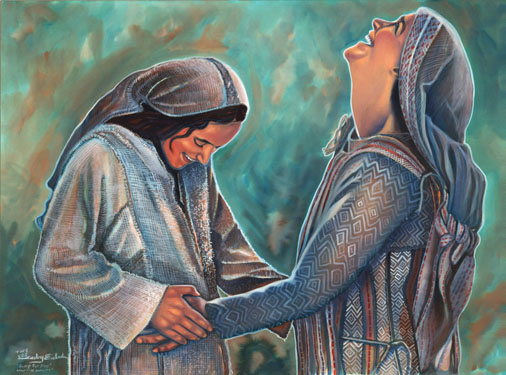
Here I go again, egged on by Elizabeth, Mary and Micah – a reflection for Advent 4C. I don’t seem able to help myself. I can’t stop preaching that small is so beautiful, thanks to God who raises the lowly, graces the dis-graced and scatters the proud. Maybe it’s because I’ve been helping small churches this year.

Jump for Joy by Corby Eisbacher reproduced with permission

In these Sundays of Advent we come face to face with the faith of Israel. It is not the faith of all Israel. If everyone agreed in their faith Jesus would not have had to face such opposition. The faith we come face to face with in Advent is the faith that has been passed down the generations in our scriptures, and lived out by so many. The faith of Israel is about what we expect and what we live for.

It’s a faith which celebrates God’s opposition to the proud and Gods’ favour for those who are lowly, humble and poor in spirit.

So we have today’s readings, from the prophet Micah (5:2-5a) and Luke (1:39-55).

But first, a diversion. 

When the wise men went looking for the one born king of the Jews they stupidly went about it the wrong way. They went looking in Jerusalem. They did not know the rule of the kingdom of God that the first come last and the last come first. The capital wouldn’t cradle the Messiah. In fact, the capital did nothing other than scoff and plot against the one born king of the Jews. Their satnav took them to Jerusalem, nine miles wide of the mark, the cross on the map where Jesus was born.

It was the chief priests and scribes that directed Herod’s attention to Bethlehem as the place where the ruler to shepherd Israel would be born. It was Herod who sent the wise men to Bethlehem to search for the child.

That’s probably the way most of us would go. You could be excused for expecting to find what you’re looking for in the capital, the seat of power.

But the faith of Israel knows different, Micah expresses that prophetic faith, implicitly warning us not to look for leadership in the usual places but to expect the one to rule in Israel to come from one of the little clans of Judah, one of the little clans of Jews, even from Bethlehem of Ephrathah.

Ephrathah is the old name for Bethlehem. It means fruitfulness and Bethlehem means the house of bread. It was the place of fruitfulness that Micah directs us to – not to Jerusalem. The thing about fruitfulness is its abundance but the abundance is the fruit of tiny seed, scattered by the fall and the wind and pollinated by the humble bee. 

The faith of Israel is found in the tiny, the lowly and the humble. This is the faith that follows the rule of the kingdom of God.

We know where Jesus was born, but we don’t know where John was. All we know is that Mary set out to a “judean town in the hill country”, to Zechariah’s house, to greet her cousin Elizabeth. Luke doesn’t tell us the town’s name, but it sounds like it was a place off the beaten track and follows the rule that the kingdom of God is hidden in small places, in the smallest of clans and in the most barren of landscapes.

It is in these places that God grows a kingdom. From the smallest of clans, from the dust of the earth, from the least and the last God works wonders. This is the faith of Israel. This is the faith of Israel which even now leaves many Jews horrified by what is being done in the name of Israel as it uses its military might. Those Jews who are horrified need our prayers as they protest and resist what is going on. The faith in Israel they see in Netanyahu is not the faith of Israel they treasure in their scripture.

The faith in Israel that has stood the test of time is, in the words of the epistle of James (4:6) that God scatters the proud, but gives grace to the humble.

Elizabeth and Mary come together in our gospel reading. There aren’t many readings where we listen to women talking together. Together they represent the truth that God gives grace to the humble. It is written loud and clear in their body language. Their joy is undeniable.

Luke describes how both Zechariah and Elizabeth were both “getting on in years” (1:7) and that theirs was a childless marriage. In those days that was the woman’s fault and that explains the “disgrace” she felt among her people even though she had lived a blameless life. Now with the promise of a son Elizabeth knows God’s favour for the dis-graced. In her pregnant body God’s favour for the dis-graced, humiliated and humble is told yet again. Elizabeth looks at her body, feels her baby and says, “this is what the Lord has done for me when he looked favourably on me and took away the disgrace I have endured among my people.” (1:25).

Then Luke has us look at Mary’s body through the eyes of Elizabeth and we hear her praise. It comes from the heart of Israel’s songbook about how her soul magnifies the Lord. Mary calls herself a lowly woman. That was no mere figure of speech. Her lowliness wasn’t her mental attitude. It was  that she truly was a poor woman. She occupied a place of poverty and powerlessness in her society. She rejoices in the favour God has shown to her, the great things he had done for her, the way he lifts up the lowly and fills the hungry with good things, while all the time opposing the proud and powerful, scattering the proud and bringing down the powerful from their thrones.

This was the faith of Israel that Mary was repeating. This was the song Jesus heard when he was growing up: Mary magnifying the Lord, praising God for his favour for the lowly.

This is the faith of Israel. This is the faith of Jesus that we hear time and again in his preaching. This is the faith we follow, not taking the foolish way of the wise men to the powerhouses, but feeling our way to find God’s favour in the insignificant, humiliated, disgraced, lowly, poor and powerless.

Inasmuch as he did for Mary and Elizabeth he does for all his people. He lifts up the lowly. He gives grace to the disgraced, scattering the arrogant and proud and the disgraceful.

This is the faith of Israel. This is the faith of Mary and Elizabeth. This is the faith of Jesus. This is our faith, the faith of the church, though sometimes you’d hardly know it infected as we are with the imperial spirit which wants to see us bigger than we are. God grows a kingdom and works wonders from the smallest of clans, from the dust of the earth, from the least. That is the reason the lowly and humble rejoice and the proud and arrogant just scoff.

Note: The artwork is by Corby Eisbacher and reproduced with her permission. Prints are available from her www.artbycorby.etsy.com

The readings:

Micah 5:2-5a
But you, O Bethlehem of Ephrathah, who are one of the little clans of Judah, from you shall come forth for me one who is to rule in Israel, whose origin is from of old, from ancient days. Therefore he shall give them up until the time when she who is in labor has brought forth; then the rest of his kindred shall return to the people of Israel. And he shall stand and feed his flock in the strength of the Lord, in the majesty of the name of the Lord his God. And they shall live secure, for now he shall be great to the ends of the earth; and he shall be the one of peace. If the Assyrians come into our land and tread upon our soil, we will raise against them seven shepherds and eight installed as rulers.

Luke 1:39-55
39In those days Mary set out and went with haste to a Judean town in the hill country, 40where she entered the house of Zechariah and greeted Elizabeth. 41When Elizabeth heard Mary’s greeting, the child leaped in her womb. And Elizabeth was filled with the Holy Spirit 42and exclaimed with a loud cry, “Blessed are you among women, and blessed is the fruit of your womb. 43And why has this happened to me, that the mother of my Lord comes to me? 44For as soon as I heard the sound of your greeting, the child in my womb leaped for joy. 45And blessed is she who believed that there would be a fulfillment of what was spoken to her by the Lord.” 46And Mary said, “My soul magnifies the Lord, 47and my spirit rejoices in God my Savior, 48for he has looked with favor on the lowliness of his servant. Surely, from now on all generations will call me blessed; 49for the Mighty One has done great things for me, and holy is his name. 50His mercy is for those who fear him from generation to generation. 51He has shown strength with his arm; he has scattered the proud in the thoughts of their hearts. 52He has brought down the powerful from their thrones, and lifted up the lowly; 53he has filled the hungry with good things, and sent the rich away empty. 54He has helped his servant Israel, in remembrance of his mercy, 55according to the promise he made to our ancestors, to Abraham and to his descendants forever.”

With our ear to the ground – down to earth preaching for the Season of Creation

This sermon was written for the 3rd Sunday in the Season of Creation and is dedicated to Earth and those who suffer along with her. Genesis 2:4b-23 and Romans 8:19-23 were the chosen readings.

September 15th 2024

It’s not all about us. Sometimes it seems like it is, either about the congregation or about people in general. We may be forgiven for thinking its all about us. But it isn’t.

Psalm 148 calls the whole creation to praise the Lord – the sun and moon, the stars, sea monsters and the deeps, fire and hail, snow and frost, stormy wind, mountains and hills, fruit trees and cedars, wild animals and all cattle, creeping things and flying birds, kings of the earth, princes and rulers, young men and women, old and young together – let them all praise the Lord.

It’s not all about us. The whole creation is called to praise the Lord together. Its all about us being joined in praise together.

Today is the 3rd Sunday of the Season of Creation. This Season of Creation is a reminder of our joint vocation; that It’s not all about us, but is for the whole of God’s creation. It’s a reminder of our separation, egocentricity, selfishness and sin.

The Season of Creation is a relatively new variation to the liturgical year, dating back to 1989 when Patriarch Demetrios (of the Orthodox Church) invited all people of goodwill to dedicate September 1st as a special day of prayer for the preservation of the natural environment. It became an ecumenical project backed by the World Council of Churches, the Roman Catholic Church and the Anglican Communion and turned into a season beginning on September 1st and ending on the Feast of St Francis of Assisi – October 4th.

You will see that this sermon sticks out like a sore thumb from today’s liturgy. And we’ve changed the readings so that they fit the Season of Creation better than the ones we are supposed to be reading today. There is a lot of work to be done to develop theological and liturgical resources to respond to the crises we see all around us, and the cries which come from the heart of creation. It’s not something I’ve done before either – it’s all new to me – but I do feel a strong sense of vocation to make this start – including penance for our neglect of the subject.

We have to begin somewhere. Your Harvest festivals and Pet Services are something of a start and echo the faith of the psalmist in Psalm 148.

I suggest we begin by putting our ear to the ground. Hebrew is the language of most of our scriptures. Adamah is the Hebrew for ground/earth. Adam bears that image in his name. God planted a garden.

We may have the Monty Python question. What has the earth ever done for us?

It was from the ground of the garden that God grew “every tree that is pleasant to the sight and good for food” (Genesis 2:9). From the ground God formed every animal of the field and every bird of the air. (Genesis 2:19). From the dust of the earth God made humanity. There is no other way. Earth is the mother of all living creatures. Everything comes from the earth – except woman. The Genesis tradition has it that she was formed from the rib of the one born of earth.

Those who play with words will know that HEART is an anagram of EARTH. Earth is the heart of creation..

Aboriginal poet Mary Duroux laments:

My mother, my mother,
what have they done?
Crucified you
like the Only Son?
Murder committed
by mortal hand!
I weep, my mother,
my mother, the land. 

The primitive and aboriginal understanding of the elements of creation is that we are caretakers of them. But over the centuries earth has become an increasingly abused and exploited partner, subject to human violence and carelessness. 

We’ve denuded her. We’ve stripped her, scarred her and left her exposed to the elements. We have fought over her and left her covered with blood. We have dug into her and taken her jewels, mining her with human greed. Mine, mine, mine! People fighting over her coal, gold and diamonds, pulling her one way and another – land grabbing. She’s mine, mine, mine.

If we put our ear to the ground we will hear her deep sigh of suffering.

The story of the Fall in Genesis is also the story of Earth. God said ‘because you … have eaten of the tree which I commanded you ‘You shall not eat,’ cursed is the ground because of you’ The curse on the ground may strike us as grossly unjust. What has earth done wrong. But the story of the Fall tells the deep truth that earth is cursed because of us, because of our disobedience, because of our greed, because of our abusive behaviours. Earth bears her curse like so many mothers bear the curse brought on them by their children.

We live in the midst of beautiful countryside. We enjoy looking over it. Our ear to the ground may be deceived by the restfulness of this patch of earth. But don’t be deceived. I bet the politics of the land round here is as contested here as anywhere – planning permissions, boundary disputes – not to mention the ripping apart of the earth to make way for HS2. Earth is cursed because of us – and Earth hasn’t been given her say. The voice of Earth in pain has been suppressed – just as the voices of so many exploited and abused remain suppressed.

When we have our ear to the ground we hear the Earth. She has her say. It’s not a human voice. She screams and groans her own way – and many of her groans and screams will be joining the groans and screams of others. Very often people are suffering grave injustice in those places where Earth hurts. People are hurt most where Earth hurts most, and Earth is hurt most where people hurt most because of the extremes of injustice, poverty and war. Think Ukraine. Think Holy Land. Think fire and flood where Earth and human life are cursed together, crying and screaming together in their own ways.

The prophets of the Old Testament had their ear to the ground. Jeremiah understood her desolation and heard her mourning and crying. Isaiah sees Earth “languishing”. Joel hears the groaning of the animals after fire has devoured Earth’s pasture and burned all the trees of the field.

Paul has his ear to the ground in the passage we’ve listened to from his letter to the Romans. He knows that creation has been subjected to futility and that the whole creation has been groaning … not only creation but we ourselves, who have the fruits of the Spirit, groan inwardly. This Season of Creation takes us down to Earth. As the Earth groans, we groan as the Spirit of God groans within us to urgently pray for God’s kingdom to come on earth as it is in heaven.

Faith takes our ear to the ground. She keeps us down to earth. Humility is a word which finds its meaning from humus, the soil. The rule of God is that the humble are blessed. How blessed are the humble. They shall inherit the earth. (Matthew 5:5). In their care Earth will find her peace. Her curse will be lifted and with all the redeemed her voice will be full of praise.

Note: The poem by Mary Duroux appears in her collection Dirge for Hidden Art

How high can you go without falling down? – a sermon and temptation for Lent 3B

A sermon for Guilden Sutton. Lent 3B. March 8th 2015.

On top of the World Trade Centre: how high can you go without falling down?

Well. Top of the morning to you.

Ever hear that expression? An Irish greeting – “top of the morning to you”, meaning “the best of the morning to you” – for which the response is “and the rest of the day to you”.

It’s a bit like our responses, “Peace be with you”, “and also with you”.

So “top of the morning to you” …………………

It’s a greeting of energy isn’t it – someone who’s got up at 5.30 and stolen a march on everyone else. “The top of the morning to you”. It’s the greeting of someone who is full of beans, feeling “on top of the world”: “On top of the world” as opposed to being “under the weather”.

I have a theory that we usually only ever see people who are “on top of the world”. People who are “under the weather” keep themselves to themselves in a self-imposed hiding, unless the weather they’re under is “fine”.

“How are you today?” “I’m fine thanks.”

But we see very few people who are really under the weather – those with depression, those who are drowning are hidden.

We are in a time of discipline. This is Lent when our consciousness of temptation is heightened and we are more likely to respond to the call to resist.

There are a number of temptations for those who feel “on top of the world”. Those “on top of the world” can be so annoying. “Cocky” is the word we’ll often use – the cock, who really is “top of the morning to you”.

Jesus had this temptation when he felt “on top of the world”. Do you remember the story (Luke 4:9-12)?

The devil had Jesus stand on the highest point of the temple and said “if you are the Son of God, throw yourself down from here”. He said “you’ll be all right because God will send his angels to make sure you don’t get hurt.”

Here is the temptation to be wonder-full, the temptation to be Mr High and Mighty, the temptation to be Mr Big. It’s a temptation that takes place on the pinnacle of the temple – on the height of religious experience and achievement. Many people stand at that same spot, on top of the world, on to the height of religious experience and achievement … and they think they’re wonderful, proud that they’ve got there, looking down on others, judging and despising.

I work at Church House. We have staff prayers on Mondays. The person leading those prayers asked us to have some moments of quietness to reflect on how we were doing in Lent, where we were up to in our Lenten discipline. This came as a bit of a shock to me because at that stage, 5 days into Lent, I hadn’t got round to thinking about my Lent.

I had read a reflection that morning on Jesus’ 3rd temptation. That made my decision for me for this Lent – to be disciplined to keep my feet on the ground, to count the blessings of being down to earth, to appreciate the lowly, and to remember who I am when, as sometimes happens, I am lured on to high ground. The question, the very real question for me (and for all of us) is how we behave when we are on high ground, when we are on the moral high ground, when we are on top of the world, how do we behave?

I was reminded of a story by G K Chesterton about a curate who had taken to praying, “not on the common floor with his fellow men, but on the dizzying heights of its spires”. Father Brown goes up to rescue him. He says: “I think there is something rather dangerous about standing on these high places even to pray. Heights were made to be looked at, not to be looked from.”

He tells the curate: “I knew a man who began by worshipping with others before the altar, but who grew fond of high and lonely places to pray from, corners or niches in the belfry or the spire. And once in one of those dizzy places, where the whole world seemed to turn under him like a wheel, his brain turned also, and he fancied he was God. So that, though he was a good man, he committed a great crime. He thought it was given to him to judge the world and strike down the sinner. He would never have had such a thought if he had been kneeling with other men upon a floor.”

You may ask what all this has to do with today’s readings. Paul (1 Cor 1:18-25) asked the Christians at Corinth to consider their own calling. He tells them “not many of you were wise by human standards, not many were powerful, not many were of noble birth. But God chose what is foolish in the world to shame the strong”.

The problems that Paul was addressing in his letter to the Corinthians are outlined in the same chapter. The Corinthian church is a divided community, torn apart by quarrels and people taking sides with Paul, Apollos or Cephas.

Paul’s response is that no one should boast about human leaders (3:21). He tells them that he came to them in weakness, in fear and trembling. “My speech and my proclamation were not with plausible words of wisdom, but with a demonstration of the Spirit and of power, so that your faith might rest not on human wisdom but on the  power of God.” (2:4)

So when we’re feeling “top of the world”, on top of our game, doing well, think again. That feeling is the doorway of temptation. God chose what is foolish in the world to shame the strong. How will you stand when you’re on top of the world? How will you behave? Will you resist the temptation to look good?

A Baptist minister talks about the robe that he puts on every Sunday. He says that it stands for his professional expertise and training. But he also says that it signals that “we’re all fools for Christ”. He says “I think of myself as a kind of court jester and freelancer in life.” He says that he is always wondering, wondering about God. He is an expert who knows his foolishness and his limits. This makes him a good facilitator of community and friendship.

What are we like? Whether we spend a lot of our time on the high ground, in high places, along corridors of power; or whether we are occasional visitors, what are we like? What do we do? How do we behave?

Do we remember our calling, to be salt of the earth, a calling of the foolish to shame the wise, a calling of the weak to shame the strong?

Do we remain down to earth, with feet on the ground? Or do we pride ourselves on our position?

Do we remain full of wonder? Or do our ways shout to those beneath us, “look at me, how wonderful I am”?

Oh, the temptations of high places and of doing well.

References:
Malcolm Guite. 2015. Word in the Wilderness: 3rd Temptation https://malcolmguite.wordpress.com/tag/temptation/
Celia Allison Hahn. 1994. Growing in Authority, Relinquishing Control. The Alban Institute.

Leaving childhood: Holy Innocents Day

Massacre of the Innocents by Fra Angelico

Today is Holy Innocents Day, when we are called to remember childhood how children have been slaughtered. The focus is on the baby boys Herod slaughtered in Bethlehem at the time of Jesus, but also embraces the children slaughtered throughout history.

Jesus teaches that “unless you change and become like children, you will never enter the kingdom of heaven.” (Matthew 18) This prompts the question about what childhood is. Is it something about vulnerability, dependence, naively and learning. Jesus added the word “humility”. “Whoever becomes humble like this child is the greatest in the kingdom of heaven.”

And then we grow out of childhood, spending a lot of our time bigging ourselves up, taking ourselves out of reach of that kingdom Jesus spoke about.

I am reading organisations don’t tweet, people do by Euan Semple? He seems to suggest that the qualities that make for childhood are the qualities that are needed for leaders and organisations to be successful as he talks about vulnerability and humility in these terms:

“Being open about your failings isn’t everyone’s cup of tea and wouldn’t be acceptable in every workplace, but just a little more openness about your failings in front of your staff might be just be the best way to improve your working relationships. Being seen not to know, and being willing to ask for help, can be the best way to make other people feel valued. It also signals to them that it is OK not to know everything all the time. This creates the sort of culture where people are willing to open up and share what they know to everyone’s mutual benefit.”

Crossing a path on Palm Sunday

MA062S01 World Bank
It’s only a donkey! There was no horsepower to Jesus’ entry to Jerusalem.
Photo from the World Bank Photo Collection

In his excellent book Barefoot DiscipleStephen Cherry reminds us that we have misunderstood Jesus’ “triumphal” entry into Jerusalem and suggests that we should not be celebrating a triumphal entry on Palm Sunday but a “humble entry”. That is what Matthew makes of it. Matthew cuts the “triumphant and victorious” reference of Zechariah’s prophecy and simply says, “Look your king is coming to you, humble, and mounted on a donkey.” (21:5). The crowd wanted a triumphal entry of a Saviour to please them. Jesus’ humble entry led to a humble end. He refused to play to the crowd (his last temptation?) who expected him to turn the tables on their occupiers, and then they turned the tables on him.

Like many Christians I joined the Palm Sunday procession yesterday. I was at Chester Cathedral. We went into the city. I have seen many processions, including many I dare not and could not cross. They were triumphal processions. They were pompous processions. Yesterday several people crossed our path.  This was an unpretentious procession. This was a procession you could touch (and the children loved petting the donkey!) I appreciated the soft edge of our procession and the hospitality of the ground that was given to all who passed by. If that’s the way of the cross, that’s the way to go.

How Jesus entered Jerusalem challenges our rather grand entrances. Don’t we like to wade in? Don’t we like to look big? Don’t we try to impress? I followed the humble procession yesterday. I’m not so sure how much I fit with my other interventions, my entries into conversations, rooms and situations. There’s a way to go: a way that is far more compassionate.

Stephen Cherry blogs at Another Angle

>h.r.l. – his royal lowliness

>

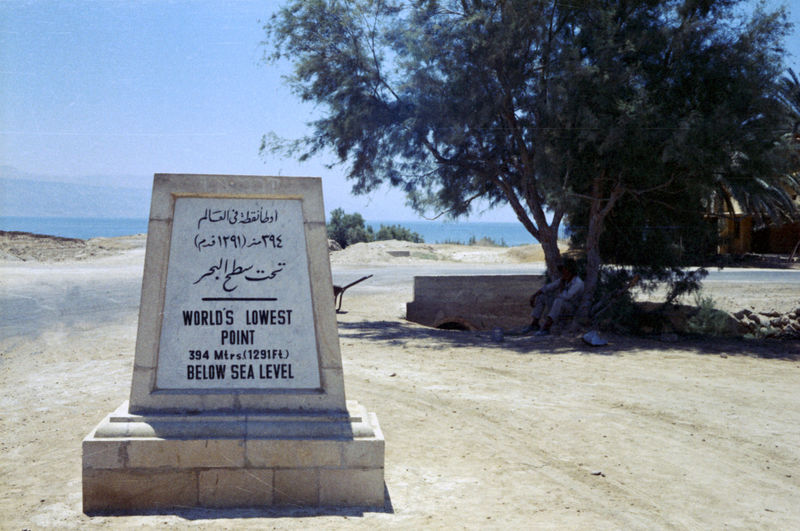
this stone marks the lowest point on earth

Jesus starts at the bottom – and stays there.

Ten days ago we were rounding off the church’s year by celebrating Christ the King – it has to remain a private awards ceremony because so many in the world choose to disagree – and Jesus would never impose himself. He’s King only to those who want him as such. Humility is his middle name.

We start the new year with clues that it is not “Highness” to describe his position, but low(li)ness. It is his royal lowliness (no capitals please) that according to the Advent hymn O come, o come Emmanuel “from depths of hell thy people save”. Jesus’s ministry begins at the lowest point on the surface of the earth – in the River Jordan. His life proceeds along the same low level of altitude – the wrong side of the fault line – to his death on the cross.

Jude Simpson has a wonderful Advent Reflection called Broken Open which takes us along this low line. She traces Jesus’s movements through the lowest points of people’s lives.