Hope Before Dawn: An Advent Imagination

Live for that day when God’s peace is all in all.
Love for that day when God’s light leaves no shadows.

These are the darkest days of our lives.
December draws a long shadow,
and we find ourselves longing for light.

These days seem to go on without end.

These are the days Isaiah fought through and hoped through
3000 years ago:
the same old, the same old.
the dark ages all over again.
This is the mean time.

This is the time to cherish those who’ve kindled hope,
those we’ve bound in scripture
who hoped in God when the world felt just as heavy as ours.
This is the time to pray.
This is the time to keep watch.
This is the time to live for another day,
to love towards another day
when the times will finally be a-changing.

These are very mean days
when nations make war on nations,
There may be no world war,
But there are too many wars
for us to call this peace.
The world is at war,
and we are all caught up
in a global propaganda war.

These are very mean days when dark forces
create a hostile environment for those seeking asylum and sanctuary,
days which leave so many children hungry
and too many families poor, 

when budget after budget
miss the opportunity to make things better.

These days, however bright the weather may be,
are dark days to too many people.

And so –
these are the very days to keep hope alive,
to pray for the day when God’s kingdom comes on earth, as it is in heaven,
to live for the day when God’s word settles disputes;
to love for the day when nation will not take up sword against nation,
and nor will we need to train for war any more.

Imagine that.
Imagine the difference
when the weapons of war,
the resources of war,
become tools for farming and feeding and healing.

Imagine the difference
if the resources of war were turned to farming.
Not just in the fields of our own villages,
but in Gaza’s broken orchards,
in Ukraine’s shelled wheatlands,
in every place where the soil has been scorched,
and the hands that sow can no longer harvest.

Isaiah’s dream has dirt under its nails.
It is a farmer’s dream,
a peacemaker’s dream –
swords hammered into ploughshares,
spears repurposed as pruning hooks,
the earth tended again.

And here’s another theme none of us can avoid,
if we care about justice and peace:
we need to be prepared in these days of darkness.
Advent comes with a wake up call.
The time has come for us to wake up, says Paul, (Romans 13)
and be ready for the Day of the Lord –
the day we live for,
the day we pray for,
the day we love for.

For Advent I’ve downloaded an app which notifies me of Fajr –
the prayer Muslims offer from dawn to sunrise.
So, this morning, at 6.05,
my phone buzzed to tell me it was time to pray,
and I was reminded of all those
who rise while the world is still dark
to end the night and hope for the day.

First they wash,
then raise their hands to acknowledge the greatness of God.
They then recite the Surah:

In the name of Allah – the Most Compassionate, Most Merciful.
All praise is for Allah – Lord of all worlds.
the Most Compassionate, Most Merciful,
Master of the Day of Judgment.
You ‘alone’ we worship and You ‘alone’ we ask for help.
Guide us along the Straight Path
the Path of those you have blessed
– not those You are displeased with, or those who are astray.


Then they bow
They stand and say, “God hears the one who praises him.”
They prostrate themselves, grounding their forehead, palms, knees and toes on the earth –
and from the ground they praise God.
They finish by turning their head
to the right and to the left
with a prayer of peace in both directions.
Then they are ready for the day
(and, dare I say, they’ve given themselves a good work out!).

There is something holy about any people
who pray before the sun comes up.
They remind us what Advent is for:
ending the night,
and hoping for the day.

And we are among those holy people
imagining that day which will end all days of wrongdoing,
when God’s word is truly heard.

That is why our time of prayer
is taken up with praying for the coming of God’s kingdom,
on earth, as it is in heaven.
Christians will always use their prayer time for that –
It’s what Jesus taught us.

It is a prayer of imagination.
It is a prayer for dawn in the dark.
It is a prayer for the day when ….
the day God’s peace is all in all,
the day God’s light leaves no shadows.

And so we live for that day —
when, as Revelation imagines,
there will be no more mourning, crying or pain,
the day that will see an end to night.

Until that day
we keep watch,
keep warm,
and keep hope alive
these dark days.
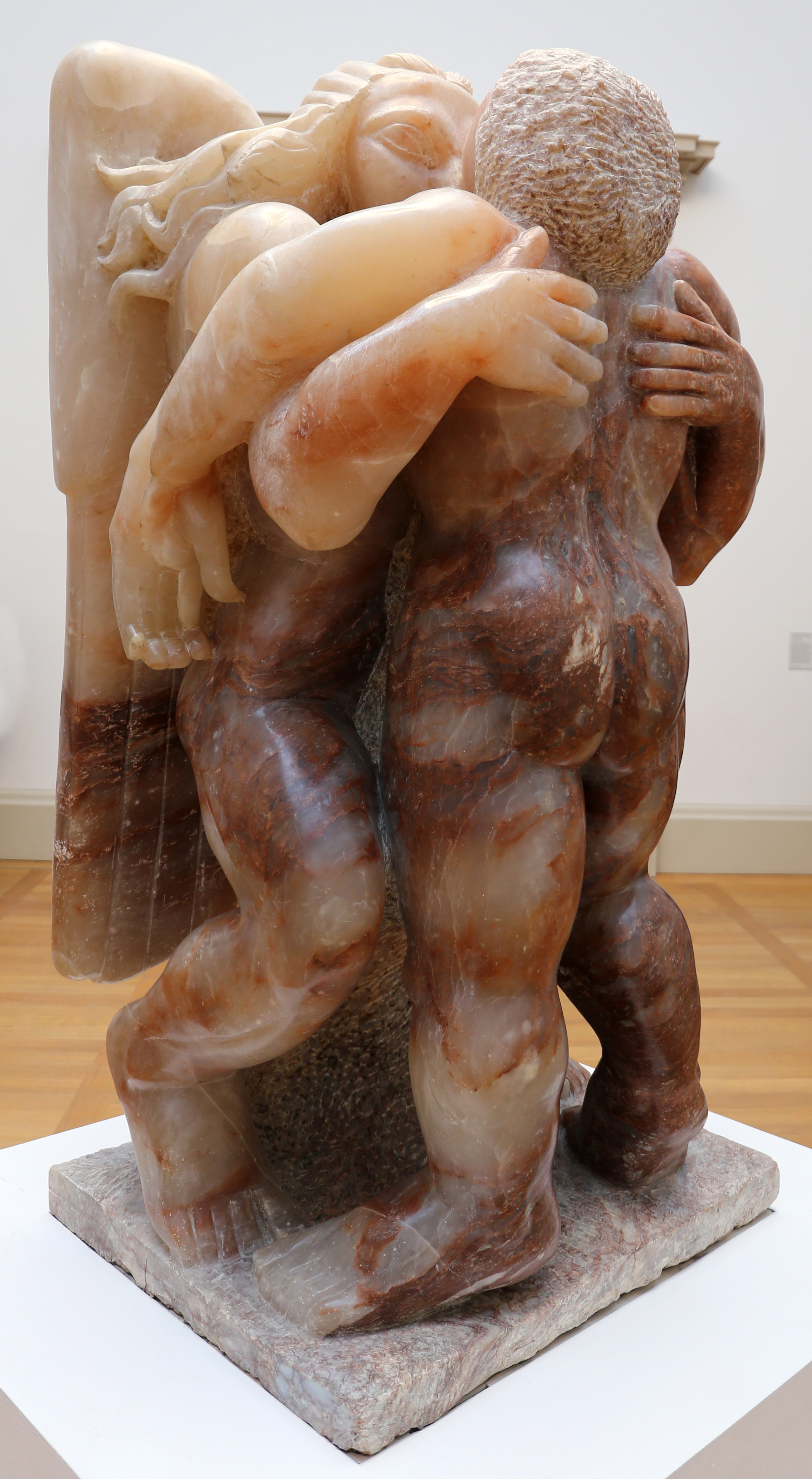
LimpLight

This one’s for all who wrestle in the dark and rise, blessed but limping, inspired by reading Genesis 32:22-31 and Luke 18:1-8 – the Revised Common Lectionary readings for October 19th 2025.

How shall we describe the state of Israel today?

The state of Israel today begins with both our readings —
from Genesis 32, the story of Jacob whose name means twister;
and from Luke 18, the story of the widow struggling for justice.

The state of Israel begins at the end of a night of struggle for the twister,
a night of struggle in which Jacob never discovers
the name of the one he’s wrestling with,
but finds himself called by a new name — Israel.

Jacob’s struggle as portrayed by Sir Jacob Epstein (shown in Tate Gallery, London)

Israel struggles with God,
and God struggles with Israel.
That is the very meaning of Israel.
If Israel means anything,
it means struggling with God.

Jacob is the first to be called Israel,
and he is called (renamed) that by the one he struggled with
because he “struggled with God and with people”
and withstood the whole night.

It is the calling of Israel to struggle faithfully through the night.

Jacob is the patriarch of Israel —
the patriarch of those who struggle with God and with people,
and who carry on wrestling through long nights and times of darkness
without being overcome,

people like the widow singled out by Jesus —
a victim of some injustice.
In the face of an utterly unjust justice system,
personified by a judge who neither feared God
nor cared what people thought,
she struggled.

For some time she struggled.
She kept coming at that lousy judge.
She wouldn’t let go until he gave in.

Those who struggle through the night,
with God and with people —
those who struggle to see the night through,
for whom the night is very dark,
and for whom there is little daylight,
those who won’t give up whatever the night brings —
they are the ones whose hope is rewarded.

They carry a blessing for all who wrestle with God
and with the wounds people inflict.

It’s the blessing of God
who himself wrestles through the darkness of the world,
who struggles with people and the suffering they cause,
but who, in spite of all that,
wrestles the whole night long.

This is the love that shines in the darkness
to the break of day.

And yet, the night is long.
Not just one night in Jacob’s life,
not just one night in ours,
but the long night of the world —
a night as long as history.

Through that long night we wrestle,
and God wrestles with us.

There are three struggles woven into this story,
and all three belong to Israel:

We struggle with God.
We struggle with people —
and people struggle with us.
And through it all,
God struggles with us.

That’s what it means to be called Israel:
to live the long night of wrestling,
and to trust that, at the end of it,
there will still be blessing.

The struggle with God

Sometimes it’s the long silence of prayer —
when we ask and wait and hear nothing.
Sometimes it’s the ache of loss,
or the questions that faith won’t easily answer.
We wrestle with God when life doesn’t fit the promise,
when love feels hidden,
when blessing comes only after a wound.

But still we hold on.
Faith is not certainty —
faith is the grip that will not let go until morning.

The struggle with people

And we wrestle with people too.
Not just those who hurt or wrong us,
but in all the difficult ways love tests us —
learning to forgive, to be patient,
to stay kind when we’d rather give up,
to bear with one another’s weakness.

People struggle with us too —
our faults, our sharp words, our stubbornness.
We are all part of each other’s wrestling.

These are the struggles that form the fruits of the Spirit —
the quiet strength that grows only in the dark:
patience, gentleness, self-control,
love that endures through the night.

The struggle with ourselves

And maybe there’s a fourth struggle too —
the one Jacob knew best —
the struggle with ourselves.
The fight to face what we’ve twisted,
to tell the truth about who we are,
and to accept the new name that grace gives us.

Before we can meet God face to face,
we have to face ourselves in the dark —
the parts we’d rather not see,
the wounds we’ve caused as well as borne.
Even that struggle can become blessing.

The struggle of God

And through it all, God struggles too —
not against us, but for us.
God wrestles through the night of the world,
bearing our pain,
refusing to give up on us.
The cross itself is the mark of that struggle —
God’s own wound,
the divine limp that still bears the weight of love.

This is the love that shines in the darkness
to the break of day.

Jacob wanted to know the man’s name,
but the man would not tell him.

Maybe that’s the mercy of God —
that we never get to hold the name too tightly.
The namelessness keeps the struggle open.
It reminds us that this wrestling is for everyone,
that God stands with all who struggle through the night —
beyond borders, beyond certainty, beyond control.

It was not for ease that prayer shall be.
The story of Israel is not the story of the untroubled.
The story of Israel is the story of the very troubled —
the story of slavery, exile, persecution,
the horrors of history, the nightmare.

Amos got it right three thousand years ago.
He condemned the complacent,
those who are at ease in Zion.
He said they put off the day of disaster
and bring near a reign of terror.
They are not fit to be called Israel.
They duck the fight and ignore the struggle.

But Jacob did not.
The widow did not.
And the God who wrestles through the night does not.

Jacob’s blessing comes with a wound.
He carries it into the dawn,
every step a reminder of the night he endured
and the God who would not let him go.

Perhaps this is the mark of the blessed —
not the ones who have had an easy time of it,
but the ones who have been wounded and changed.
The ones who know that life is not straightforward,
that faith is not certainty,
and that love costs something real.

Israel limps into the sunrise,
blessed and broken.

And still, the night is long —
as long as history,
as wide as the world.
Still, God wrestles with us,
still struggles with his people,
still bears our wounds,
and still blesses us.

And when the dawn comes —
as surely it will —
the blessing will not erase the limp,
but redeem it.

For the love that shines in the darkness
will shine until the whole world
limps into the light.

Afterthoughts
What might it mean for a people, or for a church, to be known by its limp – to be blessed not in strength but in struggle?
If God still wrestles through the long night of the world, where do you see that struggle – and that love – happening today?

Darkness needs light: a reflection on the coming of holy night

I assume that everyone’s feeling tired by midnight on Christmas Eve. Midnight is not the time to be preaching long and hard. Here’s my offering for a group of churches in rural Warwickshire.

Wherever we look in the story of Jesus’ birth there is darkness. 

Matthew’s gospel begins with Mary’s disgrace and how Joseph saved her from being cast out by marrying her. Then we’re told that the Magi’s search triggers the slaughter of the innocents by Herod – he killed all the children in Bethlehem and around who were under two years old! Then Mary and Joseph become refugees to escape Herod’s slaughter.

Luke’s gospel begins with the darkness of Joseph and Mary being forced to make the long journey from Nazareth to Bethlehem by order of the Roman emperor -just to be counted – just to become numbers in the machine of a foreign empire. 

John’s gospel begins with the life which was to be the light of all people, the light that shines in darkness.

Darkness is never far from us. It’s within us – all those dark thoughts, and it’s all around us. On this night of darkness we celebrate how the light comes to us, how the light comes to us as love (all vulnerable), how the night becomes holy – thanks be to God.

I wrote this for tonight.

One light,
so much darkness. If truth be told
what Christmas needs
is the longest of nights, 
the shortest of days,
and the time when people
are at their coldest
and meanest.

For truth to be told
darkness needs light
for the night to find its way to day,
for those who walk
through the dark night of the soul
lost in a cloud of unknowing
frightened in the valley
of the shadows of death.

If truth be told
darkness lies
in the distance between us,
what  we do to one another in war,
rape, rubble, ruin in Gaza and Kyiv.
It rides the nightmares
of suffering, anxiety, despair.
It’s the cost of living.

The data of darkness
is hidden in official secrets
and personal shame,
in the blindness of prejudices
in the lies of truth twisters
in the scheming of profiteers
in the denial of freedoms
in the erections of borders

that divide darkness
from darkness, hiding the terror
from which so many flee.
It’s in their denial. Yes,
there is no room.
It’s in their small boats
not built for the darkness
of the deep and stormy sea.

If truth be told, it’s told in numbers:
in the homeless numbers,
the foodbank users,
the choosers choosing 
heating or eating,
the children killed in war.
It‘s in the numbers of those
who are just numbers.

It’s the middle of the night,
when even the clocks
put their hands together
in time to pray.
They pray for first light
to end the night, a baby flame
in the frame of shame,
and then they pray us awake

and in the darkness, see,
shimmering and flickering
in the world which,
if truth be told,
has no room for Light,
where the only place
to rest his head lay
in the love of a mother

and the kindness of a stranger 
in the inn the light came in,
casting shadows with halos,
our light never dying.
With the angel band backing,
all hallelujah singing,
watching shepherds 
dance the night away.

Joy to the world. Happy Christmas.

© David Herbert 2023

Punctuating the night

Waking in the middle of the night,
say, midway between lying and rising,
just then, is not always curse and cue
for raking old worries to no effect.

just sometimes we awake with a blessing,
precious memories shine our consciousness:
not one, but two lights beam in darkness,
a colon before rest.

where do they come from? they travel far
but arrive fresh. they head straight for me
because only I will know the pair they are.
they come for me, a blessing, a colon before rest.

both were recalls of what was barely
registered at the time of their birth.
one a scholar defining remembrance of Him:
the other, of trouble taken to meet

a paedophile prisoner released
from his sentence. the one the very point
of the other, remembering a man lost
in the darkness of our collective sleep.

After the colon comes the sense, the blessing.
There are some things only we will know,
only alight when they come to see us,
treasure to take us to rest of night.

The words that wake us – a sermon on Isaiah 50:4

Words that wake us

A sermon preached at Mattins at Chester Cathedral on October 13th 2013.

The Lord God has given me the tongue of a teacher (or, of one who is taught), that I may know how to sustain the weary with a word.

Morning by morning he wakens – wakens my ear to listen as those who are taught. Isaiah 50:4f

What are the words that waken us?

What are the words that weaken us?

To what extent do the words that waken us make us?

To what extent do the words that wake us break us?


What are the words that wake us?

I asked some Fb friends, and got loads of replies:

They ranged from the relatively mundane (but still wonderful)

“Do you want a cup of tea?”

to the “This is the day that the Lord has made”

there were those who said that they woke to the sound of silence.

Anna says that it isn’t really words that wake us so much as noises, events, images, light etc. To which jenny replied that it isn’t so much the words, as the tone of voice that wakes us

My friends didn’t think anyone used Rise and Shine any more. A bit old fashioned they thought. Though it strikes me as a good Christian wake up call with its associations with the Lazarus story. Perhaps it’s too upbeat and cheerful when waking from slumber.

The words that wake us have the power to make us or break us. The words pounded through the bedroom door – “you’ve got 10 minutes to get dressed and be on that bus”. What effect do they have on the day and family relationships?

Those who are haunted by fear and those who are anxious about the future have other words that wake them up – not just at the crack of dawn, but repeatedly through the night.

Words spring to mind when we are anxious, excited or depressed.

The words that wake the mother struggling to make ends meet are words of panic. What are the words that wake the child who is being bullied.

Words have power.

Words weigh heavy.They shape the way in which we see ourselves and others. Dismissive put downs can affect us for decades. Careless labeling of others mean that we misjudge others.

Many of the words we pick up from a world that is indifferent or hostile to us are so powerful that we come to believe them.

Be careful how you speak to your children. One day it will be their inner voice . Peggy O’Mara

We have to take care about what we say. Particularly with our first words of the day, or the first words of a conversation. An email reply comes across well with an opening response of “it’s good to hear from you”. Macdonalds aren’t far off the mark when their “servers” bless those they have served with “have a good day” – to which the correct response (probably not often said) is “and also with you”.

Malcolm Guite, a priest-poet, asks the questions in his poem “what if …..” Some lines:

“What if every word we say,
never ends or fades away?

What if not a word is lost,
what if every word we cast
cruel, cunning, cold accurst,
every word we cut and paste
echoes to us from the past,
fares and finds us
first and last
haunts and hunts us down?

What if each polite evasion,
every word of defamation,
insults made by implication,
querulous prevarication,
compromise in convocation,
propaganda for the nation
false or flattering persuasion,
blackmail and manipulation,
simulated desperation
grows to such reverberation
that it shakes our own foundation,
shakes and brings us down?

We must weigh our words carefully. The words that wake us are the words that make us and the words that break us.

The prophet, in our first reading, has the tongue of one who is taught. I suggest that it is not the “tongue of a teacher” as translated in our reading, but the “tongue of one who is taught” … by God – given by God so that he would know how to sustain the weary with a word. (Isaiah 50:4)

The words that wake the prophet are the words that make him. The words that wake him are the words of God.It is because God speaks and the prophet listens that the prophet becomes as one who is taught, as one who can sustain the weary with a word. The prophet says, “Morning by morning he wakens my ear to listen as those who are taught.”

The Bible often refers to the voice of God not being heard. There are various reasons for God’s word not being heard. They include God’s own silence, but also there are times when God’s word is not heard because it is not listened to.

Here we meet with the prophet whose ears woke every morning to the word of God.  We can perhaps feel the intimacy between God and the prophet as the prophet feels the breath of God on his ear as he whispers him awake morning by morning.

What are the words that wake us?

There is no shortage to the words that wake us. Newspaper headlines, breakfast TV, advertising – these are the hidden persuaders who know that the words that wake us are the words that shape us, and they want to shape us to their own ends.

The prophet shows us an alternative. His ears are awakened by the whispered word of God, a word which brings blessing to him and the weary.

There are many people who have this discipline of listening to God before first light. It is a discipline shared by very many faith communities.

But our prayer, whether it be morning or evening, can be full of our own words, with God not being able to get a word in edgeways. We can say our prayers without hearing a word from God.

Hearing the word of God requires discipline and attentiveness.

We can choose the words. The words of God can be words of Jesus, words of the angels, words of scripture inspired by the Holy Spirit, words spoken through the prophets. God has spoken many words. They have been repeated down the ages and brought many to life. They have wakened many morning by morning, and hearing them has signified the end of night and the break of day. We can choose the words and we can let the words choose us.

All the words of God are summed up in the one Word, Jesus. All the words of God can be translated as love. “Love is his word” is how hymnwriter Luke Connaughton puts it. All the words of God are for the weary, the lost, the last and the least. They are timed for the dead of night, the ending of darkness and the first light of day.

If it is true that the words that wake us, make us, then is it true that if we allow the words of God to waken our ears morning by morning, we too will have the tongue of one who is taught?

Do the words by which God wakes us make us a blessing to those around us who are weary and those who are oppressed and abused by words and deeds that break them?

The Centre of the Universe

“We must take sides. Neutrality helps the oppressor, never the victim. Silence encourages the tormentor, never the tormented. Sometimes we must interfere. When human lives are endangered, when human dignity is in jeopardy, national borders and sensitivities become irrelevant. Wherever men and women are persecuted because of their race, religion, or political views, that place must – at that moment – become the center of the universe.”

Elie Wieselthe Night Trilogy