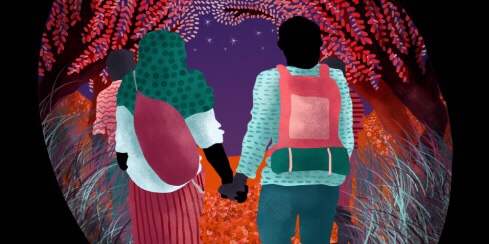
Safeguarding is the Mission of God

I had thought that this Sunday was Safeguarding Sunday. It’s not.
That’s November 16th.
But shouldn’t every Sunday be Safeguarding Sunday?
When we look at our readings for the day, (Amos 8:4-7 & Luke 16:1-13),
they are all about safeguarding,
and they expose our current safeguarding focus as hopelessly inadequate.

Safeguarding isn’t just reacting to scandals of abuse,
but is the mission of the church.
Our calling is to protect the vulnerable,
to care for creation and to defend the excluded.

And safeguarding begins with the little things.
The soil beneath our feet.
The worm in the allotment.
The bee that pollinates our food.
The sparrow that falls unnoticed to the ground.
Creation itself is vulnerable,
and safeguarding must mean cherishing the earth, not exploiting it.

If we cannot be faithful with the earth — the very ground of our life —
how can we expect to be trusted with the riches of the kingdom?

Safeguarding has a political edge which is being overlooked.

We are in the Season of Creation,
a season for highlighting the needs of the earth and the environment
and our responsibilities for safeguarding the planet.

And we are in the season of disenchantment and political turmoil
when we are seeing thousands of people taking to the streets
to protest against immigration,
who want to turn the clock back
to make Britain Great again,
or America great again,
or make themselves great again.

There are safeguarding issues here as well,
challenges to safeguard those who are vulnerable,
those in the firing line, those claiming asylum,
those terrified in the targeted hotels,
those who are scared to be seen in public.

My son told us of his experience last weekend.
He was in London during the protests.
Protesters surrounded the Uber they were in,
banging the windows, shaking the car
and shouting to the driver, “GO HOME”.
He was a Bangladeshi who has lived here for twelve years.
His home is here. That requires safeguarding.

And there is the other side.
Those protesting aren’t all fascist or racist.
They are people who feel they don’t belong,
who feel they’ve been left behind
by a society which has put financial gain above everything,
where the gap between rich and poor has grown ever wider.
It is hard for me to speak for them,
but have they had enough of “rip off Britain”,
have they lost hope? Have they been safeguarded?
Is what we are seeing on the streets a consequence
of the lack of safeguarding for these least and last,
with a poverty of opportunity?
I will not demean these people as racists or fascists.
I have lived in their communities.
Most of them have just reached the end of their tether.

They become easy prey for those who would exploit them for their own ends,
false shepherds who would mislead them with false promises.
You know who I mean.

And into this world — our world — comes the voice of Amos (Amos 8:4-7 – printed below),
eight centuries before Christ.
Because his scripture has been treasured,
we have been hearing Amos for nearly 3000 years!
He names what safeguarding failure looks like in his time:
people trampling on the needy, treating the poor as expendable,
twisting religion to cover up exploitation.
Are we any different now?
He cries out against a society where profit matters more than people,
and where the very ones who most need protection are sold for a pair of sandals.
Amos is God’s safeguarding officer, raising the alarm.

And then Jesus, in Luke’s gospel, gives us this line:

Whoever is faithful in very little is faithful also in much.

It’s a complicated parable, but this is the heart of it: the little matters.
Whoever is faithful in very little is faithful also in much.
The small ones matter.
The least matter.
The soil matters.
The worm matters.
The daily, unnoticed acts of honesty and care matter.
Because in the little, the kingdom begins.

Being faithful in the little means safeguarding creation itself:
tending the soil, honouring the creatures that work unseen,
the worms, the insects, the birds —
each one part of God’s great economy of life,
the web of life that holds us.

Being faithful in the little means safeguarding people:
the child, the refugee, the neighbour
who feels they don’t belong.

Being faithful in the little means safeguarding our choices,
managing ourselves in those moments
which could turn into flash points when we fly off the handle.

Being faithful in the little means safeguarding our community:
choosing honesty when it would be easier to cut corners,
choosing care when it would be easier to look away.

The little matters – because in the little the kingdom begins.

Jesus speaks of being our shepherd,
the true shepherd
who safeguards the last, the least and the lost.
That must include those who have been misled
by opportunistic shepherds who trade in fear.
They, too, are vulnerable, though they don’t always see it.
They are last and least in ways that make them lash out.
But they are still little ones Jesus longs to safeguard.
So safeguarding is not just paperwork or policy.
It is the mission of God, entrusted to us:
to safeguard the earth, to safeguard the poor,
(and protest against the causes of poverty and exclusion).
It is the mission of God
to safeguard even those who have lost their way.

Every time we join this mission,
we are being faithful in the little,
and the little is what God treasures.
The little are the treasures of the kingdom.

Our commonwealth is woven together
from moments of safeguarding the vulnerable,
moments of honouring the smallest,
moments of choosing care over indifference.

This is what God entrusts to us.
This is what it means to live for the kingdom.

The little matters,
because in the little, the kingdom begins.


Amos 8:4-7

Hear this, you that trample on the needy,
  and bring to ruin the poor of the land,
saying, ‘When will the new moon be over
  so that we may sell grain;
and the sabbath,
  so that we may offer wheat for sale?
We will make the ephah small and the shekel great,
  and practise deceit with false balances,
buying the poor for silver
  and the needy for a pair of sandals,
  and selling the sweepings of the wheat.’

The Lord has sworn by the pride of Jacob:
Surely I will never forget any of their deeds

What Have We Settled For?

The scriptures we read this Sunday are not the comfortable writings of a comfortable people. They are the testimony of the beaten, the displaced, the silenced, and the overlooked. Abel, Enoch, Noah, Abraham — each bears the marks of suffering and hope. They lived by faith in what they could not yet see, refusing to settle for the way things were. This is a sermon about refusing to accept the world as it is. The readings for the day (8th Sunday after Trinity, Proper 14C) were Hebrews 11:1-3, 8-16 and Luke 12:32-40.

This is not about “pie in the sky when you die.” It is about a kingdom promised by Jesus to his “little flock” — a kingdom of justice and mercy breaking into the here and now. The question is: have we settled for something less?


What Have We Settled For?

Faith, the kingdom of God, and refusing to accept the world as it is.

“Faith is confidence in what we hope for and assurance about what we do not see.”

That’s how our reading from Hebrews begins — with what is perhaps the nearest the Bible comes to a definition of faith.
And it’s not about having everything figured out, or clinging to beliefs with gritted teeth.
It’s about confidence in what we hope for — trust in a promise we can’t yet see, but which shapes our steps today.

The kingdom of God is Jesus’ promise to his “little flock” in our gospel reading: “Do not be afraid, little flock, for your Father has been pleased to give you the kingdom.”
It is a kingdom for the poor.
A kingdom for those ready for service.
A kingdom for those who refuse to settle for the way things are.
It’s a kingdom for those who keep watch for what is not yet seen, but has already been promised.

Amongst them, ones like Abraham —
ones like those who refuse to settle for the way things are —
it is amongst them that Jesus promised to come with his kingdom rule where the first comes last and the last first.
For here, amongst the faithful,
the poor, the beaten, the stranger,
Jesus becomes their servant.


This is one of the texts we have been given this morning to bring to life.
This is the text we have been given by the church which has treasured this and so many other texts of scripture for the sake of blessing and encouragement.

How are we going to bring this scripture to life?

The appointed reading from Hebrews today skips over some verses.
We don’t actually hear the parts about Abel, Enoch, and Noah,
the writer’s first three examples of faith before Abraham appears.
And yet those missing verses matter, because they set the tone.

Abel — the first murder victim in scripture,
killed by his own brother Cain.
Jealousy, resentment, and violence snuff out his life.
In Abel we see the first in a long line of victims,
the first of the murdered, whose blood cries out to God.
In our own day, Abel stands with every innocent life taken by violence —
the child caught in crossfire,
the protester beaten in the street,
the woman killed in her home.
In the world’s eyes, the murdered are the last,
powerless, silenced, gone.
In the kingdom of God, they are heard, remembered, and brought first into God’s justice.

Enoch — about whom we know almost nothing, except this:
“he walked faithfully with God” and
“he could not be found.”
That’s all we’re told.
In Enoch we see the first of the “disappeared”,
those who are taken away,
who vanish without a trace because the powers that be do not want them around.
In our own day, Enoch stands with the journalist who never came home,
the political prisoner taken in the night,
the asylum seeker lost in the system.
The disappeared are the last, erased from the record.
In the kingdom of God, they are remembered by name,
and God himself will bring them into the light.

Noah — survivor of the flood that swept everything away.
He prepared for what he had not yet seen.
He built in hope while others laughed.
He came through the storm,
but he knew what it was to live in a ruined, water-washed world.
In our own day, Noah stands with the flood refugee,
the survivor of earthquake or wildfire,
the one starting over in a land that is not their own.
Survivors are often treated as last, dependent, unwanted, pitied.
In the kingdom of God, they are the first to be comforted and restored.

And Abraham — the archetypal migrant.
He left his land and his people to follow a call into a future he could not yet see.
He lived his whole life as a nomad,
moving from place to place,
pitching his tent, always a foreigner, never arriving.
He died still looking for the better country.
In our own day, Abraham stands with those who cross borders for safety or hope,
the refugee, the economic migrant, the traveller family moved on again and again.
Migrants are often treated as last: outsiders, intruders, burdens.
In the kingdom of God, they are welcomed as first,
citizens of the better country from the moment they trust God’s promise.

Those who are commended for their faith are a murder victim, one of the disappeared, a flood survivor, and a migrant.
They are commended because they settled for nothing less than what God had promised.
They refused to accept the world as it was.
They longed for a better country.
And God is not ashamed to be called their God.


And so here’s the question the text presses on us:

What have we settled for?

Have we made peace with the world as it is – the injustice, the exclusion, the false comforts?
What compromises have we made?
Have we been lulled into a sense of false security?
Have we settled for something less? Have we become people without hope?
Is there anything we hope for, or have we written it all off as “wokery”?
Have we become cynical rather than hopeful?
Tired rather than faithful?
Have we come to terms with what we see around us — and settled for that?

The faithful of Hebrews never settled for the world as it was.
They walked as strangers and foreigners, refusing to be at home in injustice.
They pitched their tents in hope.
They died still longing for the better country.
And because they longed for it, they glimpsed it, and lived as if it were already here.

That’s what Jesus promises his little flock:
“Do not be afraid… your Father has been pleased to give you the kingdom.”
Not the kingdom as pie-in-the-sky when we die,
but the kingdom as God’s liberating rule breaking in here and now:
justice for the last, welcome for the stranger, honour for the poor, mercy for the sinner.

The faithful, when they gather around the table, give thanks for the service of Jesus,
the servant king feeding his watchful people
and giving us a taste of the better country,
the better foundations for our lives,
ever-present to those who will settle for nothing less than the justice and mercy of the kingdom of God.

The faithful please God by walking with God.
They never stop.
They keep on walking, always looking for what they don’t yet see in terms of justice and mercy.
They never settle for anything less.


An afterthought:
What do you think faith is? Do you agree with this definition from Hebrews 11 —
“Faith is confidence in what we hope for and assurance about what we do not see”?

That’s a very different thing from thinking of faith as a set of doctrines: “I believe this, I believe that.” That sort of faith can easily become an intellectual exercise, something for those who can get their heads around abstract ideas — which, because of educational privilege, often favours the first and the foremost, not the last and the least.

But the faith that waits for justice and mercy, and will not settle for anything less, is not about abstract ideas. It comes from the heart of who we are. It’s the faith of those who have endured, who have kept walking, who know what it means to hunger for the better country God has promised.

For crying out loud, what do you want me to do for you?

A sermon for the Last Sunday after Trinity (Year B) encouraging us to join Bartimaeus in his loud prayer that helps him see. The readings for the Last Sunday after Trinity (B) are Jeremiah 31:7-9 and Mark 10:46-end.

October 27th 2024

Here’s the question. “What do you want me to do for you?” This is the question Jesus asked Bartimaeus. It’s exactly the same question he asked the two disciples who approached him in last week’s gospel. The sons of Zebedee, James and John, came forward to Jesus, saying: “we want you to do for us whatever we ask of you”, to which Jesus replied: “What is it you want me to do for you?”

It’s a question any helper might ask. “What is it you want me to do for you?” It might well be a question you imagine Jesus asking you. As you settle down in prayer you might imagine Jesus asking you, “What do you want me to do for you?” Our prayer may specifically answer that question as we lay open the heart of our concerns to God.

Not that we expect God to do all we ask. Remember James and John. They wanted Jesus to do for them wherever they asked, but what they asked for was so wide of the mark that there was no way Jesus was going to do it for them. They asked to sit either side of Jesus in his glory – there was no way Jesus was going to save the seats for them. As it turned out the gospel shows us in the crucifixion scene that those to the left and right of Jesus “in his glory” are those disgraced by society, those shamed and ashamed – all three of them convicted criminals.

But sometimes our prayers are answered. Sometimes what we ask to be done is done, as in the case of Bartimaeus. 

The beginning of his prayer is shouted out and is heard above the noise of the crowd. Often our prayer is a cry, and sometimes we cry out loud, as Bartimaeus does here: ‘Jesus, Son of David, have mercy on me!’ He goes against the crowd who mercilessly tried to shut him up. But he carried on shouting, ‘Son of David, have mercy on me!’ Jesus heard his prayer. He couldn’t help hearing him: he was shouting so loud. 

Mercifully Jesus called him to him asking that question. “What do you want me to do for you?” The blind man replied, “My teacher, let me see again”. Jesus recognises the faith of the blind man in what the blind man has called him. He’s called him “Jesus”, “Son of David” and “Teacher”. According to Mark, Bartimaeus has seen in Jesus what the disciples have so far not seen. He’s the one who’s seen. It’s the disciples who are blind. When we call anyone “Teacher” we’re already trusting them to show us the way. Jesus responds to such faith, insight and trust. To the blind man he says “your faith has made you well”. Jesus had helped him see again – and Mark leaves us with this spectacle of Jesus journeying to Jerusalem with this beggar by his side. We don’t very often see the procession into Jerusalem that way, do we? But that is the way Mark paints the picture.

We can’t get away from the blind in our worship. Our other reading is also about the blind and the lame. They are what’s left of Judah after generations of suffering at the hands of the babylonian empire six centuries before Christ. Babylon invaded Judah three times that century and occupied her for 50 years. Judah was ruined. There was very little left. So much had been destroyed – Jerusalem, the temple – everything that gave them a national identity was gone. And most of the people had gone as well – killed or deported. Those who were left lived with the humiliation of being beaten. They were refugees scattered far and wide.

This scripture from Jeremiah has been treasured because of the vision Jeremiah has for these people and the words he has for them – the blind, the lame and those scattered to the four corners of the earth. These are traumatised people. They are survivors of devastating disaster. Some of you will know what it is to be traumatised by what’s happened to you. You may have lost someone or you may have suffered a life-changing injury. The news these days is full of reports of whole communities destroyed and traumatised by war in Gaza, Beirut, Lebanon. We look into their faces. There are no words. We often frame our speechlessness with those very words. “There are no words”, we say.

Traumatic shock leaves us reeling disrupting our normal mental processes because we can’t work out what is happening to us. The mind shuts down and the memory of the traumatic events become fragmented. The wounds are unspeakable. There are no words. The mind automatically shuts down feelings and turns off human responses locking violent experiences away in a form of self-protection which often means we never get to understand our pain, our loss, our grief. Trauma disrupts the trust we have – whether that is in God, in others or in the future. The future we had in mind is simply no longer there – and many traumatised people are left feeling that there is no future. “I see no future.”

This is the context for Jeremiah. He is part of a people traumatised by events. They have lost everything. There are no words. They have no vision for the future apart from their ongoing pain. But Jeremiah gives them words. They’re words given to him by God. Jeremiah shares his vision. Our reading comes from a part of the book of Jeremiah which is known as “the Book of Comfort”. God through Jeremiah is restoring their faith and renewing their hope. They have a vision for the future. Jeremiah is helping them see again.

Our readings are related. In both people are being helped to see again. That’s the one thing Bartimaeus asks of Jesus in today’s gospel. “I want to see again.” In our Old Testament reading Jeremiah helps the whole people to see themselves again, something like the people they had always been.

I suggested that you might use Jesus’ question in your prayer. Imagine Jesus asking you, “What do you want me to do for you?” After all you’ve been through, whatever that is, what will your answer be? What will you ask for?

Remember that Jesus asked that question to James and John as well as to Bartimaeus. He wasn’t interested in answering James and John’s request for status and privilege. Jesus will never answer our thirst for power, wealth or prestige. It’s no good praying over our lottery ticket. He only answers the beggar’s prayer.

Our readings are related to inspire the church to join the beggar in his prayer (not James and John in theirs).
Do we turn to Christ to help us see – to help us see differently,
to help us see ourselves differently,
to help us see our neighbours differently,
to help us see strangers differently,
to help us see our enemies differently,
to help us see the future differently,
to help us see our past differently?

Anais Nin wrote: “We don’t see things as they are, we see things as we are.” Maybe we’ve grown old. Maybe we are jaded, tired, cynical. Maybe ….

Lord Jesus, help us to see.
Help us see the way you see so that we may follow you that way.

Yes, be angry, but don’t take anger into your darkness

Sometimes a sermon feels half-baked, but that’s all this preacher has this Sunday for a small congregation meeting in the heart of Warwickshire. The focus is on anger, one of the gifts of being human, in the context of violent anti-immigration riots which have been going on in towns and cities in the UK over the last week or so. “Be angry, but don’t let the sun go down on your anger” is the text from the reading appointed for the day – Ephesians 4:25-5:2.

August 11th 2024

See how fearfully and wonderfully made we are. That’s the frame of mind of the Psalmist. We say our Amen when we join the prayer of the psalmist. We are fearfully and wonderfully made. Our Amen is our Yes to this frame of mind and part of our adoration of God. The Psalmist thanks God: “You yourself created my inmost parts. You knit me together in my mother’s womb. I thank you, for I am fearfully and wonderfully made.” (Psalms 139: 12-13)

We don’t just come with our physical make up. We have our psychological make up. We have soul. We are fearfully and wonderfully made – complete with our basic instincts and appetites. Without those instincts and appetites we wouldn’t survive or organise ourselves or build society. The desert fathers listed these instincts so that they could help people discipline them, because without that discipline they turn on us and ruin us.

Among their list of instincts and habits, as an example, is the habit of dejection – which lowers our sights and expects the worst of ourselves. Greed is in that list, and so is anger. They tried to cover all our basic instincts and habits of thought, recognising the demons that turn those instincts against us. They recognise that we all get caught up in corrupt chains of thought that ultimately bind us. You may see that in yourself. I see it in myself. I hear one thing, which leads me to another – it is my doom-looping which has made me bound to think and behave this way and that.

This morning we have a letter to read dating back nearly 2000 years which is dedicated helping to free people from these chains of thoughts and behaviours. It comes to us from the Christians of Ephesus.

Be angry, the letter reads recognising the basic instinct of anger which is part of our make up – part of being fearfully and wonderfully made. 

Be angry – why not? Jesus got angry. Our anger can be very useful. Cassian, one of the desert fathers, taught that the proper focus for anger is on our malicious thoughts and on the destructiveness we see around us. These are things we need to get angry about. Imagine a world in which no anger was focused on such things. Imagine ourselves and what we would be like without an anger against some of the ways we are. Anger can make things better.

And anger can make things worse. Anger can turn nasty. Our anger can be deeply hurtful of others and ourselves.

Anger needs reining in. Ephesians has given us a pearl of wisdom which has become almost proverbial. Be angry, but don’t let the sun go down on your anger. I dare say that has saved a good many relationships. Don’t let the angry word be the last word of the day. Don’t take your anger into the night. Keep your anger in the light.

Don’t take your anger into the darkness. Break the chain of thought before the chain of thought traps you in darkness.

We’ve seen anger spilling onto our streets this last week using mis-information to make targets of immigrants and their defenders, and Muslims and their mosques, 

Having read his book The Lightless Sky I’ve been following Afghan refugee Gulwali Passarlay. He featured in the Channel 4 election debate. He posted on Twitter this week that he has “never been this afraid” He’s lived in the UK for 17 years and been a citizen for the last 5. He posted: “I’m afraid for my kids. I to;d my wife, don’t go to the park. I had to travel from Bolton to take my kids to nursery because I was afraid for my wife to walk on the road.” There were NHS staff frightened to go to work. And yesterday I heard that a Faceboog group of British Asians in Leamington were warning members not to go into town because of the possibility of racist attack.

The mob violence we have seen is anger gone wrong – anger pent up, anger that has been taken into darkness by perpetrators who have been misled – and we all need to be very afraid. Thank God for the counter-protesters, and for those who day in and day out defend the stranger and the defenceless.

When we take anger (as well as our other instincts) into our darkness, into the night and into our sleep, we find that, there the darkness spins chains of doomloops to bind us. Anger belongs to the day. Be angry, but be angry in the light of day. The Ephesians tell us, Don’t make room for the devil to work with your anger.

If we don’t make room for the devil to work in our anger we leave room for compassion and love to work there, to direct and discipline our anger.

The permission for anger in Ephesians comes with disciplines that rein in this basic instinct. Putting away falsehood, let all of us speak the truth to our neighbours, for we are members of one another. We belong together. We are made for one another. Anger needs the light of truth, so we only speak the truth to our neighbours and about our neighbours. We’ve seen this week how the incitement to riot relies on falsehoods, deception and misinformation.

In anger, let no evil talk come out of your mouths, but only what is useful for building up, as there is need, so that your words may give grace to those who hear …. Be imitators of God … and live in love.

Anger is one of our instincts. We are fearfully and wonderfully made – with anger and much else. God loves our anger when we are imitators of God. His anger was shown by Jesus. His anger and wrath is against those who put themselves first, the entitled, the supremacists who demean others and put others beneath them and never go to their help. His anger and wrath is against those wolves in sheep’s clothing who lead people astray.

But for those put last, for those lost and misled, for those least, for those forced to flee, for those seeking sanctuary and safety, for those housed in the hotels being attacked in the mob violence, there is only words of love giving grace to those who hear them, and the promise of a rule which puts them first, not last.

Ephesians 4:25-5:2
So then, putting away falsehood, let all of us speak the truth to our neighbours, for we are members of one another. Be angry but do not sin; do not let the sun go down on your anger, and do not make room for the devil. Thieves must give up stealing; rather let them labour and work honestly with their own hands, so as to have something to share with the needy. Let no evil talk come out of your mouths, but only what is useful for building up, as there is need, so that your words may give grace to those who hear. And do not grieve the Holy Spirit of God, with which you were marked with a seal for the day of redemption. Put away from you all bitterness and wrath and anger and wrangling and slander, together with all malice, and be kind to one another, tender-hearted, forgiving one another, as God in Christ has forgiven you. Therefore be imitators of God, as beloved children, and live in love, as Christ loved us and gave himself up for us, a fragrant offering and sacrifice to God.

The congregation is the point

I don’t think I have ever preached a sermon where the point has been the congregation before. The congregation seems to be the point of the readings set for the 8th Sunday after Trinity (year B). They are Jeremiah 23:1-6, Psalm 23, Ephesians 2:11-end and Mark 6:30-34, 53-end (text below). I’m covering a long term “vacancy” in a group of churches. I’m hoping these congregations will find encouragement here.

July 21st 2024

The point of today’s readings is the gathering after the scattering – the scattering of people. I don’t think I have ever preached a sermon where the point has been the congregation before, but that seems to be the point that links the readings appointed for today. All four: the reading from Jeremiah, the Psalm, the reading from Ephesians and the gospel reading from Mark – they all build the point. The congregation is the point. The gathering after the scattering is the point.

Never has there been so many people on the move as now. By the end of last year 1 person out of every 69 was forcibly displaced, having been forced to flee persecution, conflict, violence, human rights violations and events seriously disturbing public order. That is double the number of a decade ago.

I in 69. 

Last year the global refugee population increased by 7% to over 43 million people. 73% of them came from just 5 countries: Afghanistan, Syria, Venezuela, Ukraine and Sudan.

As well as those 43 million people another 63.3 million people who were forced to flee remain in their own countries. They are known as internally displaced people. Can you imagine this? Over 9 million people in Sudan, over 7 million people in Syria, 6.9 million people in Columbia, 6.3 million people in the Democratic Republic of the Congo and 4.5 million people in Yemen – all internally displaced, mostly due to conflict and violence, and some due to natural disasters.

1 in 69.

Every bomb dropped on a village or a housing block in Ukraine and Gaza displaces the families who live there. Every military push forces out those in its path.

I in 69 people displaced and scattered. Poet Warsan Shire, herself a British poet born to Somali parents in Kenya, begins her poem called Home with the lines:
No one leaves home unless
home is the mouth of a shark.

Home by Warsan Shire, read here by Sir Jonathan Pryce

1 in 69 people forcibly displaced – according to the United Nations High Commissioner for Refugees recent report on global trends. 1 in 69 – and it’s getting worse. 1 in 69 displaced and scattered because of the failure of governments to guarantee their peace and security.

This is the world we live in. Our scriptures reflect the same realities – the failure of government to secure peace and security. Our scriptures come from the heart of people displaced by persecution, oppression and exile – and those moved with compassion for them.

Jeremiah is one such person used to address the tragedy of his contemporaries being displaced in large number and scattered far and wide. Just as the UNHCR report puts the blame on the failure of governments to safeguard peace and security, so does Jeremiah all those centuries ago.

Woe to the shepherds who destroy and scatter the sheep of the pasture! Says the Lord. Shepherd was a term used to describe the king. Jeremiah’s “woe to the shepherds” is a judgement on the line of kings who have failed the people. 

In the previous chapter Jeremiah protests against the succession of rulers whose eyes and hearts have been set on “dishonest gain, for shedding innocent blood and for practising oppression and violence” (22:17) in contrast to the good king (Josiah) who “judged the cause of the poor and needy” (22:16). 

It was the failure of the rulers to “execute justice and deliver from the hand of the oppressor anyone who has been robbed” which resulted in the scattering of people. The promise in Jeremiah is to gather the scattered, the ones lost, to raise up shepherds who will shepherd them, so that they shall fear no longer, nor be dismayed, nor go missing.

Similarly, in our gospel reading, Jesus sees the crowd coming to him. (Is Mark here seeing the fulfilment of the promise of Jeremiah?) Mark writes that Jesus had compassion on the crowd because they were like sheep without a shepherd. 

The verses of today’s gospel immediately follows the beheading of John the Baptist in prison – the beheading of Jesus’s own cousin by Herod at the request of his dancing daughter and wife. Herod, as king, was supposed to shepherd the people, but left the people like sheep without a shepherd. Mark pictures Herod partying with his courtiers and the “leaders of Galilee” – the very ones who should have been keeping watch of the people. Another Partygate. Mark pictures Herod and his court getting fat at the expense of the poor. 

The lost and scattered, then as now, are always the victims of failed government, self-serving leaders (misleaders) and corrupt shepherds. The lost and scattered are always the people on whom God shows compassion, through the prophets, through Jesus and through the work of the Holy Spirit.

All we see in today’s gospel is people gathering and coming together around Jesus and the disciples. The intention was that Jesus and his disciples were going to find a deserted place so that they could get some rest. They went by boat. But they were spotted. Many saw them and recognised them, and they hurried on foot from the towns and got there before the boat landed. There were five thousand of them – an unimaginable number of people, like sheep without a shepherd.

Again, later, when they landed at Gennesaret in the second section of our gospel reading), people recognised Jesus and they rushed about that whole region and began to bring the sick on mats to wherever they heard he was.

Notice the rush people were in. Mark underlines their hurry. They rushed about that whole region bringing the sick to wherever he was. Wherever he went, into villages or cities or farms, they laid the sick in the market-places, and begged him that they might touch even the fringe of his cloak.

Jesus doesn’t let them go. He has compassion on them.
He heals them. He makes clean what the religious (mis)leaders had made unclean He restores them to their communities – no longer outcasts.

He feeds them – yes, the crowd in today’s gospel is the crowd he feeds with just the five loaves and two fish.
And he began to teach them many things.

Here is the good shepherd doing what good shepherds do: gathering the scattered, the least, the lost, the sick and helpless – making right the people the bad shepherds and corrupt leaders had wronged.

This is the point: the gathering after the scattering. The crowding together is the point. 

And here we are – gathered, a congregation.
How do we see ourselves?
Do we see ourselves as among those on whom Jesus has compassion?
Do we see ourselves as held together by his love?
Do we see that without our gathering we would (in the words of the epistle) remain as strangers and aliens, hopeless and far off?
Do we see that we are brought to this point “by the blood of Christ”? 
Do we see that we are citizens with the saints and members of the household of God?
Do we see ourselves built together spiritually as a dwelling-place for God?
Do we see that Jesus feeds us – even as we walk together through the valley overshadowed by death?
Do we see that Jesus has begun to teach us many things?
Do we see this as the rule of heaven, his will on earth, as it is in heaven?
Do we see ourselves as the lucky ones, even as the ones the world counted least, or last or even lost, who by amazing grace have become among the first gathering of Jesus?
Do we see ourselves being joined by others, including some of the many others who make up the 1 in 69 people currently on the move, without a shepherd?
Do we see this as our place of belonging – after all our longing?

Is this not home, where we belong – counted, fed, healed, restored?
Do we see our congregation as the point that proves Jeremiah’s promise, the gathering that justifies our faith in the Lord our shepherd?

Mark 6:30-34, 53-end

The apostles gathered around Jesus, and told him all that they had done and taught. He said to them, ‘Come away to a deserted place all by yourselves and rest a while’. For many were coming and going, and they had no leisure even to eat. And they went away in the boat to a deserted place by themselves. Now many saw them going and recognised them, and they hurried there on foot from all the towns and arrived ahead of them. As he went ashore, he saw a great crowd; and he had compassion for them, because they were like sheep without a shepherd; and he began to teach them many things.

When they had crossed over, they came to land at Gennesaret and moored the boat. When they got out of the boat, people at once recognised him, and rushed about that whole region and began to bring the sick on mats to wherever they heard he was. And wherever he went, into villages or cities or farms, they laid the sick in the market-places, and begged him that they might touch even the fringe of his cloak; and all who touched it were healed.

We’re all at sea in our small boats

This is a reflection on the sea and the troubled waters we call life for the 4th Sunday after Trinity (B).

I spotted “the other boats” in the gospel reading for the day, from Mark 4:35-end (text below). They played on my mind as we prepare for a UK election which some want to turn into an election on immigration. It made me think – “we’re all at sea” and the forecast is for more storms. This sermon comes with a health warning – it is metaphor heavy.

The first verse we see when we open our Bibles is “In the beginning when God created the heavens and the earth, the earth was a formless void and darkness covered the face of the deep while the spirit of God swept over the face of the waters.” (Genesis 1:1-2) 

The last verses in our Bibles are also about water – the “river of the water of life, bright as crystal, flowing from the throne of God and of the Lamb, through the middle of the street of the city, feeding trees bearing fruit for all seasons and leaves for the healing of the nations”. (Revelation 22:1-2)

In the beginning of the Bible there is total darkness. In the end, there is only light – no darkness and no hiding.

The Bible begins in water and ends in water. And between the two there is all the difference in the world – as different as night and day.

The Bible begins in water. The water is chaos. The first thing God does is make light. The second thing he does is sort the waters out. He separates the waters of heaven and earth, gathered the water together and let dry land appear. That’s how it began. 

This is a theological view of life. This is how we open our Bibles. We open them with an understanding that we are all at sea. From the very beginning we have been surrounded by water, the sea, the deep. We’ve been on flood alert since the time of Noah.

Probably all of us here have had times in our lives when we have felt overwhelmed, engulfed or drowning – and used these metaphors to describe how we felt, using so many metaphors drawn from our collective experience down the ages of chaos and the sea. So much of our language reflects this. Like “we’re out of our depth”, or “we’re in it up to our neck”, or “we’re all at sea”.

The Bible begins with water and ends with water. From day one there is storm after storm. The waves crash all around us until that day when the waters become calm and do God’s bidding of giving life and healing to the whole of creation.

These are the times we live in, when there is one storm on top of another. For the time being we are between the devil and the deep blue sea. (Another popular saying.)

These are the times Jesus lived in as well. The storms he faced were different to ours. With his contemporaries he was assaulted by religious oppression and exclusion, a taxation poor which kept them in poverty and debt, and an occupation by a foreign power which robbed them of their freedom.

His attitude at times like these is captured in the snapshot we have of him in today’s gospel reading. They’re all at sea. A great gale arose, and the waves were beating the boat and swamping it. And Jesus slept. Calm as you like.

There were other boats. It’s strange how you miss details like this. I must have read this passage hundreds of times, but I’ve never seen those four words before. There were other boats. Have I never noticed these other boats because the focus has always been on Jesus’ boat? Have I only spotted these boats now because of the small boats that desperate refugees are taking to to escape to safe havens. 

(Isn’t it terrible that some people are turning the election into an election about immigration and the people in these small boats?) It is Refugee Week – and we need to spot their boats, not stop their boats. There is a growing refugee crisis – that means a crisis for a growing number of refugees. 1 in 69 of the world’s population is now displaced, largely because of conflicts around the world. It’s important we respond to their Mayday.  M’aidez. Help me! It is, after all, the refugees who have the problem – all those who have no safe routes for escape. They have enough problems without being turned into a political football.

We’re all at sea. We’re not all in the same boat. We’re not in the same boats as the refugees. We’re all in our different small boats. We’re all at the mercy of troublemakers, powers-that-be, the forces that make waves, and the sea so dangerous. 

There’s a well known fisherman’s prayer that captures our plight. It’s become known as the Breton Fisherman’s Prayer: 

Dear God,
be good to me;
the sea is so wide, and my boat is so small. 
Amen.

They’re words from a poem by Winfred Ernest Garrison.

It’s not surprising that so many make that prayer their own. The words fit the experience we call “being all at sea”.

The sea is our life with its currents and tides, its ferocity and deceptive charm constantly eroding and undermining us. The challenge of our lives is how we navigate these waters.

We are like those who, in the words of Psalm 107 “go down to the sea in ships and ply their trade in great waters”, who have seen the works of the Lord and his wonders in the deep. While they were at their wit’s end as they reeled and staggered like drunkards, they cried to the Lord in their trouble and he brought them out of their distress. He made the storm be still and the waves of the sea were calmed.

Our lifetime at sea is summed up in our baptism. We are soaked in deep water, and brought through water as if this is an acknowledgement of our life at sea, weathering the storms faced by us all, Jesus included. The question we’re asked in baptism is, “Do you turn to Christ?” Our response then is “I turn to Christ”. It’s stated as a promise. Perhaps it should be stated as a habit. 

In the storms of life, when you’re all at sea, when you feel you’re drowning, do you turn to Christ? The faithful ones, like the ones in the psalm, will say, “Yes, I turn to Christ. He’s the one who can sleep in the storm. He’s the non-anxious presence. We turn to him to hear him say ‘Peace! Be still!’ – and when we do, the wind dies down and we feel the calm.”

It’s easier said than done because in the midst of things it is too easy to panic.

The waves that have panicked me have been so slight compared to what others have faced. Dare I say I’ve done enough doom scrolling to sink a battleship? I am only beginning to learn to wake Jesus in my mind, to hear him in the head of the storm, to find better things to think about, to take his word as gospel. 

I know that when the sea calms for me, it calms also for all the other small boats.

Here we gather. We call this gathering place the NAVE – the Latin word for ship. We are shipmates in our small boat.

Here we are, all at sea, our metaphorical sea. The metaphorical weather is awful. Even though the long term forecast is for beautiful, calm weather, immediately, all we can expect is one storm after another. There are dark forces within us, and all around us, threatening us – driving so many from their homes, driving them to the edge, condemning them/us to their/our fate on the sea of life.

We are shipmates. We’ve been through it before. We’ve been through the waters of baptism. We’re used to turning to Christ – who in today’s gospel we see in the same boat as ourselves. In the rage of the storm he makes himself heard. We hear him call us “beloved”. The wind and the sea hear him. ‘Peace! Be still!’ they hear him say. For the moment they obey him.

Here we are, churches in the Bridges Group of Parishes – like a bridge in troubled water for all those who live in these six parishes. When we’re weary, feeling small, when times get tough, when we’re down and out, when darkness comes and pain is all around – we know the words of the one even the wind and sea obey.

Mark 4:35-end
On that day, when evening had come, he said to them, ‘Let us go across to the other side.’ And leaving the crowd behind, they took him with them in the boat, just as he was. Other boats were with him. A great gale arose, and the waves beat into the boat, so that the boat was already being swamped. But he was in the stern, asleep on the cushion; and they woke him up and said to him, “Teacher, do you not care that we are perishing?” He woke up and rebuked the wind, and said to the sea, ‘Peace! Be still!’ Then the wind ceased, and there was a dead calm. He said to them, ‘Why are you afraid? Have you still no faith?’ And they were filled with great awe and said to one another, ‘Who then is this, that even the wind and the sea obey him?’

Some thoughts on Exile and the Dislocated Bones of Ezekiel’s Imagination

Ezekiel is ecstatic in his prophecy. His visions are psychadelic. I wonder if it is this that brings his prophecy home to his fellow exiles – themselves ecstatic in the sense that they are far from home, removed from their stasis. His colourful language in response to God’s call and the suffering of their exile even resonates with us. For example, Ezekiel gives us the image of wheels within wheels which is the phrase often used to describe the powers that be. And, of course, it is Ezekiel who has given us the singalong Dry Bones as he explored the exile experience of dislocation and displacement and their eventual revival and replacement through the image of those dry bones.

(Here’s the Delta Rhythm Boys singing Dry Bones.)

Ezekiel sees the hand of God in exile. According to Ezekiel, it is God who drove Ezekiel and his fellow exiles out, for the sake of their safety. He sees the glory of God moving with them, abandoning the old place and travelling with them to their many places. Far and wide they are scattered and dispersed, becoming a diaspora. God is the scatterer rather than the perpetrators of violence and occupation and he scatters them to save them from the violence and occupation.

Ezekiel’s message would have created a very different horizon for the exiles. Maybe they thought that they were exiled because of their enemies or because of their shame and guilt. But here, Ezekiel is reframing their experience. For those who would listen there is the message of hope – that love is the reason for their exile, a concern for their safety, that God’s glory remains with them, and that that glory will give them fresh heart which will lead to their return.

“Those [the exiles] of whom the inhabitants of Jerusalem have said ‘They have gone far from the Lord; to us this land is given for a possession.’ Say to them: Thus says the Lord God: Though I removed them [the exiles] far away mong the nations, ad though I scattered them among the countries, yet I have been a sanctuary to them for a little while in the countries where they have gone. Therefore say [to the exiles]: Thus says the Lord God: I will gather you from the peoples and assemble you out of the countries where you have been scattered … I will give them one heart, and put a new spirit within them.”

Ezekiel 11

I wonder how many exiles see God as the cause of their exile, and how many see the glory of God travelling with them. Certainly xenophobic communities don’t see exiled refugees in that light as they tighten their borders against them. But let’s imagine what happens when, in the words of Warsan Shire’s poem Home, “home is the mouth of a shark”, when home is a place that is too dangerous, too dangerous to be called home, when home is no place for our gods, when they become god forsaken. The God of Exodus never settles – always ready to move in with us and move out with us. Have we got the theological imagination of Ezekiel to imagine God leading the abused, the tortured from one place of extreme danger to places of sanctuary? Have we got the imagination to see the light of God’s love in our coastal waters guiding exiles to safe havens?

no one leaves home unless
home is the mouth of a shark
you only run for the border
when you see the whole city running as well
Warsan Shire

According to Ezekiel’s ecstatic imagination the diaspora is God’s doing. It is his dislocation and dispersal. This dispersal is reenacted in our liturgy. At God’s word we go, “in peace to love and serve the world”. We are scattered far and wide like seed. We are made exiles because, in other imaginations of scripture, we are in the world but not of the world (John 17:6), sheep amongst wolves (Matthew 10:16), living in cities while calling another city home (Hebrews 11:10), praying for a kingdom like nothing on earth (Matthew 6:9-13).

Here’s Jamila Lyiscott reading Warsan Shire’s Home.

The First Photograph – a poem for these sort of times

The First Photograph

When Aylan Kurdi’s photo splashed across the waves,
it was a scoop, a spotlight on refugees, a beacon of hope
for better treatment, more welcome ways. It became
Sea Prayer for parents casting their children to sea in light vessels.
But nothing changed. It was a false dawn. Children keep drowning.
Here in Bethlehem, lives are poor, government weak.

A concrete cordon of wall dominates, not for our security mind,
but as shutter and blind to lives despised. We are occupied
by those whose minds pre-occupied by counting our threat,
known by numbers, never names. Our lives are poor,
our movement restricted, often imprisoned for raising flag,
hand or stone, getting by with our whittled olive tourist trade.

When reporters came from way out east, that was our moment,
that Aylan Kurdi flash. Three came. They’d heard our plight.
and noted our views, their reports were carried in paper news.
Their attraction, they said, was a star, a pin prick in a night sky,
inspiration for their camera and that first photograph, a baby
captured, strangely focused, fast exposed as a flash of light.

That was the image of us. It sold and sold. going world-wide,
framed, kissed and even enshrined, the light of the world,
while we still in darkness lie. There was a child, a shot in the dark.
Because of that aperture in this little Goliath walled town
where streets stay dark and soldiers still count their enemy,
we picture endurance in that light relief, that blink of an eye,
that pin prick in the night.

©David Herbert

Links to Khaled Hosseini’s Sea Prayer and the photo of Aylan Kurdi’s body

Refugees: a poem by Brian Bilston

Refugees can be read two ways. Every refugee story can be read two ways. Usual media accounts tell the story such as “migrants have been prevented” – or, as here, “Illegals have landed”. Little is told of the desperate back stories of the refugees. Their voice is unheard.

Refugees can be read two ways. It can be read as if you don’t care. And it can be read as if you do. You can read it from top to bottom, or you can turn the world upside down and read it from bottom to top, depending on how you read the world. This poem can be read two ways. That is the way with this poem exploring two very different ways of reading the situation.

Brian Bilston is known as the Twitter Laureate. You can find more of his poems at his Poetry Laboetry

North Star Fading – a poem to watch for Refugee Week

During Refugee Week I have been posting a poem a day. Today’s poem is one to watch. It highlights misleading promises, extreme dangers and dashed hopes than many refugees have to face.

Please click the image to see and hear North Star Fading – a zoom comic from PositiveNegatives who tell true stories drawn from life – this from the lives of Eritrean refugees.

Karrie Fransman did the visuals and Lula Mebrahtu was responsible for the words and sound. Interviewed about the work Karrie explained “I’m Jewish and my grandfather was a political refugee. Our festival Passover commemorates our history as refugees, so there is a personal link.”

Lula has this to say. “My own experiences play a big role when I am creating. I remember a few years back, I watched a news report about a ship that had caught on fire and sunk near the border of Italy. A lot of ‘illegal immigrants’ onboard died. There were no names, pictures or interviews with those who survived, just factual news, and the narrative was focused on the immigration crises. That same day, my mother got a phone call. It transpired that a family friend had a son on that ship, and he died. His mother didn’t even know he made the voyage. My mother had to break the news to her.”

There is more from their interview at https://www.soas.ac.uk/blogs/study/north-star-fading/

Some poems I have posted for Refugee Week are shown below this post.