Seeing the wounds Jesus shows us

A sermon for the 2nd Sunday of Easter – Year C for two small churches. The gospel for the day is John 20:19-end.
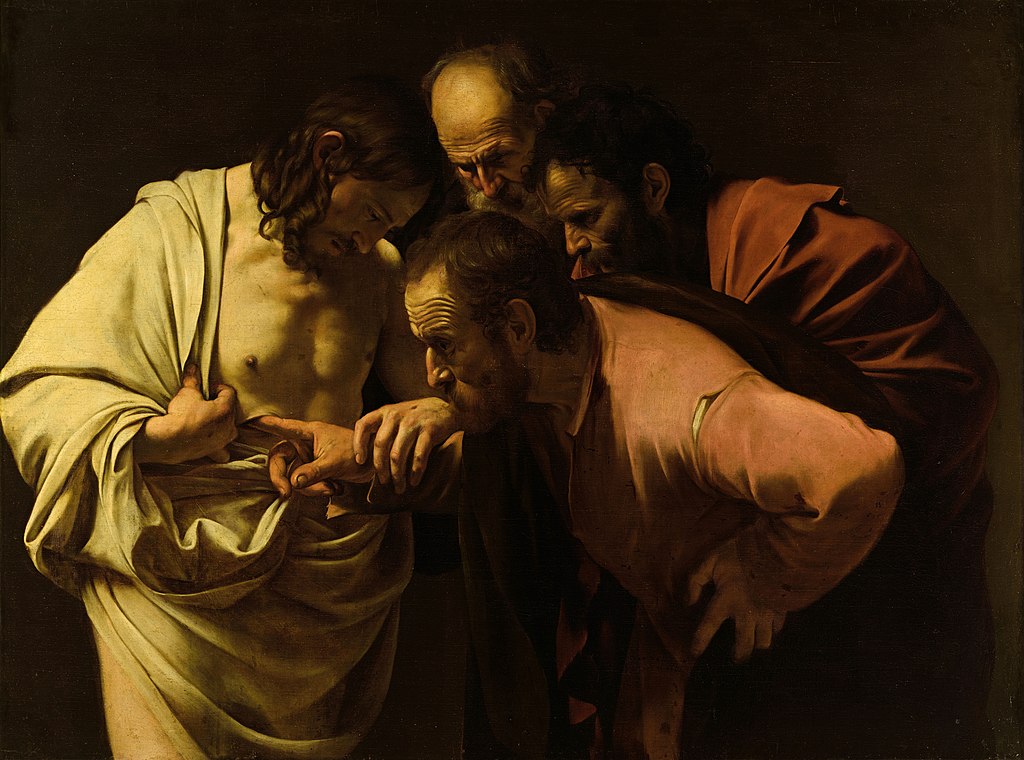
The Incredulity of St Thomas by Caravaggio – or should it be called Jesus showing Thomas his wounds?

I love preaching that brings Scripture to life—and that brings Scripture back to life.

That’s a line I’m going to repeat each week to remind us that every time we open Scripture together we are bringing it back to life.

This morning we return to John’s Gospel, still caught up in the wonder of that first Easter day (John 20:19-end). It’s a story only he tells.

John himself brings scripture back to life.
Particularly we see the influence of the creation story from the 1st chapter of our scriptures.
We can see that in the way that he tells us the time.
On the evening of that first day of the week.
It’s like last week’s gospel reading which began: Early on the first day of the week, while it was still dark. (John 20:1)
We are still on that first day which was like the first day of creation, when, according to Genesis 1:2, earth was a formless void and darkness covered the face of the deep.
That’s the time in today’s gospel. It was the first day of the week, and it was evening.
In other words, darkness was forming.
Taking our cue from Genesis, John’s readers can expect God’s wonders on this new day of creation.

Thomas wasn’t with the disciples when Jesus came on that first day, the day of resurrection.
It was the other disciples who had to let him know that they had seen the Lord.
Thomas told them that he would never believe “unless I see the nail marks in his hands and put my finger where the nails were, and put my hand into his side”.
It is this I suggest we focus on in our worship today.

Thomas is the patron saint of those who are blind because seeing wasn’t enough for him.
He needed to examine Jesus’s wounds by touching them and feeling them.
And the wonderful thing on that second Sunday, the first day of the week following, was that Jesus came and stood among them again and showed Thomas his wounds.
He welcomed his touch. He guided his hand. He let him explore his body.
Thomas is the patron saint of those who struggle to believe what they can’t see—or even what they can.
He shows us that resurrection faith isn’t just about seeing.
Sometimes it’s about touching, questioning and wrestling with God.

Jesus showed Thomas his scars. He wants his disciples to see them.


In the Last Supper, he took a loaf of bread and he broke it.
He wanted them to see his body in the brokenness of the bread.
“Take, this is my body,” he said. (Mark 14:22).
Then he gave them a cup for all of them to drink from.
In that cup he wanted them to see his blood.
“This is my blood of the covenant poured out for many.”
Even before he was wounded he wanted to show his disciples the wounds he was going to suffer.
And in today’s gospel, in one of his resurrection appearances, he invites Thomas to have a look at those wounds – to examine, inspect and see with his hands as well as his eye.

Thomas recognises Jesus through his wounds, just as Jesus wanted him to.
And this is how we come to know Jesus.
Just as Thomas encountered the risen Christ in his wounds, so too we encounter him today in the bread and wine of the Eucharist.
Every Communion we have with Jesus we have this invitation to examine the wounds of Jesus. Every time the bread is broken we are invited to see the brokenness of the body of Christ and to feel that brokenness in our mouths.
Every time we take this cup we are invited to taste the blood of Christ shed for us.

What is it that Jesus showed Thomas?
What did he want his disciples to see?
What does he want us to see when he shows us his wounds, when he invites us to see his body and his blood?

The first things we see are the wounds to his hands and feet where the nails were driven into his body by the hammer blows of empire.
Then, if he turns we see the wounds of the whipping scored into his back for being the scourge of empire and religion.
Then we see the scars on his head where they pressed the crown of thorns and added insult to injury, to press home the point that this “pretender” was nothing.

The rule of the kingdom of God is that the last, the lost and the least come first and those who are first in the kingdoms of this world come last.
The rule of the kingdom of God turns the rules of the world upside down.

In the wounds of Jesus, his disciples see a man who embodies that rule of the kingdom of God. In the brokenness of his body, in the bloodshed, we see a man the religious and political capital tried to reduce to nothing.
The plots against him and his crucifixion were intended to humiliate him and his followers – to make them least, last and lost – GONE for ever.

The problem for them was that the rule of the kingdom of God puts the least, last and lost – those lost and broken by the ways of the world – first.
When Jesus stood among his disciples, first without Thomas, then with him, he was the living proof of the fundamental rule of the kingdom of God.
Here was the humiliated, crucified and killed one.
You can’t get more “least, last and lost” than that.
Here he was, “the first fruits of those who have died”, Christ raised from the dead (1 Corinthians 15:20).

This is what Jesus showed Thomas –
the scars are the living proof of the rule of the kingdom of God.
Jesus stood among them as living proof of the rule he’d always followed,
that puts the last first and the first last.
Here is the one they put last made first.
This is what Thomas saw. This is what he said:
“My Lord, my God” – the rule of the kingdom of God realised in those few words.
“My Lord and my God” – Jesus comes first for Thomas.

So Jesus stands among us still, not with condemnation, but with scars.
What do we see? What difference does it make? Does Jesus come first?

Jesus doesn’t shame Thomas for his questions. He meets him in them.
He doesn’t rush belief. He invites it — gently, patiently, personally.

And he does the same with us.
To all who doubt, who ache, who long to see and touch and know — he says,
“Here I am. Peace be with you.”

He doesn’t hide his wounds. He offers them.
He lets us trace the pain and the mystery of a love that suffers with us and for us.
And in that wounded, risen body, we find our hope.

This morning, he says again:
“This is my body. This is my blood.”
This is how I choose to be known.
Look closely. Taste carefully.
And, if you are among the broken,
do not be afraid.

Being Believed we Become Beloved – on seeing our wounds

A sermon for the 2nd Sunday of Easter for a lively congregation in a Warwickshire village. The gospel for the day is John 20:19-end (text below)

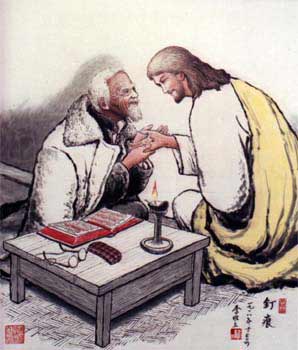
 ‘Unless I see the mark of the nails in his hands, and put my finger in the mark of the nails and my hand in his side, I will not believe.’ So says Thomas – who is not really “the doubter” but the scientist who needs to see the evidence.

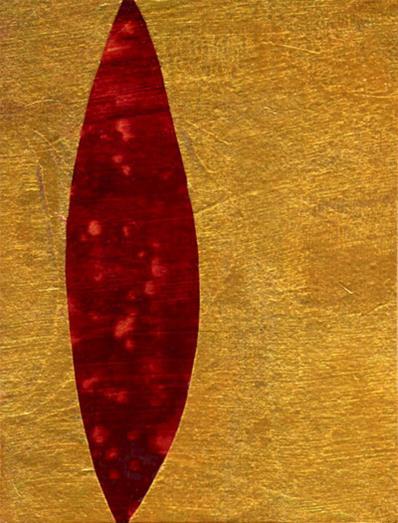
Nail Mark by Li Wei San.

Jesus showed him. He said: ‘Put your finger here and see my hands. Reach out your hand and put it in my side”. Normally we read Thomas’s response as a confession of faith – “My Lord and my God!” with a sense of joy. We could read it very differently – again with Thomas, the forensic scientist examining the body, probing Jesus, talking to to Jesus, as if a patient sufferer, while processing what he is seeing. “They did this to you?” “How deep that wound goes.” “This is what you put yourself through?” “You did this for me?” 

The realisation this examination evoked would have  a very different tone to the one we are used to. Read it differently. Instead of the tone of triumphant joy – as in “My Lord and my God” there may have been the tone of “Myyyyyy Looooord!” “Myyyyyyy God, what have they done to you?”

Thomas is the one who sees the wounds of Jesus, and the truth is in what he sees.

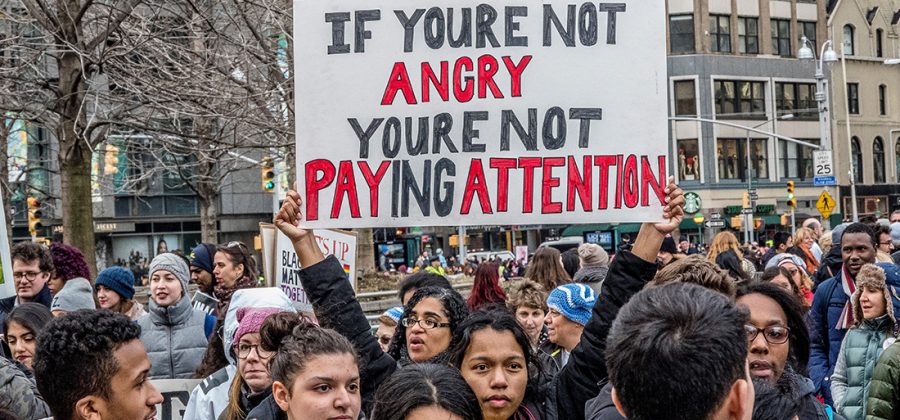
I want to explore what it is to see the wounds of others and our responses. It’s a growing question because there seems to be a battleground developing between those who want their wounds to be seen and those who very intentionally refuse to look, dismissing people for their whining. The battle has been fought down the ages, but is now being fought with a renewed intensity in the forefront of our politics.

The battle lines have been drawn between those who are “woke” and those who are “anti-woke”. The word “woke” made its way into our vocabulary through its usage in the African-American communities where it means staying “alert” to the wounds of racial discrimination. Its use spread through the Black Lives Matter movement and  the word was added to the Oxford English Dictionary in 2017. Being woke is being alert to the woundedness of others. But, most recently, woke has been turned into an offensive word and a term of abuse by those who are anti-woke who accuse the wounded and their sympathisers of being “snowflakes”.

“Unless I see your wounds” – that’s what this is about. The inspiration is Thomas and the wounds he sees, and the wounds Jesus carries. They take us to the heart of the battle.

Can we see one another’s wounds and the pain we bear. 

Can I see your wounds? Can I see how hurt you are? Can you tell us what hurts you?

We can only believe when we see the wounds and understand the back story to those wounds.

Gareth Malone has recently done a series where he put together a choir of eight singers to perform St John’s Passion by Johann Sebastian Bach. Some of you may have seen it. What made it so interesting was getting to know the eight people who formed their choir, hearing their stories and seeing their wounds. 

For example, a close relative of one of them, a niece, had been killed in a road traffic accident the previous week – and there Simon, her uncle, was there rehearsing, finding the rehearsing something that helped with the wounds.

Another of them, Joy, was one of the few who knew the passion story. She grew up in the church. Her wounds were wounds of rejection. She carried the scars of having been rejected by her parents when she was a baby, and then again felt rejected by her church at the age of 12 when it became clear to her that she was gay. (Incidentally, that has been thought to be an appropriate age for the Holy Spirit to confirm faith in a service of Confirmation.) Here we have a rejection, not a confirmation – with all the wounds and scarring that go with it. Her faith is still important to her. She was wearing a prominent cross of another rejected one.

Already, in two of them, we see their wounds. The wounds we were shown were fairly typical – the wounds of sudden loss and the wounds inflicted on some who are gay. It was only the surface we were touching. We obviously weren’t shown the complications which are personal to each wounding.

Bach himself was sore wounded. By the age of 10 he had lost both his parents. His first wife died after they’d been married 13 years. 12 of his 20 children died before they were 3. Research by John Eliot Gardiner reveals the violent, thuggish world of the young Bach. Gang warfare and bullying typified his schooling with inspection reports showing that boys were brutalised. They were “rowdy, subversive, thuggish, beer and wine loving, girl-chasing, breaking windows, brandishing daggers”. He missed 258 days of schooling in 3 years – kept at home, like many for fear of what went on in school. Do we understand his music more, do we see his musical score better for seeing the scarring and scale of his wounds?

Can we see the woundedness in others? The wounds of those who are gay. The wounds of those who have grown old and tired. The wounds of those who have had to fight through war. Can we see the woundedness of those who have had to flee – the refugee, the jilted. The wounds of those who are black those who are disabled. So many of their wounds have been inflicted by those who haven’t cared for them/us as they should

These wounds matter. The wounded don’t want to hide their wounds. Their wounds are who they are. Our wounds are who we are. They have made us who we are. As I said, it’s the Black Lives Matter movement which has encouraged wokeness. Members of the Black Lives Matter movement insist the wounds are part of who they are. Their history matters – their wounds matter.

With our own loved ones it is important to see their wounds. When a child is upset we want to know where it hurts. With a partner, we want to understand the story of their scars and the wounds they carry.

And all of us want to be believed for the stories we tell about ourselves, our battles, challenges and wounds. That is what is so important about a community like this. Our best chance of being believed is being amongst people who trust one another – who we can trust with our very lives – sheltered from the indifference and cynicism of those too wrapped up in themselves to see the gaping wounds so many have to hide because they fear they’d never be believed.

Some of our wounds are self-inflicted – maybe a relationship breakdown which was my fault, or the wounds may be the result of personal neglect, or the way we’ve misused our bodies. Our sense of shame covers up the wounds. 

Through prayer and encouragement
we may begin to open up
to the one who wants to see,
to the one who says “let me see”,
to the one we can trust
with the shame we are showing them,
to the one we trust will believe us,
even God who wants to see, to heal
what matters to us matters to him
what’s wounded us, wounded him,
crowned with agony.

It’s not “wokeness” that alerts us to the pain and wounds of others. It’s our passion for the other which we call compassion. We mustn’t let the anti-woke brigade prevent us seeing the pain and suffering of others. Not seeing why, how and what is hurting rubs salt into the wounds and isolates them from us.

When we are trusted enough for people to show themselves to us, and when we truly see them, we believe. Seeing is believing – and our hearts go out to those who have so trusted us to believe in them. They are believed and beloved. They are known.

Thomas said: “Unless I see the mark of the nails in his hands, and put my finger in the mark of the nails and my hand in his side, I will not believe.” Nor will we believe people unless we also see the marks of the nails, the cuts in their bodies, the scarring of their minds. Unless his/her/their/our nail marks are seen and his/her/their/our wounds felt he/she/they/we will not be believed and will not be beloved.

John 20:19-end

When it was evening on that day, the first day of the week, and the doors of the house where the disciples met were locked for fear of the Jews, Jesus came and stood among them and said, ‘Peace be with you.’ After he said this, he showed them his hands and his side. Then the disciples rejoiced when they saw the Lord. Jesus said to them again, ‘Peace be with you. As the Father has sent me, so I send you.’ When he had said this, he breathed on them and said to them, ‘Receive the Holy Spirit. If you forgive the sins of any, they are forgiven them; if you retain the sins of any, they are retained.’
But Thomas (who was called the Twin), one of the twelve, was not with them when Jesus came. So the other disciples told him, ‘We have seen the Lord’. But he said to them, ‘Unless I see the mark of the nails in his hands, and put my finger in the mark of the nails and my hand in his side, I will not believe.’
A week later the disciples were again in the house, and Thomas was with them. Although the doors were shut, Jesus came and stood among them and said, ‘Peace be with you.’ Then he said to Thomas, ‘Put your finger here and see my hands. Reach out your hand and put it in my side. Do not doubt but believe.’ Thomas answered him, ‘My Lord and my God!’ Jesus said to him, ‘Have you believed because you have seen me? Blessed are those who have not seen and yet have come to believe.’
Now Jesus did many other signs in the presence of his disciples, which are not written in this book. But these are written so that you may come to believe that Jesus is the Messiah, the Son of God, and that through believing you may have life in his name.

Achers of space – sermon notes for Easter 2

Into the wound
Easter 2B – Bromborough
Text – John 20:19-31

Jesus said: “In my house there are many rooms” (John 14:2). That is a mark of his hospitality. It’s the sort of thing that any good host will say to his/her guest. “We’ve got loads of room. We can easily make up a bed.” Good hosts say these things because they want their guests to feel at home – they want their guests to stay with them – they look forward to their company.

As Christians we love what Jesus said. We draw strength from the generous hospitality which says “In my house there are many rooms” – we want to dwell in that house where there is so much room and where there are so many openings.

Today’s Easter gospel is set in one room in which there are an abundance of openings – too many for us to get our heads round.

There’s

  • The opening of the door
  • The opening of Jesus’ mouth
  • The opening of Jesus’ hands and side

Each of them begs for an opening up of ourselves.

In Jesus there is so much opportunity for openings and the resurrection begs of us a reformed hospitality within ourselves. An RSVP is called for from each of us.

A little about each of the openings – the openings could well be a whole sermon series – but today a little on each.

Opening the door

The opening of the door –  the disciples had locked themselves in because they were afraid. And Jesus stands amongst them. How did that happen? The open door is a powerful Christian image because of this resurrection appearance.

I have fought a couple of battles in parish ministry. One was about church keys (and who should hold them) and the other was about trying to keep the church open. Like the disciples in today’s gospel the two churches were afraid – they wanted to lock themselves in because they were afraid of their communities.

I don’t know whether you keep this church open. I hope you do. And if you don’t, I hope that you give it some thought allowing Jesus’ words to those first disciples to ring in your ears. “Do not be afraid.” Just imagine the signage – “this church is open” (and all the ambiguity of such a sign!)

There are many metaphorical rooms that we retreat to – in fear, in shame. This gospel story is told time and again to encourage us to open up, to not be so afraid, to not be so ashamed – to let the spaces we move in reverberate to the sound of Jesus’ words.

RSVP

And that takes us to another opening.

Opening his mouth

Jesus’s opening words were “Peace be with you” . Three times in this short passage Jesus greets the disciples with “Peace be with you”. To his anxious and frightened friends he says “peace be with you”. We repeat those words in our greetings in the Peace. “The peace of the Lord be always with you”. (Always try to exchange the peace with at least three people to remember this Easter exchange that we celebrate this morning).

John doesn’t just say that Jesus spoke to his friends. He also tells us that he breathed on them. When he breathed on them they received the Holy Spirit. “The Lord is here. His Spirit is with us.”

Some ancient liturgies included a mouth to mouth kiss as part of the Peace to pass the breath of the Spirit, the breath of the post-resurrection meeting room  – a recall of the intimacy of that meeting with the risen Jesus. (See here.)

And what does that make of our hospitality?

RSVP

The third opening is that demanded by Thomas, doubting Thomas, Thomas the scientist who wouldn’t believe without seeing the evidence. Thomas said “I won’t believe until I see the mark of the nails in his hands, put my finger in the mark of the nails, and my hand in his side.” And Jesus showed Thomas the nail wounds in his hands, and the spear wound in his side.

I have copied a picture of the wounded side (pictured above) by Jan Richardson from her Painted Prayerbook. It is called “Into the Wound” and I offer it as an invitation for your prayer and wonder. I see it as a tear, as an opening, as a doorway.

Medieval artists gave great attention to Jesus’ wounds. They were often the subject of their art. Such attention for us seems gruesome – but we might be missing an opening.

Eamon Duffy, writing in 15th/16th century England: “the wounds of Christ are the sufferings of the poor, the outcast, and the unfortunate” – according to which acts of charity (foodbanks, nursing, hospitality) become a tending of the living, wounded, corporate body of Christ.

The wound is on his side. Maybe those of us who are on his side can see our own wounds in the wound of Jesus (the ones we’ve inflicted and the ones inflicted on us). Is there an invitation on this door? Is Jesus inviting Thomas, the disciples and all those on his side into the wound, to feel around the space, to know the love, to know the other side?

And is there a reciprocal arrangement, whereby we don’t hide our wounds but invite others into our hurting world so that we might find wholeness and healing? Jesus stands at the door and knocks. If his wound is our way into him, are our wounds his doorway to us?

This is what Jan Richardson writes:

“In wearing his wounds—even in his resurrection—he confronts us with our own and calls us to move through them into new life.

The crucified Christ challenges us to discern how our wounds will serve as doorways that lead us through our own pain and into a deeper relationship with the wounded world and with the Christ who is about the business of resurrection, for whom the wounds did not have the final word.

As Thomas reaches toward Christ, as he places his hand within the wound that Christ still bears, he is not merely grasping for concrete proof of the resurrection. He is entering into the very mystery of Christ, crossing into a new world that even now he can hardly see yet dares to move toward with the courage he has previously displayed.”

Thomas’s RSVP was “My Lord and my God” – his mind blown open, he believed.

Belief in resurrection is often thought of as a rational process. That is how Thomas approached it. But belief isn’t only about our heads. Belief isn’t a rational response but an emotional one. Belief comes from the German word which gives us beloved. “Belief” is “belove” – a believing disciple is a beloving and beloved disciple. When Thomas believes he doesn’t just open his mind, he  opens his mouth (as RSVP), his heart and his very gut where all our anxiety and fear find their home.

Jesus opens the room, he opens his mouth, he opens his wounds. We are invited through these open doorways, into a new life that without this gospel would be unimaginable.

Please RSVP.

The image Into the Wound is copyrighted to Jan Richardson and is used with permission – www.janrichardson.com

Thomas’s Twin – a sermon for Easter 2A

Sermon notes for Easter 2A for St Alban’s, Broadheath. Again, it could be said better, and I hope it will be. I share it anyway. The Gospel reading is John 20:19-31

Who likes ants?

We are told to learn from the ants. Proverbs 6:6 – “Go to the ant, you sluggard: consider its ways and be wise.”

It’s true. We can learn a lot about community and industry from ants. We can also learn that if they get lost they die. When ants get lost, they follow a simple rule. The rule is to follow the ant in front. But they don’t know that the ant in front of them is only following the ant in front of him. They finish up going round and round in circles, blindly following the one in front until …. They die.

There is a famous example of this deathmill from the Guyana jungle. The ants were just going round in circles – it was a trail of ants which just kept marching in a column 400 yards long (the length of a running track). It took them 2 days to complete a circuit. On and on till they died from exhaustion.

Consider its ways, and be wise. What do we learn from the ant? We learn the importance of thinking for ourselves. We learn the importance of seeing for ourselves.

“Seeing is believing.” That’s what we say, isn’t it?

“We have seen the Lord” is what the disciples say in today’s gospel reading. “We believe”. “We have seen the Lord” is what the disciples say to Thomas, who wasn’t there to see and believe. He is the odd one out.

He was in the wrong place at the wrong time and missed seeing Jesus.

Seeing is believing is the theme of John’s gospel. Time and again John refers to the disciples “coming to see”. The frequency increases as we move to the end of John’s gospel.

  • Mary Magdalen came to the tomb and saw that the stone had been removed,
  • Peter and the beloved disciple ran to the tomb and saw the linen wrappings lying there. They went into the tomb, and saw and believed.
  • Mary Magdalen told the disciples that she had seen the Lord.
  • Mary Magdalen, Peter, the beloved disciples come to see the Lord.
  • And then, that same evening of the day of resurrection, the disciples “see the Lord” – apart from Thomas. Where was he? What was he doing?

Seeing is believing.

But if seeing is believing, what about those who are not there to see, like Thomas?

And what about those who can’t see? What about those who not even Specsavers can save?

This was a problem for a friend of mine who became blind. He was troubled about all that the Gospels say about “seeing” and “believing”, and about “light” (good) and “darkness” (bad). How could he believe when he couldn’t see? How could he be saved when he had been cast into outer darkness?

Do you see his problem?

He worked it out in the end, eventually realising that there are other ways of seeing. He called it “whole body seeing” and wrote the story of his blindness and his later whole body seeing in a book called Touching the Rock.

This is how he discovered his “whole body seeing” (WBS for short). He was staying at Iona. He had been told about the altar there by people who had described it to him. Then he saw it for himself. This is what he wrote:

 “After several nights, I discovered the main altar.

I had been told about this, and I easily recognised it from the description. It was a single block of marble.

Finding one corner, I ran my fingers along the edge, only to find that I could not reach the other.

I worked my way along the front and was amazed at its size.

The front was carved with hard, cold letters. They stood out baldly, but I could not be bothered reading.

The top was as smooth as silk, but how far back did it go?

I stretched my arms out over it but could not reach the back. This was incredible.

It must have a back somewhere. Pushing myself upon to it, my feet hanging out over the front, I could reach the back. I did this again and again, measuring it with my body, till at last I began to have some idea of its proportions. It was bigger than me and much older.

There were several places on the polished surface which were marked with a long, rather irregular indentations, not cracks, but imperfections of some kind.

Could it have been dropped? These marks felt like the result of impact. The contrast between the rough depressions and the huge polished areas was extra ordinary.

Here was the work of people, grinding this thing, smoothing it to an almost greasy, slightly dusty finish which went slippery when I licked it. Here were these abrasions, something more primitive, the naked heart of the rock.”

When I read that I just went WOW. He had seen things which would not have been noticed by the casual observer with her naked eye. With his whole body seeing he had found things there which I am sure he’d be telling others about over breakfast the next day. “Come and see” he’d have been telling everyone.

I mention this because I think there is something in today’s gospel about the importance of seeing things for ourselves. When we see things for ourselves we are not seeing through other people’s eyes. We are not conforming to their vision, and we are seeing things that nobody else sees.

This brings us to the beauty of Thomas who is the focus of our gospel reading.

Thomas is a disciple who captures our imagination, isn’t he? That’s shown in the number of Thomases there are. (How many here are called Thomas, or have a Thomas in their family?)

Two of our children have Thomas in their names, after their grandfather.

We often talk about “doubting Thomas” and then refer to him as typical of us, who are often “doubters” like him.

I’m not sure that this is helpful. Thomas is actually someone who sees and believes, but in a different way. Isn’t that a more helpful way to remember Thomas?

Thomas sees things differently. This is brought out in the gospel. He wants to see through his hands and fingers. He uses his body. He doesn’t just see with his eyes. He inspects. He uses his senses and his sense. He sees with feeling. He sees from the heart.

That is the way that Thomas comes to see.

He puts his hand into Jesus’ wounds. He reaches beyond first impressions. And then he sees. He feels the love in those scars and jumps to his joyful conclusion that he is seeing our Lord and our God. This is the staggering realisation which comes from seeing from the heart, which comes from seeing with feeling, which comes from his insistence that he should see things for himself.

Thomas is not the doubter. He is one who was willing to see.


Thomas is a twin. That is how he is introduced in the gospel. “Thomas the twin”. We don’t know whether Thomas had a twin brother or sister. IT’s more likely that “twin” was Thomas’s nickname because the meaning of the name Thomas is “twin”. But if Thomas had a twin, who might it be?

That  might have been a question that entertained John’s community. “If Thomas is the twin, who is his twin brother or sister?”

They could have played with that question and wondered “is that me?”

We can play with the same question. If Thomas is like us in his doubting, can we be like him in his seeing and believing? How much like him can we be? Can we be his twin brother or sister in the way that we are so much like him in wanting to see Jesus from the heart?


Jesus made many “resurrection” appearances – or should I say that Jesus makes many “resurrection” appearances. John admits that there are so many ways that Jesus showed himself and supposed that “if every one of them were written down the world itself could not contain the books that would be written.” Jesus wants us to see him for ourselves. He wants us to be witnesses.

Mary Magdalen, Peter, the disciple (disciples?) Jesus loves/loved, Thomas and ourselves come to see in their different ways. Together we are a body of believers who through our whole body seeing see things differently.

It is in such company that Jesus shows himself so that we might see life differently – with compassion that is able to feel for scars and wounds, and with the hope that love is stronger than death.

It is in such company that Jesus shows himself to us so that we might follow him in a way of life that is life giving, instead of blindly following others till, like the ants, we drop from exhaustion.

the quote is from Touching the Rock by John Hull
I found the picture of Still Doubting at Mattseyeshaveseen – with some interesting reflection.

The Kingdom

>I have listened to two sermons from +Robert Atwell in two days. Today I get a day off!The first sermon was at the induction of friend Kathy Kirby as Vicar of St Paul’s Macclesfield. Kathy is a special person who is immensely generous in her appreciation of others. She will offer a very special ministry of affirmation and encouragement. The second sermon was to our Committee for Ministry in which he quoted “the Kingdom” by R.S.Thomas:

It’s a long way off but inside it
There are quite different things going on:
Festivals at which the poor man
Is king and the consumptive is
Healed; mirrors in which the blind look
At themselves and love looks at them
Back; and industry is for mending
The bent bones and the minds fractured
By life. It’s a long way off, but to get
There takes no time and admission
Is free, if you purge yourself
Of desire, and present yourself with
Your need only and the simple offering
Of your faith, green as a leaf.
R.S. Thomas, Collected Poems 1945-1990

I am playing round with ideas on supervision at the moment. Where many minds are bent on specifying, my mind is bent on generalising. I am told that if supervision becomes too general it loses its meaning. I counter that if supervision is too specific it doesn’t mean so much. If the kingdom is “mirrors in which the blind look at themselves and love looks at them back” I dare the word to bear such meaning and defy those who say I go too far.

Thomas

Two of our children bear Thomas in their name. Their grandfather was called Thomas. Thomas is highlighted in our Gospel today. What was he doing on this first day of the week when the other disciples were locked in in fear of the people’s anger? Did he not share the anxiety of the other disciples? Did he have more confidence?

Kate Huey, in the linked article, quotes Michael Williams’s comment about Thomas which contrasts with how Thomas is so often portrayed. He writes: “the only one amonmg the disciples who was not do filled with fear that he was unwilling to leave the disciples’ hiding place.” (see this Sunday’s gospel) Kate quotes Gail O’Day’s observation that “one week after the disciples have been visited by the risen jesus and received Jesuis’ peace and the Holy Spirit, they have once again locked themselves away behind closed doors.” Even after seeing the risen Jesus they still don’t live as an Easter people.

So was Thomas the one didn’t want to be locked away? Was he the one who wasn’t frightened? Was he the free spirit? Have we lost the truth by caricaturing him falsely as “the doubter”? And if he is the odd one out of the twelve? What does he have to say about the rest of them, and the rest of us who are similarly inclined to lock ourselves away (metaphorically) because we fear the people. What was Thomas doing?

Jan Richardson in the Painted Prayerbook has a different take on the locked room – the “secret room” as she calls this painting, and she suggests that every pilgrim needs a secret room.

She quotes Phil Cousineau’s The Art of Pilgrimage who writes this:

“Everywhere you go, there is a secret room. To discover it, you must knock on walls, as the detective does in mystery houses, and listen for the echo that protends the secret passage. You must pull books off shelves to see if the library shelf swings open to reveal the hidden room. I’ll say it again, everywhere has a secret room. You must find your own, in a small chapel, a tiny cafe, a quiet park, the home of a new firend, the pew wehere the light strikes the rose window just so. As a pilgrim you must find it or you will never understand the hidden reasons why you really left home.”

Here is sanctuary and indicates the need we all have for “retreat” for all the times when we have a choice of fight or flight and when fighting seems so hopeless. And does Jesus condemn us for locking oursleves away and trying to save our own skin? It appears not. Because to those first Christians locked in fear Jesus came with nothing other than peace. There were no recriminations for them running away or for their betrayal of his trust. All he does when he gets through their defences – past the locked doors is to “offer them greeting and gift” (Kate Huey) – “Peace be with you”.