>rigid rules

>Free coiled tape measure healthy living stock photo Creative Commons
It seems that for every crisis we try to create a series of rules to prevent the crisis recurring. Judges, teachers, doctors – all professionals – seem to be ruled by rules. Many are denied the satisfaction of doing the good they would do because the rule book forbids it. 
The problem with rules is that we find ourselves on one side of the rule or the other. Either ruled in or ruled out. It is intensely frustrating to be unjustifiably ruled out. We need to learn a lesson from the tape measure. The tape measure is a rule that fits round things that are real.
Apparently Aristotle was impressed by the improvisation of the craftsmen that he was watching on the island of Lesbos. They were building rounded columns for which rigid rulers were useless. The craftsmen improvised with a ruler that bends – which we call a tape measure.
Aristotle talks a lot about wisdom. For him practical wisdom is the key to happiness. The wise person is like the improvising builders of Lesbos who knows that rules have to be bent and that we all need to deal with others flexibly.

And this is the nature of the equitable, a correction of law where it is defective owing to its universality. … For when the thing is indefinite the rule also is indefinite, like the leaden rule used in making the Lesbian moulding; the rule adapts itself to the shape of the stone and is not rigid, and so too the decree is adapted to the facts. [Aristotle, “Nicomachean Ethics”]

A line in the sandSchwartz and Sharpe have published a book on practical wisdom.They talk about the importance of character and virtue as an alternative response to the crises which we face. They recognise two great sources of hope. The first of those they refer to as “canny outlaws” who have the moral courage to find a way around the rules. The second of those they refer to as “system changers” who have the moral courage to transform the system. (You can hear Barry Schwartz’s talk on this here).
John’s Gospel (7:53-8:11) has the story of the woman caught in adultery. According to the rules she should have been stoned to death. The (foolish) lawyers brought the woman to Jesus for his condemnation. What does he do? He kneels down and draws a rule in the sand. The woman’s accusers no longer know which side of the line they stand – wisdom had blurred their difference. Throughout the story Jesus is on the woman’s side – the side of the accused. He had blown away their rules for the sake of the woman whose proposed punishment – in now way – fitted her “crime”.

chitter-chatter

>

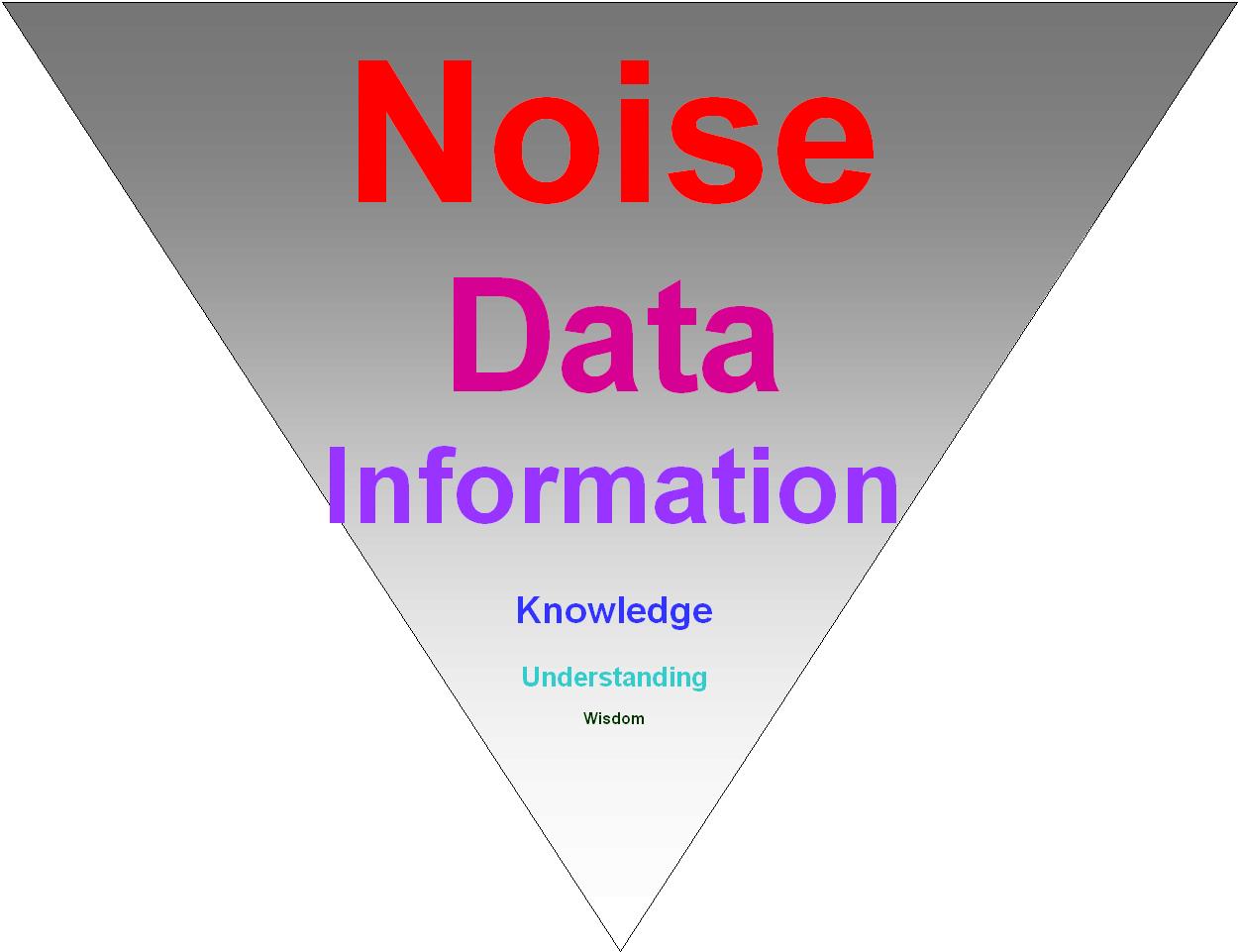
This diagram describes the ratio of noise to wisdom and the descending volume and value from noise to wisdom. According to Dee Hock “Noise becomes data when it transcends the purely sensual and has cognititve pattern.
Data becomes information when it can be related to other information in a way that adds meaning.
Information becomes knowledge when it is integrated with other information in a form useful for deciding, acting or composing new knowledge.
Knowledge becomes understanding when related to tother knowledge in a manner useful in conceiving, anticipating, evaluating and judging.
Understanding becomes wisdom when informed by purpose, ethics, principle, memory of the past, and projection into the future.” 

At one end of the spectrum, data is increasingly abundant, whereas wisdom (which is “holistic, subjective, spiritual, conceptual, creative”) seems to becoming scarcer.
 
We watched Lark Rise to Candleford last night. Based on life in bygone Buckingham (Candleford) and Juniper Hill (Lark Rise) the series reflects a time when there seems to have been a far higher ratio of understanding and wisdom to data and information. Wise counsel seems to have been part of being in settled communities slowly facing up to change. The wisdom is captured in the winning entry to last night’s poetry competition:
 
     As I went on my way,
     Gossamer threads span from bush to bush like barricades,
     As I broke through one after another
     I was taken by a childish fear
     They are trying to bind and keep me here
     But as I grew from girl to woman, I knew
     The threads that bind me were more enduring than gossamer.
     They were spun of kinship and love
     Given so freely that it could never be taken away from me. 
 
They were the days before the coming of the railway – a back story of Lark Rise. The coming of the railway meant increased communication, which meant more noise, which meant more data, which meant more information – and before we know it, we are too tired and overwhelmed to process it any further. Now we contemplate rail journeys of  only two hours from London to Glasgow – though wisdom may have gone out the window.
 
I am in the process of exploring the world of Facebook and Twitter. I now have the knowhow – now I am looking for the understanding and the wisdom to discern how to use it. Though there is a lot of noise and chatter going on I think I can now see a point to Twitter – I travel slowly! So I have changed my profile to “Cascading Insight – a dealership in second hand views” – and I am thankful for the tweets of others which have pointed me in the direction of understanding and wisdom. I will not be tweeting about my moods, where I am, and what time I’ve gone to bed. That is definitely too much information and just adds to the volume of noise we haven’t got a hope in hell of managing.

>The Information Age (2)

>Noise becomes data when it transcends the purely sensual and has cognititve pattern.
Data becomes information when it can be related to other information in a way that adds meaning.
Information becomes knowledge when it is integrated with other information in a form useful for deciding, acting or composing new knowledge.
Knowledge becomes understanding when related to tother knowledge in a manner useful in conceiving, anticipating, evaluating and judging.
Understanding becomes wisdom when informed by purpose, ethics, principle, memory of the past, and projection into the future.
Dee Hock comments that more primitive societies had a far higher ratio of wisodom and understanding to knowledge and date. They hadn’t got much in the way of data but loads of wisdom. On the other hand our society is high on data and information “but understands very little of what it knows”, leaving us with “separatist, linear, mechanistic institutions, confined with our ever more isolated specialities, constricted by ever narrowing perspectives.”
So, it looks like we are stuck between a rock and a hard place – institutions not fit for purpose in our information age and no time or inclination to understand all the information of our age. Cue – theologian and sage.

>Pearls

>Good authors gift us with pearls. Here are some pearls polished and presented by Timothy radcliffe from my reading today – What is the Point of being a Christian?
How about this?

  • As fish were made to swim in water, human beings were made to thrive in the truth (p121)
  • When Wittgenstein was asked how philosophers should greet each other, he replied ‘Take your time.’ (p123)
  • We come to see people as lovable because we see other people loving them. (p124)

and then Radcliffe uses this story. “one day a rabbi asked his students, ‘How can you tell that night has ended and the day is returning? One student suggested, ‘When you can see clearly that an animal in the distance is a lion and not a leopard.’ ‘No’, said the rabbi. ‘It is when you can look on the face of another person and see that woman or man is your sister or brother. Because until you are able to do so, no matter what time of day it is, it is still night.'”