Stressed? Just one thing’s needed

This sermon explores why Luke tell us the story of Martha and Mary. Why did he think it was important for his readers? I always begin my sermon these days by saying how I love preaching that brings scripture back to life, and that I assume those who are listening do too. The gospel for the day is Luke 10:38-42: it’s about Martha’s resentment (and, maybe, our resentments too).

The question I have reading the gospel set for today is: why did Luke think it was so important to tell this  story? It is, after all, a minor incident – the day that Martha had a strop. What is it that Luke wanted his readers to hear? It’s certainly a story that has taken off. Everyone knows about Martha and Mary – even though some of us can’t remember which is which. None of us would be any the wiser were it not for Luke.

It is a small, everyday story that I think we can all relate to.
Who hasn’t invited people into their home only to feel stressed by the so many things that need to be done—getting the meal ready on time, setting the table just so—and then having to hide all that stress, frustration, and tension behind a smiling welcome?

This is a story of two sisters. But really, is Luke telling the story because it is the story of us?

Martha is the older sister.
She’s the one who opens her home to Jesus—not just Jesus, but also his twelve disciples.
That in itself would have raised eyebrows: a household of women welcoming in a group of men.
Where’s the risk assessment for that?
Where’s the safeguarding policy?

There would have been a lot to do to make these guests welcome.
And it seems Martha was the one doing it all.
Luke says she was “distracted with much serving.”
The literal meaning of the Greek is that she was “dragged around”—pulled this way and that by all the tasks.

Meanwhile, Mary is just sitting there, listening to Jesus.

The two sisters are both followers of Jesus. They’re both his friends.
But they are very different.
Martha is a “doer.” Mary is a “listener,” a “dreamer.” The church is made up of both.
If we drew a Venn diagram of this congregation, we’d see some who are hands-on people and others who are heads-in-the-clouds people—and many who are a bit of both.
One isn’t better than the other.

Except when one gets distracted.

And that’s Martha’s problem.
It’s not that her work is unimportant or that her hospitality is wrong.
It’s that she has lost her focus. She’s no longer attending to her guest.
Instead, her gaze has shifted to her sister’s shortcomings.
Instead of speaking to Mary, she complains to Jesus about Mary.

“Lord, don’t you care that my sister has left me to do all the work by myself? Tell her to help me!”

Martha’s serving has become all about her—her effort, her stress, her sense of injustice. She’s been “dragged around” by her tasks and “put herself in an uproar” (as the Greek word for “troubled” suggests).

The story of Martha and Mary echoes other sibling rivalries in Scripture.
In Genesis, Cain and Abel both make offerings to God, but it’s the younger brother’s offering that’s accepted.
Cain puts himself in such an uproar over the seeming injustice that he murders his brother.

In Jesus’ parable of the prodigal son, it’s the older brother who refuses to join the party when his younger sibling comes home. He too is dragged around by resentment. He can only see the injustice of it all—how hard he’s worked, how little he’s been appreciated.

This is a pattern in Scripture. The first becoming last, the last becoming first. The kingdom of God upending the old order. And here, it’s the younger sister, Mary, who has chosen “the better part.”

Isn’t that how it often is with us? When we get upset, it’s so often because we’ve put ourselves first. Our effort. Our fairness. Our feelings. When that happens, we lose sight of Jesus. We lose sight of the guest.

This isn’t a story about pitting action against contemplation. The church needs both. The problem isn’t Martha’s serving. It’s her distraction.

We’ve all been in Martha’s shoes, trying to do the right thing in the wrong frame of mind. We’ve probably seen it being played out in our church politics, when, for example, a meeting gets distracted, dragged off track by our focus on the shortcomings of others, where we’ve “put ourselves in an uproar”.

Is this why Luke wanted his readers to know this particular story? So that they would hear Jesus’ response.

This is how Jesus responds:

“Martha, Martha…”

When Jesus uses a name twice in Scripture—“Martha, Martha… Saul, Saul… Jerusalem, Jerusalem…”—it’s never in anger. It’s in love, in compassion. Martha has worked herself into an inner storm, and Jesus does what he always does with storms:

“Peace. Be still.”
“You are worried and upset about many things. But only one thing is needed.”

This is a word Martha needed to hear, and it’s a word that’s been needed ever since—by every one of us who’s let worries, distractions, and resentments drown out the voice of Jesus.

The good news is Jesus doesn’t withdraw from Martha because of her distraction. He speaks to her lovingly, inviting her back to the one thing that matters: attending to him.

In Revelation 3:20, we hear Jesus say:

“Behold, I stand at the door and knock. If anyone hears my voice and opens the door, I will come in and eat with them, and they with me.”

Jesus never forces his way in. He waits for us to open the door. That is how he calls on us.

The question for Luke may be how we are when we answer Jesus’s call, when we open our lives to him and make him our guest.
How do we welcome him?
Will we listen, like Mary, who chose the one thing needed?
Or will we get distracted, dragged around by many worries and upset by the shortcomings of others?
In which case, will we listen, like Martha, and hear Jesus’s words to us – words spoken to us in love and compassion, words to calm the storm?

I assume that is what Luke wanted us to hear from his gospel today.

Closing Prayer
Lord Jesus Christ, you stood at the door and knocked,
and we welcomed you in.
Calm the storms of our hearts, still our anxious minds,
and free us from the distractions that drag us away from you,
so we may serve you with joy and without anxiety or resentment.

The Samaritan, the wounded, and the question that won’t go away

We know parable of the Good Samaritan so well we can almost recite it by heart. But maybe that’s the problem. Its edges have worn smooth with repetition, and its challenge no longer cuts as sharply as Jesus intended. What happens when we let it confront us afresh? Here’s a sermon that asks us to imagine hearing it for the first time — and to wrestle with the question that won’t go away: “Who is my neighbour?”.

My customary intro – so customary these days that we could almost do it as call and response.
Here goes: I love preaching that brings scripture back to life.
Call: Do you love preaching that brings scripture back to life?
Response: We do.

But how do we bring scripture, such as this parable of the Good Samaritan back to life when we’ve worn it smooth with repetition, so familiar that its sharp edge no longer cuts?

Can we imagine the pointedness of the parable for those hearing this for the first time?
Imagine hearing this for the very first time.

Let’s do some word association.

What word do you associate with Samaritan?

What words do you think Jesus’ Jewish contemporaries associated with Samaritan?

Very different sets of word associations

Here’s a bold assertion I read this week: This parable has single-handedly shaped the reputation of the Samaritans. Samaritans stood for everything the Jews hated. In their eyes the Samaritans were despised as the last, the least and the lost. There was no such thing as a “good” Samaritan. Now a Samaritan is someone we can call when we are at the end of our tether. A Samaritan is a first responder – one who runs into trouble to help – unlike those who run away at the first sign of trouble.

But to the question posed by the lawyer, “Who is my neighbour” Jesus casts the main characters as those last, least and lost. There are two main characters.
There is the one attacked by robbers and there is the Samaritan. 

It is interesting to note who and what Jesus sees first when he preaches the good news of the kingdom. Jesus sees first not the powerful or the prominent, but the ones left behind,
the last, the least and the lost,
the stripped, beaten, and left for dead,
the wounded and the hated.

The Samaritan and the victim are the ones Jesus sees first when he responds to the lawyer’s question, “Who is my neighbour?”.

They are the ones Jesus “sees”.

And these last, least and lost become the leaders in this discussion about neighbourliness.
Jesus promotes them to be the first to teach the lawyer (and all Jesus’s hearers) a lesson on the question “Who is my neighbour?”


Here are the last.


And here are the first,
way off in the distance,
the priest and the levite,
the first people Jesus’s hearers would have thought should have responded to the stripped, beaten and robbed.

You would expect them to do good. 

They are prominent people.
They come first in the public eye, just as they come first in the story Jesus tells.
They are the professionals – the ones who should know the scripture the lawyer quotes: “Love your neighbour as yourself.”
They would have known that as the key to eternal life, but they fail to walk the talk.
I wonder if the lawyer would have done the same – walked by on the other side, failing to walk the talk.

What happens is that the first come last in the eyes of Jesus and the kingdom of God.
They are the ones who become the outcasts by just walking by.

When Jesus preached he said to those who would listen:
Love your enemies,
do good to those who hate you,
bless those who curse you,
pray for those who abuse you. (Luke 6:27-28)

And here today, we hear of a Samaritan,
loving his enemy,
doing good to one, who in all likelihood, hated him
an answer to prayer for the victim, who in all likelihood,
joined in the abusive banter of the time.

The lawyer asked, “who is my neighbour?”
We might ask, “Who is my enemy?”

Enemy is a word of two parts.
There is the ene – meaning not,
and there is the emy,
like the French word ami,
behind which is the Latin word for friend – amicus.
My enemy is literally the one who is not my friend,
not only the one who hates me, curses me and abuses me,
but the one to whom I am nothing, a nobody.

The Samaritan loves his enemy.

This isn’t just about ancient hostilities.
Our world still draws lines between us and them.
Think of the debates around borders and strangers today.

We live in xenophobic times.
Perhaps these times are no different to other times.
Perhaps these times are no different to Jesus’ own times.
Perhaps we’ve always been wary of strangers.
They’re never our friends as long as they are strangers.
They’re the enemy to be kept out.

Behind the lawyer’s question was the idea that there has to be a limit to who our neighbour is.
Probably, like the lawyer, we share the basic assumption that our neighbours are people like us, and people who like us.
But in this parable Jesus not only single-handedly reshapes the reputation of the Samaritan, but he also challenges the scandal of the boundaries we build with our hatred and suspicion.

The lawyer leaves Jesus with the question “Who is my neighbour?”

The question Jesus leaves the lawyer with is, “Will you be a neighbour?”
“Will you go and do likewise?”
“Will you bear to be a neighbour to your enemy – being compassionate, attentive, practical and generous?”

We are left with the same questions.
Will we go and do likewise?
Will we follow the Samaritan’s lead?
Will we cross the road?
Will we engage with the victims of the way things are?
Will we go to the help of the wounded and hated?
Will we attend to their wounds? Will we find help?

Will we just leave them there, beaten and hated?

Will we keep them at arm’s length, as enemy, as “not our friends”?
Or, will we go and do likewise?
Will we love our enemy, doing good to those who hate us, blessing those who curse us, praying for those who abuse us?
Just as Jesus did.
Will we maintain the dividing lines?
Or will we simply be a neighbour, like the Samaritan,
who, unlike the lawyer, never stopped to ask,
“Who is my neighbour?” – as if there needs to be a limit.

PS. I’ve started using ChatGPT to help me prepare for preaching. This week the algorithm threw me a question that stopped me in my tracks:

What if being a neighbour means crossing every line we’ve drawn between “us” and “them”?

PPS It was Jennifer S. Wyant who claims this parable “singlehandedly reshaped the reputation of the Samaritans”.

Crossing the Lines of Division

Sermon for Proper 7C – Trinity 1
Readings: Galatians 3:23–end and Luke 8:26–39

Every generation lives with conflict. Sometimes it shocks us; other times, it simply exhausts us. We ask, again and again, “Why can’t people just get on?” But our scriptures don’t hide the truth: division runs deep — in history, in systems, in souls. This sermon explores how Paul names those divisions, how Jesus crosses them, and what happens when grace refuses to stay on its side of the line. In a world chained by difference, Christ brings the freedom of unity — not by erasing our stories, but by re-membering us into something new.

Here we go again — at the risk of repeating myself…
I love preaching that brings scripture back to life, and I hope you do too.
I say this often, but it bears repeating: when we open scripture together, we are not just reading words,
we are bringing them back to life.
And we’re bringing them to life in a world of division.

There are times when the world feels more dangerous than ever.
This week has been one of them: Israel launches missiles at Iran, Iran retaliates, and then Donald Trump gets himself involved — in his customary statesmanlike manner.
And those of us on the fringes wonder, “Why can’t people just get on?”
It’s a question many of us have asked all our adult lives, as one conflict after another flashes across our screens.

It’s as if we’re surprised when conflict breaks out,
even though our scriptures describe human history as full of it.
From the moment Adam and Eve grew up enough to blame each other,
and as for their children; Cain grew jealous of Abel and killed him.

This is the backdrop of scripture: a history full of conflict, grievance and wrong.
And that shouldn’t surprise us.
Human nature leans toward grievance and defence.
We feel a moral obligation to address what’s been done to us.
We shouldn’t be surprised when we don’t get along.
The real surprise is that we ever do.
In spite of our differences, it’s astonishing how often we manage peace.

This is the human reality Paul addresses when he writes to the Galatians.
We often skip to the famous bit: “There is neither Jew nor Gentile, slave nor free, male nor female…”
And we instinctively expand it: neither young nor old, gay nor straight, rich nor poor.

But we often miss the phrase just before: “We were held in custody under the law… we were locked up.”

We were locked into divisions. Bound by binaries.
And those divisions still exist — even in the church.
There has been one law for the gay and another for the straight.
One law for men (they could be ordained), and another for women (they could not).
There was a time when it mattered whether you were married or divorced.
These divisions weren’t just opinions — they were rules.
“This is the law,” people said. “These are the boundaries.”

But Paul names these laws for what they are: temporary, partial, and not the final word.
These binaries are unequal — and unequal binaries breed resentment, not reconciliation.
The good news is that in Christ, those old structures no longer define us.
The new reality is that all who are baptised into Christ are clothed with Christ. We are one.

So what does that actually look like?
What does it look like when someone, long bound by division, is finally set free?

That’s the power of the story in Luke’s Gospel.

Here is someone completely undone by division — fragmented and chained, living among the tombs.
They call him “Legion,” which isn’t his real name.
It’s a name that suggests occupation: a Roman military unit.
Empire has invaded his soul.
He is not just possessed — he is colonised.
He has become the embodiment of a fractured, binary-riddled world.

He’s been locked up — like those Paul was writing to.
Chained hand and foot by the law of empire.
He had broken the chains, yes — but the people still kept him out.
They feared him. He had to be driven away, kept apart.

And that’s where Jesus meets him.

Jesus crosses over — not just a lake, but boundaries of culture, class, purity, power.
He goes where the pigs are, among the tombs — all unclean territory for a devout Jew.
But this is how far Jesus is willing to go to restore a life.
To say: no one is beyond healing.
He crosses all the boundary lines, the enemy lines.
No one is so divided that they can’t be made whole.

And when the man is healed,
when he is clothed and in his right mind,
sitting at Jesus’ feet,
the people are afraid.
They’re afraid by the healing.
They’re afraid of what it might mean if the old boundaries don’t hold.
If he is restored, what does that mean for the system we’ve built?

They send Jesus away.

But before he goes, Jesus sends the man home.
And notice — he is no longer called Legion.
He is “the man”. A person. A human being.
He’s been re-membered — brought back into the body, into community.
He’s been clothed not only with literal garments, but in the language of Paul, clothed in Christ.

And this rehumanised man becomes a witness.
His life, restored, is a sign that another world is possible,
a world in which division doesn’t get the last word.

Because this is what the kingdom of God looks like.
Not just healing wounds, but undoing the whole system that caused them.
Not just restoring one man, but revealing that the lines we’ve drawn,
between the first and the last, the worthy and the broken,
don’t stand in the light of Christ.

In God’s kingdom, the last become first.
The one known as Legion, the one cast out,
becomes the first to preach the good news of Jesus to his people.
The law that once divided is replaced by a love that restores.

So today, let’s stop being surprised by conflict.
Conflict and division is the rule, the law, the norm (these days)
as it always has been. That’s what we’re locked in to
and what we’re locked in by.
So let’s stop being surprised by conflict
And instead start being amazed by grace
and the freedom that is made possible in Christ
who crosses the boundaries that divide us
to help us find our peace.
No longer divided, we are made one.
That changes everything.

I’d love to hear your thoughts — how do you see these lines being crossed in your own life or community?

A Call to Worship and Defiance

A sermon for Trinity Sunday.

I love preaching that brings Scripture to life and that brings Scripture back to life, and I hope you do too. I begin this way as a reminder that when we open scripture together we are not just reading words from the past; we are bringing it back to life. What matters today is what happens to us when we worship God.

I take us back to the words of Mary, and the words Jesus would have heard her sing, and the song which has become a heritage track for Christians down the ages: 

My soul does magnify the Lord, and my spirit rejoices in God my Saviour,
for he has seen the lowliness of his handmaiden.
He that is mighty has magnified me and holy is his name.
He has shown strength with his arm, scattering the proud in the imagination of their hearts.
He has put down the mighty from their seat and has lifted up the humble and meek.
He has filled the hungry with good things and sent the rich away empty.

When we worship, we join Mary – and every other worshipper – in magnifying the Lord, until the name of God takes on a rich texture full of the meaning of life.

There are those who take the name of God in vain—using it without meaning, without reverence, without love. “Jesus Christ” is what they sday when they hit their thumb with the hammer. “God Almighty” – but not to worship, only to swear.

But when we magnify the name of God in worship, we are not just saying it louder—we are seeing it deeper. And what comes into view is the mystery at the heart of God: not a solitary ruler, but a communion of persons—Father, Son, and Holy Spirit.

When we worship God, we magnify God until we see God in three persons: Father, Son and Holy Spirit, perfectly united in love and purpose – a community of love giving everything for the sake of the world. —a community revealing the nature of relationships and the purpose of love and being alive for others.

What the magnification reveals to the worshipper remains hidden to those who never stop to magnify: the relational depth of God, the joy of divine communion, the living mystery of Father, Son, and Spirit, woven into the very fabric of creation.

When we join this worshiping community we join in this magnifying – seeing more, knowing deeper, loving wider.
We don’t change the size of God but through magnifying we begin to see God in the smallest things: in the still, small voice of calm; in the broken bread; in the least, the last, the lost.

The magnification of the Lord is an act of defiance.

When we magnify the Lord, when we consider the heavens, the work of his fingers, when we realise that we are the ones sought after by God, when we know our place in the created order – no more than a little lower than the angels, then we realise our responsibility for all creatures: animals, birds, fish and the very state of our oceans.

We are responsible for the state of things.
And when things fall apart, it’s not because God has forgotten us- but because we have forgotten who we are.
Made a little lower than the angels, yes – but crowned with glory and honour, and called to care.

There is a call to worship, to give worth to God, to magnify the Lord.
It is a call to wake ourselves to the beauty of a God who is Father, Son and Spirit, Creator, Wisdom and Breath of life.

Worship is a defiance of our worst selves and a remembrance of our true vocation: the call of God which crowns us with glory and honour and calls us beloved.

And it is an act of defiance against those who disrupt and spoil the very nature of human being, being human – those who abuse and neglect their neighbour and their responsibility for all that God has made.

Our worship is defiance.
According to the Psalmist, even the praise that comes from the mouths of babes at the breast becomes part of the stronghold of God –
the strong hold of God on the world – against the enemy and the forces of chaos and destruction.

And our worship is God’s creation.
Our worship would be empty, foolish and mis-directed were it not for the fact of God’s majesty – if not for the fact that there is something – Someone – worthy of magnification. Our worship is a consequence of the worth of God, when we magnify the Lord.

That’s Psalm 8: awe and vocation, majesty and meaning.

But now we listen for another voice—one that calls not from the stars, but from the street where the paths meet.
In Proverbs 8, Wisdom raises her voice.
She calls out at the crossroads, beside the gates, where life happens. And her voice is not new.

She was there from the beginning—before the mountains were shaped, before the depth of the oceans was established.

Wisdom is the voice of God’s delight—
the artisan at the Creator’s side, rejoicing always, delighting in the world, delighting in us.

Christians have long heard here the echo of the Son, the Word through whom all things were made.
And the Spirit – Hovering, present, giving breath.

This is the dance of Proverbs 8: not a cold blueprint for the universe, but a joyful choreography of divine relationship.
This is Trinity: not abstract doctrine, but the lived heartbeat of God – Creator, Word, and Breath in motion, in joy, in love.

Wisdom’s call is a call to worship.
This has always been her call, from the very beginning, when the world came to be – because as soon as the world came to be, there was the need to defy our worst selves, to resist the enemies of God,
and to magnify God until we see God –
not as remote, above the heavens, pie in the sky –
but as here and now, a stronghold of love, poured out from the whole being of God.

And so, like Mary,
our souls magnify the Lord.
Not because we make God larger,
but because in worship, we finally see.

Making choices, making life

A reflection on the stories of creation in Genesis 2 and the storm on the lake in Luke 8:22-25. These are the readings set for the 2nd Sunday before Lent (C).

This image was created by AI from the words of the sermon. Interestingly and controversially AI has made a choice for a white Adonis – more filmstar than gardener!

In the beginning everything was so good, and so well made.
Everything was generated from the heavens and the earth when they were created, when the Lord God made the earth and the heavens.

This story of creation is not the history of creation – as if this happened, then that happened, and the rest is history, sort of thing.
This story of creation is the theology of creation, and is true.
It is true for those who believe in God, who see God in all our beginnings, who trust in God’s blessing. It is spiritually true, not scientifically true.
Spiritual truth stands the test of time.
It is so true that it moves us to wonder and reverence.

It comes from a faith that sees God’s blessing in the beginnings of all life, that sees heaven and earth knitted together by a God who in the first place only ever wanted to give life. It comes from a faith that sees God loving everything he has made, delighting in what he has so well made.

It is a faith which realises that without God we are nothing.
Here God brings man to life by getting into his face and breathing into his nostrils the breath of life, and the first breath of language.

God brought to the man in the garden everything he’d made from the dust of the ground.
This was to see what he’d call them and whatever he called them, that became their name. 

God wanted to see what he called them.
That is something we’ve stopped imagining isn’t it?
Do we imagine God being interested in the names we call things, and the names we call people?
How different our world would be if we did have that imagination to name others in a way that would please God.
How different our world would be if, with that imagination, we didn’t demean the creatures of God’s making.

Our naming, our calling, the language we use, is part of the choice that is fundamental to the book of Genesis. In a world where language so much divides us we could usefully reflect on the choices of words and names we make and how they reflect our relationship with God and creation. 

The choices we make about language can be mighty acts of creation.
But remember, it takes time to call someone “lovely” in a way they will understand and take to heart.
It takes no time at all to voice a hurtful call that will break the heart of a relationship.
Our words have creative power and they have destructive power.
The choice is ours to make.

From the beginning there is choice.
There’s always been choice. 

Besides our naming and calling there’s the choice of obedience and disobedience.
The choice is there for the couple in the garden.
Can we get away with eating the fruit from the tree of the knowledge of good and evil?
There was only one thing forbidden by God and that was it.
The man and the woman only had to be obedient in that one thing and they weren’t.
They were disobedient and took the law into their own hands. 

This was their first bad choice, and the rest they say is history.
One bad choice led to another, and then another and then another in rapid succession.
They got dressed to cover their shame (bad choice, but perhaps necessary), they ducked their responsibility and blamed something else (the serpent) and they hid themselves from God.

One rotten choice after another.
Hot on the heels of these choices comes the story of the children of the first procreation, the story of Adam and Eve’s two sons, Cain and Abel, the story of the first murder, a shocking murder, fratricide, the killing of brother by brother.
God had tried to help Cain. “Why are you angry?”
(Perhaps we all need God to ask us that question in our anger.)
“Why are you angry? Why is your face downcast?
If you do what is right, will you not be accepted?
But if you do not do what is right, sin is crouching at your door; it desires to have you, but you must rule over it.” (Genesis 4:6-7).

That’s the choice.
That’s the choice for Cain and it’s the choice for us.
Sin crouches at the door.
We must rule over it.
That’s the way with sin, isn’t it?
It makes itself small and then looms large.
It makes itself seem so small that we often think that we have done little wrong. 

The book of Genesis concludes with stories about Joseph and the right choices he made.
He goes from being a tactless 17 year old (37:2) to become a powerful and self-disciplined man by the choices he make.
He refuses sex when it’s offered him on a plate, and he refuses to retaliate against his brothers for their jealous bullying, instead he saves their lives and the lives of all in Egypt.
Sin was always at his door, but he nails it.
His good choices undo some of the harm caused by the bad choices of his brothers – including their jealousy of Joseph, their intention to kill Joseph (another fratricide) and their intention to deceive their father into believing his son was dead.

The picture painted by Genesis is that in all our beginnings is God’s love of life, love for our life and blessing in abundance.
There are all the blessings of creation, all the animals, the flora and fauna, and all living beings – all to enjoy.
There is almost too much to choose from and choices become challenging and difficult decisions have to be made. 

From the beginning it’s the choices we make that intrigue God.
He wants to see what we will call others.
He wants to see how we will manage the passions he has given us to work the garden and take care of everything.
He wants to see how we manage our emotions.
He wants to see the choices we make when all around us people are choosing to hate and despise others.
He wants to see the choices we make about brotherhood and sisterhood. He wants to love all the choices we make.

Genesis is a book about beginnings, but is also about the mean time, when times get mean in the midst of life, when life gets challenging and difficult, like the time depicted in today’s gospel in the crossing of the lake (Luke 8:22-25).
At first, it’s all plain sailing, so much so that Jesus fell asleep.
Then a squall came down on the lake, and the boat was swamped and they were in danger.
They panicked.
“We’re going to drown!”

Isn’t this the way life goes?
First it’s plain sailing – then as we grow up life gets rough and we have choices to make.
The choice is whether we become doomsayers – “we are drowning in this, or in that”, or whether we remain hopeful, constant in love, believing our blessing.
When the storm subsided, when all was calm, Jesus asked those who were with him, “where is your faith?”

They were amazed.
“Even the winds and the water obey him”.
Their choice was to follow him.
How do the choices we make show our faith and our choice to trust that God is with us in the storms of our lives, longing to love the choices we make within those storms – whether we choose life, whether we choose peace, whether we choose kindness, whether we choose obedience?

Here’s the link to the readings

The blessing of being alongsides

A reflection on Psalm 1 and Luke 6:17-26 for two small congregations in a group of parishes in vacancy.
The 3rd Sunday before Lent – Year C

In last week’s gospel (Luke 5:1-11) crowds surrounded Jesus so much that to find space for himself Jesus needed to get into a boat on the lake as crowds gathered around Him to hear His teachings.

We have another crowd in today’s gospel (Luke 6:17-26). There’s a large crowd of his disciples (including the twelve he called “apostles”), and “a great number of people from all over Judea, from Jerusalem, from the coastal region around Tyre and Sidon” who had come to hear him and be healed of their diseases.

In the context of safeguarding we need to note that Luke has underlined where Jesus was in relation to the crowd. He is not “high up”, over others. 

In the boat on the lake he would have been lower than his hearers. 

And in today’s gospel Luke paints a different picture to Matthew’s Sermon on the Mount. Luke has them all on a level place – Jesus on the level with all the people. 

In this, and so many other ways, Luke is wanting to show how Jesus stands in relation to others – never overbearing, never patronising, always side by side – as typified by walking incognito with disciples to Emmaus. 

There is no distance between Jesus and the people. He was there with them, eye to eye, shoulder to shoulder, side by side, valuing relationship over hierarchy.

That’s the position you’re hoping to fill, isn’t it? You’re hoping for a priest who will ask your permission to come alongside, as your helper. It’s probably also the position we long to be ourselves, alongside others with others alongside us.

None of us are ever safe when people look down on us, and nobody is safe from us as long we look down on them. Jesus’ physical positioning in relation to others guarantees safety. He is the good shepherd.

That’s how Jesus positioned himself, alongside us, always on the side of those he blesses. What is our position? Where do we stand?

The psalmist points to those who take a very different position. They “walk in the counsel of the wicked”, “linger in the way of sinners” and join “the assembly of the scornful”. They’re condemned. They won’t stand the judgement of the law of the Lord or stand in the “congregation of the righteous”.

There is another way. That is the way of Jesus and all those who delight in the law of the Lord, meditating on his law day and night. They’re the ones blessed and the psalmist sees them like trees “planted by streams of water, bearing fruit in due season”.

There is a clear choice: the way of the wicked, or the way of the Lord. It’s either blessings or curse.

I had to go to a two column format to get our two readings on one sheet of paper. But in so doing I have shown the pairings: 

Blessed are all you who are poor, but woe to you who are rich
Blessed are you who hunger now, but woe to you who are well fed now
Blessed are you who weep now, but woe to you who laugh now
Blessed are you when people hate you, exclude you and insult you, and woe to you when everyone speaks well of you

This is the law of the Lord. This is Jesus’ teaching. This is the law of the Lord according to Luke who has already given us Mary’s song celebrating the ways of God in scattering the proud, toppling rulers from their thrones, raising the humble and humiliated, filling the hungry with good things and sending the rich empty away. This is the law of the Lord. (Luke 1:46-53).

This is the law of the Lord brought to us by Luke who has already told us how Jesus preached in the synagogue about the law of the Lord being good news for the poor: freedom for prisoners, recovery of sight for the blind and liberation for the oppressed. (Luke 4:18-19).

This is the law of the Lord our scriptures describe as blessed. This is the law that delights the blessed but which the wicked, the sinners and the scornful scorn. This is the law that those who are blessed think on day and night, according to Psalm 1.

They are like a tree planted by streams of water, bearing fruit in due season, with leaves that do not wither.

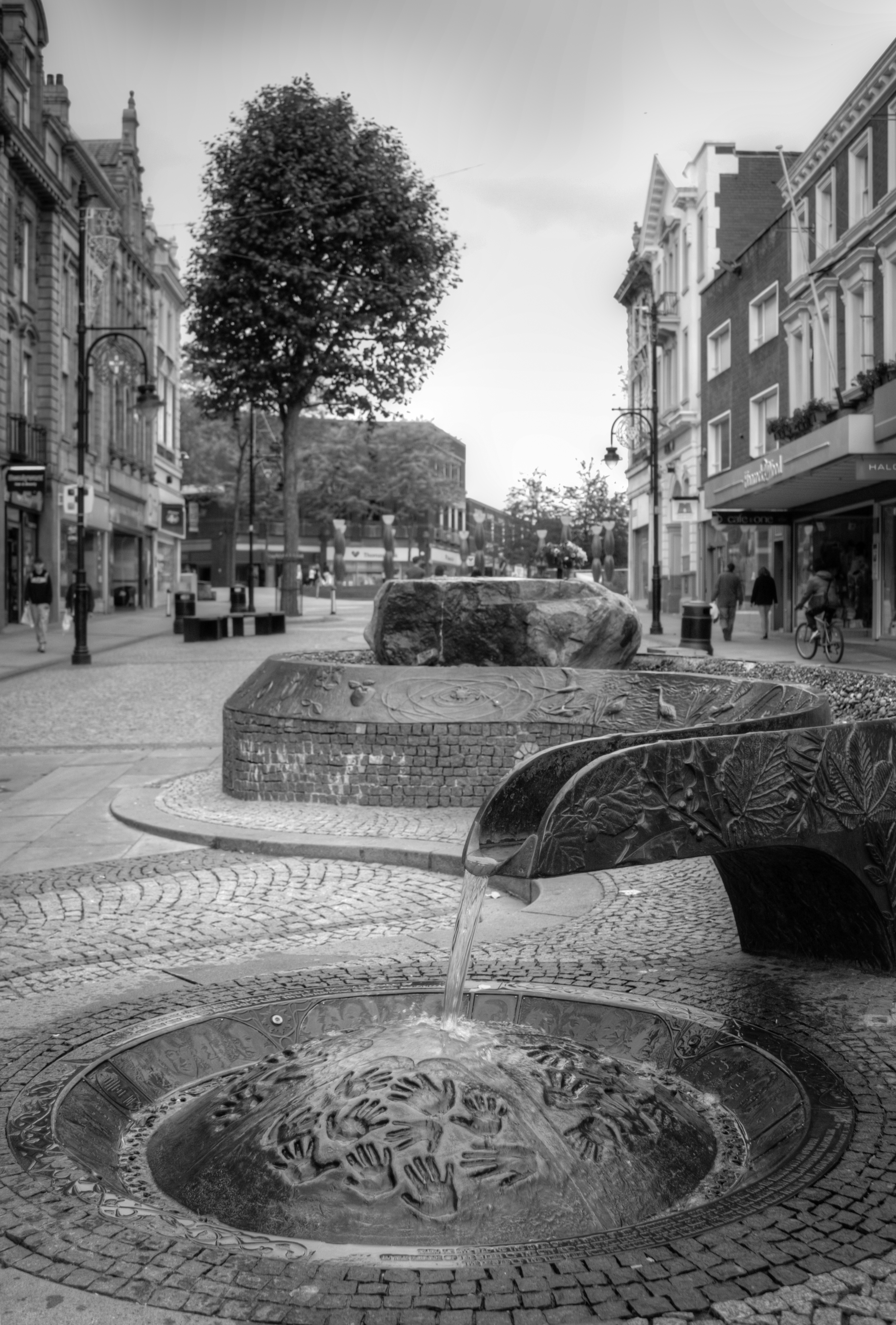
When I read that verse this week my mind went to a sculpture called The River of Life which runs down the main shopping street in Warrington. The sculpture was built by Warrington Council after two bombs were detonated by the IRA, killing 3 year old Johnathan Ball and 12 year old Tim Parry and injuring 56 others. It was the day before Mothering Sunday, March 20th, 1993.

The city council turned to a sculptor to discuss a memorial. Stephen Broadbent was the sculptor. He saw that the street was not just physically broken, but spiritually broken as well. He wanted to design something that would be “a symbol of renewal and faith in the power of the human spirit to triumph over adversity and to invest the future with hope.”

His inspiration was the image of the river of life in Revelation 22.
The angel showed me the river of the water of life, as clear as crystal, flowing out from the throne of God and of the Lamb down the middle of the great street of the city. On each side of the river stood the tree of life, bearing twelve crops of fruit, yielding its fruit every month. And the leaves of the tree are here for the healing of the nations.

And so it is. Now, flowing down that street is the River of Life  he made and on either side of the streaming water are trees, one for each month, each bearing fruits of the Spirit for the healing of the nations, for all times and seasons.

And so it is in Psalm 1 where the blessed are like a tree planted by streams of water bearing fruit in due season. I wonder that Stephen Broadbent himself is one of those trees, planted by the stream of tragedy and violence, leaving blessings of hope and healing through the season of trauma and grief.

I’ve seen photocards with these verses from Psalm 1. In them the stream is picturesque with sunlight reflecting from its gentle flow. The psalm doesn’t say the water is safe. 

The stream may be dangerous, fast flowing floodwater, a tidal wave, or deep or toxic. 

Or with a stretch of the imagination, the waters could be the waters that have to break for us to be born or baptised. 

Or the stream and the metaphor may be a metaphor for life.

Does the law of the Lord raise up people who delight in the law that there should be people by all the rough waters of life, that there should be lifesavers of healing, hope and blessing bearing fruit for all seasons of difficulty and danger?

It’s worth visiting that sculpture in Warrington. It’s on Bridge Street. It was always Bridge Street. The street hasn’t been renamed because of the sculpture and its intention to bridge the awful violence that tore people’s lives apart.

And here we are. The Bridges Group of Parishes – so called because of the bridges of the villages that make up the group of parishes. And the bridges are there to bridge the waterways that cut through the landscape.

We’ve reflected on Jesus’ position in relation to the crowds that streamed to him. We’ve reflected on the Psalmist’s position on those who delight in the law of the Lord.
We’ve reflected on the sculptor’s position in relation to the trauma of a community.
What about our own position?

Are we bridge builders and lifesavers? Do we delight in the law of the Lord, meditating on his law day and night? Are we blessed as agents of blessing, healing and hope? Or are we a curse on the poor, the stranger, the refugee, and all those vulnerable to losing their life at sea because we take our cues from the scornful, lingering in the way of sinners, taking the counsel of sinners?

Where are we as the river of life flows through our lives? Are we bridgebuilders offering healing where there has been division, hope where there has been despair? Are we like trees that bear the fruits of God’s Spirit, the fruits of love, joy, peace, forbearance, kindness, goodness, faithfulness, gentleness and self-control (against which no other law can stand) (Galatians 5:22f)? 

What is our position in relation to those Jesus blesses? Are we on their side, or are we on the side condemned by Jesus, with those who’ve grown rich at the expense of the poor, those who have stuffed themselves while so many go hungry, those who can afford to laugh while the rest of the world is in bits, those who walk the corridors of powers and still exclude, insult and reject others?

For as long as we delight in the law of the Lord, for as long as we seek to understand it, we will be on the side of those in the roughest of waters.

Here Am I: Embracing God’s Call in Worship

Worship fires us. Worship hires us. This is what we see at the heart of our two readings today. (Isaiah 6:1-8 and Luke 5:1-11). This is a sermon for the 4th Sunday before Lent for a small church “in vacancy”.

The poetry of Mary Oliver is full of worship. Here are some of her lines:

Poems are not words, after all,
but fires for the cold,
ropes let down to the lost,
something as necessary as bread
in the pockets of the hungry.

Poems are not words, but fires for the cold, ropes let down to the lost, something as necessary as food in the pockets of the hungry.

There is poetry in the heart of worship – fires for the cold, ropes let down to the lost. We repeat these lines of poetry in the heart of our worship. We call it the Sanctus. The poetry goes along these two lines:

Holy, holy, holy is the Lord Almighty,
the whole earth is full of his glory.

This is the song of the seraphim overheard by the prophet Isaiah in his vision of heaven when he was transported in worship. They are words which reverberate in our own worship. Holy, holy, holy is the Lord Almighty. The whole earth is full of his glory. This has become our song too.

In Mary Oliver’s words, they are fires for the cold, ropes let down to the lost. Holy, holy, holy is the Lord Almighty; the earth is full of his glory. This is the song of those Isaiah sees around the throne – the song of the seraphim. 

Seraphim are the fiery ones. That is the meaning of seraphim. Their words are fires for the cold, ropes let down to the lost. They are ropes we hang onto as we join Isaiah as he is transported in worship.

The whole earth is full of his glory. This is the faith of the heavenly host. It doesn’t mean that everything is hunky dory. Isaiah knows only too well his own lies and the lies of those around him. I am a man of unclean lips, and I live among a people of unclean lips. And that hasn’t changed over the centuries, has it? We say one thing and mean another. We mislead and are misled. Truth is distorted to our own ends. We, too, are a people of unclean lips living among a people of unclean lips.

In our gospel reading Simon Peter is transported to a similar sense of wonder and worship. Luke paints the scene well. Jesus is on the edge of the lake, with people on the edge. 

Crowds are all around him. The only space he could find was by getting into the boat of one of the fishermen, one whose life was all at sea, a landless labourer on the lowest level of Roman occupations pushed to the edge by the taxes they had to pay for the right to fish and the right to sell their fish. Jesus put himself in the same boat as them.

Jesus told Simon Peter to put out a little from the shore – and there Jesus sat and taught the crowds on the shore. (Interestingly, he would have been on a lower lever to those he was teaching.)

Jesus then told Simon Peter to “put out into deep water, and there let down the nets for a catch”. They were astonished by how much they caught because they had been fishing all night and had caught nothing.

To deep water, far from the safe haven where everything is smooth sailing is where Jesus led Simon Peter, to where life is desperate, dangerous and difficult, the place we’re afraid to go to – and it was there that Simon Peter saw the glory of the Lord in the miraculous catch which would mean that he and his partners had something to take to market.

Both Simon Peter and Isaiah are gifted a vision of the glory of the Lord that fills the earth. Simon Peter’s reaction is similar to Isaiah’s. “Go away from me, Lord; I am a sinful man.” Jesus answers as if to calm the storm arising in Simon Peter. “Don’t be afraid.” he tells Simon Peter. “From now on you will fish for people.” And from that moment they did, pulling their boats onto the shore. They left everything and followed Jesus.

For Isaiah it had been a burning coal from one of the fiery ones to his unclean lips which took away his guilt and opened his mouth to the Lord’s question, “Whom shall I send? And who will go for us?” with his own words, “Here am I. Send me!”

Both recruits, Isaiah and Simon Peter were recruited in worship and their sense of the glory of the Lord that fills the whole earth. Neither recruit thought themselves worthy. One was a man of unclean lips, the other “a sinful man”.  Neither was a strong candidate, neither had anything they needed to prove and neither was recruited on merit. Once again we see the rule of the kingdom of God which starts with the last and the least in the building of that kingdom – the very opposite to the general rules of every other kingdom.

And here are we. Here are we, caught up in worship, sharing the sense of God’s glory in spite of our unworthiness, clinging to the songlines from the heart of heaven through the amazing grace of God. Lines let down to the lost, as necessary as bread in the pockets of the hungry.

Holy, holy, holy is the Lord Almighty,
the whole earth is full of his glory.

And here we are. Here we are in what we call “a vacancy” waiting for someone who knows the earth is full of God’s glory to say to the Bishop “here am I, send me”, someone who will leave everything to follow Jesus to the Bridges Group.

And here we are. Here we are – possibly tiring in waiting. It is, after all, getting to be a long vacancy. Let us not lose heart. Our worship becomes our encouragement however deep the water in which we find ourselves. Let the live coal touch our lips and be the fire for our cold hearts so that we don’t become prophets of doom.

Even in the waiting, God’s glory is at work. It may seem like there is no answer, but His glory fills the earth, and He is already moving in ways we can’t always see.

Here we are, worshipping through the amazing grace of God in sight of the glory which fills the earth. Our worship opens our minds, our hearts and our mouths. Our worship prepares our next step beyond our unworthiness

Our worship calls us back to God’s glory. How shall we respond to that call? Is ours a “yes” to God, or a “no” to God? Peter typifies us. His call reminds us that God is always at work in the deep waters, in the quiet moments, in the challenging seasons preparing his people to fish for people by reaching out in love and serving in faith. How shall we respond? What is the “here am I” that God is waiting to hear from our heart.

Here we are.
Here we are,
a few of us,
too few of us
if we keep saying “No”,
enough of us
if our response is “Yes”,
all of us
growing older by the day.
Here we are
looking round for help.
Who’ll do this,
who’ll do that?

It’s easy to lose heart and to say “nobody will”. That is the language of doomsayers and the sound of bitter experience. It’s a self-fulfilling prophecy and it’s the sound of people speaking for everybody. It’s not the sound of hope and not the sound of those who believe God’s glory is at work throughout the world in ways we can’t always see.

Here we are, without churchwardens. “Nobody wants to be churchwarden”. That is doomsaying and is without hope. When we say “Nobody wants to be ….” we are speaking for everybody. We can’t speak for everybody, only for ourselves.  Somebody will be churchwarden. It’s just a case of waiting for one or two people to be caught up in the glory that fills the earth – for their “yes” to the call they hear in their sense of worship, and for their reassurance that their recruitment is not about their merit but about God’s love and glory.

Even in the waiting, God’s glory is at work. It may seem like there is no answer, but His glory fills the earth, and He is already moving in ways we can’t always see.

How will each of us respond to the call of the moment when we realise Holy, holy, holy is the Lord almighty and the whole earth is full of his glory. The call will be different for each of us. 

What is the “Here am I” that God is waiting to hear from your heart?