Reflecting All The Light We Cannot See

Light
Light
The visible reminder of Invisible Light.
T. S. Eliot

all_the_light_we_cannot_see_doerr_novel

What was intended to be a summer read turned out to be an early winter read – very appropriately because this is a book about light and darkness, perfect for Advent and the darkest time of the year. In All the Light We Cannot See we see the world through the hands of a blind woman, Marie-Laure. As a child she is given a model of her world which helps her to feel her way in spite of all the light she cannot see. In telling her story, Anthony Doerr, is putting a model into our hands to remind us how complex life is and to help us discover the light that can be hidden in the smallest detail.

Anthony Doerr has spun for us a hopeful story that is full of humanity. Besides the blind girl, there is an orphaned German boy who becomes a radio technician. The setting is the Second World War which so divided and devastated Europe. Their lives don’t cross till later but Doerr skillfully weaves their stories together in brief alternating chapters.

With the rise of populist politics as expressed in the Brexit referendum and elsewhere, it seems that we are again in a dark age (and the book is a startling reminder of the institutions that have grown up in post-war Europe which so far have preserved peace – it would be stupid and careless if this were to be unpicked). There is a lot of darkness as we don’t know where we are heading. There is a lot of light that we cannot see as we turn ourselves inwards.

There is so much light we cannot see – from the past and into the future. But in the hands of a blind girl the author has placed a model which can help us through to the light we cannot see. The model maker is her father – significantly a locksmith. I say significantly because of these lines by poet Malcolm Guite in response to one of the Advent antiphons:

Even in the darkness where I sit
And huddle in the midst of misery
I can remember freedom, but forget
That every lock must answer to a key,
That each dark clasp, sharp and intricate,
Must find a counter-clasp to meet its guard,
Particular, exact and intimate,
The clutch and catch that meshes with its ward.
I cry out for the key I threw away
That turned and over turned with certain touch
And with the lovely lifting of a latch
Opened my darkness to the light of day.
O come again, come quickly, set me free
Cut to the quick to fit, the master key.

Julia McGuinness has also written about this book. She captures the ideas of light within limited spaces which is so much part of this story set in the extremes of human existence.

Part of my work is to support newly ordained clergy. One of the cheesy things I do is write to those who have been recently ordained, just before Christmas. I say something like:

Happy first Christmas to you as a “priest”. I hope you enjoy your first Christmas celebrations. It is a wonderful moment – embracing strangers/visitors. One of the ideas that came to me (when I was struggling to find yet another homily in a busy Christmas season) was a play with the word “manger”. Pronounced the French way it’s about eating. Pronounced the Christmas way it’s where Jesus is born. Do we prepare a manger with the hands we offer for the bread? Is this when Jesus is born? As we place the bread in the hands of others, are we laying Jesus in their manger?

When we take the bread into our hands, into the manger we prepare, we take all the light we cannot see. This is the body of Christ, the light of the world. This is the faith we have as Christians, a faith that in the darkest times there is all the light we cannot see. The light that shines in the darkness, makes a difference as to how we recognise one another, how we see one another, how we see our past, how we see our future – as not so dark as maybe we once thought. This too, like Marie-Laure’s model, is something so small that is placed into our hands, to help us discover the light that can be hidden in the smallest detail, in places we would never look into because of their depth of darkness.

Besides preparing a manger with our hands, we often put our hands together to pray (like a candle flame), and we often close our eyes (as if a reminder of the darkness). There are all sorts of reasons for these customs – but in our heart of hearts we know that there is all the light that shines in darkness. By praying we witness to the true light that gives light to everyone.

At the end of his magnificent novel, Doerr imagines:

People walk the paths of the gardens below, and the wind sings anthems in the hedges, and the big old cedars at the entrance to the maze creak. Marie-Laure imagines the electro-magnetic waves travelling into and out of Michael’s (game) machine, bending around them, just as Etienne used to describe, except now a thousand times more criss cross the air than when he lived – maybe a million times more. Torrents of text conversations, tides of cell conversations, of television programmes, of emails, vast networks of fibre and wire interlaced above and beneath the city, passing through buildings, arcing between Metro tunnels, between antennas atop buildings, from transmitters with cellular transmitters in them, commercials … flashing into space and back to earth again, I’m gong to be late and maybe we should get reservations? and ten thousand I miss yours, fifty thousand I love yours, hate mail and appointment reminders and market updates, jewelry ads, coffee ads, furniture ads flying invisibly over the warrens of Paris, over the battlefields and tombs’ over the Ardennes, over the Rhine, over Belgium and Denmark, over the charred and ever-shifting landscapes we call nations.

And is it so hard to believe that souls might also travel those paths? That her father and Etienne and Madame Manec and the German boy named Werner Pfennig might harry the sky in flocks, like egrets, like terns, like starlings? That great shuttles of souls might fly about faded but audible if you listen closely enough? They flow above the chimneys, ride the sidewalks, slip through your jacket and shirt and breastbone and lungs and pass out through the other side, the air a library and the encore of every life lived, every sentence spoken, every word transmitted still reverberating within it.

I am imagining it. I am imagining the map Doerr has drawn of some of the light we cannot see. 

I can’t wait to read this again.
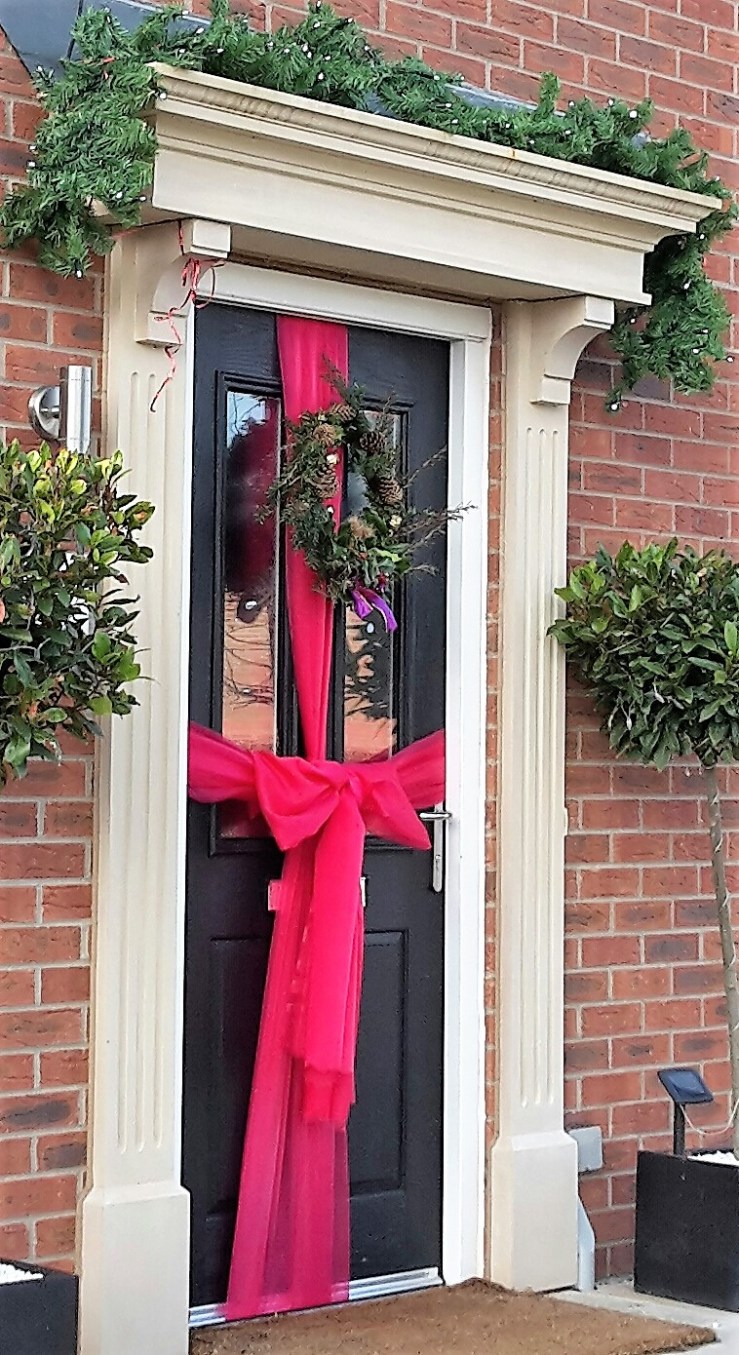
Opening Advent Doors

advent-door

Advent is a time for praying for the coming of Emmanuel, that God may be with us, and for each of the evenings of the week before Christmas there is an “O” antiphon. Each of the seven antiphons is prefaced by “O” and addressed to the Messiah according to the names for him found in Isaiah. The “O” expresses our longing. The seven antiphons are addressed to Wisdom, Lord, Root of Jesse, Key of David, Dayspring, King and Emmanuel.

Doors are very much a theme of Advent. Doors are both barriers and openings. We open a “door” a day on our Advent calendar to signify our willingness to open our hearts to the coming of Christ. Many decorate their front doors in a way that invites the stranger, in a way that begs to be opened (as in the door of one of our neighbours pictured above). Some doors are hard to shift and many are locked behind them.

Malcolm Guite has written a beautiful poem in response to the O Clavis antiphon (based on Isaiah 22:22):

O Key of David and sceptre of the House of Israel;
you open and no one can shut;
you shut and no one can open:
Come and lead the prisoners from the prison house,
those who dwell in darkness and the shadow of death.

This is Malcolm’s response (which is set in a beautiful image by Linda Richardson):

Even in the darkness where I sit
And huddle in the midst of misery
I can remember freedom, but forget
That every lock must answer to a key,
That each dark clasp, sharp and intricate,
Must find a counter-clasp to meet its guard,
Particular, exact and intimate,
The clutch and catch that meshes with its ward.
I cry out for the key I threw away
That turned and over turned with certain touch
And with the lovely lifting of a latch
Opened my darkness to the light of day.
O come again, come quickly, set me free
Cut to the quick to fit, the master key.

The poem senses despair but also senses freedom, if only we could find “the key  I threw away”, that “turned and over turned with certain touch and … opened my darkness to the light of day”. I love the sense of freedom because “every lock must answer to its key” and “each dark clasp … must find a counter-clasp to meet its guard”.

There are so many locks to spring. Back in the 14th century, Hafiz wrote about the sort of people who lock others up, and the sort of people who work in the darkness to set people free. They “drop keys all night long”:

The small person
builds cages for everyone
he
sees.

Instead, the sage,
who needs to duck his head,
when the moon is low
can be found dropping keys, all night long
for the beautiful
rowdy,
prisoners.

What are the cages, catches, vices, locks and blocks that bind us? What needs to be undone for peace to be declared on earth?

You may be interested in the Jesus Doors by Cheshire artist Ali Hutchison and the Advent Haikus Jim Bridgman has written for every day of Advent as part of his blog which is Really Nothing but which is in fact, quite something. You might also be interested in The Advent Door by Jan Richardson.

Bernard on Canals & Reservoirs


Wisdom runs deep, and the pace of our lives seems to run us out of wisdom.

Bernard (he became Abbot of Clairvaux 900 years ago in 1115) has this to say about the pace of our lives and the place of stillness:

The man who is wise, therefore, will see his life as more like a reservoir than a canal. The canal simultaneously pours out what it receives; the reservoir retains the water till it is filled, then discharges the overflow without loss to itself … Today there are many in the Church who act like canals, the reservoirs are far too rare … You too must learn to await this fullness before pouring out your gifts, do not try to be more generous than God.

Hidden Islam & Makeshift Places of Worship

“Consider these facts. In Italy the right to worship, without discrimination, is enshrined within the constitution. There are 1.35 million Muslims in Italy and yet only eight official mosques in the whole country. … This shortage of places to worship is particularly acute in North East Italy as the right wing Lega Nord party campaigns on an anti-Islamic platform.  this region, consent to build a new mosque is never granted.”

That is how Martin Parr introduces a wonderful book that documents the places of worship improvised by the Muslim population of NE Italy, a large proportion of whom are migrant workers. The book is called Hidden Islam and is made up of a series of photographs by Nicolo Degiorgis of the places of worship housed in lockups, garages, shops, warehouses and old factories.

The book’s design is intriguing. Each page is folded. On the outside of the fold is a simple black and white photo of a shop, warehouse etc together with the building’s postcode. There is no clue on the outside of what goes on in the inside. To find that out, we have to go to the inside of the fold – and there we find vibrant photos of Friday Prayers. For example, the stark exterior photo of a garage (postcode V136015)


opens to this


A wonderful book which tells a disgraceful story in a disarmingly simple way.

My own morning prayers took me to Ezra 6 in the Hebrew Scriptures (Old Testament). That situation offers such a contrast to what is happening in Italy and in so many other places where the rights and needs of religious minorities are ignored. The scene there is the rebuilding of the Temple in Jerusalem with the support of the imperial government. Royal revenues were to be used to provide whatever was necessary “so that they may offer pleasing sacrifices to the God of heaven, and pray for the life of the king and his children.” (Ezra 6:10).

It seems obvious to me that religious people need to gather to pray, to pray even for those who persecute them, and to pray for the welfare of the city. Religious landmarks in our cities and on our skylines are reminders of our vocation as children of God. They should be there for all our citizens.

The Art of Hearing Heartbeats

The Art of Hearing Heartbeats is Jan-Philipp Sendker’s first novel. It has a fairy tale feel and is set in Burma.

This book is a lovely telling of a woman overcoming her sense of resentment and betrayal through hearing the story of her lost father. The story-telling helps Julia and the reader see life in a different way, as Tin Win (with the help of Mi Mi and U May) makes sense of his blindness through his sense of hearing.

Mi Mi can’t walk, Tin Win can’t see – together they make the perfect couple (is it an unconscious retelling of the Genesis creation story against the background of a Burmese village?)

It is a book about seeing. U May (blind Buddhist monk), speaking to Tin Win: “It’s true, I lost my eyesight many years ago. But that doesn’t mean I’m blind … the true essence of things is invisible to the eyes. Our sensory organs love to lead us astray, and eyes are the most deceptive of all. We rely too heavily upon them. We believe that we see the world around us, and yet it is only the surface that we perceive. We must learn to divine the true nature of things, their substance, and the eyes are rather a hindrance than a help in that regard. They distract us. We love to be dazzled.”

“A person who relies too heavily on his eyes neglects the other senses – and I mean more than his hearing or sense of smell. I’m talking about the organ within us for which we have no name, let us call it the compass of the heart… A person without eyes must be aware. It sounds easier than it is. You must attend to every movement and every breath. As soon as I become careless or let my mind wander, my senses lead me astray. They play tricks on me like ill-mannered children looking for attention.”

It is a book that collapses distance and challenges the perceptions of the all-seeing, all-dancing world. “There were things a person who walked through the world on two sound feet simply couldn’t understand. They believed that people saw with their eyes. That footsteps overcame distances.”

It is a book about fear (or rather, the absence of fear). Rage muddles the senses. U May, speaking to Tin Win: “Eyes and ears are not the problem, Tin Win. It is rage that blinds and deafens us. Or fear. Envy, mistrust. The world contracts, gets all out of joint when you are angry or afraid.”

It is a book about the power that is stronger than fear and rage, which brings with it the art of hearing heartbeats.

Julia’s father tells her the tale of the prince and princess from two neighbouring and enemy kingdoms. They die on the same day. The prince dies in the mouth of a croc. The princess dies of a broken heart.

“The two kings decided independently not to bury their children but to burn them on the river bank. As chance would have it, the ceremonies fell on the same day, at the same hour. The kings cursed and threatened one another, each blaming the other for the death of his child.

“It was not long before the flames were roaring and the two corpses ablaze. All at once the fires began to smoulder. It was a windless day, and two great, mighty columns of smoke climbed straight to heaven. And suddenly it grew quite still. The fires ceased their crackling, burning on without a sound. The river ceased its chortling and gurgling. Even the kings fell silent.

“Then the animals began to sing … and suddenly … the two columns of smoke drifted slowly towards each other. The louder and clearer the animals’ song, the closer the columns drew, until at last they embraced each other and became one, as only lovers can.”

I love the book. I love the title.

Where do prayers come from?

Where does the word “pray” come from, and who are the pray-ers?

According to the Online Etymology Dictionary prayer comes from the Old French:

praying

According to Hebrew Word Meanings palal has at its root the word “fall”:  “The word palal literally means to “fall down to the ground in the presence of one in authority pleading a cause””.

Kenneth Bailey (in Jesus through Middle Eastern Eyes) doesn’t quite make the connection between the Greek word for meek and prayer. In discussing the Beatitudes he does point out the word prays (praïs)  as the Greek translation of “meek”. So, is this where the word “pray” comes from? Or, put it another way, do the words of prayer come from the meek, the prays? Are they the pray-ers whose prayers and praise are acceptable to God?

The meek, the prays, are, according to Jesus, the poor and humble, the little ones, and they will inherit the earth. The pray-ers will be answered. “Blessed are the meek, for they shall inherit the land.” (Matthew 5:5)

The term meek comes from one of the psalms (Psalm 37:11) where it shows its meaning as “slow to anger” and “gentle with others”. For Aristotle, virtue lies between two extremes. In his Nicomachean Ethics, according to Bailey, “The one who is truly prays (meek) is the one who becomes angry on the right grounds against the right person at the right moment and for the right length of time”.

Is that what prayers do? Is that what prayers are? Is that how prayers are? Is that where prayers come from?

The photo is by Steve Evans: Ethiopia, Innocent Prayers of a Young Child

Making connections for International Happiness Day

Today is the International Day of Happiness, a day dedicated to happiness by the United Nations. The International Day of Happiness website makes the point that our “happiness is part of something bigger”, wanting me “to create more happiness in the world around me”, “to connect”, “to help make the world a more connected place by sharing something positive with others”. My contribution to that is to share the brilliant TED talk by Martin Seligman on “positive psychology”.

Happiness is something to aim at, but the selfish pursuit of happiness will be self-defeating and will thwart personal happiness. My guess is that the UN intention is that we should be concerned for everyone else’s happiness – and that we should make that our business. The General Assembly passed this resolution on June 28th 2012:

Conscious that the pursuit of happiness is a fundamental human goal,[…] Recognizing also the need for a more inclusive, equitable and balanced approach to economic growth that promotes sustainable development, poverty eradication, happiness and the well-being of all peoples, Decides to proclaim 20 March the International Day of Happiness, Invites all Member States, organizations of the United Nations system and other international and regional organizations, as well as civil society, including non-governmental organizations and individuals, to observe the International Day of Happiness in an appropriate manner, including through education and public awareness-raising activities

Many people have written about happiness and how we find it. Christopher Jameson, Abbot of Worth Abbey and author of Finding Happiness, finds happiness in the way of life based on the Rule of Benedict. He writes:

All too often, happiness is narrowed down to mean feeling good. There is of course nothing wrong with feeling good but such a narrow definition leaves little room for the delight of virtue and the joy of grace. To find happiness, we need to broaden our definition so that feeling good is put into the wider context of doing good and knowing good.

Where do we find happiness? Viktor Frankl was a leading psychiatrist in Vienna, working at the Rothschild Hospital. There he risked his life and career by falsely diagnosing those who were mentally ill so that they would not be euthanized by the Nazis. He had a visa to move with his new wife to America, but, by then in 1941, the Nazis had already started rounding up the Jews to take them to concentration camps. The focus was on the elderly and Frankl knew that it wouldn’t be long before his parents would be taken away. He had to decide between a new (and “happy”) life in America, or staying to be with his parents so that he could help them adjust to the trauma of camp life. He decided to stay. He survived the camps and found there much that confirmed his theories of meaning in life (logotherapy). He wrote Man’s Search for Meaning. He describes his work in the camps as a continuation of his work in Vienna, working, for example to establish suicide prevention centres for young people. It was all about helping people to find meaning in their lives, helping them to discover what they wanted to live for. For Frankl, happiness ensues – it comes after meaning.

What sets people apart is the pursuit of meaning. Happiness without meaning is shallow, selfish and short-lived because it depends on “happinings” (I just noticed the “pinings” in that word). I think this is what the United Nations intend: that we find happiness through (in the words of Christopher Jameson) “knowing good” and “doing good”. To underline that the UN Foundation and Pharrell Williams are inviting people to sign the Live Earth Petition to persuade world leaders to commit to tackling climate change.

Happiness is blessing. It is the subject of Jesus’ sermon in Matthew 5. For Jesus there is no happiness without meaning. Happiness is life giving, not life-taking. He begins many phrases with the words “you are blessed when ….. you’re poor in spirit, when you mourn, when you’re meek, when you hunger and thirst for righteousness, when you’re merciful, when you’re a peacemaker ….”

PS There is a rare clip from 1972 of Viktor Frankl delivering a powerful message about the the search for meaning.

In our all together

LondonClubDressCode bordercropped

What shall I wear?

It’s a question that never crossed my mind when I turned up to a fancy dress party in plain clothes. Embarassing. It seems to be a question that never crossed the mind of the guest who was caught out at the wedding (Matthew 22:1-14).

He could have argued back. Jesus had, after all, told people not to worry about what to wear (Matthew 6:31), but there he was just tipping his head towards Eden where the boy and girl were unashamed by being in the all-together (Genesis 2:25). At the other bookend (Revelation 21:2) we are shown what we’ll look like when all-together we are got ready by God. “And I saw the holy city, the new Jerusalem, coming down out of heaven from God, prepared as a bride for her husband.”

There is a dressing down for those who worry about what they wear, and those who aren’t ready in time. Jesus reminds us that God clothes us. The guest who hadn’t dressed properly wasn’t clothed in righteousness.

There are various dressing prayers. David Adam has a dresing prayer based on St Patrick’s Breastplate. And Jan Richardson has this blessing in her Painted Prayerbook:

In your mercy
clothe me

in your protection
cloak me

in your care
enfold me

in your grace
array me.

With your justice
dress me

for your labor
garb me

by your love
envelop me

and fit me
for your work.

Photo by Paul Vlaar (http://www.neep.net/photo/london/show.php?12881) [CC-BY-SA-2.5 (http://creativecommons.org/licenses/by-sa/2.5)%5D, via Wikimedia Commons

In the beginning you weep

In the beginning you weep. The starting point for many things is grief, at the place where endings seem so absolute. One would think it should be otherwise but the pain … Is antecedent to every new opening in our lives.

Belden Lane in The Solace of Fierce Landscapes

David Runcorn uses this quote to introduce the “unexpected starting place” of leadership in 1 and 2 Samuel in Fear and Trust. There patriarchy, represented by Hannah’s husband Elkanah and Eli, the priest at Shiloh. Patriarchal leadership had produced a very barren spiritual landscape. The unexpected starting place is a childless woman who Eli thought was a drunk.

Trust in the slow work of God

The 10,000 year clock, part of the Long Now Project

“Above all, trust in the slow work of God.
We are quite naturally impatient in everything
to reach the end without delay.
We should like to skip the intermediate stages.
We are impatient of being on the way to something
unknown, something new.
And yet it is the law of all progress
that it is made by passing through
some stages of instability—
and that it may take a very long time.

And so I think it is with you;
your ideas mature gradually—let them grow,
let them shape themselves, without undue haste.
Don’t try to force them on,
as though you could be today what time
(that is to say, grace and circumstances
acting on your own good will)
will make of you tomorrow.

Only God could say what this new spirit
gradually forming within you will be.
Give Our Lord the benefit of believing
that his hand is leading you,
and accept the anxiety of feeling yourself
in suspense and incomplete.”

Pierre Teilhard de Chardin

Here’s more about the 10,000 year clock and the Long Now Project.