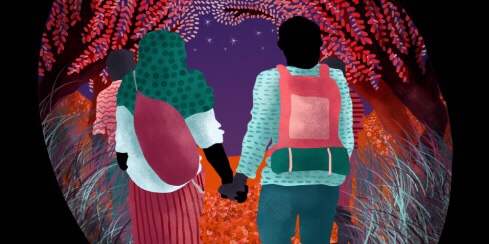
My Hazara People – a poem by Shukria Rezaei (15)

shukria-rezaei

The theme of Refugee Week 2019 is You, me, and those who came before. It is an invitation to explore the lives of refugees, and those who have welcomed them – throughout the generations.

I’m observing Refugee Week with a poem a day. This poem highlights the horrors faced by children – such horrors and distress that they can’t find the words to describe what has happened to them. This poem, brought to our attention by Kate Clanchy, is by Shukria Rezaei (pictured right) who “can’t write” about her Hazara people – she just can’t find the words. I read her poem side by side this report on the growing outrage over the separation of children from their parents at the southern US border.

Shukria’s Hazara people have been persecuted for centuries. They settled in Afghanistan in the thirteenth century but for much of that time have lived on the edge of economic survival, being driven from their land and being sold as slaves. They are Shi’a and have been persecuted by the majority Sunni population. The Taliban declared jihad on the Hazaras when they seized power in 1996.

This is the first poem Shukria wrote when she came to the UK aged 15.

I can’t write about my Hazara people
who have suffered for decades
in Afghanistan where they come from
in Pakistan where they are murdered
in Iran where they offend
because of their almond-shaped eyes
my mind is blank!

I can’t write about how loud the shooting was
just two miles from my house.
How my aunt fainted.
How nervous my mom got,
how the cup fell from her hand.

I can’t write about how innocent people died,
how the Martyr’s necropolis gets bigger and bigger,
how my people suffer,
how cruel this world can get,
how frightening it is

for kids like me.

Shukria Rezaei (15)

Home – by Warsan Shire – a poem for Refugee Week

The 20th Refugee Week begins on June 17th, with a look at #generations. The theme of Refugee Week 2019 is You, me, and those who came before. It is an invitation to explore the lives of refugees, and those who have welcomed them – throughout the generations.

I suppose there is an air of helplessness and resentment in those who don’t regard themselves as refugees. I share the sense of helplessness. But then I remember our own family story of a woman crossing the border in a boot of a car having past her baby to an unknown woman to cross separately. That woman never knew whether she would be reunited with her baby. Fortunately they were reunited. Without that baby our family would be incomplete and a generation of students would be missing out on a compassionate and art teacher.

This poem by Warsan Shire explores the terrifying circumstances which force people to flee for their lives. No one leaves home unless home is the mouth of a shark. “You only run for the border when you see the whole city running as well”. Warsan Shire (born 1988) is a fine British poet, born to Somali parents in Kenya. Here is her poem, Home:

no one leaves home unless
home is the mouth of a shark
you only run for the border
when you see the whole city running as well

your neighbors running faster than you
breath bloody in their throats
the boy you went to school with
who kissed you dizzy behind the old tin factory
is holding a gun bigger than his body
you only leave home
when home won’t let you stay.

no one leaves home unless home chases you
fire under feet
hot blood in your belly
it’s not something you ever thought of doing
until the blade burnt threats into
your neck
and even then you carried the anthem under
your breath
only tearing up your passport in an airport toilets
sobbing as each mouthful of paper
made it clear that you wouldn’t be going back.

you have to understand,
that no one puts their children in a boat
unless the water is safer than the land
no one burns their palms
under trains
beneath carriages
no one spends days and nights in the stomach of a truck
feeding on newspaper unless the miles travelled
means something more than journey.
no one crawls under fences
no one wants to be beaten
pitied

no one chooses refugee camps
or strip searches where your
body is left aching
or prison,
because prison is safer
than a city of fire
and one prison guard
in the night
is better than a truckload
of men who look like your father
no one could take it
no one could stomach it
no one skin would be tough enough

the
go home blacks
refugees
dirty immigrants
asylum seekers
sucking our country dry
niggers with their hands out
they smell strange
savage
messed up their country and now they want
to mess ours up
how do the words
the dirty looks
roll off your backs
maybe because the blow is softer
than a limb torn off

or the words are more tender
than fourteen men between
your legs
or the insults are easier
to swallow
than rubble
than bone
than your child body
in pieces.
i want to go home,
but home is the mouth of a shark
home is the barrel of the gun
and no one would leave home
unless home chased you to the shore
unless home told you
to quicken your legs
leave your clothes behind
crawl through the desert
wade through the oceans
drown
save
be hunger
beg
forget pride
your survival is more important

no one leaves home until home is a sweaty voice in your ear
saying-
leave,
run away from me now
i dont know what i’ve become
but i know that anywhere
is safer than here

Rags – a poem by Caroline Bird

This poem by young British poet and playwright Caroline Bird has more than a whiff of Pentecost about it. Caroline Bird was born in 1986. Already she has had five collections of poetry published. This poem is from her latest collection In These Days of Prohibition (Carcanet, 2017).

Rags

When love comes through
the vents, you press wet rags against
the grill, lest you are smoked out
of your loneliness, you tape egg boxes
to your ears so you can’t hear
the hissing, you swathe yourself
in shame like vinegar
and brown paper. At sundown,
you gather up the rags
and press them to your face
like the dress of a lover, hoping for
a slight effect, the remnants of a rush –
not enough to change your mind – just
enough to pacify the night.

Yes, I’ve done all that. And now I am full of questions.

How do we make the most of love?
How do we make the most of every minute of love?
What do we do about our preoccupations and those things which make us unprepared for love?
How dare we hope for love and remain openminded to recognise love?
How do we avoid leaving it all too late?
How can we let love do her work in us and through us?

Tell me: what does strong leadership look like?

I was floored (or is it flawed?) when the conversation turned to “strong leadership”. I was asked, “What does strong leadership look like to you?” Well, I know that strong leadership doesn’t look like Boris or Donald, and that leadership can be shared, and that leaders should be as strong as they can be in the circumstances.

So I blathered – without realising that this really was a question to which Jesus is the answer.

What does strong leadership look like?

    It looks like Jesus on a cross (is that cross a leadership vote?)
    It looks like Jesus unafraid of nature’s forces
    It looks like Jesus turning his back on the religious and political capital
    It looks like love for the most demonised, ostracised and marginalised
    It looks like Jesus bent refreshing the feet of weary travellers
    It looks like a touch, and feels like a breath
    It looks like a gathering treasuring wisdom
    It looks playfully relaxed with time to rest and pray
    It looks like it can endure tyranny as long as tyranny lasts
    It looks like it’s been to hell and back
    It looks out for the broken
    It looks broken
    It is scarred

What does strong leadership look like to you?

The place of maps

I have just been reading The Book of Negroes by Canadian author Lawrence Hill. It gets its controversial title from a historic document from the 18th century which is kept at the National Archives at Kew. It is a ledger of over 3,000 names of enslaved African, the “Black Loyalists” who escaped to Britain’s lines in the American Revolution. It was the first time in history that thousands of black people were formally recorded by a historical body, in this case, the British Navy.

The book describes the journeys of Aminata Diallo who was grabbed from her village in west Africa in 1750 by slave traders. She was just 11 when she had to walk “three moons”, shackled in irons in a coffle from her village of Bayo to the ship which would take her into slavery in the American colonies.

She makes the most of her very limited opportunities. She learns to read and write (in secret), and she longs to return to her homeland. Occasionally she is able to look at maps of Africa, but there were no places marked on them except for a few ports. Inland was shown with drawings of elephants – as if that was all there was.

I wonder if that is where we are sometimes. We can map thresholds and the ports. We can say so and so lives there. We can recognise faces but sometimes can’t get past face value. It is only when we care to listen, to let people speak, to allow them to show us around their lives that we begin to build up a better map of where they have come from, and where they might be journeying to. (The more diverse the maps, the better – geographical, historical, political, psychological dimensions all add to our understanding.) Then we begin to understand the hinterland. Then we can better understand each other.

This is what Aminata writes at the end of her story:

I would like to draw a map of the places where I have lived. I would put Bayo on the map, and trace in red my long path to the sea. Blue lines would show the ocean voyages. Cartouches would decorate the margins. There would be no elephants or want of towns, but rather paintings of guineas made from gold mines of Africa, a woman balancing fruit on her head, another with blue pouches for medicine, a child reading, and the green hills of Sierra Leone, land of my arrivals and embarkations.

PS. When I say that Lawrence Hill is a “Canadian author” I am guilty oversimplifying the map of his life – drawing elephants, if you like. He was born in Newmarket, Ontario – the son of a black father and a white mother who moved to Ontario from Washington DC. These are details to add to the map of Lawrence Hill’s life. Reading another of his books, Black Berry, Sweet Juice: On Being Black and White in Canada might add psychological and sociological dimensions to that map. I’d like to find out by reading more.

Breath – my chosen poem of the month

Breath by Adrian Rice was Carol Rumen’s Poem of the Week on Saturday and was Mark Oakley’s #APoemADay on Tuesday. It is stunningly beautiful and was nominated for the Pushcart Prize. It is my poem of the month.

What is death
but a letting go
of breath?

One of the last
things he did
was to blow up

the children’s balloons
for the birthday party,
joking and mock cursing

as he struggled
to tie all
those fluttery teats.

Then he flicked them
into the air
for the children

to fight over.
Some of them
survived the party,

and were still there
after the funeral,
in every room of the house,

bobbing around
mockingly
in the last draft.

She thought about
murdering them
with her sharpest knife,

each loud pop
an angry bullet
from her heart.

Instead, in the quietness
that followed her
children’s sleep,

she patiently gathered
them all up,
slowly undoing

each raggedy nipple,
and, one by one, she took his
last breath into her mouth.

What is life
but a drawing in
of breath?

These short lines breathe love, speaking of life (teats, nipples and birthdays) and death, love and grief. I worry that the balloons took his last breath, and took a father away from his children and their mother. Did he die in that moment when there should have been celebration and fun? I’m pleased that the balloons remained for the funeral, and that they were there to be murdered with her sharpest knife (who might have been murdered otherwise?) and thankfully reprieved to become new life and consolation.

This is a drama well chosen for Easter. The rooms seem many, as in “my Father’s house” and there is a breath of Johannine Pentecost (and being born again) from the balloons’ nipples.  There is comedy in the tragedy. “One of the last things he did was to blow up.” And how simple the answers to the questions that open and close the poem. “What is life?” What is life but a letting go of breath? What is life but a drawing in of breath?

Kintsugi, the art of scars and the value of repair

kintsugi2Things break. We break things. We break. But what do we do with the pieces?

When I have broken things I have sometimes pretended it’s never happened (playing the innocent) or I have hidden the evidence. When I’ve broken I have pretended it’s never happened, or I have hidden the shame. This is shocking dishonesty.

The prophet Jeremiah knew a thing or two about brokenness and shame. The broken thing he had his eye on was the nation itself. He came to see hope in brokenness – not shame – by studying the work of a potter. The potter was making a vessel of clay and it was spoiled in the making. Instead the potter reworked it into another vessel “as seemed good to him”. He heard God say, “can I not do as this potter has done?”

There is another school of pottery which makes something of broken pieces. This is Kintsugi. Kintsugi is known as “golden joinery” because of the method of using gold dust to mend the broken pieces. The repairs themselves become the work of art. While we might be tempted to use superglue to mend a broken ornament and then turn the damage to the wall, Kintsugi works in a different way. The repair is brazen and flaunted. The breakage gives the object a story and the object becomes more valuable than it ever was before.

The Japanese art of Kintsugi has given rise to a philosophy and metaphor for life. Also known as the “art of scars” it signals a way for us to value what is broken in our lives and to celebrate what has re-paired us.

We can look at the broken pieces of our society. Those broken pieces all have labels to identify one piece from another, and we continue to break into new pieces. We’ve got new labels, more broken pieces with Leavers/Remainers. They go along with more worn labels such as Workers/Shirkers, Gay/Straight, Black/White, North/South, Red/Blue etc etc. I like the suggestion that prayer is like the gold dust of Kintsugi – when we pray we seek to make a-mends and pray for repair and reconciliation. The putting together of the pieces is the answer to that prayer.

Kintsugi is one art of scars. Writing this as we come into Holy Week I am conscious that Christianity too is the art of scars – though crimson rather than gold. Brokenness is taken with utmost seriousness. All the repair work and the reconciliations stand proud as witnesses. Repaired brokenness makes us more precious and valuable than ever.

PS. Here’s more about the spirituality of mending by Laura Everett

PPS. #Visiblemending is trending on Twitter

PPPS. Mending is seen as practice for “tikkun olam” – for the “mending of the world”

A Pearl from Dietrich Bonhoeffer

dafjas9u8aenm4b
Dietrich Bonhoeffer’s statue is one of ten to modern martyrs, unveiled in July 1998, which stand above the west entrance to Westminster Abbey. The sculptor was Tim Crawley.

On this day, 1945, Dietrich Bonhoeffer was martyred – aged 39. His life, teaching and death are constant reminders of the cost of discipleship and the need for political engagement. Here is one of his pearls:

God travels wonderful ways with human beings, but he does not comply with the views and opinions of people. God does not go the way that people want to prescribe for him; rather, his way is beyond all comprehension, free and self-determined beyond all proof.

Where reason is indignant, where our nature rebels, where our piety anxiously keeps us away: that is precisely where God loves to be. There he confounds the reason of the reasonable; there he aggravates our nature, our piety—that is where he wants to be, and no one can keep him from it.

Only the humble believe him and rejoice that God is so free and so marvelous that he does wonders where people despair, that he takes what is little and lowly and makes it marvelous. And that is the wonder of all wonders, that God loves the lowly…. God is not ashamed of the lowliness of human beings. God marches right in.

He chooses people as his instruments and performs his wonders where one would least expect them. God is near to lowliness; he loves the lost, the neglected, the unseemly, the excluded, the weak and broken.

Dietrich Bonhoeffer, God is in the Manger: Reflections on Advent and Christmas

Brexit – made in England, led by donkeys

Brexit shambles and uncertainty continues as the government suffers another humiliating defeat. Parliament struggles to find a way through an impasse which bears the stamp “made in England” – not made in Britain.

What was dreamed up by some in England (and set alight by papers) has drawn other nations in. Not only Scotland and Northern Ireland and, of course, Wales, but the other 27 nations of the EU. We seem to have forgotten the trouble we are putting these other nations in. What time and money this all must have cost! How distracting from other challenges facing us!

Slowly options are being narrowed down. There are very few people who want us to leave without a deal, and hopefully Parliament will take that option off the table today. And then there become two. There’s either the Withdrawal Agreement, which has been so decisively voted down in Parliament. The EU are insistent that there can be no other. But it does seem that would risk so much and there is no way of knowing what future trade deals there would be, or what manufacturing base would vote “remain” and remain, or what the effect of unravelling institutions for peace and research development. Or there is the deal which we already have as members of the EU.

Sadly Parliament has been unable to find a way through the impasse. It isn’t helped by the fact that truth is “spun” and so often not told. Parliament should be a safe container for our differences. Ideally those we elect represent our differences in that space and work to resolve them so that we can remain committed to one another. I fear what will happen if this safe space no longer works, what will happen if there is a further vote, whether that be a General Election or a second referendum. But I am beginning to see that that is what is going to happen. The people are going to be the ones with the casting vote. I dread the strife on our streets and in families. But it might have to come to this. It seems we have a choice between two:

  1. The Withdrawal agreement
  2. The deal we already have.

There is the third option of the deal which we can never have – that dreamt up by those in Never Never Land. It seems to boil down to a choice of two. The first is a vote to leave. The second is a vote to remain.

Oh no, not that again.

And where will our political parties lead us? The Conservatives are surely cornered as the Brexit party. But what about Labour? Now all options are looking exhausted, (and Parliament has been right to exhaust them), they surely now have to campaign at last on the deal we already have, which is in those two political and economic unions in which there is always room for improvement and reform – that is, the UK and the EU.

Credit to Teresa May. She voted remain but has worked tirelessly to deliver the vote of the referendum. And credit all those involved in both sides of the negotiations. They have tried to find a way – but perhaps there never was a way that would leave our nation any better off.

March 13th 2019

PS thanks to the billboard campaign @bydonkeys, as, for example, shown in the photo above.

Mushrooms

Mushrooms, by Sylvia Plath, is my poem of the month. Do you want to know what it’s about? One person says it’s about mushrooms. The beauty of poetry is its surplus of meaning. Poems mean a lot – a lot more than the sum of their words and usually a lot more than the poet intends.

Context matters. Friend Helen Scarisbrick, who always wants to explore chaos and complexity, introduced this poem as part of opening worship for a leadership day in the Diocese of Chester alongside the parable of the mustard seed.

Jesus said, “What shall we say the kingdom of God is like, or what parable shall we sue to describe it? It is like a mustard seed, which is the smallest seed you plant in the ground. Yet when planted, it grows and becomes the largest of all garden plants, with such big branches that the birds of the air can perch in its shade.

Instantly the poem becomes much more than about mushrooms. It was then a poem about everything that ever lives – for me, anyway, who carries at the back of my mind these words from Dee Hock, (founder of Visa), railing against failed command and control methods and thinking his way to a better understanding of life from the earth beneath his feet. In Birth of the Chaordic Age he wrote the words which forever challenge my understanding of organisation and leadership:

Soil is building as thousands of gophers, mice and moles work assiduously carrying grass underground and dirt to the surface. Beneath us, billions of worms, ants, beetles and other creatures till the soil around the clock. Trillions of microscopic creatures live, excrete, die beneath my feet, fulfilling their destiny and mine as well, just as surely as fulfil theirs.

In that context it becomes a poem about the power of perseverance, the power in weakness, the place of the seed. It becomes a reminder of the organisms that are part of our organisation which we ignore or oversimplify to our peril, and a reminder that there is “room” in “mushroom” to think again about life, organisation and leadership. It becomes a reminder of what and who we don’t notice, a voice for the voiceless. That makes it my Poem of the Month.

Mushrooms

Overnight, very
Whitely, discreetly,
Very quietly

Our toes, our noses
Take hold on the loam,
Acquire the air.

Nobody sees us,
Stops us, betrays us;
The small grains make room.

Soft fists insist on
Heaving the needles,
The leafy bedding,

Even the paving.
Our hammers, our rams,
Earless and eyeless,

Perfectly voiceless,
Widen the crannies,
Shoulder through holes. We

Diet on water,
On crumbs of shadow,
Bland-mannered, asking

Little or nothing.
So many of us!
So many of us!

We are shelves, we are
Tables, we are meek,
We are edible,

Nudgers and shovers
In spite of ourselves.
Our kind multiplies:

We shall by morning
Inherit the earth.
Our foot’s in the door.

PS. Mushrooms is from Sylvia Plath’s first collection of poems, The Colossus and Other Poems (1960).