#cLectio – David’s counter culture

52029310_10218201991904229_4334449603207233536_nWho counts counts? Counts count numbers,‬
‪overpower them, reducing them, demeaning them‬
‪making them number, dumber, cannon fodder,‬
‪forced labour, numbers & counters who don’t count,
won’t count.‬ Beware those who count
counter to those God counts dear.

#1Chronicles21 #cLectio #morningprayer

A reflection for Twitter on 1 Chronicles 21 – the set reading for Morning Prayer today.

Sunflowers weeping

kiefer_hortus_conclusus.990x0

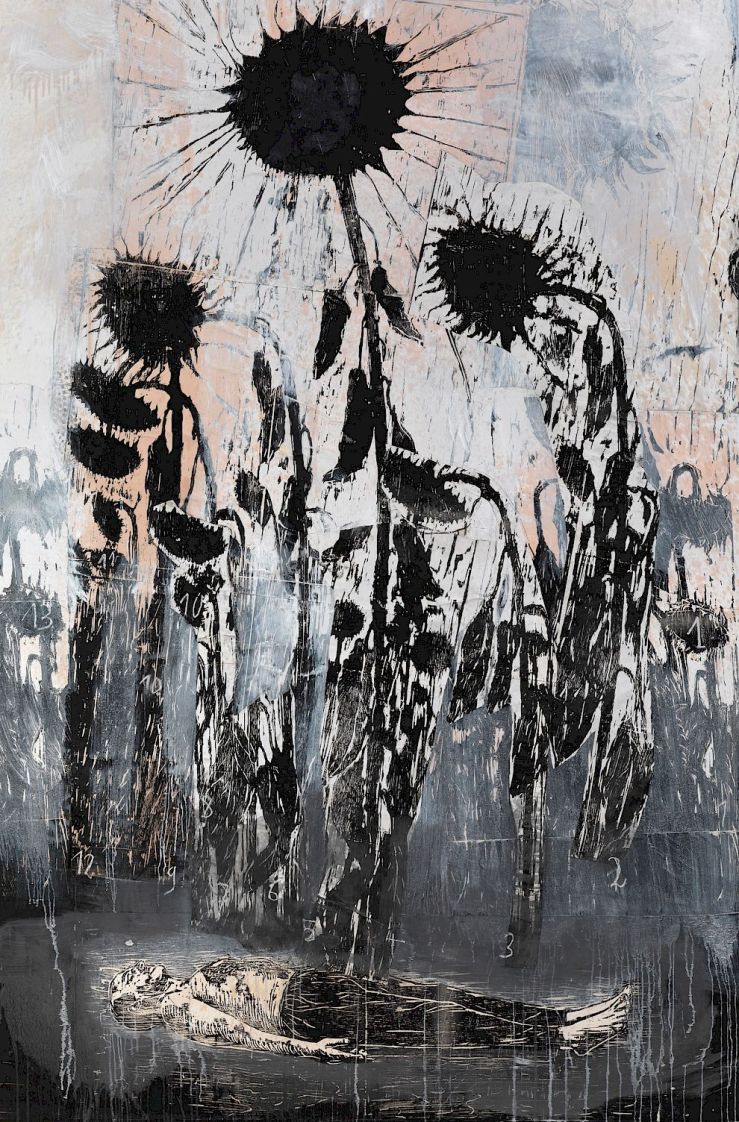
The sunflowers weep. Anselm Kiefer has done several paintings of sunflowers. He was born in 1945 in Germany, two months before the end of the war. It is hard to imagine the state of mind of the German nation at that time – on the edge of a shameful defeat, confronting the horrors of their totalitarian regime and, of course, the Holocaust. How does a society ever recover from sinking that abysmally low?

Anselm Kiefer has been determined to confront  his culture’s dark past. Here, the sunflower weeps. The sunflower looks so different in Kiefer’s work to the glory of its portrayal by Van Gogh. In Kiefer’s work, the sunflower stands for the national shame. Once proud and tall, the sunflower hangs its head in shame and disgrace – and weeps.

We can see the tears falling – they are the sunflowers going to seed. The seed is watering the earth for a new cycle of life – for a better season.

I was hoping to use this picture in a sermon – (particularly appropriate for Holocaust Memorial Day). I asked myself, “is Kiefer a Christian?”. Then I thought, “what is the point of that question?”, and “what an ugly question to be asking”. In that question there is a “as opposed to what?” – as in “if he is not a Christian then what is he?”. It becomes “Is he a Christian – (as opposed to a Jew)?” See what I mean. It’s an ugly question, particularly on Holocaust Memorial Day.

Kiefer is an artist in the business of lament and hope. There are plenty of others – largely inspired by the Jewish artists and prophets of the Hebrew scriptures.

Mornings at Blackwater – Mary Oliver shines through

Mary Oliver died January 17th 2019. She survived her past and made much of her “one and precious life”. Hers is the poetry of mindfulness and love. Here she writes of Mornings at Blackwater.

For years, every morning, I drank
from Blackwater Pond.
it was flavored with oak leaves and also, no doubt,
the feet of ducks.

And always it assuaged me
from the dry bowl of the very far past.

What I want to say is
that the past is the past,
and the present is what your life is,
and you are capable
of choosing what will be,
darling citizen.

So come to the pond,
or the river of your imagination,
or the harbor of your longing,

and put your lips to the world.
And live
your life.

photo taken at Stavanger

A Saviour Stitched to a Star

moravian starThe Feast of Epiphany – when wise ones followed a star, seeing in it the shape of things to come.

Poet Mary Karr stitches crucifixion and resurrection to a star (not her words) in a poem called Descending Theology: The Resurrection. I wonder if it is that same star, and I wonder whether the wise ones saw the shape of things to come in the star they followed.

I have stitched Mary Karr’s poem to a particular image of the star of Bethlehem. It is particularly three dimensional, with a reach not just from east to west, but in all directions – to all the nations. (In fact, it has 26 points – that makes a full alphabet for me.)

The poem:

From the star points of his pinned extremities,
cold inched in – the black ice and squid ink –
till the hung flesh was empty.
Lonely even in that void even for pain,
he missed his splintered feet,
the human stare buried in his face.
He ached for two hands made of meat
he could reach to the end of.
In the corpse’s core, the stone fist
of his heart began to bang
on the stiff chest’s door, and breath spilled
back into that battered shape. Now

it’s your limbs he comes to fill, as warm water
shatters at birth, rivering every way.

If you liked this poem you might also like Descending Theology: The Nativity, also by Mary Karr. There’s an interview with Mary Karr by Krista Tippett here. Here’s how to get instructions to make a Moravian star (as pictured).

I don’t know who the man born blind is either, but idly speculating …

Who is the man born blind? Who do you think he is? How do you picture him? When Jesus went looking for him (John 9:35), after he had been thrown out, who did he ask for? Did he have a name?

John leaves him anonymous. He may be Bartimaeus but if it is John has stripped him of his name. Anyway, Bartimaeus is another man who is blind in Mark’s gospel – it’s the other one (also nameless) that Jesus uses spit on to help him see (Mark 8:22-26).

Even if it is Bartimaeus the meaning is unclear, for if Bartimaeus is an Aramaic name his name means “unclean”, but if it is a Greek name his name means “honoured”. He certainly isn’t unclean in the eyes of Jesus and John. In fact he is a man whose blindness is accompanied by other gifts – a kind of biblical sage who is such a contrast to the able-bodied disciples.

Is he then, the model disciple?

We guess the identity of the “beloved disciple”. There are theories – could be John, Peter, Lazarus – but there’s no settled answer.

It might be that John has deliberately anonymised both of them, the man born blind and the beloved disciple.

Who is the beloved disciple? My suggestion is that the beloved disciple is whoever has his or her head on the bosom of Jesus (John 13:23), so that he/she can hear the whispered will of God, so that he/she can feel how the heart of Jesus ticks.

And similarly I wonder, is the man born blind the one who comes to see? – was blind, but now s/he sees – not through their own efforts, experience, wisdom or learning but through the gift and creation of God.

I don’t know whether you ever call rain “spit”. Our dog always pokes her nose out of the door warily to check whether it is spitting. Even if it is just spitting she turns tail and heads back in.

The rain is the spit on the earth, and the making of mud. It was from the mud that the Lord God formed humanity to become a living being (Genesis 2:7) and it was with the mud and a rub of the eyes by the lord both of light and darkness that the man born blind could see (John 9:6).

But is this just about the one man born blind? Is it about all those who “come to see”? And is the man born blind a new Adam? Is the man born blind the beloved disciple?

Just speculating. Who do you think he is?

An Old Woman – a poem by Arun Kolatkar

An old woman grabs
hold of your sleeve
and tags along.

She wants a fifty paise coin.
She says she will take you
to the horseshoe shrine.

You’ve seen it already.
She hobbles along anyway
and tightens her grip on your shirt.

She won’t let you go.
You know how old women are.
They stick to you like a burr.

You turn around and face her
with an air of finality.
You want to end the farce.

When you hear her say,
‘What else can an old woman do
on hills as wretched as these?’

You look right at the sky.
Clear through the bullet holes
she has for her eyes.

And as you look on
the cracks that begin around her eyes
spread beyond her skin.

And the hills crack.
And the temples crack.
And the sky falls

With a plateglass clatter
around the shatterproof crone
who stands alone.

And you are reduced
to such much small change
in her hand.

Arun Kolatkar (1932-2004)

img_0307
Arun Kolatkar was a poet from Maharashtra in India. He was a prolific poet writing in both Marathi and English. He was also an award winning designer. He won the Commonwealth Poetry Prize for his collection of poems, Jejuri, published in 1976.

This poem describes a fairly typical experience. The reader stands in the shoes of someone accosted in the street by a beggar desperate for money for something to eat. The reader knows what it’s like, to be stuck to “like a burr”. What we often forget, because we want to look past them as if they weren’t there, is that, for the desperate too, it’s part of their everyday, to latch on to others in the hope of charity. The tendency for the accosted is to shake off the attention. The norm for the beggar is to be shaken off.

But, in this poem, there is a notable turn towards compassion. The speaker looks “clear through the bullet holes she has for her eyes”. “You” look through and past her, but as you do so what you look at begins to shatter, and it’s only the “shatterproof crone who stands alone”. Is it then that the bullet hole eyes take on their significance? Is it at this point you recognise her wounds, the battles she may have fought and lost? Is it at this point that you realise what has become of her, and what has become of you in the hands of poverty – that “you are reduced to so much small change in her hand”?

There is such pathos in that last line. There is such small change in small change for a life that should be demanding huge change.