Growing Gardens of Love

How disappointing is joyless religion? William Blake captures the disappointment so well in The Garden of Love.

I went to the Garden of Love,
and saw what I never had seen;
a Chapel was built in the midst,
where I used to play on the green.

And the gates of this Chapel were shut,
and ‘thou shalt not’ written over the door;
so I turned to the Garden of Love
that so many sweet flowers bore.

And I saw it was filled with graves,
and tombstones where flowers should be;
and priests in black gowns were walking their rounds,
and binding with briars my joys and desires.

This is big religion and tragic religion. This is religion that perversely keeps watch, that keeps people out of the garden, that cancels playtime. It overpowers many faith communities around the world. Eucharistic religion, on the other hand, rejoices in the present moment, delights in love and hope, and grows new gardens of playfulness. Church planters take note.

The photo has been released into public domain by its author, Chitrapa at the wikipedia project

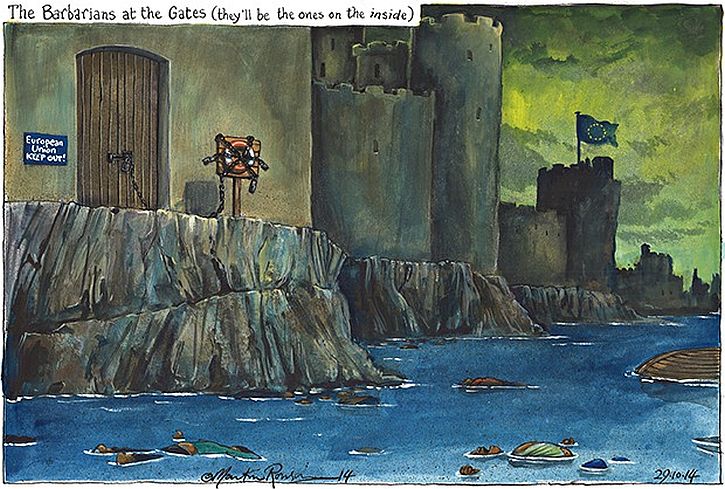
Watching migrants drown: ‘there are lines which, if crossed, make us immoral’

Great post and collection of responses to a shocking decision.

Gerry's avatarThat's How The Light Gets In

Martin Rowson 29.10.14

Martin Rowson in today’s Guardian

A few days ago I posted a piece about the photo of desperate migrants perched on top of the border fence that surrounds the Spanish enclave of Melilla on the north African coast.  Now we learn that the British government has supported, and the EU justice and home affairs council has adopted a policy of leaving migrants to drown.

For the past year the Italian navy, with EU financial and logistical support, has operated a search-and-rescue operation called Mare Nostrum for migrants in danger of drowning in the Mediterranean which has saved the lives of an estimated 150,000 refugees. It is to be replaced with a much more limited EU ‘border protection’ operation codenamed Triton which will not conduct search-and-rescue missions. The justification given by both the UK government and the EU for this inhumane decision is that Mare Nostrum exercised a ‘pulling factor’, encouraging economic migrants to set sail for Europe.

Amnesty International’s UK director, Kate…

View original post 1,224 more words

The gateway where hope and history rhyme

Migrant Mother - Dorothea Lange 1936
Migrant Mother – Dorothea Lange 1936

In her beautiful blog, Maria Popova describes Reverend Victoria Stafford’s meditation in The Small Work in the Great Work (in the collection The Impossible Will Take a Little While: Perseverance and Hope in Troubled Times) as “gorgeous”. Stafford is “interested in what Seamus Heaney calls the meeting point of hope and history, where what has happened is met by what we make of it. What has happened is met midstream by people who are … spiritual beings and all that implies from creativity, imagination, crazy wisdom, passionate compassion, selfless courage, and radical reverence for life.” Here is how Heaney puts it in The Cure at Troy where hope and history rhyme:

Human beings suffer,
They torture one another,
They get hurt and get hard.
No poem or play or song
Can fully right a wrong
Inflicted and endured.

The innocent in gaols
Beat on their bars together.
A hunger-striker’s father
Stands in the graveyard dumb.
The police widow in veils
Faints at the funeral home.

History says, don’t hope
On this side of the grave.
But then, once in a lifetime
The longed-for tidal wave
Of justice can rise up,
And hope and history rhyme.

So hope for a great sea-change
On the far side of revenge.
Believe that further shore
Is reachable from here.
Believe in miracle
And cures and healing wells.

Popova frames her post with Dorothea Lange’s iconic photograph of Migrant Mother. The woman moved by Lange is possibly a Californian pea picker in the Great Depression. Perhaps Popova has been prompted to turn to this photo by Stafford’s anecdote:

“I have a friend who traffics in words. She is not a minister, but a psychiatrist in the health clinic at a prestigious women’s college. We were sitting once not long after a student she had known and counselled,  had committed suicide… My friend, the doctor, the healer, held the loss very closely in those first few days, not unprofessionally, but deeply, fully – as you or I would have, had this been someone in our care.

At one point (with tears streaming down her face), she looked up in defiance (this is the only word for it) and spoke explicitly of her vocation, as if out of the ashes of that day she were renewing a vow or making a new covenant (and I think she was). She spoke explicitly of her vocation, and of yours and mine. She said, “You know I cannot save them. I am not here to save anybody or to save the world. All I can do – what I am called to do – is to plant myself at the gates of Hope. Sometimes they come in; sometimes they walk by. But I stand there every day and I call out till my lungs are sore with calling, and beckon and urge them toward beautiful life and love.”

Michael Sadgrove also claims the “gate” as the standpoint for Christian ministry. Considering Job in his book Wisdom and Ministry, Sadgrove asks about the piety required of those who are called to be friends and comforters to those who have to endure pain, and says that we don’t stand apart from suffering humanity, but face the world as it is. “We must often sit among the ahses where Job is, and must always go outside the gate to the place of the skull, where Jesus is.”

Opening the gate of Hope at the meeting point of  hope and history begins with holding a moment (as in Lange’s photo) closely and deeply, and meeting that with all that we are. For me, this is a passionate rendition of all the pastoral cycle seeks to do in theological reflection and pastoral practice. The final word goes to Victoria Stafford: “Whatever our vocation, we stand, beckoning and calling, singing and shouting, planted at the gates of Hope.” There we see the world “as it is and as it could be; the place from which you glimpse not only struggle, but joy in the struggle” Dorothea Lange’s Migrant Mother is in the public domain.

People gatherers

Feeding the 5000 by Eularia Clarke

Some people are just good at gathering people together. They call on people and the people come. This seems to be what leaders can do – or, rather, are those people who can gather us together our leaders? People gatherers have an attraction and an authority. Whether we call a meeting or throw a party, we are acting as people with authority, people able to call on others. Most people can grow that authority, usually by the attractive way that they gather people. Conversely, we have all been in gatherings which have been so carelessly organised that we have said “never again”. There’s usually a reason why “nobody came”.

Neighbours Table tells the story of a people gatherer. In an interview with Tammy Helfrich (available as podcast), Sarah Harmeyer talks about her recent life as a “people gatherer”. She adopts a word for the year. Word of the Year 2011 was “community” which brought a vision for inviting 500 people to her table during the year. At the point of the interview, she is nearing 1500 for the 3 year period on a budget of $75 per month. She started with an invitation to a “pot luck” delivered to her neighbours. Her father made a table to seat 20 – 91 came. She suggests that people are waiting to be invited, that whole neighbourhoods are waiting for such catalysts for change, for people to step forward.

Her “manners” can guide us all. “Plan ahead to be present with people”, develop a culture of mutual respect, interest and listening, introduce people to one another by saying what you love about them – all that makes for a good time gathering. So, pause for thought. Why do we call people together? Are they just instruments to our ambition, pawns in our little games? Are we prepared for them? What is our interest in their offering? Do we know them? Do we love them?

There is always a reason why “people come flocking”.

PS People gatherers are the image of God who gathers people like a shepherd, making of them a nation and a church. Eularia Clarke’s picture of the feeding of the 5000 is a celebration of God as “people-gatherer”, recalling the feeding of the multitude. The painting is part of the Methodist Modern Art Collection, © TMCP, and is used with their permission.

In our all together

LondonClubDressCode bordercropped

What shall I wear?

It’s a question that never crossed my mind when I turned up to a fancy dress party in plain clothes. Embarassing. It seems to be a question that never crossed the mind of the guest who was caught out at the wedding (Matthew 22:1-14).

He could have argued back. Jesus had, after all, told people not to worry about what to wear (Matthew 6:31), but there he was just tipping his head towards Eden where the boy and girl were unashamed by being in the all-together (Genesis 2:25). At the other bookend (Revelation 21:2) we are shown what we’ll look like when all-together we are got ready by God. “And I saw the holy city, the new Jerusalem, coming down out of heaven from God, prepared as a bride for her husband.”

There is a dressing down for those who worry about what they wear, and those who aren’t ready in time. Jesus reminds us that God clothes us. The guest who hadn’t dressed properly wasn’t clothed in righteousness.

There are various dressing prayers. David Adam has a dresing prayer based on St Patrick’s Breastplate. And Jan Richardson has this blessing in her Painted Prayerbook:

In your mercy
clothe me

in your protection
cloak me

in your care
enfold me

in your grace
array me.

With your justice
dress me

for your labor
garb me

by your love
envelop me

and fit me
for your work.

Photo by Paul Vlaar (http://www.neep.net/photo/london/show.php?12881) [CC-BY-SA-2.5 (http://creativecommons.org/licenses/by-sa/2.5)%5D, via Wikimedia Commons

Celebrating eucharistic action: Dix’s purple passage

Fresco of a female figure holding a chalice from Catacomb of Saints Marcellinus & Peter in Rome
Fresco of a woman holding a chalice from Catacomb of Saints Marcellinus & Peter in Rome

“At the heart of it all is the eucharistic action, a thing of absolute simplicity—the taking, blessing, breaking and giving of bread and the taking, blessing and giving of a cup of wine and water, as these were first done with their new meaning by a young Jew before and after supper with His friends on the night before He died. He had told his friends to do this henceforward with the new meaning “for the anamnesis” of Him, and they have done it always since.

Was ever another command so obeyed? For century after century, spreading slowly to every continent and country and among every race on earth, this action has been done, in every conceivable human circumstance, for every conceivable human need from infancy and before it to extreme old age and after it, from the pinnacles of earthly greatness to the refuge of fugitives in the caves and dens of the earth.
People have found no better thing than this to do
  • for sovereigns at their crowning and for criminals going to the scaffold;
  • for armies in triumph or for a bride and bridegroom in a little country church;
  • for the proclamation of a dogma or for a good crop of wheat; 
  • for the wisdom of the Parliament of a mighty nation or for a sick old woman afraid to die; 
  • for a school child sitting an examination or for Columbus setting out to discover America;
  • for the famine of whole provinces or for the soul of a dead lover;
  • in thankfulness because my mother did not die of pneumonia;
  • for a village chief much tempted to return to fetish because the yams had failed; because the Turk was at the gates of Vienna;
  • for the repentance of Margaret; for the settlements of a strike;
  • for a child for a barren woman; for Captain so-and-so, wounded and prisoner of war;
  • while the lions roared in the nearby amphitheatre;
  • on the beach at Dunkirk; while the hiss of scythes in the thick June grass came faintly through the windows of the church;
  • tremulously, by an old monk on the fiftieth anniversary of his vows;
  • furtively, by an exiled bishop who had hewed timber all day in a prison camp near Murmansk;
  • gorgeously, for the canonisation of S. Joan of Arc—one could fill many pages with the reasons why people have done this, and not tell a hundredth part of them.
And best of all, week by week and month by month, on a hundred thousand successive Sundays, faithfully, unfailingly, across all parishes of Christendom, the pastors have done this just to make the plebs sancta Dei— the holy common people of God.”

Dom Gregory Dix, The Shape of the Liturgy, London, 1945, p. 743, with a few changes I’ve made for the sake of a more inclusive language.

Ordination of Deacons

Image

It is 40 years since I was ordained a deacon at Sheffield Cathedral, and I have the privilege of being present for the ordination of 21 new deacons at Chester Cathedral today. These are people who have listened to God, heard his call, and responded with “here, I am”. These words are a commitment to being “present”, to “lifelong, disciplined attentiveness” according to David Runcorn in Fear and Trust.

Runcorn contrasts the failed leaders of 1 and 2 Samuel (there isn’t a success story among them) and offers the examples of Gandalf (Lord of the Rings) and Dumbledore (Harry Potter).

  • both bring the gifts of widely lived and well processed experience
  • both are significant guides and mentors to younger characters
  • both have taken the time and trouble to enter and understand worlds very different from their own
  • both are able to function peaceably without being the centre of the action
  • both display a combination of gentleness and decisiveness, authority and compassion
  • both are reconciled to their dispensability and accept that when the time comes, the world will continue without them.

That sounds good to me as a summary for ordained ministry and as a guide for theological education.

In the beginning you weep

In the beginning you weep. The starting point for many things is grief, at the place where endings seem so absolute. One would think it should be otherwise but the pain … Is antecedent to every new opening in our lives.

Belden Lane in The Solace of Fierce Landscapes

David Runcorn uses this quote to introduce the “unexpected starting place” of leadership in 1 and 2 Samuel in Fear and Trust. There patriarchy, represented by Hannah’s husband Elkanah and Eli, the priest at Shiloh. Patriarchal leadership had produced a very barren spiritual landscape. The unexpected starting place is a childless woman who Eli thought was a drunk.

Jesus is a very disruptive influence: a sermon on Matthew 10:34

Notes for a sermon for Ashton Hayes for June 22nd 2014

Fresco in the "Visoci Decani" in  Kosovo
Fresco in the “Visoci Decani” in Kosovo

Text: “Do not think that I have come to bring peace to the earth: I have not come to bring peace, but a sword.” (Matthew 10:34)

Teachers are busy writing school reports. Here’s Jesus’ report from the autumn term:

  • Resistant materials – A – excellent in woodwork section, and obviously well supported by the help and stimulation he gets at home.
  • Maths – F – Lacks basics. Keeps muttering about “Three in One” and “I and the Father are one”.
  • Graphic communications – D – Prefers to draw with a stick in the sand than to use pencil and paper.
  • Physical Education – D- Jesus has been a troublemaker. He refuses instruction in swimming, and is surprised that he sinks when he tries to walk on the water.
  • Overall – it saddens us to say that Jesus is a disruptive influence in the class. He flouts uniform regulations by turning up in sandals. He chooses his friends unwisely.

Another report was found by Monty Python.

Pupil’s name: God

  • Biology – 28% – weak, thinks he knows it all. Constantly rude about Darwin.
  • Domestic Science – 54% – a useful cook, the pillar of salt will come in handy for a long time.
  • Games – will not row, hates games and once parted the waters of the swimming pool during a match against the old boys which was both unsporting and dangerous. He can still do press ups.
  • Progress and conduct: “I am afraid that I am severely disappointed in God’s work. He has shown no interest in rugger, asked to be excused prayers and moves in a mysterious way. His attentions to the carpentry teacher’s fiancée caused her to leave a term early, and there are several nasty rumours flying around.

There is no getting round the fact that Jesus is a disruptive influence. As he says himself in today’s gospel reading: “I didn’t come to bring peace. I  came to bring a sword.” (Matt 10:34)

Here’s trouble and an affront that we overlook at our peril. This is challenging behaviour.

His mother was no better. Her song (from Luke’s songbook and gospel), Luke 1:46-55, aka Magnificat, was banned for many years. The authorities in British ruled India, and in 1980’s Guatemala and Argentina banned the words from being read out loud because they were too revolutionary.

Mary knew that Jesus was not good news for everyone. For every blessing that she sang there was an answering curse on those who thought they had it all. She sang of the one who looks with favour on the lowly, and who scatters those who are proud in their innermost thoughts, the one who lifts up the lowly, but brings down rulers from their thrones, who fills the hungry with good things, but sends the rich away empty.

Woe betide us if we become proud, rich and powerful. According to her song, we will be scattered, brought down and sent away empty.

Mary too is disruptive and dangerous for the authorities. It is no wonder that she is silenced by the authorities from time to time. Jesus takes after his mother and father. Blame the parents, if you like.

50 years ago, this weekend, three young men went to investigate a church that had been burnt out. The church was Mount Zion Methodist Church in Neshoba County in Mississippi. This was a building that was being used to register black voters in the States in what was called Freedom Summer, 50 years ago, in 1964 in the civil rights movement.

The state authorities were bitterly opposed to the voter registration campaign, believing that blacks shouldn’t be able to vote. You can feel the authorities bristling with the arrival of these three men: Michael Schwermer, James Chaney and Andrew Goodman. The authorities were sheltering the culprits of the chapel burning. Their crime was about to be exposed by these men who had come to disrupt their peace.

Deputy Sherriff Cecil Price followed the men as they drove back to their home in Lauderdale County. He intercepted them just on the county line and ordered them into his car. He then drove them to a deserted piece of land where they were met by two cars full of Ku Klux Klan members. They beat, shot and killed the three men, 50 years ago this weekend, June 21st 1964.

The lives of the three are commemorated in a stained glass window in the chapel of Cornell University. Their faith is celebrated in the words of the gospel song made famous by Pete Seeger and Joan Baez – “we shall overcome”.

Are they martyrs for us? Or were they disruptive and dangerous? What do we think? Are we on the side of the Klansmen, or the poor of the earth?

Those three didn’t bring peace. Neither did they bring a sword. They brought beatings, shootings, burnings and violence. They didn’t bring those things themselves. They brought those things on themselves. They engaged the powers and suffered their might.

Does this help us to understand what Jesus said when he said, “I didn’t come to bring peace, I came to bring a sword”? In the cold light of day these words strike us as difficult. They challenge us and disrupt us. The more we burn with passion, the hotter we get under the collar, the more our hearts burn within us, the more understandable they become.

What good is gentle Jesus, meek and mild in a world that is crying out for disruption? The prophet Jeremiah complains about the false prophets who claim that there is peace when there is no peace. (Jer 6:14)

No, Jesus comes with a sword. He is disruptive and he is divisive. The authorities expected him to go one way, and he went the other – to the lost, the last and the least. His words were salvation to some, but offensive to others.

The words of Mary’s song provide commentary on Jesus as well as his father: he looked with favour on the lowly, and scattered those who are proud in their innermost thoughts, lifting up the lowly, while bringing down rulers from their thrones, filling the hungry with good things, while sending the rich away empty.

He never used the sword.

The sword is metaphorical. It is an effect. The sword is what happens as a consequence of his love. People turn on one another and on him. Even families and friends turn against each other. He is disruptive and unsettling for us all.

He didn’t bring a sword but he brought a sword on himself. The political and religious authorities got him in the end. Jesus never drew a sword – he loved through the challenge and disruption. And he told his followers to put their sword away, as we recall from the incident in the Garden of Gethsemane. (Matt 26:51ff)

When Jesus said “I haven’t come to bring peace, but a sword” he was preparing his followers for mission, so that they might be disruptive in a world crying out for disruption. He was preparing them for a dangerous mission which could bring disruption, persecution and even death.

What is true of Jesus is true of the church.

Just some times we have to stand against the crowd – like those who were conscientious objectors in the war 100 years ago, like those who protest when they see injustice being done, like when we side with the scapegoat, the sick, the prisoner, the stranger.

It just might be that we have to stand alone – our friends may desert us, our families may turn on us, we may lose our cherished place in the community.

We stand for love and we overcome evil with good. We can’t pretend there is peace where there is none. We haven’t come to bring peace, but a possible sword on ourselves.

So I wonder what it will say on my final report. Will it say that I have been a troublemaker? Will it say that my behaviour has been challenging? Will it say that I have been disruptive for the sake of those who suffer in the way things are?

Or will it say, “he was just nice”? What good is that, only being nice? Being nice just doesn’t cut it does it?

References:

Thanks to http://www.pleacher.com/forwards/forwards/jcreport.html for Jesus’ school report.
Thanks to http://www.churchinacircle.com/2013/12/29/marys-subversive-song/ for the ideas about Mary’s subversive song.