Man of the Match

First half:

Shaking off the tiredness of the day
ushered black skin dayglo into concessionary parking
(it’s not Premier League you understand)
we trudge to Eastlands
side by side strangers
whose separate feelings
we don’t understand
but whose goal we share.
Parking charges upwards
through five poundland to eight poundland.
The crowd thickens, the heartbeat quickens
by pubs and scarf sellers geared and guarded
for their once in a while chance of trade and profit.
Tickets are for sale.
Queues pour from tiny windows like snakes
slowly slithering. We could complain.
It was an hour. But we’re not united.
We are City and what is a missing half?

Second Half:

A boy in the crowd waits to be found
amongst wannabes dreaming catapults
from limelight to spotlight.
Many moons from Titograd
to the moment of his life
a debut, two goals and a loud speaker
hailing the name Stevan Jovetic,
Number 35. Man of the Match
found and fanned to high heaven,
feelings united, everything forgotten.
Five nil.

Teaching and hospitality – pause for thought from Henri Nouwen

“When we look at teaching in terms of hospitality, we can say that the teacher is called upon to create for students a free and fearless space where mental and emotional development can take place…. The hospitable teacher has to reveal to the students that they have something to offer. Many students have been for so many years on the receiving side and have become so deeply impregnated with the idea that there is still a lot more to learn, that they have lost confidence in themselves and can hardly imagine that they themselves have something to give, not only to the ones who are less educated but to their fellow students and teachers as well…..”

Henri Nouwen in Reaching Out

The Centre of the Universe

“We must take sides. Neutrality helps the oppressor, never the victim. Silence encourages the tormentor, never the tormented. Sometimes we must interfere. When human lives are endangered, when human dignity is in jeopardy, national borders and sensitivities become irrelevant. Wherever men and women are persecuted because of their race, religion, or political views, that place must – at that moment – become the center of the universe.”

Elie Wieselthe Night Trilogy

Days of Awe

Day 272 - Chag Sameach!

We can learn so much from the liturgies of other faith traditions. These are the  10 Days of Awe, Yamim Noraim in the Jewish calendar. They begin with Rosh Hashanah, New Year’s day celebrating the day the world was born, and end in Yom Kippur, the Day of Atonement.

Rabbi Melissa Weintraub draws attention to the Days of Awe in an article in the Huffington Post. She calls the Yamim Noraim “a kind of high speed enactment of our life’s journey from birth to death”. She says “our liturgy brings us to the edge of the precipice between life and death in order to create the emotional conditions for urgent expression”

She recalls seeing her “schmaltzy” father leaning over his walker crying his heart out. He said, “I never got to say goodbye. Everyone – my mother, sisters, and brothers – all died without knowing how much I loved them.” She suggests that the Yamim Noraim summon us to rehearse the end of our lives – “to lean over our walkers in advance. To say what we need to say before it is too late.”

She illustrates her point by sharing a moving account of Steve Martin’s final meeting with his father, with whom he had had a difficult relationship.

I walked into the house they had lived in for 35 years, and my weeping sister said, “He’s saying goodbye to everyone.” A hospice nurse said to me, “This is when it all happens.” I didn’t know what she meant, but I soon would..

I walked into the bedroom where he lay, his mind alert but his body failing. He said, almost buoyantly, “I’m ready now.” I understood that his intensifying rage of the last few years had been against death and now his resistance was abating. I stood at the end of the bed, and we looked into each other’s eyes for a long, unbroken time. At last he said,”You did everything I wanted to do.”

I said, “I did it because of you.” It was the truth.

I sat on the edge of the bed. Another silence fell over us. Then he said, “I wish I could cry, I wish I could cry.”

At first I took this as a comment on his plight, but I am forever thankful that I pushed on. “What do you want to cry about?” I finally said.

“For all the love I received and couldn’t return.”

He had kept his secret, his desire to love his family, from me and my mother his whole life. It was as though an early misstep had kept us forever out of stride. Now, two days from his death, our pace was aligning, and we were able to speak.

I sometimes think of our relationship graphically, as a bell curve. In my infancy, we were perfectly close. Then the gap widened to accommodate our differences and indifference. In the final days of his life, we again became perfectly close.

There is a physicality to the introspection of the Days of Awe. Rabbi Melissa shows us some of the scope of atonement. I am grateful for her insights from a tradition that prepares such care-full celebrations of the grace of new life and atonement.

L’Shana Tovah. Happy New Year.

Thank you to slgckgc for the photo of the shofar blowing.

Intercession

Praying Hands
Thank you C Jill Reed for this photo of Praying Hands: a 30 ton 60 ft tall bronze statue at Oral Roberts University, in Tulsa, Oklahoma. The praying hands are just so huge that they make our own hands puny in comparison. Surely these are the hands of Christ, through whom our prayers are heard and minded by God.  He is the great High Priest whose love blesses the universe.

All Christians are called to be intercessors with responsibilities to pray for our enemies as well as our friends.

Dietrich Bonhoeffer wrote about the importance of intercessory prayer in Life Together:

A Christian community either lives by the intercessory prayers of its members for one another, or the community will be destroyed.

I can no longer condemn or hate other Christians for whom I pray, no matter how much trouble they case me. In intercessory prayer the face that may have been strange and intolerable to me is transformed into the face of one for whom Christ died, the face of a pardoned sinner. That is a blessed discovery for the Christian who is beginning to offer intercessory prayer for others.

As far as we are concerned, there is no dislike, no personal tension, no disunity or strife that cannot be overcome by intercessory prayer. Intercessory prayer is the purifying bath into which the individual and the community must enter every day.

The Church’s Lectionary prompts us to read two passages which talk about table manners. The passage from Hebrews (13:1-8) reminds us to entertain strangers (“for by doing that some have entertained angels without knowing it”) and to remember those in prison (“as though you were in prison with them”). The Gospel passage (Luke 14:7-14) Jesus turns the tables on our normal manners by telling us to “invite the poor, the crippled, the lame and the blind” when giving a banquet, rather than friends, family and people who do us good.

These are extraordinary and good table manners. What we are supposed to do at our tables we are also supposed to do in our prayers. In our prayers we are entertaining people in our hearts and minds. And we have to stretch our minds and hearts so that we pray for those who are at the margins of our consciousness – we prepare a place for the stranger, the poor, the prisoner.

In praying for them we bring them centre stage in an act of remembrance, as if we were in prison with them. We pray for those for whom life has gone wrong, for those who don’t know what peace is, or family is. We pray for the unlovely and the lost as if we are unlovely and lost with them. This is a sympathetic (or empathic) position, but it is not about identification, because, as Oswald Chambers reminds us, intercession also puts us in God’s place. He writes: “People describe intercession by saying, “It is putting yourself in someone else’s place.” That is not true! Intercession is putting yourself in God’s place; it is having his mind and his perspective.”

These are deeply healing processes. When we pray for others we are at the very least remedying neglect and overcoming fears and divisions. And we are, at the very most, putting ourselves “in God’s place” of overcoming evil with far better table manners and prayer.

Reading as a lover

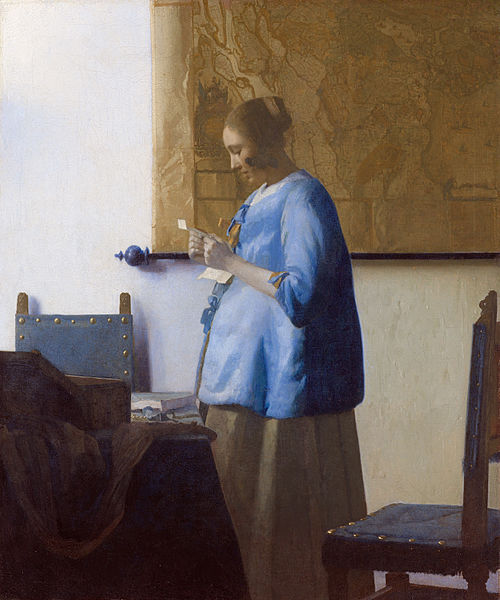
Woman reading a letter by Johannes Vermeer ca 1662
Woman in Blue Reading a Letter by Johannes Vermeer ca 1662

In an address to a recent seminar on teaching RE and Christianity in schools Professor David Ford draws attention to the importance of “reading religiously” by referring to these words from Paul Griffiths:

So far as I can recall, I have always been able to read, to make sense of and be excited by written things. I know, of course, that there was a time when I could not read; it’s just that I cannot remember it. But I was never taught, and have still not properly learned, how to read with careful, slow attentiveness; it is difficult for me to read with the goal of incorporating what I read, of writing it upon the pages of my memory; I find it hard to read as a lover, to caress, lick, smell, and savor the words on the page, and to return to them ever and again.

I read, instead, mostly as a consumer, someone who wants to extract what is useful or exciting or entertaining from what is read, preferably with dispatch, and then move on to something else… I’m not alone in this condition. Most academic readers are consumerist in their reading habits, and this is because they, like me, have been taught to be so and rewarded for being so.

But I’ve also spent a good portion of my life trying to understand what it means to be a Christian, as well as much time studying literary works composed by Indian Buddhists. Both of these practices have gradually led me to see that consumerist reading isn’t the only kind there is. It’s also possible to read religiously, as a lover reads, with a tensile attentiveness that wishes to linger, to prolong, to savor, and has no interest at all in the quick orgasm of consumption.

Reading religiously, I’ve come to think, is central to being religious. Losing, or never having, the ability so to read is tantamount to losing, or never having, the ability to offer a religious account of things.

Paul J Griffiths. Religious Reading. The place of reading in the practice of religion (Oxford and New York: Oxford University Press, 1999) pp.ix-x.

A turnaround

And so we set sail from Patara. Well we flew home from our holidays actually.

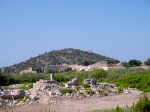
We arrived in Patara fairly wrecked, but left refreshed and restored, thanks to the place, its people, many friends and a great climate. We thrived on the wonderful welcome and service we had (particular thanks to Nadi and Mehmet at Golden Lighthouse). Nothing is too much trouble for the lovely people of this quiet village. I wonder how deep rooted traditions of hospitality and generosity need to be to be effective. They certainly seem to be part of Patara culture, which traces its history back beyond the days when it was the capital city of the Lycian League. It is a place that does us good at so many levels.

Acts 21:1 refers to Paul’s journey through Patara. Paul and Luke came to Patara via Kos and Rhodes. They changed ship at Patara to sail to Syria. It was good to be following in Paul’s footsteps, coming into Patara one way, and leaving in an altogether better shape for the onward journey.

Çok tesekkur ederim, Patara.

Eternity

The grave of William Blake (on St George's Day) Approximately 0.87 miles from Haggerston in Hackney, Greater London · © ceridwen Photos kindly supplied by Geograph, and may be reused subject to this creative commons usage licence.

He who binds to himself a joy
does the winged life destroy;
But he who kisses the joy as it flies
lives in eternity’s sunrise.

William Blake

William Blake died on August 12th 1827. The grave of William Blake (on St George’s Day) is at Bunhill Fields Burial ground in Hackney, Greater London. Photo © ceridwen kindly supplied by Geograph, and may be reused subject to this creative commons usage licence.

The freedom of all the children of God

Today we celebrate the anti-slave campaigners, William Wilberforce, Olaudah Equiano and Thomas Clarkson. It’s today because it’s the anniversary of William Wilberforce’s death.

Campaigns against slavery, human trafficking and child labour continue, as do campaigns  for a living wage. They must. We pray this prayer;

God our deliverer, who sent your Son Jesus Christ to set your people free from the slavery of sin:
grant that, as your servants William Wilberforce, Olaudah Equiano and Thomas Clarkson toiled against the sin of slavery,
so we may bring compassion to all and work for the freedom of all the children of God, through Jesus Christ your Son our Lord.

“No man is good enough to govern another man, without that other’s consent.” Abraham Lincoln