Hope Before Dawn: An Advent Imagination

Live for that day when God’s peace is all in all.
Love for that day when God’s light leaves no shadows.

These are the darkest days of our lives.
December draws a long shadow,
and we find ourselves longing for light.

These days seem to go on without end.

These are the days Isaiah fought through and hoped through
3000 years ago:
the same old, the same old.
the dark ages all over again.
This is the mean time.

This is the time to cherish those who’ve kindled hope,
those we’ve bound in scripture
who hoped in God when the world felt just as heavy as ours.
This is the time to pray.
This is the time to keep watch.
This is the time to live for another day,
to love towards another day
when the times will finally be a-changing.

These are very mean days
when nations make war on nations,
There may be no world war,
But there are too many wars
for us to call this peace.
The world is at war,
and we are all caught up
in a global propaganda war.

These are very mean days when dark forces
create a hostile environment for those seeking asylum and sanctuary,
days which leave so many children hungry
and too many families poor, 

when budget after budget
miss the opportunity to make things better.

These days, however bright the weather may be,
are dark days to too many people.

And so –
these are the very days to keep hope alive,
to pray for the day when God’s kingdom comes on earth, as it is in heaven,
to live for the day when God’s word settles disputes;
to love for the day when nation will not take up sword against nation,
and nor will we need to train for war any more.

Imagine that.
Imagine the difference
when the weapons of war,
the resources of war,
become tools for farming and feeding and healing.

Imagine the difference
if the resources of war were turned to farming.
Not just in the fields of our own villages,
but in Gaza’s broken orchards,
in Ukraine’s shelled wheatlands,
in every place where the soil has been scorched,
and the hands that sow can no longer harvest.

Isaiah’s dream has dirt under its nails.
It is a farmer’s dream,
a peacemaker’s dream –
swords hammered into ploughshares,
spears repurposed as pruning hooks,
the earth tended again.

And here’s another theme none of us can avoid,
if we care about justice and peace:
we need to be prepared in these days of darkness.
Advent comes with a wake up call.
The time has come for us to wake up, says Paul, (Romans 13)
and be ready for the Day of the Lord –
the day we live for,
the day we pray for,
the day we love for.

For Advent I’ve downloaded an app which notifies me of Fajr –
the prayer Muslims offer from dawn to sunrise.
So, this morning, at 6.05,
my phone buzzed to tell me it was time to pray,
and I was reminded of all those
who rise while the world is still dark
to end the night and hope for the day.

First they wash,
then raise their hands to acknowledge the greatness of God.
They then recite the Surah:

In the name of Allah – the Most Compassionate, Most Merciful.
All praise is for Allah – Lord of all worlds.
the Most Compassionate, Most Merciful,
Master of the Day of Judgment.
You ‘alone’ we worship and You ‘alone’ we ask for help.
Guide us along the Straight Path
the Path of those you have blessed
– not those You are displeased with, or those who are astray.


Then they bow
They stand and say, “God hears the one who praises him.”
They prostrate themselves, grounding their forehead, palms, knees and toes on the earth –
and from the ground they praise God.
They finish by turning their head
to the right and to the left
with a prayer of peace in both directions.
Then they are ready for the day
(and, dare I say, they’ve given themselves a good work out!).

There is something holy about any people
who pray before the sun comes up.
They remind us what Advent is for:
ending the night,
and hoping for the day.

And we are among those holy people
imagining that day which will end all days of wrongdoing,
when God’s word is truly heard.

That is why our time of prayer
is taken up with praying for the coming of God’s kingdom,
on earth, as it is in heaven.
Christians will always use their prayer time for that –
It’s what Jesus taught us.

It is a prayer of imagination.
It is a prayer for dawn in the dark.
It is a prayer for the day when ….
the day God’s peace is all in all,
the day God’s light leaves no shadows.

And so we live for that day —
when, as Revelation imagines,
there will be no more mourning, crying or pain,
the day that will see an end to night.

Until that day
we keep watch,
keep warm,
and keep hope alive
these dark days.

Luke’s Last Surprise: One Condemned Man Joining Another as the First in Paradise

This Sunday marks the end of the Christian year.
Next Sunday we hop on the next liturgical cycle of readings – it will be Year A.
Each year focuses on a particular gospel. Next year it will be Matthew’s. This year it has been Luke’s.

When I began this preaching year, I wondered what Luke would offer us.
I wondered how he might inspire us, challenge us, lead us.
And now, at the end of the year, I find myself saying one thing above all: WOW.
Luke has surprised us. Luke has stretched us.
Luke has shown us the kingdom of God in places we would never have thought to look.

This Sunday is a WOW moment,
a hinge on which we hang our wonder,
before the new year opens again.
Next week we begin again,
not from cold, not from scratch,
but already warmed by hope,
already knowing what God’s kingdom looks like
in the dominion of darkness.

We will return to the manger
knowing now what Luke has shown us all year –
that God’s kingdom begins with the smallest,
with the least, with the last instead of the first,
in a vulnerable baby held by exhausted parents
on the edges of empire.

These are the readings (Colossians 1:11-20 and Luke 23:33-43) that crown our year.
And this is where Luke has been leading us all along:
not to a palace, but to the place of the skull,
Not to a gold throne, but to a wooden cross.
A king.
A sign nailed above his head.
And a thief beside him.
That’s the gospel picture.
That’s where Luke brings us when the year ends and we crown Christ our King.

Our other reading, from Colossians, may seem difficult at first –
until we recognise it as a hymn.
A hymn praising the God who rescues us from the dominion of darkness,
who strengthens us with endurance,
who qualifies us for the kingdom of his beloved Son –
the kingdom of light,
the kingdom where Christ is King.

Luke paints the scene.
It is the “dominion of darkness” (to use the phrase from Colossians).
The place is the place of the skull,
Death Row in the Dominion of Darkness:
there is the smell of death
and the overpowering smell
of cruelty, injustice and wrongdoing.
There are three crosses.
One is for Jesus, the others for two criminals crucified either side of him.

Luke gives them very different voices.
One sneers – placing him with those who mock, jeer and insult Jesus.
“He saved others, let him save himself if he is who he says he is.”
(In other words, he isn’t who he says he is.)
“Aren’t you the Messiah? Save yourself and us!”

The other criminal rebukes him, saying the two of them deserve their punishment.
Then he protests Jesus’ innocence. “This man has done nothing wrong.”
And in that moment he is just right.
He is right to defend the defenceless
against the forces which have conspired against Jesus.
“This man has done nothing wrong,”
and yet he is facing the same sentence, only worse,
because insult is added to injury.

Then he turns to Jesus.
“Jesus, remember me when you come into your kingdom”

This criminal is the first to defend Jesus publicly.
He is the first to take his stand with Jesus.
And Luke wants us to see him.
This figure.
This last, least, condemned man
who becomes the first to declare Jesus innocent
and the first to receive a royal promise.

He is the last person in the world you’d expect
to be the first to defend Jesus –
(we are led to believe that there is no honour amongst thieves),
but here he is in the picture of paradise – alongside Jesus.
The last becomes the first in paradise,
that kingdom of love –
a relationship, not a place.

And here – right here – you can almost see it happen:

And perhaps this is Luke’s final surprise for us:
that the first to enter paradise with the King is not a saint or a scholar or a faithful disciple,
but a criminal who can offer Jesus nothing but honesty and trust.

He offers no record of virtue.
No proof of goodness.
No last-minute achievements.
He can’t even lift his hands in prayer.
All he can do is speak the truth —
about himself, about Jesus, about the kingdom.
And Jesus takes that truth, that tiny seed of faith,
and makes it bloom.

“Today you will be with me in paradise.”

And that paradise begins there,
in the dominion of darkness,
with a king crowned not with gold but with thorns,
and a wrongdoer who sees more clearly than anyone else.

The only crown Jesus could ever wear is a crown of thorns.
They’re the thorns of scorn, the barbs of bitterness.
They’re our failures, our wounds, our complicity,
our inability to rule even ourselves.

But the kingdom Luke has been showing us week after week
is a kingdom where the last come first,
the lost are found
and where the crucified King gathers in his arms
those the world’s unjust powers condemn.

This is the WOW moment.
Everything has led to this,
when the thorns begin to flower.
This is what Luke is intent on showing us.

His sequel, Acts,becomes the story
of the cross in bloom.
The frightened disciples become bold and generous.
The failures become witnesses.
A crippled beggar stands up and walks.
An Ethiopian outsider becomes the first fully Gentile convert.
A persecutor becomes an apostle.
Prisoners sing hymns; jailers are baptised;
enemies share bread.

Again and again the thorns flower.
Again and again the barren places bear fruit.
Again and again the last become first.

This is where the King of Love leads us:
into a rule of life that puts the last first
and sees thorns flower with grace.

All year long Luke has shown us a kingdom that grows in unlikely places,
and now at the last,
he shows us the unlikeliest place of all,
the place of the skull, Death Row.
Yet even here, if we look through Luke’s eyes,
Something ]begins to bloom.

At the place of the Skull grows the tree of life.
The crown of thorns flowers with grace.
The King of Love
and the convicted criminal
become the first couple in the new creation –
the first to walk the way of mercy,
the first to step into the garden of God’s future.

This is how the Christian year ends:
not with worldly triumph,
but with this strange, saving beauty –
a King who makes the last first,
who turns a place of execution into a place of promise,
who opens paradise to the least likely of all.

This is the kingdom of God and the gentle thorn-crowned rule of Jesus.

Luke 23:33-43

When they came to the place called the Skull, they crucified him there, along with the criminals – one on his right, the other on his left. Jesus said, ‘Father, forgive them, for they do not know what they are doing.’ And they divided up his clothes by casting lots.

The people stood watching, and the rulers even sneered at him. They said, ‘He saved others; let him save himself if he is God’s Messiah, the Chosen One.’

The soldiers also came up and mocked him. They offered him wine vinegar and said, ‘If you are the king of the Jews, save yourself.’

There was a written notice above him, which read: this is the king of the jews.

One of the criminals who hung there hurled insults at him: ‘Aren’t you the Messiah? Save yourself and us!’

But the other criminal rebuked him. ‘Don’t you fear God,’ he said, ‘since you are under the same sentence? We are punished justly, for we are getting what our deeds deserve. But this man has done nothing wrong.’

Then he said, ‘Jesus, remember me when you come into your kingdom.’

Jesus answered him, ‘Truly I tell you, today you will be with me in paradise.’

This is where mercy takes her stand: far off, in the distance

Readings: Luke 18:9–14; Ecclesiasticus 35:12–17

The clocks have changed. The weather’s changed.
And we stand now on the bridge between seasons.

Today is the last Sunday after Trinity.
Next Sunday is the first in the new Kingdom season –
when we see the darkness of the kingdoms of this world,
and pray again for the world to be turned the right way up
with the rule of God’s Kingdom founded in heaven.

As the light shortens and we cross that bridge between seasons,
it feels right to pause and ask what endures –
what stands firm when the world tilts and turns.

And Jesus gives us this story;
a parable about where mercy truly stands.

This is where mercy takes her stand: far off, in the distance.

I want us to notice this morning
the two men Jesus talks about in the parable –
a story he addressed to some
who were confident of their own righteousness
and looked down on everyone else.

Notice how the Pharisee did what was expected of him,
just as he was supposed to,
obedient to the teachings of his religion.

He tithed and he fasted.
He did just what was right.
He was a religious success –
the sort of success to make a temple proud.

He stood confidently still,
as if he owned the place –
the temple where he was the perfect fit,

And he smugly gave thanks
that he wasn’t like the others:
robbers, evildoers, and adulterers.

In fact, he put himself first,
the best he could be,
better than all the rest,
better than the tax collector they all despised,
standing over there, at a distance.

He gave himself the prize,
he was the pride of the temple –
the one to catch the eye
of those like him on centre stage:
the success stories,
the ones who come first in their own eyes
and the eyes of the world,
those who are proud of their achievement,
who look down on those who can’t match them.

But he’s not the one who catches Jesus’ eye.
Mercy’s gaze has turned elsewhere.

This is where mercy takes her stand —
not in the proud posture of the Pharisee,
but with the one who stands at a distance,
head bowed, heart open,
praying only, “God, be merciful to me, a sinner.”

The tax collector hasn’t much to commend him.
He’s made a living making compromises,
lining his own pocket when he must,
doing the bidding of an empire,
taxing his people, cheating his people,
keeping them poor.

He too has come to pray.
He stands apart.
He knows he’s not fit
to join those who look down on him.
He knows the weight of those eyes
and their condemnation, surely justified.

But still he prays where he’s been pushed aside –
in that low place, in that honest place –
and he finds the only prayer he can manage:
“God, be merciful to me, a sinner.”

That’s all.

There are people good at praying, like the Pharisee.
It comes easy to them.

But this tax collector has nothing to claim.
He can’t make comparisons; he can’t claim to be good.
He has no list of good intentions.
All he has are these few words –
and that’s enough for Jesus.

Jesus has highlighted two men –
two types, one self-righteous and sure of himself,
the other “worse” by some distance.

There’s only one who goes home justified,
and it’s not the one we expected,
the one who thanks God he’s better than all the rest,
the one who thinks he’s the best he can be.

It’s the other one, the one on the edge,
the one in the distance, going home justified
(whatever “going home” might mean).

That’s quite some punchline from Jesus,
punching the pride of the temple,
and those confident in their own goodness,
who look down on everyone else.

“All who exalt themselves will be humbled,
and those who humble themselves will be exalted.”


That’s turning the world upside down,
and the truth inside out.

And it still happens today,
whenever we’re brave enough to look beyond ourselves.

There’s a man who sits under the bridge in our town.
I’ve passed him many times,
hesitating, not sure what to say,
worried about what it might cost to engage.
But this week, I stopped.
I’d found my opening line.
We talked.
He had plenty to say.
I found him articulate, intelligent, resilient,
unhealthy, unlucky.
I went away thankful.

I wasn’t thankful I wasn’t like him –
God forbid.
Rather, I was thankful that I am.
Thankful that mercy makes us kin,
that empathy builds bridges and common ground.

I had stood my distance – the shame was all mine.
The shame that it’s taken me so long
to learn how to join those down and those out.

This is where mercy takes her stand —
on the bridges, in the margins,
in the hearts of those who stand at a distance.

And maybe this is a small thing to notice,
but it strikes me that the Pharisee, in his way,
is saying what we so often hear today —
“I’m feeling blessed.”
Blessed that life’s gone well,
blessed that I’m not struggling,
blessed that I’m not like those who’ve fallen on hard times.
But the tax collector doesn’t say that.
He doesn’t feel blessed —
he only feels the weight of mercy.
And yet he’s the one who goes home justified,
seen, forgiven, restored.
Maybe that’s what blessing really looks like —
not success, but mercy meeting us
when we’ve nothing left to boast about.

Today is Bible Sunday,
a reminder that Scripture isn’t just something we read —
it’s something that reads us.
The Pharisee knew his Bible well,
but he used it to build himself up.
The tax collector may not have known a verse,
yet he lived the truth of one we’ve heard this morning:
“The prayer of the humble pierces the clouds” (Ecclesiasticus 35).
God’s Word lands where mercy already waits.

And that is what this parable shows us —
the way God’s kingdom comes:
not through pride or perfection,
but through mercy that stoops low
and finds us where we are.

For God sides with the penitent sinner,
with the humble, with the broken,
with those the world overlooks.
And when we begin to see as God sees —
when we recognise the brother under the bridge,
the sister on the edge —
we discover that the kingdom has already drawn near.

This is where mercy takes her stand:
far off, in the distance,
on the edge where humility meets hope,
and where God is already at work,
turning the world the right way up.

All who exalt themselves will be humbled,
and all who humble themselves will be exalted.
That’s not a threat.
That’s a promise.
That’s the way the world is set right.

Luke 18:9-14
To some who were confident of their own righteousness and looked down on everyone else, Jesus told this parable: ‘Two men went up to the temple to pray, one a Pharisee and the other a tax collector. The Pharisee stood by himself and prayed: “God, I thank you that I am not like other people – robbers, evildoers, adulterers – or even like this tax collector. I fast twice a week and give a tenth of all I get.”
‘But the tax collector stood at a distance. He would not even look up to heaven, but beat his breast and said, “God, have mercy on me, a sinner.”
‘I tell you that this man, rather than the other, went home justified before God. For all those who exalt themselves will be humbled, and those who humble themselves will be exalted.

LimpLight

This one’s for all who wrestle in the dark and rise, blessed but limping, inspired by reading Genesis 32:22-31 and Luke 18:1-8 – the Revised Common Lectionary readings for October 19th 2025.

How shall we describe the state of Israel today?

The state of Israel today begins with both our readings —
from Genesis 32, the story of Jacob whose name means twister;
and from Luke 18, the story of the widow struggling for justice.

The state of Israel begins at the end of a night of struggle for the twister,
a night of struggle in which Jacob never discovers
the name of the one he’s wrestling with,
but finds himself called by a new name — Israel.

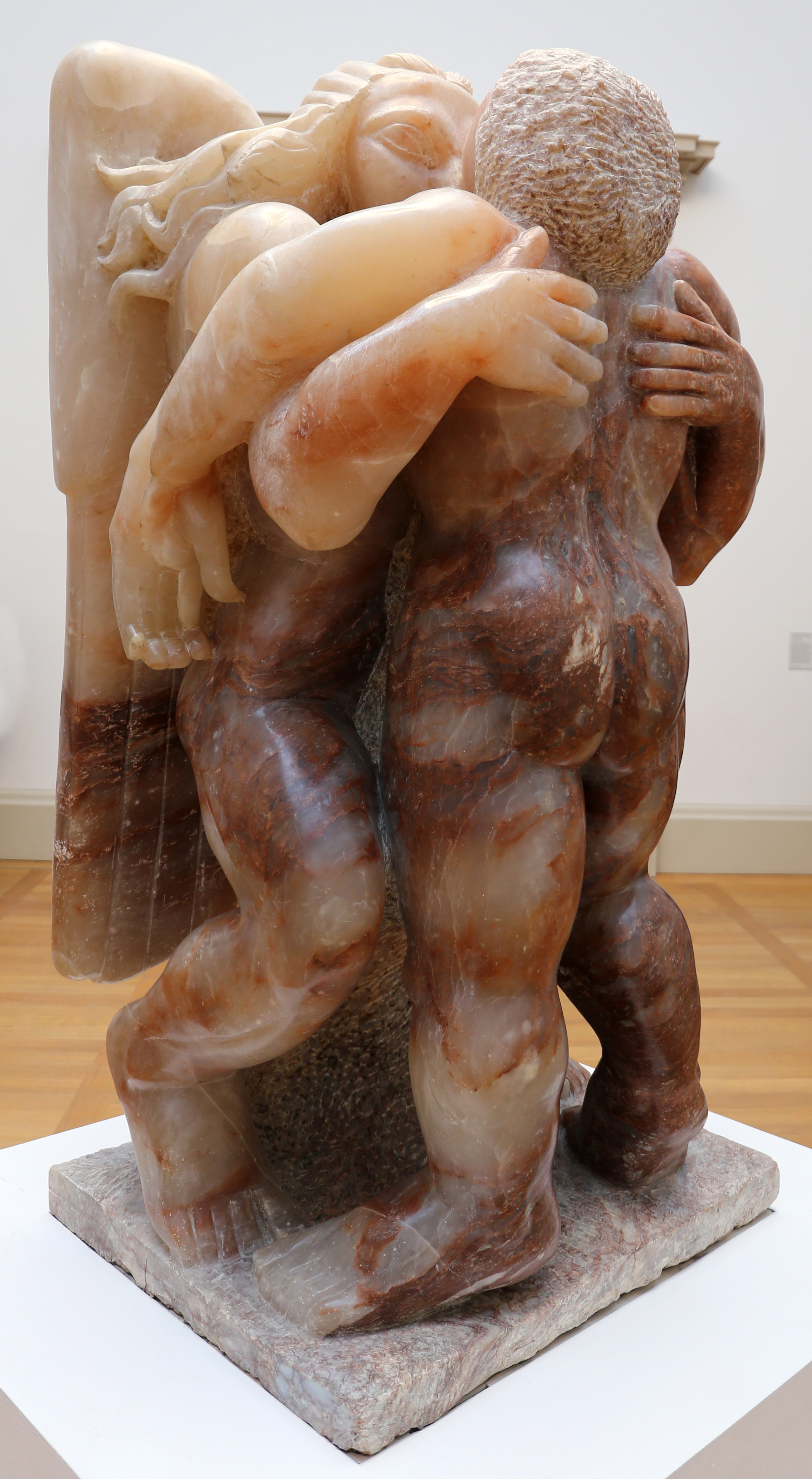
Jacob’s struggle as portrayed by Sir Jacob Epstein (shown in Tate Gallery, London)

Israel struggles with God,
and God struggles with Israel.
That is the very meaning of Israel.
If Israel means anything,
it means struggling with God.

Jacob is the first to be called Israel,
and he is called (renamed) that by the one he struggled with
because he “struggled with God and with people”
and withstood the whole night.

It is the calling of Israel to struggle faithfully through the night.

Jacob is the patriarch of Israel —
the patriarch of those who struggle with God and with people,
and who carry on wrestling through long nights and times of darkness
without being overcome,

people like the widow singled out by Jesus —
a victim of some injustice.
In the face of an utterly unjust justice system,
personified by a judge who neither feared God
nor cared what people thought,
she struggled.

For some time she struggled.
She kept coming at that lousy judge.
She wouldn’t let go until he gave in.

Those who struggle through the night,
with God and with people —
those who struggle to see the night through,
for whom the night is very dark,
and for whom there is little daylight,
those who won’t give up whatever the night brings —
they are the ones whose hope is rewarded.

They carry a blessing for all who wrestle with God
and with the wounds people inflict.

It’s the blessing of God
who himself wrestles through the darkness of the world,
who struggles with people and the suffering they cause,
but who, in spite of all that,
wrestles the whole night long.

This is the love that shines in the darkness
to the break of day.

And yet, the night is long.
Not just one night in Jacob’s life,
not just one night in ours,
but the long night of the world —
a night as long as history.

Through that long night we wrestle,
and God wrestles with us.

There are three struggles woven into this story,
and all three belong to Israel:

We struggle with God.
We struggle with people —
and people struggle with us.
And through it all,
God struggles with us.

That’s what it means to be called Israel:
to live the long night of wrestling,
and to trust that, at the end of it,
there will still be blessing.

The struggle with God

Sometimes it’s the long silence of prayer —
when we ask and wait and hear nothing.
Sometimes it’s the ache of loss,
or the questions that faith won’t easily answer.
We wrestle with God when life doesn’t fit the promise,
when love feels hidden,
when blessing comes only after a wound.

But still we hold on.
Faith is not certainty —
faith is the grip that will not let go until morning.

The struggle with people

And we wrestle with people too.
Not just those who hurt or wrong us,
but in all the difficult ways love tests us —
learning to forgive, to be patient,
to stay kind when we’d rather give up,
to bear with one another’s weakness.

People struggle with us too —
our faults, our sharp words, our stubbornness.
We are all part of each other’s wrestling.

These are the struggles that form the fruits of the Spirit —
the quiet strength that grows only in the dark:
patience, gentleness, self-control,
love that endures through the night.

The struggle with ourselves

And maybe there’s a fourth struggle too —
the one Jacob knew best —
the struggle with ourselves.
The fight to face what we’ve twisted,
to tell the truth about who we are,
and to accept the new name that grace gives us.

Before we can meet God face to face,
we have to face ourselves in the dark —
the parts we’d rather not see,
the wounds we’ve caused as well as borne.
Even that struggle can become blessing.

The struggle of God

And through it all, God struggles too —
not against us, but for us.
God wrestles through the night of the world,
bearing our pain,
refusing to give up on us.
The cross itself is the mark of that struggle —
God’s own wound,
the divine limp that still bears the weight of love.

This is the love that shines in the darkness
to the break of day.

Jacob wanted to know the man’s name,
but the man would not tell him.

Maybe that’s the mercy of God —
that we never get to hold the name too tightly.
The namelessness keeps the struggle open.
It reminds us that this wrestling is for everyone,
that God stands with all who struggle through the night —
beyond borders, beyond certainty, beyond control.

It was not for ease that prayer shall be.
The story of Israel is not the story of the untroubled.
The story of Israel is the story of the very troubled —
the story of slavery, exile, persecution,
the horrors of history, the nightmare.

Amos got it right three thousand years ago.
He condemned the complacent,
those who are at ease in Zion.
He said they put off the day of disaster
and bring near a reign of terror.
They are not fit to be called Israel.
They duck the fight and ignore the struggle.

But Jacob did not.
The widow did not.
And the God who wrestles through the night does not.

Jacob’s blessing comes with a wound.
He carries it into the dawn,
every step a reminder of the night he endured
and the God who would not let him go.

Perhaps this is the mark of the blessed —
not the ones who have had an easy time of it,
but the ones who have been wounded and changed.
The ones who know that life is not straightforward,
that faith is not certainty,
and that love costs something real.

Israel limps into the sunrise,
blessed and broken.

And still, the night is long —
as long as history,
as wide as the world.
Still, God wrestles with us,
still struggles with his people,
still bears our wounds,
and still blesses us.

And when the dawn comes —
as surely it will —
the blessing will not erase the limp,
but redeem it.

For the love that shines in the darkness
will shine until the whole world
limps into the light.

Afterthoughts
What might it mean for a people, or for a church, to be known by its limp – to be blessed not in strength but in struggle?
If God still wrestles through the long night of the world, where do you see that struggle – and that love – happening today?

Border Crossing: the dangerous way of grace

Our politics, like our hearts, are haunted by borders and fear. But Luke’s gospel shows Jesus walking the edge — not to keep people out, but to draw them in. Preached in a week when fragile talk of a ceasefire in Gaza flickers across the news, this reflection on Luke 17:11–19 and 2 Timothy 2:8–15 explores what happens when the unchained word of God crosses the lines we draw, healing what fear divides.


Jesus is on his way to Jerusalem, travelling along the border between Samaria and Galilee.
This is what Luke wants us to notice —
that Jesus is on the edge, not in the middle.
He’s on the edge where belonging is uncertain.

In nature, the edge is often where life is richest.
When two landscapes meet — forest and field, land and river —
there’s a place called an ecotone.
It’s a place of tension, yes,
but also of surprising life,
where species from both sides mingle
and new life appears.

Perhaps that’s why Jesus walks the edge —
because that’s where new life is breaking out.

We’ve all walked that edge:
in the playground,
the first days in a new job,
moving into a new community —
will we be included, will we settle?

Luke introduces us to ten lepers,
forced to live on that edge
by their communities who have wrenched them from home,
from all they’ve ever known, by one word — Unclean.

They are the wrong side of the border,
cast over the edge —
and that’s why they have to shout to Jesus.
They have to get their word across that boundary.

This is how Jesus gets to Jerusalem —
by walking the edge,
the dangerous way,
where grace and fear meet,
where the kingdom begins to break through.

But not every edge is walked the same way.
Our leaders keep pointing us to the edge too —
the edge of our borders, our safety, our identity.
They edge us with fear.
They tell us who to blame, who not to trust,
who belongs, and who should stay outside.

And we see again what happens
when fear builds its own borders.
Across the news this week —
the fragile talk of ceasefire,
the first steps toward peace in Gaza —
we glimpse what it costs to live so long
behind walls of pain and suspicion.

Every side has its wounds,
every border its fear.
And yet even there,
the smallest word of peace,
the tiniest crossing of compassion,
is a holy thing.
It’s where grace dares to walk the edge again.

And that’s the challenge for us, too.
Because we all have borders of our own —
those quiet lines we draw in our hearts,
between those we find easy to love
and those we keep at a distance.

The question is:
whose edge are we walking?
The one that fear builds,
or the one Jesus blesses —
the edge where healing begins?

Fear has its own language,
and it spreads easily.
You can hear it in the way people talk,
the way headlines shout,
the way words build walls
long before bricks ever do.

That’s what happened to the ten lepers.
They were pushed to the edge by words —
words that said Unclean,
words that exiled them from home,
from family, from touch.

And now they have to shout from a distance,
just to be heard —
their voices straining across the border,
trying to bridge the gap
that other people’s words created.

And Jesus sends a word back.
No touch, no ceremony —
just a word that crosses the border:
“Go, show yourselves to the priests.”

And as they go, they are made clean.
The word runs free.
It doesn’t stop at the boundary;
it heals as it goes.

Paul once wrote, chained in a prison cell:
“I may be in chains,
but the word of God is not chained.”

It’s the same truth here.
The unchained word runs ahead of Jesus,
crossing the lines that fear has drawn,
healing what twisted speech has broken.

This isn’t the first time Luke shows us Jesus on the edge.
From the very beginning, his gospel has been about
the outsiders God draws in.
It’s Luke who tells of the shepherds —
night workers, unclean in their own way —
hearing angels sing of peace on earth.
Luke remembers the woman who wept on Jesus’ feet,
the prodigal welcomed home,
the beggar Lazarus lifted up,
and another Samaritan —
the one who stopped on the roadside to bind up wounds.

In Luke’s world,
the people we push aside
become the very ones who show us what mercy looks like.
And here again, it’s the Samaritan —
the one no one expected —
who becomes the model of faith,
the first to come home to God.

But one turns back.
One crosses the border again.
He’s the foreigner —
the one who, by every rule, should have stayed outside.
Yet he comes closer,
falls at Jesus’ feet,
and his first word isn’t a cry for help,
but a word of thanks.

Ten were made clean —
but only this one is made whole.
Because healing isn’t complete
until it finds its voice in thanksgiving.

That’s the word Jesus has been waiting for —
not Unclean, not Go away,
but Thank you.
A word that restores relationship,
that binds what fear has torn apart.

The Samaritan becomes the first citizen
of this new borderland kingdom —
a kingdom without fences,
where mercy is the mother tongue.

And maybe this is what it means
to follow Jesus on his way to Jerusalem —
to walk the edge,
not the safe, well-marked path,
but the dangerous way,
where love meets fear
and refuses to turn back.

Because that’s where the unchained word still runs free —
crossing borders,
breaking through divisions,
making strangers into neighbours,
and outcasts into brothers and sisters.

Prayer

May the Christ who walks the edges
find us there —
where fear builds walls
and grace dares to cross.
May his word set us free
to speak peace,
to live thanks,
and to walk the dangerous way of grace.

From the Riverbank

– Sister Itchen and the River of Life
A sermon for Harvest Festival at St Lawrence’s Napton, inspired by St Francis’s Canticle of the Creatures, the Warwickshire River Itchen, artist Stephen Broadbent’s River of Life sculpture in Warrington, the writing of Robert Macfarlane and the indigenous wisdom represented by Robin Wall Kimmerer. It’s a thanksgiving for the quiet grace that still flows through creation, and a reminder that we are family with all that lives.


We are brothers and sisters together,
one family, caring for one another.
It’s 800 years this year since St Francis highlighted the interdependence of all things that have life,
and I thought it would be appropriate to have Francis helping us in our Harvest thanksgiving,
when we give thanks for the fruits of God’s creation.

Today we praise God for his creation,
for the nature given to us.

We would be mistaken to think we praise God alone.
For Francis, all creation sings God’s praise —
our whole family: Brothers Sun, Wind and Fire,
Sisters Moon and Water.

If St Francis had walked here,
I think he would have sung of Brother Itchen
the river that rises at Wormleighton and flows its way
past Priors Hardwick through here in Napton.

It seeps quietly through our fields,
watering crops and feeding wildlife,
joining its voice to the River Leam and the Avon beyond.

It’s not a mighty river like the Jordan or the Nile,
but a patient, life-giving one —
a reminder that the grace of God often flows quietly,
unnoticed, yet sustaining everything around it.

Robert Macfarlane asks in a book I’m reading,
“Is a river alive?”
I think the Itchen would answer yes.
It breathes, moves, nourishes —
and if we listen carefully, we can almost hear it praise.

Other songs of the church treasures spell this interdependence of praise out in more detail.
The Benedicite calls
the sun, moon and stars,
every shower of rain and fall of dew,
all winds, and fire and heat,
winter and summer,
the chill and cold,
frost and cold, ice and sleet,
mountains and hills,
everything that grows upon the earth,
springs of water, seas and streams,
whales and everything that moves in the water,
all the birds of the air, the beasts of the wild,
flocks and herds, men and women
all to praise and glorify God,
alongside those of upright spirit,
those who are holy and humble in heart.

Psalm 148 is a call to worship
for the angels, the sun, the moon and stars of light,
for the waters, sea monsters and all deeps,
for fire and hail, snow and mist,
for mountains and hills, fruit trees and cedars,
wild beasts, all cattle, creeping things, birds,
kings of the earth and all people,
men and women, boys and girls
to worship and praise together.

The prophet, Isaiah, anticipated the joy of creation.
He saw the mountains and the hills bursting into song
and the trees of the field clapping their hands.

And, of course, we know that the hills are alive with the sound of music.

This is ancient wisdom that is treasured in many indigenous cultures
but which has been forgotten over the years.
We forget we are called to worship with the whole of creation
and we presume we worship alone — homo sapiens.

Is that why our family ties with the rest of nature have broken?
We’ve stopped caring as brothers and sisters.
Instead, we’ve used our dominance for exploitation of our brothers and sisters.

Robert Macfarlane asks in a book I’m reading (and heartily recommend),
“Is a river alive?”
“Is a river alive?”
I think the Itchen would answer yes.
She breathes, she moves, she nourishes —
and if we listen carefully, we can almost hear her praise.

That same living flow runs through the Bible —
through the river that rises in Eden, watering the garden,
through the waters that break open in the desert,
through the River of Life that Ezekiel and John both saw,
flowing from the throne of God,
their trees bearing fruit each month,
and their leaves for the healing of the nations.

The artist Stephen Broadbent knows something of that healing power.
His River of Life sculpture in Warrington
was created after two boys were killed by a terrorist bomb there in 1993.
In that place of loss and grief,
Stephen imagined a river of life flowing through the heart of the town —
a river that gathers up pain and turns it into hope.

The bronze figures he shaped seem to rise from the water itself.
They are imprinted with the hands of children,
contemporaries of the boys killed,
their hands open in welcome and peace.

By the river are the leaves of trees – 12 of them,
one for each month of the year,
a monthly reminder that the river and her trees
are there for all time, even the worst of times,
always remembering, healing and renewing life.

That is what God’s river does —
whether in scripture, in the heart of a town like Warrington,
or in the quiet fields of Warwickshire.
She carries life wherever she goes.
She invites us to join her flow —
to live as people of blessing, healing, and renewal.

I’ve got an allotment this year.
I see something of that same grace there.

An allotment teaches you that nothing is wasted.
Weeds go on the compost, scraps rot down into soil,
and what looks like death becomes food for life.

The tiniest seed, almost too small to hold,
can multiply into a hundredfold abundance.
And if you care for the soil, safeguard the earth,
you discover her astonishing energy for renewal.

It changes the way you look at things.
You learn the value of everything,
you learn to work with the grain of creation, not against it.
And you discover joy in being part of that family again —
brother soil, sister seed, mother earth,
working alongside us in God’s garden.

So today, at Harvest, our thanksgiving is not a private prayer.
It is part of a chorus with the sun, the moon, the wind, the water —
with rivers that sing and trees that clap their hands,
with a creation that still waits for healing,
yet never stops praising.

St Francis knew it 800 years ago.
The Bible has sung it for thousands of years.
Artists and poets remind us in scarred places.
And even the humble allotment teaches us:
we are family with all creation.

Our calling is to live as grateful brothers and sisters,
giving thanks, safeguarding the earth,
and letting the river of life flow through us
for the healing of the world

Are the rich fit for the kingdom of God? Here’s the test.

A sermon for September 28th 2025 – the 15th Sunday after Trinity (Proper 21C)

All three readings, (Amos 6:1a, 4-7, 1 Timothy 6:6-19, Luke 16: 19-end) address the issue of wealth. (There is far more in the Bible about wealth and riches than about sexual morality, though that is hard to believe when we listen to the politics of the church).

Amos condemns those who are at ease in Zion, those who feel secure in Samaria – the notables of the first nations.
He condemns those who lie on beds of ivory, and lounge on their couches, who drink wine from bowls and massage themselves with the finest oils, but who don’t give a fig about those whose lives are ruined.
For Amos, they will be the first to be exiled.
The revelry of the loungers shall pass away – and we will be all the better for that.
Now, there’s a phrase to conjure with. “They shall pass away” –
dead, no more, nada – thank God –
and those who are the victims of their indifference will breathe a sigh of relief.
What use are the loungers to the world?

The kingdom of God does not belong to the comfortable and secure,
but to the last, the least, and the lost.

Then Paul, in his letter to Timothy talks about the great gain in godliness combined with contentment.
He doesn’t condemn people for having things but warns against wanting more and more.
True wealth is “godliness with contentment”.
That’s the way to be happy.
Paul warns Timothy about the dangers of desire.
“Those who want to be rich fall into temptation and are trapped by many senseless and harmful desires that plunge people into ruin and destruction.”
The danger of desire is that it makes us restless, blind to our neighbour, and forgetful of God. When we chase being first we often step over those who are last.
When we crave more, we forget those with less.
When we seek security in wealth, we leave others lost.

Paul warns that desire blinds us to our neighbour.
And Jesus shows us the tragic result – a rich man so blinded by wealth that he couldn’t see Lazarus at his own gate.

Isn’t it interesting that nobody knows the name of the rich man?
But we all know Lazarus.
The rich man has been forgotten.
That phrase again – he is passed away. He is no more. He is dead.
He is in torment for the torment that Lazarus went through at the rich man’s gate.
He was covered with sores,
and was so hungry he’d have gladly eat the crumbs from the floor of the rich man’s table.
See how the dogs came and licked his sores.
The compassion of the dogs is such a contrast to the indifference of the rich man.

The rich man was at his gate, on his doorstep.
Compassion was surely in his reach.
But he’d made wealth his wall,
and when death came, that wall turned into an unbridgeable chasm.
He passed away into torment, dead to the kingdom of God.
Whereas Lazarus is carried by all the angels to be with Abraham – carried as one of the people of God.
“The loungers shall pass away” says Amos.
And in this parable, the rich man – nameless, forgotten – has passed away.
Dead to God’s kingdom, dead to compassion, dead to life.

We are a rich nation.
And yet, how often we choose not to see the plight of the poor.
The men, women and children arriving in small boats —
are they not Lazarus at our gate?
They lie at the threshold of our common life, in need of compassion.

And here’s the Gospel twist:
Lazarus means “helped by God.”
God helps the poor, the overlooked, the forgotten.
They are not abandoned.
And in God’s strange mercy, they are also sent to help us.
Lazarus is not just a man to be pitied — he is a gods­end.

How the rich man needed Lazarus.
At the end of the parable, he begs Abraham to send Lazarus back to warn his brothers.
But Abraham replies:
They already have Moses and the prophets — they should listen to them.
He could also have said:
They already had Lazarus — lying at their gate.
That was their opportunity. How many more chances do they need?

Lazarus is the examiner of compassion,
who stands at the door and knocks to see if any love of God lives in this household.
This is where the kingdom of God begins: in the last, the least and the lost whom God helps.

The rich man failed the test.
He failed the test to help the ones God helps.
He was like those condemned by Amos – a reveller, a lounger,
and he becomes one of the first in the gospel to go into exile, into torment, into unending death.

Can a rich man ever enter the kingdom of God?
Yes, but only if they help the ones God helps.

The tragedy for the rich man was that he never recognised Lazarus as the gift God had sent him. Wealth had become his wall against him.
When death came, that wall turned into an unbridgeable chasm.
The rich man passed away nameless, forgotten, as Amos warned.
“The revelry of the loungers shall pass away.”

But Lazarus —
helped by God, sent by God —
was lifted up and carried by the angels to the bosom of Abraham.

Pope Francis reminded us that the poor are our evangelisers.
They proclaim the gospel to us.
They show us the face of Christ.
They test our compassion
and teach us where the kingdom of God begins (and where it ends).

So the question is this:
will we see these godsends at our gate,
within our reach, and open the bridge of compassion?
Or, will we, like the rich man, turn away and pass away?

Safeguarding is the Mission of God

I had thought that this Sunday was Safeguarding Sunday. It’s not.
That’s November 16th.
But shouldn’t every Sunday be Safeguarding Sunday?
When we look at our readings for the day, (Amos 8:4-7 & Luke 16:1-13),
they are all about safeguarding,
and they expose our current safeguarding focus as hopelessly inadequate.

Safeguarding isn’t just reacting to scandals of abuse,
but is the mission of the church.
Our calling is to protect the vulnerable,
to care for creation and to defend the excluded.

And safeguarding begins with the little things.
The soil beneath our feet.
The worm in the allotment.
The bee that pollinates our food.
The sparrow that falls unnoticed to the ground.
Creation itself is vulnerable,
and safeguarding must mean cherishing the earth, not exploiting it.

If we cannot be faithful with the earth — the very ground of our life —
how can we expect to be trusted with the riches of the kingdom?

Safeguarding has a political edge which is being overlooked.

We are in the Season of Creation,
a season for highlighting the needs of the earth and the environment
and our responsibilities for safeguarding the planet.

And we are in the season of disenchantment and political turmoil
when we are seeing thousands of people taking to the streets
to protest against immigration,
who want to turn the clock back
to make Britain Great again,
or America great again,
or make themselves great again.

There are safeguarding issues here as well,
challenges to safeguard those who are vulnerable,
those in the firing line, those claiming asylum,
those terrified in the targeted hotels,
those who are scared to be seen in public.

My son told us of his experience last weekend.
He was in London during the protests.
Protesters surrounded the Uber they were in,
banging the windows, shaking the car
and shouting to the driver, “GO HOME”.
He was a Bangladeshi who has lived here for twelve years.
His home is here. That requires safeguarding.

And there is the other side.
Those protesting aren’t all fascist or racist.
They are people who feel they don’t belong,
who feel they’ve been left behind
by a society which has put financial gain above everything,
where the gap between rich and poor has grown ever wider.
It is hard for me to speak for them,
but have they had enough of “rip off Britain”,
have they lost hope? Have they been safeguarded?
Is what we are seeing on the streets a consequence
of the lack of safeguarding for these least and last,
with a poverty of opportunity?
I will not demean these people as racists or fascists.
I have lived in their communities.
Most of them have just reached the end of their tether.

They become easy prey for those who would exploit them for their own ends,
false shepherds who would mislead them with false promises.
You know who I mean.

And into this world — our world — comes the voice of Amos (Amos 8:4-7 – printed below),
eight centuries before Christ.
Because his scripture has been treasured,
we have been hearing Amos for nearly 3000 years!
He names what safeguarding failure looks like in his time:
people trampling on the needy, treating the poor as expendable,
twisting religion to cover up exploitation.
Are we any different now?
He cries out against a society where profit matters more than people,
and where the very ones who most need protection are sold for a pair of sandals.
Amos is God’s safeguarding officer, raising the alarm.

And then Jesus, in Luke’s gospel, gives us this line:

Whoever is faithful in very little is faithful also in much.

It’s a complicated parable, but this is the heart of it: the little matters.
Whoever is faithful in very little is faithful also in much.
The small ones matter.
The least matter.
The soil matters.
The worm matters.
The daily, unnoticed acts of honesty and care matter.
Because in the little, the kingdom begins.

Being faithful in the little means safeguarding creation itself:
tending the soil, honouring the creatures that work unseen,
the worms, the insects, the birds —
each one part of God’s great economy of life,
the web of life that holds us.

Being faithful in the little means safeguarding people:
the child, the refugee, the neighbour
who feels they don’t belong.

Being faithful in the little means safeguarding our choices,
managing ourselves in those moments
which could turn into flash points when we fly off the handle.

Being faithful in the little means safeguarding our community:
choosing honesty when it would be easier to cut corners,
choosing care when it would be easier to look away.

The little matters – because in the little the kingdom begins.

Jesus speaks of being our shepherd,
the true shepherd
who safeguards the last, the least and the lost.
That must include those who have been misled
by opportunistic shepherds who trade in fear.
They, too, are vulnerable, though they don’t always see it.
They are last and least in ways that make them lash out.
But they are still little ones Jesus longs to safeguard.
So safeguarding is not just paperwork or policy.
It is the mission of God, entrusted to us:
to safeguard the earth, to safeguard the poor,
(and protest against the causes of poverty and exclusion).
It is the mission of God
to safeguard even those who have lost their way.

Every time we join this mission,
we are being faithful in the little,
and the little is what God treasures.
The little are the treasures of the kingdom.

Our commonwealth is woven together
from moments of safeguarding the vulnerable,
moments of honouring the smallest,
moments of choosing care over indifference.

This is what God entrusts to us.
This is what it means to live for the kingdom.

The little matters,
because in the little, the kingdom begins.


Amos 8:4-7

Hear this, you that trample on the needy,
  and bring to ruin the poor of the land,
saying, ‘When will the new moon be over
  so that we may sell grain;
and the sabbath,
  so that we may offer wheat for sale?
We will make the ephah small and the shekel great,
  and practise deceit with false balances,
buying the poor for silver
  and the needy for a pair of sandals,
  and selling the sweepings of the wheat.’

The Lord has sworn by the pride of Jacob:
Surely I will never forget any of their deeds

Here, where the lost are found

A reflection for a small church on Luke 15:1-10 and 1 Timothy 1:12-17

Why are we here?
We are here to hear Jesus.

Our gospel reading introduces us to a gathering to hear Jesus:
“The tax collectors and sinners were all gathering round to hear him.”
That is the gathering we join,
and we do that alongside Paul,
who in our first reading names himself the worst of all sinners,
an ex-blasphemer, persecutor and violent man.

That is the context of every worshipping community.
In our gospel, it caused trouble for Jesus.
The Pharisees and the teachers of the law muttered their opposition:
“This man welcomes sinners and eats with them.”

So Jesus told them two parables.
Luke pairs them: a man’s story and a woman’s story.
A shepherd leaves the ninety-nine to search for the one lost sheep.
A woman lights a lamp, sweeps the house, and searches carefully until she finds her lost coin.
Luke underlines the quality of their searching.
They both show “immense patience”,
a patience that refuses to give up,
a patience that never says “it’s not worth it”.
The shepherd goes after the sheep until he finds it.
The woman spares no effort until she finds it.

They are finders.

Jesus tells these parables against those who were muttering.

The tax collectors and sinners gathered to hear Jesus were also finders.
They had found in him the word of life.
Luke even arranges his gospel so that this gathering follows immediately after Jesus says: “Let anyone with ears to hear listen.”
Who is it that comes to listen?
The tax collectors and sinners.
They are the finders.
The Pharisees and the teachers of the law are also within earshot, but they refuse to listen.
They just scoff.

Luke keeps staging this confrontation.
The tax collectors and sinners are outcasts –
lost by the systems of the world governed by the rich and powerful,
represented here by the Pharisees and lawyers.
The Pharisees and lawyers are respected, secure, and honoured.
In the kingdom of their own making, they are the winners.
They have the best seats. They decide who is in and who is out.

But Jesus sees them differently,
not as winners, but as losers.
They lose people.
They’re dismissive of those who don’t fit.

And isn’t that the way of the world?
We keep losing people
through contempt and neglect,
through systems that write off the poor, the dishonoured, the inconvenient.

These two parables aren’t just about a sheep and a coin,
but about everyone lost in the games of the rich and powerful.

We live in the kingdom where scoffing, exclusion and arrogance are normalised.
But we live for the kingdom where the winners are seen as losers,
and the lost, the last and the least become finders.

And here we are: gathered, like them, not by merit,
but by the word of Jesus,
finders of the way.

The church is the fellowship of the found:
found by Jesus, founded on his word.

I don’t know whether any of you are watching the new series of Freddie Flintoff’s Field of Dreams.
He sets up cricket teams in some of the most deprived areas.
He visits a pupil referral unit in Liverpool,
boys permanently excluded from school,
written off as trouble. Lost boys.
And he makes a team of them.

Flintoff refuses to let them stay lost.
With immense patience, he works with them,
coaxes them, encourages them,
hoping they might find purpose, dignity, hope.

If one man can give such patience to boys dismissed by the system,
how much more will Christ Jesus seek and find the lost?

That is what Paul says in our first reading.
He calls himself “the worst of sinners”—
a blasphemer, persecutor, violent man.
If anyone was beyond hope, it was him.
Yet Christ Jesus showed him mercy,
so that in him the immense patience of God might be displayed,
the patience of the shepherd,
the patience of the searching woman
magnified in Christ’s patience for us.

Paul is proof that no one is too far gone,
no one is finally lost to God.

And that is why we are here.
We may feel small, even overlooked,
like a congregation easily written off.
But in Christ’s kingdom, no congregation, no gathering is lost,
and no person is forgotten.

We are not the society of the scoffers,
drawing lines and writing people off.
We are the fellowship of the found,
found by Christ’s immense patience,
gathered by his mercy,
called to practise the same humility and hospitality:
ready to search, to welcome, to rejoice
whenever one who was lost is found.

Jesus still eats with tax collectors and sinners.
He still makes room for the poor, the marginalised, the left-behind.

And here we are,
the ones he has found,
gathered at his table.
Here we are,
the fellowship of his patience,
the people of his joy.

Every welcome we give is a share in heaven’s joy.

Every time the overlooked are honoured,
the lonely embraced,
the written-off given a place,
we join the joy of the finders of God
and the joy of God in the lost God has found.

Here we are. Found, forgiven, rejoicing.

A motley crew of cheerleaders

Sometimes one sermon leads to another. The focus here is Hebrews 11:29-12:2, very much picking up from last week’s sermon commending those who never give up and never settle for the way things are, always hoping for justice and love. Here we join the author of Hebrews in looking more closely at who these people are because they really are our cheerleaders. The gospel reading is Luke 12:49-56.

This morning I want to bring to your attention the great cloud of witnesses who surround us.
It is such an evocative image that the author of this letter to the Hebrews has brought to the church.
It is a piece of art.

(The authorship of Hebrews has been kept a mystery.
There is a strong case that the author is a woman – perhaps Priscilla, named as a church leader in Paul’s letters.
Her authorship may have been suppressed because she was a woman.
To avoid repeatedly saying “the author” I’ll be using the pronouns, she/her.
I think it’s helpful to picture the hand of the person writing this letter.
It may well be a woman’s hand.)

Last week we heard from her letter the closest the Bible comes to defining faith:
“Faith is confidence in what we hope for and assurance about what we do not see” (Hebrews 11:1).

She then gave us a list of people who lived faithfully in hope and love, never settling for anything less that what God had promised.
She commends them for their faith.

She lists some by name:
Abel, the first of many victims of resentment and murder,
Enoch, the first of “the disappeared” – those who vanish without a trace,
Noah, the first of many victims of flooding and climate change, and
Abraham, the archetypal migrant, forever moving from place to place, a stranger and foreigner wherever he went, refusing to settle for the world as it was, forever following a call into a future he could not yet see.

They’re the patriarchs of faith.

But she goes on to name others, and, in today’s reading (Hebrews 11:29–12:2),
to hold up a whole host of unnamed witnesses.
These, too, are the people she commends for their faith.

The technology she has at her disposal was words, and she uses them like a camera lens – zooming in so we see them vividly.
She populates the crowd. They are not faceless.
She wants us to see them for who they are.
She has given us a series of close-ups of them.

Here they are.
They faced jeers and flogging, even chains and imprisonment.
They were put to death by stoning, they were sawn in two, they were killed by the sword.
They went about in sheepskins and goatskins,
destitute, persecuted and ill-treated,
They wandered the desert and mountains, living in caves and in holes in the ground.

These are the people commended for their faith.

Have a look at them. They won’t mind you taking their photo.
See the man in the torn sheepskin,
and the woman whose wrists still bear rope marks.
See the exile who carries home only in memory
and the young man with a limp and joy in his eyes.

Take those photos to heart. Treasure them.
None of them are ever going to make the front cover of Vogue.
They are the last people anyone would think of.

But this is the kingdom of God we are talking about,
where there is one rule
that the first shall be last, and the last first.

And this is sacred scripture,
the treasure of those who are last, lost and least in the kingdoms of this world,
whose hope is stubborn, resilient, never-say-die,
and will settle for nothing less
than the justice and mercy of God’s kingdom.

This cloud of witnesses surrounds us:
not a polished gallery of saintly portraits,
but a motley crew — scarred, weathered, unkempt, unruly.

They are our cheerleaders.
Imagine them as the author of Hebrews wants us to.
Imagine each and every one of them cheering you on.
Come on Margaret, Come on Niki.
“Don’t give up”, “Don’t get downhearted”, “Don’t beat yourself up”, “Keep hope alive”.

We look after our grandchildren two days a week.
One of them is soon to be 5, the other is 2.
The days are long and hard.
These days highlight my weaknesses, especially as we all tire towards the end of the day. 
Patience wears thin. I can feel mean, and I hate myself for feeling like that.
But there are other times when I see how good I can be and how helpful I can be to them.
I love that, and they love that.

I suspect many parents, grandparents and carers know what I’m talking about, especially in the long summer holidays.

In moments like those, moments of temptation, weakness and vulnerability we need the right voices in our heads and ears.
We need to hear these cheerleaders who’ve come through their trials.

But there are other cheerleaders too, if we can call them that,
The voices of dog whistlers and fearmongers
egging us on in a different race altogether:
the race to be anxious about everything,
to fear the stranger,
to protect our own at the expense of others,
to trade trust for suspicion and love for self-preservation.

They sound persuasive because they speak the language of fear — and fear is loud.
But it is not the language of the kingdom.

Hope is the language of the kingdom.
Mercy is the language of the kingdom.
Love is the language of the kingdom.

The gospel ends with Jesus asking a question, more or less wondering to himself,
“How is it that you do not know how to interpret this present time?” (Luke 12:56)

It may be that we have got it wrong, that we are seeing things the wrong way,
through the wrong eyes.
The author of Hebrews has given us a different picture,
a picture of the last and least who lived for hope, mercy and love.
They’re the eyes through which we need to see the present time,
the mean time that we are called to live through with faith.

They’re the cheerleaders who love us,
who want us to run well the race that is set before us,
who cry out “Don’t give up! Keep hope alive!”

Don’t give in to those who put themselves first.
Don’t give in to those who want to lose you and confuse you.
Don’t give in to those for whom you matter least.

They are the ones who have come last, been least, and got lost,
who were beaten, broken and jeered,
but who persevered, running their race,
and are commended for their faith.
They never gave up, and they don’t want us to either.
They want us to keep running forward
till mercy, justice and love become the rule of the day.
Theirs are the cheers we need to hear.