Crossing the Lines of Division

Sermon for Proper 7C – Trinity 1
Readings: Galatians 3:23–end and Luke 8:26–39

Every generation lives with conflict. Sometimes it shocks us; other times, it simply exhausts us. We ask, again and again, “Why can’t people just get on?” But our scriptures don’t hide the truth: division runs deep — in history, in systems, in souls. This sermon explores how Paul names those divisions, how Jesus crosses them, and what happens when grace refuses to stay on its side of the line. In a world chained by difference, Christ brings the freedom of unity — not by erasing our stories, but by re-membering us into something new.

Here we go again — at the risk of repeating myself…
I love preaching that brings scripture back to life, and I hope you do too.
I say this often, but it bears repeating: when we open scripture together, we are not just reading words,
we are bringing them back to life.
And we’re bringing them to life in a world of division.

There are times when the world feels more dangerous than ever.
This week has been one of them: Israel launches missiles at Iran, Iran retaliates, and then Donald Trump gets himself involved — in his customary statesmanlike manner.
And those of us on the fringes wonder, “Why can’t people just get on?”
It’s a question many of us have asked all our adult lives, as one conflict after another flashes across our screens.

It’s as if we’re surprised when conflict breaks out,
even though our scriptures describe human history as full of it.
From the moment Adam and Eve grew up enough to blame each other,
and as for their children; Cain grew jealous of Abel and killed him.

This is the backdrop of scripture: a history full of conflict, grievance and wrong.
And that shouldn’t surprise us.
Human nature leans toward grievance and defence.
We feel a moral obligation to address what’s been done to us.
We shouldn’t be surprised when we don’t get along.
The real surprise is that we ever do.
In spite of our differences, it’s astonishing how often we manage peace.

This is the human reality Paul addresses when he writes to the Galatians.
We often skip to the famous bit: “There is neither Jew nor Gentile, slave nor free, male nor female…”
And we instinctively expand it: neither young nor old, gay nor straight, rich nor poor.

But we often miss the phrase just before: “We were held in custody under the law… we were locked up.”

We were locked into divisions. Bound by binaries.
And those divisions still exist — even in the church.
There has been one law for the gay and another for the straight.
One law for men (they could be ordained), and another for women (they could not).
There was a time when it mattered whether you were married or divorced.
These divisions weren’t just opinions — they were rules.
“This is the law,” people said. “These are the boundaries.”

But Paul names these laws for what they are: temporary, partial, and not the final word.
These binaries are unequal — and unequal binaries breed resentment, not reconciliation.
The good news is that in Christ, those old structures no longer define us.
The new reality is that all who are baptised into Christ are clothed with Christ. We are one.

So what does that actually look like?
What does it look like when someone, long bound by division, is finally set free?

That’s the power of the story in Luke’s Gospel.

Here is someone completely undone by division — fragmented and chained, living among the tombs.
They call him “Legion,” which isn’t his real name.
It’s a name that suggests occupation: a Roman military unit.
Empire has invaded his soul.
He is not just possessed — he is colonised.
He has become the embodiment of a fractured, binary-riddled world.

He’s been locked up — like those Paul was writing to.
Chained hand and foot by the law of empire.
He had broken the chains, yes — but the people still kept him out.
They feared him. He had to be driven away, kept apart.

And that’s where Jesus meets him.

Jesus crosses over — not just a lake, but boundaries of culture, class, purity, power.
He goes where the pigs are, among the tombs — all unclean territory for a devout Jew.
But this is how far Jesus is willing to go to restore a life.
To say: no one is beyond healing.
He crosses all the boundary lines, the enemy lines.
No one is so divided that they can’t be made whole.

And when the man is healed,
when he is clothed and in his right mind,
sitting at Jesus’ feet,
the people are afraid.
They’re afraid by the healing.
They’re afraid of what it might mean if the old boundaries don’t hold.
If he is restored, what does that mean for the system we’ve built?

They send Jesus away.

But before he goes, Jesus sends the man home.
And notice — he is no longer called Legion.
He is “the man”. A person. A human being.
He’s been re-membered — brought back into the body, into community.
He’s been clothed not only with literal garments, but in the language of Paul, clothed in Christ.

And this rehumanised man becomes a witness.
His life, restored, is a sign that another world is possible,
a world in which division doesn’t get the last word.

Because this is what the kingdom of God looks like.
Not just healing wounds, but undoing the whole system that caused them.
Not just restoring one man, but revealing that the lines we’ve drawn,
between the first and the last, the worthy and the broken,
don’t stand in the light of Christ.

In God’s kingdom, the last become first.
The one known as Legion, the one cast out,
becomes the first to preach the good news of Jesus to his people.
The law that once divided is replaced by a love that restores.

So today, let’s stop being surprised by conflict.
Conflict and division is the rule, the law, the norm (these days)
as it always has been. That’s what we’re locked in to
and what we’re locked in by.
So let’s stop being surprised by conflict
And instead start being amazed by grace
and the freedom that is made possible in Christ
who crosses the boundaries that divide us
to help us find our peace.
No longer divided, we are made one.
That changes everything.

I’d love to hear your thoughts — how do you see these lines being crossed in your own life or community?
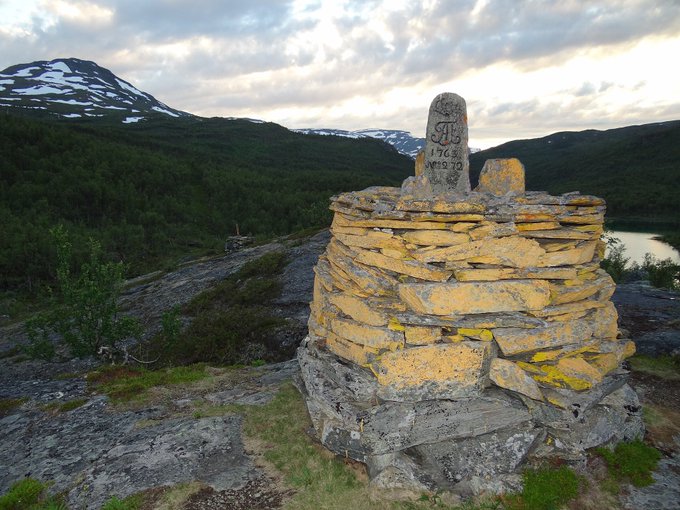
Laban and Jacob have their say on the folly of borders and their control

A cairn marking the boundary between Norway and Sweden in a remote area of the Arctic. Photo by Bjorn Christian Torrissen

The UK Government has announced plans to take “full control” of borders unveiling an Australian-style points system to overhaul immigration law and close our borders to unskilled workers and those who can’t speak English. When we talk about taking “full control of our borders” aren’t we just allowing fear and anxiety to take control of our borders? Are we forgetting that border controls escalate and will be reciprocated? Have we given any thought to who in the end will wipe our bums? Are we not just trading hostility?

This is all part of the deceit of government.

I have been intrigued by the stories about Jacob and Laban from Genesis 29-31. Jacob is the “leg-puller”, the “supplanter”, the “deceiver”. Jacob was born pulling the leg of his older twin brother Esau, trying to stop him being the first-born. Laban is the “white man“. Laban means white.

The story of Laban and Jacob is a saga of deception – the white man deceiving the deceiver, though was Jacob the outsmarter of the two?

The two of them come to terms with each other by building a “witness heap” of stones laid by their families as a commitment to peace. It marked the first bilingual place name recorded in the Bible – Laban called it Jegar Sahadutha and Jacob called it Galeed – the translations of “witness heap” in their respective languages.

Galeed, (we would perhaps call it a cairn) stood as a landmarked prayer. It provided a boundary to their hostility, an end to it. Significantly both Jacob and Laban refuse to take control of their new border. Instead they pray: “The Lord watch between you and me”. The Lord is the one they want to control their border and to watch their limits so that they never cross for harm but only cross for peace.

I wonder when we pray, when we put or hands together, whether we are building a cairn – a knuckle-boned physical structure to mark the limits of our hostility and anxiety, to say “beyond this only peace, beyond this only love”.

Are our churches also cairn-like landscaped prayers – places to confess our hostility, to find better ways to deal with our differences and markers within our communities beyond which we commit to “go in peace”? “This heap is a witness, and this pillar is a witness, that I will not go past this heap to your side to harm you and that you will not go past this heap and pillar to my side to harm me.” (Genesis 31:51f)

Borders are worse for our control when our export is fear. The boundaries of our Brexit mindset become brickset – walls built against others deconstructing differences, obstructing relationships, restricting trade and exchange.

Where are we building our witness heaps and our places of commitment? How are we replacing walls with cairns? How do we lament our nationalism?

Genesis 31:44-54
Come now, let us make a covenant, you and I; and let it be a witness between you and me.’ 45So Jacob took a stone, and set it up as a pillar. 46And Jacob said to his kinsfolk, ‘Gather stones,’ and they took stones, and made a heap; and they ate there by the heap. 47Laban called it Jegar-sahadutha:* but Jacob called it Galeed.* 48Laban said, ‘This heap is a witness between you and me today.’ Therefore he called it Galeed, 49and the pillar* Mizpah,* for he said, ‘The Lord watch between you and me, when we are absent one from the other. 50If you ill-treat my daughters, or if you take wives in addition to my daughters, though no one else is with us, remember that God is witness between you and me.’
51 Then Laban said to Jacob, ‘See this heap and see the pillar, which I have set between you and me. 52This heap is a witness, and the pillar is a witness, that I will not pass beyond this heap to you, and you will not pass beyond this heap and this pillar to me, for harm. 53May the God of Abraham and the God of Nahor’—the God of their father—‘judge between us.’ So Jacob swore by the Fear* of his father Isaac, 54and Jacob offered a sacrifice on the height and called his kinsfolk to eat bread; and they ate bread and tarried all night in the hill country.

The Fourth of July

There are already “safe spaces for respectful conversations across partisan divides” which have been developed with great care through community development. They are shockingly liberal and discomforting, but need treasuring and multiplying. The above sign is from St James’ Church, Piccadilly in which rough sleepers mix (and sleep) with other worshippers (gathering from across many partisan divides) under one roof.

Parker J Palmer, in the Huffington Post draws attention to a project organised by the Wisconsin Council of Churches (with backing from Baha’i, Buddhist, Christian, Muslim and Jewish communities) initiated by a call from thirty-six religious leaders from across the state have called for “a Season of Civility“. Amidst “partisan rancour” they realise that they “must create ‘safe spaces’ for respectful conversations across the partisan divides. And we must move beyond the walls of our congregations to include everyone in our local communities in this dialogue.” They are using Parker Palmer’s Healing the Heart of Democracy to help guide their thinking, focusing on five “habits of the heart”:

  • understanding that we are all in this together (where have we heard that before?)
  • an appreciation of the value of “otherness”
  • an ability to hold tension in life-giving ways
  • a sense of personal voice and agency
  • a capacity to create community

Palmer’s Huffington Post article is written with American civility (or, lack of) in mind, but the issues he faces are universal. They transgress partisan divides. “The powers” have ways of discouraging us from rattling cages and discouraging conflict. In workshops (safe spaces?) I have seen that conflict has negative connotations for most people. But Palmer reminds us that conflict has a real place in the development of civility, community and society. “America was founded on the historically novel and radical premise that conflict and tension, rightly held, are the engine, not the enemy, of a better social order.” “The civility we need will come not from watching our tongues, but from valuing our diferences and the creativity that can come when we hold them well.”

lop-sided truth


Channel 4’s drama series, The Promise, proved to be a powerful expose of the human cost of the protracted conflict on Palestinian soil. I was glad of the insight into this tragic (and for me, little understood) history spanning the last hundred years. (How is it so easy to remain ignorant of such significant events?). The story is based on a diary written by Len and held by Erin, his grandaughter. Len is a former British soldier who served both at the liberation of Bergen-Belsen and in Palestine, in the tense months before Israel declared itself a state in 1948 when the occupying British army was subject to a sustained and bloody terrorist campaign by Zionist groups. Besides portraying the cruel hard-heartedness of Jewish people trying to make room for themselves and the violent disruption to the loves and homes of the Palestinian people, the series brilliantly portrayed the plight of the professional soldier and his role at the complicated heart of conflict.

israel_wall
The size of the problem! Photo by Jim Forrest

In my enthusiasm for The Promise, I searched for reviews in the blogosphere – just to validate my enthusiasm. I found a review in the New Statesman, complete with outrageous and outraged comments. Comments include “inaccurate”, “anti-semitic” and “one-sided”. It made me wonder how The Promise (or any account) can be other than one-sided. Anyone who builds a bloody great wall – designed to prevent their neighbour seeing over – is destined to be victim of one-sided accounts of history. In conflict there is no middle ground. There is one side, or the other. There is no dis-passionate observer sitting on the fence with a view of both sides. There can be no balance.

There can, however, be peace process. Prophet (and Jew) Amos, centuries ago (a farmer from Tekoa – another Jewish settlement south of Bethlehem), proposed the “swords into ploughshares” policy – an early disarmament programme. “Swords” represent all the paraphernalia of war – its weaponry, its defences and its propaganda – upsetting the balance of truth and jeopardising peace for generations to come. Conflict creates its own insecurity and reverses common sense  – requisitioning the economic tools for prosperity, to melt them down for the savagery of war. We can, even with our one-sided truth, work for this disarmament. Even me, writing this, has declared my one-sided hand in conflict against those who were outraged by the pro-Palestinian stance of The Promise. But I didn’t see the series as an incendiary device lobbed over a great wall of conflict – but as an exercise to expose what is happening. Truth and plight can only be exposed one-sidedly. It is up to us to make it “sword” or “ploughshare”.

Borderlands

>

For the first time in a long time I have been having to stand my ground. This is because of an inter-personal, intra-departmental boundary dispute. In other words, we are not sure what we are each doing. This is not a major international incident, though there are significant tensions at the border. We don’t know where the boundaries are supposed to be, and because of that we haven’t worked out how we live together at the boundary.
The damage of borderlands is beautifully brought out in a poem I have just read by Gloria Anzaldua – who describes herself as a “chicana dyke-feminist, tejana patlache poet, writer, and cultural theorist” and “as a border woman [who] grew up between two cultures, the Mexican (with a heavy Indian influence) and the Anglo (as a member of a colonised people in our own territory). I have been straddling that tejas-mexican border, and others, all my life It’s not a comfortable place to live in, this place of contradictions. hatred, anger and exploitation are the prominent features of this landscape”. (The photo is by Brian Auer)
Here’s the poem – as I read it in Edward Soja’s book, Thirdspace:
                         I press my hand to the steel curtain – 
               chainlink fence crowned with rolled barbed wire –
        rippling from the sea where Tijuana touches San Diego
unrolling over mountains
     and plains
              and deserts,
this “Tortilla Curtain” turning into el rio Grande
      flowing down to the flatlands
           of the Magic Valley of South Texas
      its mouth emptying into the Gulf.
1,950 mile-long open wound
                     dividing a pueblo, a culture,
                     running down the length of my body,
                         staking fence rods in my flesh,
                         splits me   splits me
                         me raja   me raja
                                                                               This is my home
                                                                               this thin edge of
                                 barbwire.
                       But the skin of the earth is seamless.
                       The sea cannot be fenced,
             el mar does not stop at borders.
       To show the white man what she thought of his 
                           arrogance,
                   Yemaya blew that wire fence down.
                     The land was Mexican once,
                          was Indian always
                              and is.
                         And   will be again.