Hope Before Dawn: An Advent Imagination

Live for that day when God’s peace is all in all.
Love for that day when God’s light leaves no shadows.

These are the darkest days of our lives.
December draws a long shadow,
and we find ourselves longing for light.

These days seem to go on without end.

These are the days Isaiah fought through and hoped through
3000 years ago:
the same old, the same old.
the dark ages all over again.
This is the mean time.

This is the time to cherish those who’ve kindled hope,
those we’ve bound in scripture
who hoped in God when the world felt just as heavy as ours.
This is the time to pray.
This is the time to keep watch.
This is the time to live for another day,
to love towards another day
when the times will finally be a-changing.

These are very mean days
when nations make war on nations,
There may be no world war,
But there are too many wars
for us to call this peace.
The world is at war,
and we are all caught up
in a global propaganda war.

These are very mean days when dark forces
create a hostile environment for those seeking asylum and sanctuary,
days which leave so many children hungry
and too many families poor, 

when budget after budget
miss the opportunity to make things better.

These days, however bright the weather may be,
are dark days to too many people.

And so –
these are the very days to keep hope alive,
to pray for the day when God’s kingdom comes on earth, as it is in heaven,
to live for the day when God’s word settles disputes;
to love for the day when nation will not take up sword against nation,
and nor will we need to train for war any more.

Imagine that.
Imagine the difference
when the weapons of war,
the resources of war,
become tools for farming and feeding and healing.

Imagine the difference
if the resources of war were turned to farming.
Not just in the fields of our own villages,
but in Gaza’s broken orchards,
in Ukraine’s shelled wheatlands,
in every place where the soil has been scorched,
and the hands that sow can no longer harvest.

Isaiah’s dream has dirt under its nails.
It is a farmer’s dream,
a peacemaker’s dream –
swords hammered into ploughshares,
spears repurposed as pruning hooks,
the earth tended again.

And here’s another theme none of us can avoid,
if we care about justice and peace:
we need to be prepared in these days of darkness.
Advent comes with a wake up call.
The time has come for us to wake up, says Paul, (Romans 13)
and be ready for the Day of the Lord –
the day we live for,
the day we pray for,
the day we love for.

For Advent I’ve downloaded an app which notifies me of Fajr –
the prayer Muslims offer from dawn to sunrise.
So, this morning, at 6.05,
my phone buzzed to tell me it was time to pray,
and I was reminded of all those
who rise while the world is still dark
to end the night and hope for the day.

First they wash,
then raise their hands to acknowledge the greatness of God.
They then recite the Surah:

In the name of Allah – the Most Compassionate, Most Merciful.
All praise is for Allah – Lord of all worlds.
the Most Compassionate, Most Merciful,
Master of the Day of Judgment.
You ‘alone’ we worship and You ‘alone’ we ask for help.
Guide us along the Straight Path
the Path of those you have blessed
– not those You are displeased with, or those who are astray.


Then they bow
They stand and say, “God hears the one who praises him.”
They prostrate themselves, grounding their forehead, palms, knees and toes on the earth –
and from the ground they praise God.
They finish by turning their head
to the right and to the left
with a prayer of peace in both directions.
Then they are ready for the day
(and, dare I say, they’ve given themselves a good work out!).

There is something holy about any people
who pray before the sun comes up.
They remind us what Advent is for:
ending the night,
and hoping for the day.

And we are among those holy people
imagining that day which will end all days of wrongdoing,
when God’s word is truly heard.

That is why our time of prayer
is taken up with praying for the coming of God’s kingdom,
on earth, as it is in heaven.
Christians will always use their prayer time for that –
It’s what Jesus taught us.

It is a prayer of imagination.
It is a prayer for dawn in the dark.
It is a prayer for the day when ….
the day God’s peace is all in all,
the day God’s light leaves no shadows.

And so we live for that day —
when, as Revelation imagines,
there will be no more mourning, crying or pain,
the day that will see an end to night.

Until that day
we keep watch,
keep warm,
and keep hope alive
these dark days.

Seeing the wounds Jesus shows us

A sermon for the 2nd Sunday of Easter – Year C for two small churches. The gospel for the day is John 20:19-end.

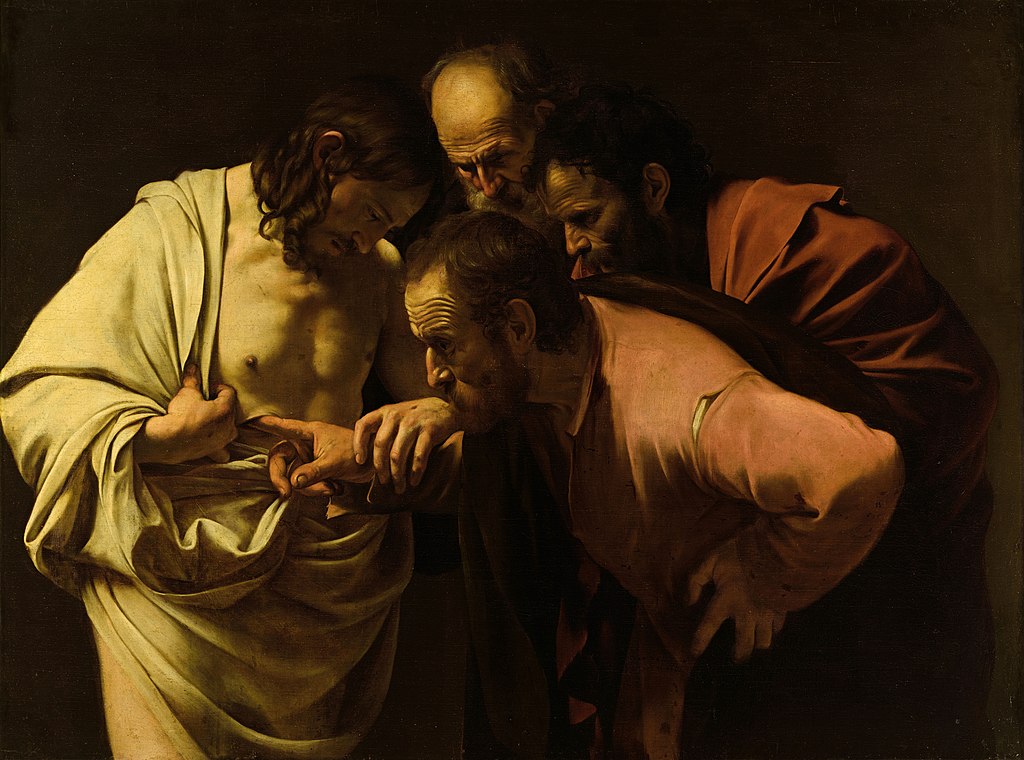
The Incredulity of St Thomas by Caravaggio – or should it be called Jesus showing Thomas his wounds?

I love preaching that brings Scripture to life—and that brings Scripture back to life.

That’s a line I’m going to repeat each week to remind us that every time we open Scripture together we are bringing it back to life.

This morning we return to John’s Gospel, still caught up in the wonder of that first Easter day (John 20:19-end). It’s a story only he tells.

John himself brings scripture back to life.
Particularly we see the influence of the creation story from the 1st chapter of our scriptures.
We can see that in the way that he tells us the time.
On the evening of that first day of the week.
It’s like last week’s gospel reading which began: Early on the first day of the week, while it was still dark. (John 20:1)
We are still on that first day which was like the first day of creation, when, according to Genesis 1:2, earth was a formless void and darkness covered the face of the deep.
That’s the time in today’s gospel. It was the first day of the week, and it was evening.
In other words, darkness was forming.
Taking our cue from Genesis, John’s readers can expect God’s wonders on this new day of creation.

Thomas wasn’t with the disciples when Jesus came on that first day, the day of resurrection.
It was the other disciples who had to let him know that they had seen the Lord.
Thomas told them that he would never believe “unless I see the nail marks in his hands and put my finger where the nails were, and put my hand into his side”.
It is this I suggest we focus on in our worship today.

Thomas is the patron saint of those who are blind because seeing wasn’t enough for him.
He needed to examine Jesus’s wounds by touching them and feeling them.
And the wonderful thing on that second Sunday, the first day of the week following, was that Jesus came and stood among them again and showed Thomas his wounds.
He welcomed his touch. He guided his hand. He let him explore his body.
Thomas is the patron saint of those who struggle to believe what they can’t see—or even what they can.
He shows us that resurrection faith isn’t just about seeing.
Sometimes it’s about touching, questioning and wrestling with God.

Jesus showed Thomas his scars. He wants his disciples to see them.


In the Last Supper, he took a loaf of bread and he broke it.
He wanted them to see his body in the brokenness of the bread.
“Take, this is my body,” he said. (Mark 14:22).
Then he gave them a cup for all of them to drink from.
In that cup he wanted them to see his blood.
“This is my blood of the covenant poured out for many.”
Even before he was wounded he wanted to show his disciples the wounds he was going to suffer.
And in today’s gospel, in one of his resurrection appearances, he invites Thomas to have a look at those wounds – to examine, inspect and see with his hands as well as his eye.

Thomas recognises Jesus through his wounds, just as Jesus wanted him to.
And this is how we come to know Jesus.
Just as Thomas encountered the risen Christ in his wounds, so too we encounter him today in the bread and wine of the Eucharist.
Every Communion we have with Jesus we have this invitation to examine the wounds of Jesus. Every time the bread is broken we are invited to see the brokenness of the body of Christ and to feel that brokenness in our mouths.
Every time we take this cup we are invited to taste the blood of Christ shed for us.

What is it that Jesus showed Thomas?
What did he want his disciples to see?
What does he want us to see when he shows us his wounds, when he invites us to see his body and his blood?

The first things we see are the wounds to his hands and feet where the nails were driven into his body by the hammer blows of empire.
Then, if he turns we see the wounds of the whipping scored into his back for being the scourge of empire and religion.
Then we see the scars on his head where they pressed the crown of thorns and added insult to injury, to press home the point that this “pretender” was nothing.

The rule of the kingdom of God is that the last, the lost and the least come first and those who are first in the kingdoms of this world come last.
The rule of the kingdom of God turns the rules of the world upside down.

In the wounds of Jesus, his disciples see a man who embodies that rule of the kingdom of God. In the brokenness of his body, in the bloodshed, we see a man the religious and political capital tried to reduce to nothing.
The plots against him and his crucifixion were intended to humiliate him and his followers – to make them least, last and lost – GONE for ever.

The problem for them was that the rule of the kingdom of God puts the least, last and lost – those lost and broken by the ways of the world – first.
When Jesus stood among his disciples, first without Thomas, then with him, he was the living proof of the fundamental rule of the kingdom of God.
Here was the humiliated, crucified and killed one.
You can’t get more “least, last and lost” than that.
Here he was, “the first fruits of those who have died”, Christ raised from the dead (1 Corinthians 15:20).

This is what Jesus showed Thomas –
the scars are the living proof of the rule of the kingdom of God.
Jesus stood among them as living proof of the rule he’d always followed,
that puts the last first and the first last.
Here is the one they put last made first.
This is what Thomas saw. This is what he said:
“My Lord, my God” – the rule of the kingdom of God realised in those few words.
“My Lord and my God” – Jesus comes first for Thomas.

So Jesus stands among us still, not with condemnation, but with scars.
What do we see? What difference does it make? Does Jesus come first?

Jesus doesn’t shame Thomas for his questions. He meets him in them.
He doesn’t rush belief. He invites it — gently, patiently, personally.

And he does the same with us.
To all who doubt, who ache, who long to see and touch and know — he says,
“Here I am. Peace be with you.”

He doesn’t hide his wounds. He offers them.
He lets us trace the pain and the mystery of a love that suffers with us and for us.
And in that wounded, risen body, we find our hope.

This morning, he says again:
“This is my body. This is my blood.”
This is how I choose to be known.
Look closely. Taste carefully.
And, if you are among the broken,
do not be afraid.

Darkness needs light: a reflection on the coming of holy night

I assume that everyone’s feeling tired by midnight on Christmas Eve. Midnight is not the time to be preaching long and hard. Here’s my offering for a group of churches in rural Warwickshire.

Wherever we look in the story of Jesus’ birth there is darkness. 

Matthew’s gospel begins with Mary’s disgrace and how Joseph saved her from being cast out by marrying her. Then we’re told that the Magi’s search triggers the slaughter of the innocents by Herod – he killed all the children in Bethlehem and around who were under two years old! Then Mary and Joseph become refugees to escape Herod’s slaughter.

Luke’s gospel begins with the darkness of Joseph and Mary being forced to make the long journey from Nazareth to Bethlehem by order of the Roman emperor -just to be counted – just to become numbers in the machine of a foreign empire. 

John’s gospel begins with the life which was to be the light of all people, the light that shines in darkness.

Darkness is never far from us. It’s within us – all those dark thoughts, and it’s all around us. On this night of darkness we celebrate how the light comes to us, how the light comes to us as love (all vulnerable), how the night becomes holy – thanks be to God.

I wrote this for tonight.

One light,
so much darkness. If truth be told
what Christmas needs
is the longest of nights, 
the shortest of days,
and the time when people
are at their coldest
and meanest.

For truth to be told
darkness needs light
for the night to find its way to day,
for those who walk
through the dark night of the soul
lost in a cloud of unknowing
frightened in the valley
of the shadows of death.

If truth be told
darkness lies
in the distance between us,
what  we do to one another in war,
rape, rubble, ruin in Gaza and Kyiv.
It rides the nightmares
of suffering, anxiety, despair.
It’s the cost of living.

The data of darkness
is hidden in official secrets
and personal shame,
in the blindness of prejudices
in the lies of truth twisters
in the scheming of profiteers
in the denial of freedoms
in the erections of borders

that divide darkness
from darkness, hiding the terror
from which so many flee.
It’s in their denial. Yes,
there is no room.
It’s in their small boats
not built for the darkness
of the deep and stormy sea.

If truth be told, it’s told in numbers:
in the homeless numbers,
the foodbank users,
the choosers choosing 
heating or eating,
the children killed in war.
It‘s in the numbers of those
who are just numbers.

It’s the middle of the night,
when even the clocks
put their hands together
in time to pray.
They pray for first light
to end the night, a baby flame
in the frame of shame,
and then they pray us awake

and in the darkness, see,
shimmering and flickering
in the world which,
if truth be told,
has no room for Light,
where the only place
to rest his head lay
in the love of a mother

and the kindness of a stranger 
in the inn the light came in,
casting shadows with halos,
our light never dying.
With the angel band backing,
all hallelujah singing,
watching shepherds 
dance the night away.

Joy to the world. Happy Christmas.

© David Herbert 2023

Christmas and the cost of living

This poem was inspired by a small and mighty Christmas cards designed by a friend.

Christmas and the cost of living

Why do we make
Christmas so big
when joy’s so short,
innocence lost,
when baby’s squeezed
in a one star place?

Why do we make
Christmas so big
when the word,
from the beginning
was just a whisper
kissed of God?

Why do we make
Christmas so big
when we hang the tree,
lynch the light and
tinsel tight tie
the hostage angel?

Do we there nail
our hope that in
Advent edgeway
such baby-talk
may faithful grow
mercy, love, peace?

©David Herbert

The First Photograph – a poem for these sort of times

The First Photograph

When Aylan Kurdi’s photo splashed across the waves,
it was a scoop, a spotlight on refugees, a beacon of hope
for better treatment, more welcome ways. It became
Sea Prayer for parents casting their children to sea in light vessels.
But nothing changed. It was a false dawn. Children keep drowning.
Here in Bethlehem, lives are poor, government weak.

A concrete cordon of wall dominates, not for our security mind,
but as shutter and blind to lives despised. We are occupied
by those whose minds pre-occupied by counting our threat,
known by numbers, never names. Our lives are poor,
our movement restricted, often imprisoned for raising flag,
hand or stone, getting by with our whittled olive tourist trade.

When reporters came from way out east, that was our moment,
that Aylan Kurdi flash. Three came. They’d heard our plight.
and noted our views, their reports were carried in paper news.
Their attraction, they said, was a star, a pin prick in a night sky,
inspiration for their camera and that first photograph, a baby
captured, strangely focused, fast exposed as a flash of light.

That was the image of us. It sold and sold. going world-wide,
framed, kissed and even enshrined, the light of the world,
while we still in darkness lie. There was a child, a shot in the dark.
Because of that aperture in this little Goliath walled town
where streets stay dark and soldiers still count their enemy,
we picture endurance in that light relief, that blink of an eye,
that pin prick in the night.

©David Herbert

Links to Khaled Hosseini’s Sea Prayer and the photo of Aylan Kurdi’s body

First Steps

The path of the righteous is like the light of dawn
which shines brighter and brighter until full day.
Proverbs 4:18

Who knows where first steps lead?
We feel our way through death’s vale,
beyond the pale to dark corners,
blind alleys, a way hardly taken,
through dark nights of the soul.
This is the path of the righteous,
the path of Missio Dei,
the path of light to dawn.

You want it darker? I’m ready, my lord

Leonard Cohen, tenant of the Tower of Song, born with the gift of a golden voice wanted it even darker on his last album. Darkness is keenly felt by many, particularly at this time of year when the darkness reinforces experiences of isolation and grief. The fairy lights that bedeck so many houses is an act of defiance against the darkness. Nowadays these artificial lights double up as Halloween and Christmas lights, intended to brighten our winter days and to jolly up the darkness.

But there is a sense in which we need it to be darker. Advent is a season to be rescued from the light-hearted. It is a time of year to get serious about the darkness that is part of our lives in our relationships, in our despair, in our anxiety, in our jealousy. It is a time to get real about the suffering so many endure, the millions forced from their homes, the many who suffer the consequences of economic austerity.

Those for whom this is too serious, those who are afraid of the dark, do us no favours when they say “lighten up”. Their merriment is like the fairy lights which don’t diminish the darkness but only pollute the night sky. We need it darker to realise that we are not all sweetness and light wherever, whatever and whoever we are.

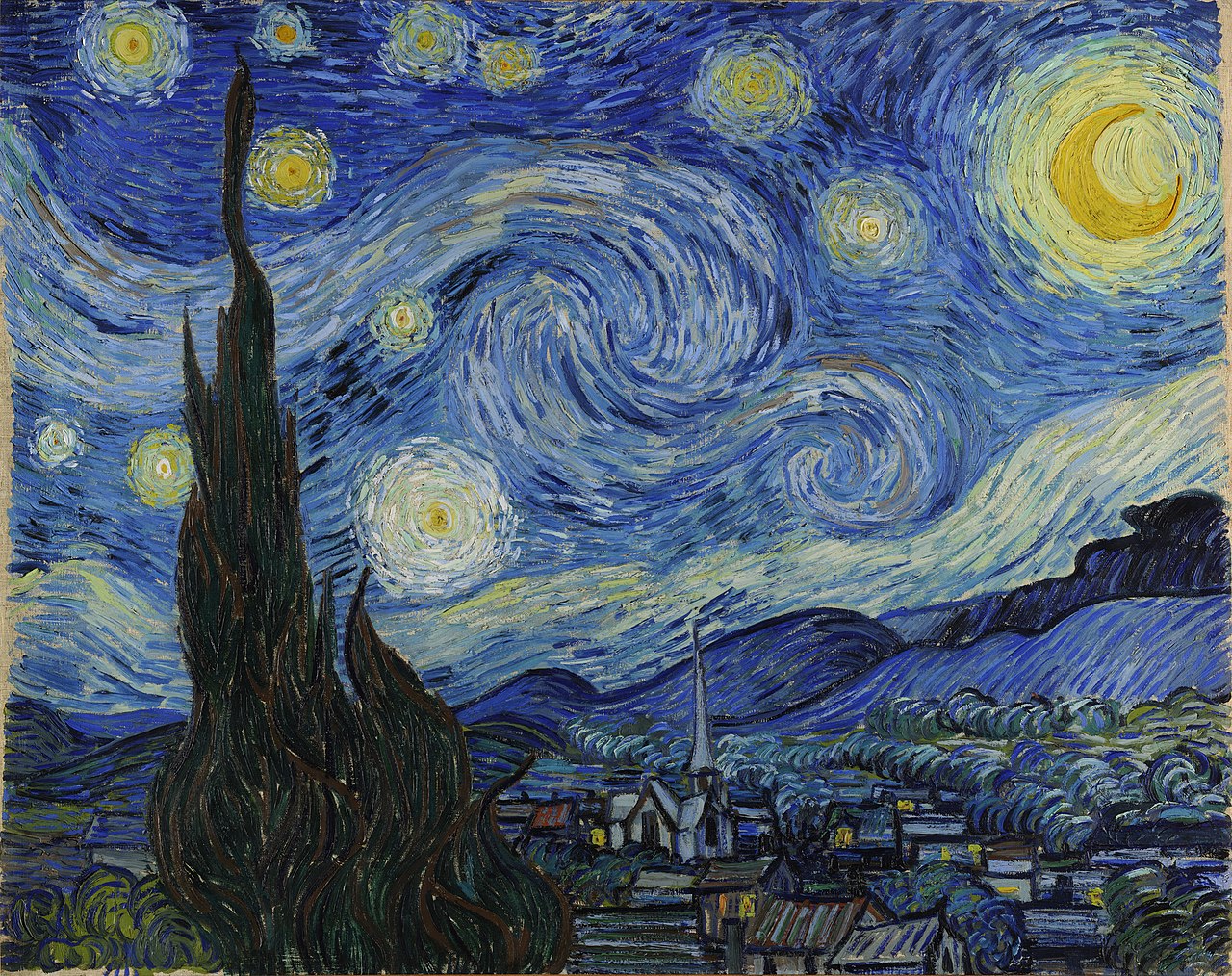
Vincent van Gogh lived through some dark times. He wrote to his brother Theo: “I am so angry with myself because I cannot do what I should like to do, and at such a moment one feels as if one were lying bound hand and foot at the bottom of a deep dark well, utterly helpless”. Like Leonard, Vincent did dark. And yet, in another letter to Theo, he wrote:

“It is true that I am often in the greatest misery, but still there is within me a calm, pure harmony and music. In the poorest huts, in the dirtiest corner, I see drawings and pictures. And with irresistible force my mind is drawn towards these things. Believe me that sometimes I laugh heartily because people suspect me of all kinds of malignity and absurdity, of which not a hair of my head is guilty — I, who am really no one but a friend of nature, of study, of work, and especially of people.”

In his darkness he saw the most beautiful stars, some of which he painted and gifted to us. (Do see Loving Vincent if you get the chance.)

1280px-Van_Gogh_-_Starry_Night_-_Google_Art_Project

In ancient times the stars were guides to the wise and inspiration to the faithful. These days it’s Cowell-made stars that draw us. Stellar constellations are lost on most of us, mainly because we can no longer see them. The light in which we trust is artificial. We need it darker for a time.

PS You may be interested in Jenny Bridgman’s Advent blog exploring Dark Spaces

Reflecting All The Light We Cannot See

Light
Light
The visible reminder of Invisible Light.
T. S. Eliot

all_the_light_we_cannot_see_doerr_novel

What was intended to be a summer read turned out to be an early winter read – very appropriately because this is a book about light and darkness, perfect for Advent and the darkest time of the year. In All the Light We Cannot See we see the world through the hands of a blind woman, Marie-Laure. As a child she is given a model of her world which helps her to feel her way in spite of all the light she cannot see. In telling her story, Anthony Doerr, is putting a model into our hands to remind us how complex life is and to help us discover the light that can be hidden in the smallest detail.

Anthony Doerr has spun for us a hopeful story that is full of humanity. Besides the blind girl, there is an orphaned German boy who becomes a radio technician. The setting is the Second World War which so divided and devastated Europe. Their lives don’t cross till later but Doerr skillfully weaves their stories together in brief alternating chapters.

With the rise of populist politics as expressed in the Brexit referendum and elsewhere, it seems that we are again in a dark age (and the book is a startling reminder of the institutions that have grown up in post-war Europe which so far have preserved peace – it would be stupid and careless if this were to be unpicked). There is a lot of darkness as we don’t know where we are heading. There is a lot of light that we cannot see as we turn ourselves inwards.

There is so much light we cannot see – from the past and into the future. But in the hands of a blind girl the author has placed a model which can help us through to the light we cannot see. The model maker is her father – significantly a locksmith. I say significantly because of these lines by poet Malcolm Guite in response to one of the Advent antiphons:

Even in the darkness where I sit
And huddle in the midst of misery
I can remember freedom, but forget
That every lock must answer to a key,
That each dark clasp, sharp and intricate,
Must find a counter-clasp to meet its guard,
Particular, exact and intimate,
The clutch and catch that meshes with its ward.
I cry out for the key I threw away
That turned and over turned with certain touch
And with the lovely lifting of a latch
Opened my darkness to the light of day.
O come again, come quickly, set me free
Cut to the quick to fit, the master key.

Julia McGuinness has also written about this book. She captures the ideas of light within limited spaces which is so much part of this story set in the extremes of human existence.

Part of my work is to support newly ordained clergy. One of the cheesy things I do is write to those who have been recently ordained, just before Christmas. I say something like:

Happy first Christmas to you as a “priest”. I hope you enjoy your first Christmas celebrations. It is a wonderful moment – embracing strangers/visitors. One of the ideas that came to me (when I was struggling to find yet another homily in a busy Christmas season) was a play with the word “manger”. Pronounced the French way it’s about eating. Pronounced the Christmas way it’s where Jesus is born. Do we prepare a manger with the hands we offer for the bread? Is this when Jesus is born? As we place the bread in the hands of others, are we laying Jesus in their manger?

When we take the bread into our hands, into the manger we prepare, we take all the light we cannot see. This is the body of Christ, the light of the world. This is the faith we have as Christians, a faith that in the darkest times there is all the light we cannot see. The light that shines in the darkness, makes a difference as to how we recognise one another, how we see one another, how we see our past, how we see our future – as not so dark as maybe we once thought. This too, like Marie-Laure’s model, is something so small that is placed into our hands, to help us discover the light that can be hidden in the smallest detail, in places we would never look into because of their depth of darkness.

Besides preparing a manger with our hands, we often put our hands together to pray (like a candle flame), and we often close our eyes (as if a reminder of the darkness). There are all sorts of reasons for these customs – but in our heart of hearts we know that there is all the light that shines in darkness. By praying we witness to the true light that gives light to everyone.

At the end of his magnificent novel, Doerr imagines:

People walk the paths of the gardens below, and the wind sings anthems in the hedges, and the big old cedars at the entrance to the maze creak. Marie-Laure imagines the electro-magnetic waves travelling into and out of Michael’s (game) machine, bending around them, just as Etienne used to describe, except now a thousand times more criss cross the air than when he lived – maybe a million times more. Torrents of text conversations, tides of cell conversations, of television programmes, of emails, vast networks of fibre and wire interlaced above and beneath the city, passing through buildings, arcing between Metro tunnels, between antennas atop buildings, from transmitters with cellular transmitters in them, commercials … flashing into space and back to earth again, I’m gong to be late and maybe we should get reservations? and ten thousand I miss yours, fifty thousand I love yours, hate mail and appointment reminders and market updates, jewelry ads, coffee ads, furniture ads flying invisibly over the warrens of Paris, over the battlefields and tombs’ over the Ardennes, over the Rhine, over Belgium and Denmark, over the charred and ever-shifting landscapes we call nations.

And is it so hard to believe that souls might also travel those paths? That her father and Etienne and Madame Manec and the German boy named Werner Pfennig might harry the sky in flocks, like egrets, like terns, like starlings? That great shuttles of souls might fly about faded but audible if you listen closely enough? They flow above the chimneys, ride the sidewalks, slip through your jacket and shirt and breastbone and lungs and pass out through the other side, the air a library and the encore of every life lived, every sentence spoken, every word transmitted still reverberating within it.

I am imagining it. I am imagining the map Doerr has drawn of some of the light we cannot see. 

I can’t wait to read this again.

A resolution: notes for a sermon for the 2nd Sunday of Christmas

Notes for a sermon for January 5th 2014 at St Alban’s, OffertonJohn 1:1-18

Note: this is the first time some of the congregation will have seen each other this new year.
Ask about resolutions made? (And broken) Find some out.
And ask for people to pray for each other that they might keep their resolve.

Mine is to “notice more” and to “welcome each day”.

It’s never too late to make a resolution.
We don’t reserve resolutions for New Year’s Eve do we?
Making resolutions is an everyday activity. Each year has its critical moments during which we make resolutions. (And we should be helping each other to keep those resolutions for as long as they need to be kept).

I have been wondering what a congregational resolution might look like.

Many of our resolutions are money oriented aren’t they, like “making ends meet”. I am sure that many of you make such resolutions, and I am sure that many of your PCC resolutions are along those lines. You might also have resolutions in place regarding your GAP goals. And you need to help each other to keep those resolutions.

I am wondering whether we would like to make a fresh resolution in the light of this morning’s gospel. The resolution is “let’s see”. Can I explain?

John’s gospel begins in a way that none of the others do.

John doesn’t introduce the themes of his gospel with reference to the nativity of Jesus. Instead, John sets the scene (no pun) by referring to darkness and light.
His point is that the world and our times are overwhelmed in darkness and that Jesus is the light that shines in that darkness.
The light helps us to see even when we are living through dark times.
That’s how John sets the scene for his gospel.
The darkness is so dark that some can’t even see the darkness.
God causes his light to shine in that darkness. That’s the good news.

Having introduced that theme John then goes on to provide examples of specific instances when the light did shine in the darkness, when people saw and realised, when the penny dropped.

That’s why I suggest that a good resolution for you as a congregation is “LET’S SEE” – and I hope that you will pray for one another that you may keep that resolution and that you may help one another to see.

John’s gospel is littered with invitations to come and see.

He said to two of John the Baptist’s disciples, “Come and see”.
You can almost hear them talking to one another, “shall we?”, “shalln’t we?” finally resolving “yes, let’s see.” (1:39)

Philip found Nathanael and urged him to “come and see”.
“Come and see what we have found”. He had found him about whom Moses and the prophets wrote, Jesus, son of Joseph from Nazareth”. (1:46)

And then there was the woman Jesus met at the well at Samaria. She went to the city and called out “come and see a man who told me everything I have ever done! He cannot be the Messiah, can he?” And they left the city with the resolution to go and see. (4:29)

The disciples that Jesus loves (the beloved disciples), according to John, are the ones who accept the invitation – the ones who come to see him as the light, the resurrection and the life.

Our gospel for this morning mentions “seeing”, or, “not seeing” – because of the darkness.

 The word became flesh and dwelt among us, and we have beheld/seen his glory. (1:14)

 No one has ever seen God. It is God the only Son, who is close to the Father’s heart, who has made him known. (1:18)

 No one had seen God. But Jesus has made him known. We can see God in and through Jesus because he is the very image of God – he is the spit of his father. In Jesus we have the opportunity to see God.

Do you fancy making a resolution this morning to go alongside those others you have made in your lives?
Do you want to see?
In dark times in your relationships, in dark times in your work, in dark times in your families, in dark times in your faith, in dark times as a congregation, in dark times in your health, do you want to see?
At times when you feel trapped, do you want to see a way forward?

We try to cover our darkness don’t we?
We make up a face that hides the cracks.
We give the impression that we know where we’re going.
We smile and present a brave face to the world.
We hide our dark thoughts.
We pretend we are all sunshine and light.

But this does not help us to SEE. We hide our darkness by using artificial light.

If we hide our darkness, if we pretend everything is hunky-dory we are not going to see the true light which God causes to shine among us, through Jesus, through his saints and through one another.
(If we think everything is hunky-dory, we see nothing. We are blind fools).
We have to be honest about our dark times and our dark thoughts.

A lady I know, Jan Richardson, has recently lost her husband.
He died after what should have been fairly routine surgery at the beginning of December.
She is an artist who keeps a blog called the Painted Prayerbook.
Most weeks she produces an image to accompany the Sunday readings and writes a blessing which she posts on her blog.

I’m going to read her latest blessing, written for Epiphany, written in the light (or, rather, the darkness) of her husband’s death, and written in the light of herself being blessed through those who shared their darkness “by entering into days of waiting and nights of long vigil.” It begins with the words that reflect that darkness. “This blessing hardly knows what to say …” It is called:

This Brightness That You Bear
A Blessing for My Family

This blessing
hardly knows what to say,
speechless as it is
not simply
from grief
but from the gratitude
that has come with it—

the thankfulness that sits
among the sorrow
and can barely begin
to tell you
what it means
not to be alone.

This blessing
knows the distances
you crossed
in person
in prayer
to enter into
days of waiting,
nights of long vigil.

It knows the paths
you traveled
to be here
in the dark.

Even in the shadows
this blessing
sees more than it can say
and has simply
come to show you
the light
that you have given

not to return it
to you
not to reflect it
back to you
but only to ask you
to open your eyes
and see
the grace of it,
the gift that shinesin this brightness
that you bear.

Let’s see.

Is that a resolution you want to make in the light of John’s gospel and in the light of Jesus?
Is that something you want to help others do?
Is that something you want to resolve to do as a church and congregation?
Is this a blessing you want to bear in your lives for those who share the darkness with us?

Shall we help one another to see? Is that a resolution worth keeping?