Seeing the wounds Jesus shows us

A sermon for the 2nd Sunday of Easter – Year C for two small churches. The gospel for the day is John 20:19-end.
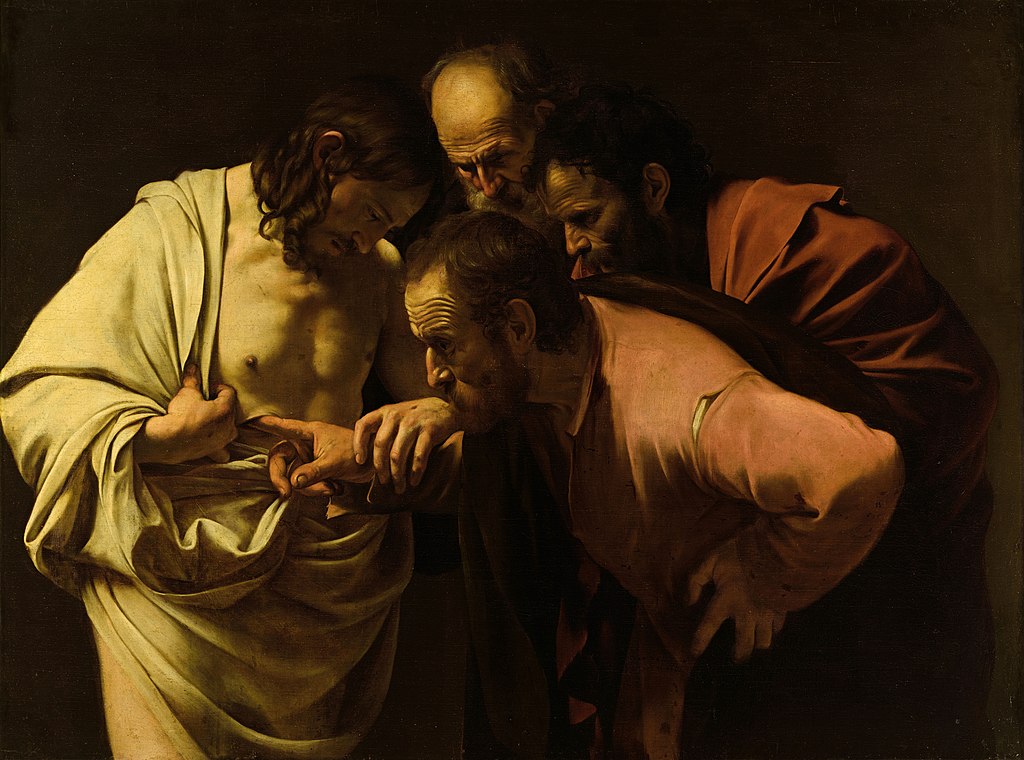
The Incredulity of St Thomas by Caravaggio – or should it be called Jesus showing Thomas his wounds?

I love preaching that brings Scripture to life—and that brings Scripture back to life.

That’s a line I’m going to repeat each week to remind us that every time we open Scripture together we are bringing it back to life.

This morning we return to John’s Gospel, still caught up in the wonder of that first Easter day (John 20:19-end). It’s a story only he tells.

John himself brings scripture back to life.
Particularly we see the influence of the creation story from the 1st chapter of our scriptures.
We can see that in the way that he tells us the time.
On the evening of that first day of the week.
It’s like last week’s gospel reading which began: Early on the first day of the week, while it was still dark. (John 20:1)
We are still on that first day which was like the first day of creation, when, according to Genesis 1:2, earth was a formless void and darkness covered the face of the deep.
That’s the time in today’s gospel. It was the first day of the week, and it was evening.
In other words, darkness was forming.
Taking our cue from Genesis, John’s readers can expect God’s wonders on this new day of creation.

Thomas wasn’t with the disciples when Jesus came on that first day, the day of resurrection.
It was the other disciples who had to let him know that they had seen the Lord.
Thomas told them that he would never believe “unless I see the nail marks in his hands and put my finger where the nails were, and put my hand into his side”.
It is this I suggest we focus on in our worship today.

Thomas is the patron saint of those who are blind because seeing wasn’t enough for him.
He needed to examine Jesus’s wounds by touching them and feeling them.
And the wonderful thing on that second Sunday, the first day of the week following, was that Jesus came and stood among them again and showed Thomas his wounds.
He welcomed his touch. He guided his hand. He let him explore his body.
Thomas is the patron saint of those who struggle to believe what they can’t see—or even what they can.
He shows us that resurrection faith isn’t just about seeing.
Sometimes it’s about touching, questioning and wrestling with God.

Jesus showed Thomas his scars. He wants his disciples to see them.


In the Last Supper, he took a loaf of bread and he broke it.
He wanted them to see his body in the brokenness of the bread.
“Take, this is my body,” he said. (Mark 14:22).
Then he gave them a cup for all of them to drink from.
In that cup he wanted them to see his blood.
“This is my blood of the covenant poured out for many.”
Even before he was wounded he wanted to show his disciples the wounds he was going to suffer.
And in today’s gospel, in one of his resurrection appearances, he invites Thomas to have a look at those wounds – to examine, inspect and see with his hands as well as his eye.

Thomas recognises Jesus through his wounds, just as Jesus wanted him to.
And this is how we come to know Jesus.
Just as Thomas encountered the risen Christ in his wounds, so too we encounter him today in the bread and wine of the Eucharist.
Every Communion we have with Jesus we have this invitation to examine the wounds of Jesus. Every time the bread is broken we are invited to see the brokenness of the body of Christ and to feel that brokenness in our mouths.
Every time we take this cup we are invited to taste the blood of Christ shed for us.

What is it that Jesus showed Thomas?
What did he want his disciples to see?
What does he want us to see when he shows us his wounds, when he invites us to see his body and his blood?

The first things we see are the wounds to his hands and feet where the nails were driven into his body by the hammer blows of empire.
Then, if he turns we see the wounds of the whipping scored into his back for being the scourge of empire and religion.
Then we see the scars on his head where they pressed the crown of thorns and added insult to injury, to press home the point that this “pretender” was nothing.

The rule of the kingdom of God is that the last, the lost and the least come first and those who are first in the kingdoms of this world come last.
The rule of the kingdom of God turns the rules of the world upside down.

In the wounds of Jesus, his disciples see a man who embodies that rule of the kingdom of God. In the brokenness of his body, in the bloodshed, we see a man the religious and political capital tried to reduce to nothing.
The plots against him and his crucifixion were intended to humiliate him and his followers – to make them least, last and lost – GONE for ever.

The problem for them was that the rule of the kingdom of God puts the least, last and lost – those lost and broken by the ways of the world – first.
When Jesus stood among his disciples, first without Thomas, then with him, he was the living proof of the fundamental rule of the kingdom of God.
Here was the humiliated, crucified and killed one.
You can’t get more “least, last and lost” than that.
Here he was, “the first fruits of those who have died”, Christ raised from the dead (1 Corinthians 15:20).

This is what Jesus showed Thomas –
the scars are the living proof of the rule of the kingdom of God.
Jesus stood among them as living proof of the rule he’d always followed,
that puts the last first and the first last.
Here is the one they put last made first.
This is what Thomas saw. This is what he said:
“My Lord, my God” – the rule of the kingdom of God realised in those few words.
“My Lord and my God” – Jesus comes first for Thomas.

So Jesus stands among us still, not with condemnation, but with scars.
What do we see? What difference does it make? Does Jesus come first?

Jesus doesn’t shame Thomas for his questions. He meets him in them.
He doesn’t rush belief. He invites it — gently, patiently, personally.

And he does the same with us.
To all who doubt, who ache, who long to see and touch and know — he says,
“Here I am. Peace be with you.”

He doesn’t hide his wounds. He offers them.
He lets us trace the pain and the mystery of a love that suffers with us and for us.
And in that wounded, risen body, we find our hope.

This morning, he says again:
“This is my body. This is my blood.”
This is how I choose to be known.
Look closely. Taste carefully.
And, if you are among the broken,
do not be afraid.

The young man in white linen – and the first Easter sermon

This sermon was prepared for a group of churches coming together to celebrate Easter. The gospel is the ending of Mark’s gospel (16:1-8 (printed below))- the last spoken words being the first Easter sermon.

March 31st 2024

This is how Mark’s gospel ends – with three women (call them the spice girls!) fleeing from the tomb, seized by terror and amazement, saying nothing to anyone because they were afraid. There is nothing else. 

People have wondered about this ending. Some have said that we’ve lost the ending. Some have tried to change the ending: we can see when we look in the print versions of our Bibles. Those false endings attempt to correct what they see missing but are so out of character of Mark’s gospel that they have been dismissed by one commentator as “betrayals”. 

They’re also misleading – they take our eye off the ending of Mark’s gospel. Instead of seeing a line drawn under the fear of those three women, our eye is taken elsewhere. If only we could take scissors to those false endings, then our eyes would be taken by what’s there in Mark’s ending, not by what is missing.

What’s there for us to see? There are three women. Mark names them. They are Mary Magdalene, Mary, the mother of James and Salome. And there’s a young man. He plays the lead part. I’ve never paid any attention to him before – my apologies to him. There is no one else.

(There is the usual power dynamic with the young mansplaining to the women – but let’s not get distracted by that, I say mansplainingly!). Mark wants us to see the interplay between them to finish the gospel. 

So, the young man. He’s wearing white linen. Seeing that gives us a smell. There is a perfume called White Linen – a costly fragrance. According to the Estee Lauder website, White Linen captures the very essence of a perfect day: early Spring breezes tinged with the fragrance of fresh flowers and endless blue sky. Blissful. It smells like Easter!

In my mind I’ve called this sermon White Linen because the threads of that white linen weave themselves through Mark’s gospel and on into our own lives. 

We’re going in deep this morning – we have to to bring this gospel to life. I hope you will bear with me in following the threads of this white linen worn by the young man.

The young man is the last person with anything to say in Mark’s gospel. (The women are too afraid to speak.) We’ll look at those words later.

I wonder where he got the linen from. Could it be the grave clothes left behind by Jesus? And where did Jesus get the white linen from? 

Mark tells us that Joseph of Aramathea (one of the ruling council and authorities responsible for Jesus’ crucifixion) bound Jesus’ body in linen refusing him the proper burial rites so that they could bury him in a hurry before the sabbath. Is the young man wearing the linen cloth abandoned by the risen Jesus who was no longer there?

And where did Joseph of Aramathea get the cloth from? Well, Mark tells us that when Jesus was arrested all his followers “deserted him and fled”. Mark singles out from among  them “a certain young man”. “A certain young man was following him, wearing nothing but a linen cloth. They caught hold of him, but he left the linen cloth and ran off naked.”

Is this the same young man to whom Mark gives the last words of his gospel? Is this the same young man the women find? And if so, what happened to the linen cloth that he ran off naked without? Was that what the crowd, with their swords and clubs got hold of? And is that what they gave Joseph to bind Jesus in death when they sealed him in the tomb?

You might think rightly that this linen cloth would be anything but white. It would have been dirty with  dust and sweat – and it passed into the grubby hands of the authorities. But Mark tells us about Jesus’ transfiguration earlier in his gospel, when his own clothes became dazzling white such as noone on earth could bleach them. (9:3)

Do you see the connection? If Jesus’s clothes became dazzling white at his transfiguration, why not at his resurrection? 

So we see the young man in white linen in the intentional ending of Mark’s gospel. 

He is sat at the right hand of the empty tomb. That’s where Mark places him for our imagination to feast on – the seat at the right hand being the seat of power. He’s become the person of power for the church Mark is writing his gospel for. Even though, (even if), this is the same young man who three days earlier was last seen fleeing – deserting Jesus along with all the others, in this last scene of Mark’s gospel, he is highlighted as seated in the seat of power at the scene of glory.

He stands for all those who flee, including those who leave everything behind, even going naked. He stands for the disciples who failed and betrayed Jesus. He stands for those too frightened to speak. 

Mark gives his last spoken words to the young man. They are a challenge and invitation to the frightened, fleeing, failing friends of Jesus to follow again. He says: “Do not be alarmed: you are looking for Jesus of Nazareth, who was crucified. He has been raised; he is not here. Look, there is the place they laid him. But go, tell his disciples and Peter that he is going ahead of you to Galilee; there you will see him, just as he told you.”

And after that there is not a single word spoken. In spite of the young man’s instruction, “Go, tell”, all there is is a telling silence, and the only sound is the sound of fear. The women, “they said nothing to anyone, for they were afraid.”

The ending of Mark’s gospel is abrupt. The other gospel writers detail resurrection appearances in contrast to Mark, who in just a few words, the last words of the young man, promises his followers that they will see him if they follow him. He says “He is going ahead of you to Galilee, there you will see him.” He is going ahead of those who follow. They will see him in Galilee – down to earth, not pie in the sky.

I wonder who the young man is. I wonder if the young man also stands for the church. When the church shares the young man’s words, identifying Jesus of Nazareth, who was crucified, who has been raised and who goes before us, who we follow and often fail. Is Mark picturing the church, in the form of the young man, at the right hand of the tomb as the power of God for as long as we say to one another, “Go. Tell. Follow.”

Is that the white linen churches are bedecked with? Is the dazzling white linen on the altar the cloth that draped the young man, that was first snatched from him when he fled naked, that was picked up by the powers that be and used to bind the body of Jesus?

Is what the young man said to the women also intended for us? Surely so. “He is going ahead of you to Galilee, there you will see him.” Galilee was their home. Galilee was where they had come from. Galilee was the place they were troubled, impoverished, exploited and where life was never easy. According to the young man that’s where Jesus headed – to their homes, to their work, to their villages, to their neighbours, to their enemies.  There they would see him if they followed him – not anywhere else.

Galilee isn’t our home. But if we trust the gospel which is Mark’s, we can surely trust that the risen Jesus goes before us to the places where we are troubled, impoverished and exploited, to our workplaces, to our street corners, to our shelters. We will see him there, only ever there, only ever down to earth.

The ending of Mark’s gospel raises so many questions. They’re glorious questions.

But one thing is for sure. That is that Jesus won’t be wearing white linen. He shed that at the tomb for the young man who had failed and fled, and for the women who failed to tell, for all of us who fail and yet still want to follow – and for the church – to pick up the threads. Jerusalem and the tomb was never Jesus’ final destination. He went ahead to Galilee inviting followers. His destination is our everyday. We will find him there, in the rest of our lives, if we follow. Promise.

Mark 16:1-8

When the sabbath was over, Mary Magdalene, and Mary the mother of James, and Salome bought spices, so that they might go and anoint him. And very early on the first day of the week, when the sun had risen, they went to the tomb. They had been saying to one another, ‘Who will roll away the stone for us from the entrance to the tomb?’ When they looked up, they saw that the stone, which was very large, had already been rolled back. As they entered the tomb, they saw a young man, dressed in a white robe, sitting on the right side; and they were alarmed. But he said to them, ‘Do not be alarmed; you are looking for Jesus of Nazareth, who was crucified. He has been raised; he is not here. Look, there is the place they laid him. But go, tell his disciples and Peter that he is going ahead of you to Galilee; there you will see him, just as he told you.’ So they went out and fled from the tomb, for terror and amazement had seized them; and they said nothing to anyone, for they were afraid.

PS I am grateful for the insights of Ched Myers in his commentary on Mark’s gospel, Binding the Strong Man, and for insights from Alan, Jeanette, Karen and Lesley.

Taking sides on the road to Emmaus

A sermon for the third Sunday of Easter (April 23rd 2023) for Holy Trinity, Leamington, based on the gospel for the day – Luke 24:13-35 (text below)

Lovers in Arles by Vincent van Gogh

When you walk through a storm
Hold your head up high
And don’t be afraid of the dark

At the end of a storm
There’s a golden sky
And the sweet silver song of a lark

Walk on through the wind
Walk on through the rain
For your dreams be tossed and blown

Walk on, walk on
With hope in your heart
And you’ll never walk alone
You’ll never walk alone.

This Rogers and Hammerstein song has stood the test of time. It was originally part of their 1945 musical, Carousel. It is the anthem of Liverpool. It is also the anthem for Celtic and Borussia Dortmund, several Dutch teams, a Belgian team, and also became the anthem of support for medical workers, first responders and those in quarantine during the pandemic.

It’s an anthem which has stood the test of time. It’s seen us through the pandemic and saw Liverpool fans through Hillsborough and other tragedies. It was sung as a tribute to the Busby Babes at Manchester United’s first home game after the Munich air disaster in 1958 and was also used to support those affected by the fire at Bradford City’s Valley Parade which killed 58. Some of you may have YNWA tattooed on your body somewhere.

This is a song with legs. Behind it is a truth with even longer legs. The last words of Matthew’s gospel are “Remember, I am with you to the end of time”. These are the words of the risen Jesus even though he has walked through the valley of the shadow of death. Remember, I am with you to the end of time. These are the daddy long legs behind the Liverpool anthem and all the songs of faith which have sustained so many on their long and difficult walks to freedom through storms of betrayal, injustice and pain.

In today’s gospel, Jesus, the I AM of “I am with you always”, joins two people on their way home from the festival in Jerusalem. He asked them what they were discussing, and Luke tells us “they stood still, looking sad”. They had reason to be sad. They had hoped that Jesus was the one to free Israel, but their own leaders and priests had handed Jesus over to be condemned to death by crucifixion

They walked on. They walked on with Jesus. They walked on, with Jesus listening to the hope that was in their heart and his response: his explanation of things in all the scriptures about him.

Here, as in other resurrection appearances, Jesus appears as stranger. They don’t know the one who has joined them is Jesus, and only discover his identity when he broke bread with them and reflected on the change of heart they felt as they walked with Jesus.

Jesus becomes known in the breaking of bread and through companionship. Companions are literally those we eat bread with. That is the meaning of the word companion.

When Jesus accepted the invitation of these two (Cleopas and the other whose name isn’t given) he joined them as companions, and they found him in the intimacy of companionship.

Was the revelation, and is the revelation, through the way the bread was taken, blessed, broken and shared? Was it, and is it, through the visibility of the scars and vulnerability. All of us will have our stories to tell about how Jesus has become known to us through the companionship of breaking bread together.

Through Ezekiel (Ezekiel 36:26) God promised God’s people a new heart – a heart of flesh instead of hearts of stone. When the penny drops, Cleopas and his companion say to each other with the benefit of hindsight, “Were not our hearts burning within while he was talking to us on the road?” Is this not the fulfilment of that promise? 

The road home from Jerusalem had been a road of desolation for the two of them – they shared their heartbreak with the one who joined them at their side and then found all the consolation they could ever have wished for, and more. It was with a fresh heart that they rushed back to Jerusalem and told the eleven what had happened to them on the road. We’re not told what happened next for them. We can only assume that their next steps were to walk on, with that fresh heart to their being, with hope at their heart.

I was leading worship in a strange church a couple of weeks ago. It was a service I had never led before. I sat in the church beforehand, on my own when someone joined me, sitting at my side. She was calm, a non-anxious presence, who quietly engaged me in conversation. I knew her slightly – enough for us to have a conversation about what matters to us. So it wasn’t small-talk. I immediately knew what she had done. Of all the things that she could have been doing, she had joined me, she had taken my side.

She will never know the effect of that simple action – taking my side. It was certainly heart-warming. It was immensely encouraging (encouraging literally means heartening). It gave me confidence. I knew I wasn’t on my own.

All of us, feeling vulnerable,
love it when others take our side,
when they sit with us, 
when they walk with us, 
when their heart goes out to us, 
when they make sure 
we never walk alone. 

When they join our side 
with a love that is patient and kind, 
that isn’t boastful or rude, 
that bears all things, 
believes all things, 
hopes all things, 
endures all things – 
well, (in the words of Andrew Lloyd Webber), 
that changes everything, 
doesn’t it? 

Is it not Christ
in such love
who takes our side
even as a stranger?

Isn’t it this love,
joining us at our side
who gives us new heart,
a heart-warming of flesh,
emboldened and encouraged?

Emboldened and encouraged
enough for us also 
through Christ and in Christ
to take the side of others
along their roads of sorrow,
even through the valley
of shadows marked Death

heartened to side with them
as part of the promise
“You’ll never walk alone”,
joined by the insistence of Jesus,
“I am with you always,
to the end of time.”

So, who is it  who has joined you on your journey, particularly when you have felt like Cleopas and his companion? Who has taken your side, particularly when you have felt forsaken? Who has stayed by your side through thick and thin? Who has loved with a love divine? These are the people who have encouraged us and given us fresh heart. These are the people through whom Christ lives his life in ways we often don’t recognise.

We give thanks for them and their presence in our lives – and we pray that we too may commit ourselves to Jesus’ risen life by siding with those Jesus sides with – those who are poor, or lost, or broken – in fact, everyone apart from the proud and self-satisfied – walking with them, standing up for them, taking their side, joining them.

Note: the information about YNWA is from https://en.wikipedia.org/wiki/You%27ll_Never_Walk_Alone

Luke 24:13-35

Now on that same day two of them were going to a village called Emmaus, about seven miles from Jerusalem, and talking with each other about all these things that had happened. While they were talking and discussing, Jesus himself came near and went with them, but their eyes were kept from recognising him. And he said to them, ‘What are you discussing with each other while you walk along? They stood still, looking sad. Then one of them, whose name was Cleopas, answered him, ‘Are you the only stranger in Jerusalem who does not know the things that have taken place there in these days?’ He asked them, ‘What things?’ They replied, ‘The things about Jesus of Nazareth, who was a prophet mighty in deed and word before God and all the people, and how our chief priests and leaders handed him over to be condemned to death and crucified him. But we had hoped that he was the one to redeem Israel. Yes, and besides all this, it s now the third day since these things took place. Moreover, some women of our group astounded us. They were at the tomb early this morning, and when they did not find his body there, they came back and told us that they indeed had seen a vision of angels who said that he was alive. Some of those who were with us went to the tomb and found it just as the women had said, but they did not see him.’ Then he said to them, ‘Oh, how foolish you are, and how slow of heart to believe all that the prophets have declared! Was it not necessary that the Messiah should suffer these things and then enter into his glory?’ Then beginning with Moses and all the prophets, he interpreted to them the things about himself in all the scriptures.

As they came near to the village to which they were going, he walked ahead as if he were going on. But they urged him strongly, saying, ‘stay with us because it is almost evening and the day in now nearly over.’ So he went in to stay with them. When he was at the table with them he took bread, blessed and broke it, and gave it to them. Then their eyes were opened and they recognised him; and he vanished from their sight. They said to each other, ‘Were not our hearts burning within us while he was talking to us on the road, while he was opening the scriptures to us?’ That same hour they got up and returned to Jerusalem; and they found the eleven and their companions gathered together. They were saying, “The Lord has risen indeed, and he has appeared to Simon!’ Then they told what had happened on the road, and how he had been made known to them in the breaking of the bread.

Breath – my chosen poem of the month

Breath by Adrian Rice was Carol Rumen’s Poem of the Week on Saturday and was Mark Oakley’s #APoemADay on Tuesday. It is stunningly beautiful and was nominated for the Pushcart Prize. It is my poem of the month.

What is death
but a letting go
of breath?

One of the last
things he did
was to blow up

the children’s balloons
for the birthday party,
joking and mock cursing

as he struggled
to tie all
those fluttery teats.

Then he flicked them
into the air
for the children

to fight over.
Some of them
survived the party,

and were still there
after the funeral,
in every room of the house,

bobbing around
mockingly
in the last draft.

She thought about
murdering them
with her sharpest knife,

each loud pop
an angry bullet
from her heart.

Instead, in the quietness
that followed her
children’s sleep,

she patiently gathered
them all up,
slowly undoing

each raggedy nipple,
and, one by one, she took his
last breath into her mouth.

What is life
but a drawing in
of breath?

These short lines breathe love, speaking of life (teats, nipples and birthdays) and death, love and grief. I worry that the balloons took his last breath, and took a father away from his children and their mother. Did he die in that moment when there should have been celebration and fun? I’m pleased that the balloons remained for the funeral, and that they were there to be murdered with her sharpest knife (who might have been murdered otherwise?) and thankfully reprieved to become new life and consolation.

This is a drama well chosen for Easter. The rooms seem many, as in “my Father’s house” and there is a breath of Johannine Pentecost (and being born again) from the balloons’ nipples.  There is comedy in the tragedy. “One of the last things he did was to blow up.” And how simple the answers to the questions that open and close the poem. “What is life?” What is life but a letting go of breath? What is life but a drawing in of breath?

Notes heard above The Noise of Time

The Noise of TimeI don’t read that much but every now and then I come across something that takes my breath away. Julian Barnes, through his book The Noise of Time, has me intrigued with the noise of time. This is a poetic book that is well crafted and beautifully composed. It tells us the time and the time is telling. It is a short book in which a lot of time is told in a short time. It is a time of terror.
I read this book for the first time at the end of Holy Week, through the three days known as the TriDuum, Maundy Thursday through till Holy Saturday – the short time it took to tell so much of time. I was attentive to the noises of that other time told through three days: the crushing noise of religious and political authority almost overpowering a more faithful and resilient strain.

There are three main characters in The Noise of Time. There’s the “author” who is the one who remembers. There’s Shostakovich, who is the one who hears. And there is the one less than human, Power deformed. Arguably there is a cast of three in the Triduum. There’s the one who remembers (the witnesses), the one who hears (on the cross) and the ones Power deformed (who know not what they do).

Running through my mind while I read this book were lines from a poem by Anna Lightart called The Second Music:

Now I understand that there are two melodies playing,
one below the other, one easier to hear, the other

lower, steady, perhaps more faithful for being less heard
yet always present.

The Noise of Time is a book full of threes – if you like, there are three hands: an hour hand, minute hand and second hand. The three chapters measure three movements: On the LandingOn the Plane and In the Car. 

There are three brands of cigarettes (Kazbeks, Belamors, Herzegovinas). There are three vodka glasses for three vodka drinkers (the perfect number for vodka drinking). There are three wives (Nina, Margarita and Irina). There are three ways to destroy your soul: “by what others did to you, by what others made you do to yourself, and by what you voluntarily chose to do to yourself”. (p.181)

There are three Conversations with Power and there are three leap years twelve years apart from each other (1936, 1948 and 1960). This is the time frame of a crushing history. It is a history which crushes the human spirit and twists arts and artists to the ends of empire, turning them into cowards – which threatened to be a life’s work (being a coward, just to survive).

“It was not easy being a coward. Being a hero was much easier than being a coward. To be a hero, you only had to be brave for a moment – when you took out the gun, threw the bomb, pressed the detonator, did away with the tyrant, and with yourself as well. To be a coward was to embark on a career that lasted a lifetime. You couldn’t ever relax. You had to anticipate the next occasion when you would have to make excuses for yourself, dither, cringe, reacquaint yourself with the taste of rubber boots and the state of your fallen, abject character. Being a coward required pertinacity, persistence, a refusal to change – which made it, in a way, a kind of courage. He smiled to himself and lit another cigarette. The pleasures of irony had not yet deserted him.” (p.171)

Dimitiri Shostakovich was one of the major composers of the twentieth century. I’m no musician but I do know that there are usually four movements to a symphony. That is music’s shape. In his threes, is Barnes describing the way in which totalitarianism deforms truth and beauty? There is the hint of a fourth movement in the opening and closing of the book in epigraph and coda. In these there are the three characters on stage (it’s a station platform). There’s one who remembers, there’s one who hears and there’s one who is a vulgar “half man” (reduced by the noise of time to being less than himself, a mere “technique of survival”. The one who remembered, remembers the vodka and remembers how the one who heard pricked up his ears as he heard the notes of the clinking vodka glasses.

This is what was remembered:

“They were in the middle of Russia, in the middle of a war, in the middle of all kinds of suffering within that war. There was a long station platform, on which the sun had just come up. There was a man, half a man really, wheeling himself along on a trolley, attached to it by a rope threaded through the top of his trousers. The two passengers had a bottle of vodka. They descended from the train. The beggar stopped singing his filthy song. Dimitri Dmitrievich held the bottle, he the glasses. Dimitri Dmitrievich poured vodka into each glass …

He was no barman, and the level of vodka in each glass was slightly different …

But Dimitri Dmitrievich was listening , and hearing as he always did. So when the three glasses with their different levels came together in a single chink, he had smiled, and put his head on one side so that the sunlight flashed briefly off his spectacles, and murmured, “A triad”.

And that was what the one who remembered had remembered. War, fear, poverty, typhus and filth, yet in the middle of it, above it and beneath it and through it all, Dimitri Dmitrievich had heard a perfect triad… a triad put together by three not very clean vodka glasses and their contents was a sound that rang clear of the noise of time, and would outlive everyone and everything. And perhaps, finally, this was all that mattered.” (p.196)

So the tragedy is told in The Noise of Time. There is a lot of time told in a short time. In one moment there is a note of beauty, a sound of music ringing above the noise of time, testimony to the human spirit, crushed, humiliated for so much of the time. There is the sounding of hope.

“Art belongs to everybody and nobody. Art belongs to all time and no time. Art belongs to those who create it and those who savour it. Art no more belongs to the People and the Party than it once belonged to the aristocracy and the patron. Art is the whisper of history, heard above the noise of time.” (p.97)

The Mother and Father of all Song: The Song of Songs

the_kiss_-_gustav_klimt_-_google_cultural_institute
The well known “The Kiss” (1907-08) by Gustav Klimt (in a garden, wrapped in gold)

I don’t count myself a “biblical scholar”. When I come to my daily reading from the Old Testament it is often as if I am reading the section for the first time. (Along with others I tend to tweet my naive responses with the #cLectio hashtag, here, here, here, here and here.) My current intrigue is with the Song of Songs, a tiny book of love poetry. And it is as if I am reading it for the first time. I guess it has always been a closed book to me – closed because of its reputation and the manner of its interpretation possibly as a consequence of its reputation. By reputation it is highly erotic and “saucy”. I’d prefer the description “absolutely delightful”. I wonder if a sense of embarrassment has led to its allegorical interpretations shared by synagogue and church which sees the poetry referring to the love of God for his people. Have such interpretations demeaned the text?

Some people will be surprised the Song of Songs is included in our scripture because there is no mention of God and the content is highly erotic. The Song of Songs is the title of the book. It is a superlative title indicating that this Song is very special. Colloquially we could say that this is the “mother and father of all song”. There are two speakers who are lovers. Later readers have named them Solomon (even David) and “the Shulammite” (someone from Jerusalem which translates as “the place of peace”). Allegorical interpreters have called one of the lovers “God” and the other “Israel” or “Church”. Personally I don’t see why we need to rush to their naming and I have preferred to leave them to themselves as two lovers. One of them, the maiden, has her confidantes. They are “daughters of Jerusalem”. They stand by. They have a view but no say. They stay as readers and celebrants. I have chosen to join them.

To me the couple are young lovers and with the Daughters of Jerusalem we are privileged to watch love building through them. My reading may have been influenced by Trevor Dennis (here is reason why we should reading him) who finds reason to call Adam and Eve children in his reading of Genesis. There are so many references to a garden in the Song of Songs that I couldn’t help going back to the Garden of Eden, to the boy and the girl we find in paradise. We have to be sorry the way they turned out (and the way they were turned out). I can’t help wondering whether The Song of Songs is dreaming a happy ending, building in love rather than falling in love.

In Imagining God Dennis imagines this “childs’ play”:

One hot afternoon Adam and Eve, unselfconsciously naked, sat on the bank of one of the rivers of Eden, dangling their feet in the water. Eve picked up a flat, round stone, stood up and flicked it in twelve graceful bounces right across to the other side.

‘Who taught you to do that?’ asked Adam.
‘God did.’
Adam turned towards God. ‘Did you really?’
‘Yes.’
‘Could you teach me?’
‘Of course. Watch.’

God stood up, chose a stone carefully, kissed it, curled his finger round it, and, with a movement of his wrist too quick to catch, sent it spinning downstream. It went almost as far as Adam and Eve could see, then swung round in a tight circle and came speeding towards them again, till with one last bounce it skipped back into God’s hand. It had hit the water two hundred times, and had left two hundred circles spreading and entwining themselves upon the surface. From the middle of each circle a fish leaped, somersaulted, and splashed back into the river.

‘Now you try!’ said God. Adam pushed him into the water. God came to the surface a few yards out from the bank. ‘That was level ten, by the way,’ he called. ‘Eve’s only at level two at the moment, aren’t you Eve?’ ‘You were showing off, God,’ said Eve. ‘You’ll be walking on the water next!’ ‘That’s level twenty,’ laughed God, and promptly disappeared beneath the surface.

So it was once in Eden. So it can be still. So it is, on rare and precious occasions. But Adam and Eve complicated matters. They grew up to think flicking stones child’s play. They turned in upon themselves, and God remained out of sight, beneath the surface. They did not sit with him on the bank any more. Now and then, realizing their loneliness and overcome with sudden longing, they would gaze out across the water and see the ripples he left behind. But these were soon gone, and the water would resume its customary smoothness, as if nothing had happened, as if he had never been there.

There are so many beautiful images in this Love Song of Love Songs. It is spring time, a time for building love’s nest. The references to spring signify love that is young, lovers for whom relationship is a novel and delicious mystery.

My beloved speaks and says to me:
“Arise, my love, my fair one,
and come away;
for now the winter is past,
the rain is over and gone.
The flowers appear on the earth;
the time of singing has come,
and the voice of the turtle-dove is heard in the land.
The fig tree puts forth its figs,
and the vines are in blossom;
they give fragrance.
Arise, my love, my fair one,
and come away.”
Song of Songs 2:10-13

The song is soaked in pleasant images, images that are so sensual. They are images of body and bed, field and garden. The whole of creation seems to behind their love and a rich harvest is the outcome of their love. With the Daughters of Jerusalem and with the young lovers, we are allowed into a special world. For me, this is a creation story: the mother and father of so many love songs.

(And, of course, it reminded me of another garden, the strange meeting of two people there and the love that never goes cold between them.)

Mary stood weeping outside the tomb … As she wept, she bent over to look into the tomb; and she saw two angels in white, sitting where the body of Jesus had been lying, one at the head and the other at the feet. They said to her, “Woman, why are you weeping?” She said to them, “They have taken away my Lord, and I do not know where they have laid him.” When she had said this, she turned round and saw Jesus standing there, but she did not know that it was Jesus. Jesus said to her, “Woman, why are you weeping? For whom are you looking?” Supposing him to be the gardener, she said to him, “Sir, if you have carried him away, tell me where you have laid him, and I will take him away.” Jesus said to her, “Mary!” She turned and said to him in Hebrew “Rabbouni!” (which means Teacher).                           John 20:11-16

Love has created a world of its own – always has done, always will.

The text of the Song of Songs is laid out here.

Achers of space – sermon notes for Easter 2

Into the wound
Easter 2B – Bromborough
Text – John 20:19-31

Jesus said: “In my house there are many rooms” (John 14:2). That is a mark of his hospitality. It’s the sort of thing that any good host will say to his/her guest. “We’ve got loads of room. We can easily make up a bed.” Good hosts say these things because they want their guests to feel at home – they want their guests to stay with them – they look forward to their company.

As Christians we love what Jesus said. We draw strength from the generous hospitality which says “In my house there are many rooms” – we want to dwell in that house where there is so much room and where there are so many openings.

Today’s Easter gospel is set in one room in which there are an abundance of openings – too many for us to get our heads round.

There’s

  • The opening of the door
  • The opening of Jesus’ mouth
  • The opening of Jesus’ hands and side

Each of them begs for an opening up of ourselves.

In Jesus there is so much opportunity for openings and the resurrection begs of us a reformed hospitality within ourselves. An RSVP is called for from each of us.

A little about each of the openings – the openings could well be a whole sermon series – but today a little on each.

Opening the door

The opening of the door –  the disciples had locked themselves in because they were afraid. And Jesus stands amongst them. How did that happen? The open door is a powerful Christian image because of this resurrection appearance.

I have fought a couple of battles in parish ministry. One was about church keys (and who should hold them) and the other was about trying to keep the church open. Like the disciples in today’s gospel the two churches were afraid – they wanted to lock themselves in because they were afraid of their communities.

I don’t know whether you keep this church open. I hope you do. And if you don’t, I hope that you give it some thought allowing Jesus’ words to those first disciples to ring in your ears. “Do not be afraid.” Just imagine the signage – “this church is open” (and all the ambiguity of such a sign!)

There are many metaphorical rooms that we retreat to – in fear, in shame. This gospel story is told time and again to encourage us to open up, to not be so afraid, to not be so ashamed – to let the spaces we move in reverberate to the sound of Jesus’ words.

RSVP

And that takes us to another opening.

Opening his mouth

Jesus’s opening words were “Peace be with you” . Three times in this short passage Jesus greets the disciples with “Peace be with you”. To his anxious and frightened friends he says “peace be with you”. We repeat those words in our greetings in the Peace. “The peace of the Lord be always with you”. (Always try to exchange the peace with at least three people to remember this Easter exchange that we celebrate this morning).

John doesn’t just say that Jesus spoke to his friends. He also tells us that he breathed on them. When he breathed on them they received the Holy Spirit. “The Lord is here. His Spirit is with us.”

Some ancient liturgies included a mouth to mouth kiss as part of the Peace to pass the breath of the Spirit, the breath of the post-resurrection meeting room  – a recall of the intimacy of that meeting with the risen Jesus. (See here.)

And what does that make of our hospitality?

RSVP

The third opening is that demanded by Thomas, doubting Thomas, Thomas the scientist who wouldn’t believe without seeing the evidence. Thomas said “I won’t believe until I see the mark of the nails in his hands, put my finger in the mark of the nails, and my hand in his side.” And Jesus showed Thomas the nail wounds in his hands, and the spear wound in his side.

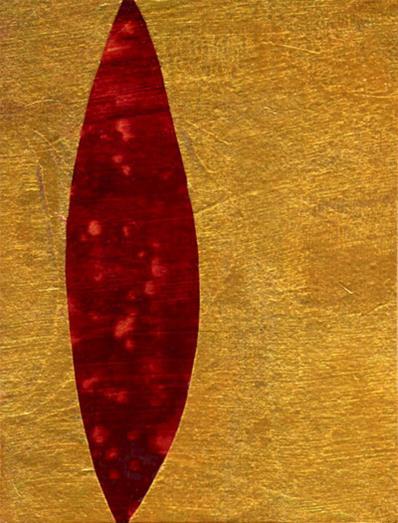
I have copied a picture of the wounded side (pictured above) by Jan Richardson from her Painted Prayerbook. It is called “Into the Wound” and I offer it as an invitation for your prayer and wonder. I see it as a tear, as an opening, as a doorway.

Medieval artists gave great attention to Jesus’ wounds. They were often the subject of their art. Such attention for us seems gruesome – but we might be missing an opening.

Eamon Duffy, writing in 15th/16th century England: “the wounds of Christ are the sufferings of the poor, the outcast, and the unfortunate” – according to which acts of charity (foodbanks, nursing, hospitality) become a tending of the living, wounded, corporate body of Christ.

The wound is on his side. Maybe those of us who are on his side can see our own wounds in the wound of Jesus (the ones we’ve inflicted and the ones inflicted on us). Is there an invitation on this door? Is Jesus inviting Thomas, the disciples and all those on his side into the wound, to feel around the space, to know the love, to know the other side?

And is there a reciprocal arrangement, whereby we don’t hide our wounds but invite others into our hurting world so that we might find wholeness and healing? Jesus stands at the door and knocks. If his wound is our way into him, are our wounds his doorway to us?

This is what Jan Richardson writes:

“In wearing his wounds—even in his resurrection—he confronts us with our own and calls us to move through them into new life.

The crucified Christ challenges us to discern how our wounds will serve as doorways that lead us through our own pain and into a deeper relationship with the wounded world and with the Christ who is about the business of resurrection, for whom the wounds did not have the final word.

As Thomas reaches toward Christ, as he places his hand within the wound that Christ still bears, he is not merely grasping for concrete proof of the resurrection. He is entering into the very mystery of Christ, crossing into a new world that even now he can hardly see yet dares to move toward with the courage he has previously displayed.”

Thomas’s RSVP was “My Lord and my God” – his mind blown open, he believed.

Belief in resurrection is often thought of as a rational process. That is how Thomas approached it. But belief isn’t only about our heads. Belief isn’t a rational response but an emotional one. Belief comes from the German word which gives us beloved. “Belief” is “belove” – a believing disciple is a beloving and beloved disciple. When Thomas believes he doesn’t just open his mind, he  opens his mouth (as RSVP), his heart and his very gut where all our anxiety and fear find their home.

Jesus opens the room, he opens his mouth, he opens his wounds. We are invited through these open doorways, into a new life that without this gospel would be unimaginable.

Please RSVP.

The image Into the Wound is copyrighted to Jan Richardson and is used with permission – www.janrichardson.com

Thomas’s Twin – a sermon for Easter 2A

Sermon notes for Easter 2A for St Alban’s, Broadheath. Again, it could be said better, and I hope it will be. I share it anyway. The Gospel reading is John 20:19-31

Who likes ants?

We are told to learn from the ants. Proverbs 6:6 – “Go to the ant, you sluggard: consider its ways and be wise.”

It’s true. We can learn a lot about community and industry from ants. We can also learn that if they get lost they die. When ants get lost, they follow a simple rule. The rule is to follow the ant in front. But they don’t know that the ant in front of them is only following the ant in front of him. They finish up going round and round in circles, blindly following the one in front until …. They die.

There is a famous example of this deathmill from the Guyana jungle. The ants were just going round in circles – it was a trail of ants which just kept marching in a column 400 yards long (the length of a running track). It took them 2 days to complete a circuit. On and on till they died from exhaustion.

Consider its ways, and be wise. What do we learn from the ant? We learn the importance of thinking for ourselves. We learn the importance of seeing for ourselves.

“Seeing is believing.” That’s what we say, isn’t it?

“We have seen the Lord” is what the disciples say in today’s gospel reading. “We believe”. “We have seen the Lord” is what the disciples say to Thomas, who wasn’t there to see and believe. He is the odd one out.

He was in the wrong place at the wrong time and missed seeing Jesus.

Seeing is believing is the theme of John’s gospel. Time and again John refers to the disciples “coming to see”. The frequency increases as we move to the end of John’s gospel.

  • Mary Magdalen came to the tomb and saw that the stone had been removed,
  • Peter and the beloved disciple ran to the tomb and saw the linen wrappings lying there. They went into the tomb, and saw and believed.
  • Mary Magdalen told the disciples that she had seen the Lord.
  • Mary Magdalen, Peter, the beloved disciples come to see the Lord.
  • And then, that same evening of the day of resurrection, the disciples “see the Lord” – apart from Thomas. Where was he? What was he doing?

Seeing is believing.

But if seeing is believing, what about those who are not there to see, like Thomas?

And what about those who can’t see? What about those who not even Specsavers can save?

This was a problem for a friend of mine who became blind. He was troubled about all that the Gospels say about “seeing” and “believing”, and about “light” (good) and “darkness” (bad). How could he believe when he couldn’t see? How could he be saved when he had been cast into outer darkness?

Do you see his problem?

He worked it out in the end, eventually realising that there are other ways of seeing. He called it “whole body seeing” and wrote the story of his blindness and his later whole body seeing in a book called Touching the Rock.

This is how he discovered his “whole body seeing” (WBS for short). He was staying at Iona. He had been told about the altar there by people who had described it to him. Then he saw it for himself. This is what he wrote:

 “After several nights, I discovered the main altar.

I had been told about this, and I easily recognised it from the description. It was a single block of marble.

Finding one corner, I ran my fingers along the edge, only to find that I could not reach the other.

I worked my way along the front and was amazed at its size.

The front was carved with hard, cold letters. They stood out baldly, but I could not be bothered reading.

The top was as smooth as silk, but how far back did it go?

I stretched my arms out over it but could not reach the back. This was incredible.

It must have a back somewhere. Pushing myself upon to it, my feet hanging out over the front, I could reach the back. I did this again and again, measuring it with my body, till at last I began to have some idea of its proportions. It was bigger than me and much older.

There were several places on the polished surface which were marked with a long, rather irregular indentations, not cracks, but imperfections of some kind.

Could it have been dropped? These marks felt like the result of impact. The contrast between the rough depressions and the huge polished areas was extra ordinary.

Here was the work of people, grinding this thing, smoothing it to an almost greasy, slightly dusty finish which went slippery when I licked it. Here were these abrasions, something more primitive, the naked heart of the rock.”

When I read that I just went WOW. He had seen things which would not have been noticed by the casual observer with her naked eye. With his whole body seeing he had found things there which I am sure he’d be telling others about over breakfast the next day. “Come and see” he’d have been telling everyone.

I mention this because I think there is something in today’s gospel about the importance of seeing things for ourselves. When we see things for ourselves we are not seeing through other people’s eyes. We are not conforming to their vision, and we are seeing things that nobody else sees.

This brings us to the beauty of Thomas who is the focus of our gospel reading.

Thomas is a disciple who captures our imagination, isn’t he? That’s shown in the number of Thomases there are. (How many here are called Thomas, or have a Thomas in their family?)

Two of our children have Thomas in their names, after their grandfather.

We often talk about “doubting Thomas” and then refer to him as typical of us, who are often “doubters” like him.

I’m not sure that this is helpful. Thomas is actually someone who sees and believes, but in a different way. Isn’t that a more helpful way to remember Thomas?

Thomas sees things differently. This is brought out in the gospel. He wants to see through his hands and fingers. He uses his body. He doesn’t just see with his eyes. He inspects. He uses his senses and his sense. He sees with feeling. He sees from the heart.

That is the way that Thomas comes to see.

He puts his hand into Jesus’ wounds. He reaches beyond first impressions. And then he sees. He feels the love in those scars and jumps to his joyful conclusion that he is seeing our Lord and our God. This is the staggering realisation which comes from seeing from the heart, which comes from seeing with feeling, which comes from his insistence that he should see things for himself.

Thomas is not the doubter. He is one who was willing to see.


Thomas is a twin. That is how he is introduced in the gospel. “Thomas the twin”. We don’t know whether Thomas had a twin brother or sister. IT’s more likely that “twin” was Thomas’s nickname because the meaning of the name Thomas is “twin”. But if Thomas had a twin, who might it be?

That  might have been a question that entertained John’s community. “If Thomas is the twin, who is his twin brother or sister?”

They could have played with that question and wondered “is that me?”

We can play with the same question. If Thomas is like us in his doubting, can we be like him in his seeing and believing? How much like him can we be? Can we be his twin brother or sister in the way that we are so much like him in wanting to see Jesus from the heart?


Jesus made many “resurrection” appearances – or should I say that Jesus makes many “resurrection” appearances. John admits that there are so many ways that Jesus showed himself and supposed that “if every one of them were written down the world itself could not contain the books that would be written.” Jesus wants us to see him for ourselves. He wants us to be witnesses.

Mary Magdalen, Peter, the disciple (disciples?) Jesus loves/loved, Thomas and ourselves come to see in their different ways. Together we are a body of believers who through our whole body seeing see things differently.

It is in such company that Jesus shows himself so that we might see life differently – with compassion that is able to feel for scars and wounds, and with the hope that love is stronger than death.

It is in such company that Jesus shows himself to us so that we might follow him in a way of life that is life giving, instead of blindly following others till, like the ants, we drop from exhaustion.

the quote is from Touching the Rock by John Hull
I found the picture of Still Doubting at Mattseyeshaveseen – with some interesting reflection.

The work of forgiveness

Forgiveness doesn’t change the past, but it releases us from the power of the past. Forgiveness doesn’t rewrite history. But it prevents our histories from asphyxiating us. Fundamentally, forgiveness transforms our past from an enemy to a friend, from a horror-show of shame to a storehouse of wisdom. In the absence of forgiveness we’re isolated from our past, trying pitifully to bury or deny or forget or destroy the many things that haunt and overshadow and plague and torment us. Forgiveness doesn’t change these things, but it does change their relationship to us. No longer do they imprison us or pursue us or surround us or stalk us. Now they accompany us, deepen us, teach us, train us. No longer do we hate them or curse them or resent them or begrudge them. Now we find acceptance, understanding, enrichment, even gratitude for them. That’s the work of forgiveness. It’s about the transformation of the prison of the past.

Sam Wells from his Easter Day Sermon 2013

Thomas

Two of our children bear Thomas in their name. Their grandfather was called Thomas. Thomas is highlighted in our Gospel today. What was he doing on this first day of the week when the other disciples were locked in in fear of the people’s anger? Did he not share the anxiety of the other disciples? Did he have more confidence?

Kate Huey, in the linked article, quotes Michael Williams’s comment about Thomas which contrasts with how Thomas is so often portrayed. He writes: “the only one amonmg the disciples who was not do filled with fear that he was unwilling to leave the disciples’ hiding place.” (see this Sunday’s gospel) Kate quotes Gail O’Day’s observation that “one week after the disciples have been visited by the risen jesus and received Jesuis’ peace and the Holy Spirit, they have once again locked themselves away behind closed doors.” Even after seeing the risen Jesus they still don’t live as an Easter people.

So was Thomas the one didn’t want to be locked away? Was he the one who wasn’t frightened? Was he the free spirit? Have we lost the truth by caricaturing him falsely as “the doubter”? And if he is the odd one out of the twelve? What does he have to say about the rest of them, and the rest of us who are similarly inclined to lock ourselves away (metaphorically) because we fear the people. What was Thomas doing?

Jan Richardson in the Painted Prayerbook has a different take on the locked room – the “secret room” as she calls this painting, and she suggests that every pilgrim needs a secret room.

She quotes Phil Cousineau’s The Art of Pilgrimage who writes this:

“Everywhere you go, there is a secret room. To discover it, you must knock on walls, as the detective does in mystery houses, and listen for the echo that protends the secret passage. You must pull books off shelves to see if the library shelf swings open to reveal the hidden room. I’ll say it again, everywhere has a secret room. You must find your own, in a small chapel, a tiny cafe, a quiet park, the home of a new firend, the pew wehere the light strikes the rose window just so. As a pilgrim you must find it or you will never understand the hidden reasons why you really left home.”

Here is sanctuary and indicates the need we all have for “retreat” for all the times when we have a choice of fight or flight and when fighting seems so hopeless. And does Jesus condemn us for locking oursleves away and trying to save our own skin? It appears not. Because to those first Christians locked in fear Jesus came with nothing other than peace. There were no recriminations for them running away or for their betrayal of his trust. All he does when he gets through their defences – past the locked doors is to “offer them greeting and gift” (Kate Huey) – “Peace be with you”.