The Samaritan, the wounded, and the question that won’t go away

We know parable of the Good Samaritan so well we can almost recite it by heart. But maybe that’s the problem. Its edges have worn smooth with repetition, and its challenge no longer cuts as sharply as Jesus intended. What happens when we let it confront us afresh? Here’s a sermon that asks us to imagine hearing it for the first time — and to wrestle with the question that won’t go away: “Who is my neighbour?”.

My customary intro – so customary these days that we could almost do it as call and response.
Here goes: I love preaching that brings scripture back to life.
Call: Do you love preaching that brings scripture back to life?
Response: We do.

But how do we bring scripture, such as this parable of the Good Samaritan back to life when we’ve worn it smooth with repetition, so familiar that its sharp edge no longer cuts?

Can we imagine the pointedness of the parable for those hearing this for the first time?
Imagine hearing this for the very first time.

Let’s do some word association.

What word do you associate with Samaritan?

What words do you think Jesus’ Jewish contemporaries associated with Samaritan?

Very different sets of word associations

Here’s a bold assertion I read this week: This parable has single-handedly shaped the reputation of the Samaritans. Samaritans stood for everything the Jews hated. In their eyes the Samaritans were despised as the last, the least and the lost. There was no such thing as a “good” Samaritan. Now a Samaritan is someone we can call when we are at the end of our tether. A Samaritan is a first responder – one who runs into trouble to help – unlike those who run away at the first sign of trouble.

But to the question posed by the lawyer, “Who is my neighbour” Jesus casts the main characters as those last, least and lost. There are two main characters.
There is the one attacked by robbers and there is the Samaritan. 

It is interesting to note who and what Jesus sees first when he preaches the good news of the kingdom. Jesus sees first not the powerful or the prominent, but the ones left behind,
the last, the least and the lost,
the stripped, beaten, and left for dead,
the wounded and the hated.

The Samaritan and the victim are the ones Jesus sees first when he responds to the lawyer’s question, “Who is my neighbour?”.

They are the ones Jesus “sees”.

And these last, least and lost become the leaders in this discussion about neighbourliness.
Jesus promotes them to be the first to teach the lawyer (and all Jesus’s hearers) a lesson on the question “Who is my neighbour?”


Here are the last.


And here are the first,
way off in the distance,
the priest and the levite,
the first people Jesus’s hearers would have thought should have responded to the stripped, beaten and robbed.

You would expect them to do good. 

They are prominent people.
They come first in the public eye, just as they come first in the story Jesus tells.
They are the professionals – the ones who should know the scripture the lawyer quotes: “Love your neighbour as yourself.”
They would have known that as the key to eternal life, but they fail to walk the talk.
I wonder if the lawyer would have done the same – walked by on the other side, failing to walk the talk.

What happens is that the first come last in the eyes of Jesus and the kingdom of God.
They are the ones who become the outcasts by just walking by.

When Jesus preached he said to those who would listen:
Love your enemies,
do good to those who hate you,
bless those who curse you,
pray for those who abuse you. (Luke 6:27-28)

And here today, we hear of a Samaritan,
loving his enemy,
doing good to one, who in all likelihood, hated him
an answer to prayer for the victim, who in all likelihood,
joined in the abusive banter of the time.

The lawyer asked, “who is my neighbour?”
We might ask, “Who is my enemy?”

Enemy is a word of two parts.
There is the ene – meaning not,
and there is the emy,
like the French word ami,
behind which is the Latin word for friend – amicus.
My enemy is literally the one who is not my friend,
not only the one who hates me, curses me and abuses me,
but the one to whom I am nothing, a nobody.

The Samaritan loves his enemy.

This isn’t just about ancient hostilities.
Our world still draws lines between us and them.
Think of the debates around borders and strangers today.

We live in xenophobic times.
Perhaps these times are no different to other times.
Perhaps these times are no different to Jesus’ own times.
Perhaps we’ve always been wary of strangers.
They’re never our friends as long as they are strangers.
They’re the enemy to be kept out.

Behind the lawyer’s question was the idea that there has to be a limit to who our neighbour is.
Probably, like the lawyer, we share the basic assumption that our neighbours are people like us, and people who like us.
But in this parable Jesus not only single-handedly reshapes the reputation of the Samaritan, but he also challenges the scandal of the boundaries we build with our hatred and suspicion.

The lawyer leaves Jesus with the question “Who is my neighbour?”

The question Jesus leaves the lawyer with is, “Will you be a neighbour?”
“Will you go and do likewise?”
“Will you bear to be a neighbour to your enemy – being compassionate, attentive, practical and generous?”

We are left with the same questions.
Will we go and do likewise?
Will we follow the Samaritan’s lead?
Will we cross the road?
Will we engage with the victims of the way things are?
Will we go to the help of the wounded and hated?
Will we attend to their wounds? Will we find help?

Will we just leave them there, beaten and hated?

Will we keep them at arm’s length, as enemy, as “not our friends”?
Or, will we go and do likewise?
Will we love our enemy, doing good to those who hate us, blessing those who curse us, praying for those who abuse us?
Just as Jesus did.
Will we maintain the dividing lines?
Or will we simply be a neighbour, like the Samaritan,
who, unlike the lawyer, never stopped to ask,
“Who is my neighbour?” – as if there needs to be a limit.

PS. I’ve started using ChatGPT to help me prepare for preaching. This week the algorithm threw me a question that stopped me in my tracks:

What if being a neighbour means crossing every line we’ve drawn between “us” and “them”?

PPS It was Jennifer S. Wyant who claims this parable “singlehandedly reshaped the reputation of the Samaritans”.

Ah Bisto! Conspiracy Theories of Pentecost and Community

>

People who breathe together, stay together. People who can smell one another create community. The person who holds his nose because he doesn’t like the air that he is breathing is excluding himself from that community.

Ivan Illich reminds us of an old German saying: ich kann Dich gut reichen, “I can smell you well”. It captures well an apect of openness we often miss. We have our eyes and ears open, but rarely do we talk about having our nose open. I can smell you well. For me that adds another sense to the story of the Good Samaritan. Did the victim in the ditch smell so badly that people could not tolerate his smell, and had to walk by on the other side, holding their nose against the stink. With nose open, the Good Samaritan had his arms free to manhandle the victim to safety and recovery.


There is a custom in Christian liturgy called the “kiss of peace“, or osculum pacis – only recovered relatively recently in the Church of England. These days the kiss of peace isn’t so much a kiss as a handshake – very British – but at least it’s touching. Apparently in some places, until the 3rd century, the kiss was “mouth to mouth”, and was a sharing and mingling of breath. John’s story of Pentecost reminds us that Jesus breathed on his disciples, saying “receive the Holy Spirit” (John 20:22). They smelt each other well. They shared their breath in con-spiracy. The church formed conspiratorially to be a conspiracy. Illich writes:

“Peace as the commingling of soil and water sounds cute to my ears; but peace as the result of conspiratio exacts a demanding, today almost unimaginable, intimacy.”

Pax board, Early 16th century, in a frame from 19th century
16th century Pax Board from Budepest

The intimacy didn’t last as some regarded the practise as scandalous.  For example, Tertullian (in the third century) was rather worried about possible embarassment to “a decent matron”. The practice got well watered down. By the 13th century, the Catholic Church had substituted a pax board which the congregation kissed instead of kissing one another!

“Don’t imagine you can be friends with people you can’t smell.” That was the advice Illich was given. Friendships and communities develop amongst people who smell each other well, who can breathe in the air and the smell of their friends and neighbours, and who allow their own air and smell to be breathed by others. Friendships and communities are conspiracies – threatened in our de-odourised times of Lynx, Colgate and Ambi-pur where we struggle to smell anyone, or anything, well.

The playground cry “you stink, you stink” marks a cruel exclusion by those who won’t smell a person well – it is often accompanied with the gesture of the nose being held or up-turned. The person excluded has to find their friends who are prepared to smell. Above every friendship, every community, every conspiracy, there is a nose.

>Supervision and oversight

>It’s hard to believe the stories of people who have been told by their supervisor that they haven’t time for supervision.

Friend John Lees led a training session on supervision and collaborative ministry for clergy who will be moving on to posts of responsibility in the next few months. He invited us to think of the different supervisory roles people may ask us to take on. In our own words these roles included acting as advocate, mediator, valuer, confessor, coach etc etc. This has got me to thinking that supervision actually happens formally and informally. By formal supervision I mean the intentional setting aside of space for supervision (that’s the space that often gets crowded out by business). When we ask for feedback, support, directions are we not also asking for supervision, but without requiring the creation of an intentional space? To my mind we are at that moment asking for someone to watch over us, to look after us and to help us to a superiorvision.

I worry that “supervision” has become a word made precious by those who would like to see themselves as supervisors. I wonder whether supervision thereby becomes something that is exclusive to the few – depending on scarce resources. I wonder whether supervision isn’t something that all of us need – but in very different guises. Vigilance and watching out for one another alerts us to the needs of others – when they need encouragement, assurance and challenge. The requests aren’t always verbalised. Jesus tells the story of the victim of violence lying at the side of the road. He remarks on the neglectful carelessness of those who passed him by. He highlights the response of the Good Samaritan who looked after the wounded victim and watched over his recovery.

Supervision belongs to the whole people of God. It is in fact a gift of God for his people which gives us confidence in prayer. The Lord who watches over us will neither slumber nor sleep (Ps 121). Therefore, we need to avoid the exclusive practice of supervision to make room for both the informal and formal requests that come our way (the way of all humans) – and we all need to have the confidence to ask for the help we need to get a better sight of our lives. We are all vulnerable. I fear that if we don’t make room for both the formal and informal aspects of supervision we will continually overlook the victims of our peripheral vision. I wonder whether the priest and the levite who passed by the wounded victim of Jesus’s story said – “sorry, that was an oversight”. It’s strange that “oversight” has two such opposite meanings.

Post-Phone (get it?)

I rarely get letters now – apart from leaflets from the local pizzerias. There are days when the phone does not ring. Communication has changed very significantly and rapidly. We have moved from beacon to drum to messenger to post to phone to fax to email to facebook to …. We have moved from moorland track to canals to railtrack to the road to the by-pass to Runway 5. Our horizons have shifted from village to town to Spanish Costas to antipodean holidays and now interplanetary travel plans.

My own journey is from a 35 year ministry in parishes where my business was “to know and be known” to living more anonymously on a housing estate. I have been discovering what most people have long known. That is, that communication is minimal in neighbourhoods. We talk amiably as neighbours – though we don’t see much of one another because working hours are very different. Others are just “passers by”. When we go to the local shops (thank goodness we’ve got some) we pass by one another without recognising one another and realising that the common ground that we share.

Fortunately new communities are being constructed all the time. These are often communities of our own making – virtual communities which offer conviviality and new possibilities for relationship. Unfortunately we feel safer in our Facebook communities than we do in our own street (even though the stats say that crime is lower than it has been for years).

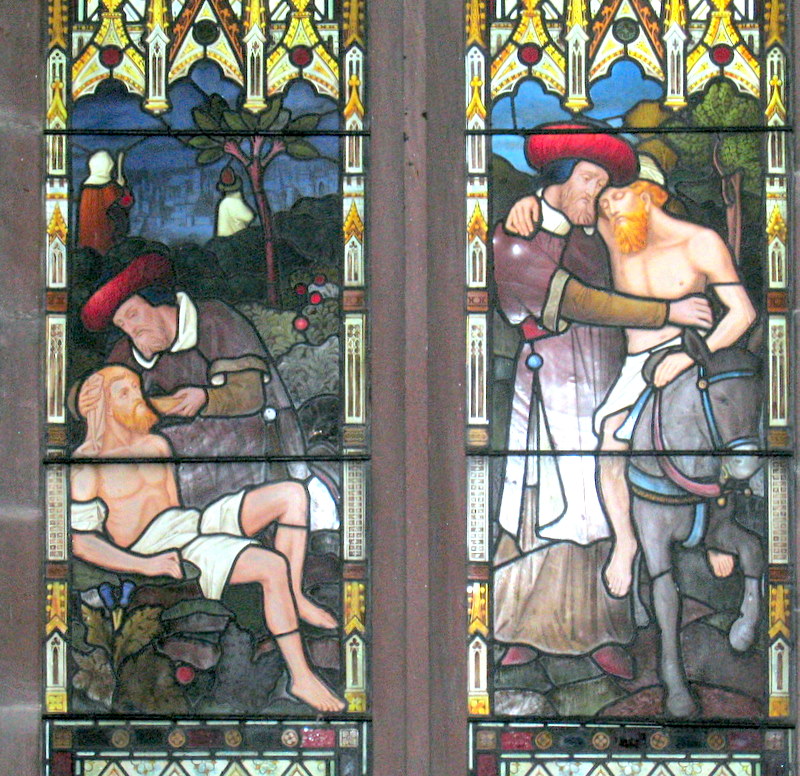
Good Samaritan window at Tarvin Church

Passers-by don’t get a good press in the gospels. The Good Samaritan was the exception to the general rule of passers-by when he went out of his way to help the victim. Peter Shaw, in Conversation Matters, reports on a discussion with Veronica who told him about the short conversations she had (she is a flight attendant). She explained that they were all trained to be cheerful, and to look people in the eye and smile. She was full of stories about conversations she had with footballing stars and leading politicians making the point that what mattered was not who they were, but the way they were. What sort of tone did they adopt? Did they smile? Were they cheerful? Did they say ‘thank you’?

I suppose these sort of short conversations prevent us from being just passers-by of one another. A “thank you” shows we appreciate the other person. A “good morning”  shows we’ve noticed. A “how are you” shows we care. Words get over our boundaries. Maybe communities are only built brick by brick and word by word.