Is the I a number that marks a beginning, or, is that I me with rather less feeling, as in number with a silent b? Is this a play on words, or, a play on numbers with words, a play for today, November 1st?
Here it is: 1 11, 11/1 or 1/11 – depending whether you’re American or not, All Saints Day, when the air’s cleaned of mischief when the I’s come out to play, 1 11, the first eleven, the perfect team.
The play goes on. Picture that All, for all the saints, its two ll’s standing as one, seeing as one, holding hands, a love’s embrace.
Or is it illness we see under the spill and spell of numbers – III, iIIness – to make a season to remember the dark days of the fall, when another I joins the ranks of the ones of one and eleven
to make 11/11 a day when the evil of war became an anvil for the forging of peace? Is this a play on numbers, or a poem that builds today?
There are other acts, other dates, nothing ever begins with the first.
Take, for example, 911, our 11/9 which we’ll call 9/11 for its hallowing of American soil. 911, the emergency number, our 999. The 9 followed by the twin towers, all the ones destroyed when the ground reduced to zero.
Picture those 1s and you’lll see there’s never one alone.
Ceiling to floor, ceiling to floor, each 1 towering, one copying another, each office a cell a spreadsheet of humanity, each one working part of their lives, one of a family, one of a community of so many other ones.
And then came Hamas on a day which belongs to the same season of war. Did that mark a beginning? Was that the start of things as the Israeli right claims? Or was it just the extreme one in a string of grievance and reprisals?
7/10 we’d call it, a high mark of history, possibly the end of a nation. Israel has always known its numbers, the seven days of creation, the ten, the measure of God’s authority. They multiply those numbers to sum up the fullness and perfection of life
or to ask the question of the times – how many times must we forgive? Is it 70? Is it just 70? Good news responds: It’s not just 70. It’s 7 times that. It’s so many times we’re bound to lose count. There’s no going back to number 1 and whatever its cause. No one ever started it.
This one’s for all who wrestle in the dark and rise, blessed but limping, inspired by reading Genesis 32:22-31 and Luke 18:1-8 – the Revised Common Lectionary readings for October 19th 2025.
How shall we describe the state of Israel today?
The state of Israel today begins with both our readings — from Genesis 32, the story of Jacob whose name means twister; and from Luke 18, the story of the widow struggling for justice.
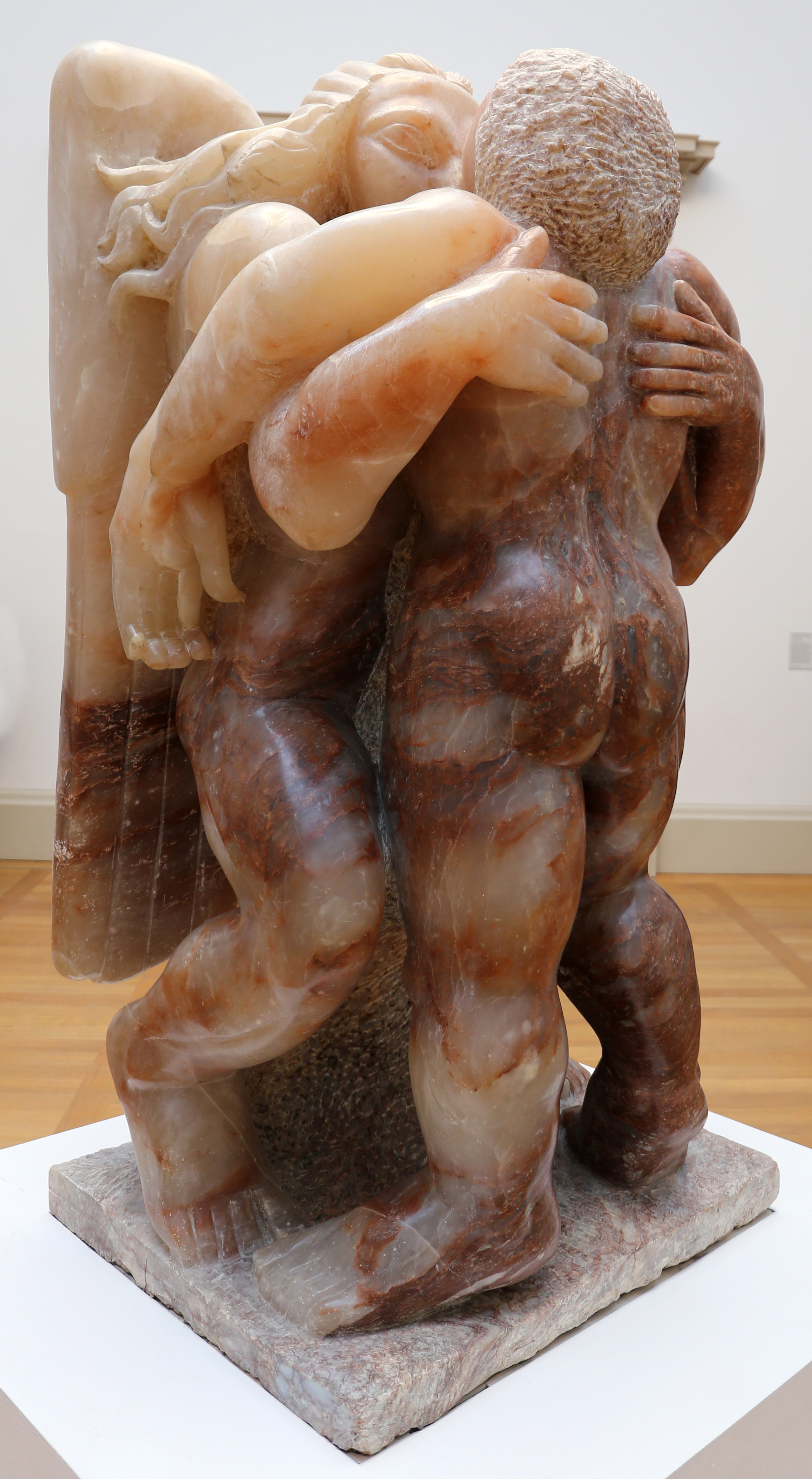
The state of Israel begins at the end of a night of struggle for the twister, a night of struggle in which Jacob never discovers the name of the one he’s wrestling with, but finds himself called by a new name — Israel.
Jacob’s struggle as portrayed by Sir Jacob Epstein (shown in Tate Gallery, London)
Israel struggles with God, and God struggles with Israel. That is the very meaning of Israel. If Israel means anything, it means struggling with God.
Jacob is the first to be called Israel, and he is called (renamed) that by the one he struggled with because he “struggled with God and with people” and withstood the whole night.
It is the calling of Israel to struggle faithfully through the night.
Jacob is the patriarch of Israel — the patriarch of those who struggle with God and with people, and who carry on wrestling through long nights and times of darkness without being overcome,
people like the widow singled out by Jesus — a victim of some injustice. In the face of an utterly unjust justice system, personified by a judge who neither feared God nor cared what people thought, she struggled.
For some time she struggled. She kept coming at that lousy judge. She wouldn’t let go until he gave in.
Those who struggle through the night, with God and with people — those who struggle to see the night through, for whom the night is very dark, and for whom there is little daylight, those who won’t give up whatever the night brings — they are the ones whose hope is rewarded.
They carry a blessing for all who wrestle with God and with the wounds people inflict.
It’s the blessing of God who himself wrestles through the darkness of the world, who struggles with people and the suffering they cause, but who, in spite of all that, wrestles the whole night long.
This is the love that shines in the darkness to the break of day.
And yet, the night is long. Not just one night in Jacob’s life, not just one night in ours, but the long night of the world — a night as long as history.
Through that long night we wrestle, and God wrestles with us.
There are three struggles woven into this story, and all three belong to Israel:
We struggle with God. We struggle with people — and people struggle with us. And through it all, God struggles with us.
That’s what it means to be called Israel: to live the long night of wrestling, and to trust that, at the end of it, there will still be blessing.
The struggle with God
Sometimes it’s the long silence of prayer — when we ask and wait and hear nothing. Sometimes it’s the ache of loss, or the questions that faith won’t easily answer. We wrestle with God when life doesn’t fit the promise, when love feels hidden, when blessing comes only after a wound.
But still we hold on. Faith is not certainty — faith is the grip that will not let go until morning.
The struggle with people
And we wrestle with people too. Not just those who hurt or wrong us, but in all the difficult ways love tests us — learning to forgive, to be patient, to stay kind when we’d rather give up, to bear with one another’s weakness.
People struggle with us too — our faults, our sharp words, our stubbornness. We are all part of each other’s wrestling.
These are the struggles that form the fruits of the Spirit — the quiet strength that grows only in the dark: patience, gentleness, self-control, love that endures through the night.
The struggle with ourselves
And maybe there’s a fourth struggle too — the one Jacob knew best — the struggle with ourselves. The fight to face what we’ve twisted, to tell the truth about who we are, and to accept the new name that grace gives us.
Before we can meet God face to face, we have to face ourselves in the dark — the parts we’d rather not see, the wounds we’ve caused as well as borne. Even that struggle can become blessing.
The struggle of God
And through it all, God struggles too — not against us, but for us. God wrestles through the night of the world, bearing our pain, refusing to give up on us. The cross itself is the mark of that struggle — God’s own wound, the divine limp that still bears the weight of love.
This is the love that shines in the darkness to the break of day.
Jacob wanted to know the man’s name, but the man would not tell him.
Maybe that’s the mercy of God — that we never get to hold the name too tightly. The namelessness keeps the struggle open. It reminds us that this wrestling is for everyone, that God stands with all who struggle through the night — beyond borders, beyond certainty, beyond control.
It was not for ease that prayer shall be. The story of Israel is not the story of the untroubled. The story of Israel is the story of the very troubled — the story of slavery, exile, persecution, the horrors of history, the nightmare.
Amos got it right three thousand years ago. He condemned the complacent, those who are at ease in Zion. He said they put off the day of disaster and bring near a reign of terror. They are not fit to be called Israel. They duck the fight and ignore the struggle.
But Jacob did not. The widow did not. And the God who wrestles through the night does not.
Jacob’s blessing comes with a wound. He carries it into the dawn, every step a reminder of the night he endured and the God who would not let him go.
Perhaps this is the mark of the blessed — not the ones who have had an easy time of it, but the ones who have been wounded and changed. The ones who know that life is not straightforward, that faith is not certainty, and that love costs something real.
Israel limps into the sunrise, blessed and broken.
And still, the night is long — as long as history, as wide as the world. Still, God wrestles with us, still struggles with his people, still bears our wounds, and still blesses us.
And when the dawn comes — as surely it will — the blessing will not erase the limp, but redeem it.
For the love that shines in the darkness will shine until the whole world limps into the light.
Afterthoughts What might it mean for a people, or for a church, to be known by its limp – to be blessed not in strength but in struggle? If God still wrestles through the long night of the world, where do you see that struggle – and that love – happening today?
Our politics, like our hearts, are haunted by borders and fear. But Luke’s gospel shows Jesus walking the edge — not to keep people out, but to draw them in. Preached in a week when fragile talk of a ceasefire in Gaza flickers across the news, this reflection on Luke 17:11–19 and 2 Timothy 2:8–15 explores what happens when the unchained word of God crosses the lines we draw, healing what fear divides.
Jesus is on his way to Jerusalem, travelling along the border between Samaria and Galilee. This is what Luke wants us to notice — that Jesus is on the edge, not in the middle. He’s on the edge where belonging is uncertain.
In nature, the edge is often where life is richest. When two landscapes meet — forest and field, land and river — there’s a place called an ecotone. It’s a place of tension, yes, but also of surprising life, where species from both sides mingle and new life appears.
Perhaps that’s why Jesus walks the edge — because that’s where new life is breaking out.
We’ve all walked that edge: in the playground, the first days in a new job, moving into a new community — will we be included, will we settle?
Luke introduces us to ten lepers, forced to live on that edge by their communities who have wrenched them from home, from all they’ve ever known, by one word — Unclean.
They are the wrong side of the border, cast over the edge — and that’s why they have to shout to Jesus. They have to get their word across that boundary.
This is how Jesus gets to Jerusalem — by walking the edge, the dangerous way, where grace and fear meet, where the kingdom begins to break through.
But not every edge is walked the same way. Our leaders keep pointing us to the edge too — the edge of our borders, our safety, our identity. They edge us with fear. They tell us who to blame, who not to trust, who belongs, and who should stay outside.
And we see again what happens when fear builds its own borders. Across the news this week — the fragile talk of ceasefire, the first steps toward peace in Gaza — we glimpse what it costs to live so long behind walls of pain and suspicion.
Every side has its wounds, every border its fear. And yet even there, the smallest word of peace, the tiniest crossing of compassion, is a holy thing. It’s where grace dares to walk the edge again.
And that’s the challenge for us, too. Because we all have borders of our own — those quiet lines we draw in our hearts, between those we find easy to love and those we keep at a distance.
The question is: whose edge are we walking? The one that fear builds, or the one Jesus blesses — the edge where healing begins?
Fear has its own language, and it spreads easily. You can hear it in the way people talk, the way headlines shout, the way words build walls long before bricks ever do.
That’s what happened to the ten lepers. They were pushed to the edge by words — words that said Unclean, words that exiled them from home, from family, from touch.
And now they have to shout from a distance, just to be heard — their voices straining across the border, trying to bridge the gap that other people’s words created.
And Jesus sends a word back. No touch, no ceremony — just a word that crosses the border: “Go, show yourselves to the priests.”
And as they go, they are made clean. The word runs free. It doesn’t stop at the boundary; it heals as it goes.
Paul once wrote, chained in a prison cell: “I may be in chains, but the word of God is not chained.”
It’s the same truth here. The unchained word runs ahead of Jesus, crossing the lines that fear has drawn, healing what twisted speech has broken.
This isn’t the first time Luke shows us Jesus on the edge. From the very beginning, his gospel has been about the outsiders God draws in. It’s Luke who tells of the shepherds — night workers, unclean in their own way — hearing angels sing of peace on earth. Luke remembers the woman who wept on Jesus’ feet, the prodigal welcomed home, the beggar Lazarus lifted up, and another Samaritan — the one who stopped on the roadside to bind up wounds.
In Luke’s world, the people we push aside become the very ones who show us what mercy looks like. And here again, it’s the Samaritan — the one no one expected — who becomes the model of faith, the first to come home to God.
But one turns back. One crosses the border again. He’s the foreigner — the one who, by every rule, should have stayed outside. Yet he comes closer, falls at Jesus’ feet, and his first word isn’t a cry for help, but a word of thanks.
Ten were made clean — but only this one is made whole. Because healing isn’t complete until it finds its voice in thanksgiving.
That’s the word Jesus has been waiting for — not Unclean, not Go away, but Thank you. A word that restores relationship, that binds what fear has torn apart.
The Samaritan becomes the first citizen of this new borderland kingdom — a kingdom without fences, where mercy is the mother tongue.
And maybe this is what it means to follow Jesus on his way to Jerusalem — to walk the edge, not the safe, well-marked path, but the dangerous way, where love meets fear and refuses to turn back.
Because that’s where the unchained word still runs free — crossing borders, breaking through divisions, making strangers into neighbours, and outcasts into brothers and sisters.
Prayer
May the Christ who walks the edges find us there — where fear builds walls and grace dares to cross. May his word set us free to speak peace, to live thanks, and to walk the dangerous way of grace.
Here’s a sermon for the 5th Sunday after Trinity (year B) for a group of churches who on the 5th Sunday of the monthcome together for their “Gathering”, together with a poem which inspired me for this – Harry Baker reading Unashamed. The gospel for the day is Mark 5:21-end.
June 30th 2024
The preacher’s task is to bring the gospel to life. The test is whether you love the gospel more after the sermon than before and whether it has a greater power.
To start, I wondered whether we could spend a few moments hearing from one another any words or phrases that particularly struck you, shouted at you or surprised you ……….
Just as today’s gospel comes to us in two parts, so this sermon has two parts. In the first we will look for Mark’s meaning. The second is an application to us.
Mark 5:21-end When Jesus had crossed again in the boat to the other side, a great crowd gathered around him, and he was by the lake. Then one of the leaders of the synagogue named Jairus came and, when he saw him, fell at his feet and begged him repeatedly, ‘My little daughter is at the point of death. Come and lay your hands on her, so that she may be made well, and live.’ So he went with him.
And a large crowd followed him and pressed in on him. Now there was a woman who had been suffering from haemorrhages for twelve years. She had endured much under many physicians, and had spent all that she had; and she was no better, but rather grew worse. She had heard about Jesus, and came up behind him in the crowd and touched his cloak, for she said, ‘If I but touch his clothes, I will be made well’. Immediately her haemorrhage stopped, and she felt in her body that she was healed of her disease. Immediately aware that power had gone forth from him, Jesus turned about in the crowd and said ‘Who touched my clothes?’ And his disciples said to him, ‘You see the crowd pressing in on you; how can you say, “Who touched me?”’ He looked all around to see who had done it. But the woman, knowing what had happened to her, came in fear and trembling, fell down before him, and told him the whole truth. He said to her, ‘Daughter, your faith has made you well; go in peace, and be healed of your disease.’
While he was still speaking, some people came from the leader’s house to say ‘Your daughter is dead. Why trouble the teacher any further?’ But overhearing what they said, Jesus said to the leader of the synagogue, ‘Do not fear, only believe’. He allowed no one to follow him except Peter, James, and John, the brother of James. When they came to the house of the leader of the synagogue, he saw a commotion, people weeping and wailing loudly. When he had entered, he said to them, ‘Why do you make a commotion and weep? The child is not dead but sleeping’. And they laughed at him. Then he put them all outside, and took the child’s father and mother and those who were with him, and went in where the child was. He took her by the hand and said to her, ‘Talitha cum’, which means, ‘Little girl, get up!’ And immediately the girl got up and began to walk about (she was twelve years of age). At this they were overcome with amazement. He strictly ordered them that no one should know this, and told them to give her something to eat.
The gospel has two parts – as expressed by our two readers. There’s the story of an unnamed woman and the story of a girl who we know as Jairus’s daughter. Both of them are healed by Jesus. The story of the woman’s healing is sandwiched into the story of Jairus’s daughter. The story of one interrupts the other.
By arranging the stories in this way, Mark, the gospel writer makes sure that we read them in the context of each other. He downplays one in relation to the other, leaving the reader with the task of amplifying the other.
There’s an overlapping timeline. Unusually Mark gives us precise detail about how old Jairus’s daughter is. She’s 12 years old. And he tells us that the woman had been haemorrhaging for 12 years. Their stories overlap. The woman became ill just when Jairus’s daughter was born. 12 years ago.
We always need to prick our ears up when we hear the number 12 in the gospels. It’s a number pattern that sums up Israel’s identity. The 12 tribes of Israel. The 12 disciples. 12 baskets of food left over at the feeding of the 5000. By including these details Mark is wanting us to realise that these two stories are about Israel and the kingdom of God.
The woman had suffered 12 years of haemorrhaging. Mark tells us she endured much under many physicians. They’d taken all her money. She had nothing, and far from getting better she’d got worse. This is what the institutions of Israel did to people.
It was worse than that. There were strict rules for people like her. They were listed in their scriptures. “When a woman has a discharge of blood for many days at a time other than her monthly period … she will be unclean as long as she has the discharge … Any bed she lies on will be unclean … anything she sits on will be unclean … anyone who touches them will be unclean. They must wash their clothes and bathe with water. (Leviticus 15:25-31)
For 12 years this woman would have been told she was unclean, and would have known those who came into contact with her would have been unclean. Not only is she poor, she’s in pain – and she is isolated and cast out because people had to be kept separate from things that made them unclean. She reminds me of the widow in the temple who Jesus watched as she put two coins into the treasury. It angered Jesus to think that her religious leaders had taken everything from her. She was left with nothing. Here, too, this woman is left with nothing. Her physicians had taken everything.
The rules of society were kept by the synagogue – people meeting together to observe the rules and be bound by them. Jairus was the ruler of the synagogue, the ruler of the rule-keepers, that ruled people in or ruled people out, that ruled people like our friend in the story out, and that made all women like her unclean, untouchable outcasts of society. Jairus had the power, privilege and prestige of being the ruler of the synagogue – and his daughter will have benefitted all her life from the prestige and protection of bring his daughter. There is such a contrast between the woman and the girl.
Did you notice how the crowd outside Jairus’s house laughed at Jesus? I was hurt when I read that. How dare they? But then I realised that this was the ruler’s family, his house, his daughter. They were used to being the most important. They were used to being first. They were probably offended that Jesus had put them last because he had allowed the least to interrupt him and make him late.
He was late because he wanted to know who had touched him. He’d felt something. She comes forward and tells him “the whole truth”. It was this that made Jesus late for his next appointment. He had put the last first. He had been touched by the least, the outcast – this poor woman. He listened to the whole truth from her. I love that phrase “the whole truth” – the truth of her suffering, the truth of her isolation, the truth of her treatment, the truth of her poverty, the truth of her loneliness and the truth of her faith in Jesus, that he, of all people could bear her touch.
This would have taken time. Jesus listens to her whole truth and finds in her faith the whole truth. He loves her. He calls her “daughter”. She is a true daughter of Israel. Her faith has made her such. She has been last but she comes first. She comes before the daughter of the ruler of the synagogue. The one who was used to coming first was going to have to wait. They were all going to have to wait while the last came first.
Where does this leave us? Loosely connected to all this I wanted to dwell on one of the words that struck me when I was reading this in preparation for today – that is the the word “crowd”. It’s mentioned three times in this passage. Hearing performance poet Harry Baker prompted me on this. He’s touring with his show he’s calling “Wonderful”.
Harry Baker performing Unashamed at his favourite place, Margate
For a moment I want to put us in the crowd around Jesus. We are, after all, here for “the gathering” (all the churches coming together). Gathering is a more genteel way of saying crowd. We’re not quite in the Glastonbury league, but we are a crowd.
We’re with the woman who wants to reach Jesus. We’re with all those who believe Jesus can bear our touch – however unclean we may feel, or however ashamed we’ve been made to feel. We’re with all those who believe they’re a lot better for knowing Jesus than if they’d not. We’re careful not to crowd people out, particularly those others who know they only need to touch Jesus to feel better.
Shall we tell Jesus the whole truth of our lives, knowing he welcomes the interruptions of the poor, in spirit or otherwise? Or just the edited version? Or just our best side?
Shall we see in each other the whole truth, the whole truth of those we see around us, the whole truth seen by Jesus – that in the words of the psalmist (Psalm 139), that we are “fearfully and wonderfully made”? Is that how we are going to see each other? Is that how we are to make others feel? Not “unclean and ashamed”. There are already enough people making us feel like that. But “fearfully and wonderfully made” – not many see that in us, and not many are interested in “the whole truth” about ourselves – except, we hope, this crowd, these our brothers and sisters, claimed by Jesus as his sons and daughters – children in the kingdom of God, people in whom Jesus sees the truth that despite all appearances we are fearfully and wonderfully made.
This is part of a series of reflections inspired by readings from the Book of Acts. This time the focus is on a scene at the Beautiful Gate of the Temple in Acts 3:1-10. The text is included at the end of the reflection. You might want to read that first because, after all, this is just a reflection. This is the part of the passage where I started:
One day Peter and John were going up to the temple at the hour of prayer … And a man lame from birth was being carried in. People would lay him at the gate of the temple called the Beautiful Gate so that he could ask for alms from those entering the temple.
And this is the question my reading left me with:
Who do we see on our way to worship? Who don’t we see?
The beggar isn’t named but I want to find a name for him. He is sitting at the Beautiful Gate and has his eye on all those going into worship, including Peter and John. They recognise him though they might not already know him. They see him as he looks at them.
Who do we see on our way to worship? Who don’t we see?
Willie James Jennings, in Acts, writes “At the doorway to worship are those whose very presence should discipline praise and guide hope. Before praises go up to God the poor and lame, the sick and pained must be seen.” (p41). Luke has already given his readers the story of the Good Samaritan featuring the pious hypocrites who fail to notice the needs of the wounded in the gutter.
Who do we see on our way to worship? Who don’t we see?
There is a lot of seeing in this passage. The lame man “saw Peter and John”, Peter “looked intently at him” and said “look at us”. Those in need need to be seen. So many in need remain invisible in corridors of power – being seen by those on their way to worship is their hope.
Who do we see on our way to worship? Who don’t we see?
The lame man, the beggar, probably didn’t know that he too was on his way to worship. Peter and John tell him to look at them. And Peter said to him: “I have no silver or gold, but what I have I give you; in the name of Jesus Christ of Nazareth, stand up and walk”. (Acts 3:6). His feet and ankles became strong and he was able to jump up, stand and walk, entering the temple with Peter and John, “walking and leaping and praising God”. (Acts 3:8)
Who do we see on our way to worship? Who don’t we see?
Jesus sees himself in the prisoner, the hungry, the stranger and the sick. In a parable the king curses those who gave him no food, no welcome, no clothing and no companionship. Those guilty ask the king, “When was it that we saw you hungry or thirsty or a stranger or naked or sick or in prison and did not take care of you?” He answers them: “Truly I tell you, just as you did not do it to the least of these, you did not do it to me.” (Matthew 25:31-46). Do we see Jesus in and with the vulnerable or do we overlook them?
Who do we see on our way to worship? Who don’t we see?
Perhaps we see Israel. From the beginning Israel walked with a limp. It might not be stretching imagination too far to see here those who inherited the name Israel from the patriarch Jacob who was called Israel because he wrestled with God. Israel is the Hebrew name that stands for those who wrestle with God. Israelites are bound by the injury and blessing of that wrestling and struggle. Jacob’s hip was put out of joint and he always limped after that. (Genesis 32:24-30). Is this who Peter and John saw? Perhaps significantly, we’re told that the man is more than 40 years old (Acts 4:22). 40 years is always the length of time that Israel waits. Did Peter and John see this man as Israel, limping and lame from the start, and now standing and leaping and praising God? If this is Israel, is this the Jewish people so often overlooked by Christians on their way to worship?
Who do we see on our way to worship? Who don’t we see?
Or, is this the church (or us), lying there lame in our excuses for mission and our attempts at Jesus begging for the power of the Holy Spirit.
Who do we see on our way to worship? Who don’t we see?
I said I wanted to find a name for the man born lame – we have a choice: he is the man born lame, he is Christ, he is Israel, he is church, he is us – all needing to be seen on the way to worship. Whatever his name, he is one who has been lame from the beginning and he is vulnerable. He begs to be seen and he begs to be seen by us, even on our way to worship. We need to make peace with him and take him with us in our hearts and imagination into our worship. If we don’t then our worship is hollow, hypocritical and unacceptable to God.
Who do we see on our way to worship? Who don’t we see?
Here’s the passage:
Acts 3:1-10 One day Peter and John were going up to the temple at the hour of prayer at three o’clock in the afternoon. And a man lame from birth was being carried in. People would lay him at the gate of the temple called the Beautiful Gate so that he could ask for alms from those entering the temple. When he saw Peter and John about to go into the temple, he asked them for alms. Peter looked intently at him, as did John, and said, “Look at us.” And he fixed his attention on them, expecting to receive something from them. Peter said, ” I have no silver or gold, but what I have I give you; in the name of Jesus Christ of Nazareth, stand up and walk.” And he took him by the right hand and raised him up, and immediately his feet and ankles were made strong. Jumping up, he stood and began to walk, and he entered the temple with them, walking and leaping and praising God. All the people saw him walking and praising God, and they recognised him as the one who used to sit and ask for alms at the Beautiful Gate of the temple, and they were filled with wonder and astonishment at what had happened to him.
How many sides has a coin? When we toss a coin we call “heads” or “tails” because we assume that a coin just has the two sides. On the toss of a coin we are divided into winners and losers. The winners are able to claim that they won fairly (even though only by chance) and the losers have to suck it up. There are two sides now and both know whether they are on the side with greater chance or lesser chance. The losers’ last chance is to overturn privilege – and the odds are always stacked against them.
The 12 sided thrupenny bit was first minted in 1937
But there aren’t just two sides to a coin. There is another smaller side which nobody calls because it so disproportionately small that the chance of it landing on its edge are virtually zero. But then, who hasn’t spent time standing coins on their edge, and who of us of a certain age hasn’t enjoyed making the old thrupenny bit take its stand on one of its twelve sides (as opposed to its two large sides).
Just imagine twelve sides. That is precisely what our scriptures imagine – with the twelve tribes of the twelve sons of Jacob finding and founding society in the land they were caused to occupy. The early church shared that imagination, counting twelve apostles and replenishing that number when one fell out. The thrupenny bit represents a design to facilitate concelebration, conversation and dialogue – remembering that there are rarely only two sides to any question and that to resolve conflict many sides have to be considered. Sitting round a circular table is to adopt this design. Each person has their point of view, their side, in a facilitative process which intends to iron out the abuses of positional power.
Pope Francis, in Fratelli Tutti(2020), suggests the image of the polyhedron as the shape of better things to come. Promoting a “culture of encounter” he writes:
“The image of the polyhedron can represent a society where differences coexist, complementing, enriching and reciprocally illuminating one another, even amid disagreements and reservations. Each of us can learn something from others. No one is useless and no one is expendable. This also means finding ways to include those on the peripheries of life. For they have another way of looking at things; they see aspects of reality that are invisible to the centres of power where weighty decisions are made.”
Fratelli Tutti 2020
Colum McCann underlines how tricky it is to get beyond binary thinking about winners and losers and right and wrong in his novel Apeirogon. The title is a mathematical term for an object of an “observably infinite number of sides” – a shape that reflects that conflict can never be reduced to simple opposed positions. Apeirogon is based on the real life friendship between Rami Elhanan and Bassam Aramin, two fathers (one Israeli, the other Palestinian) united in their grief for their daughters – both killed in conflict. They both join the Parents Circle Families Forum – a group of people similarly bereaved who unite in their sorrow to press for a peaceful resolution to the conflict.
Apeirogon: a shape with a countably infinite number of sides. Countably infinite being the simplest form of infinity. Beginning from zero, one can use natural numbers to count on and on and even though the counting will take forever one can still get to any point in the universe in a finite amount of time
from The Apeirogon
And there’s another shape – the circle. The shape of things to come if ever we come to the time of resolution – when there are no sides to join or oppose, when the corners we tend to cling to are rounded off by our encounter with the various truths of any situation. The earth is well rounded as if prepared for peace making.
The Fool (1944) by Cecil Collins The Fool features in much of Collins’s art. The Fool represents saint, artist and poet – the saviours of life, according to Collins. He always portrays the fool as an innocent figure who, although finding no place in the modern world, has the vision to find fulfilment and eventual reward. Here the Fool is carrying a heart (for love) and an owl (for wisdom and freedom)
When it comes to power and leadership in the church are we confused by worldly perceptions of power and success?
Recently I have heard about arguments amongst leaders about who sits in the “best seats” in the chancel, and there’s real power politics at play in ecclesiastical processions!
If we are entitled (Rev, Reader etc) what are we entitled to? Cases of abuse show how wrong some of us so entitled have been.
What are the qualifications for leadership? And what is our unconscious bias about those qualifications – and how much potential is wasted by those biases?
Justin Lewis-Anthony makes the case that our understandings of leadership are qualified and conditioned by Hollywood and the leadership of those on the “wild frontier” as portrayed by decades of “westerns”. (Donald Trump fits that well.) Lewis-Anthony talks about “the myth of leadership” and describes the way the myth is told.
Someone comes from the outside, into our failing community. He is a man of mystery, with a barely suppressed air of danger about him. At first he refuses to use his skills to save our community, until there is no alternative, and then righteous violence rains down. The community is rescued from peril, but in doing so the stranger is mortally wounded. He leaves, his sacrifice unnoticed by all.
This is the plot of Shane, Triumph of the Will, Saving Private Ryan and practically every western every made. It is the founding myth of our politics and our society. It tells us that violence works, and that leadership only comes from the imposition of a superman’s will upon the masses, and preferably those masses “out there”, not us.
The Bible is very critical of worldly systems of power and leadership. Walter Brueggemann (in Truth Speaks to Power) makes the point that the pharoah is never named in Exodus, but that he is a metaphor representing “raw, absolute, worldly power”. He is never named “because he could have been any one of a number of candidates, or all of them. Because if you have seen one pharoah, you’ve seen them all. They all act in the same way in their greed, uncaring violent self-sufficiency.” Samuel is scathing about the Israelites’ insistence that they be led like the other nations. He knew (1 Samuel 8:11-17) that those sort of leaders are always on the take (sons, daughters, chariots, horses, fields and livestock – everything).
The ways of God are very different to the ways of preferment and career advancement. Paul is amazed when he surveys his fellow disciples. He wrote to the church of Corinth: “Consider your calling. Not many of you were wise according to worldly standards, not many were powerful, not many were of noble birth. But God chose what is foolish in the world to shame the wise. God chose what is weak in the world to shame the strong; God chose what is low and despised in the world, even things that are not, to bring to nothing things that are, so that no human being might boast in the presence of God.” (1 Corinthians 1:26-29).
Similarly Jesus praised God that she had hidden the things of heaven from the seemingly well qualified. “Jesus, full of joy through the Holy Spirit said, “I praise you Father, Lord of heaven and earth, because you have hidden these things from the wise and learned, and revealed them to little children.” (Luke 10:21).
What difference would it make to our CVs if we focused on our foolishness and our weakness? Would it prompt us to realise that power and leadership is found in some very strange places and surprising people? What difference does it make when we recognise that leadership qualifications are the gift of God and that the leadership qualities are love, joy, peace, forbearance, kindness, goodness, faithfulness, gentleness and self-control (Galatians 5:22-23) by which measures pharoahs look hopelessly unqualified.
I have recently had the privilege of reading The Bible and Disabilityedited by Sarah Melcher, Michael C Parsons and Amos Yong. I quickly realised how pervasive disability is and how important a lens it is to view Christian leadership. Under their prompt it is easy to see how “disabled” the people featured in scripture are. Moses was chosen in spite of his speech impediment. Jacob bore his limp with pride that he wrestled with God (and Israel takes its identity and name from that fight). Jesus’ crucifixion was the ultimate disability.
I asked the question on Twitter, “would it make a difference in leadership if we focused on disabilities and vulnerabilities rather than just abilities?” Friend Mark Bennett replied: “In Matthew’s gospel Jesus uses parables so that people hear, “see”, understand anew, overcoming disabilities of preconception, prejudice and fear.” Friend Jenny Bridgman replied: “”What are my blind spots?” is a tough but necessary #leadership question. Some more are: What can someone else do better that I can? How can I free them to do that well? Or even – how do my/our disabilities and vulnerabilities make my/our leadership more effective?”
I suspect that as long as we ignore these questions there will always be “us” and “them” – a few privileged by the powers-that-be working “for” (or even “against” as some sort of pharoah) rather than working and living “with” and in love with others.
PS. I didn’t include the title of Justin Lewis-Anthony’s book because it is so flippin’ long – It is You are the Messiah and I should know: Why Leadership is a Myth(and probably a Heresy) .



 Grits and Grains