Hope Has Hooves: Keeping Faith When the World Feels Mean

This sermon was preached for the Second Sunday before Advent — sometimes called Kingdom Sunday, and this year also marked as Safeguarding Sunday.
It begins with the prophet Malachi’s vision of a day when “the sun of righteousness will rise with healing in its wings,” and when God’s people “will go out and frolic like well-fed calves.”
It’s a vivid, earthy picture of freedom — hope that doesn’t float above the world but thunders joyfully across it.
Hope, as it turns out, has hooves.


‘Surely the day is coming; it will burn like a furnace.
All the arrogant and every evildoer will be stubble,
and that day that is coming will set them on fire,’ says the Lord Almighty.
‘Not a root or a branch will be left to them.
But for you who revere my name,
the sun of righteousness will rise with healing in its rays.
And you will go out and frolic like well-fed calves.’ (Malachi 4:1-2a)

I thought I’d let Malachi do the talking this morning. 

He did his talking 450 years before Christ after the Jewish community had returned from exile.
They thought everything was going to be hunky-dory.
The Temple had been restored, the worship re-established,
and people hoped – and expected – that Israel would be great again.

But the glorious renewal never materialised. It rarely does.

The community Malachi is speaking to is one that had expected to be spared the ways of the arrogant and the evildoers.
Instead they found themselves small, struggling and disillusioned.
They are weary. They are disappointed. They’ve had enough.

And into that discouragement, Malachi tells them not to give up.

In my last parish we lived next door to a dairy farm.
The farmer knew how much we loved the moment when the cows were released into the fields after winter – those first few minutes when they leap and dance and frolic before settling down to graze away their days.
On our final day there, as a goodbye, he freed the cows (earlier than he normally would) just so we could watch them. A little gesture of joy and encouragement.

Watch the moment when these animals are released and leap into life.
This is the kind of hope we’re talking about — wild, earthy, triumphant (From the Funky Farmer)

That’s the image Malachi gives us: “You will go out and frolic like well-fed calves.”
Imagine that, he implies.
Feel it.
Let that joy into your bones.

The day is coming,
the day to end all days,
the day we’ve prayed for,
the end of wrongdoing, the end of misery, the end of oppression,
the end of the arrogant, the end of the evildoer.

But between the promise and its fulfilment, they still had to live through some very tough times indeed.
They still lived between a rock and a hard place.

He’s speaking to a community who’ve given up waiting for times to change,
who’ve lost hope.
And he may as well be speaking to us.

Things haven’t changed that much. His times are still our times.
The arrogant and the evildoers still seem to carry the day,
and we too can feel like a struggling and disillusioned generation.
We get weary. We get disappointed.

This is one of the readings appointed for today.
And its words speak, with beautiful conciseness and clarity, of the day we all pray for –
the day when everything broken will finally be set right.

And what Malachi offers is not a vague or floaty hope.
Not a “pie in the sky when you die” kind of hope.
Not the sort of hope that shrugs and says,
“Well, it won’t happen in my lifetime—maybe someday, somewhere else.”

No.
Malachi’s hope is earthed.
It has muscle and movement.
It has sun-warmed skin and strong legs.
It leaps. It runs. It frolics.

Hope, in Malachi’s vision, is not an idea.
It’s an animal set free.

Hope has hooves.

And because hope has hooves, it doesn’t wait politely for the world to improve.
It doesn’t sit still until things get better.
It doesn’t retreat into a dream or escape into the clouds.

Hope is not about leaving this world behind;
it’s about this world being set right.

The freedom Malachi imagines does not happen “up there” or “somewhere else”
but here—in the fields of our own lives,
in the soil beneath our feet,
in the communities that have grown tired and heavy with disappointment.

Hope is grounded.
Hope is embodied.
Hope is movement.

And that is why those who have given up hope
so often spiritualise it, soften it, postpone it.
They make it so distant that it no longer touches the earth.
They reduce it to wishful thinking or to a future reward
instead of a promise that breaks into the present.

But real biblical hope always has dirt on its feet.
It always has skin in the game.
It always demands something of us.

It is a hope with hooves—
a hope that will not stand still
because God will not stand still.

And so we pray for that day.
Every time we say the Lord’s Prayer — “your kingdom come” — we are praying Malachi’s prayer.
We’re praying for the day when wrong is ended, when justice rises,
when the oppressed stand tall,
when the broken are made whole,
when healing breaks out like sunlight over a cold field.

But praying for that day is not passive.
It is not waiting-room spirituality.
It is preparation.
It is participation.
It is permission for God to rearrange our lives as well as the world.

Paul, writing to the Thessalonians, puts it plainly:
“Never tire of doing good.”

Never tire.
Not when we get weary.
Not when hope feels heavy.
Not when the world seems to resist every effort toward kindness, justice, truth.

Because if hope has hooves, we need to keep ours moving.

Doing good is not an extra.
It is not the garnish on Christian faith.
It is the shape of hope lived out.
It is the daily, steady work of aligning our lives with the world God is bringing into being.

And Jesus, in the Gospel reading, speaks of upheaval—
nations in uproar,
wars and rumours of wars,
the ground trembling beneath our certainties.

But then he says something deeply strengthening:
“Do not be afraid.”

Not because everything is fine — it isn’t.
Not because everything will suddenly get better — it may not.
But because God is with us in the meantime,
and it is precisely in these mean times
that our hope matters most.

The world being turned the right way up is bound to be unsettling.
Those who profit from cruelty won’t like it.
Those who cling to power will resist it.
Those who prefer darkness will fear the light.

But discipleship has always been lived with courage.
Courage to do good when others give up.
Courage to tell the truth when lying is easier.
Courage to protect the vulnerable when it costs something.
Courage to embody hope when cynicism is fashionable.

And that brings us to Safeguarding Sunday.

We haven’t mentioned it until now —
and that’s intentional —
because safeguarding isn’t a special theme for one Sunday,
or a box to tick,
or a duty we dust off once a year.

Safeguarding is simply hope in practice.
It is the grounded hope Malachi speaks of,
the persevering hope Paul commends,
the courageous hope Jesus prepares us for.

Safeguarding says:
in this community,
in this place,
every person matters.
The vulnerable are protected.
The wounded are listened to.
The frightened are safe.
This is a place where harm is named, not hidden,
and where healing is made possible.

Safeguarding is part of the way we pray “your kingdom come.”
It is part of the way we “never tire of doing good.”
It is part of the way we “do not be afraid.”

It is hope with hooves —
hope that moves,
hope that watches over,
hope that makes room,
hope that keeps all God’s people safe
until that promised day dawns
and we go out and frolic like well-fed calves.

So today we keep our hope alive,
we keep our feet moving,
and we keep one another safe.

Hope doesn’t just have feathers,
as Emily Dickinson writes in her poetry.
Hope has hooves.

The calling of God’s people in every generation
is to keep faith in these mean times,
to never give up hope in these mean times,
to never stop loving in these mean times.
These are the things we need to keep going forever,
faith, hope and love,
until the day comes which sees the end of the arrogant and the evildoer,
the day the sun of righteousness will rise
with healing in its wings.

Until then, we keep faith.
We keep hope.
We keep love.

Our call is to live for that day.
Discovering consolation with Simeon and Anna

The weekend of Holocaust Memorial Day is the day we celebrate The Presentation of Christ in the Temple. Here’s what I prepared for a small worship gathering in a Warwickshire village.

Presentation of Christ in the Temple – January 28th 2024

I don’t know how many of you watch films, TV or read books. Charles Darwin read novels to relax. But he had one requirement. The book had to have a happy ending. If it didn’t he would fling it furiously on the fire.

So says Polish poet Wislawa Szymborska in her poem called Consolation.

The poem continues:

Roaming in his mind over so many times and places
looking back on all the extinct species,
such triumphs of strong over weak,
so many tests of survival,
sooner or later all in vain,
that at least in fiction
and its micro-scale
he had a right to expect a happy ending.

I don’t know what you make of evolutionary theory, whether you agree with it or not, but I suppose that our usual viewpoint is that of the “survivor” and the “strong” and “fit”. The theory is about the “fittest” surviving. The theory is very good news for the strong as they continually score triumphs over the weak, but it’s very bad news for the forever beaten, weakened to extinction. The logic of natural selection and survival of the fittest was behind the Nazi death camps – their catastrophe we remember this weekend in Holocaust Memorial Day.

Seeing life like that, it is understandable that Darwin looked for happy endings when he read to relax.

Our gospel this morning is about the search for happy endings. Simeon, we are told, was “righteous and devout” and was “looking forward to the consolation of Israel”. His consolation was to take the child Jesus in his arms and to find in him the hope of salvation, “a light for revelation to the Gentiles” and for glory to the people Israel.

The old lady in the gospel story, Anna, started speaking about the child “to all who were looking for the redemption of Jerusalem” – in other words, those looking for consolation because of the state of Jerusalem.

The poet continues her poem by listing all sorts of happy endings. Here they are, some of them:

And so, necessarily: sunrays behind a cloud,
lovers together again, kin reconciled,
doubts dissolved, faith rewarded,
fortunes recovered, treasures dug up.
Neighbours regret their mulishness,
good names restored, greed put to shame,
old maids married to respectable ministers,
schemers expelled to the other hemisphere,
forgers of documents cast down the stairs,
seducers of virgins hurrying to altars
orphans taken in, widows embraced,
pride humbled, wounds mended,
prodigal sons invited to the table,
the cup of bitterness poured into the sea,
tissues wet with tears of reconciliation,
universal singing and music-making,
and the puppy Fido,
lost already in the first chapter,
let him run home again
and bark joyfully.

We’re here, not just because we are survivors. We may have survived many plots and lived through many twists and turns but it is because we love our neighbours as we love ourselves that we are here. Together we stand. We know those who are going through hell. We know those who are hanging on by a thread. We know those who are beaten, rejected and weakened by those who are stronger, wealthier and better connected. We know the plight of the poor, the refugee. We know the victims of hate crimes. We know people who aren’t allowed to be themselves. We cry for the children killed in war, for the families who go hungry. We’re here for them, to worship the God who brings consolation.

Nicholas Winton saved the lives of many Jewish children. His life is featured in the film One Life now showing in cinemas.

We all understand that fiction is fiction and that too often there are no happy endings. There is too much tragedy and that grieves us so. We live in the world where the strong rule over the weak, and where the weak, if they survive at all, continue to suffer. If only there could be a happy ending to all the unhappy endings.

And so we pray – for those who are poor, those who are sick, those in prison, those who are vulnerable. In our prayers we are looking for consolation for those for whom we pray. We are with Simeon whose eyes were fixed on the consolation of Israel, and we are with Anna in her conversations with those looking for the redemption of Jerusalem. We are with them looking for the happy ending for all those who have been wronged and for all those suffering in the state of things today.

We will do all in our power to help those who need our help. We will fight for better lives, happier endings. We gather our energies to make sure that the vulnerable do survive. We know they deserve their happy-ever-after and we will do all in our power to stop those who don’t care for the way it ends for them, the heartless beasts, the wolves, the tyrants.

Israel was suffering from heartless beasts. They were prey to wolves. Tyrants ruled them. They had a history of exile, persecution, oppression – a vast accumulation of trauma and tragedy. Simeon felt that. Anna felt that. And all those Anna spoke amongst felt that. That is why they were looking for the redemption of Jerusalem – a very different ending to the ignominious end which seemed to be their destiny.

Simeon knows there is a happy ending. He has seen it with his own eyes. He has held it in his arms. He has embraced the ending which will see many “fall” and many “raised”. The poor will be blessed. They will rise up. The beasts will be slain. This is the consolation of weak, occupied, isolated Israel. The consolation of Israel is the survival of the least, the last and the lost. The consolation of Israel is the humiliation of the beastly strong. The consolation of Israel is the child. The consolation of Israel is the vulnerability God takes to heart.

Not everyone knows that the Christmas season is a 40 day season in the liturgical year, just like Advent was and Lent is. The Christmas story ends with the presentation of Jesus in the temple. There is a Feast on February 2nd to celebrate this ending. That is the 40th day which churches keep on the Sunday before feb 2nd if they don’t keep weekday festivals. Our gospel reading is the reading for that 40th day.

There are many twists and turns in the Christmas story. There is the danger Mary is in by getting pregnant outside of marriage, there is the discomfort of the journey, there not being any room for them in Bethlehem, the threat to Jesus’ life from Herod, having to take flight to Egypt as refugees. All this is part of the story, let alone the battle between light and dark. There is a happy ending. Simeon finds the consolation Israel was searching for and Anna names their redeemer.

Musicals were playing in the background when I was finishing this sermon. The earworm was Love changes everything. It is love that changes everything. It is love that gives Charles Darwin and ourselves a happy ending. The happy ending is not the survival of the fittest. 

The happy ending is the unhappy ending for the villains (often the fittest, strongest, riches and most powerful). The happy ending is the survival of the people God loves – those so easily lost and so often last and least.

Luke 2:22-40
When the time came for their purification according to the law of Moses, they brought him up to Jerusalem to present him to the Lord (as it is written in the law of the Lord, ‘Every firstborn male shall be designated as holy to the Lord”), and they offered a sacrifice according to what is stated in the law of the Lord, ‘a pair of turtle-doves or two young pigeons.’

Now there was a man in Jerusalem whose name was Simeon; this man was righteous and devout, looking forward to the consolation of Israel, and the Holy Spirit rested on him. It had been revealed to him by the Holy Spirit that he would not see death before he had seen the Lord’s Messiah. Guided by the Spirit, Simeon came into the temple; and when the parents brought in the child Jesus, to do for him what was customary under the law, Simeon took him in his arms and praised God, saying,
“Master, now you are dismissing your servant in peace,
according to your word;
for my eyes have seen your salvation,
which you have prepared in the presence of all peoples,
a light for revelation to the Gentiles
and for glory to your people Israel.’

And the child’s father and mother were amazed at what was being said about him. Then Simeon blessed them and said to his mother Mary, ‘This child is destined for the falling and the rising of many in Israel, and to be a sign that will be opposed so the inner thoughts of many will be revealed – and a sword will pierce your own heart too.’

There was also a prophet, Anna the daughter of Phanuel, of the tribe of Asher. She was of a great age, having lived with her husband for seven years after her marriage, and then as a widow to the age of eighty-four. She never left the temple but worshipped there with fasting and prayer night and day. At that moment she came, and began to praise God and to speak about the child to all who were looking for the redemption of Jerusalem.

When they had finished everything required by the law of the Lord, they returned to Galilee, to their own town of Nazareth. The child grew and became strong, filled with wisdom; and the favour of God was upon him.

Redressing the power of kings – a sermon for coronation weekend

A sermon for Easter 5 (A) for St Mark’s, Leamington. May 7th 2023.

The Gospel reading is John 14:1-14.

Who has seen the most coronations? (The maximum is going to be 3, dating back to 1936). I’ve seen two and remember just one. Like many families we got our first TV to watch Queen Elizabeth’s coronation.

Our scriptures are very sceptical about monarchy, probably because these scriptures come from the heart of a people who have been repeatedly traumatised by imperial power. There will be a whole range of positions on the monarchy represented here this morning, from those strongly in favour to those of you who would line up with the anti-monarchist protesters. That whole range of positions can be traced back as far as the time of the prophet Samuel.

The memory of the people of God always goes as far back as the time they were held in Egypt, to the prince known as Pharoah and the memory of how oppressed, exploited and persecuted they were by him. He was always demanding more from them. More bricks, more bricks, more bricks to build his pyramids of power. This Pharoah isn’t named but that doesn’t matter, because, as one wise scholar of these scriptures says, “when you’ve met one pharoah, you’ve met them all”.

The people of God remember injustice, their history of persecution, their repeated exile, their holocaust – and they/we rejoice that God joins them/us in their/our struggle.

There was a time when Israel was governed by prophecy. Israel wasn’t like the other nations, until the elders came to the prophet Samuel asking him to appoint a king because (and this sounds really childish) everyone else has one.

This is 1 Samuel 8

All the elders of Israel gathered together and came to Samuel saying: “you are old and your sons do not follow in your ways; appoint for us then, a king to govern us, like other nations.’

Samuel prayed about this, and he heard God saying, “don’t take this personally, they have not rejected you, they have rejected me from being king over them.” Then God told Samuel to warn the people about kings and their ways.

So Samuel warned Israel about kings – basically saying that they’re always on the take. “He will take your sons and appoint them to his chariots and be his horsemen … he will take your daughters to be perfumers, cooks and bakers. He will take the best of your fields, grain, vineyards and orchards. He’ll take 10% of your grain in tax. He will take your male and female slaves, and the best of your cattle and donkeys. He will always be on the take, and will always be taking the best.

“Never trust princes” says the psalmist in Psalm 146. Never trust princes, nor any human power, for there is no help in them, speaks the psalm. There are so many people across the world lost, displaced and hated by the powers that be who know the truth of the psalmist – who this morning, like us, on this 5th Sunday of Easter, will be breaking bread, defying their princes as they commit their lives, their trust and their hopes to God, simply because, in the words of Psalm 146, it is the Lord their God who:

  • gives justice to those who suffer wrong
  • Bread to those who hunger
  • Looses those who are bound
  • Opens the eyes of the blind
  • Lifts up those who are bowed down
  • Watches over the stranger in the land
  • Upholds the orphan and widow
  • Turns the way of the wicked upside down

These are all God’s people – those who suffer wrong, who are hungry, bound, blind, bowed down, strangers in the land, widows and orphans – learning from first hand experience, and guided by the wisdom of ages that princes can’t always be trusted even though they are often charming.

That is why what we saw in yesterday’s coronation was a redressing of the power of kings. We saw King Charles being undressed and then being dressed up with the regalia binding him to the kingship of God, and binding him (and us) to those who have been let down by kingdoms and empires.

Here’s how they hemmed him in, how they redressed his power with prayer.

First they gave him spurs, symbols of military honour and chivalry, praying that he may be a brave advocate for those in need.

Then they gave him the kingly sword that it be not a sign and symbol of judgement, but of justice, not of might but of mercy.

Then the bracelets of sincerity and truth, tokens of the Lord’s protection.

Then the robe, that he may be clothed in righteousness and garments of salvation.

Then the orb, set under the cross, that the kingdoms of the world may be seen under the rule of God in the cross.

Then the ring

Then the glove, praying that he will hold authority with gentleness and grace.

Then the royal sceptre

Then the crown that he may be crowned in gracious favour

The whole thing was a dressing prayer for the king, praying for the power of God in his life, so that he comes into his power not to be served but to serve.

The meaning of the word religion goes back to binding. Religion means to be bound. In the coronation service we saw the king being bound by those who are leaders of our religious communities. Our bishops and other faith leaders binded the monarch, as they have repeatedly done over the centuries.

I’m not a chess player but I know the rule of the game is that the king cis bound to only move one square at a time. In fact, he can’t even move as far as the lowly pawn. He relies on the defence of his queen, his castles, his knights, his pawns – and yes, his bishops. The game is set up with the bishops sandwiching the royal couple.

Bishops are anything but straightforward. The rule is that they move diagonally, criss-crossing the board. In yesterday’s service we didn’t see them moving diagonally, we saw them moving diaconally binding the king to the gospel, binding him and his kingdom to the broken hearted, captives, the bruised.

Today’s gospel hasn’t been chosen because it is coronation weekend, though it could well have been. It is the gospel appointed for this Sunday in Easter. In it Jesus addresses those troubled by the state of things and all that they are having to endure. He says, do not let your hearts be troubled, trust in me. He is not talking to the troublemakers. He’s talking to the troubled.

In my Father’s house, he says, there are many dwelling places. This he says to a people whose land is occupied and who have been continuously displaced by others who have wanted their lebensraum or living room. In my Father’s house there are many dwelling places. If it were not so, would I have told you that I go to prepare a place for you?

My Father’s house is the kingdom. It is the place of longing as we pray for the kingdom to come on earth, as it is in heaven, and it is the place where God longs for us, for our be-longing. Different versions of the Bible translate the many dwelling places as many rooms, or as many mansions. The meaning is the same – that there is so much room that has been prepared for the troubled in heart. It is positively palatial.

This is the metaphorical space we enter as soon as we submit to Jesus as the way, and the truth, and the life, when as his beloved disciples we lay ourselves close to his heart, when we join with him in communion. And this is the place we come to when we pray, when we are troubled by whatever is going on which has a different way, truth and life.

Just as they do in chess, so in yesterday’s service (and I presume in their daily prayer) the bishops were walking diaconally the many spaces, the many rooms, the many dwelling places made ready for us by Jesus for the broken-hearted, the wronged, the bruised.

Maybe one or two of you are more used to coronations then me but I admit to being very moved and surprised by the binding of the monarch, and I ask myself why I am so surprised.

Is it that we have neglected prayer for the queen or the king? Surely our scriptures teach us to pray for kings because their feet are feet of clay. It is because they can’t be trusted that we need to pray for them.

Have we neglected to pray for our bishops, to bind them to their diaconal ministry of gathering the prayers of the people, to hearing and resounding their cries?

Have we neglected to pray for others who have all the power in the world to ruin us? Have we become indifferent to the gross inequalities of this nation and kingdom, much of which is rather close to the home of our king and his family?

When we pray in Christ we pray in the dwelling places made ready for us by Christ. There we may know what is on the heart of the King of kings, what is the prayer of the King of kings. Surely it is this: that the only way, the only truth, the only life for any kingdom is the way of Jesus, and any other way, truth or life is a travesty of justice.

When we pray in Christ we build capacity and room for others to breathe. This is our service. When we serve one another we join with Christ who came to serve, not to be served. These are the very foundations of the royal house Jesus shows those who are troubled in today’s gospel: a palace fit for the King of kings and all those he loves, in which there is so much board, so many spaces, and more than enough room for everything except any other way, truth or life.

As in chess the king needs the binding protection of our prayer, so, for now and for as long as he reigns we pray for/with Charles, for/with his family, for/with his advisers and ministers, for/with those who suffer wrong, for /with those who go hungry, for/with those who are bowed down, for/with those who are refugees, that together we may be saved from the ways of the wicked and the wrongs of the kingdom.

Broken: stunning, timely and beautiful BBC drama

For “Broken” read “broke”.
For “Broken” read “society terribly broken”.
For “Broken” read “heartbreaking”.
For “Broken” read “compassion”.

Broken is a six part drama by Jimmy McGovern set in the north of England (filmed in Liverpool). It is Daniel Blake-bleak. You can watch it on BBC iPlayer.

There are many great performances. Sean Bean makes an excellent priest (playing Father Michael Kerrigan) and Anna Friel plays the part of a single mother well past the end of her tether. They do “broken” very well.

We only get hints about the reasons for Father Michael’s brokenness. He has been shamed and shaming and he is willing to break himself for the rest of his life. We see his brokenness mending as he seeks to make amends for his past, and we see the brokenness around him mending through his offering.

The parish could be any urban area in northern England. It is poverty stricken. The people walk, they don’t drive. The shops are closed. The only shops left open are the betting shops – their gaming machines having bled the community dry reducing people to dire debt and desperation.

Sam Wollaston, in his review for the Guardian, is right when he says: “This is a portrait of poverty in forgotten Britain, minimum pay and zero hours, crisis, debt and desperation.”

This is where people live and where they stay. Father Michael also sounds like a man who isn’t going anywhere. He has a strong regional accent. He sounds as if he comes from somewhere. It isn’t surprising that the priest and people love one another dearly. They might be from different places, but they both belong somewhere – as opposed to the urban metropolitans who could belong anywhere and often can’t be trusted because of that. (See note below about the Anywhere and Somewhere tribes.)

Father Michael is the person people turn to – they rely on him. They trust him above all others. But he is not the “heroic leader”. He is wounded himself, shamed and vulnerable, hoping for heaven. He is unassuming, self-effacing. He knows “it’s easy to forget Christ’s here, giving us strength, easing our pain,” and so he lights a candle as he invites people to open the heart of their troubles.

I could be critical. It is very clerical. But is that liberalism speaking? Is that the criticism of a metropolitan who could belong anywhere. There is no criticism from the people who are THERE, broken. He can be trusted. He is there. He is on their side utterly. They need someone to be on their side. The institutions they should be able to rely on repeatedly let them down. They need his ministry.

Christina played by Anna Friel is desperately poor. Just when we think she can go no lower her mother with whom she lives (and who helps share the living costs) dies. She pretends that she is still alive so she can claim her mother’s next pension payment. She’s arrested. Father Michael goes to court as her character witness. He calls her “this wonderful woman” who does everything for her children. I have no doubt that anybody would ever have called her “wonderful” before, but there was evident integrity in Father Michael’s statement. He uncovered the truth through his love and practical wisdom.

There is a moving scene n the confessional. A woman confesses that she is going to kill herself because she has stolen a vast amount from her employer (to feed her gambling addition). She recognises Father Michael’s vulnerability and witnesses his own confession.

We need more drama like this. We need to know more about people like Christina. We need to understand how wonderful they are. We need her to have more of a say in our national life. We need more priests like Sean Bean. We need more people to know they are “wonderful”. We need as much as ever to find our way through brokenness, and we need our Prime Ministers to learn from the witness of the faithful ministers in our broken communities.

I wonder how many priests, having watched this, will be left wondering how far they have moved from their calling – going somewhere else. And I wonder how many will be left wondering whether they are called to be priests – at any rate, whether they are good enough to be a friend broken for others somewhere just like that.

NOTE: David Goodhart in The Road to Somewhere: the populist revolt and the future of politics (2017) claims that there are two tribes, the Anywheres and the Somewheres. The Anywheres are light in their attachments “to larger group identities, including national ones; they value autonomy and self-realisation before stability, community and tradition”.  The Somewheres are grounded in place, uneasy with the modern world, experiencing change as loss. Goodhart used this theory to explain Brexit decision.

Exile

By_the_Rivers_of_Babylon

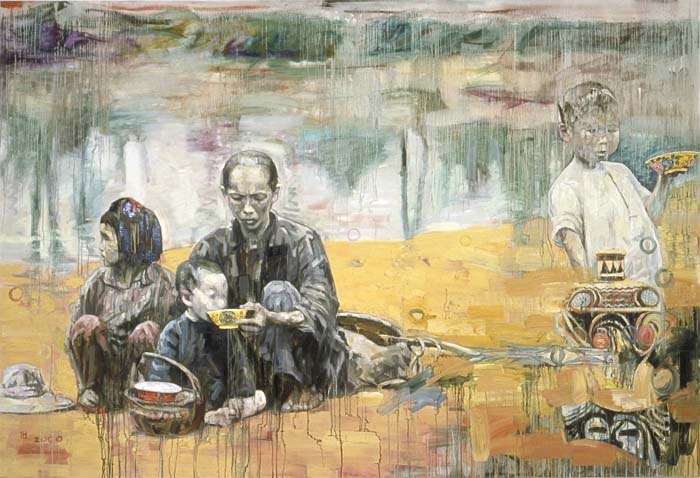
This beautiful photo By the Rivers of Babylon is by HungLiu. By the rivers of Babylon we sat down and wept.

This is one of the most poignant lines in Scripture (Psalm 137:1) recalling such sad times of exile. Those exiles wondered “how can we sing the Lord’s song in a strange land”.

Ben Quash, in Abiding, reminds us of the wisdom that the people of God are nearer to God “when they are in some sort of exile”. The Letter to Hebrews reminds us that “we have no abiding city” and Jesus has warning for those who feel too much at home in this world. Exile and the loss of home(land) must be an awful experience, shaking people to the roots of their identity. I don’t know whether it would be possible to sing any sort of song in such a strange land.

Quash, and many others, suggest that Christians should choose exile. This is “some sort of exile” which may, or may not have the brutality of violent removal and fearful flight. Quash refers to Hauerwas and Yoder who commend life lived “out of control”, “without the compulsion to hold on to the strings of power”. This is some sort of exile which is a walking with God who showed himself in Jesus as having nowhere to lay his head and who finished his days on the dump outside Jerusalem’s city wall.

The Jewish prophet Jeremiah points the way to vocation found in exile. He makes the “prison” of exile into a far more constructive way of life. He writes: “Seek the welfare of the city where I have sent you into exile, and pray to the Lord on its behalf, for in its welfare you will find your welfare.”

It is countercultural and strange to live “out of control”, accepting exilic status and praying for our enemies. It means that we are no longer to see ourselves as “host” but as “guest”. (It may be that the Church can’t be trusted with being “host”. There have been so many complaints about the abuse of power by the Church “in control”). When Jeremiah suggests that the exiles “pray for the welfare of the city” he is encouraging them to be “good guests”. The exiles’ vocation was, and is, how to be a blessing to a host culture on territory which is strange, without losing heart.

I have loved justice and hated iniquity, therefore I die in exile.
Pope Gregory VII

Our own culture is strange. There are many things that go on in society which are strange ways. Many aspects of social policy (I am thinking of the “bedroom tax” and other impending welfare reforms and the impoverishment of families and children) are out of our control. We don’t see the world in the same way. Our values are different. In many ways, we are in a strange land. Most of us don’t bear the physical hardships of those in refugee camps, but there is much that we lament. How do we sing the Lord’s song in a strange land?

Singing the Lord’s song in this strange land is something Jeremiah and Quosh insist that we do. The worship offered by exiles is, according to Quash, both resistance and gift. Quash writes:

God’s will to restore people to freedom before him, to overturn the idolatrous service of other gods, needs people who will use their voices to ‘sing his new song’ …

The early Christians may have handled the currency of the Empire each day, but before any of that, before sunrise, they met as the people of God, as the Church. That was their true city, their real ‘kingdom’, their Jerusalem. Christians’ present challenge too, is to live and work in the world in such a way that the song they sing as people in the Church is strong enough and beautiful enough to relativise ad transform other less sacred songs.

Turning stones

Stone Tower III

How far skims the stone on the water?
big bounces, many bounces,
final skip
each stone weighed with outstretched arm
for howls of laughter
for cries of pain.
How deep gashes the body with violent pelt?
Turning stones on the one hand
to the other
(weaker)
turns random stones
from arsenal to cairn no stone unturned

Richard Beck posts a quote from a recent interview given by Sr Joan Chittister for the Jackson Free Press. The question was:

“So, as a woman of faith, as a monastic, how do you see your role and the role of other people of faith in the world?”

Sister Joan’s reply:

It’s a simple one: To see injustice and say so, to find the truth and proclaim it, to allow no stone to be unturned when it is a stone that will be cast at anyone else. It’s just that simple. There is nothing institutional, organizational, political about it. It says: “Where I am, you may not harm these people. You may not deride them; you may not reject them; you may not sneer at them, and you certainly cannot blame them for their own existence.”

Shard Villa (1872-1874) - stone megaphone detail

Photos by Keith Bloomfield and Don Shall

“There is no neutrality in a situation of injustice and oppression. If you say you are neutral, you are a liar, for you have already taken sides with the powerful. Our God is not a neutral God. We have a God who does take sides. . . who will not let us forget the widow and the orphan.”
Desmond Tutu

Photo by gitgat.